In 2021, the U.S. ran a deficit of $2.772 trillion. We know that much of the stimulus created by that deficit spending was in reaction to the economic disruption created by Covid-19. Fast forward 5-years, and the 2026 fiscal year (10/1/25-9/30/26) federal deficit is projected to be around $1.9 trillion. That is potentially a lot of stimulus provided to the private sector through the U.S.’s deficit spending. But is this nearly $2 trillion in “stimulus” really creating $2 trillion in demand for goods and services and will it create similar consequences to what we witnessed in 2022 when inflation spiked? I don’t think so.
First, 2021’s stimulus was also accompanied by supply factors, as the economy was effectively “shut down” compounding inflationary pressures. In addition, the 2021 deficit included “only” $352 billion in interest expense associated with financing our national debt (now >$40 trillion).
The primary differences between 2021’s deficit and 2026’s are the facts that supply factors are not present as the economy is able to meet current demand with far fewer impediments and >50% of the deficit now pays for the interest expense on that $40 trillion national debt. Instead of going to individuals in the private sector that might use that $1 trillion in interest expense to demand goods and services, most of that interest expense is going to pension funds, insurance companies, banks, the Fed, foreigners, wealthy people. etc. According to my former INVESCO colleague, Charles DuBois, “only about 10-20% of the interest received is spent into the current domestic economy.”
Consequently, today’s roughly $2 trillion deficit is much less stimulative than the $2 trillion deficits from 5-years ago. Chuck estimates that it is “perhaps about $0.6 trillion less stimulative”. Inflation remains an issue, and may worsen should oil shocks materialize during the next several months, but it is not as bad as it could be if we were truly running a $2 trillion annual deficit with most of those $s flowing into the bank accounts of individuals, who like to spend!
I hope that you’ve had a great week. I very much enjoyed my three days at the NCPERS Funding Forum in Chicago, where I spoke about bringing certainty to pension plans through cash flow matching (CFM) in an investment landscape providing abundant uncertainty.
As I mentioned during my talk, the only certainty in most pension plans today are the benefit payments that are due each month. How are plans managing that responsibility? Unfortunately, not well, as most cobble together liquidity through a cash sweep of bond interest, dividends, capital distributions, and sales of securities. The only contributor to that liquidity pot that makes sense is bond interest, as dividends and capital distributions should be reinvested in their potentially higher earning strategies, while sales of securities don’t always occur at advantageous times.
But can a pension plan generate enough interest income from their bonds to cover the necessary liquidity? NO! Following my talk on Wednesday morning, an experienced trustee questioned my promotion of CFM based on his math that would have the entire pension plan’s corpus needing to be in bonds for the YTM to produce enough interest (liquidity) to meet his fund’s monthly obligations. He did not realize that a properly constructed CFM portfolio would use both interest and principal from maturing bonds (no sales). The combination of interest and principal will be used to meet those pesky obligations each month (chronologically) when due without any collective deficits.
We often recommend that a pension plan convert their current active core bond portfolio from a benchmark focused strategy to a CFM portfolio now focused on meeting the monthly promises. But the allocation to CFM should really be a function of the plan’s funded status. Better funded plans don’t need to take as much risk as weaker funded plans. Negative cash flow plans, of which most public funds are today, especially need reliable cash flow to meet liquidity challenges. Again, the last thing any pension plan should be doing is forcing sales of securities to meet on-going cash needs.
As U.S. interest rates continue to rise, the YTM on CFM portfolios continues to rise. Longer-term CFM assignments, such as a 30-year period, are seeing YTMs in the 6%+ range. Given the average public fund ROA is roughly 6.6%-6.75%, pension plans can cover a significant percentage of their return target through a strategy providing certainty, barring any defaults (a rare IG event). Please don’t let this opportunity to secure the pension promises pass you by. We’ve seen this happen before and the outcome isn’t pretty.
Question from a pension plan sponsor: I often hear you espousing the use of Cash Flow Matching to replace the pension fund’s core fixed income mangers. Is it prudent to only have one manager in that space?
As always, thank you for that question. We are often asked to respond to this question. Simply put, YES! it is quite prudent and recommended to have one cash flow matching manager to represent the liquidity assets. This is because there is one single liability cash flow schedule. If you had multiple CFM managers, their cash flows could potentially conflict with each other and not know what liabilities they are funding. Please remember that the primary objective in managing a pension plan is to secure the promises (benefits) at a reasonable cost and with prudent risk. It is NOT a performance objective.
If it were a performance objective than you might be right to want multiple fixed income managers, each representing an uncorrelated skill that when combined might be able to add alpha relative to a generic asset-focused index, but the only index that truly matters is your plan’s specific liabilities and the payment of those benefits when due.
In a CFM implementation, asset cash flows (principal and interest) from investment-grade bonds are carefully matched against the present value (PV) of those future liability cash flows of benefits and expenses. Our proprietary optimization process constructs a portfolio that matches your monthly liquidity needs at the lowest cost chronologically as far out as the mandate is funded. CFM is an exercise in bond math, which states that the longer the maturity and the higher the yield, the greater the cost reduction. We are not looking to produce an alpha relative to your liabilities, but we will because of the bias in our portfolio to A and BBB rated bonds that come with greater yields than the discount rate.
Investment-grade bonds are perhaps the safest investment one can make given that the frequency of defaults, which is <0.2% annually (2/1,000 bonds) as determined by S&P for the last 40+-years. It is only the possibility of a default that keeps this process from being absolutely certain.
Once a CFM portfolio is constructed, the cash flow relationship between assets and liabilities is locked in. It doesn’t matter if interest rates rise or fall because cash flows are future values and not interest rate sensitive. The YTW on day one of the portfolio is the likely return over the duration of the assignment – today we are constructing 30-year assignments with YTWs in excess of 6%. Can you expect that from your “active” fixed income managers, especially given the uncertain interest rate environment? For context, core fixed income managers benchmarked to the Aggregate index have likely delivered little to no return during the last five years, as the index was up 0.1% for the 5-years ending June 30, 2026. Using those managers to fulfill your liquidity needs opens up the possibility that you are locking in losses when bonds are traded to meet monthly benefit payments. There is no forced liquidity in a properly constructed CFM portfolio.
As always, we are happy to conduct a free analysis of what your cash flow needs look like and how CFM can help you secure those promises.
Dallas, TX voters may be asked to approve nearly $1 billion in debt this fall to help the city deliver a long-promised new police academy, while also providing financial flexibility ($500 million) for ongoing contributions into the city’s police and fire pension fund. Jack Ireland, the city’s chief financial officer, told the council that voter approval of pension obligation bonds (POB) wouldn’t trigger the issuance of new debt, but would “give the City Council the financial flexibility to approve its usage if interest rates improved in the future.”
However, not everyone is in agreement regarding the potential POB issuance. Councilman Adam Bazaldua said “asking voters to support another bond package, including the conditional approval of pension obligation bonds, sends the wrong message”. “It’s hard enough for us to decipher and educate our voters with the language that is required by state law, that will tell them their tax rates will go up with these bonds, but now we have to explain to them we’re asking you to approve half a billion dollars that we may not ever even touch or use,” Bazaldua said. “I’m adamantly opposed to this.”
A City Council vote is set for Aug. 12. If approved, any bond proposals would appear on the general election ballot on Nov. 3.
What would you do? Unfortunately, conventional thinking would have the City issue the bonds and contribute the proceeds into the P&F fund, where trustees and their advisors would apply those funds to the current asset allocation. The conventional POB strategy essentially says:
Borrow at X% → put the proceeds into the pension → invest in the existing portfolio expecting Y% → hope Y > X%.
That process is exactly the arbitrage framework that makes POBs controversial. The Government Finance Officers Association (GFOA) explicitly identifies the possibility that invested proceeds fail to earn more than the bond interest rate as a principal POB risk—and recommends against POB issuance largely because of risks such as this. I ran around the country in 2020-2021 arguing that historically low interest rates made the issuance of POBs sound but only if the proceeds were used to defease the plan’s liabilities – not invest them in traditional markets. What followed was 2023’s -18% return for the S&P 500 and a -12% return for the Aggregate index. Just what I and the GFOA warned against.
We believe that using cash flow matching (CFM) for the proceeds makes ultimate sense. At only 36% funded, this fund is facing insolvency due to significant negative annual cash flow and annual contributions that fall short of the ADC. This fund needs an economic boost and putting $500 million to work immediately and securing the next couple of years of benefits will buy some time for the growth assets to perform. Actually, they need significantly more than $500 million to get back on the right footing, but anything is better than nothing. As a reminder, a pension plan that is roughly only 1/3 funded and striving for a 6.5% return, actually needs to generate a nearly 20% annual return just to maintain the funding deficit.
I would describe our process as creating two portfolios: A liquidity bucket consisting of the CFM strategy and a growth buck that contains all non-core bonds. Furthermore, I would add any existing core bonds from the legacy assets into the liquidity bucket to be used to further build out the CFM portfolio. Here are the roles for the two portfolios/buckets:
Cash Flow Matching
Legacy / Growth Portfolio
Secure pension benefits
Generate long-term growth
Provides needed liquidity
Market-dependent relative returns
Uses bond principal + interest
Contains equities/alternatives/etc.
This portfolio is Liability-focused
Total return-focused
Creates cash flow roadmap
Creates uncertain cash flows
Eliminates a cash sweep
Can withstand market risk
Buys time
Uses that time
With a pension as poorly funded, it is impossible for traditional pension management to perform two conflicting jobs simultaneously: generate high returns and provide liquidity to pay benefits.
I know that our recommendation goes against the traditional approach, but CFM brings an element of certainty to the management of pension assets that is desperately in need of some certainty. Dallas needs a dramatic improvement in the plan’s funding. Why should they continue to ride the rollercoaster of returns, which only guarantees volatility and may lead to further funding erosion? Use the POB proceeds, but only if near-term liabilities can be secured.
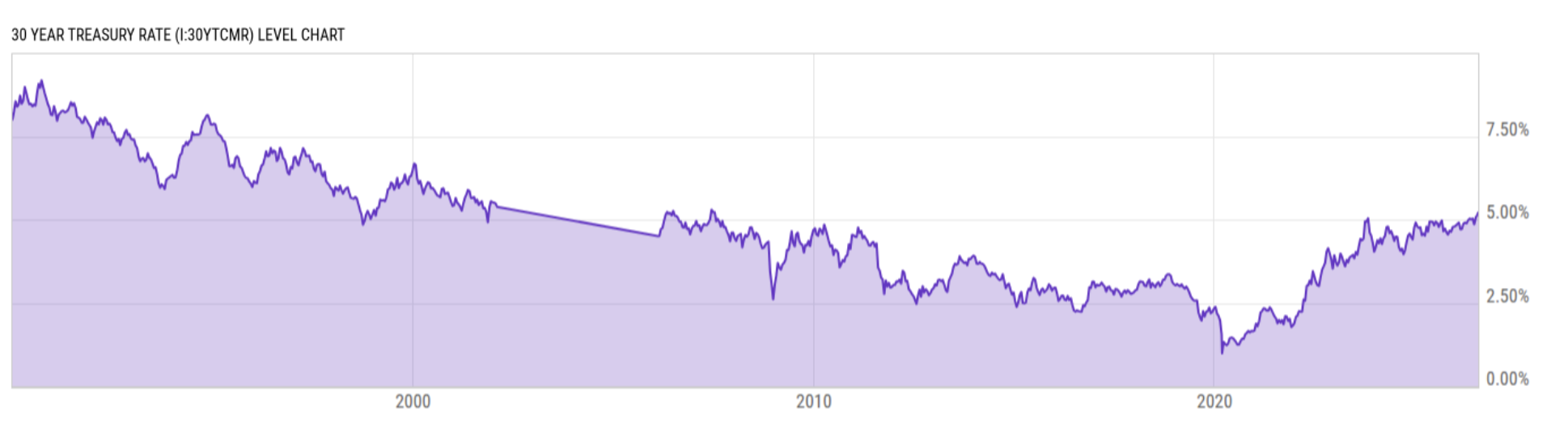
Uncertainty abounds! That uncertainty continues to drive expectations for oil, inflation, and interest rates up and down like a Yoyo. However, recent inflationary trends suggest that U.S. interest rates could continue higher. The U.S. 30-year Treasury bond’s yield is only 4 basis points off it’s cyclical peak since rates began rising aggressively in March 2022.
At Ryan ALM, we recently completed a cash flow matching (CFM) analysis for a public fund in which we were able to defease the pension plan’s liabilities out to 2100. The portfolio that we created to accomplish that objective had a YTM of 6.03%. Barring any defaults (occur at <0.2% in IG space), that is what the plan sponsor should expect to receive over the life of the program. Unlike a broadly diversified pension asset allocation striving to hit an ROA target and all of its standard deviation, there is NO volatility associated with that long-term return and cash flows. There is no potential for a major drawdown impacting future contributions and the plan’s funded status.
Just how has the bond market changed? This morning, our head trader, Steve Devito, shared with us the characteristics for a couple of bonds that had been shown to him. Here is an incredible example of where rates have gone: $2mm par value of ORCL 6.70 maturing in 2056 @ +245 above the comparable Treasury offered at a 7.70% YTM (quality:Baa2 / BBB-). WOW! Here you have an investment-grade corporate bond trading at a yield of 7.7%. The average ROA for a public pension plan is roughly 6.75%. In another example, Steve shared: $2mm GOOGL 6.50 maturing in 2066 @ +124 above the comparable Treasury at a YTM of 6.50% AA (40-year maturity). Google is offering a AA credit 40-year bond at a YTM of 6.5%!
I suspect that there are many other examples of high quality corporate bonds trading at yields greater than 6%. So, I ask: At what level of rates do U.S. corporate bonds become too much competition for U.S. equities and all their uncertainty? As a pension plan sponsor, wouldn’t you prefer to have the certainty of a CFM portfolio securing your pension liabilities from next month chronologically as far into the future as your allocation goes? In the meantime, your residual alpha assets have just been granted a longer investing horizon allowing them to wade through today’s uncertainty without being encumbered with a cash sweep of dividends and capital distributions.
As we regularly write, we are always willing to showcase how CFM can positively impact your plan by providing a free analysis. You will get a better understanding of your plan’s cash flow requirements and an understanding of the potential cost reduction of the future benefit payments. You’ll also have a greater appreciation for the possible significant reduction in asset management fees that is achieved through the use of CFM. Now is the time to act before the markets negatively react to these rising U.S. interest rates.
We are happy to share with you Ron Ryan’s latest thoughts related to asset allocation and how it should be responsive and not strategic. We at Ryan ALM, Inc. have witnessed many investing cycles during our decades in the pension industry. We have seen well-funded defined benefit pension plans witness their funded status/ratio deteriorate quickly as markets retrenched. As Ron highlights in his latest thoughtful piece, public pension plans have made terrific strides to improve funding from roughly 71% to a recent high of 88.7% according to Milliman.
Given the improved funding, are U.S.-based pension plans de-risking? Unfortunately, no. They continue to operate with an objective to maximize the return on the assets and not with the more appropriate objective to SECURE the promises made to their members. The former objective continues these plans on a rollercoaster of returns. Regrettably, a return focus only guarantees volatility: volatility of returns leading to volatility of contributions and ultimately the funded status of the plan. It makes little sense.
Adopting an objective that is focused on securing the pension promises creates an element of certainty within the management of pensions not often found, if at all. By securing the promises, one dramatically improves the liquidity needed to meet those monthly obligations. It also creates a longer investing horizon for the assets not used to meet the plan’s liquidity.
We believe that Cash Flow Matching (CFM) is the only strategy that creates the necessary liquidity with certainty, as the asset cash flows of principal and interest are matched to the liability cash flows of benefits and expenses. There is no sweeping of the dividends and capital distributions, which should be reinvested in the products with higher potential returns and NOT used for distributions to beneficiaries.
As your plan’s funded status improves, respond by allocating more of the plan’s assets to CFM. Don’t let your winnings ride. Take risk form the plan’s asset allocation in a responsive way to positive changes in the plan’s funded status. Markets have been producing outsized positive returns, but standard deviations measure both upside and downside possibilities. Is your plan’s sponsor able to withstand a major market correction similar to what we’ve seen previously (2000-’02 and 2007-’09)? Will the likely increase in contributions be crushing?
Who knows what is going to happen with interest rates, inflation, the price of oil, equity markets, etc. Bringing some certainty to pension management should be everyone’s objective. If done correctly, everyone will be able to sleep well at night knowing that your future promises have been secured no matter what transpires in markets that remain out of our control.
Due to great uncertainty brought on by the conflict in the Middle East and the war’s potential impact on the price of oil ($85.63 at 10:01 EST) that could drive inflation higher, U.S. long-dated Treasury yields continue to rise. In fact, the U.S. 30-year Treasury yield has not been this high (5.26%) since July 6, 2007, when the yield was at 5.28%. Where yields go from here is anyone’s guess, but I will share that oil, as represented by WTI, has risen 24.9% since June 30, 2026. Given the exposure that oil or oil-derived inputs have in more than 6,000 products, the significant rise in the recent price could impact inflation for quite some time, even if oil soon began to flow more freely.
We recently saw the average 30-year BBB+ bond trading at 110 bps above the prevailing 30-year Treasury. If that relationship is maintained, pension plans could potentially cover most of their desired return on asset (ROA) annual target (average public pension plan has a 6.75% ROA) through bonds. Should inflation spike once again, there is no telling how high U.S. interest rates could rise. Despite domestic equity’s apparent immunity to market fundamentals and geopolitical risks, there will come a time when higher U.S. yields become too attractive to ignore leading to the potential for rebalancing out of equities into fixed income. That action will likely lead to lower equity prices and falling bond yields.
So, I ask, why wait? Why wait to take risk from your current asset allocation before the markets act? Why not SECURE your benefit promises through cash flow matching (CFM) well into the future and reduce the volatility related to returns, contributions, and funded status? Why not take advantage of very attractive bond yields? As a reminder, core, active fixed income strategies are highly interest rate sensitive. Rising yields negatively impact bond prices, as seen in the performance of the Aggregate Bond Index, which is up only 0.1% annually for the 5-years ending June 30, 2026. However, a CFM strategy, which secures benefits that are future values, eliminates interest rate risk, as future values are not interest rate sensitive.
Public pension plans have done a good job of improving their funded ratios since bottoming after the Great Financial Crisis but remain only one market crash away from repeating this vicious cycle. Get off the performance rollercoaster. Secure your promises chronologically for some period into the future (your plan’s funded status should dictate the allocation). You and your participants will sleep much better knowing that the promises made will be kept.
I recently attended a public pension conference in which the following question was asked by the moderator: Should public pension funds once again adopt a 60%/40% asset allocation framework? As a reminder, there may be an average exposure that results from a review of all public fund data, but there is NO such thing as an appropriate or standard asset allocation. Given that every defined benefit plan has its own unique liabilities, funded status/funded ratio, different workforces, ability to contribute, etc., how could there be a standard exposure to any asset class, let alone a standard 60% equity/40% fixed income allocation.
I’m sure that this question originates through the belief that the pension objective is to achieve a return on asset (ROA) assumption, as if there is some magic combination of assets and weightings that will enable the pension plan to achieve the return target. However, as regular readers of this blog know, we, at Ryan ALM, think that the primary objective when managing a DB pension plan is NOT a return objective but it is to SECURE the promised benefits at a reasonable cost and with prudent risk.
Pursuing a return objective guarantees volatility – volatility of returns, contributions, and funded status. It does not guarantee success! Regarding the volatility of returns, the annual standard deviation for a pension plan’s asset allocation is roughly 12%-15%. Refocusing on the plan’s unique liabilities secures, through cash flow matching (CFM), the monthly promises (benefit payments) from the first month out as far as the allocation will cover. Through this process the necessary liquidity is provided each month, while also providing the additional benefit of extending the investing horizon for the remainder of the assets that are no longer needed as a source of liquidity. We refer to these residual assets as the alpha or growth assets that now can grow unencumbered.
These growth assets can be invested almost anyway that you want. You can decide to just buy the S&P 500 index at low fees or construct a more intricate asset allocation with exposures and weightings of your choice. Again, there is no one size fits all solution. We do suggest that the better the funded ratio/status of your plan, the greater the allocation to the CFM strategy. If your plan is less well funded today, start with a more modest CFM allocation, and expand it as funding levels improve. In any case, you are bringing an element of certainty to what has been historically a very uncertain process.
So, please remember that every DB plan is unique. Don’t let anyone tell you that your fund needs to have X% in asset class A or Y% in asset class B. Securing the benefits should be the most important decision. How you build the alpha portfolio will be a function of so many other factors related specifically to your plan and its governance.
Jack Webb, who portrayed Joe Friday in the 1950s crime drama “Dragnet”, was famous for saying in season two “all we want are the facts, ma’am.” The catchphrase eventually morphed into a shorter phrase with the help of comedian, Stan Freberg, who released his parody “St. George and the Dragonet” in which he stated, “just the facts, Ma’am”. That phrase has been carried forward in Dragnet remakes. But, I digress.
Today, I present to you a Joe Friday moment. Here are the facts: Oil prices have risen by 27% since July 6th. U.S. Treasury yields are rising across the yield curve, and the 30-year Treasury yield is within 6 bps of this cycle’s high of 5.2%. The 10-year Treasury yield is currently 4.66% as of 10:24 am on 7/22/26. Investment grade corporate bond spreads have finally started to widen although slowly. According to Morgan Stanley, the “average” yield on a BBB+ corporate is 6.23% or roughly 1.1% higher than the yield on the comparable 30-year Treasury bond. Inflation, which moderated in June, is likely to spike higher given the current direction of activity in the Middle East and its impact on shipping lanes.
These are the facts. They suggest to me, and hopefully you, that the current U.S. interest rate environment is ripe for de-risking activities through cash flow matching (CFM). Why continue to live with the uncertainty surrounding oil, inflation, rates, etc., when you can SECURE your fund’s promises in the near-term?
I wish that I had a crystal ball to help me forecast the future but alas I don’t, and I suspect that you don’t either. Given the lack of clarity related to future events, I suggest that we live in the moment. We have an environment in which the cost of those future promises (benefit payments) can be cut dramatically. An environment that brings an element of certainty to a very uncertain process. An environment in which U.S. interest rates are providing plan sponsors with a significant portion of the annual return on investment target.
We’ve seen this scenario before. At the start of the 2000s, we had pension plans extremely well-funded and contribution expenses well-controlled. That opportunity went unheeded. The result of that inaction proved to be disastrous as we saw DB pension funding get pounded by two major equity market corrections. Are you confident that another major correction isn’t around the corner?
Like Joe Friday, I rely on the facts, which I’ve now presented to you. Ignore them at your peril.
As you look at the landscape for defined benefit pension plans, it is readily apparent that there is only one CERTAINTY. Each month your fund must fulfill a promise. Benefit payments (and expenses) can’t wait to be paid. Like clockwork, B&E come due each month whether markets have behaved or suddenly made finding liquidity a challenge. What have you done to make sure that those obligations are met?
Pension plan management is primarily focused on the fund’s assets. Sponsors and their advisors put together an asset allocation framework that is singularly focused on the annual required return on assets (ROA). But those asset allocation frameworks come with a lot of volatility and uncertainty. Many factors contribute to market movements. Each one out of the control of the pension sponsor.
Do you know where stocks will be trading in 1-hour let alone 1-month, 1-year, or 1-decade? How about inflation? Interest rates? What about the Middle East, Ukraine, China, etc.? Why live with such uncertainty?
How comforting would it be to know what a pension fund’s annual contributions will be for the next 10-, 20- or 30+-years? No guessing, no budgeting woes, and no unfortunate spikes in annual contributions for public systems that harm one’s ability to support the social safety net. The process that can create this level of certainty has been used for decades: Cash Flow Matching (CFM).
As previously mentioned, current pension management approaches are return focused, which only guarantees volatility. Volatility in returns, contributions, and funded status! A CFM approach, which is the careful matching of asset cash flows (principal and interest) with the liability cash flows of benefits and expenses, will bring certainty (outside of a rare IG default) to the management of DB pensions. Importantly, liquidity is created and available when needed. There is no forced selling to fulfill those commitments. No scraping of dividend income which is detrimental to the long-term success of the equity program.
Importantly, a CFM program also “buys time” for the residual assets (presumably the alpha assets) to grow unencumbered with the goal to meet future liabilities. A longer investing horizon will dramatically enhance the probability of those assets meeting long-term return expectations.
Given that there is currently only one certainty (monthly obligations) for sponsors of DB pension plans, wouldn’t it be beneficial to create another level of certainty through the SECURING of the monthly promises? Why wait, especially given all the uncertainty facing market participants today? Ryan ALM, Inc. is always willing to provide you with a free analysis of what CFM could do for your fund. We’re ready to help you sleep better at night.