Why wait?

By: Russ Kamp, CEO, Ryan ALM, Inc.

Due to great uncertainty brought on by the conflict in the Middle East and the war’s potential impact on the price of oil ($85.63 at 10:01 EST) that could drive inflation higher, U.S. long-dated Treasury yields continue to rise. In fact, the U.S. 30-year Treasury yield has not been this high (5.26%) since July 6, 2007, when the yield was at 5.28%. Where yields go from here is anyone’s guess, but I will share that oil, as represented by WTI, has risen 24.9% since June 30, 2026. Given the exposure that oil or oil-derived inputs have in more than 6,000 products, the significant rise in the recent price could impact inflation for quite some time, even if oil soon began to flow more freely.

We recently saw the average 30-year BBB+ bond trading at 110 bps above the prevailing 30-year Treasury. If that relationship is maintained, pension plans could potentially cover most of their desired return on asset (ROA) annual target (average public pension plan has a 6.75% ROA) through bonds. Should inflation spike once again, there is no telling how high U.S. interest rates could rise. Despite domestic equity’s apparent immunity to market fundamentals and geopolitical risks, there will come a time when higher U.S. yields become too attractive to ignore leading to the potential for rebalancing out of equities into fixed income. That action will likely lead to lower equity prices and falling bond yields.

So, I ask, why wait? Why wait to take risk from your current asset allocation before the markets act? Why not SECURE your benefit promises through cash flow matching (CFM) well into the future and reduce the volatility related to returns, contributions, and funded status? Why not take advantage of very attractive bond yields? As a reminder, core, active fixed income strategies are highly interest rate sensitive. Rising yields negatively impact bond prices, as seen in the performance of the Aggregate Bond Index, which is up only 0.1% annually for the 5-years ending June 30, 2026. However, a CFM strategy, which secures benefits that are future values, eliminates interest rate risk, as future values are not interest rate sensitive.

Public pension plans have done a good job of improving their funded ratios since bottoming after the Great Financial Crisis but remain only one market crash away from repeating this vicious cycle. Get off the performance rollercoaster. Secure your promises chronologically for some period into the future (your plan’s funded status should dictate the allocation). You and your participants will sleep much better knowing that the promises made will be kept.

A “Joe Friday” Moment

By: Russ Kamp, CEO, Ryan ALM, Inc.

Jack Webb, who portrayed Joe Friday in the 1950s crime drama “Dragnet”, was famous for saying in season two “all we want are the facts, ma’am.” The catchphrase eventually morphed into a shorter phrase with the help of comedian, Stan Freberg, who released his parody “St. George and the Dragonet” in which he stated, “just the facts, Ma’am”. That phrase has been carried forward in Dragnet remakes. But, I digress.

Today, I present to you a Joe Friday moment. Here are the facts: Oil prices have risen by 27% since July 6th. U.S. Treasury yields are rising across the yield curve, and the 30-year Treasury yield is within 6 bps of this cycle’s high of 5.2%. The 10-year Treasury yield is currently 4.66% as of 10:24 am on 7/22/26. Investment grade corporate bond spreads have finally started to widen although slowly. According to Morgan Stanley, the “average” yield on a BBB+ corporate is 6.23% or roughly 1.1% higher than the yield on the comparable 30-year Treasury bond. Inflation, which moderated in June, is likely to spike higher given the current direction of activity in the Middle East and its impact on shipping lanes.

These are the facts. They suggest to me, and hopefully you, that the current U.S. interest rate environment is ripe for de-risking activities through cash flow matching (CFM). Why continue to live with the uncertainty surrounding oil, inflation, rates, etc., when you can SECURE your fund’s promises in the near-term?

I wish that I had a crystal ball to help me forecast the future but alas I don’t, and I suspect that you don’t either. Given the lack of clarity related to future events, I suggest that we live in the moment. We have an environment in which the cost of those future promises (benefit payments) can be cut dramatically. An environment that brings an element of certainty to a very uncertain process. An environment in which U.S. interest rates are providing plan sponsors with a significant portion of the annual return on investment target.

We’ve seen this scenario before. At the start of the 2000s, we had pension plans extremely well-funded and contribution expenses well-controlled. That opportunity went unheeded. The result of that inaction proved to be disastrous as we saw DB pension funding get pounded by two major equity market corrections. Are you confident that another major correction isn’t around the corner?

Like Joe Friday, I rely on the facts, which I’ve now presented to you. Ignore them at your peril.

DB Pension Plans: Only One Certainty

By: Russ Kamp, CEO, Ryan ALM, Inc.

As you look at the landscape for defined benefit pension plans, it is readily apparent that there is only one CERTAINTY. Each month your fund must fulfill a promise. Benefit payments (and expenses) can’t wait to be paid. Like clockwork, B&E come due each month whether markets have behaved or suddenly made finding liquidity a challenge. What have you done to make sure that those obligations are met?

Pension plan management is primarily focused on the fund’s assets. Sponsors and their advisors put together an asset allocation framework that is singularly focused on the annual required return on assets (ROA). But those asset allocation frameworks come with a lot of volatility and uncertainty. Many factors contribute to market movements. Each one out of the control of the pension sponsor.

Do you know where stocks will be trading in 1-hour let alone 1-month, 1-year, or 1-decade? How about inflation? Interest rates? What about the Middle East, Ukraine, China, etc.? Why live with such uncertainty?

How comforting would it be to know what a pension fund’s annual contributions will be for the next 10-, 20- or 30+-years? No guessing, no budgeting woes, and no unfortunate spikes in annual contributions for public systems that harm one’s ability to support the social safety net. The process that can create this level of certainty has been used for decades: Cash Flow Matching (CFM).

As previously mentioned, current pension management approaches are return focused, which only guarantees volatility. Volatility in returns, contributions, and funded status! A CFM approach, which is the careful matching of asset cash flows (principal and interest) with the liability cash flows of benefits and expenses, will bring certainty (outside of a rare IG default) to the management of DB pensions. Importantly, liquidity is created and available when needed. There is no forced selling to fulfill those commitments. No scraping of dividend income which is detrimental to the long-term success of the equity program.

Importantly, a CFM program also “buys time” for the residual assets (presumably the alpha assets) to grow unencumbered with the goal to meet future liabilities. A longer investing horizon will dramatically enhance the probability of those assets meeting long-term return expectations.

Given that there is currently only one certainty (monthly obligations) for sponsors of DB pension plans, wouldn’t it be beneficial to create another level of certainty through the SECURING of the monthly promises? Why wait, especially given all the uncertainty facing market participants today? Ryan ALM, Inc. is always willing to provide you with a free analysis of what CFM could do for your fund. We’re ready to help you sleep better at night.

The Benefit of Higher U.S. Interest Rates

By: Russ Kamp, CEO, Ryan ALM, Inc.

Rising interest rates can often create stresses in an economy and within the capital markets. They certainly make financing big ticket items more painful. They can destabilize equity markets, although it seems as if the current equity market is immune to any risk at this time. They harm most fixed income managers/strategies, as rising rates lower the present value of their bonds.

However, rising rates are GREAT for cash flow matching (CFM) strategies, as the higher rates reduce the cost of those future pension promises (benefit payments). We were recently asked by a public pension fund to provide them with an analysis of what CFM could potentially do for them in this environment. They provided us with the requisite data – projected benefits, expenses, and contributions as far into the future as possible – which we then ran through our cost optimization model that we call the Liability Beta Portfolio (LBP).

The output is compelling! We can secure this fund’s net (after contributions) liabilities (all of them!) through September 30, 2053. The future value (FV) of those liabilities is $86.2 million. However, the plan needs to set aside only $50.1 million in present value (PV) assets to defease those liabilities with certainty. The $36.1 million cost reduction is locked in on the day that the portfolio is created. That “savings” equates to a cost reduction of 41.9%!

So, this plan sponsor can now SECURE pension payments for 27-years. The residual assets not needed in the CFM portfolio can now grow unencumbered. If I were them I’d just buy a S&P 500 ETF creating considerable savings from lower management fees and far less complexity. Furthermore, the plan sponsor now knows what contributions will look like for the next nearly three decades. They won’t have to be alarmed should markets suffer a deep and extended correction, as the assets AND liabilities will move in lockstep.

By the way, these benefits were achieved without taking substantial risk, as our process only uses investment-grade corporate bonds rated BBB+ or better. Defaults, which are the only risk within the strategy, have been 0.2% (2/1000 bonds) annually for the last 40-years according to S&P.

Why use CFM? The benefits are incredible, including; certainty, security, all the necessary liquidity, an extended investing horizon, lower management fees, stable contributions, and improved sleep! If these benefits sound attractive to you, provide us the same info that our public fund prospect did (see above) and we’ll provide you with a free analysis, too. We are confident that you’ll be as blown away as they were and the many clients that we are proud to support.

Bonds as Performance Drivers? No, Sir!

By: Russ Kamp, CEO, Ryan ALM, Inc.

U.S. fixed income benefitted tremendously from the nearly 4-decade decline in interest rates. From 1981 through 2021, the U.S. enjoyed a significant collapse in bond yields helping to fuel an unprecedented rally in risk assets. However, as Bob Dylan said, “the times they are a changin”!

The U.S. Federal Reserve’s FOMC announced on March 16, 2022, that the new Fed Fund’s target would be 0.25%-0.5% beginning on St. Patrick’s day 2022. This action marked the beginning of a rate regime change resulting from Covid-19 implications, including abundant stimulus creating massive demand for goods and services that couldn’t be met as production/manufacturing activities were disrupted.

The U.S. Fed Fund’s rate would eventually rise to 5.25%-5.50% in July 2023 (following 11 rate increases). Today, the Fed Fund’s rate stands at 3.5%-3.75%. For context, the average Fed Fund’s rate since 1971 is 5.39%, which includes a peak of nearly 20% in December 1980, and ultimately 0% in December 2008, in reaction to the GFC. It would once again hit 0% during Covid.

As a result, bond investors, such as pension plans, have ridden a rollercoaster of performance. Performance looked terrific for much of the nearly 40-year bull market but has been challenging since the Fed’s initial action in 2022. In fact, the Aggregate Index (Lehman, Barclays, Bloomberg, etc.) has produced only a 3.3% return for 20-years through March 2026. It is worse if you look at shorter timeframes, as the Index was up only 1.7% for 10-years, 0.3% for 5-years, and -0.1% YTD (all through March 31, 2026).

For pension plan sponsors and their advisors who are reluctant to utilize cash flow matching (CFM) as it might harm the pension plan’s ability to achieve the ROA, those performance #s above should be a wake-up call! As a reminder, the YTM of a CFM portfolio is a good proxy for what the fund will achieve for the period that liabilities are defeased. Given that Ryan ALM, Inc. is currently generating a YTM of 5.02% for a client with a 30-year defeasement and a 4.6% YTM for another with a 10-year CFM mandate, which result do you think is more harmful to the pension plan?

Furthermore, the CFM portfolio’s return is not predicated on the direction of interest rates, as it very much is with active core fixed income strategies. Importantly, CFM provides all the liquidity needed to meet the monthly benefit payments without having to sell assets, perhaps at inappropriate times. By cash flow matching bond principal and interest income with the plan’s liability cash flows (benefits and expenses), CFM secures the pension promises and reduces the FV cost (with certainty) of those obligations in the process. For the client with the 30-year CFM mandate, we are reducing future funding costs by -31.1% and for the 10-year CFM program, we have reduced funding cost by -28.0%.

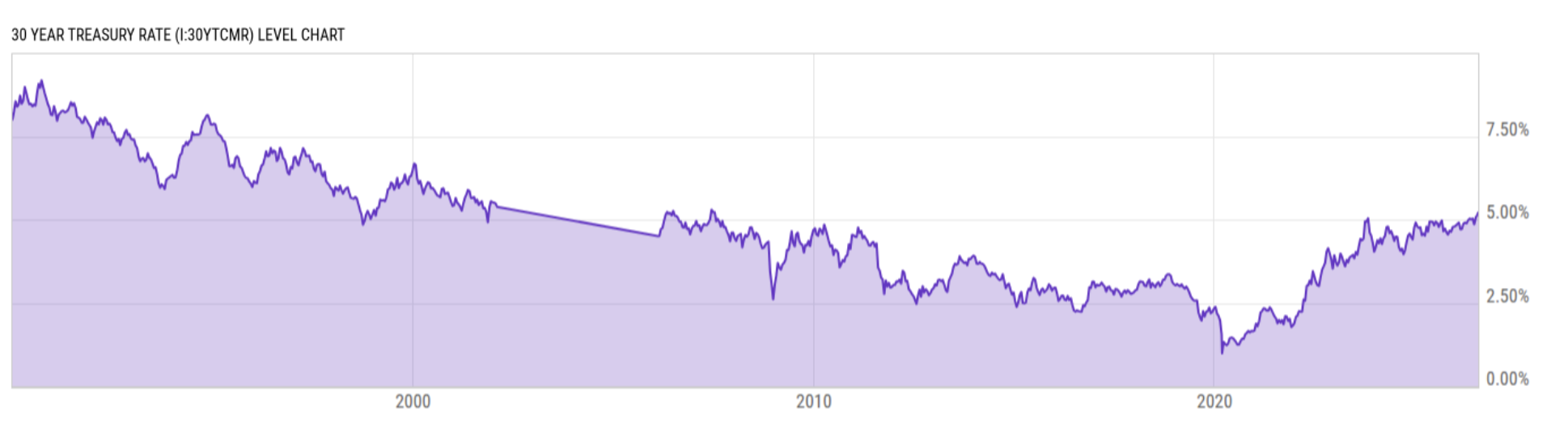
Where are we today? After a brief respite, U.S interest rates are once again trending higher, as greater inflation takes hold. Who knows where inflation and interest rates will eventually land, but a pension plan (or E&F) could benefit tremendously in this environment by engaging Ryan ALM, Inc. and our CFM capability. The 30-year Treasury bond yield history below highlights the rising rate environment. As a reminder, Ryan ALM builds CFM portfolios using investment-grade corporate that have yields substantially higher than comparable Treasury maturities.

So, I ask: Why sit with active fixed income and subject your plan’s bond allocation to the whims of an unknown interest rate environment when you can SECURE the pension promise with near certainty (absent any defaults)? Wouldn’t it be wonderful to know that your liquidity needs are all set for some prescribed period? Wouldn’t your plan participants want to know that the promises given have been secured? Now is the time to bring an element of certainty to the management of pension assets that doesn’t currently exist. Given the geopolitical uncertainty and the potential impact on inflation, rates, and other markets, creating funding certainty should be priority #1. Why isn’t it?

Why Wouldn’t You Prefer a SD of +/-0%?

By: Russ Kamp, CEO, Ryan ALM, Inc.

I continue to be surprised that more pension plans don’t embrace greater certainty in the management of their funds. The Iran War is leading to great uncertainty related to inflation, interest rates, and economic growth. Yes, U.S. equities have enjoyed a healthy recovery following the initial outbreak in the Middle East, but is that sustainable?

Callan does a good job of providing a regular review of what asset allocation would be necessary to achieve a 7% return and the risk (measured as standard deviation) to achieve that return objective. Callan indicated that it was very easy to achieve a 7% return all the way back in 1994 when U.S. interest rates were higher than they are today. In fact, an allocation of 85% to fixed income and small allocations to L.C. equity, SC equity, and int’l stocks would have produced a 7% return with only a 5.6% annual standard deviation.

However, in the most recent update from 2024, Callan suggests the following asset allocation is necessary to achieve a 7% return:

This means that 68% of the time, a plan sponsor should expect an annual return of 7% +/- 8.6%. At two standard deviations (95% of the observations or 19/20 years), the annual return will fall between +/- 17.2% of the 7% target. Would you be comfortable knowing that your fund could generate an annual return of -10.2%? Think about the impact a return like that would have on contributions?

What if I said that cash flow matching (CFM) a portion of your pension fund would result in those assets having an annual SD of 0% barring a default which occurs at a rate of 0.18% annually among investment grade corporate bonds for the last 40-years. How’s that possible? When CFM is implemented, the plan’s asset cash flows and matched agains the plan’s liability cash flows (benefits and expenses). They mover in lockstep with each other no matter where rates go. Today’s U.S. interest environment is attractive and getting more attractive as I write this post, as the 30-year Treasury bond yield has topped 5% (5.02% at 11:47 am DST). Higher rates are great for CFM, as they lower the present value of those future promises.

Furthermore, the use of a CFM portfolio secures the pension promises, dramatically improves plan liquidity, eliminates interest rate risk for the portion of the plan, extends the investing horizon for the residual plan assets, and reduces the cost of those future pension promises. Again, why wouldn’t you embrace an element of certainty?

I’m not sure what the Callan team would identify as the proper allocation to achieve a 7% return today, but I suspect that the annual standard deviation is greater than the 8.6% from 2024. Every time a pension plan falls short of the annual ROA, contributions must increase to make up for the shortfall. Greater investment certainty, like that associated with using CFM, reduces the likelihood that the pension plan sponsor with suffer from a negative surprise associate from increased contributions.

Is Now Really the Time to Buy Stocks?

By: Russ Kamp, CEO, Ryan ALM, Inc.

U.S. equity markets enjoyed a robust April despite myriad economic and geopolitical inputs that might have given investors pause. Should equity investors remain bullish at this time? The graph below caught my attention primarily because of the recent disconnect between the two lines related to the Shiller Excess Cape Yield (ECY) and subsequent 10-year Real Return for equities. There are many, many valuation tools that claim to provide clues about the future direction of stocks, and this is such an example. Those tools can be short-, medium-, and long-term in nature. The ECY happens to be one valuation metric that provides “guidance” for longer time frames. The current reading of 1.60% certainly looks rich relative to its long history.

In case you don’t know, the Shiller excess CAPE yield is a valuation measure that compares the stock market’s earnings yield with the “real” yield on the 10-year Treasury note. In simple terms, it asks how much extra return stocks may offer over inflation-adjusted government bonds.

How it is calculated

  • Take the inverse of the CAPE ratio, which is the market’s “earnings yield.”
  • Subtract the real 10-year Treasury yield.

So, ECY=(1/CAPE)10-year real Treasury yield

A higher excess CAPE yield suggests stocks might look more attractive relative to bonds. A lower reading suggests the equity risk premium is thinner, meaning stocks offer less return versus bonds. As mentioned above, current readings show the S&P 500 Shiller Excess CAPE Yield around 1.60% for April 2026, which is well below its long-term average of 4.60%. Another data source put it at 1.41 as of April 30, 2026.

Investors have historically used the ECY as a long-term asset allocation tool, especially when comparing stocks with Treasury bonds. It is not a short-term trading signal, but rather a rough guide to whether equities look cheap or expensive relative to real bond yields. A CAPE yield below 2% has generally signaled subdued future equity returns over the next 5 to 10 years, providing a valuation warning sign, and not an exact measure.

As a reminder, there are many valuation techniques used to identify opportunities and risk when investing in U.S. equities. Depending on a pension plan’s liquidity needs, funded ratio, willingness to take risk, etc. today’s current environment may be providing an opportunity to reduce risk by trimming equities and using the proceeds along with core fixed income assets to establish a cash flow matching mandate. In the process, the plan’s liquidity is improved, promised benefits secured, and the investing horizon extended for the residual assets. Give us a call. We are always willing to provide a free analysis showcasing how CFM can help your fund.

A Ryan ALM, Inc. Client Portfolio Review

By: Russ Kamp, CEO, Ryan ALM, Inc.

We are blessed to work with a wonderful array of clients, both pension and E&F. They have chosen to bring an element of certainty to the management of their fund. We commend them for that decision and thank them for the confidence that they’ve shown in us and our cash flow matching (CFM) strategy/capability.

Our client relationships begin with the acquisition of important inputs including projections of benefits/grants, expenses, and contributions as far into the future as possible. Most often these are provided by the fund’s actuary. The next step in building a portfolio is to create a Custom Liability Index (CLI), that will establish the framework for monthly distributions.

Upon completion of the CLI, we will work with the client and their advisors to determine the appropriate allocation to CFM. We often suggest converting the current core fixed income allocation since bonds should only be used for their cash flows. Once that has been determined, we will build a high quality bond portfolio (most often 100% IG corporate bonds) that carefully matches asset cash flows of interest and principal with the liability cash flows (benefits and expenses (B&E)).

Once this portfolio is built, we have created an element of certainty for the plan sponsor, as asset cash flow will march in harmony with the liability cash flows barring a bond default, which occurs <0.2% annually (40-year study by S&P). It is only upon changes in the actuaries forecast that lead us to adjust the portfolio, and those annual changes tend to be quite insignificant.

Now the fun part: We are often asked to provide quarterly updates on our portfolio, which couldn’t be any easier. My last portfolio review lasted about 37 seconds. I stated that the projected cash flows that had been shared with us were matched by the asset cash flows, and that there have been no instances in which monthly cash flow needs were not met in their entirety. Furthermore, there have been no defaults in our portfolio ensuring that future cash flow needs will also be met as required. Any questions?

As you can see, there is no need to fret about the direction of U.S. interest rates. No worry about what the “Fed” may do today, tomorrow, or next year. No forecasting of the economic environment, inflation, and/or the geopolitical landscape. Once the CFM portfolio is constructed, the cost savings (cost to fund future B&E) is known and locked in. How many investment managers can tell you how the portfolio will perform over the duration of the program?

Why wouldn’t you want to bring an element of certainty to your fund? Wouldn’t a “sleep-well-at-night” strategy bring comfort to you and those that you serve? If the true objective in managing a defined benefit fund is to SECURE the promised benefits at low cost and with prudent risk, is there another investment strategy that can match the positive attributes of CFM? If we’ve grabbed your attention, reach out. We provide a free analysis of how CFM can make your fund less volatile and uncertain.

March Proves Challenging for Core Fixed Income

By: Russ Kamp, CEO, Ryan ALM, Inc.

March was a difficult month for active core fixed income managers, as the Bloomberg U.S. Aggregate Index fell -1.8%. Uncertainty related to the impact of the Iran War on oil prices and subsequently inflation, pushed rates higher across the Treasury yield curve. The U.S. 10-year Treasury note saw yields rise 38 bps to 4.31%.

Agencies fell -1.7% in line with Treasuries, while the Corporate sector declined -2.0%. Corporate spreads ended March with an option adjusted spread (OAS) of 88.6 bps. The best performing Corporate sector was Financials (-1.7%), while Utilities performed worst at -2.2%.

The greatest risk managing bonds is interest rate risk. Given both geopolitical (Iran, Taiwan, Ukraine) and economic risks (oil, inflation, interest rates), now is the time to significantly reduce risk within your fund, whether that be a DB pension or E&F. Why continue to ride active fixed income through these uncertain markets? One can use a cash flow matching (CFM) strategy to SECURE and fund net liabilities chronologically well into the future. In the process, interest rate risk is eliminated as future benefits and expenses are not interest rate sensitive.

Furthermore, by securing near-term liabilities, the non-bond assets can now grow unencumbered providing more time to wade through these challenging times. I have no idea how long this conflict will last. I also don’t know how much damage has occurred and that which might still happen to oil production in the Middle East. Implementing a strategy that doesn’t rely on forecasting U.S. interest rates should be a high priority today.

Making the switch is easy. Rotate your current core fixed income assets from an active investment strategy to a CFM portfolio. There isn’t a need to revisit the fund’s asset allocation. We’ll even look for opportunities to take-in-kind some of your existing holdings. You’ll appreciate not having to search each month for the liquidity to meet the monthly promises that have been made to your participants, as the CFM strategy will provide all the liquidity that you need. Moreover, the Ryan ALM CFM model is skewed to A/BBB+ corporate bonds which should outyield most generic bond indexes that are skewed to Treasuries (e.g. the AGG).


What is the PCE Price Index Telling Us?

By: Russ Kamp, CEO, Ryan ALM, Inc.

As most investors know, the Federal Reserve’s primary inflation measure is the Core Personal Consumption Expenditures (PCE) price index. The Federal Open Market Committee (FOMC) targets 2% annual PCE inflation while trying to balance long-term price stability and maximum employment. The PCE is produced by the Department of Commerce. Why the PCE? The PCE inflation index covers broad household spending and importantly it adjusts for shifts in consumer behavior, unlike fixed-basket indexes, such as the Consumer Price Index (CPI). Furthermore, the PCE reflects actual expenditures economy-wide and updates the index weights more dynamically. The goal of the PCE inflation measure is to help gauge underlying trends in the broader economy.

The most recent PCE inflation data was published as of today, March 13, 2026, covering a period through January 2026. Core PCE (excluding food and energy) ticked up to 3.06% in January 2026, after having touched 3% at year-end. Cleary, this reading remains well above the Fed’s 2% target, reflecting persistent underlying pressures that may become even more dramatic with the 41% increase per barrel of WTI registered since the close on Friday, February 27th.

The PCE inflation measure has recently accelerated while CPI cooled primarily due to differences in housing weights (lower in PCE) and consumer behavior adjustments.

MonthHeadline PCE (%)Core PCE (%)Headline CPI (%)Core CPI (%)
Dec 20252.93.02.72.9
Jan 20262.93.12.42.5
Feb 2026 (est)??2.4?

The fact that core PCE has now exceeded 3% must be worrying for the FOMC/FED that are also dealing with broader economic pressures, such as employment and US interest rates. Speaking of rates, historically the U.S. 10-year Treasury note has traded at a premium yield to inflation of roughly 2%, with periods as high as 3% or greater. The 10-year Treasury note is currently trading at a yield of 4.25% (as of 10:29 am) suggesting that a “normal” spread should have the YTM at 5.1%.

Given the great uncertainty related to current economic and geopolitical issues, it would not be surprising to see the Treasury yield curve continue to shift upwards. Such a move would create a wonderful environment for pension plan sponsors to de-risk through a cash flow matching (CFM) strategy. It is time to bring an element of certainty to the management of DB pensions to reside in a state of great uncertainty! Don’t wait to explore the amazing benefits provided by CFM.