Milliman: Corporate Pension Funding Highest Since 2007

By: Russ Kamp, CEO, Ryan ALM, Inc.

Milliman has once again released its monthly Milliman 100 Pension Funding Index (PFI), which analyzes the 100 largest U.S. corporate pension plans. It would be fascinating to see how these 100 plans differ from a list just 20-years ago.

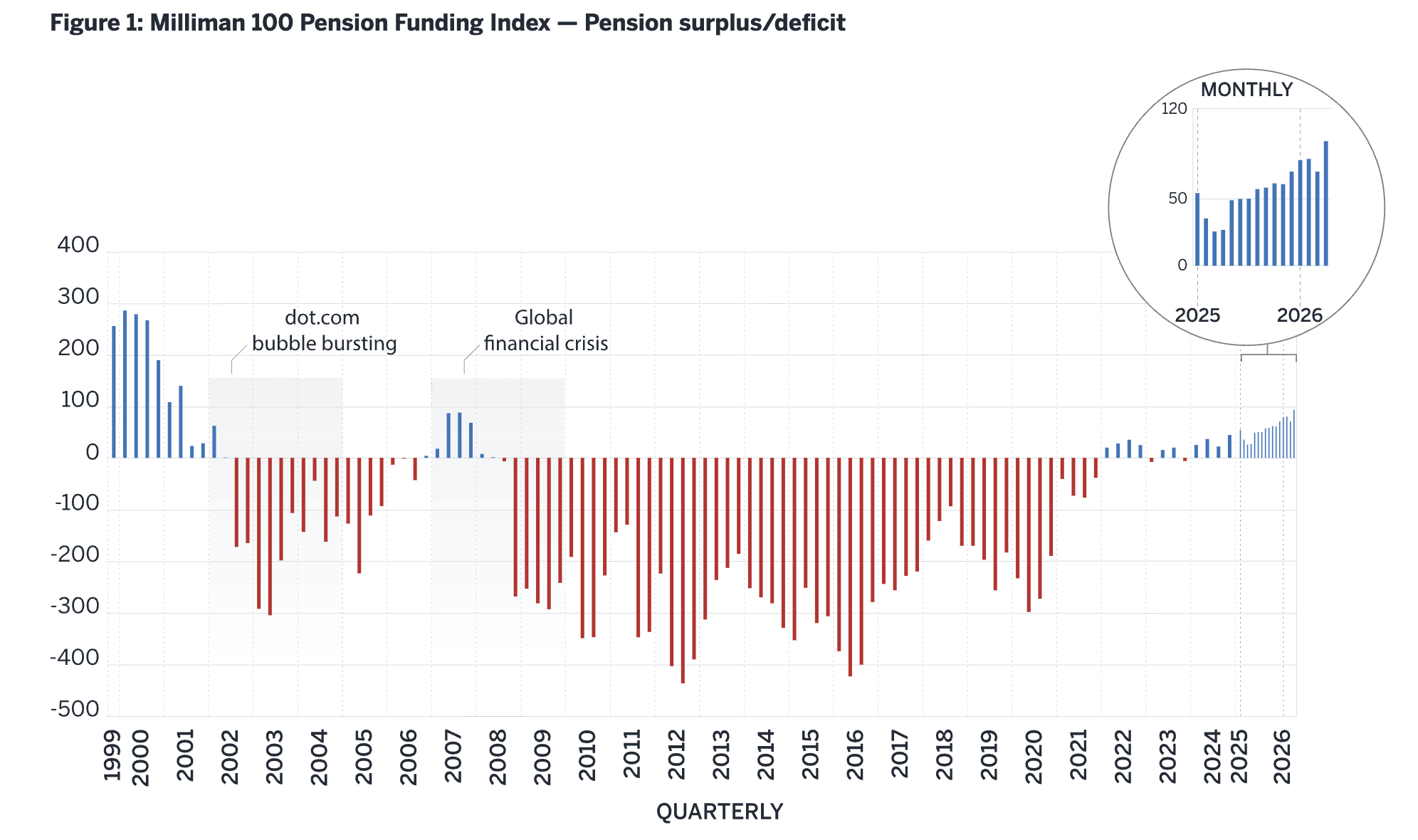
As for today’s members, the Milliman 100 PFI plans showed improved funding by $23 billion during April. These stellar results were driven by strong equity returns as the constituents averaged a 2.13% gain. As a result, the funded ratio dramatically improved from 105.9% at the end of March to 107.8% at the end of April representing the highest level of funding since October 2007, when it stood at 108.1%. Strong investment gains increased assets by $20 billion and now stand at $1.297 trillion, while the projected benefit obligation fell slightly to $1.204 trillion, as the monthly discount rate edged up one basis point, to 5.66% from 5.65%. 

“After a flat first quarter, the funding surplus grew to $94 billion at the end of April, primarily due to strong market returns,” said Zorast Wadia, author of the Milliman 100 PFI. “This means plan sponsors continue to have more pension risk management options as plans move further into surplus territory.”

Plan sponsors would be wise to seek risk reducing strategies. The previous high watermark was achieved in October 2007, just prior to the start of the Great Financial Crisis, which pummeled markets through March of 2009. As the graph below highlights, the Milliman 100 went from a small surplus in the Q3’07 to a major deficit within 6 months. It would be another 13-years before a surplus was once again created.

Plan sponsors should secure the pension promises through a cash flow matching (CFM) strategy and then actively manage surplus assets since they’ve now created a much longer investing horizon for those assets. Ryan ALM, Inc. is always willing to provide a free analysis of what is possible through CFM.

For the full Milliman report, click on the link below.

View this month’s complete Pension Funding Index.

Unique Liabilities Require A Unique Solution

By: Russ Kamp, CEO, Ryan ALM, Inc.

Most pension plans have exposure to fixed income. Perhaps not as much as they did prior to 2000, but today’s common thinking is that the current exposure is enough to act as a buffer should equity markets not continue along this momentum fueled path, and finally, to support the monthly liquidity needs of the fund. But are those the right reasons to use bonds and what type of fixed income should be used to accomplish those objectives?

We observe that most funds use a variety of investment grade bonds (Treasuries, Agencies, Corporates, etc.) and they have that collection benchmarked to a generic index such as the Bloomberg U.S. Aggregate Index (a.k.a. the Agg). As a reminder, the Agg was created by Ron Ryan when he was Head of Research at Lehman Brothers a few years ago. But, again, is this the right approach? We at Ryan ALM, Inc. believe that bonds should only be used for their cash flows (principal and interest) and not as a performance driver. Bonds are perhaps the only asset class with a known cash flow equal to the value at maturity (PAR) and contractual interest payments. Those known cash flows can be modeled to meet the plan’s ongoing liability cash flows (benefits + expenses). 

Which brings me to the point that every pension plan’s liabilities are unique, and as such, no generic index such as the Agg could possibly match a plan’s liabilities. If the asset cash flows don’t match and fund the liability cash flows (benefits and expenses), the plan is subject to unnecessary interest rate risk. Again, given that every pension plan has a unique set of liabilities this would suggest that each pension plan needs to have an investment strategy created specifically for their cash flow needs. Cash Flow Matching (CFM) is an investment strategy with a very long and successful history. An appropriately crafted CFM portfolio will meet and fully fund chronologically the liability cash flows as far into the future as the allocation to the CFM strategy lasts.

We take great pride in our proprietary CFM optimization modeling, which we began using at Ryan ALM’s founding in 2004. Having the ability to tailor unique solutions to client specific issues/requests is a hallmark of our firm, and this capability is being recognized throughout the industry. In fact, we recently received this feedback from an ALM expert at a large asset/liability consulting firm, who stated that I’m “impressed with the team’s ability to build portfolios for such non-standard cashflow streams.” Thank you!

We’d be happy to demonstrate our capability and we’re always willing to provide a free analysis highlighting how your fund could benefit through CFM and Ryan ALM’s expertise. Just call us.

Why Wouldn’t You Prefer a SD of +/-0%?

By: Russ Kamp, CEO, Ryan ALM, Inc.

I continue to be surprised that more pension plans don’t embrace greater certainty in the management of their funds. The Iran War is leading to great uncertainty related to inflation, interest rates, and economic growth. Yes, U.S. equities have enjoyed a healthy recovery following the initial outbreak in the Middle East, but is that sustainable?

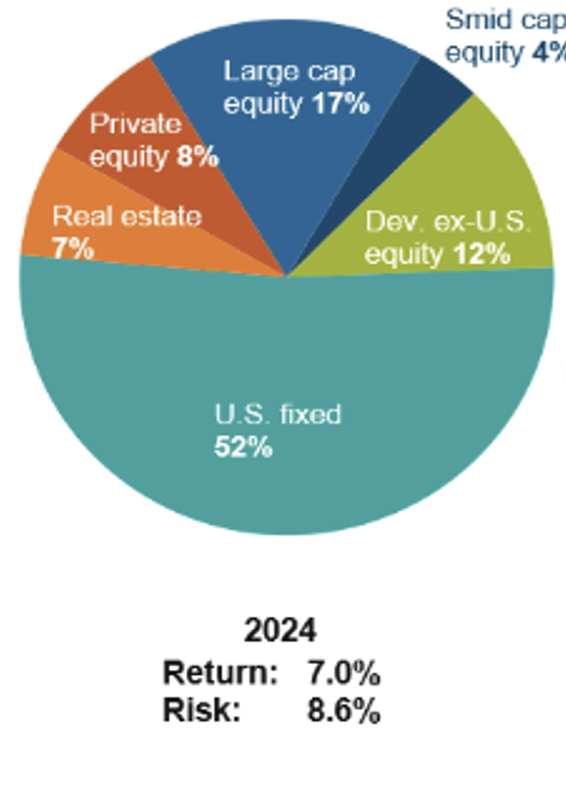
Callan does a good job of providing a regular review of what asset allocation would be necessary to achieve a 7% return and the risk (measured as standard deviation) to achieve that return objective. Callan indicated that it was very easy to achieve a 7% return all the way back in 1994 when U.S. interest rates were higher than they are today. In fact, an allocation of 85% to fixed income and small allocations to L.C. equity, SC equity, and int’l stocks would have produced a 7% return with only a 5.6% annual standard deviation.

However, in the most recent update from 2024, Callan suggests the following asset allocation is necessary to achieve a 7% return:

This means that 68% of the time, a plan sponsor should expect an annual return of 7% +/- 8.6%. At two standard deviations (95% of the observations or 19/20 years), the annual return will fall between +/- 17.2% of the 7% target. Would you be comfortable knowing that your fund could generate an annual return of -10.2%? Think about the impact a return like that would have on contributions?

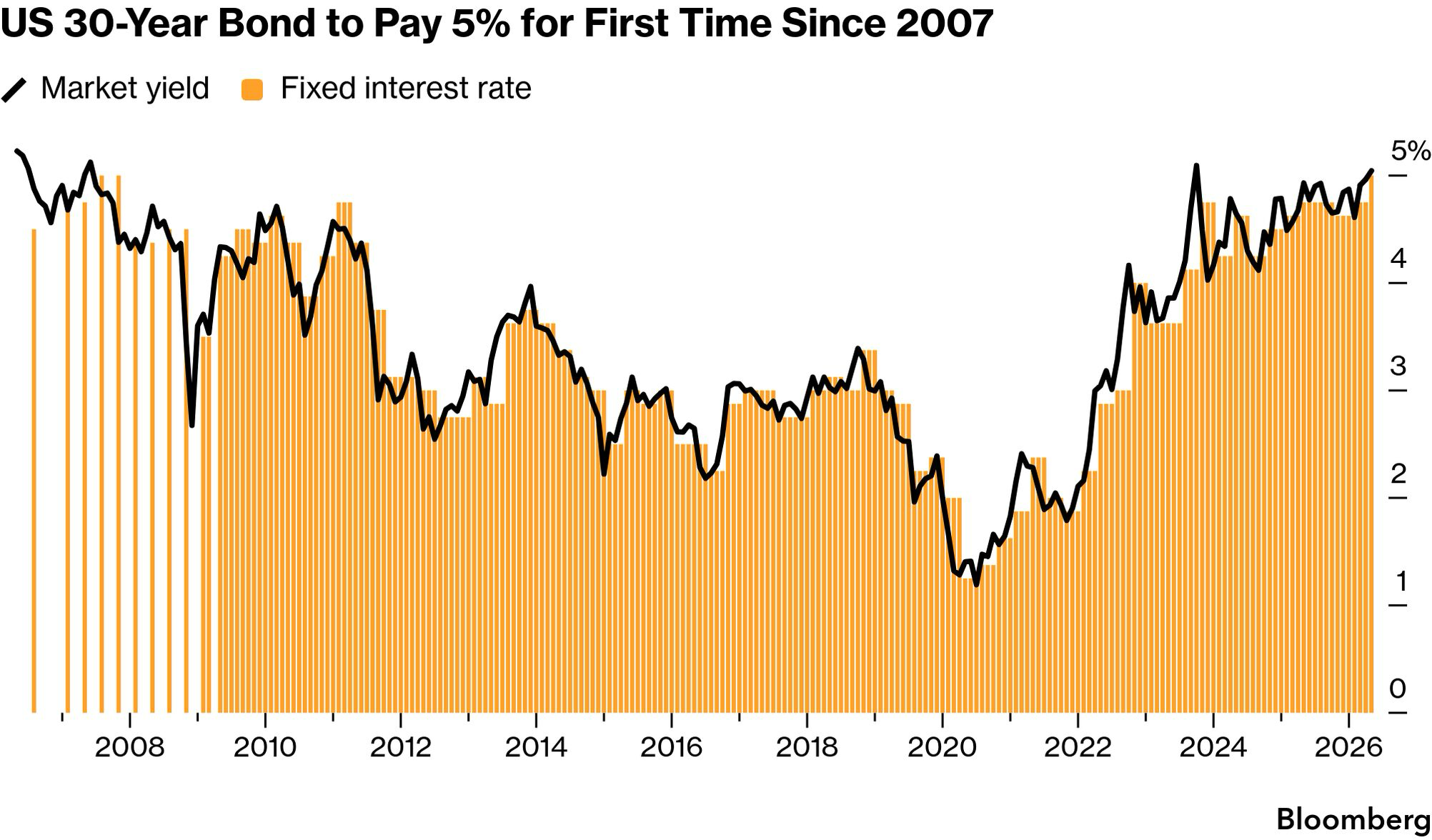
What if I said that cash flow matching (CFM) a portion of your pension fund would result in those assets having an annual SD of 0% barring a default which occurs at a rate of 0.18% annually among investment grade corporate bonds for the last 40-years. How’s that possible? When CFM is implemented, the plan’s asset cash flows and matched agains the plan’s liability cash flows (benefits and expenses). They mover in lockstep with each other no matter where rates go. Today’s U.S. interest environment is attractive and getting more attractive as I write this post, as the 30-year Treasury bond yield has topped 5% (5.02% at 11:47 am DST). Higher rates are great for CFM, as they lower the present value of those future promises.

Furthermore, the use of a CFM portfolio secures the pension promises, dramatically improves plan liquidity, eliminates interest rate risk for the portion of the plan, extends the investing horizon for the residual plan assets, and reduces the cost of those future pension promises. Again, why wouldn’t you embrace an element of certainty?

I’m not sure what the Callan team would identify as the proper allocation to achieve a 7% return today, but I suspect that the annual standard deviation is greater than the 8.6% from 2024. Every time a pension plan falls short of the annual ROA, contributions must increase to make up for the shortfall. Greater investment certainty, like that associated with using CFM, reduces the likelihood that the pension plan sponsor with suffer from a negative surprise associate from increased contributions.

Is Now Really the Time to Buy Stocks?

By: Russ Kamp, CEO, Ryan ALM, Inc.

U.S. equity markets enjoyed a robust April despite myriad economic and geopolitical inputs that might have given investors pause. Should equity investors remain bullish at this time? The graph below caught my attention primarily because of the recent disconnect between the two lines related to the Shiller Excess Cape Yield (ECY) and subsequent 10-year Real Return for equities. There are many, many valuation tools that claim to provide clues about the future direction of stocks, and this is such an example. Those tools can be short-, medium-, and long-term in nature. The ECY happens to be one valuation metric that provides “guidance” for longer time frames. The current reading of 1.60% certainly looks rich relative to its long history.

In case you don’t know, the Shiller excess CAPE yield is a valuation measure that compares the stock market’s earnings yield with the “real” yield on the 10-year Treasury note. In simple terms, it asks how much extra return stocks may offer over inflation-adjusted government bonds.

How it is calculated

  • Take the inverse of the CAPE ratio, which is the market’s “earnings yield.”
  • Subtract the real 10-year Treasury yield.

So, ECY=(1/CAPE)10-year real Treasury yield

A higher excess CAPE yield suggests stocks might look more attractive relative to bonds. A lower reading suggests the equity risk premium is thinner, meaning stocks offer less return versus bonds. As mentioned above, current readings show the S&P 500 Shiller Excess CAPE Yield around 1.60% for April 2026, which is well below its long-term average of 4.60%. Another data source put it at 1.41 as of April 30, 2026.

Investors have historically used the ECY as a long-term asset allocation tool, especially when comparing stocks with Treasury bonds. It is not a short-term trading signal, but rather a rough guide to whether equities look cheap or expensive relative to real bond yields. A CAPE yield below 2% has generally signaled subdued future equity returns over the next 5 to 10 years, providing a valuation warning sign, and not an exact measure.

As a reminder, there are many valuation techniques used to identify opportunities and risk when investing in U.S. equities. Depending on a pension plan’s liquidity needs, funded ratio, willingness to take risk, etc. today’s current environment may be providing an opportunity to reduce risk by trimming equities and using the proceeds along with core fixed income assets to establish a cash flow matching mandate. In the process, the plan’s liquidity is improved, promised benefits secured, and the investing horizon extended for the residual assets. Give us a call. We are always willing to provide a free analysis showcasing how CFM can help your fund.

Pension Game: Find the Liabilities?

By: Russ Kamp, CEO, Ryan ALM, Inc.

I can remember as a child playing the games hide-and-seek and manhunt among myriad activities with my friends in Palisades Park. We would play for hours. It was particularly exciting as daylight waned just before we were beckoned home when the streetlights flicked on.

Those games were innocent and most of the time no one got hurt. However, Ron Ryan, Ryan ALM’s Chairman, has written about another game. In this competition, he’s challenging pension professionals to “find the liabilities”. Why? Unfortunately, most of the effort put forth by pension professionals (outside of actuaries) is focused on assets: the allocation, manager selection, and performance. But is that the correct approach? Of course not.

The only reason that a pension plan exists is because of a promise that has been made to the plan participant. Pre-funding that promise through a pension system is a most effective approach to meeting those future obligations. As a result, that promise needs to be the focal point of pension management, but it rarely is. Unfortunately, most folks think that managing a pension is all about returns. How has the fund performed relative to the return on asset (ROA) assumption.

As Ron points out in this excellent piece, if all the investment managers/strategies outperform their generic asset specific benchmarks, but the total fund underperforms its liability growth rate, has the fund won? Of course not. That’s why we believe that the primary objective in managing a DB pension plan should be to SECURE the promises at a reasonable cost and with prudent risk.

As I mentioned earlier, the games that I engaged in as a child in New Jersey were innocent. Failure to understand what a plan’s liabilities look like could be much more harmful. We’ve seen that scenario play out many times and with significant consequences. Don’t let your fund become the victim of an assets-only approach.

What is My Funded Ratio? Who Cares!

By: Russ Kamp, CEO, Ryan ALM, Inc.

The funded ratio of a DB pension plan gets a lot of attention, especially if it is perceived to be weak. But does the funded ratio truly tell you the whole story as to the financial health of a DB pension plan? We, at Ryan ALM, Inc. don’t think so.

So, how is the funded ratio calculated:

Funded ratio = MV of plan assets / plan liabilities earned to date X 100

The market value of assets is a present value (PV) calculation. The market value of liabilities is the future value of liabilities earned to date discounted back to a PV calculation based on a discount rate. For public and multiemployer plans the discount rate tends to be the fund’s return on asset assumption (ROA), while it is an AA corporate blended rate for private pensions. In today’s interest rate environment, the discount rate for private plans will be roughly 1.5% less than the discount rate based on the average ROA. That means that liabilities for private funds will have a greater current value than the value of liabilities calculated based on the discount rate using the ROA. Oh, okay, so the choice of a discount rate can change my funded ratio. That’s interesting. So that tells me that if I wanted to improve my funded ratio, all I’d have to do is increase my discount rate to lower the PV of my liabilities. That’s very interesting.

So, it appears that the funded ratio calculation can be manipulated to some extent. As we think about the formula above, is there anything missing? Yes, where are the future contributions, which can be significant. Why are future payment liabilities in the calculation, but projected contributions, which are future assets of the fund, not included? Common thinking suggests that those future contributions aren’t guaranteed, which is why they aren’t factored into the funded ratio calculation. However, is that a correct assumption? In doing some research, it appears >80% of DB pension funds receive 100% of the annual required contribution (ARC). Even NJ’s public pension system is making the ARC and then some.

We recently had a conversation with a large plan sponsor who thought that their fund was <50% funded based on the formula above. Not surprisingly, they were very focused on this ratio and looking for investment strategies that could potentially enhance it. As an FYI, this plan’s future contributions as forecasted by their actuary were significant. In fact, future contributions were so large that they were equal to 73% of the forecasted liabilities! Yes, without including the pension fund’s current assets, this plan was 73% funded, provided those projected contributions were met which they have been for more than a decade.

So, given these forecasted contributions is that pension fund really <50% funded?

In another example, the same fund that thought that they were poorly funded, could defease net pension liabilities for the next 33-years. How is it possible that a plan that believes it is <50% funded able to significantly reduce risk, enhance liquidity, and SECURE pension promises for 33-years? Furthermore, this fund was going to establish a $4.4 billion surplus on the day that those benefits and expenses were defeased for 33-years. If it just earned the projected ROA, that $4.4 billion would grow to $34.2 billion during that 33-year period. Wow! 

So, I ask once more, does that sound like a plan in financial distress, which a funded ratio of <50% might suggest? NO!

The funded ratio is but one measure of a pension plan’s health. Unfortunately, many in our industry would look at that # and say that more risk needs to be taken to achieve “full funding” down the road, when in fact reducing risk through a cash flow matching (CFM) strategy is the appropriate approach. It is past the time to get off the scary asset allocation rollercoaster. 

What Would You Do?

By: Russ Kamp, CEO, Ryan ALM, Inc.

Happy St. Paddy’s Day to my Irish friends (I’m 1/2 Irish) and those that would like to be. May the luck of the Irish embrace you today.

As many of you know, we are always willing to provide to the pension and E&F communities a free analysis to highlight how a Cash Flow Matching (CFM) mandate could secure the promised benefits/grants for your fund and importantly, provide the necessary liquidity to meet future promises. In many cases, we will produce multiple runs covering a variety of periods usually 5-years to 30-years. Often the sponsor of the fund is shocked by the potential cost reduction of those future obligations.

We recently provided a large pension plan with several potential implementations, as they try to improve the fund’s liquidity profile, while also desiring to secure those future promises. Here are three scenarios that we provided to them and I’d welcome your feedback on what you would do.

Scenario #1 – Provide a CFM portfolio using the core fixed income allocation ($3 billion/15% of total assets) to match and fund the NET (after contributions) liability cash flows of benefits and expenses (B&E). In this scenario, we can cover the next 6-years of B&E through 6/30/32, covering $3.44 billion in FV benefits and expenses for $3.0 billion (a cost reduction of $443.3k or 12.88%). The YTM on the portfolio is 4.09 and the duration 3.09 years, with the average quality being A-. The remaining assets can continue to be managed as they currently are, but they now benefit from a 6-year investing horizon in which they are no longer providing any liquidity to meet monthly obligations.

Scenario #2 – Provide a CFM portfolio using the same $3 billion (only needed $2.96 billion) or 15% of the fund’s total assets, but implement the strategy using a vertical slice of the liabilities going out 30-years. In this example, we can cover 22% of the liability cash flows for the next 30-years. The FV of those liabilities are $6.3 billion (as opposed to the $3.44 billion using 100% CFM for 6-years). We can reduce the FV cost by $3.33 billion or 53%. The remaining 85% of the fund’s assets can be managed as they presently are, but they don’t benefit from the longer investing horizon, as they will be called upon to provide liquidity to meet the residual B&E.

Scenario #3 – 100% CFM covering net liabilities through 6/30/59. In this case we showed that we can cover 100% of the NET B&E for $9.9 billion in assets, while providing the plan with a $4.4 billion surplus. The FV of those B&E through 2059 are reduced by about $13 billion or 56%! The surplus assets now have a 33-year investing horizon to just grow and grow! A modest 6.5% annualized return for that period produces a surplus of $34.2 billion that can be used to fund B&E after 2059, enhance benefits, and/or reduce future contributions. An 8% annualized return produces a surplus >$75 billion. Oh, my! Also, in this scenario, the organization ONLY needs an annual 2.56% return on the remaining assets to fully fund ALL projected B&E well beyond 2059, as determined by our Asset Exhaustion Test (AET).

Importantly, these scenarios only work if the sponsoring entity provides the forecasted contributions, which in this case they have consistently done for the past 10+ years.

So, I ask once again, what would you do? Scenario 1 ($3 billion/15% of total assets) provides a 100% coverage for 6-years while reducing cost by 13%. Scenario 2 reduces the cost of FV B&E by 53% or $3.4 billion, but covers only 22% of the liabilities, while Scenario 3 reduces the FV cost by 56%, while securing the net promises through 2059 for a cost of $9.9 billion resulting in a surplus of $4.4 billion.

I guess that there is a fourth scenario which is to do nothing, but why would you want to continue to ride the proverbial performance rollercoaster that only guarantees volatility and not success when you can secure a portion of the liabilities, significantly reduce the cost of those future promises, improve liquidity, and “buy time” for the residual assets to just grow unencumbered?

As the Irish say – May the most you wish for be the least you get“.

Good Question!

By: Russ Kamp, CEO, Ryan ALM, Inc.

We occasionally post questions received in reaction to our blogs in new blog posts since many of our readers might have similar thoughts/ideas. In reaction to yesterday’s post, “All-time High Funded Ratio” a reader calling themselves LoudlyObservant (great name) stated the following:

Why wouldn’t such well-funded plans take steps to lock in the funding of their beneficiary payments through a cash flow matching portfolio? Isn’t the first fiduciary duty of loyalty expressed in controlling the relevant risk to the beneficiaries, which involves BOTH securing adequate assets and then actually funding the payments? Many of these plans have hit the first goal but are still exposed to funding risk. With a ready solution at hand, the plan sponsors open themselves to criticism for not acting on their second responsibility.

Thank you, Loudly! Great questions and observations. We often talk about the fact that pension plans at all funding levels need liquidity, not just well-funded plans, but when you have a universe of plans that on average are fully funded, why not dramatically reduce risk. We witnessed what happened to DB pension plans at the end of 1999, when most plans were well overfunded only to see the funded status plummet and contribution expenses explode following two major market corrections.

I’m neither smart enough nor is my crystal ball better than anyone else’s to know if a major market correction is on the horizon but why take the chance unnecessarily. We’ve seen a significant percentage of Special Financial Assistance (SFA) recipients engage in cash flow matching to secure the SFA assets and the benefits that they will protect. Why not adopt CFM for the legacy assets, too? As we’ve mentioned, we are providing a service to you and your plan participants. It isn’t just another product. Time to get off the proverbial rollercoaster of returns and secure the promises and your plan’s funded status.

It’s Not A Product – It’s A Service!

By: Russ Kamp, CEO, Ryan ALM, Inc.

Anyone who has read my blogs (>1,700 to date) knows that my personal mission and that of Ryan ALM, Inc. is to protect and preserve defined benefit pension plans. How is our collective mission pursued? It is through the implementation of unique client-specific cash flow matching (CFM) assignments. Since every pension plan has liabilities unlike any other fund, a unique solution must be created unlike most investment management products sold today.

Here is the reality: There are a lot of wonderful people in our industry, representing impressive investment organizations, tasked with introducing a variety of investment products. Plan sponsor trustees, with the help of their investment consultants, must determine which products are necessary for their plan to help reach the goal of funding the promised benefits. This is an incredibly challenging exercise if the goal is to cobble together a collection of investment managers whose objective is to achieve a return on asset assumption (ROA). This exercise often places pension funds on the proverbial rollercoaster of returns. The pursuit of a return as the primary goal doesn’t guarantee success, but it does create volatility.

On the other hand, wouldn’t it be wonderful if one could invest in strategy that brings an element of certainty to the management of pension plans? What if that strategy solved the problem of producing ALL of the necessary liquidity needed to fund monthly benefits and expenses without having to sell securities or sweep cash (dividends and capital distributions) from higher earning products? Wouldn’t it be incredible if in the process of providing the liquidity for some period of time, say 10-years, you’ve now extended the investing horizon for the residual assets not needed in the liquidity bucket? Impossible! Hardly. Cash flow matching does all that and more.

I recently had the privilege of introducing CFM to someone in our industry. The individual was incredibly curious and asked many questions. Upon receiving my replies, they instinctively said “why isn’t everyone using this”? That person then said you aren’t selling a product: it is a SERVICE. How insightful. Yes, unlike most investment strategies that are sold to fill a gap in a traditional asset allocation in pursuit of the “Holy Grail” (ROA), CFM is solving many serious issues for the plan sponsor: liquidity and certainty being just two.

Substituting one small cap manager for another, or shifting 3% from one asset class or strategy to another is not going to make a meaningful impact on that pension plan. You get the beta of that asset class plus or minus some alpha. None of these actions solve the problem of providing the necessary liquidity, with certainty, when needed. None of them are creating a longer investing horizon for the residual assets to just grow and grow. None of those products are supporting the primary pension objective which is to SECURE the promised benefits at low cost and with prudent risk.

So, Ryan ALM, Inc. is providing a critical service in support of our mission which is to protect and preserve your DB pension plan. Why aren’t you and others (everyone) taking advantage of this unique service?

MV versus FV

By: Russ Kamp, CEO, Ryan ALM, Inc.

There seems to be abundant confusion within certain segments of the pension industry regarding the purpose and accounting (performance) of a Cash Flow Matching (CFM) portfolio on a monthly basis. Traditional monthly reports focus on the present value (PV) of assets in marking those assets to month-end prices. However, when utilizing a CFM strategy, one is hoping to defease (secure) promised benefits which are a future value (FV). As a reminder, FVs are not interest rate sensitive. The movement in monthly prices become irrelevant.

If pension plan A owes a participant $1,000 next month or 10-years from now, that promise is $1,000 whether interest rates are at 2% or 8%. However, when converting that FV benefit into a PV using today’s interest rates, one can “lock in” the relationship between assets and liabilities (benefit payment) no matter which way rates go. To accomplish this objective, a CFM portfolio will match those projected liabilities through an optimization process that matches principal, interest, and any reinvested income from bonds to those monthly promises. The allocation to the CFM strategy will determine the length of the mandate (coverage period).

Given the fact that the FV relationship is secured, providing plan sponsors with the only element of certainty within a pension fund, does it really make any sense to mark those bonds used to defease liabilities to market each month? Absolutely, NOT! The only concern one should have in using a CFM strategy is a bond default, which is extremely rare within the investment grade universe (from AAA to BBB-) of bonds. In fact, according to a recent study by S&P, the rate of defaults within the IG universe is only 0.18% annually for the last 40-years or roughly 2/1,000 bonds.

A CFM portfolio must reflect the actuaries latest forecast for projected benefits (and expenses), which means that perhaps once per year a small adjustment must be made to the portfolio. However, most pension plans receive annual contributions which can and should be used to make those modest adjustments minimizing turnover. As a result, most CFM strategies will purchase bonds at the inception of a mandate and hold those same issues until they mature at par. This low turnover locks in the cost reduction or difference in the PV vs. FV of the liabilities from day 1 of the mandate. There is no other strategy that can provide this level of certainty.

To get away from needing or wanting to mark all the plan’s assets to market each month, segregate the CFM assets from the balance of the plan’s assets. This segregation of assets mirrors our recommendation that a pension plan should bifurcate a plan’s asset allocation into two buckets: liquidity and growth. In this case, the CFM portfolio is the liquidity bucket and the remaining assets are the growth or alpha assets. If done correctly, the CFM portfolio will make all the necessary monthly distributions (benefits and expenses), while the alpha assets can just grow unencumbered. It is a very clean separation of the assets by function.

Yes, bond prices move every minute of every day that markets are open. If your bond allocation is being compared to a generic bond index such as the Aggregate index, then calculating a MV monthly return makes sense given that the market value of those assets changes continuously. But if a CFM strategy can secure the cost reduction to fund FVs on day 1, should a changing MV really bother you? Again, NO. You should be quite pleased that a segment of your portfolio has been secured. As the pension plan’s funded status improves, a further allocation should be made to the CFM mandate securing more of the promised benefits. This is a dynamic and responsive asset allocation approach driven by the funded status and not some arbitrary return on asset (ROA) target.

I encourage you to reach out to me, if you’d appreciate the opportunity to discuss this concept in more detail.