The Benefit of Higher U.S. Interest Rates

By: Russ Kamp, CEO, Ryan ALM, Inc.

Rising interest rates can often create stresses in an economy and within the capital markets. They certainly make financing big ticket items more painful. They can destabilize equity markets, although it seems as if the current equity market is immune to any risk at this time. They harm most fixed income managers/strategies, as rising rates lower the present value of their bonds.

However, rising rates are GREAT for cash flow matching (CFM) strategies, as the higher rates reduce the cost of those future pension promises (benefit payments). We were recently asked by a public pension fund to provide them with an analysis of what CFM could potentially do for them in this environment. They provided us with the requisite data – projected benefits, expenses, and contributions as far into the future as possible – which we then ran through our cost optimization model that we call the Liability Beta Portfolio (LBP).

The output is compelling! We can secure this fund’s net (after contributions) liabilities (all of them!) through September 30, 2053. The future value (FV) of those liabilities is $86.2 million. However, the plan needs to set aside only $50.1 million in present value (PV) assets to defease those liabilities with certainty. The $36.1 million cost reduction is locked in on the day that the portfolio is created. That “savings” equates to a cost reduction of 41.9%!

So, this plan sponsor can now SECURE pension payments for 27-years. The residual assets not needed in the CFM portfolio can now grow unencumbered. If I were them I’d just buy a S&P 500 ETF creating considerable savings from lower management fees and far less complexity. Furthermore, the plan sponsor now knows what contributions will look like for the next nearly three decades. They won’t have to be alarmed should markets suffer a deep and extended correction, as the assets AND liabilities will move in lockstep.

By the way, these benefits were achieved without taking substantial risk, as our process only uses investment-grade corporate bonds rated BBB+ or better. Defaults, which are the only risk within the strategy, have been 0.2% (2/1000 bonds) annually for the last 40-years according to S&P.

Why use CFM? The benefits are incredible, including; certainty, security, all the necessary liquidity, an extended investing horizon, lower management fees, stable contributions, and improved sleep! If these benefits sound attractive to you, provide us the same info that our public fund prospect did (see above) and we’ll provide you with a free analysis, too. We are confident that you’ll be as blown away as they were and the many clients that we are proud to support.

Bonds as Performance Drivers? No, Sir!

By: Russ Kamp, CEO, Ryan ALM, Inc.

U.S. fixed income benefitted tremendously from the nearly 4-decade decline in interest rates. From 1981 through 2021, the U.S. enjoyed a significant collapse in bond yields helping to fuel an unprecedented rally in risk assets. However, as Bob Dylan said, “the times they are a changin”!

The U.S. Federal Reserve’s FOMC announced on March 16, 2022, that the new Fed Fund’s target would be 0.25%-0.5% beginning on St. Patrick’s day 2022. This action marked the beginning of a rate regime change resulting from Covid-19 implications, including abundant stimulus creating massive demand for goods and services that couldn’t be met as production/manufacturing activities were disrupted.

The U.S. Fed Fund’s rate would eventually rise to 5.25%-5.50% in July 2023 (following 11 rate increases). Today, the Fed Fund’s rate stands at 3.5%-3.75%. For context, the average Fed Fund’s rate since 1971 is 5.39%, which includes a peak of nearly 20% in December 1980, and ultimately 0% in December 2008, in reaction to the GFC. It would once again hit 0% during Covid.

As a result, bond investors, such as pension plans, have ridden a rollercoaster of performance. Performance looked terrific for much of the nearly 40-year bull market but has been challenging since the Fed’s initial action in 2022. In fact, the Aggregate Index (Lehman, Barclays, Bloomberg, etc.) has produced only a 3.3% return for 20-years through March 2026. It is worse if you look at shorter timeframes, as the Index was up only 1.7% for 10-years, 0.3% for 5-years, and -0.1% YTD (all through March 31, 2026).

For pension plan sponsors and their advisors who are reluctant to utilize cash flow matching (CFM) as it might harm the pension plan’s ability to achieve the ROA, those performance #s above should be a wake-up call! As a reminder, the YTM of a CFM portfolio is a good proxy for what the fund will achieve for the period that liabilities are defeased. Given that Ryan ALM, Inc. is currently generating a YTM of 5.02% for a client with a 30-year defeasement and a 4.6% YTM for another with a 10-year CFM mandate, which result do you think is more harmful to the pension plan?

Furthermore, the CFM portfolio’s return is not predicated on the direction of interest rates, as it very much is with active core fixed income strategies. Importantly, CFM provides all the liquidity needed to meet the monthly benefit payments without having to sell assets, perhaps at inappropriate times. By cash flow matching bond principal and interest income with the plan’s liability cash flows (benefits and expenses), CFM secures the pension promises and reduces the FV cost (with certainty) of those obligations in the process. For the client with the 30-year CFM mandate, we are reducing future funding costs by -31.1% and for the 10-year CFM program, we have reduced funding cost by -28.0%.

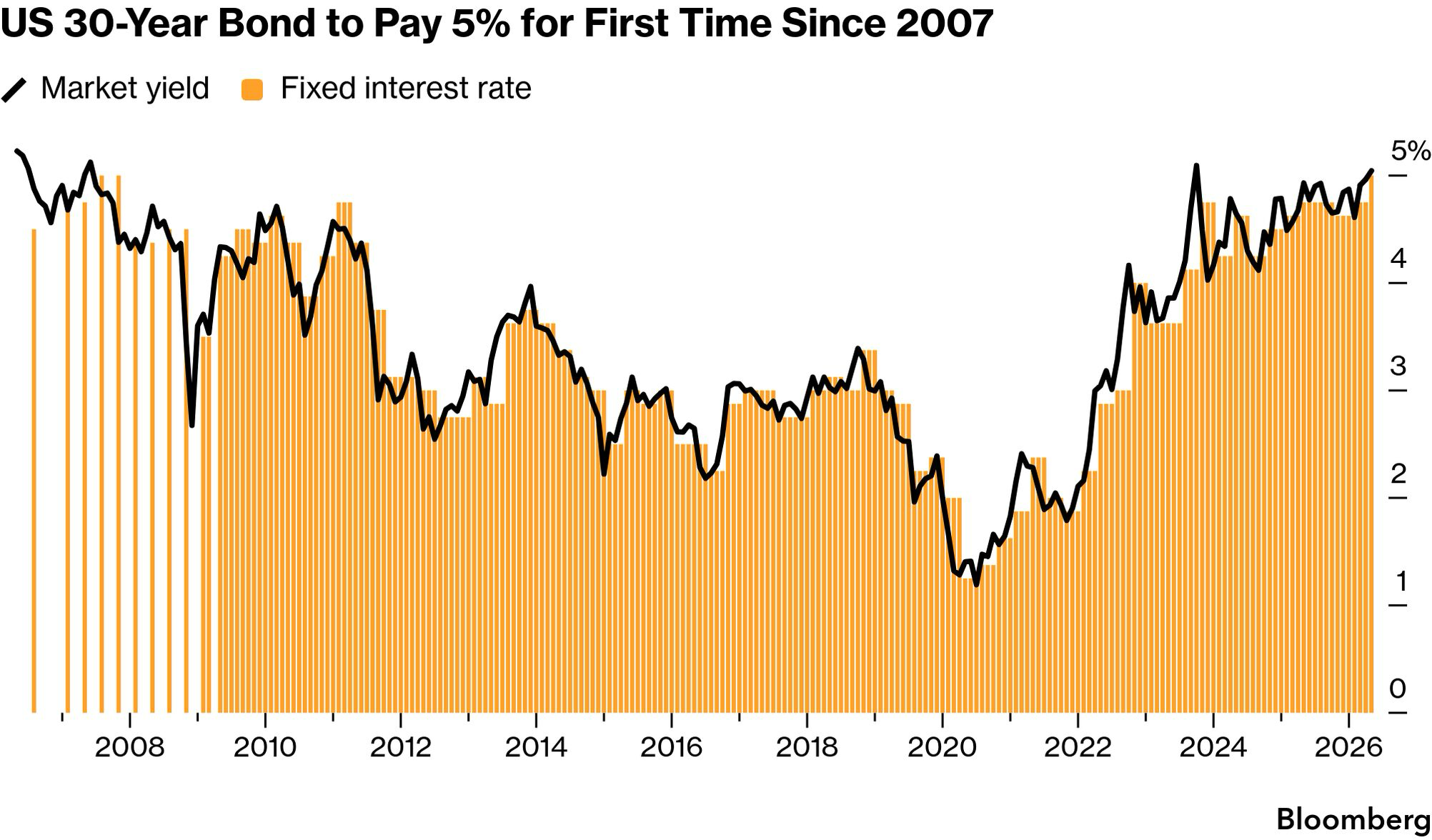
Where are we today? After a brief respite, U.S interest rates are once again trending higher, as greater inflation takes hold. Who knows where inflation and interest rates will eventually land, but a pension plan (or E&F) could benefit tremendously in this environment by engaging Ryan ALM, Inc. and our CFM capability. The 30-year Treasury bond yield history below highlights the rising rate environment. As a reminder, Ryan ALM builds CFM portfolios using investment-grade corporate that have yields substantially higher than comparable Treasury maturities.

So, I ask: Why sit with active fixed income and subject your plan’s bond allocation to the whims of an unknown interest rate environment when you can SECURE the pension promise with near certainty (absent any defaults)? Wouldn’t it be wonderful to know that your liquidity needs are all set for some prescribed period? Wouldn’t your plan participants want to know that the promises given have been secured? Now is the time to bring an element of certainty to the management of pension assets that doesn’t currently exist. Given the geopolitical uncertainty and the potential impact on inflation, rates, and other markets, creating funding certainty should be priority #1. Why isn’t it?

Pension Plan Sponsor: “I Wish that I could…”

By: Russ Kamp, CEO, Ryan ALM, Inc.

In October, I will celebrate my 45th year in the pension/investment industry. I’ve been truly blessed, but also frustrated by activities that I deem detrimental to the successful management of DB pension plans.

First and foremost, I believe that a majority of folks think that achieving the return on asset assumption (ROA) is the primary objective in managing a DB pension plan. This is an incorrect assumption! Creating an asset allocation targeted at a return only guarantees annual volatility, and NOT success.

Second, meeting monthly liquidity through the sweeping of interest, dividends, capital distributions, and worse, the selling of investments harms the long-term return of your fund.

Third, using core fixed income as a return generator is not a sound strategy, as bonds are highly interest rate sensitive, and who knows the future direction of rates.

That being said, if I were a pension plan sponsor, I’d wish that I could find an investment strategy that provided: All of the plan’s liquidity needs, certainty for a portion of that plan, and a longer investment horizon for my alpha generating assets (non-bonds) so that I enhance the probability of achieving the desired outcome.

Great news – there is such a strategy. Cash Flow Matching (CFM) is designed to use investment-grade bonds for their cash flows of interest and principal (upon maturity) to match liability cash flows of benefits and expenses for as far out as the allocation goes. Furthermore, it extends the investing horizon for the non-bond assets so that they can wade successfully through choppy markets without being a source of liquidity. Finally, there is an element of certainty (minus that rare occurrence of an IG bond default) absent in the management of DB pension plans outside of a pension risk transfer (PRT) or an annuity.

I believe that the primary objective in managing a DB pension plan is to SECURE the pension promise at low cost and with prudent risk. Does focusing on the ROA secure benefits – no. The “sweeping” of dividends, interest, and capital distributions to meet ongoing liquidity needs can negatively impact the plan’s long-term return. Guinness Global (U.K. investment shop) produced a study that said sweeping dividends and not reinvesting them reduced the return to the S&P 500 by 47% over 10-year periods back to 1940 and 57% for 20-year periods.

Finally, bonds are highly interest rate sensitive. After a nearly 40-year decline in U.S. interest rates which drove bond prices up and yields down, we have seen rates rise to more average levels where they are holding leading to very weak fixed income returns for recent performance periods. Matching asset cash flows with liability cash flows eliminates interest rate risk for that portion of the portfolio, as benefits and expenses are future values that are not interest rate sensitive. Furthermore, Ryan ALM’s approach is to use 100% IG corporate bonds to build the CFM portfolio. A 100% IG portfolio will outperform a core active fixed income portfolio by the yield differential given the core portfolio’s exposure to agencies and Treasuries.

Question: If you had the opportunity to bring some certainty to the management of pensions, why wouldn’t you do it? If not, please share with us why not.

A Ryan ALM, Inc. Client Portfolio Review

By: Russ Kamp, CEO, Ryan ALM, Inc.

We are blessed to work with a wonderful array of clients, both pension and E&F. They have chosen to bring an element of certainty to the management of their fund. We commend them for that decision and thank them for the confidence that they’ve shown in us and our cash flow matching (CFM) strategy/capability.

Our client relationships begin with the acquisition of important inputs including projections of benefits/grants, expenses, and contributions as far into the future as possible. Most often these are provided by the fund’s actuary. The next step in building a portfolio is to create a Custom Liability Index (CLI), that will establish the framework for monthly distributions.

Upon completion of the CLI, we will work with the client and their advisors to determine the appropriate allocation to CFM. We often suggest converting the current core fixed income allocation since bonds should only be used for their cash flows. Once that has been determined, we will build a high quality bond portfolio (most often 100% IG corporate bonds) that carefully matches asset cash flows of interest and principal with the liability cash flows (benefits and expenses (B&E)).

Once this portfolio is built, we have created an element of certainty for the plan sponsor, as asset cash flow will march in harmony with the liability cash flows barring a bond default, which occurs <0.2% annually (40-year study by S&P). It is only upon changes in the actuaries forecast that lead us to adjust the portfolio, and those annual changes tend to be quite insignificant.

Now the fun part: We are often asked to provide quarterly updates on our portfolio, which couldn’t be any easier. My last portfolio review lasted about 37 seconds. I stated that the projected cash flows that had been shared with us were matched by the asset cash flows, and that there have been no instances in which monthly cash flow needs were not met in their entirety. Furthermore, there have been no defaults in our portfolio ensuring that future cash flow needs will also be met as required. Any questions?

As you can see, there is no need to fret about the direction of U.S. interest rates. No worry about what the “Fed” may do today, tomorrow, or next year. No forecasting of the economic environment, inflation, and/or the geopolitical landscape. Once the CFM portfolio is constructed, the cost savings (cost to fund future B&E) is known and locked in. How many investment managers can tell you how the portfolio will perform over the duration of the program?

Why wouldn’t you want to bring an element of certainty to your fund? Wouldn’t a “sleep-well-at-night” strategy bring comfort to you and those that you serve? If the true objective in managing a defined benefit fund is to SECURE the promised benefits at low cost and with prudent risk, is there another investment strategy that can match the positive attributes of CFM? If we’ve grabbed your attention, reach out. We provide a free analysis of how CFM can make your fund less volatile and uncertain.

It’s Not A Product – It’s A Service!

By: Russ Kamp, CEO, Ryan ALM, Inc.

Anyone who has read my blogs (>1,700 to date) knows that my personal mission and that of Ryan ALM, Inc. is to protect and preserve defined benefit pension plans. How is our collective mission pursued? It is through the implementation of unique client-specific cash flow matching (CFM) assignments. Since every pension plan has liabilities unlike any other fund, a unique solution must be created unlike most investment management products sold today.

Here is the reality: There are a lot of wonderful people in our industry, representing impressive investment organizations, tasked with introducing a variety of investment products. Plan sponsor trustees, with the help of their investment consultants, must determine which products are necessary for their plan to help reach the goal of funding the promised benefits. This is an incredibly challenging exercise if the goal is to cobble together a collection of investment managers whose objective is to achieve a return on asset assumption (ROA). This exercise often places pension funds on the proverbial rollercoaster of returns. The pursuit of a return as the primary goal doesn’t guarantee success, but it does create volatility.

On the other hand, wouldn’t it be wonderful if one could invest in strategy that brings an element of certainty to the management of pension plans? What if that strategy solved the problem of producing ALL of the necessary liquidity needed to fund monthly benefits and expenses without having to sell securities or sweep cash (dividends and capital distributions) from higher earning products? Wouldn’t it be incredible if in the process of providing the liquidity for some period of time, say 10-years, you’ve now extended the investing horizon for the residual assets not needed in the liquidity bucket? Impossible! Hardly. Cash flow matching does all that and more.

I recently had the privilege of introducing CFM to someone in our industry. The individual was incredibly curious and asked many questions. Upon receiving my replies, they instinctively said “why isn’t everyone using this”? That person then said you aren’t selling a product: it is a SERVICE. How insightful. Yes, unlike most investment strategies that are sold to fill a gap in a traditional asset allocation in pursuit of the “Holy Grail” (ROA), CFM is solving many serious issues for the plan sponsor: liquidity and certainty being just two.

Substituting one small cap manager for another, or shifting 3% from one asset class or strategy to another is not going to make a meaningful impact on that pension plan. You get the beta of that asset class plus or minus some alpha. None of these actions solve the problem of providing the necessary liquidity, with certainty, when needed. None of them are creating a longer investing horizon for the residual assets to just grow and grow. None of those products are supporting the primary pension objective which is to SECURE the promised benefits at low cost and with prudent risk.

So, Ryan ALM, Inc. is providing a critical service in support of our mission which is to protect and preserve your DB pension plan. Why aren’t you and others (everyone) taking advantage of this unique service?

What Topics Would You Pick?

By: Russ Kamp, CEO, Ryan ALM, Inc.

I’m hopefully attending the FPPTA conference in Orlando beginning on Sunday, February 1, 2026. My attendance will be very much dependent on the path of the next winter storm takes as it migrates up the East coast. I’ve been asked to speak on a couple of occasions at this event for which I’m always very appreciative to be given the opportunity to share my perspectives on a variety of pension subjects.

The first opportunity is straightforward in that I will be addressing the importance of cash flow in managing defined benefit pension plans. In my opinion, there is nothing more important than generating and managing cash flow to meet ongoing plan liabilities of benefits and expenses. As pension plans have pursued a more aggressive asset allocation utilizing significantly more alternatives – private equity, private credit, real estate infrastructure, etc. – liquidity has become more challenging. As a result, some of the strategies that have been adopted to raise the necessary cash flow are not in the best interest of the plans longer term. I’ll be happy to share my thoughts on those issues if you want to reach out to me.

Regarding my second opportunity to share some perspective, I am one of four individuals who were asked to identify three pension related topics for a session called “Around the Pension World Discussion”. There will be six randomly selected topics from the original list of 12 that will be covered in 15-minute increments. It is a really interesting concept, and hopefully as we lead the conversation will get great input from the attendees.

The three topics that I chose are:

  1. Liquidity – it is being challenged through the migration of assets to alternative strategies.
  2. Uncertainty – Human beings hate uncertainty as it has both a physiological and psychological impact on us. Yet little to none of our current practices managing pensions brings certainty.
  3. The Primary Pension objective – managing a DB pension is about securing the promised benefits at a reasonable cost and with prudent risk. It is not a return objective.

Clearly, there are tons of topics covering investments/asset allocation, risk management, governance, actuarial assumptions, plan design, etc. It shouldn’t be surprising why I chose the topics that I did based on my focus on securing pension promises through cash flow matching (CFM). We provide the necessary liquidity to meet those ongoing expenditures, while securing the promises given to the plan participants. In addition, CFM is a “sleep-well-at-night” strategy that brings certainty to the management of pension plans that engage in very uncertain practices.

What topics would you have chosen? Please reply to this post. I’d like to share your topics and the rationale behind choosing them in a follow-up blog. Have a great day!

How Does One Secure A Benefit?

By: Russ Kamp, CEO, Ryan ALM, Inc.

We hope that you’ll agree that going to Chicago in January demonstrates the lengths that Ryan ALM personnel will go to help plan sponsors and their advisors protect and preserve DB pension plans. We are just thankful that we left yesterday, as today’s temperature is not expected to get to 0. OUCH!

Ron Ryan and I spent the last couple of days speaking with a number of funds and consultants about the many benefits of cash flow matching (CFM), which is gaining incredible traction among pension sponsors of all types. Who doesn’t want an element of certainty and enhanced liquidity within their plans given all the uncertainty we are facing in markets and geopolitically.

The idea of creating an element of certainty within the management of pension plans sounds wonderful, but how is that actually achieved? This is a question that we often receive and this trip was no exception. We had been discussing the fact that the relationship between asset cash flows (bond principal and interest) and liability cash flows (benefits and expenses) is locked in on the day that the bond portfolio is produced. The optimization process that we created blends the principal and interest from multiple bonds to meet the monthly obligations of benefits and expenses with an emphasis on longer maturity and higher yielding bonds to capture greater cost reduction of those future promises.

However, to demonstrate how one defeases a future liability, my example below highlights the matching of one bond versus one future $2 million 10-year liability. In this example from 18-months ago we purchased:

Bond: MetLife 6.375% due 6/15/34, A- quality, price = $107.64

Buy $1,240,000 par value of MetLife at a cost = $1,334,736

Interest is equal to the par value of bonds ($1,240,000) times the bond’s coupon (6.375%)

As a result of this purchase, we Receive: 

  Interest =  $78,412.50 annually ($39,206.25 semi-annual payments)

                            Total interest earned for 10 years is $784,125

  Principal = $1,240,000 at maturity (par value)

Total Cash Flow = $2,024,125  – $2,000,000 10-year Liability  = $24,124.99 excess

                             ($24,124.99 excess Cash Flow)

Benefits:

Able to fund $2 million benefit at a cost of $1.335 million or a -33.25% cost reduction

Excess cash flow can be reinvested or used to partially fund other benefits

In today’s yield environment, our clients benefit to a greater extent asking us to create longer maturity programs given the steepness of the yield curve. If they don’t have the assets to fund 100% of those longer-term liabilities, we can defease a portion of them through what we call a vertical slice. That slice of liabilities can be any percentage that allows us to cover a period from next month to 30-years from now. In a recent analysis produced for a prospect, we constructed a portfolio of bonds that covered 40% of the pension plan’s liabilities out to 30-years. As a result, we reduced the present value cost to defease those liabilities by –42.7%!!

Reach out to us today to learn how much we can reduce the future value cost of your promised benefits. We do this analysis for free. We encourage you to take us up on our generous offer.

FV Benefits Reduced by -56.1% – Really!

By: Russ Kamp, CEO, Ryan ALM, Inc.

I truly relish getting feedback related to my blog posts. I wasn’t surprised that there was more activity, and a little skepticism, related to my recent post that discussed the output from a current project. You may recall the post titled, “Bond Math and A Steepening Yield Curve – Perfect Together”, in which I shared that one particular Cash Flow Matching (CFM) implementation resulted in a potential -56.1% reduction in the FV cost of promised pension benefits. A few folks questioned the math, while another made the comment that the “savings” or cost reduction was nothing more than the time value of money. But isn’t that the reason to have pension assets in the first place so you are not funding liabilities at 100 cents on the dollar (pay-as-you-go).

Well, here’s the thing, the use of bonds, the only asset class with a known cash flow (future value at maturity and contractual semi-annual interest payments), brings to the management of pensions an element of certainty not found elsewhere. Yes, it is conceivable that one could cobble together a group of investment strategies that might subsequently achieve a targeted return that would help pay those obligations, but the volatility associated with this return-focused approach may also lead to significant underperformance and higher contribution expenses in the process.

With CFM, the savings (cost reduction) gets locked in on day one of the assignment. Give us a 5-year, 10-year, or longer assignment to secure those promised benefits, and we’ll be able to give you the likely return for that entire period. What other investment strategy can do that? Furthermore, CFM provides the necessary liquidity without forced selling or the sweep of dividends, interest, and capital distributions that should be reinvested in those higher returning strategies. In the process, the investing horizon for the plan’s assets is extended enhancing the probability that they will achieve the desired outcome.

In the example used in the previous Blog post, the -56.1% cost reduction was achieved with only 40% of the plan’s assets. By using a vertical slice approach, in which we secure a portion of the monthly obligations, we were able to extend the coverage period from 11-years to 30-years. That extension allowed us to use longer maturity bonds at substantially higher yields, which took advantage of bond math that proclaims that the longer the maturity and the higher the yield, the lower the cost. It’s true!

In today’s interest rate environment in which the average BBB corporate bond is trading at a yield close to 6%, a pension plan can capture roughly 89% of the target return (6.75% average ROA) with little to no volatility. How wonderful! Given that humans hate uncertainty, why don’t plan sponsors adopt the use of CFM to bring some certainty to their pension systems? Why do they choose to continue to ride the rollercoaster of returns provided by markets leading to increased contributions following down markets?

So, if you are still skeptical regarding our ability to provide significant cost reductions specific to your set of liabilities, allow us to provide you with a FREE analysis highlighting how CFM can support your pension plan and the plan’s participants. There may not be such a thing as a free lunch, but we can provide you with a sleep-well-at-night strategy.

Bond Math and A Steepening Yield Curve – Perfect Together!

By: Russ Kamp, CEO, Ryan ALM, Inc.

We are in the midst of a project for a DB pension plan in which we were asked to model a series of liability cash flows (benefits and expenses) using cash flow matching (CFM) to defease and secure those liabilities. The plan sponsor is looking to allocate 40% of the plan’s assets initially to begin to de-risk the fund.

We first approached the assignment by looking to defease 100% of the liabilities as far into the future as that 40% allocation would cover those benefits and expenses. As it turns out, we can defease the next 11-years of projected B&E beginning 1/1/26 and carrying through to 10/31/37. As we’ve written many times in this blog and in other Ryan ALM research (ryanalm.com), we expect to reduce the cost of future liabilities by about 2% per year in this interest rate environment. Well, as it turns out, we can reduce that future cost today by 23.96% today.

Importantly, not only is the liquidity enhanced through this process and the future expenses covered for the next 11-years, we’ve now extended the investing horizon for the remaining assets (alpha assets) that can now just grow unencumbered without needing to tap them for liquidity purposes – a wonderful win/win!

As impressive as that analysis proved to be, we know that bond math is very straightforward: the longer the maturity and the higher the yield, the greater the potential cost savings. Couple this reality with the fact that the U.S. Treasury yield curve has steepened during the last year, and you have the formula for far greater savings/cost reduction. In fact, the spread between 2-year Treasury notes and 30-year bonds has gone from 0.35% to 1.35% today. That extra yield is the gift that keeps on giving.

So, how does one use only 40% of the plan’s assets to take advantage of both bond math and the steepening yield curve when you’ve already told everyone that a full implementation CFM only covers the next 11-years? You do a vertical slice! A what? A vertical slice of the liabilities in which you use 40% of the assets to cover all of the future liabilities. No, you are not providing all of the liquidity necessary to meet monthly benefits and expenses, but you are providing good coverage while extending the defeasement out 30-years. Incredibly, by using this approach, we are able to reduce the future cost of those benefits not by an impressive 24%, but by an amazing 56.1%. In fact, we are reducing the future cost of those pension promises by a greater sum than the amount of assets used in the strategy.

Importantly, this savings or cost reduction is locked-in on day one. Yes, the day that the portfolio is built, that cost savings is created provided that we don’t experience a default. As an FYI, investment-grade corporate bonds have defaulted at a rate of 0.18% or about 2/1,000 bonds for the last 40-years according to S&P.

Can you imagine being able to reduce the cost of your future obligations by that magnitude and with more certainty than through any other strategy currently in your pension plan? What a great gift it is to yourself (sleep-well-at-night) and those plan participants for whom you are responsible. Want to see what a CFM strategy implemented by Ryan ALM can do for you? Just provide us with some basic info (call me at 201/675-8797 to find out what we need) and we’ll provide you with a free analysis. No gimmicks!

Do the Analysis! Remove the Guess Work.

By: Russ Kamp, CEO, Ryan ALM, Inc.

I am truly blessed working for an organization such as Ryan ALM, Inc. I am awed by the folks that I get to work with and the product/strategy that I get to represent. As a reminder, we’ve created a cash flow matching (CFM) strategy that brings an element of certainty to the management of pensions that should be welcomed by pension plan sponsors and their advisors far and wide. What other strategy can inform you on the day that the portfolio is constructed what the performance of that strategy will be for the full-term of the assignment (barring any defaults within investment grade bonds)? Name another strategy that can lay out the liquidity with certainty for each month (chronologically) of that assignment.

Given that liquidity is becoming a challenge as pension plans (mostly public) adopt a more aggressive asset allocation favoring alternative investments, using a CFM strategy that provides ALL the liquidity to meet ongoing benefits and expenses should be a decision that is easily embraced. Yet, our conversations with key decision makers often stall as other parties get involved in the “review”. To this day, I’m not sure what is involved in most of those conversations.

Are they attempting to determine that a traditional core fixed income strategy benchmarked to a generic index such as the BB Aggregate is capable of producing the same outcome? If so, let me tell you that they can’t and it won’t. Any fixed income product that is not managed against your plan’s specific liabilities will not provide the same benefits as CFM. It will be a highly interest rate sensitive product and performance will be driven by changes in interest rates. Do you know where U.S. rates are headed? Furthermore, the liquidity provided by a “core” fixed income strategy is not likely to be sufficient resulting in other investment products needing to be swept of their liquidity (dividends and capital distributions), reducing the potential returns from those strategies.  Such a cash sweep will reduce the ROA of these non-bond investments. Guinness Global’s study of S&P data for the last 85 years has shown that dividends and reinvestment of dividends account for 50% or more of the S&P returns for rolling 10- and 20-year periods dating back to 1940.

Are they trying to determine if the return produced by the CFM mandate will be sufficient to meet the return on asset assumption (ROA)? Could be, but all they need to realize is that the CFM portfolio’s yield will likely be much higher than the YTM of a core fixed income strategy given CFM’s 100% exposure to corporate bonds versus a heavy allocation to lower yielding Treasuries and agencies in an Agg-type portfolio. In this case, the use of a CFM strategy to replace a core fixed income mandate doesn’t impact the overall asset allocation and it certainly doesn’t reduce the fund’s ability to meet the long-term return of the program.

Instead of trying to incorporate all these unknown variables/inputs into the decision, just have Ryan ALM do the analysis. We love to work on projects that help the plan sponsor and their advisors come to sound decisions based on facts. There is no guess work. Importantly, we will construct for FREE multiple CFM portfolios, if necessary, to help frame the decision. Each plan’s liabilities are unique and as such, each CFM portfolio must be built to meet that plan’s unique liability cash flows.

All that is required for us to complete our analysis are the projected liability cash flows of benefits and expenses (contributions, too) as far into the future as possible. The further into the future, the greater the insights that we will create for you. We can use the current allocation to fixed income as the AUM for the analysis or you can choose a different allocation. We will use 100% IG corporates or you can ask us to use either 100% Treasuries/STRIPS or some combination of Treasuries and corporate bonds. We can defease 100% of the plan’s liabilities for a period of time, such as the next 10-years or do a vertical slice of a % of the liabilities, such as 50%, which will allow the CFM program to extend coverage further into the future and benefit from using longer maturity bonds with greater YTMs. Isn’t that exciting!

So, I ask again, why noodle over a bunch of unknowns, when you could have Ryan ALM provide you with a nearly precise evaluation of the benefits of CFM for your pension plan? When you hire other managers in a variety of asset classes, do they provide you with a portfolio up front? One that can give you the return that will be generated over a specific timeframe? No? Not surprised. Oh, and BTW, we provide our investment management services at a significantly lower fee than traditional core fixed income managers and we cap our annual fee once a certain AUM is reached. Stop the guess work. Have us do the work for you. It will make for a much better conversation when considering using CFM. Call me at 201/675-8797 or email me at rkamp@ryanalm.com for your free analysis. I look forward to speaking with you!