ARPA Update as of March 20, 2026

By: Russ Kamp, CEO, Ryan ALM, Inc.

I’m sure that folks were very (perhaps bitterly) disappointed not to get my weekly update yesterday on the PBGC’s implementation of the ARPA pension legislation. I was traveling for business yesterday, but unlike many travelers, my experience at Newark Airport was shockingly positive. I have heard of 4-6 hour waits to get through security and planes that are forced to leave the gate with as few as 5 passengers. Various estimates put the daily impact of these disruptions at $285 million to $580 million once a 10% reduction in flights occurs.

What about ARPA? As regular readers know, the PBGC has worked through a significant majority of non-mass withdrawal applicants. There remains just one fund – Plasterers Local 79 Pension Plan – that hasn’t gotten to submit an initial application form those on the waitlist. There are still a few pension funds from the original Priority Groups that haven’t filed an initial application seeking SFA.

During the prior week, Cumberland, Maryland Teamsters Construction and Miscellaneous Pension Plan received approval of its revised SFA application. They will receive $9.5 million for their 101 plan members. Congrats!

In other news, there is no other news, as there were no new applications submitted, as the PBGC’s eFiling portal remains temporarily closed. Also, there were no applicants denied, no plans were asked to repay a portion of the SFA, and no applications were withdrawn or added to the waitlist.

The treatment of the 80 plans (from potentially 131) currently on the waitlist that fall under the category of plans suffering mass withdrawal prior to 2020 is the last remaining significant issue that the PBGC must still work through.

U.S. Treasury yields have risen sharply since the beginning of the Iran conflict. As challenging as that development is on existing bond funds, the entry point for SFA recipients wanting to use CFM to secure the benefits and expenses is as good as it has been in more than 1-year. As a reminder, higher yields reduce the cost of those future promises.

What Would You Do?

By: Russ Kamp, CEO, Ryan ALM, Inc.

Happy St. Paddy’s Day to my Irish friends (I’m 1/2 Irish) and those that would like to be. May the luck of the Irish embrace you today.

As many of you know, we are always willing to provide to the pension and E&F communities a free analysis to highlight how a Cash Flow Matching (CFM) mandate could secure the promised benefits/grants for your fund and importantly, provide the necessary liquidity to meet future promises. In many cases, we will produce multiple runs covering a variety of periods usually 5-years to 30-years. Often the sponsor of the fund is shocked by the potential cost reduction of those future obligations.

We recently provided a large pension plan with several potential implementations, as they try to improve the fund’s liquidity profile, while also desiring to secure those future promises. Here are three scenarios that we provided to them and I’d welcome your feedback on what you would do.

Scenario #1 – Provide a CFM portfolio using the core fixed income allocation ($3 billion/15% of total assets) to match and fund the NET (after contributions) liability cash flows of benefits and expenses (B&E). In this scenario, we can cover the next 6-years of B&E through 6/30/32, covering $3.44 billion in FV benefits and expenses for $3.0 billion (a cost reduction of $443.3k or 12.88%). The YTM on the portfolio is 4.09 and the duration 3.09 years, with the average quality being A-. The remaining assets can continue to be managed as they currently are, but they now benefit from a 6-year investing horizon in which they are no longer providing any liquidity to meet monthly obligations.

Scenario #2 – Provide a CFM portfolio using the same $3 billion (only needed $2.96 billion) or 15% of the fund’s total assets, but implement the strategy using a vertical slice of the liabilities going out 30-years. In this example, we can cover 22% of the liability cash flows for the next 30-years. The FV of those liabilities are $6.3 billion (as opposed to the $3.44 billion using 100% CFM for 6-years). We can reduce the FV cost by $3.33 billion or 53%. The remaining 85% of the fund’s assets can be managed as they presently are, but they don’t benefit from the longer investing horizon, as they will be called upon to provide liquidity to meet the residual B&E.

Scenario #3 – 100% CFM covering net liabilities through 6/30/59. In this case we showed that we can cover 100% of the NET B&E for $9.9 billion in assets, while providing the plan with a $4.4 billion surplus. The FV of those B&E through 2059 are reduced by about $13 billion or 56%! The surplus assets now have a 33-year investing horizon to just grow and grow! A modest 6.5% annualized return for that period produces a surplus of $34.2 billion that can be used to fund B&E after 2059, enhance benefits, and/or reduce future contributions. An 8% annualized return produces a surplus >$75 billion. Oh, my! Also, in this scenario, the organization ONLY needs an annual 2.56% return on the remaining assets to fully fund ALL projected B&E well beyond 2059, as determined by our Asset Exhaustion Test (AET).

Importantly, these scenarios only work if the sponsoring entity provides the forecasted contributions, which in this case they have consistently done for the past 10+ years.

So, I ask once again, what would you do? Scenario 1 ($3 billion/15% of total assets) provides a 100% coverage for 6-years while reducing cost by 13%. Scenario 2 reduces the cost of FV B&E by 53% or $3.4 billion, but covers only 22% of the liabilities, while Scenario 3 reduces the FV cost by 56%, while securing the net promises through 2059 for a cost of $9.9 billion resulting in a surplus of $4.4 billion.

I guess that there is a fourth scenario which is to do nothing, but why would you want to continue to ride the proverbial performance rollercoaster that only guarantees volatility and not success when you can secure a portion of the liabilities, significantly reduce the cost of those future promises, improve liquidity, and “buy time” for the residual assets to just grow unencumbered?

As the Irish say – May the most you wish for be the least you get“.

Unfortunately, the Joke Was On Us!

By: Russ Kamp, CEO, Ryan ALM, Inc.

I started raising alarm bells related to DB pension exposure to alternatives – mainly private equity and private credit several years ago, and have produced roughly a dozen blog posts that touch on this issue. You may recall some of the posts from 2024:

The Joke’s On Us!

Good Ideas are Often Overwhelmed!

Kinda Silly Question

Well, unfortunately it appears that it is time to pay the piper! As mentioned in the posts listed above, we as an industry don’t truly appreciate the idea that there is a natural capacity to EVERY investment. As an industry, we DO overwhelm good ideas and those funds that are late to the party are often left with just the crumbs in the chaffing dish.

I stumbled over a good, but scary, list of recent events within private credit. The list was compiled by Ignacio Ramirez Moreno, Host of The Blunt Dollar Podcast:

Cliffwater saw 14% redemption requests.

Morgan Stanley’s fund got 10.9%.

Blackstone hit a record 7.9%.

All three capped withdrawals below what investors requested.

Glendon Capital flagged concerns about Blue Owl’s valuations.

Pimco called it “a crisis of really bad underwriting.”

JPMorgan’s marking down loans and tightening lending to private credit funds.

Partners Group thinks defaults could double.

Pimco’s predicting a “full-blown default cycle.”

Apollo’s saying the pain could last 12-18 months.

Well, that is some list! In addition, I was always quite skeptical of the credit quality that was assigned to these companies, and I guess that I wasn’t too far off given that 43% of private credit borrowers have negative free cash flow. Furthermore, the U.S./Israel vs. Iran war won’t help either, as inflation expectations have ratcheted higher reducing significantly the prospects for Fed action leading to lower rates. In fact, it would not be surprising to see the Fed have to raise rates. If such an action occurs, the higher interest rates could exacerbate the current challenging environment for private debt borrowers and their income statements.

Let’s see how the pension plan sponsor community and their advisors deal with private credit’s first real crisis. It should be both interesting and likely painful.

ARPA Updated as of March 13, 2026

By: Russ Kamp, CEO, Ryan ALM, Inc.

I’ll be wearing my green tomorrow. How about you? Perhaps the luck of the Irish will carry some weight with the PBGC during the upcoming week, but it didn’t have much sway last week.

The PBGC accepted two revised applications for Special Financial Assistance (SFA) for the week ending March 13th. Iron Workers Local No. 12 Pension Fund and the Iron Workers-Laborers Pension Plan of Cumberland, Maryland submitted revised applications. Together they are seeking a modest $24.2 million for their 1,413 plan participants. The PBGC will have 120-days to act on the applications.

According to the PBGC’s website, their e-Filing Portal remains temporarily closed. As discussed previously, there is one fund currently on the waitlist that hasn’t submitted an initial application that is not classified as a Plan Terminated by Mass Withdrawal before 2020 Plan Year.

In other ARPA news, there were no applications approved or denied in the past week, and none withdrawn. The PBGC currently has 15 applications under review, including nine that are an initial application. Fortunately, it seems as if any SFA recipient that might have had to repay a portion of the grant due to census issues has done so at this point. There have been no payments of excess funds since last September.

There has not yet been a public, plan‑by‑plan PBGC resolution of the mass‑withdrawal‑terminated plans on the SFA waitlist. As previously mentioned, the legal landscape has changed (2025) which puts pressure on the PBGC oversight. What changed from the original interpretation of “eligible plans” was the Second Circuit’s decision held that the SFA statute does not exclude multiemployer plans that had previously terminated by mass withdrawal, reversing PBGC’s denial of SFA to a fund that terminated in 2016. Furthermore, the court read ARPA’s “critical and declining” language to focus on status in the 2020–2022 window, and rejected PBGC’s position that lack of ongoing “zone status” or prior termination automatically barred eligibility.

As a result, the PBGC’s Office of Inspector General (OIG) issued a 2025 risk advisory flagging that the appellate decision opens the door for 123 terminated plans to seek SFA (80 currently on the waitlist), 91 of which are terminated and insolvent and 32 that are terminated but not yet insolvent and have not received traditional financial assistance.​ The OIG estimates that if SFA is ultimately provided to that group, gross SFA exposure could be on the order of billions of dollars. But, just think about the American Workers that might eventually recoup their promised benefits.

What is the PCE Price Index Telling Us?

By: Russ Kamp, CEO, Ryan ALM, Inc.

As most investors know, the Federal Reserve’s primary inflation measure is the Core Personal Consumption Expenditures (PCE) price index. The Federal Open Market Committee (FOMC) targets 2% annual PCE inflation while trying to balance long-term price stability and maximum employment. The PCE is produced by the Department of Commerce. Why the PCE? The PCE inflation index covers broad household spending and importantly it adjusts for shifts in consumer behavior, unlike fixed-basket indexes, such as the Consumer Price Index (CPI). Furthermore, the PCE reflects actual expenditures economy-wide and updates the index weights more dynamically. The goal of the PCE inflation measure is to help gauge underlying trends in the broader economy.

The most recent PCE inflation data was published as of today, March 13, 2026, covering a period through January 2026. Core PCE (excluding food and energy) ticked up to 3.06% in January 2026, after having touched 3% at year-end. Cleary, this reading remains well above the Fed’s 2% target, reflecting persistent underlying pressures that may become even more dramatic with the 41% increase per barrel of WTI registered since the close on Friday, February 27th.

The PCE inflation measure has recently accelerated while CPI cooled primarily due to differences in housing weights (lower in PCE) and consumer behavior adjustments.

MonthHeadline PCE (%)Core PCE (%)Headline CPI (%)Core CPI (%)
Dec 20252.93.02.72.9
Jan 20262.93.12.42.5
Feb 2026 (est)??2.4?

The fact that core PCE has now exceeded 3% must be worrying for the FOMC/FED that are also dealing with broader economic pressures, such as employment and US interest rates. Speaking of rates, historically the U.S. 10-year Treasury note has traded at a premium yield to inflation of roughly 2%, with periods as high as 3% or greater. The 10-year Treasury note is currently trading at a yield of 4.25% (as of 10:29 am) suggesting that a “normal” spread should have the YTM at 5.1%.

Given the great uncertainty related to current economic and geopolitical issues, it would not be surprising to see the Treasury yield curve continue to shift upwards. Such a move would create a wonderful environment for pension plan sponsors to de-risk through a cash flow matching (CFM) strategy. It is time to bring an element of certainty to the management of DB pensions to reside in a state of great uncertainty! Don’t wait to explore the amazing benefits provided by CFM.

It’s Not Just the Price of Gasoline!

By: Russ Kamp, CEO, Ryan ALM, Inc.

Folks (the investment community) seem to be focused on the rising price of oil for its effect on gasoline prices, but the impact of rising oil prices has far greater implications for the broader U.S. economy. Evidence indicates that a vast majority of manufactured goods and industrial processes use petroleum products that are feedstocks to make plastics, synthetic fibers, solvents, and many chemicals, which then become inputs into consumer goods, packaging, vehicles, electronics, building materials, and more.

Because plastics, synthetic fibers, and petrochemical-derived materials pervade sectors from automotive to consumer goods to packaging, a large majority of U.S. manufactured products (“most”) depend on oil products somewhere in their supply chain, either as material or as critical process input.

An extended increase in the price oil could have a dramatic impact on inflation, U.S. interest rates, the labor force, and overall economic activity. Have pension plans done enough to secure the necessary liquidity to meet the promised benefits and the expenses incurred to meet those monthly payments? Has the significant migration of pension assets to alternatives significantly reduced the available liquidity? Do plans understand that in crisis most asset classes tend to find correlations closer to 1 than 0, making the forced sale of assets to meet benefits challenging and more expensive.

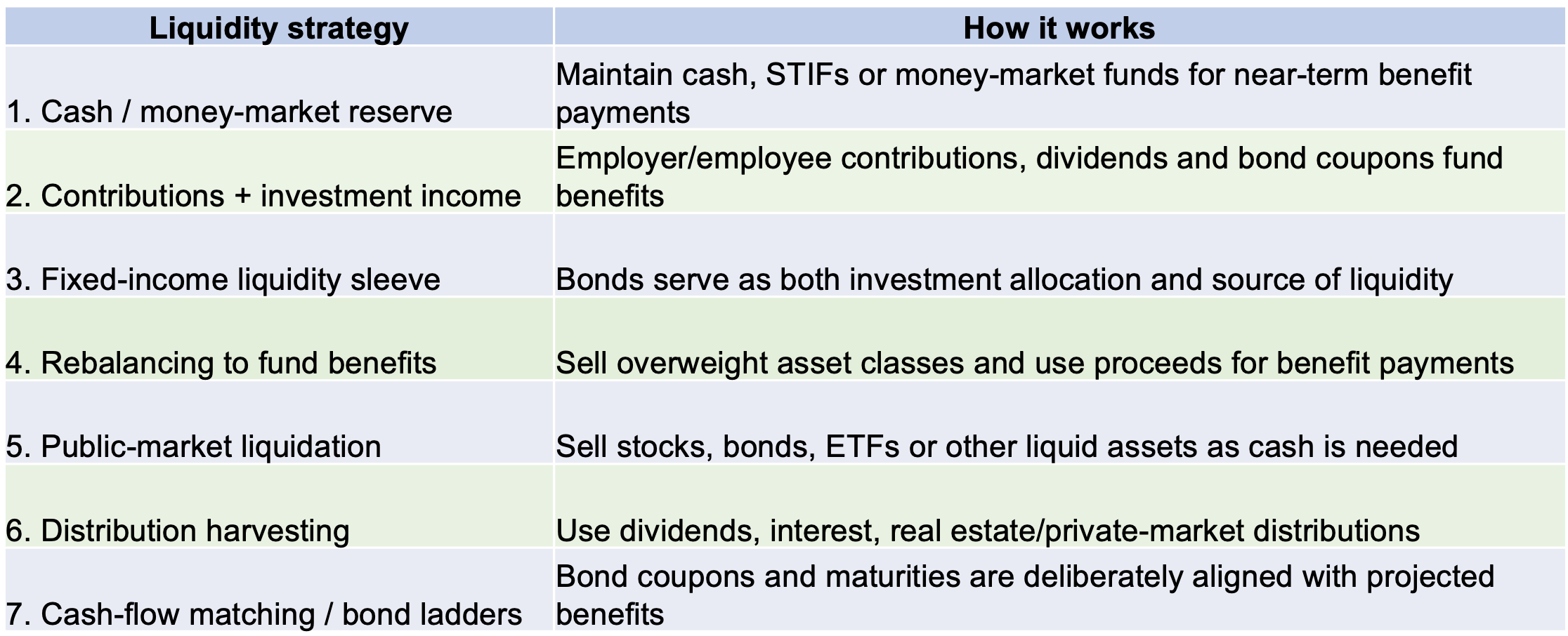
Dividing a pension plans asset allocation into two buckets – liquidity and growth – as opposed to having the plan’s assets focused on the return on asset (ROA) assumption can mitigate liquidity risk. Use a cash flow matching (CFM) strategy to ensure that the necessary liquidity (asset cash flows of interest and maturing principal from bonds) is available to meet the liability cash flows of benefits and expenses monthly. While the CFM strategy is SECURING the promised benefits, the remainder of the assets can just grow unencumbered – no forced selling.

Who knows how long this conflict in the Middle East will last. Pension plans may be “long-term” investors, but they have short-term cash needs that must be met. There is no kicking the can down the road. Adopt this bi-furcated asset allocation and enjoy the benefits that come from the knowledge that your promises have been secured.

Milliman: Corporate Pension Funding now at 109.4%

By: Russ Kamp, CEO, Ryan ALM, Inc.

Milliman has released the latest monthly report on the Milliman 100 Pension Funding Index (PFI). As a reminder, this index analyzes the 100 largest U.S. corporate pension plans.

For February, the PFI funded ratio rose from 109.1% as of January 31, to 109.4% as of February 28, marking the highest collective funded ratio since the 109.9% mark observed in July 2001. However, the funding improvement was solely a result of asset performance, as declining discount rates of 14 basis points reduced the discount rate to 5.33% and raised the PFI projected benefit obligation (liabilities) to $1.235 trillion. Fortunately, monthly returns of 2.15% offset the impact of falling U.S. interest rates leading to growth in the market value of plan assets by $22 billion, to $1.351 trillion.

“February’s investment performance drove the month’s $5 billion gain in funding levels,” said Zorast Wadia, author of the Milliman PFI. He went on to say that “while this marks 11 straight months of funding improvements, further declines in interest rates may occur, and ongoing market volatility makes it vital for plan sponsors to undertake surplus-management strategies focused on both sides of the balance sheet.” We continue to support Zorast in recommending that managing assets to liabilities is critical for DB pension plans in all market environments, but especially given the significant uncertainty under which markets are currently operating. As a reminder, the primary objective in managing a DB pension is to SECURE the promised benefits at a reasonable cost and with prudent risk. It is NOT a return objective.

We, at Ryan ALM, do not forecast interest rates, but the impact of rising oil prices (WTI currently up 30.7% as of 9:13 am EST since Friday) will likely have an impact on inflation and interest rates. It will be interesting to see if a potential fall in the value of liabilities proves greater than the potential impact that rising rates might have on equity markets and other assets. Will we see the 12th consecutive month of improved funding levels?

Please click on the link below for a look at the complete Milliman corporate pension funding report.

View this month’s complete Pension Funding Index.

ARPA Update as of February 27, 2026

By: Russ Kamp, CEO, Ryan ALM, Inc.

Welcome to March and all the “madness” that comes with it!

Regarding ARPA and the PBGC’s implementation of this critical pension legislation, last week proved to be fairly quiet, and I imagine it will continue to be so, as the PBGC works through the remaining applications currently under review (14) and those that will likely be resubmitted (25). Quiet, unless some action is taken on the 80 plans sitting on the waitlist that were terminated by mass withdrawal prior to 2020.

During the past week there were no applications approved or denied, no pension plans were asked to repay a portion of their SFA and no pension funds asked to be added to the waitlist.

In other news, there was one revised application filed. Bricklayers Local No. 55 Pension Plan, a non-priority group member, is seeking $6.4 million for its 483 members. The PBGC has 120-days to review and approve the application before it is automatically accepted. The only other news of note related to two pension funds that withdrew applications. Non-priority group member, Retail Bakers’ Pension Trust Fund of St. Louis, withdrew its initial application. They’d been seeking $5.7 million for 566 plan members. Warehouse Employees Union Local 169 and Employers Joint Pension Plan, another non-priority group member, withdrew an already revised application in which they were hoping to secure $77.8 million for 3,609 plan participants.

The uncertainty related to action in Iran has U.S. Treasury yields rising across the Treasury yield curve as inflation concerns once again come into focus. Rising rates are challenging for bond investors unless a cash flow matching (CFM) strategy has been used. As a reminder, CFM will secure the promised benefits (and expenses, if desired) for as long as the SFA allocation lasts. As a reminder, those B&E are future values which are not interest rate sensitive. Importantly, higher interest rates will create more cost savings related to those future promises for pension plans still waiting to receive their SFA.

New Jersey’s Pension System’s “High” Investment Return

By: Russ Kamp, CEO, Ryan ALM, Inc.

As a taxpaying resident in New Jersey and a huge supporter of defined benefit plans who has a daughter in the system, I was happy to read that NJ’s pension systems generated strong investment returns in fiscal year 2025, reporting a nearly 11% return. Terrific. Yet, despite the above target return (7.0% ROA), the impact on the system’s funded status was negative. Yes, the funded ratio improved (assets/liabilities), but the funded status further deteriorated (funding gap in $s). Since the system is striving for 7% and the combined funded ratio of the various plans is <50%, a system like NJ’s would need to double the annual return on asset target just to keep the $ deficit stable.

It is great to see that NJ is finally bringing some financial discipline to the management of its pensions, with contributions at least matching the Actuarial Determined Contribution (ADC), but after decades of failing to do so (I think since Washington slept here), the systems are in need of significant funding improvement. Trying to generate outsized gains through a riskier asset allocation is not a long-term winning formula, often leading to greater annually required contributions when markets behave badly and assets get whacked.

The management of DB pension plans is not rocket science if the basics of sound pension management are followed. For instance, plans receiving the full ADC have on average an 80% funded ratio, while those not receiving the full ADC sit with funded ratios <70% (NCPERS study). Plans sitting with funded ratios below 50% are not likely to create enough excess return relative to the annual ROA to be able to close the funding gap. This often leads to plans making difficult decisions such as creating plans with multiple tiers, which I really despise.

Plans should focus on meeting the ADC, securing the promised benefits in the near-term, which buys time for the growth or alpha assets to perform, and reduce costs of administration, including management fees. DB plans are critical to the creation of a dignified retirement. Having a significant percentage of our seniors lacking the financial wherewithal to remain active in our economy is a major problem with long-term implications.

Good Question!

By: Russ Kamp, CEO, Ryan ALM, Inc.

We occasionally post questions received in reaction to our blogs in new blog posts since many of our readers might have similar thoughts/ideas. In reaction to yesterday’s post, “All-time High Funded Ratio” a reader calling themselves LoudlyObservant (great name) stated the following:

Why wouldn’t such well-funded plans take steps to lock in the funding of their beneficiary payments through a cash flow matching portfolio? Isn’t the first fiduciary duty of loyalty expressed in controlling the relevant risk to the beneficiaries, which involves BOTH securing adequate assets and then actually funding the payments? Many of these plans have hit the first goal but are still exposed to funding risk. With a ready solution at hand, the plan sponsors open themselves to criticism for not acting on their second responsibility.

Thank you, Loudly! Great questions and observations. We often talk about the fact that pension plans at all funding levels need liquidity, not just well-funded plans, but when you have a universe of plans that on average are fully funded, why not dramatically reduce risk. We witnessed what happened to DB pension plans at the end of 1999, when most plans were well overfunded only to see the funded status plummet and contribution expenses explode following two major market corrections.

I’m neither smart enough nor is my crystal ball better than anyone else’s to know if a major market correction is on the horizon but why take the chance unnecessarily. We’ve seen a significant percentage of Special Financial Assistance (SFA) recipients engage in cash flow matching to secure the SFA assets and the benefits that they will protect. Why not adopt CFM for the legacy assets, too? As we’ve mentioned, we are providing a service to you and your plan participants. It isn’t just another product. Time to get off the proverbial rollercoaster of returns and secure the promises and your plan’s funded status.