What Do You Need?

By: Russ Kamp, CEO, Ryan ALM, Inc.

We are now nearly through the first half of 2026. That doesn’t seem possible. Despite the very uncertain economic and geopolitical environment, U.S. equities continue to march higher, especially for stocks associated in any way with AI. As a result, I suspect that a number of plan sponsors/trustees will say that they only need for those good times to keep rolling. But is that possible given current valuations? On the other hand, perhaps you are a sponsor/trustee that believes that nothing grows to the heavens, and as a result you might be looking to take a little risk out of your current asset allocation. If so, I have a suggestion. But first, here are a few questions that I’d like you to consider:

  • How is your fund’s current liquidity profile?
  • If raising the necessary monthly liquidity is challenging, how would you like a strategy that provides the liquidity you need, net of contributions, each month chronologically as far out as the strategy’s allocation will take you?
  • Given current equity valuations, how would you like an extended investing horizon that buys time for your fund’s alpha assets to wade through potentially choppy near-term markets without fear of forced selling to meet benefits and expenses?
  • How does reducing investment management fees sound?
  • How would you like to stabilize contribution costs and the funded ratio?
  • The investment strategy that I am referring to brings an element of certainty to the management of pensions that sorely lack that today. How does that sound?
  • How do you think your participants would appreciate knowing that their promised benefits are SECURED for the period that your new strategy covers?
  • Interest rates are the greatest threat to a fixed income (bond) investment program. How would you like a strategy that is not impacted by changes in U.S. interest rates?

Come on Kamp, is there really an investment strategy that can secure the benefits, buy time for the residual assets to just grow unencumbered, lower investment fees, eliminate interest rate risk, and provide the liquidity that I’ll need to pay my monthly bills? There sure is! For regular readers of this blog, you likely know that I’m referring to Cash Flow Matching (CFM) as the investment strategy.

This bond product carefully matches the asset cash flows of principal and interest with the liability cash flows of benefits and expenses. By doing so, the benefits are secured for the length of the program. We have assignments from 3-years to 30-years. We’ve just bought time for the assets not engaged in CFM to wade through any ugliness in markets without fear of liquidation to meet monthly payouts. Furthermore, we are matching future values which are not interest rate sensitive. A $1,000 benefit payment next month is $1,000 whether rates are at 2% or 10%. Finally, we provide our investment management services at attractively low rates.

We also provide a free analysis to any sponsor who’d like to know how CFM could benefit their fund. We’ll produce a CFM portfolio that will help you understand the potential cost reduction in the value of those future benefit promises. In today’s rate environment, we can produce portfolios that reduce the future cost of providing benefits by roughly 2% per year. Ask us to cover the next 10-years and the savings becomes very attractive and meaningful. We are ready when you are!

The Benefit of Higher U.S. Interest Rates

By: Russ Kamp, CEO, Ryan ALM, Inc.

Rising interest rates can often create stresses in an economy and within the capital markets. They certainly make financing big ticket items more painful. They can destabilize equity markets, although it seems as if the current equity market is immune to any risk at this time. They harm most fixed income managers/strategies, as rising rates lower the present value of their bonds.

However, rising rates are GREAT for cash flow matching (CFM) strategies, as the higher rates reduce the cost of those future pension promises (benefit payments). We were recently asked by a public pension fund to provide them with an analysis of what CFM could potentially do for them in this environment. They provided us with the requisite data – projected benefits, expenses, and contributions as far into the future as possible – which we then ran through our cost optimization model that we call the Liability Beta Portfolio (LBP).

The output is compelling! We can secure this fund’s net (after contributions) liabilities (all of them!) through September 30, 2053. The future value (FV) of those liabilities is $86.2 million. However, the plan needs to set aside only $50.1 million in present value (PV) assets to defease those liabilities with certainty. The $36.1 million cost reduction is locked in on the day that the portfolio is created. That “savings” equates to a cost reduction of 41.9%!

So, this plan sponsor can now SECURE pension payments for 27-years. The residual assets not needed in the CFM portfolio can now grow unencumbered. If I were them I’d just buy a S&P 500 ETF creating considerable savings from lower management fees and far less complexity. Furthermore, the plan sponsor now knows what contributions will look like for the next nearly three decades. They won’t have to be alarmed should markets suffer a deep and extended correction, as the assets AND liabilities will move in lockstep.

By the way, these benefits were achieved without taking substantial risk, as our process only uses investment-grade corporate bonds rated BBB+ or better. Defaults, which are the only risk within the strategy, have been 0.2% (2/1000 bonds) annually for the last 40-years according to S&P.

Why use CFM? The benefits are incredible, including; certainty, security, all the necessary liquidity, an extended investing horizon, lower management fees, stable contributions, and improved sleep! If these benefits sound attractive to you, provide us the same info that our public fund prospect did (see above) and we’ll provide you with a free analysis, too. We are confident that you’ll be as blown away as they were and the many clients that we are proud to support.

Bonds as Performance Drivers? No, Sir!

By: Russ Kamp, CEO, Ryan ALM, Inc.

U.S. fixed income benefitted tremendously from the nearly 4-decade decline in interest rates. From 1981 through 2021, the U.S. enjoyed a significant collapse in bond yields helping to fuel an unprecedented rally in risk assets. However, as Bob Dylan said, “the times they are a changin”!

The U.S. Federal Reserve’s FOMC announced on March 16, 2022, that the new Fed Fund’s target would be 0.25%-0.5% beginning on St. Patrick’s day 2022. This action marked the beginning of a rate regime change resulting from Covid-19 implications, including abundant stimulus creating massive demand for goods and services that couldn’t be met as production/manufacturing activities were disrupted.

The U.S. Fed Fund’s rate would eventually rise to 5.25%-5.50% in July 2023 (following 11 rate increases). Today, the Fed Fund’s rate stands at 3.5%-3.75%. For context, the average Fed Fund’s rate since 1971 is 5.39%, which includes a peak of nearly 20% in December 1980, and ultimately 0% in December 2008, in reaction to the GFC. It would once again hit 0% during Covid.

As a result, bond investors, such as pension plans, have ridden a rollercoaster of performance. Performance looked terrific for much of the nearly 40-year bull market but has been challenging since the Fed’s initial action in 2022. In fact, the Aggregate Index (Lehman, Barclays, Bloomberg, etc.) has produced only a 3.3% return for 20-years through March 2026. It is worse if you look at shorter timeframes, as the Index was up only 1.7% for 10-years, 0.3% for 5-years, and -0.1% YTD (all through March 31, 2026).

For pension plan sponsors and their advisors who are reluctant to utilize cash flow matching (CFM) as it might harm the pension plan’s ability to achieve the ROA, those performance #s above should be a wake-up call! As a reminder, the YTM of a CFM portfolio is a good proxy for what the fund will achieve for the period that liabilities are defeased. Given that Ryan ALM, Inc. is currently generating a YTM of 5.02% for a client with a 30-year defeasement and a 4.6% YTM for another with a 10-year CFM mandate, which result do you think is more harmful to the pension plan?

Furthermore, the CFM portfolio’s return is not predicated on the direction of interest rates, as it very much is with active core fixed income strategies. Importantly, CFM provides all the liquidity needed to meet the monthly benefit payments without having to sell assets, perhaps at inappropriate times. By cash flow matching bond principal and interest income with the plan’s liability cash flows (benefits and expenses), CFM secures the pension promises and reduces the FV cost (with certainty) of those obligations in the process. For the client with the 30-year CFM mandate, we are reducing future funding costs by -31.1% and for the 10-year CFM program, we have reduced funding cost by -28.0%.

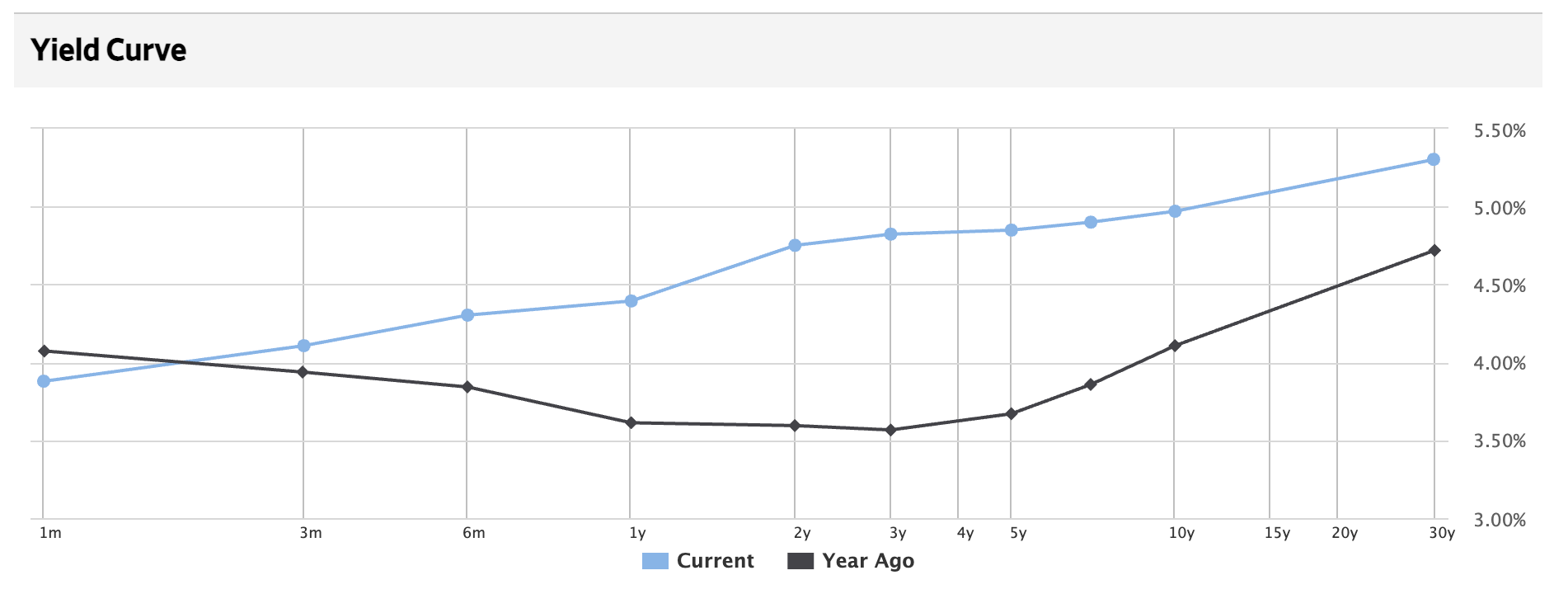
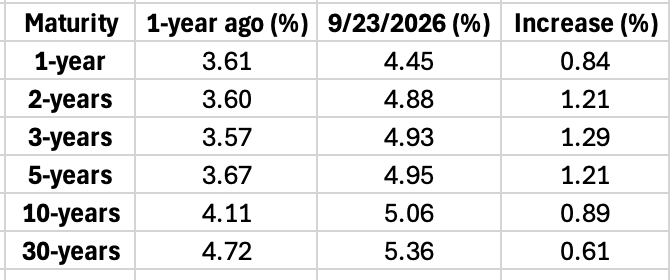
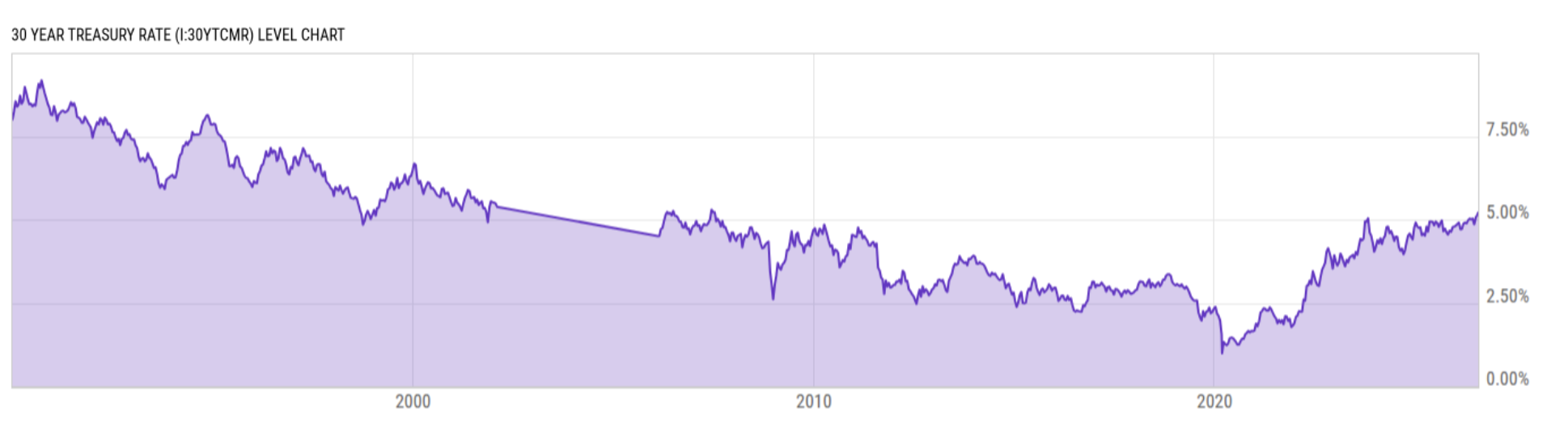
Where are we today? After a brief respite, U.S interest rates are once again trending higher, as greater inflation takes hold. Who knows where inflation and interest rates will eventually land, but a pension plan (or E&F) could benefit tremendously in this environment by engaging Ryan ALM, Inc. and our CFM capability. The 30-year Treasury bond yield history below highlights the rising rate environment. As a reminder, Ryan ALM builds CFM portfolios using investment-grade corporate that have yields substantially higher than comparable Treasury maturities.

So, I ask: Why sit with active fixed income and subject your plan’s bond allocation to the whims of an unknown interest rate environment when you can SECURE the pension promise with near certainty (absent any defaults)? Wouldn’t it be wonderful to know that your liquidity needs are all set for some prescribed period? Wouldn’t your plan participants want to know that the promises given have been secured? Now is the time to bring an element of certainty to the management of pension assets that doesn’t currently exist. Given the geopolitical uncertainty and the potential impact on inflation, rates, and other markets, creating funding certainty should be priority #1. Why isn’t it?

Unique Liabilities Require A Unique Solution

By: Russ Kamp, CEO, Ryan ALM, Inc.

Most pension plans have exposure to fixed income. Perhaps not as much as they did prior to 2000, but today’s common thinking is that the current exposure is enough to act as a buffer should equity markets not continue along this momentum fueled path, and finally, to support the monthly liquidity needs of the fund. But are those the right reasons to use bonds and what type of fixed income should be used to accomplish those objectives?

We observe that most funds use a variety of investment grade bonds (Treasuries, Agencies, Corporates, etc.) and they have that collection benchmarked to a generic index such as the Bloomberg U.S. Aggregate Index (a.k.a. the Agg). As a reminder, the Agg was created by Ron Ryan when he was Head of Research at Lehman Brothers a few years ago. But, again, is this the right approach? We at Ryan ALM, Inc. believe that bonds should only be used for their cash flows (principal and interest) and not as a performance driver. Bonds are perhaps the only asset class with a known cash flow equal to the value at maturity (PAR) and contractual interest payments. Those known cash flows can be modeled to meet the plan’s ongoing liability cash flows (benefits + expenses). 

Which brings me to the point that every pension plan’s liabilities are unique, and as such, no generic index such as the Agg could possibly match a plan’s liabilities. If the asset cash flows don’t match and fund the liability cash flows (benefits and expenses), the plan is subject to unnecessary interest rate risk. Again, given that every pension plan has a unique set of liabilities this would suggest that each pension plan needs to have an investment strategy created specifically for their cash flow needs. Cash Flow Matching (CFM) is an investment strategy with a very long and successful history. An appropriately crafted CFM portfolio will meet and fully fund chronologically the liability cash flows as far into the future as the allocation to the CFM strategy lasts.

We take great pride in our proprietary CFM optimization modeling, which we began using at Ryan ALM’s founding in 2004. Having the ability to tailor unique solutions to client specific issues/requests is a hallmark of our firm, and this capability is being recognized throughout the industry. In fact, we recently received this feedback from an ALM expert at a large asset/liability consulting firm, who stated that I’m “impressed with the team’s ability to build portfolios for such non-standard cashflow streams.” Thank you!

We’d be happy to demonstrate our capability and we’re always willing to provide a free analysis highlighting how your fund could benefit through CFM and Ryan ALM’s expertise. Just call us.

Is Now Really the Time to Buy Stocks?

By: Russ Kamp, CEO, Ryan ALM, Inc.

U.S. equity markets enjoyed a robust April despite myriad economic and geopolitical inputs that might have given investors pause. Should equity investors remain bullish at this time? The graph below caught my attention primarily because of the recent disconnect between the two lines related to the Shiller Excess Cape Yield (ECY) and subsequent 10-year Real Return for equities. There are many, many valuation tools that claim to provide clues about the future direction of stocks, and this is such an example. Those tools can be short-, medium-, and long-term in nature. The ECY happens to be one valuation metric that provides “guidance” for longer time frames. The current reading of 1.60% certainly looks rich relative to its long history.

In case you don’t know, the Shiller excess CAPE yield is a valuation measure that compares the stock market’s earnings yield with the “real” yield on the 10-year Treasury note. In simple terms, it asks how much extra return stocks may offer over inflation-adjusted government bonds.

How it is calculated

  • Take the inverse of the CAPE ratio, which is the market’s “earnings yield.”
  • Subtract the real 10-year Treasury yield.

So, ECY=(1/CAPE)10-year real Treasury yield

A higher excess CAPE yield suggests stocks might look more attractive relative to bonds. A lower reading suggests the equity risk premium is thinner, meaning stocks offer less return versus bonds. As mentioned above, current readings show the S&P 500 Shiller Excess CAPE Yield around 1.60% for April 2026, which is well below its long-term average of 4.60%. Another data source put it at 1.41 as of April 30, 2026.

Investors have historically used the ECY as a long-term asset allocation tool, especially when comparing stocks with Treasury bonds. It is not a short-term trading signal, but rather a rough guide to whether equities look cheap or expensive relative to real bond yields. A CAPE yield below 2% has generally signaled subdued future equity returns over the next 5 to 10 years, providing a valuation warning sign, and not an exact measure.

As a reminder, there are many valuation techniques used to identify opportunities and risk when investing in U.S. equities. Depending on a pension plan’s liquidity needs, funded ratio, willingness to take risk, etc. today’s current environment may be providing an opportunity to reduce risk by trimming equities and using the proceeds along with core fixed income assets to establish a cash flow matching mandate. In the process, the plan’s liquidity is improved, promised benefits secured, and the investing horizon extended for the residual assets. Give us a call. We are always willing to provide a free analysis showcasing how CFM can help your fund.

Pension Plan Sponsor: “I Wish that I could…”

By: Russ Kamp, CEO, Ryan ALM, Inc.

In October, I will celebrate my 45th year in the pension/investment industry. I’ve been truly blessed, but also frustrated by activities that I deem detrimental to the successful management of DB pension plans.

First and foremost, I believe that a majority of folks think that achieving the return on asset assumption (ROA) is the primary objective in managing a DB pension plan. This is an incorrect assumption! Creating an asset allocation targeted at a return only guarantees annual volatility, and NOT success.

Second, meeting monthly liquidity through the sweeping of interest, dividends, capital distributions, and worse, the selling of investments harms the long-term return of your fund.

Third, using core fixed income as a return generator is not a sound strategy, as bonds are highly interest rate sensitive, and who knows the future direction of rates.

That being said, if I were a pension plan sponsor, I’d wish that I could find an investment strategy that provided: All of the plan’s liquidity needs, certainty for a portion of that plan, and a longer investment horizon for my alpha generating assets (non-bonds) so that I enhance the probability of achieving the desired outcome.

Great news – there is such a strategy. Cash Flow Matching (CFM) is designed to use investment-grade bonds for their cash flows of interest and principal (upon maturity) to match liability cash flows of benefits and expenses for as far out as the allocation goes. Furthermore, it extends the investing horizon for the non-bond assets so that they can wade successfully through choppy markets without being a source of liquidity. Finally, there is an element of certainty (minus that rare occurrence of an IG bond default) absent in the management of DB pension plans outside of a pension risk transfer (PRT) or an annuity.

I believe that the primary objective in managing a DB pension plan is to SECURE the pension promise at low cost and with prudent risk. Does focusing on the ROA secure benefits – no. The “sweeping” of dividends, interest, and capital distributions to meet ongoing liquidity needs can negatively impact the plan’s long-term return. Guinness Global (U.K. investment shop) produced a study that said sweeping dividends and not reinvesting them reduced the return to the S&P 500 by 47% over 10-year periods back to 1940 and 57% for 20-year periods.

Finally, bonds are highly interest rate sensitive. After a nearly 40-year decline in U.S. interest rates which drove bond prices up and yields down, we have seen rates rise to more average levels where they are holding leading to very weak fixed income returns for recent performance periods. Matching asset cash flows with liability cash flows eliminates interest rate risk for that portion of the portfolio, as benefits and expenses are future values that are not interest rate sensitive. Furthermore, Ryan ALM’s approach is to use 100% IG corporate bonds to build the CFM portfolio. A 100% IG portfolio will outperform a core active fixed income portfolio by the yield differential given the core portfolio’s exposure to agencies and Treasuries.

Question: If you had the opportunity to bring some certainty to the management of pensions, why wouldn’t you do it? If not, please share with us why not.

March Proves Challenging for Core Fixed Income

By: Russ Kamp, CEO, Ryan ALM, Inc.

March was a difficult month for active core fixed income managers, as the Bloomberg U.S. Aggregate Index fell -1.8%. Uncertainty related to the impact of the Iran War on oil prices and subsequently inflation, pushed rates higher across the Treasury yield curve. The U.S. 10-year Treasury note saw yields rise 38 bps to 4.31%.

Agencies fell -1.7% in line with Treasuries, while the Corporate sector declined -2.0%. Corporate spreads ended March with an option adjusted spread (OAS) of 88.6 bps. The best performing Corporate sector was Financials (-1.7%), while Utilities performed worst at -2.2%.

The greatest risk managing bonds is interest rate risk. Given both geopolitical (Iran, Taiwan, Ukraine) and economic risks (oil, inflation, interest rates), now is the time to significantly reduce risk within your fund, whether that be a DB pension or E&F. Why continue to ride active fixed income through these uncertain markets? One can use a cash flow matching (CFM) strategy to SECURE and fund net liabilities chronologically well into the future. In the process, interest rate risk is eliminated as future benefits and expenses are not interest rate sensitive.

Furthermore, by securing near-term liabilities, the non-bond assets can now grow unencumbered providing more time to wade through these challenging times. I have no idea how long this conflict will last. I also don’t know how much damage has occurred and that which might still happen to oil production in the Middle East. Implementing a strategy that doesn’t rely on forecasting U.S. interest rates should be a high priority today.

Making the switch is easy. Rotate your current core fixed income assets from an active investment strategy to a CFM portfolio. There isn’t a need to revisit the fund’s asset allocation. We’ll even look for opportunities to take-in-kind some of your existing holdings. You’ll appreciate not having to search each month for the liquidity to meet the monthly promises that have been made to your participants, as the CFM strategy will provide all the liquidity that you need. Moreover, the Ryan ALM CFM model is skewed to A/BBB+ corporate bonds which should outyield most generic bond indexes that are skewed to Treasuries (e.g. the AGG).


What is My Funded Ratio? Who Cares!

By: Russ Kamp, CEO, Ryan ALM, Inc.

The funded ratio of a DB pension plan gets a lot of attention, especially if it is perceived to be weak. But does the funded ratio truly tell you the whole story as to the financial health of a DB pension plan? We, at Ryan ALM, Inc. don’t think so.

So, how is the funded ratio calculated:

Funded ratio = MV of plan assets / plan liabilities earned to date X 100

The market value of assets is a present value (PV) calculation. The market value of liabilities is the future value of liabilities earned to date discounted back to a PV calculation based on a discount rate. For public and multiemployer plans the discount rate tends to be the fund’s return on asset assumption (ROA), while it is an AA corporate blended rate for private pensions. In today’s interest rate environment, the discount rate for private plans will be roughly 1.5% less than the discount rate based on the average ROA. That means that liabilities for private funds will have a greater current value than the value of liabilities calculated based on the discount rate using the ROA. Oh, okay, so the choice of a discount rate can change my funded ratio. That’s interesting. So that tells me that if I wanted to improve my funded ratio, all I’d have to do is increase my discount rate to lower the PV of my liabilities. That’s very interesting.

So, it appears that the funded ratio calculation can be manipulated to some extent. As we think about the formula above, is there anything missing? Yes, where are the future contributions, which can be significant. Why are future payment liabilities in the calculation, but projected contributions, which are future assets of the fund, not included? Common thinking suggests that those future contributions aren’t guaranteed, which is why they aren’t factored into the funded ratio calculation. However, is that a correct assumption? In doing some research, it appears >80% of DB pension funds receive 100% of the annual required contribution (ARC). Even NJ’s public pension system is making the ARC and then some.

We recently had a conversation with a large plan sponsor who thought that their fund was <50% funded based on the formula above. Not surprisingly, they were very focused on this ratio and looking for investment strategies that could potentially enhance it. As an FYI, this plan’s future contributions as forecasted by their actuary were significant. In fact, future contributions were so large that they were equal to 73% of the forecasted liabilities! Yes, without including the pension fund’s current assets, this plan was 73% funded, provided those projected contributions were met which they have been for more than a decade.

So, given these forecasted contributions is that pension fund really <50% funded?

In another example, the same fund that thought that they were poorly funded, could defease net pension liabilities for the next 33-years. How is it possible that a plan that believes it is <50% funded able to significantly reduce risk, enhance liquidity, and SECURE pension promises for 33-years? Furthermore, this fund was going to establish a $4.4 billion surplus on the day that those benefits and expenses were defeased for 33-years. If it just earned the projected ROA, that $4.4 billion would grow to $34.2 billion during that 33-year period. Wow! 

So, I ask once more, does that sound like a plan in financial distress, which a funded ratio of <50% might suggest? NO!

The funded ratio is but one measure of a pension plan’s health. Unfortunately, many in our industry would look at that # and say that more risk needs to be taken to achieve “full funding” down the road, when in fact reducing risk through a cash flow matching (CFM) strategy is the appropriate approach. It is past the time to get off the scary asset allocation rollercoaster. 

DB Pension Plan “Absolute Truths” Revisited

By: Russ Kamp, CEO, Ryan ALM, Inc.

This post may be familiar to some of you, as I originally published it in October 2024. Given today’s great uncertainty related to geopolitics, markets, and the economy, I thought it relevant to share once again. Please don’t hesitate to reach out to me if you want to challenge any part of this list. We always welcome your feedback.

The four senior members at Ryan ALM, Inc. have collectively more than 160 years of pension/investment experience. We’ve lived through an incredible array of markets during our tenures. We have also witnessed many attempts on the part of Pension America to try various strategies to meet the promises that have been made to the pension plan participants.

Regrettably, defined benefit (DB) pension plans continue to be tossed aside by corporate America in favor of defined contribution (DC) plans. Both public and multiemployer plan sponsors would be wise to adopt a strategy that seeks more certainty to protect and preserve these critically important retirement vehicles before they are subject to a similar fate.

We’ve compiled a list of DB pension “Absolute Truths” that we believe return the management of pension plans back to its roots when SECURING the promised benefits at a reasonable cost and with prudent risk was the primary objective. The dramatic move away from the securing of benefits to the arms race focused on the return on asset assumption (ROA) has eliminated any notion of certainty in favor of far greater variability in likely outcomes.

Here are the Ryan ALM DB Truths:

  • Defined Benefit (DB) pension plans are the best retirement vehicle!
  • They exist to fulfill a financial promise that has been made to the plan participant upon retirement.
  • The primary objective in managing a DB plan is to SECURE the promised benefits at a reasonable cost and with prudent risk.
  • The promised benefit payments are liabilities of the pension plan sponsor.
  • Liabilities need to be measured, monitored, and managed more than just once per year.
  • Liabilities are future value (FV) obligations – a $1,000 monthly benefit is $1,000 no matter what interest rates do. As a result, they are not interest rate sensitive.
  • Pension inflation is not equal to the CPI but a rate unique to each plan sponsor.
  • Best way to hedge pension inflation is through Cash Flow Matching (CFM) since inflation is in the actuarial projections
  • Plan assets (stocks, bonds, real estate, etc.) are present value (PV) or market value (MV) calculations. We do not know the FV of assets except for bonds cash flows (interest and principal at maturity).
  • To measure and monitor the funded status, liabilities need to be converted from FV to PV – a Custom Liability Index (CLI) is absolutely needed.
  • A discount rate is used to create a PV for liabilities – ROA (publics), ASC 715 (corps), STRIPS, etc.
  • Liabilities are bond-like in nature. The PV of future liabilities rises and falls with changes in the discount rate (interest rates).
  • The nearly 40-year decline in US interest rates beginning in 1982 crushed pension funding, as the growth rate for future liabilities far exceeded the growth rate of assets.
  • The allocation of plan assets should be separated into two buckets – Liquidity (beta) and Growth (alpha).
  • The liquidity assets should consist of a bond portfolio that matches (defeases) asset cash flows with the plan’s liability cash flows (benefits and expenses (B&E)).
  • This task is best accomplished through a CFM investment process.
  • The liquidity assets should be used to fund B&E chronologically buying time for the alpha assets to grow unencumbered in their quest to meet those faraway future liabilities not yet defeased by the liquidity assets.
  • The Growth assets will consist of all non-bonds, which can now grow unencumbered, as they are no longer a source of liquidity. Growth assets will fund those remaining future liabilities not yet defeased by the liquidity assets.
  • The Return on asset (ROA) assumption should be a calculated # derived through an Asset Exhaustion Test (AET)
  • The pension plan’s asset allocation should be responsive to the plan’s funded status and not the ROA.
  • As the funded status improves, port alpha (profits) from the Growth portfolio into the Liquidity bucket (de-risk) extending the cash flow matching assignment and securing more promises.
  • This de-risking ensures that plans don’t continue to ride the asset allocation rollercoaster leading to volatile contribution costs.
  • DB plans are a great recruiting and retention tool for managing a sponsor’s labor force.
  • DB plans need to be protected and preserved, as asking untrained individuals to fund, manage, and then disburse a “benefit” through a Defined Contribution plan is poor policy.
  • Unfortunately, doing the same thing over and over and over is not working. A return to pension basics is critical.

You’ve made a promise: measure it – monitor it – manage it – and SECURE it…   

Get off the pension funding rollercoaster – sleep well!

Eliminate the Uncertainty

By: Russ Kamp, CEO, Ryan ALM, Inc.

There are many benefits to using Cash Flow Matching (CFM) for your pension plan, endowment or foundation. The obvious benefit is the liquidity that is created to meet ongoing expenditures, whether benefit payments or grants. That liquidity comes at a premium today for many entities that have migrated significant financial resources to alternative investments, which are having a difficult time providing their investors with capital distributions.

The other significant benefit is the certainty that comes from using CFM. I’ve appreciated the opportunity to speak at NCPERS, IFEBP, LATEC, and OPAL in the last few months and in each case, I asked the audience if there was any investment strategy within their fund that brought certainty? Not a single hand was raised. They could have mentioned cash reserves as an example, but that is an expensive long-term strategy because of the low short-term yields available today.

The cloud of uncertainty under which we live is not comfortable! Yes, both pension funds and E&Fs are long-term investors, but the riding of markets up and down often leads to a significant increase in the contributions necessary to maintain their funding. That activity is not helpful to anyone. Who knows what will transpire as our country navigates through several potential geopolitical landmines. Combine that reality with uncertain economic growth, weaker labor markets, sticky inflation, and equity valuations that seem stretched, and markets could be in for a rocky period.

Wouldn’t it be a blessing to have CFM in place that not only provides the necessary liquidity so that assets aren’t forced to be sold at less than opportune times, but a strategy (service) that provides certainty since your obligations (liability cash flows) are matched with asset cash flows of bond principal and interest income for as far out as the bond and cash allocation will provide. It isn’t often that we are presented with an investment strategy that is truly a sleep-well-at-night offering for the long term. 

As a reminder, humans hate uncertainty, as it impacts us in both psychological and physiological ways. Yet, in the management of pensions and E&Fs, sponsors have wholeheartedly embraced uncertainty. The disconnect is quite surprising. Again, I don’t know what will transpire in markets today, tomorrow, or next year. I don’t know how the Iran situation will impact shipping lanes and the price of oil and inflation or worse, destabilize the entire region by bringing into the conflict Iran’s friends, such as Russia and China. I’m not a gambler and I don’t believe that managers of pension assets should be either.

I think it is critically important to SECURE the promises given to your plan’s participants and to achieve that objective with low cost and prudent risk. Riding the asset allocation rollercoaster accomplishes neither objective. Now’s the time to act. Not after markets have been rocked.