Pension Plan Sponsor: “I Wish that I could…”

By: Russ Kamp, CEO, Ryan ALM, Inc.

In October, I will celebrate my 45th year in the pension/investment industry. I’ve been truly blessed, but also frustrated by activities that I deem detrimental to the successful management of DB pension plans.

First and foremost, I believe that a majority of folks think that achieving the return on asset assumption (ROA) is the primary objective in managing a DB pension plan. This is an incorrect assumption! Creating an asset allocation targeted at a return only guarantees annual volatility, and NOT success.

Second, meeting monthly liquidity through the sweeping of interest, dividends, capital distributions, and worse, the selling of investments harms the long-term return of your fund.

Third, using core fixed income as a return generator is not a sound strategy, as bonds are highly interest rate sensitive, and who knows the future direction of rates.

That being said, if I were a pension plan sponsor, I’d wish that I could find an investment strategy that provided: All of the plan’s liquidity needs, certainty for a portion of that plan, and a longer investment horizon for my alpha generating assets (non-bonds) so that I enhance the probability of achieving the desired outcome.

Great news – there is such a strategy. Cash Flow Matching (CFM) is designed to use investment-grade bonds for their cash flows of interest and principal (upon maturity) to match liability cash flows of benefits and expenses for as far out as the allocation goes. Furthermore, it extends the investing horizon for the non-bond assets so that they can wade successfully through choppy markets without being a source of liquidity. Finally, there is an element of certainty (minus that rare occurrence of an IG bond default) absent in the management of DB pension plans outside of a pension risk transfer (PRT) or an annuity.

I believe that the primary objective in managing a DB pension plan is to SECURE the pension promise at low cost and with prudent risk. Does focusing on the ROA secure benefits – no. The “sweeping” of dividends, interest, and capital distributions to meet ongoing liquidity needs can negatively impact the plan’s long-term return. Guinness Global (U.K. investment shop) produced a study that said sweeping dividends and not reinvesting them reduced the return to the S&P 500 by 47% over 10-year periods back to 1940 and 57% for 20-year periods.

Finally, bonds are highly interest rate sensitive. After a nearly 40-year decline in U.S. interest rates which drove bond prices up and yields down, we have seen rates rise to more average levels where they are holding leading to very weak fixed income returns for recent performance periods. Matching asset cash flows with liability cash flows eliminates interest rate risk for that portion of the portfolio, as benefits and expenses are future values that are not interest rate sensitive. Furthermore, Ryan ALM’s approach is to use 100% IG corporate bonds to build the CFM portfolio. A 100% IG portfolio will outperform a core active fixed income portfolio by the yield differential given the core portfolio’s exposure to agencies and Treasuries.

Question: If you had the opportunity to bring some certainty to the management of pensions, why wouldn’t you do it? If not, please share with us why not.
The Proof’s in the Pudding!

By: Russ Kamp, Managing Director, Ryan ALM, Inc.

Not sure why I used the title that I did, but I recently had pudding (vanilla) over the holiday weekend, so maybe that inspired me, and boy, was it good! That said, we, at Ryan ALM, Inc., are frequently challenged about the benefits of Cash Flow Matching (CFM) versus other LDI strategies, most notably duration matching. There seems to be singular focus on interest rate risk without any consideration for the need to create the necessary liquidity to meet monthly benefit payments. Given that objective, it isn’t surprising that duration matching strategies have been the dominant investment strategy for LDI mandates. But does that really make sense?

Are duration matching strategies that use an average duration or several key rate durations along the Treasury curve truly the best option for hedging interest rate risk? There are also consulting firms that espouse the use of several different fixed income managers with different duration objectives such as short-term, intermediate, and long-term duration mandates. Again, does this approach make sense? Will these strategies truly hedge a pension plan’s interest rate sensitivity? Remember, duration is a measure of the sensitivity of a bond’s price to changes in interest rates. Thus, the duration of a bond is constantly changing.

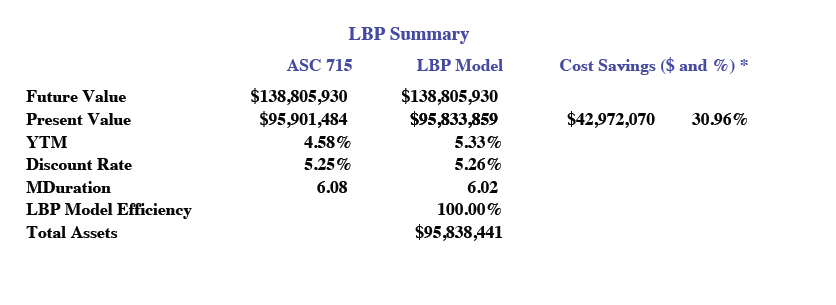
We, at Ryan ALM, Inc., believe that CFM provides the more precise interest rate hedge and duration matching, while also generating the liquidity necessary to meet ongoing benefits (and expenses (B&E)) when needed. How? In a CFM assignment, every month of the mandate is duration matched (term structure matched). If we are asked to manage the next 10-years of liabilities, we will match 120 durations, and not just an “average” or a few key rates. In the example below, we’ve been asked to fund and match the next 23+ years. In this case, we are funding 280 months of B&E chronologically from 8/1/24 to 12/31/47. As you can see, the modified duration of our portfolio is 6.02 years vs. 6.08 years for liabilities (priced at ASC 715 discount rates). This nearly precise match will remain intact as US interest rates move either up or down throughout the assignment.

Furthermore, CFM is providing monthly cash flows, so the pension plan’s liquidity profile is dramatically improved as it eliminates the need to do a cash sweep of interest, dividends, and capital distributions or worse, the liquidation of assets from a manager, the timing of which might not be beneficial. Please also note that the cost savings (difference between FV and PV) of nearly 31% is realized on the day that the portfolio is constructed. Lastly, the securing of benefits for an extended time dramatically improves the odds of success as the alpha/growth assets now have the benefit of an extended investing horizon. Give a manager 10+ years and they are likely to see a substantial jump in the probability of meeting their objectives.

In this US interest rate environment, where CFM portfolios are producing 5+% YTMs with little risk given that they are matched against the pension plan’s liabilities, why would you continue to use an aggressive asset allocation framework with all of the associated volatility, uncertainty, and lack of liquidity? The primary objective in managing a pension plan is to SECURE the promised benefits at a reasonable cost and with prudent risk. It is not an arms race designed on producing the highest return, which places most pension plans on the asset allocation rollercoaster of returns.

ARPA Update as of May 24, 2024

By: Russ Kamp, Managing Director, Ryan ALM, Inc.

I hope that you enjoyed a long, restful weekend. Our thoughts and prayers are with all of the US service men and women who gave the ultimate sacrifice to enable the rest of us to continue to enjoy our freedom.

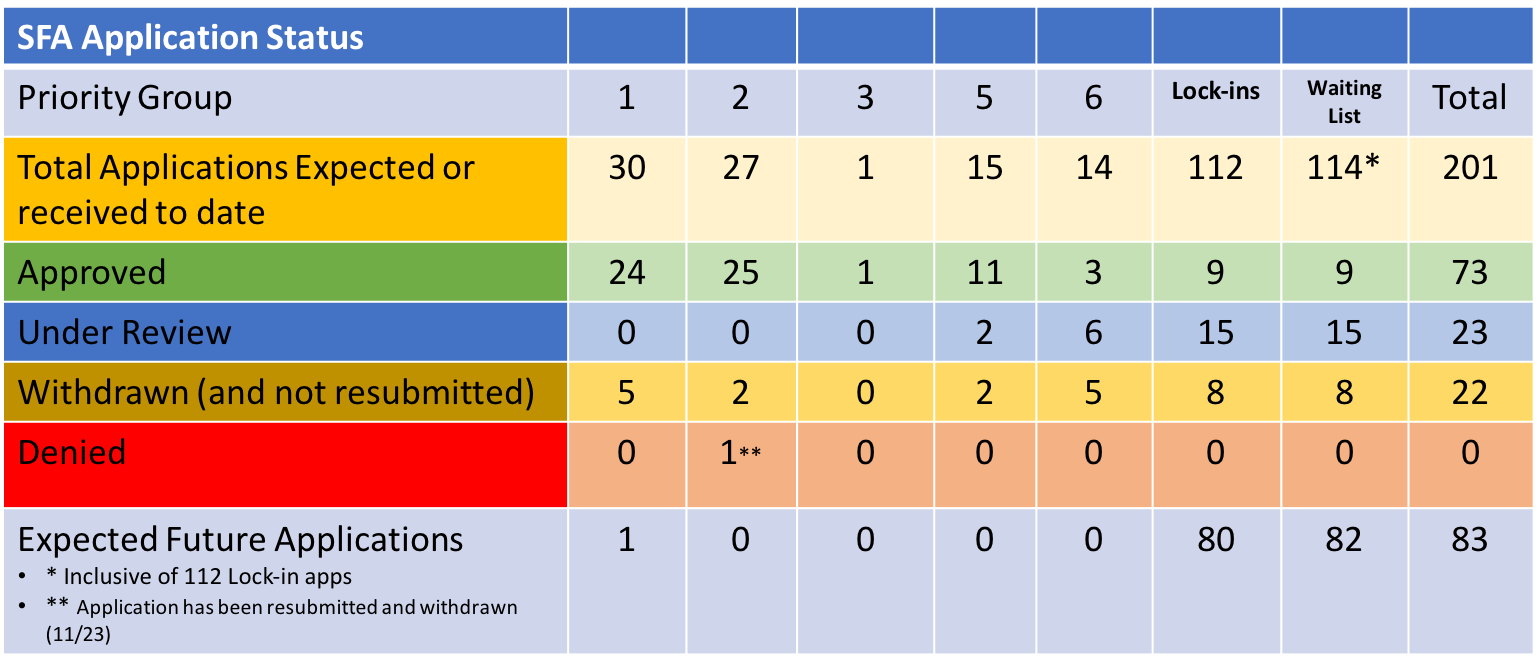
With respect to the ARPA legislation and the PBGC’s yeoman effort to implement, there was some activity last week. In fact, there were three plans that filed applications and one that received approval. Local Union No. 226 International Brotherhood of Electrical Workers Open End Pension Trust Fund, Local 1783 I.B.E.W. Pension Plan, and the Pressroom Unions’ Pension Plan each filed its initial application45 last week seeking SFA. The three plans are non-priority group members and in total they have asked for $127.4 million for just over 3,400 plan participants.

Happy to report that the UFCW Regional Pension Fund received approval for its application. The non-priority fund will receive $54.5 million, including interest, for its 4,605 participants. This bring the # of approved applications to 73 and a total of $52.2 million in final SFA amount approved including interest and FA loan repayments. There was no other activity report including applications denied, excess SFA repaid, plans added to the waitlist or plans on the waitlist setting a lock-in date for valuation purposes.

There is the possibility that 128 additional plans may receive SFA before the legislation expires. This total includes those under review, those plans that have withdrawn and not refiled, and finally, those plans on the waitlist that have yet to file the initial application.

How “Real” Will the Fed Get?

By: Ronald J. Ryan, CEO, Ryan ALM, Inc.

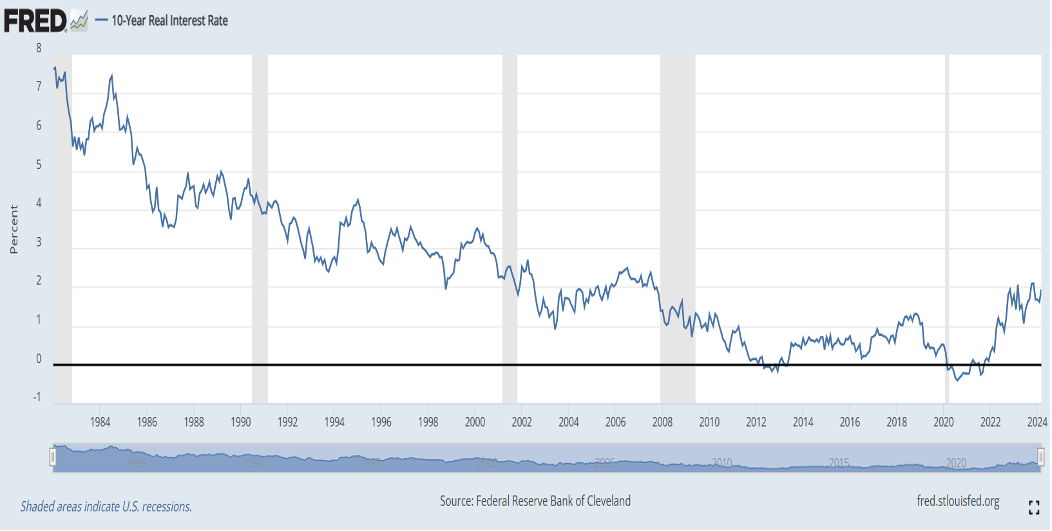
Chairman Powell and the Fed have consistently said they want real rates. The Fed primarily focuses on the Personal Consumption Expenditures (PCE) as their gauge of inflation. Currently the PCE is at 2.7%. What the Fed has not said is the target level of real rates. Historically, real rates as measured by the St. Louis Fed have averaged about 3.0% although the trend line has decreased steadily since the 1980s (see graph below). With the PCE at 2.7% today a 2% to 3% real rate would suggest a 4.70% to 5.70% 10-year Treasury nominal rate. With the 10-year Treasury at 4.66% today, it would seem that there is no reason for any cut in rates by the Fed. In fact, there may be more reason to increase rates.

The question remains… where will inflation (as measured by the PCE) level off? Who knows since there are too many factors to consider. The major causes of inflation today seem to be:

  1. Excessive Government Spending

Biden 2025 budget of $7.3 trillion is 12.3% higher than the 2024 budget of $6.5 trillion. Jamie Dimon, CEO of JP Morgan Chase, warns that excessive deficit spending is inflationary and that interest rates could spike up to 8%. The Biden Administration Student Loan forgiveness package could increase the deficit by $430 billion if successful.

  • Oil Prices

       West Texas Intermediate (WTI) Crude oil prices are up over 19% in 2024.

  • Red Sea Attacks

About 12% of global trade goes through here to the Suez Canal. Ships now have to be rerouted around southern tip of Africa creating a delay of about two weeks at a cost of $3,786 per vessel or about $1 million per week. According to Drewry World Container Index costs are up over 90% YoY.

  • Francis Scott Key Bridge Collapse

One of the largest ports in America handling $80 billion in cargo annually. Estimated closure costs = $15 million per day with closure expected for two to three years.

As always, the motto “let the buyer beware” (Caveat Emptor) seems to apply here.

Market Volatility Giving You The Woollies?

I’ve witnessed many market declines during my more than 33 years in the investment industry, and I would be lying if I told you that I called the beginning, end, and ultimate magnitude of any of the sell-offs.  Market declines are part of the investing game.  But just knowing that isn’t enough, as unfortunately, they can have a profound impact on retirement plans and retirement planning, both institutional and individual, as they impact the psyche of the investors.

It is well documented how individuals tend to buy high and sell low. The market crash of 2007 – 2009 drove many individuals out of equities at or near the bottom, and many of those “investors” have kept their allocations to equities below 2007 levels. It hasn’t been that much better for the average institutional investor either.  We are aware of a number of situations (NJ for one) that plowed into expensive, absolute-return product at the bottom of the equity market only to see that portfolio dramatically underperform very inexpensive beta, as the equity markets have rallied since March 2009.

In some cases, the selling “pressure” was the result of liquidity needs, which lead to the tremendous explosion in the secondary markets for private equity, real estate, etc. in 2009.  The E&F asset allocation model, made so famous by Yale, was the undoing for many retirement plans, as the failure to secure adequate liquidity exacerbated market losses. Who knows whether the turmoil in Greece will lead to their exit (expulsion) from the Euro, but there is certainly heightened fear and volatility in the global markets? Are you currently prepared to meet your liquidity needs?

As we’ve discussed within both the Fireside Chats and on the KCS blog, the development of a hybrid asset allocation model geared specifically to your plan’s liabilities, can begin to de-risk your plan, while dramatically improving liquidity.  The introduction of the beta / alpha concept will provide plan sponsors with an inexpensive cash matching strategy that meets near-term benefit needs, while extending the investing horizon for the less liquid investments in your portfolio. By not being forced to sell into the market correction, your investments have a greater chance of rebounding when the market settles.

Traditional asset allocation models subject the entire portfolio to market movements, while the beta / alpha approach only subjects the alpha assets to volatility.  But, since one doesn’t have to sell alpha assets to meet liquidity needs given that the beta portfolio is used for that purpose, the volatility doesn’t matter. Don’t fret about Greece and its potential implications for the global markets and your plan. Let us help you design an asset allocation that improves liquidity, extends the investment horizon for your alpha assets, and begins to de-risk your plan, as the funded ratio and status improve.

Double DB presented on Fox Business today

Double DB presented on Fox Business today

I had the pleasure to represent the Double DB pension alliance on Fox Business today.  We introduced the Double DB plan in a conversation with Adam Shapiro.  We hope that you find our conversation enlightening.  Ed Friend, Ron Ryan, Barry Gillman and KCS are looking forward to fielding your questions.  Enjoy!