Just Because You Can, Doesn’t Mean…

By: Russ Kamp, CEO, Ryan ALM, Inc.

On Wednesday of this week, I produced a blog post highlighting the dramatic improvement in the Pension Benefit Guaranty Corporation’s (PBGC) financials. I questioned why the premiums paid by both private pensions and mutliemployer pensions needed to be so high given the current strength with a >$64 billion surplus. Furthermore, I considered that these premiums have gone from being a necessity to a burden today. That burden is one contributor to DB pension plans continuing to be frozen, terminated, and the liabilities eventually transferred to an insurance company.

Well, wouldn’t you know. Just yesterday I read that the PBGC has raised the premium rates applicable for plan years beginning in 2027, which they announced on Oct. 14. Those rates were increased in accordance with the indexing rules provided in Section 4006 of ERISA. Just because they can raise those premiums based on Section 4006, should they? Here are the details from the PBGC.

Rates for Single-employer Plans

Per-participant rate for flat-rate premiums. The per-participant rate for flat-rate premiums will be $116 for 2027. The increase in this rate for 2027 are comparable to those the PBGC set for 2026 compared to 2025, as well as those it set for 2025 compared to 2024 and for 2024 compared to 2023. And as with those other years, the increases from 2026-2027 are generally substantially below the increases in the rates from 2022 to 2023. For all those years, the PBGC increased this premium by $5 from year to year.

Per-participant cap. The per-participant cap for 2027 is $783, $32 higher than that the PBGC set for 2026. That’s a slightly smaller increase than the $34 increase from 2025 to 2026, but bigger than the $31 increase from 2024 to 2025.

The premium rate per $1,000 in unfunded vested benefits (UVBs). The last time this rate has increased was from 2022 to 2023; since then, it has been $52 and will be at that rate for 2027 as well.

Rates for Multiemployer Plans

The per-participant rate for flat-rate premium for multiemployer plans increased by much smaller amounts and the rate per $1,000 in UVBs for single-employer plans stayed the most stable. The per-participant rate for flat-rate premiums for 2027 will be $42, a $2 increase over the 2026 rate. This PBGC has increased this rate by $1 to $3 ever since 2018.

Indexation

For 2019 and earlier years, the PBGC premium rates and the variable rate premiums (VRPs) were not indexed; from 2020-2023, all premium rates and the VRP cap were subject to indexing. Starting in 2024, indexing of the VRP rate stopped; however, all other premium rates and the VRP cap still are indexed.

Again, just because they can increase rates, does it mean that they should? The PBGC should not be a profit center. Yes, markets go up and down and surpluses can be impacted, but a $64 billion surplus seems extreme, especially if the burden of supporting a DB plan becomes more challenging. We need DB pension plans, as asking the American worker to fund, manage, and disburse a “retirement” benefit through a DC offering is just silly given their lack of disposable income, investment acumen, and NO crystal ball to help with longevity. We can and should do better as a pension industy.
PBGC Premiums: Helpful Or A Burden?

By: Russ Kamp, CEO, Ryan ALM, Inc.

I’ve written often about the demise of the traditional defined benefit pension plan. We’ve gone from a retirement system in which employers provided workers with a monthly benefit for life to one in which employees are increasingly expected to fund, manage, and then disburse their own retirement benefit. There are many reasons for this transformation. But here’s one that deserves much more attention: Have PBGC premiums helped accelerate the demise of the pension plans the PBGC was created to protect?

The Pension Benefit Guaranty Corporation (PBGC) was established by ERISA in 1974 to protect the retirement incomes of participants in private-sector defined benefit plans. That is an incredibly important mission. But protecting pension promises requires pension plans to exist in the first place. Unfortunately, the cost of maintaining a traditional pension has increased dramatically, and I believe that PBGC premiums have become part of that burden.

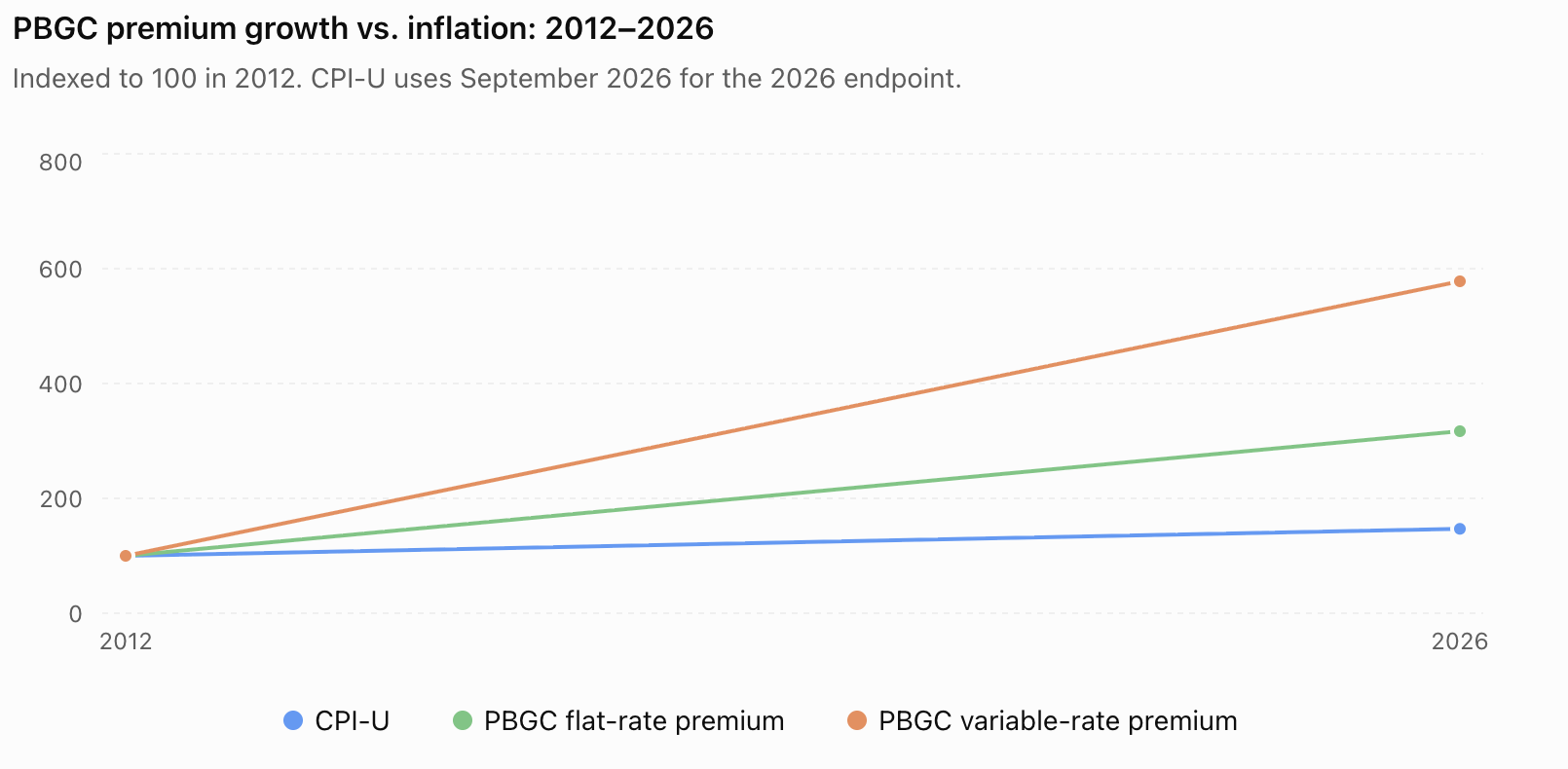
Consider what has happened. In 2012, the flat-rate PBGC premium for a single-employer plan was $35 per participant. By 2026, it is $111. Even more significant is the variable-rate premium assessed on underfunded plans. That charge has risen from $9 per $1,000 of unfunded vested benefits in 2012 to $52 today. In other words, before considering the participant cap, an employer can effectively pay an additional 5.2% annually on its unfunded vested pension liability simply for the privilege of continuing to sponsor the plan.

This image has an empty alt attribute; its file name is image-1.png

Since 2012, consumer prices have risen approximately 47%. Over the same period, PBGC’s flat-rate premium has increased 217%, while its variable-rate premium has increased 478%.

Suppose an employer has $100 million in unfunded vested benefits and isn’t constrained by the per-participant cap. The variable-rate premium alone could theoretically amount to roughly $5.2 million per year. That money doesn’t improve the plan’s funded status. It doesn’t purchase bonds to secure future benefit payments (cash flow matching). It doesn’t generate investment income for the pension trust. And it doesn’t pay a retiree’s monthly pension benefit. It goes to the PBGC.

I’m certainly not suggesting that PBGC premiums are solely responsible for the decline of defined benefit plans. They aren’t. Accounting changes, funding volatility, investment risk, interest-rate movements, longevity risk, regulatory complexity, and the introduction of defined contribution plans have all contributed. Furthermore, the decline in private-sector DB plans began long before today’s higher premiums existed. But those increases have not helped sponsors maintain DB plans.

Interestingly, the PBGC’s single-employer insurance program is no longer in the precarious financial condition that originally helped justify dramatic premium increases. In fact, the PBGC now enjoys a $64.9 billion surplus as of the end of fiscal year 2025, including a $62.2 billion surplus for private pension plans. Wow! Yet employers maintaining DB plans continue to face substantial and ever increasing premiums. We should at least be asking whether those premium levels remain appropriate.

The PBGC was created to protect pension promises. That’s a mission I strongly support. But if the cost of that protection contributes to employers deciding they no longer want to provide those promises, we have a problem worth discussing.

ARPA Update as of September 25, 2026

By: Russ Kamp, CEO, Ryan ALM, Inc.

I hope that those of you in the Northeast weren’t too badly impacted by this weekend’s nor’easter. For those of you who are like me and had no idea what the difference is between a hurricane and a nor’easter, here are three main differences. A nor’easter is an extratropical (non-tropical) cyclone, that is formed through temperature contrasts between warm and cold air masses, and usually hugs the U.S. East Coast or nearby Atlantic ocean. A hurricane is a tropical cyclone, formed over warm water in tropical or subtropical oceans. Lastly, the nor’easter season is generally Fall to early Spring, while hurricane season is June to November.

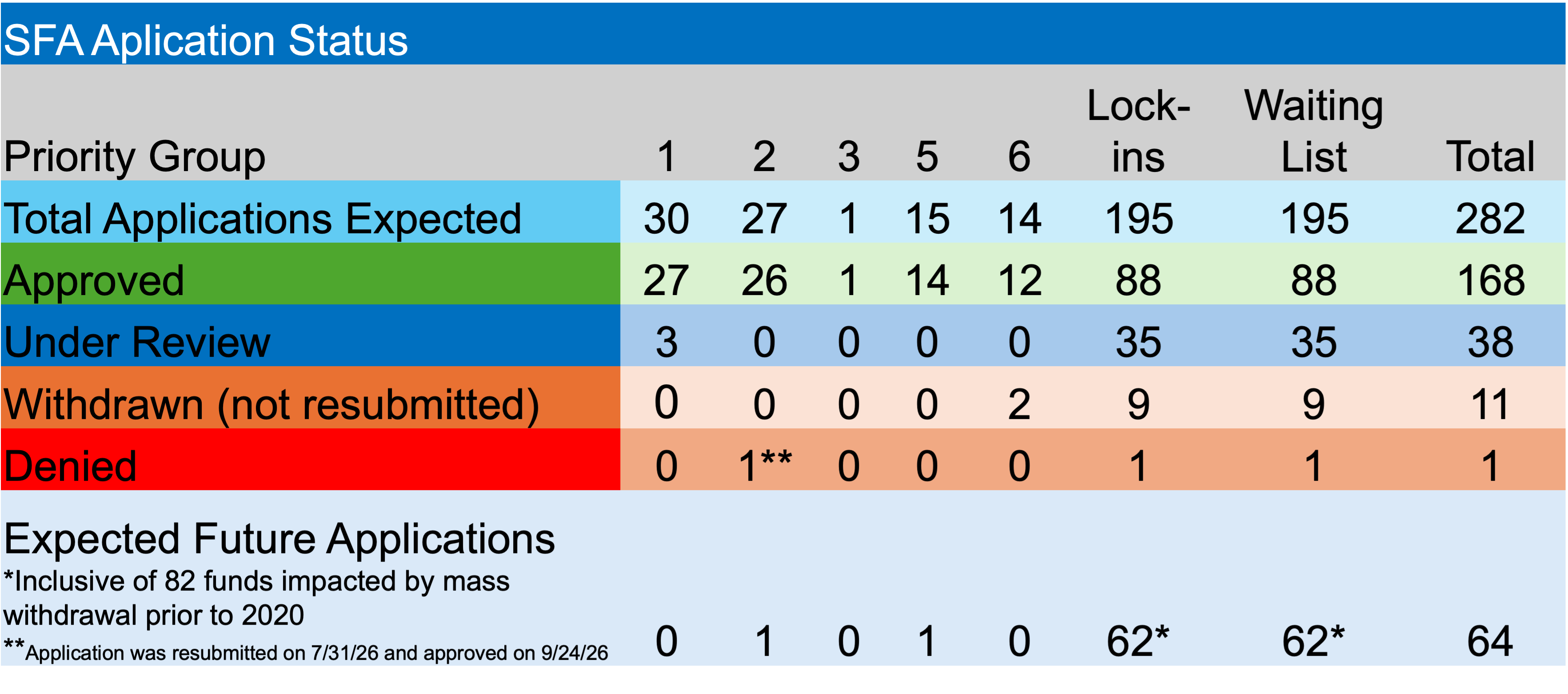
Regarding ARPA and the PBGC’s effort to implement this important legislation, the week wending September 25th was relatively calm, as there was one initial application submitted, one application seeking SFA approved, and another withdrawn. There are currently 38 applications before the PBGC.

Brooklyn, NY-based Production Service and Sales District Council Pension Fund, a non-priority fund, submitted its initial application seeking $92.1 million in SFA for the 3,848 members of the pension fund. As with many of the recently submitted applications, this plan is located in the Second Circuit. On the other hand, Retirement Plan of Local 1102 Retirement Fund, also a non-priority fund, withdrew its initial application in which it sought $3.7 million for the 220 members of that plan.

I’m pleased to report that Bakery Drivers Local 550 and Industry Pension Fund has FINALLY received approval for its application. As you may recall, this plan has been on a merry-go-round in its pursuit of SFA grant money. They were initially denied due to ineligibility back in January 2023. This priority Group two member resubmitted an application in May 2025 only to have that application denied. Well, they must have gotten all their ducks in order, because on September 18, 2026, they were approved for $144.5 million in SFA for its 1,122 participants. Congratulations!

In other ARPA news, there were no plans denied and not others sought to be added to the waitlist.

Timing is everything in life, and for those plans that are about to receive SFA grant assets, their timing couldn’t be better, as U.S. interest rates continue to move higher providing plan sponsors with a great opportunity to secure those promised benefits at substantially reduced future values. Let us know how we can help you.

ARPA Update as of August 28, 2026

By: Russ Kamp, CEO, Ryan ALM, Inc.

Good morning! I hope that you enjoyed the last weekend in August. If you live around NJ, you likely had a top-10 weather day for 2026. It was spectacular.

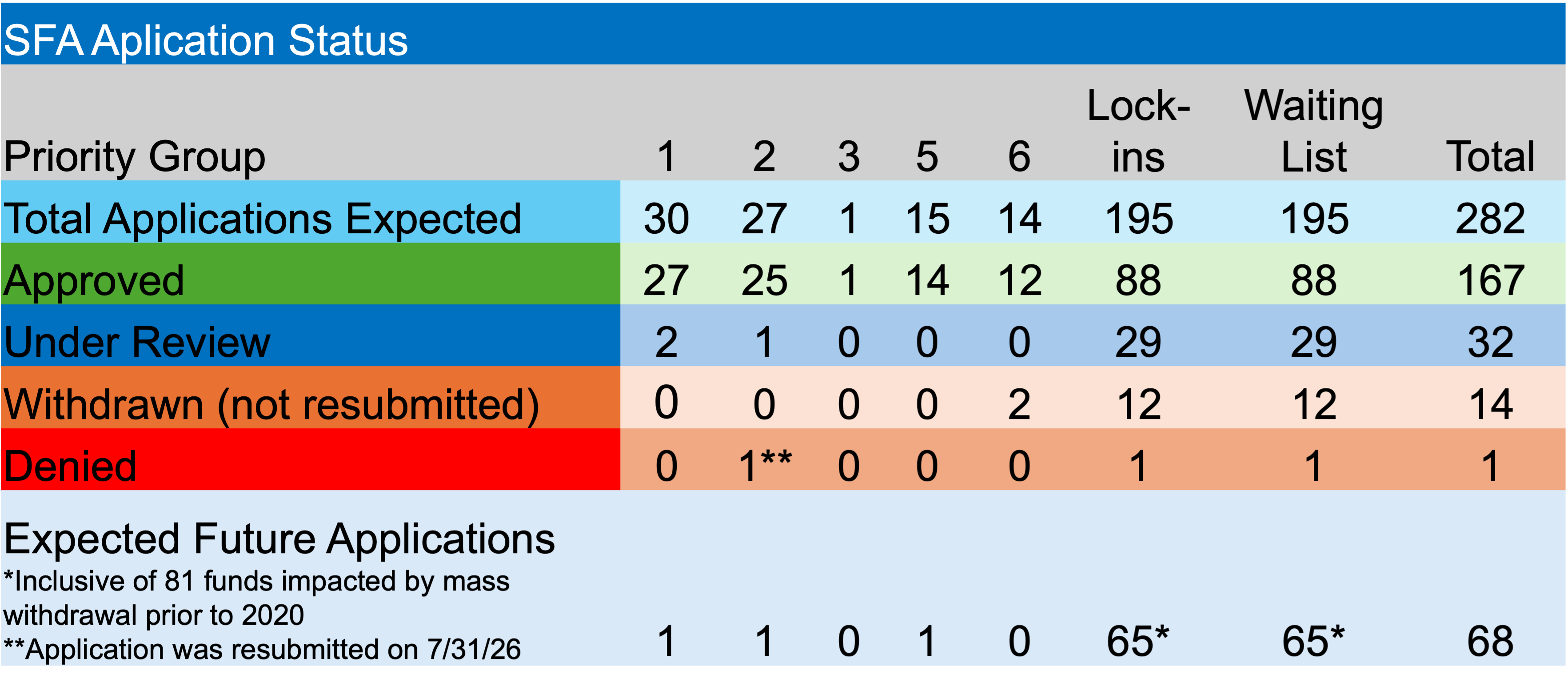
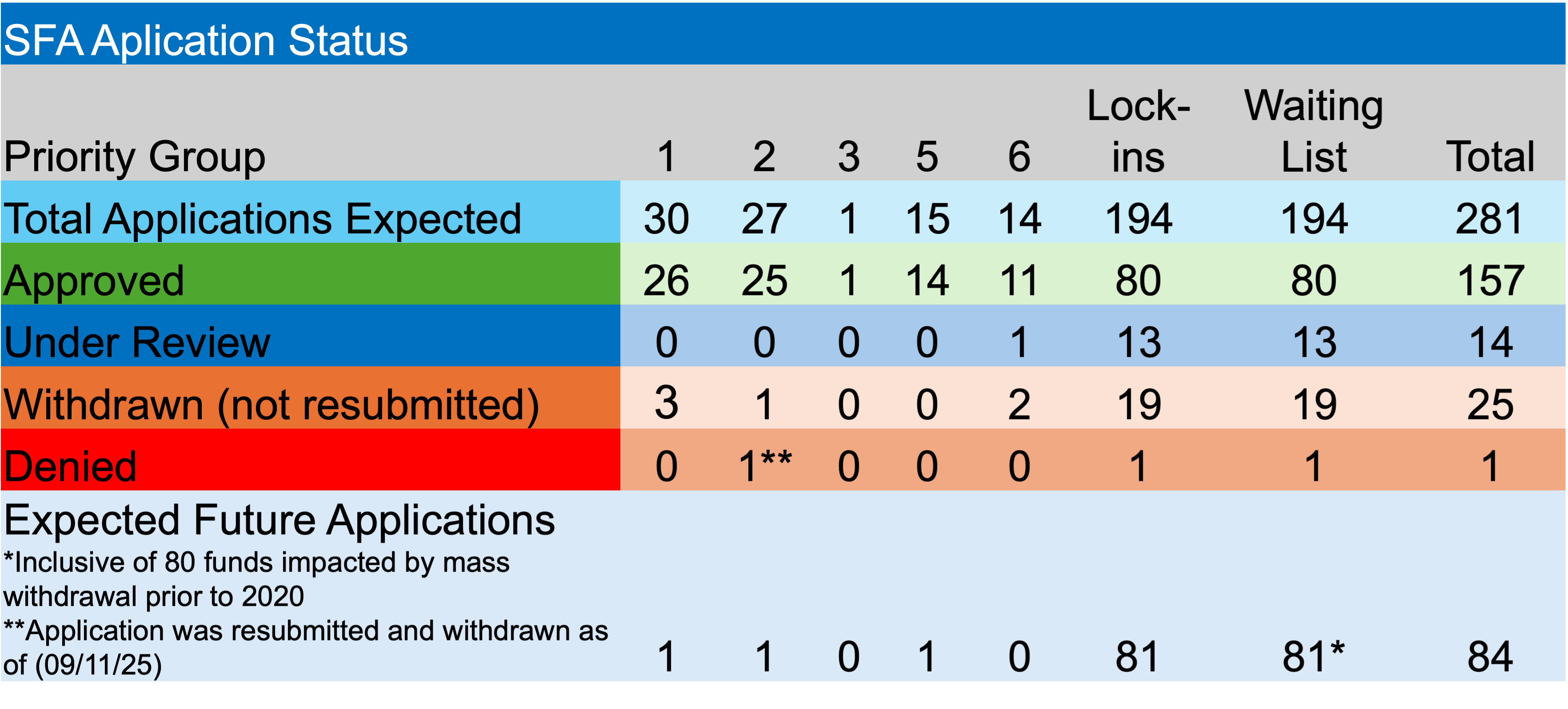
Regarding ARPA and the PBGC’s implementation of this critical pension legislation, the proverbial floodgates have opened, as a plethora of new applications are being reviewed. For much of 2026, the PBGC had between 8-10 applications under review at any point in time. There are currently 32 funds, including many new applications that fall within the Second Circuit related to plans that suffered a mass withdrawal prior to 2020, that are seeking Special Financial Assistance. If those applications are approved, another $1.4+ billion will go to support 63.4k plan participants.

However, there is one wrinkle for which I need to get more info. California Winery Workers’ Pension Plan, Fresno, CA, which is NOT located in NY, CT, or VT, submitted an application on 8/21/26. This is the first non-Second Circuit mass withdrawal plan to submit an application for SFA. We were led to believe that only plans from the three states within the Second Circuit would be permitted to file for SFA. Will this development prove to be a one-off?

In other ARPA news, Retail Bakers’ Pension Trust Fund of St. Louis, a non-priority plan, had its revised application approved. They will receive $6.5 million for the 566 members.

Pleased to report that no applications were denied or withdrawn during the previous week, and one fund, Defined Benefit Plan for the Operative Plasterers’ and Cement Masons’ International Association Local Union 394 Pension Trust Fund, was added to the waitlist, as another mass withdrawal casualty prior to 2020.

Clearly, we have some homework to do to understand the circumstances surrounding the application submitted by the Winery Workers. In the meantime, it is great to see that fourteen Second Circuit plans are now in the queue to potentially receive SFA.

ARPA Update as of August 21, 2026

By: Russ Kamp, CEO, Ryan ALM, Inc.

Welcome to the last full week of August. How is that possible? What does the final third of 2026 have in store for us? Equity investors will hope that the good times roll, while active fixed income managers/investors hope that something changes to stabilize U.S. rates and their near-term prospects. Let’s not forget the mid-terms. The next four months should be quite interesting.

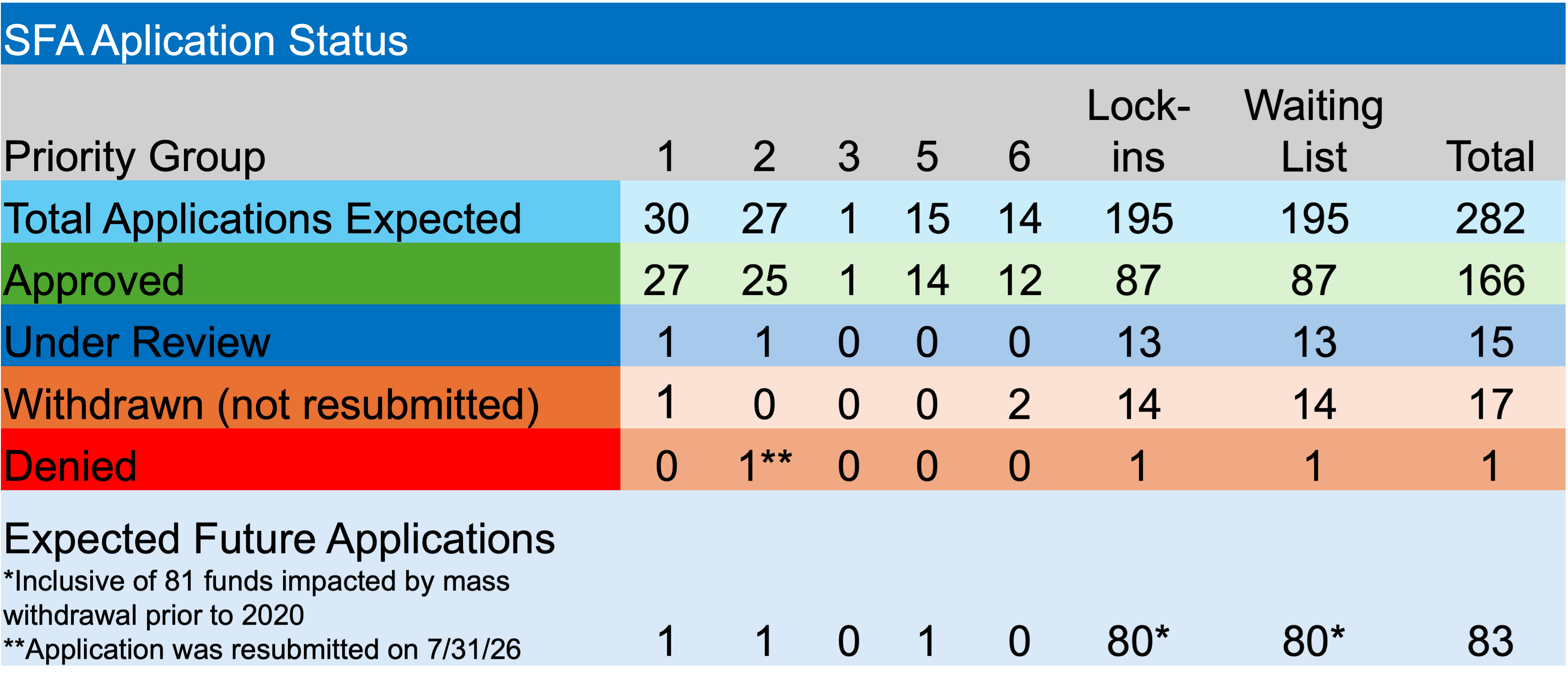
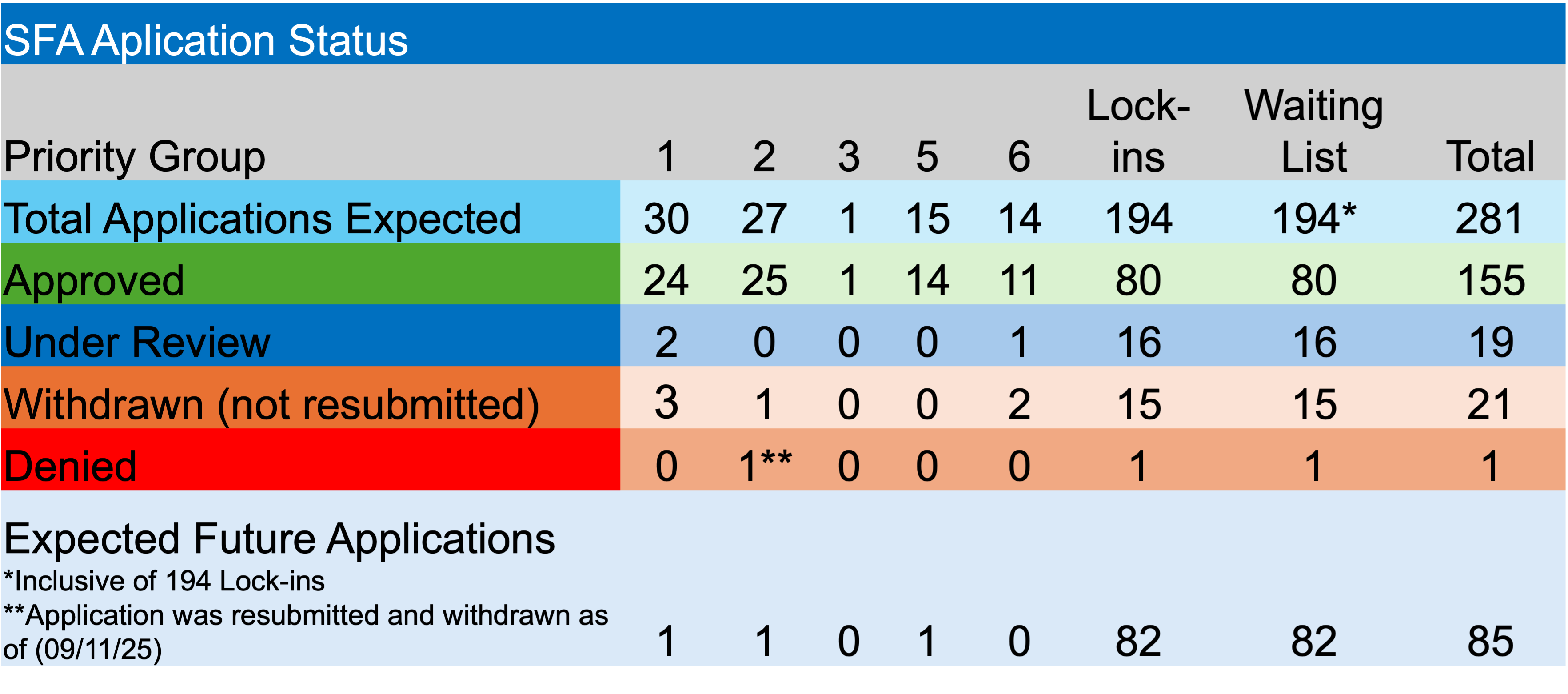
Regarding the PBGC’s implementation of the ARPA pension legislation, last week proved to be busy, as 6 pension funds submitted applications seeking special financial assistance (SFA). One of the five, Bindery Industry Employers GCC/IBT Pension Plan, a Priority Group 1 plan, submitted a revised application. Bindery first submitted an application back in February 2023. They are seeking $18.8 million for 686 members of its plan. The other five applicants are all listed as having been impacted by mass withdrawal prior to 2020. Collectively they are requesting $128.4 million for 3,272 participants. As reported previously, the PBGC is accepting applications from those plans located in the Second Circuit (NY, CT, and VT), and each of these five plans are domiciled in NY.

In other news, there were no plans receiving approval, but there were also no plans being denied based on ineligibility. Furthermore, there were no plans withdrawing an application in the prior week, too.

There remains plenty of work for the PBGC as they currently sit with 19 applications in front of them. The good news for those potential SFA recipients: U.S. interest rates remain inflated providing those plans with the potential to significantly reduce the cost of those future benefits that they will be covering. I implore those plans to secure the promises through a cash flow matching (CFM) implementation. There is so much more downside risk to potential reward by choosing to go active with allocations to both core fixed income and equities.

ARPA Update as of August 14, 2026

By: Russ Kamp, CEO, Ryan ALM, Inc.

This post is being produced on my flight to Chicago, where I will be speaking at the NCPERS conference on Wednesday. Importantly, I will once again be talking about cash flow matching (CFM), but in the context of a successful implementation of the strategy for a defined benefit pension plan. As many recipients of the Special Financial Assistance (SFA) have found, CFM SECURES the promised benefits, while providing the necessary monthly liquidity to meet ongoing benefits (and expenses) chronologically. I hope that you have a great week.

This past week saw revised applications submitted by Building Trades Pension Fund of Western Pennsylvania and Iron Workers’ Pension Trust Fund for Colorado. They are seeking a combined $55.7 million in SFA for their 5,573 participants.

Non-priority group member, Building Trades Pension Fund of Western Pennsylvania, withdrew its revised application. They’d been seeking $39.7 million in SFA for the 3,907 members of their plan.

Happy to report that there were no pension funds denied the opportunity to file an SFA application and none required to refund a portion of the SFA due to census errors. I think that it is safe to assume that we’ve seen the last of the census problems that plagued initial application filers.

You may recall that I mentioned Retirement Plan of Local 1102 Retirement Fund as being the first of the “Mass Withdrawal” plans to be allowed to submit an application. I now have a better understanding of the likely direction that the PBGC will be taking thanks to Rich Hudson, First Actuarial. According to Rich, the PBGC will only allow multiemployer plans located in the Second Circuit (VT, CT, and NY) to submit applications since it was the Second Circuit that ruled that the Plans Terminated by Mass Withdrawal before 2020 Plan Year were eligible to seek SFA provided that met the other requirements. It appears that plans located in the other Circuits – there are 13 U.S. federal Courts of Appeal, including the D.C. Circuit and the Federal Circuit – will not get the opportunity to file before the ARPA legislation concludes at the end of 2026. I’m sure that there will be more on this issue to discuss.

ARPA Update as of March 20, 2026

By: Russ Kamp, CEO, Ryan ALM, Inc.

I’m sure that folks were very (perhaps bitterly) disappointed not to get my weekly update yesterday on the PBGC’s implementation of the ARPA pension legislation. I was traveling for business yesterday, but unlike many travelers, my experience at Newark Airport was shockingly positive. I have heard of 4-6 hour waits to get through security and planes that are forced to leave the gate with as few as 5 passengers. Various estimates put the daily impact of these disruptions at $285 million to $580 million once a 10% reduction in flights occurs.

What about ARPA? As regular readers know, the PBGC has worked through a significant majority of non-mass withdrawal applicants. There remains just one fund – Plasterers Local 79 Pension Plan – that hasn’t gotten to submit an initial application form those on the waitlist. There are still a few pension funds from the original Priority Groups that haven’t filed an initial application seeking SFA.

During the prior week, Cumberland, Maryland Teamsters Construction and Miscellaneous Pension Plan received approval of its revised SFA application. They will receive $9.5 million for their 101 plan members. Congrats!

In other news, there is no other news, as there were no new applications submitted, as the PBGC’s eFiling portal remains temporarily closed. Also, there were no applicants denied, no plans were asked to repay a portion of the SFA, and no applications were withdrawn or added to the waitlist.

The treatment of the 80 plans (from potentially 131) currently on the waitlist that fall under the category of plans suffering mass withdrawal prior to 2020 is the last remaining significant issue that the PBGC must still work through.

U.S. Treasury yields have risen sharply since the beginning of the Iran conflict. As challenging as that development is on existing bond funds, the entry point for SFA recipients wanting to use CFM to secure the benefits and expenses is as good as it has been in more than 1-year. As a reminder, higher yields reduce the cost of those future promises.

ARPA Updated as of March 13, 2026

By: Russ Kamp, CEO, Ryan ALM, Inc.

I’ll be wearing my green tomorrow. How about you? Perhaps the luck of the Irish will carry some weight with the PBGC during the upcoming week, but it didn’t have much sway last week.

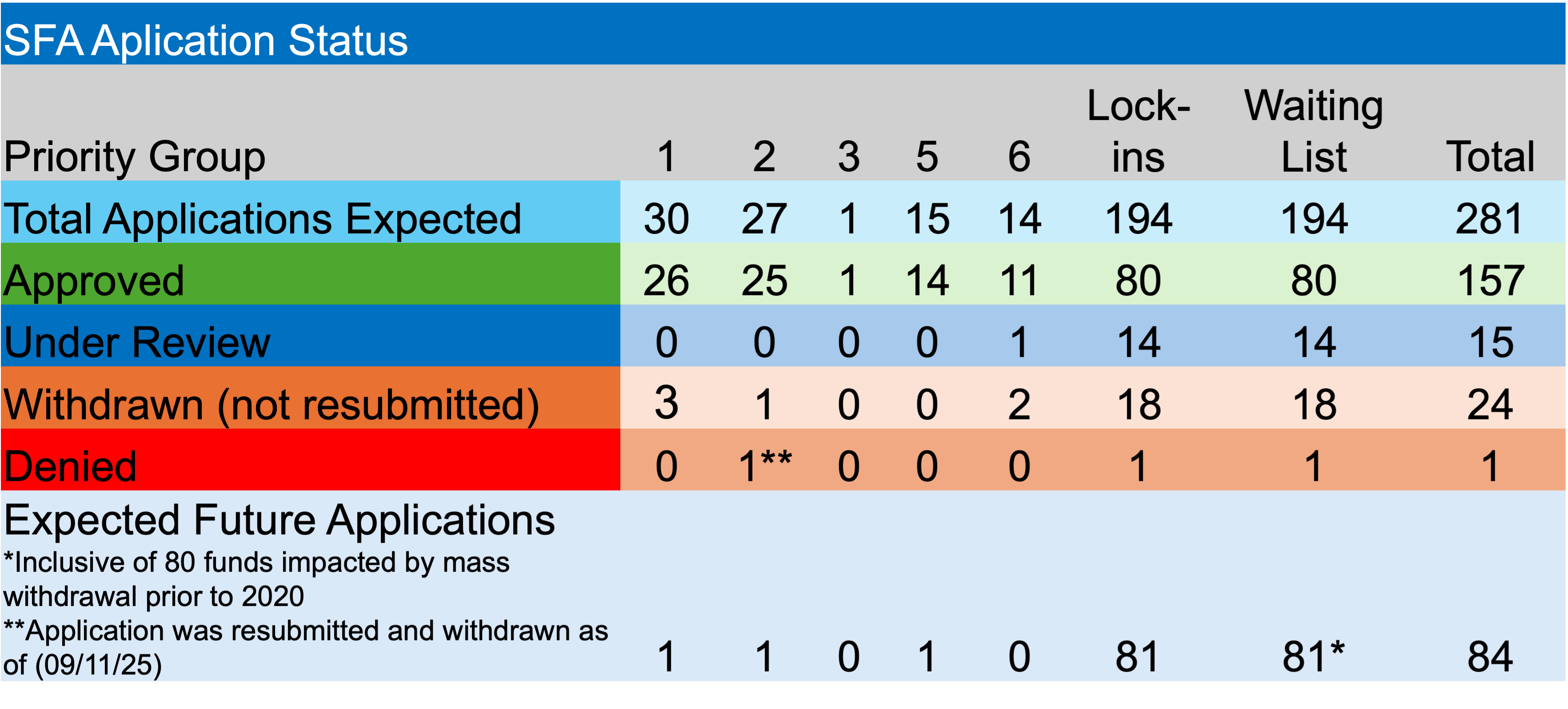
The PBGC accepted two revised applications for Special Financial Assistance (SFA) for the week ending March 13th. Iron Workers Local No. 12 Pension Fund and the Iron Workers-Laborers Pension Plan of Cumberland, Maryland submitted revised applications. Together they are seeking a modest $24.2 million for their 1,413 plan participants. The PBGC will have 120-days to act on the applications.

According to the PBGC’s website, their e-Filing Portal remains temporarily closed. As discussed previously, there is one fund currently on the waitlist that hasn’t submitted an initial application that is not classified as a Plan Terminated by Mass Withdrawal before 2020 Plan Year.

In other ARPA news, there were no applications approved or denied in the past week, and none withdrawn. The PBGC currently has 15 applications under review, including nine that are an initial application. Fortunately, it seems as if any SFA recipient that might have had to repay a portion of the grant due to census issues has done so at this point. There have been no payments of excess funds since last September.

There has not yet been a public, plan‑by‑plan PBGC resolution of the mass‑withdrawal‑terminated plans on the SFA waitlist. As previously mentioned, the legal landscape has changed (2025) which puts pressure on the PBGC oversight. What changed from the original interpretation of “eligible plans” was the Second Circuit’s decision held that the SFA statute does not exclude multiemployer plans that had previously terminated by mass withdrawal, reversing PBGC’s denial of SFA to a fund that terminated in 2016. Furthermore, the court read ARPA’s “critical and declining” language to focus on status in the 2020–2022 window, and rejected PBGC’s position that lack of ongoing “zone status” or prior termination automatically barred eligibility.

As a result, the PBGC’s Office of Inspector General (OIG) issued a 2025 risk advisory flagging that the appellate decision opens the door for 123 terminated plans to seek SFA (80 currently on the waitlist), 91 of which are terminated and insolvent and 32 that are terminated but not yet insolvent and have not received traditional financial assistance.​ The OIG estimates that if SFA is ultimately provided to that group, gross SFA exposure could be on the order of billions of dollars. But, just think about the American Workers that might eventually recoup their promised benefits.

ARPA Update as of February 27, 2026

By: Russ Kamp, CEO, Ryan ALM, Inc.

Welcome to March and all the “madness” that comes with it!

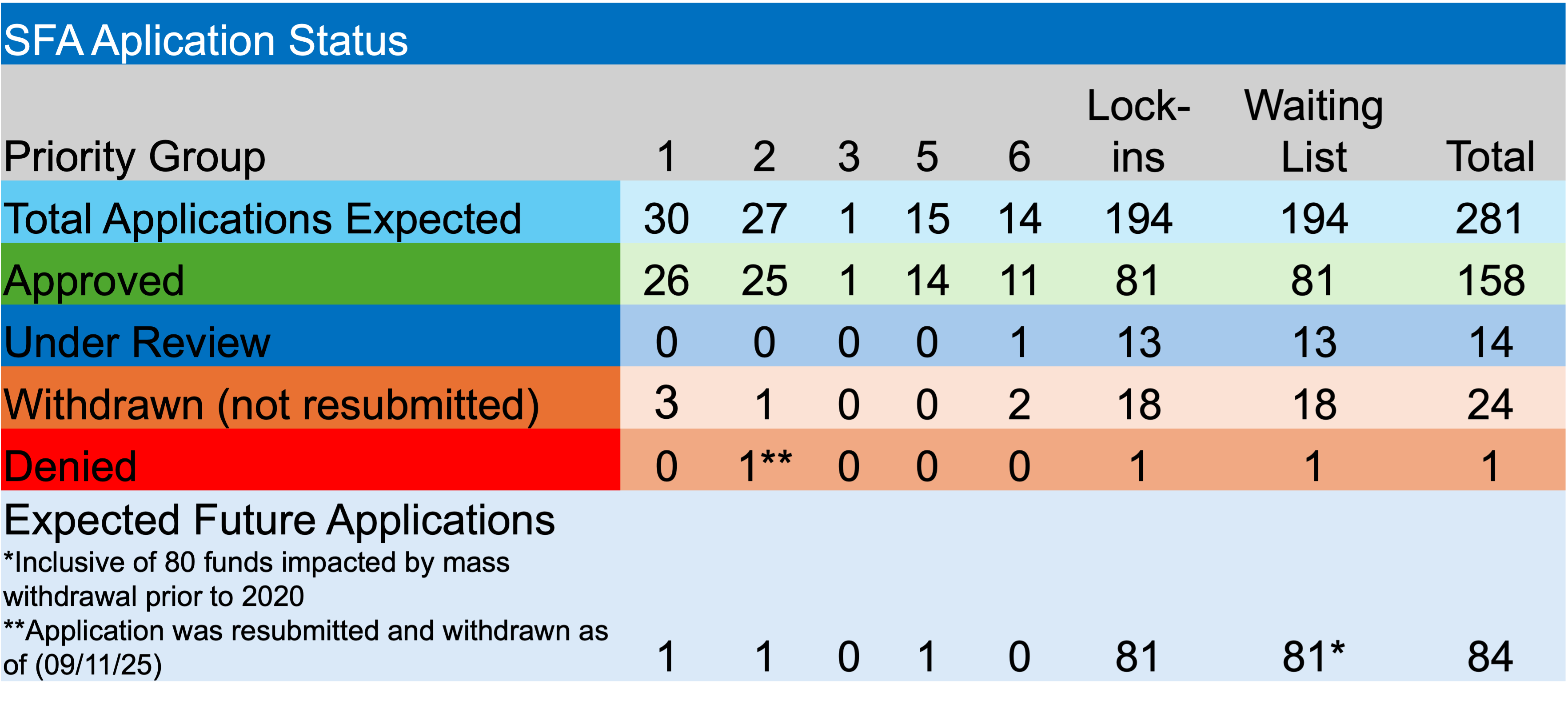
Regarding ARPA and the PBGC’s implementation of this critical pension legislation, last week proved to be fairly quiet, and I imagine it will continue to be so, as the PBGC works through the remaining applications currently under review (14) and those that will likely be resubmitted (25). Quiet, unless some action is taken on the 80 plans sitting on the waitlist that were terminated by mass withdrawal prior to 2020.

During the past week there were no applications approved or denied, no pension plans were asked to repay a portion of their SFA and no pension funds asked to be added to the waitlist.

In other news, there was one revised application filed. Bricklayers Local No. 55 Pension Plan, a non-priority group member, is seeking $6.4 million for its 483 members. The PBGC has 120-days to review and approve the application before it is automatically accepted. The only other news of note related to two pension funds that withdrew applications. Non-priority group member, Retail Bakers’ Pension Trust Fund of St. Louis, withdrew its initial application. They’d been seeking $5.7 million for 566 plan members. Warehouse Employees Union Local 169 and Employers Joint Pension Plan, another non-priority group member, withdrew an already revised application in which they were hoping to secure $77.8 million for 3,609 plan participants.

The uncertainty related to action in Iran has U.S. Treasury yields rising across the Treasury yield curve as inflation concerns once again come into focus. Rising rates are challenging for bond investors unless a cash flow matching (CFM) strategy has been used. As a reminder, CFM will secure the promised benefits (and expenses, if desired) for as long as the SFA allocation lasts. As a reminder, those B&E are future values which are not interest rate sensitive. Importantly, higher interest rates will create more cost savings related to those future promises for pension plans still waiting to receive their SFA.

ARPA Update as of February 6, 2026

By: Russ Kamp, CEO, Ryan ALM, Inc.

It looks like those of us in the Northeast will finally get some respite from the bitter cold, as temps will moderate this week and actually hit the 30s. However, those multiemployer pension plans currently sitting on the waitlist and classified as a Plan Terminated by Mass Withdrawal before 2020 Plan Year, continue to be frozen in place. According to the PBGC’s latest update, there are 80 plans that fall under the Mass Withdrawal classification. I’ll share more info on this subject later in this post.

Regarding last week’s activity, the PBGC is reporting that one fund, Operative Plasterers & Cement Masons Local No. 109 Pension Plan, a Troy, MI, construction union, will receive $13.7 million for the 1,439 plan members. In addition to the one approval, there was another fund that withdrew its initial application. Norfolk, VA-based International Association of Bridge, Structural, Ornamental and Reinforcing Ironworkers Local No. 79 Pension Fund was seeking $14.6 million in SFA for 462 participants in the plan.

There were no applications submitted for review. It appears that only one non-mass withdrawal plan, Plasterers Local 79 Pension Plan, remains on the waitlist. Fortunately, there were no plans asked to rebate a portion of the SFA grant due to census errors or any funds deemed no eligible.

Regarding the 80 mass withdrawal funds currently sitting on the waitlist, MEPs terminated by mass withdrawal under ERISA §4041A(a)(2) are explicitly ineligible for SFA under ARP/IRA rules, regardless of application timing. Furthermore:

No “initial application” option exists post-termination date.

Mass withdrawal means that all/substantially all employers completely withdraw leading to a plan termination.

PBGC SFA statute excludes §4041A(a)(2) terminated plans.

For the 80 funds sitting on the waitlist, it seems like a long shot that the APRA legislation will be amended to accommodate these funds seeking SFA. I’ll continue to monitor this situation in future posts.