Important NIRS Statement related to Alaska

By: Russ Kamp, CEO, Ryan ALM, Inc.

I recently published a post highlighting how powerful public pension funds are as an economic force. Despite DB pension fund demise in the private sector, they remain widely used to support hiring and retention of critical public servants. However, there are gaps in their usage and significant attempts have been made to shift the burden for a dignified retirement from the employer to the employee through DC offerings.

Recently, there was a bipartisan attempt by the Alaska legislation to reintroduce defined benefit plans to public sector workers, which were shuttered to new employees back in the early 2000s. Unfortunately, the bill was vetoed by Governor Dunleavy. The following text is a statement from Dan Doonan, Executive Director, National Institute on Retirement Security related to the Alaska situation. It is excellent!

Statement on Efforts in Alaska to Restore Pension Benefits to Address Grave Workforce Shortage

WASHINGTON, D.C., May 19, 2026 – In response to the veto of bipartisan legislation passed by the Alaska legislature to provide defined benefit pensions to Alaska’s public employees, the National Institute on Retirement Security (NIRS) issued the following statement today from Dan Doonan, NIRS executive director:

“Alaska’s effort to restore a pension plan for public workers represents meaningful progress in addressing one of the state’s most pressing challenges: attracting and retaining a stable, experienced public workforce. While Governor Dunleavy has vetoed the legislation, the fact that the measure passed both the House and Senate demonstrates a growing recognition that retirement benefits are not just about retirement security — they also are an essential workforce management tool.

For years, Alaska has faced deep and growing staffing shortages and retention problems across the public sector after closing its pension plans, especially in education and public safety. Pensions are a proven tool for helping employers recruit qualified workers, reduce costly turnover, and retain experienced employees who provide continuity and institutional knowledge. Too often, Alaska has served as a training ground where workers gain experience and then leave for other states that provide pension benefits and offer public employees financial security after careers serving their communities.

Research delivered by NIRS to the Alaska Department of Education found that Alaska’s shift away from pensions contributed to higher turnover among public education employees. Alaska is a rare example in which data was available to compare the behavior of workers in the same jobs and communities, with the same employers, but with different benefit offerings. That increased worker turnover in Alaska carries real costs for employers, taxpayers, and communities alike.

Importantly, the new pension tier approved by the legislature offered an innovative middle-ground design approach to protect taxpayer interests, with both risk- and cost-sharing features.

Despite the veto, the legislation is an important step forward because policymakers from both parties acknowledge that retirement plan design directly affects workforce stability and the quality of public services. Supporters rightly argued that offering a redesigned, innovative pension plan with taxpayers’ protections would help address chronic vacancies and improve retention in critical public-sector jobs.

We hope Alaska lawmakers continue this conversation and make another run at restoring a pension option in the future. States across the country increasingly recognize that pensions remain one of the most cost-effective tools available to build and sustain a strong workforce capable of delivering essential public services.”

The National Institute on Retirement Security is a non-profit, non-partisan organization established to contribute to informed policymaking by fostering a deep understanding of the value of retirement security to employees, employers, and the economy as a whole. Located in Washington, D.C., NIRS membership includes financial services firms, employee benefit plans, trade associations, and other retirement service providers. More information is available at www.nirsonline.org.

Thanks, Dan and NIRS, for your continuing advocacy for DB pension plans.

Milliman: Corporate Pension Funding now at 109.4%

By: Russ Kamp, CEO, Ryan ALM, Inc.

Milliman has released the latest monthly report on the Milliman 100 Pension Funding Index (PFI). As a reminder, this index analyzes the 100 largest U.S. corporate pension plans.

For February, the PFI funded ratio rose from 109.1% as of January 31, to 109.4% as of February 28, marking the highest collective funded ratio since the 109.9% mark observed in July 2001. However, the funding improvement was solely a result of asset performance, as declining discount rates of 14 basis points reduced the discount rate to 5.33% and raised the PFI projected benefit obligation (liabilities) to $1.235 trillion. Fortunately, monthly returns of 2.15% offset the impact of falling U.S. interest rates leading to growth in the market value of plan assets by $22 billion, to $1.351 trillion.

“February’s investment performance drove the month’s $5 billion gain in funding levels,” said Zorast Wadia, author of the Milliman PFI. He went on to say that “while this marks 11 straight months of funding improvements, further declines in interest rates may occur, and ongoing market volatility makes it vital for plan sponsors to undertake surplus-management strategies focused on both sides of the balance sheet.” We continue to support Zorast in recommending that managing assets to liabilities is critical for DB pension plans in all market environments, but especially given the significant uncertainty under which markets are currently operating. As a reminder, the primary objective in managing a DB pension is to SECURE the promised benefits at a reasonable cost and with prudent risk. It is NOT a return objective.

We, at Ryan ALM, do not forecast interest rates, but the impact of rising oil prices (WTI currently up 30.7% as of 9:13 am EST since Friday) will likely have an impact on inflation and interest rates. It will be interesting to see if a potential fall in the value of liabilities proves greater than the potential impact that rising rates might have on equity markets and other assets. Will we see the 12th consecutive month of improved funding levels?

Please click on the link below for a look at the complete Milliman corporate pension funding report.

View this month’s complete Pension Funding Index.

Oh, Canada!

By: Russ Kamp, CEO, Ryan ALM, Inc.

There were significant trade developments announced yesterday between the U.S. and Canada, which don’t seem to be getting the attention that they deserve. I wish that these developments were driven by Canada in retaliation for both the women’s and men’s gold medal performances in Italy, but it seems as if the U.S. is being a sore winner in this situation.

So, what happened yesterday? U.S. under President Trump has reclassified Canada from a Tier 1 allied trading partner to a Tier 3 restricted commerce nation through an executive order.​ Oh, boy, that sounds onerous. It seems as if this escalation follows tensions brought about by new U.S. tariffs on Canadian goods such as steel, lumber, and energy products prompting Canada to diversify partnerships with China, Mexico, and others. Previously, Canada ranked as the U.S.’s top export market and second-largest trading partner overall, with highly integrated supply chains in autos and energy. The move to tier 3 immediately increases tariffs to 35% on ALL Canadian goods – ouch! Furthermore, this classification places Canada in the same trading bucket as countries such as Belarus and Venezuela.

Not surprisingly, Canada, led by Prime Minister Mark Carney, is countering by pursuing deeper relations with China, Ecuador, Indonesia, and India to reduce U.S. reliance, which still accounts for nearly 70% of its exports. According to various press reports, the White House announced the order approximately two hours before it became public, automatically imposing a 35% tariff on all Canadian goods, financial restrictions, and a freeze on joint military contracts. Canadian Prime Minister Mark Carney responded within 90 minutes by announcing countermeasures in Parliament, including export controls on critical minerals, such as potash, and withdrawal from NORAD data sharing.​

This move is highly disruptive to integrated North American supply chains. The decision followed escalating U.S. tariffs and was defended in Trump’s recent State of the Union address.​​ Canada now faces sharp export declines to its largest market, potentially worsening its trade balance and likely depreciating the Canadian $. Business investment drops due to higher costs for US machinery, leading to layoffs, reduced GDP growth, and sustained inflation from tariff pass-throughs. The potential for retaliatory measures like export controls on minerals will further strain relations between these two long-term allies.

Please don’t think that this development only strikes at Canada’s economy. US consumers and industries will see higher input costs such as steel, which estimates suggest could be as high as $7.5B+, leading to inflation and eroding competitiveness in batteries, clean energy, and defense. Canadian retaliation reduces US exports, impacts GDP, and exacerbates supply chain vulnerabilities with no quick domestic substitutes.

Higher inflation will impact interest rates, leading to higher costs of borrowing, and depending on the significance of these developments could lead to a bear market environment and an economic slowdown concurrent with existing labor force concerns. So, why isn’t this getting more attention?

ARPA Update as of February 6, 2026

By: Russ Kamp, CEO, Ryan ALM, Inc.

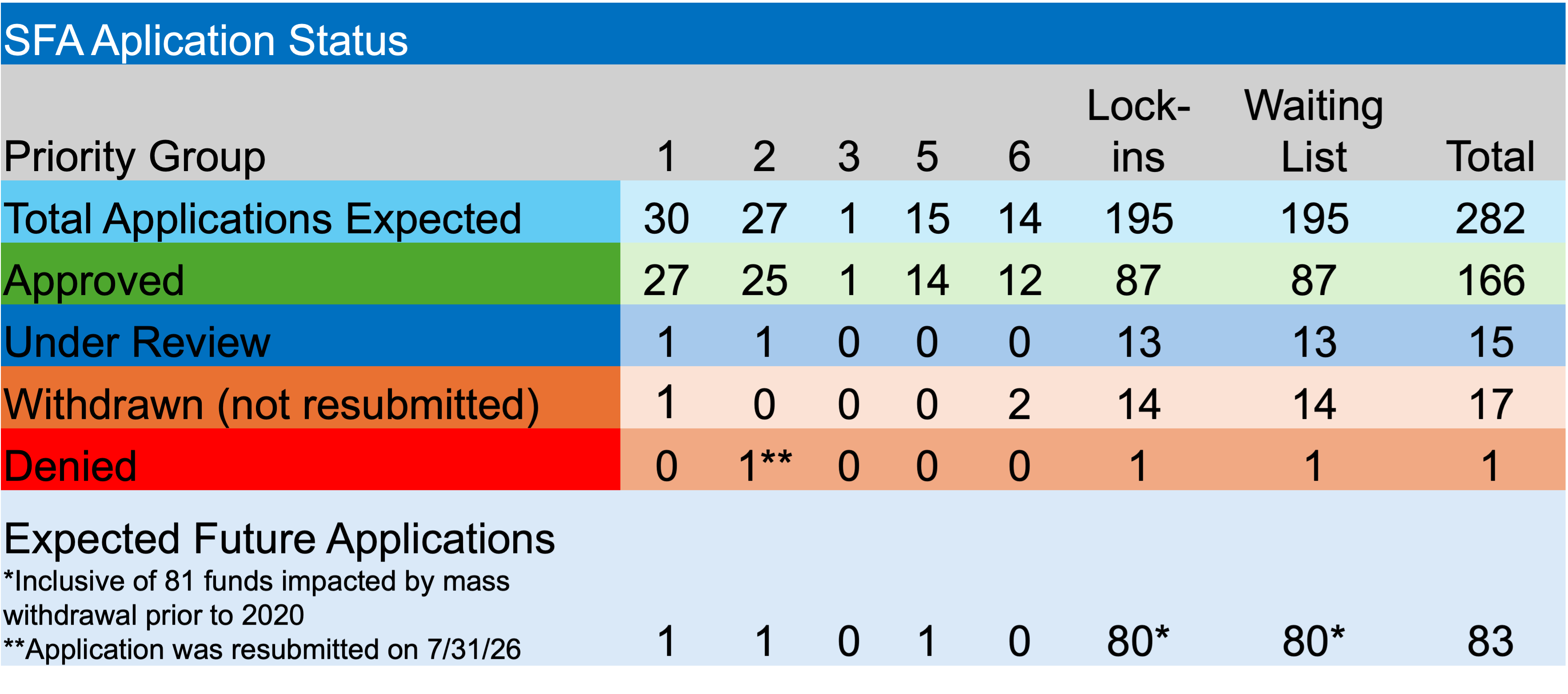
It looks like those of us in the Northeast will finally get some respite from the bitter cold, as temps will moderate this week and actually hit the 30s. However, those multiemployer pension plans currently sitting on the waitlist and classified as a Plan Terminated by Mass Withdrawal before 2020 Plan Year, continue to be frozen in place. According to the PBGC’s latest update, there are 80 plans that fall under the Mass Withdrawal classification. I’ll share more info on this subject later in this post.

Regarding last week’s activity, the PBGC is reporting that one fund, Operative Plasterers & Cement Masons Local No. 109 Pension Plan, a Troy, MI, construction union, will receive $13.7 million for the 1,439 plan members. In addition to the one approval, there was another fund that withdrew its initial application. Norfolk, VA-based International Association of Bridge, Structural, Ornamental and Reinforcing Ironworkers Local No. 79 Pension Fund was seeking $14.6 million in SFA for 462 participants in the plan.

There were no applications submitted for review. It appears that only one non-mass withdrawal plan, Plasterers Local 79 Pension Plan, remains on the waitlist. Fortunately, there were no plans asked to rebate a portion of the SFA grant due to census errors or any funds deemed no eligible.

Regarding the 80 mass withdrawal funds currently sitting on the waitlist, MEPs terminated by mass withdrawal under ERISA §4041A(a)(2) are explicitly ineligible for SFA under ARP/IRA rules, regardless of application timing. Furthermore:

No “initial application” option exists post-termination date.

Mass withdrawal means that all/substantially all employers completely withdraw leading to a plan termination.

PBGC SFA statute excludes §4041A(a)(2) terminated plans.

For the 80 funds sitting on the waitlist, it seems like a long shot that the APRA legislation will be amended to accommodate these funds seeking SFA. I’ll continue to monitor this situation in future posts.

ARPA Update as of January 30, 2026

By: Russ Kamp, CEO, Ryan ALM, Inc.

So much for escaping the bitter cold in New Jersey by flying to Orlando, FL. The reality is that Orlando is sitting at 25 degrees this morning (Sunday 2/1). Someone is playing a nasty trick on all those snowbirds. It is a good thing for me that I’ll be spending most of my time in a conference room until Wednesday (FPPTA). I hope that you have a great week.

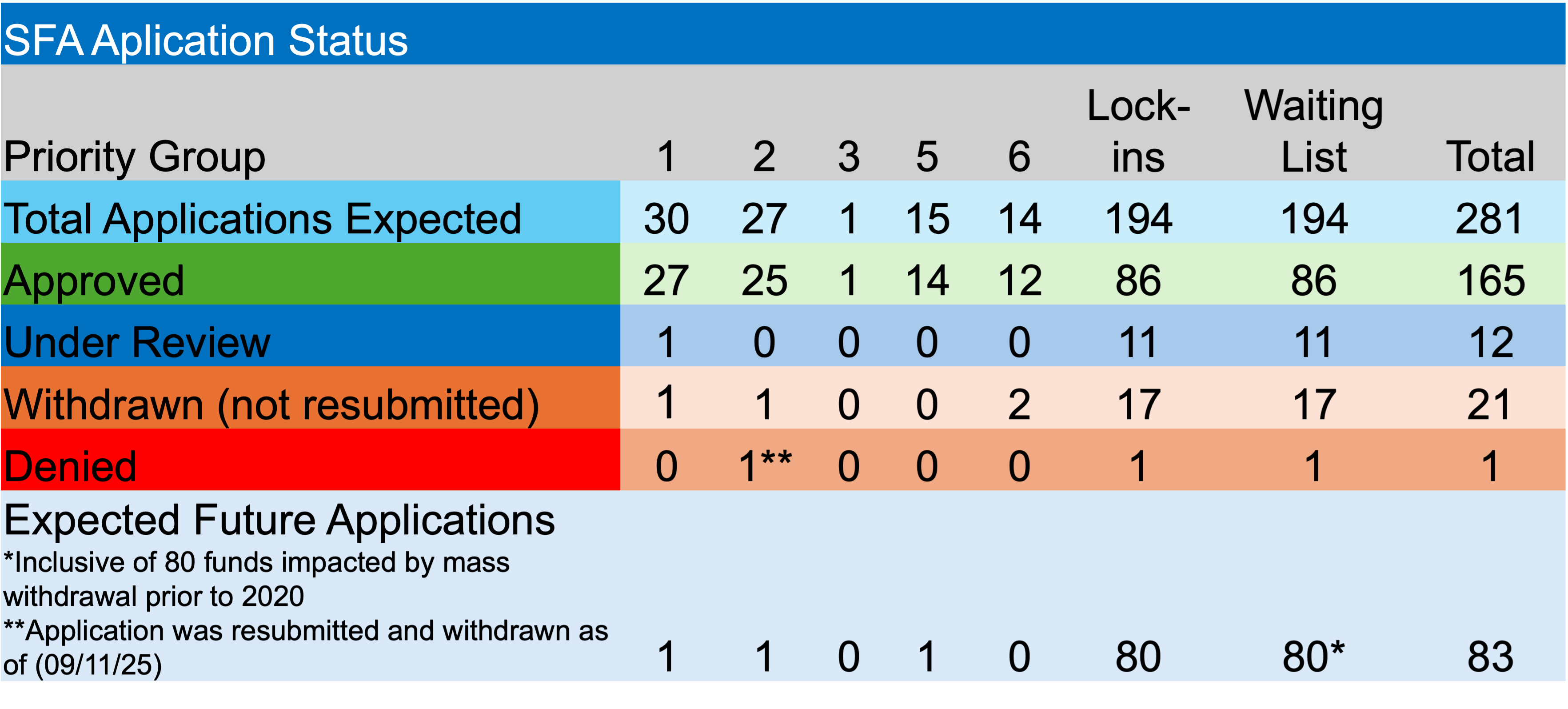
Regarding ARPA and the PBGC’s continuing implementation of this critical legislation, there was activity last week, and some of it was surprising. As I’ve mentioned on several occasions, the ARPA legislation specifically states that all initial applications seeking special financial assistance (SFA) needed to be submitted to the PBGC by 12/31/25. Revised applications could be resubmitted after that date and until 12/31/26. That said, there were three initial applications filed with the PBGC during the week ending January 30th. What gives?

In other news, Cincinnati-based Asbestos Workers Local No. 8 Retirement Trust Plan received approval for SFA. They will get $40.1 million to support their 451 plan participants. In other news, Local 1814 Riggers Pension Plan, withdrew its initial application which had been filed through the PBGC’s e-Filing portal last October. They are hoping to secure a $2.5 million SFA grant for their 65 members.

Fortunately, there were no previous recipients of SFA asked to repay a portion of the grant due to census errors nor were any applications denied due to eligibility issues. Lastly, no new pension plans asked to be added to the waitlist which currently numbers more than 80 systems.

The U.S. Treasury yield curve remains steep, with 30-year bond yields exceeding the yield on the 2-year note by 1.34% as of Friday’s closing prices. This steepening provides plan sponsors and grant recipients with attractive yields on longer maturity cash flow matching programs used to secure the promised benefits.

A Time to Look Back

By: Russ Kamp, CEO, Ryan ALM, Inc.

Nearly eight years ago (2/28/18), I produced a blog post titled, “Let’s Just Cut Them Off!”, in which I took offense to an article trashing pension legislation then referred to as the “Butch Lewis Act” (BLA). The writer of the article, Rachel Greszler, The Heritage Foundation, stated that the BLA (as well as other potential solutions at that time) were nothing more than tax-payer bailouts.  She estimated that these bailouts could amount to as much as $1 trillion. I stated at that time that “I don’t know where she has gotten this figure, but it is not close to reality.”

Ms. Greszler defined the potential recipients of these loans (now grants) as the entire universe of multi-employer plans totaling roughly 1,375 (at that time) with an unfunded liability of $500 billion.  However, the Butch Lewis Act, and subsequently ARPA) was only designed for those plans that were designated as “Critical and Declining”.  The total amount of underfunding for that cohort was roughly $70 billion.  A far cry from the $1 trillion that she highlighted above.

So, where are we today? I’m happy to report that as of 12/19/25, the PBGC has approved Special Financial Assistance to 151 pension plans totaling $75.2 billion. These grants are ensuring that 1,873,112 American workers will receive the retirement benefits they were promised! Amazing!

In my original post, I wrote “given the author’s concern for the million or so union workers whose benefits may be trashed, she certainly doesn’t propose any solutions other than to say that a “bailout” is a horrible way to go.  If these plans don’t receive assistance, they are likely to fail, placing a greater burden on the Pension Benefit Guaranty Corporation (PBGC), which is already financially troubled.” Fortunately, through the ARPA pension legislation, the PBGC’s multiemployer insurance fund is stronger today than it has been in decades.

I finished my post with the following thoughts: “Retirement benefits stimulate economic activity, and usually on the local level. The loss of retirement benefits will have a direct impact on these economies. Also, these benefits are taxed, which helps pay for a portion of the loans (now grants). Doing nothing is not an answer. I applaud the effort of those individuals who are driving the Butch Lewis Act. I encourage everyone to reach out to your legislatures to educate them on the BLA and to gain their support. There are millions of Americans who need your support.  Thank you!”

I was thrilled to work with Ron Ryan and the BLA team headed by John Murphy and David Blitzstein. It remains one of the highlights of my 44-year career. Who knew when I began working with Ron and that team it would lead me to eventually join Ryan ALM, Inc. We continue to fight to protect and preserve DB pensions for the masses. There is a ton of work remaining to do. Securing those promises through cash flow matching (CFM) is an important first step. Let us help you accomplish that objective.

ARPA Update as of December 12, 2025

By: Russ Kamp, CEO, Ryan ALM, Inc.

Unlike the Northeast, access to the PBGC’s e-Filing portal is thawing. According to the PBGC’s website, “the e-Filing Portal is open only to plans at the top of the waiting list that have been notified by PBGC that they may submit their applications. Applications from any other plans will not be accepted at this time.” Despite the dozens of multiemployer plans that remain on the waitlist, the floodgates have certainly not opened.

In fact, only two plans were permitted to submit applications last week. UFCW – Northern California Employers Joint Pension Plan, a Priority Group 6 member, submitted a revised application seeking >$2.3 billion for nearly 140k members, while UFCW, Local 23 and Giant Eagle Pension Plan, a non-priority group member, filed an initial application hoping to garner $40 million in SFA for 7,100 plan participants.

In other news, Dairy Industry-Union Pension Plan for Philadelphia and Vicinity, Warehouse Employees Union Local No. 730 Pension Trust Fund, and Cleveland Bakers and Teamsters Pension Plan received approval for SFA grants. Collectively they will receive $303.4 million (including interest and loan repayments) for 13,533 plan participants. There have now been 150 plans approved for SFA totaling just over $75 billion in grants.

Fortunately, there were no plans asked to repay a portion of the SFA due to census errors, no plans denied a filing, and no withdrawals of previously submitted applications. There were two more funds added to the waitlist and nine that locked in their valuation dates, including the two most recent additions to the waitlist. There remain 85 applications that have yet to be submitted to the PBGC.

Recent Federal Reserve interest rate action has rates on the long-end of the yield curve ratcheting higher. The 30-year Treasury Bond’s yield is at 4.83% (12:-5 pm). Comparable 30-year IG corporates are trading at yields close to 6% at this time. It remains an excellent time to secure the promised benefits through a CFM strategy.

ARPA Update as of December 5, 2025

By: Russ Kamp, CEO, Ryan ALM, Inc.

Welcome to the first review of December 2025. We aren’t quite at the beginning of winter, but you could sure fool me, as New Jersey is gripped by cold front and we saw our first modest snowfall just in time for me to start decorating my house for Christmas. I hope that you had a wonderful weekend.

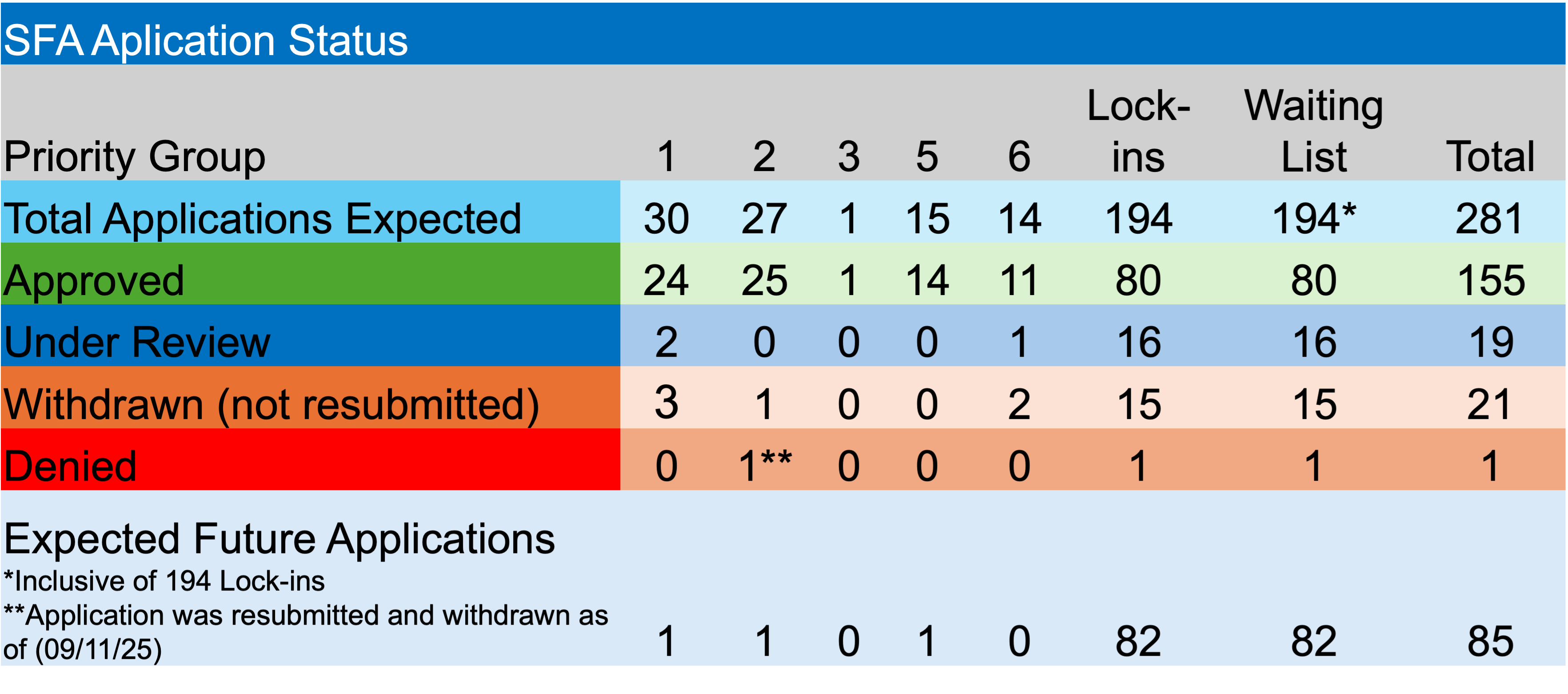
With regard to ARPA and the PBGC’s implementation of this critical legislation, there was a little reported activity last week, but certainly not enough to make a dent in the current waitlist. Unfortunately, the PBGC’s e-Filing portal remains temporarily closed. Despite that fact, pension plans continue to be added to the waitlist. USW District 10, Local 286 Pension Plan is the latest fund, making it the 186th non-priority group plan added since the start of the program. By my estimate, there are still 83 pension funds sitting on the waitlist hoping to get a chance to submit an application for SFA grant $.

In other APRA news, two pension funds received approval to receive the SFA. Teamsters Local 210 Affiliated Pension Plan and Local Union 1710 I.B.E.W. Pension Trust Fund, both non-priority plans, will receive a total of $149.2 million in SFA for just over 9,500 participants. As mentioned above, the PBGC’s e-Filing portal remains temporarily closed, so there were no additional applications received during the week. There are currently 24 applications in front of PBGC staff.

In addition, there were no plans asked to rebate a portion of their SFA grant due to census errors, and there haven’t been since mid-September. Fortunately, no plans were denied the ability to submit an application due to the lack of eligibility and no applications were withdrawn. However, there were six plans that locked-in a valuation date, as each chose 9/30/25 as the plan’s measurement date. There are still 14 plans on the waitlist that haven’t chosen to lock-in a valuation date.

With the two approvals from last week, there are now 147 plans that have or will soon receive Special Financial Assistance totaling $74.7 billion supporting the earned pensions for 1.85 million American workers and retirees. Outstanding! That is a lot of economic stimulus that helps more than just the recipient of the retirement benefit, but also the communities in which they reside.

ARPA Update as of November 21, 2025

By: Russ Kamp, CEO, Ryan ALM, Inc.

Welcome to Thanksgiving week. I don’t think that I’m alone when I say that Thanksgiving is my absolute favorite holiday. I hope that you and your family enjoy a truly special day. I’m thankful that we’ll have all of our kids and grandkids together and also very happy not to have to watch the Giants that day!

With regard to ARPA and the PBGC’s implementation of this critically important legislation, after a week of “rest”, there was some activity posted by the PBGC through the weekly update on their website. Not as much activity as one would expect, given the significant waiting list (81 funds) of pension plans to submit an initial application.

Happy to report that there was an application approved. It is the first one in more than one month (10/16/25). Emeryville, CA-based, Distributors Association Warehousemen’s Pension Trust, will receive $32.7 million in SFA for 3,358 plan participants. Their revised application was approved on November 20th.

In other ARPA news, Cumberland, Maryland Teamsters Construction and Miscellaneous Pension Plan, has submitted a revised application. They are hoping to get approval for $8.4 million in SFA for 101 members. In addition, there were no pension funds asked to repay a portion of the SFA due to census errors, which has been the case for the last couple of months. There were also no applications denied due to eligibility issues.

I’ve discussed quite often the growing list of funds that have asked to be added to the waitlist. These non-priority funds appear to be running out of time to have their initial application reviewed. Two more funds were added in the last week. By my estimate, there remain 79 pension systems yet to file the initial application. As a reminder, the legislation specifically reads that initial applications must be filed with the PBGC by December 31, 2025. Unfortunately, the PBGC’s e-Filing portal remains temporarily closed.

ARPA Update as of November 14, 2025

By: Russ Kamp, CEO, Ryan ALM, Inc.

I hope that last week was great for you. I didn’t recognize anyone from the PBGC at the IFEBP in Honolulu last week, but I suspect that there must have been a few attendees. Why? Well, for the first time that I can recall since I began producing these weekly updates, there is nothing to report in terms of the PBGC’s implementation of the ARPA pension legislation. NOTHING!

Now, I’m sure that a lot is going on behind the scenes, especially given the announcement that Janet Dhillon has been confirmed as the 17th Director of the Pension Benefit Guaranty Corporation, but in the weekly update produced as of Friday, November 14th, there were no applications submitted, as the PBGC’s e-Filing portal remains temporarily closed. No pension plans received approval for SFA nor were any denied. There were no withdrawals of previously submitted applications. Lastly, there were no multiemployer plans asking to be added to the growing waitlist.

As we get closer to the legislation’s deadline for new applications to be submitted, we are down to about 6-7 weeks until December 31, 2025. Having a week in which nothing concrete was reported reduces the odds that most of those plans yet to file will actually be given that opportunity.

The graph above reflects the activity through November 7th. Despite the lack of activity last week, the PBGC deserves high praise for their handling of this critical legislation that has helped som many American workers and pensioners. Lastly, at the IFEBP was asked to touch on ARPA/SFA and how best to incorporate ALM strategies to mitigate risk. I’ve had the privilege to speak on this topic numerous times. In summation, the allocation of Special Financial Assistance (SFA) to multiemployer plans is truly of gift. That allocation is not likely to ever be repeated. As such, plans should take every precaution to ensure the maximum coverage of benefits (and expenses) while minimizing the risk through their investments. Call on us (ryanalm.com) if we can help you think through the use of Cash Flow Matching to SECURE those promises.