Will You Be Wearing A Bathing Suit?

By: Russ Kamp, CEO, Ryan ALM, Inc.

I’m not asking about your plans for America’s 250th celebration come this Fourth of July. 

I read a very interesting email yesterday that referenced the tragic events in Venezuela by saying that the “earthquake doesn’t write the verdict. It audits the books.” My initial reaction: that’s harsh given the significant deaths and injuries that resulted, but upon reflection the author is correct. It wasn’t the fact that an earthquake of that magnitude hadn’t occurred in 125-years. It was the fact that poor planning, weak building codes, inferior construction, and poor maintenance well before the event created the tragic outcome.

As I contemplated the authors words, I began to reflect on what Warren Buffet had said in his 2001 annual letter to shareholders. He stated, “only when the tide goes out do you discover who’s been swimming naked.” Bringing this post back to investing and the impact on pension plans;

  • Rising markets make almost every strategy appear successful.
  • Cheap credit, abundant liquidity, and investor optimism hide poor decisions and weak fundamentals.
  • Excessive leverage, weak business models, and speculation can all seem to work (think SPCX).

But when the “tide goes out” (markets decline) we are left with the truth, and it can be pretty ugly.

  • Companies with too much debt struggle.
  • Investors who relied on leverage are forced to sell.
  • Weak business models fail (Dot Com bubble).
  • Investment managers, pension plans, and their advisors that took hidden risks are exposed.

Importantly, bear markets don’t create weakness—they expose weakness that was already there.

We witnessed what happened following the go go 1990s, when it seemed as if every investment made money, pension funded ratios were at or near all-time highs, and contributions were well contained. It was that prolonged bull market that made almost any pension investment strategy look successful. But then the piper came calling! By the time the tide had rolled out, we witnessed the crushing impact on America’s pension system that hadn’t done anything to secure the promised benefits, improve liquidity, and reduce risk in very aggressive asset allocations.

So, I ask once more, will you be wearing a bathing suit when the next market crash/event occurs? Have you done enough to protect the promises made to your plan participants? If you are concerned that you haven’t, let us perform the audit before the event occurs. Our turnkey system will:

  • Properly measure your fund’s liabilities and cash flow needs.
  • Generate and maintain sufficient liquidity chronologically.
  • Avoid excessive risk.
  • Manage interest-rate risk.
  • Buy-time for the growth assets to perform.
  • Stabilize the funded status and contribution expenses.

Those plans that prepare ahead of the “event”, will be the ones that are healthy when the tide begins to rise again. Prudent risk management matters much more than chasing returns. The real test of an investment strategy for a pension system isn’t during bull markets—it’s during highly uncertain ones, when hidden vulnerabilities become impossible to ignore. Will your fund pass an audit?
Try Clapping With One Hand

By: Russ Kamp, CEO, Ryan ALM, Inc.

The only reason that your DB pension plan exists is because a promise was given to your participants that they would receive a monthly benefit for life upon meeting some requirements such as years employed and retirement age. The promise wasn’t based on whether your particular pension fund achieved the annual return on asset assumption (ROA). If the ROA was achieved – great. Contributions would be as forecasted by your actuary. If not, it would be time to ante up more in annual contributions. But at the end of the day, you remain on the hook to make that monthly payment.

Given that reality, does it make sense that the primary focus is on the ROA and not the promised benefits? Regrettably, for most of Pension America, the annual ROA is the goal. However, pursuing that objective only guarantees volatility and not success. On the other hand, we, at Ryan ALM, Inc., believe that the primary pension objective is to SECURE the promised benefits at a reasonable cost and with prudent risk. By securing that promise, you eliminate uncertainty and volatility in the funded status.

Here’s the rub, the pension liabilities are the domain of the actuaries, while asset allocation falls to the asset consultants. How often do those entities communicate? How often do you as the plan sponsor know how that promise you made is behaving? Does it make sense to you that assets are constantly being measured while the liabilities may get a once per year update 4-6 months delayed? Wouldn’t it make much more sense to have both the assets and liabilities updated at the same time so that asset allocation adjustments could be made as necessary?

Think about a bridge with two primary supports. One of the supports are representative of the actuaries and the other one is the asset consultants. To get from one side of the pension canyon to the other side, there needs to be a connector. What entity is that? It is not your investment managers, who are focused on a generic benchmark and not your plan’s liabilities. Ryan ALM believes that we can be that entity, as we provide a turnkey system of sustainable solutions to make sure that each pension fund that we support understands the promises that have been made, develops the correct cash flow roadmap, and carefully constructs the necessary match between liability cash flows of benefits and expenses with the asset cash flows (principal and interest) from IG bonds to SECURE those monthly promises.

Our mission is to secure your promises at both low cost and with prudent risk. It is not to have you sit firmly on the rollercoaster of market returns with the hope that the plan’s asset allocation will deliver a return near the ROA. The current breakdown in communication between actuaries and asset consultants is like trying to clap with one hand. As hard as you try, it just won’t work. Let Ryan ALM be your bridge. With us you’ll receive a monthly Custom Liability Index (CLI) based on your fund’s forecasted liabilities, monthly liquidity chronologically as far into the future as your allocation to a cash flow matching (CFM) mandate covers, time for the residual assets (alpha assets) to grow, low cost management fees, ongoing monitoring of the relationship of assets to liabilities, and a stable funded ratio and contribution expenses for that portion of the plan. We connect assets to liabilities through our proprietary turnkey system of four products. Think of us as the maestro leading the orchestra. Both hands are working for you and your participants.

ARPA Update as of November 14, 2025

By: Russ Kamp, CEO, Ryan ALM, Inc.

I hope that last week was great for you. I didn’t recognize anyone from the PBGC at the IFEBP in Honolulu last week, but I suspect that there must have been a few attendees. Why? Well, for the first time that I can recall since I began producing these weekly updates, there is nothing to report in terms of the PBGC’s implementation of the ARPA pension legislation. NOTHING!

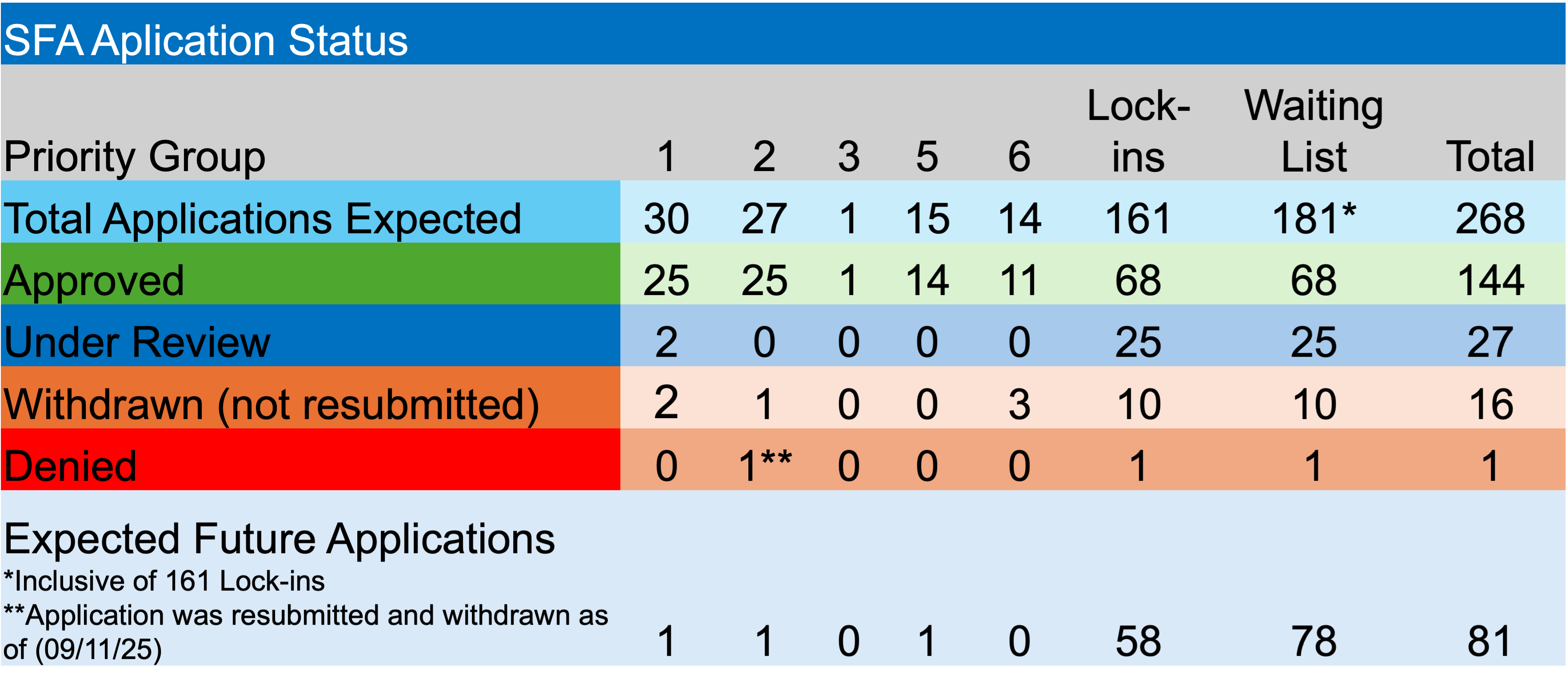
Now, I’m sure that a lot is going on behind the scenes, especially given the announcement that Janet Dhillon has been confirmed as the 17th Director of the Pension Benefit Guaranty Corporation, but in the weekly update produced as of Friday, November 14th, there were no applications submitted, as the PBGC’s e-Filing portal remains temporarily closed. No pension plans received approval for SFA nor were any denied. There were no withdrawals of previously submitted applications. Lastly, there were no multiemployer plans asking to be added to the growing waitlist.

As we get closer to the legislation’s deadline for new applications to be submitted, we are down to about 6-7 weeks until December 31, 2025. Having a week in which nothing concrete was reported reduces the odds that most of those plans yet to file will actually be given that opportunity.

The graph above reflects the activity through November 7th. Despite the lack of activity last week, the PBGC deserves high praise for their handling of this critical legislation that has helped som many American workers and pensioners. Lastly, at the IFEBP was asked to touch on ARPA/SFA and how best to incorporate ALM strategies to mitigate risk. I’ve had the privilege to speak on this topic numerous times. In summation, the allocation of Special Financial Assistance (SFA) to multiemployer plans is truly of gift. That allocation is not likely to ever be repeated. As such, plans should take every precaution to ensure the maximum coverage of benefits (and expenses) while minimizing the risk through their investments. Call on us (ryanalm.com) if we can help you think through the use of Cash Flow Matching to SECURE those promises.

The Times They Are A-Changin’

By: Russ Kamp, CEO, Ryan ALM, Inc.

Thank you, Bob Dylan, for the lyric that is just perfect for this blog post. I have just returned from the IFEBP conference in Honolulu, HI. What a great conference, and not just because it was in Hawaii (my first time there). If it wasn’t the location, then what made this one so special? For years I would attend this conference and many others in our industry and never hear the word liability mentioned, as in the pension promise, among any of the presentations.

So pleased that during the last few years, as U.S. interest rates have risen and defined benefit pension funding has improved, not only are liabilities being discussed, but more importantly, asset allocation strategies focused on pension liabilities are being presented much more often. During this latest IFEBP conference there were multiple sessions on ALM or asset allocation that touched on paying heed to the pension plan’s liabilities, including:

“Asset Allocation for Today’s Markets”

“My Pension Plan is Well-Funded – Now What?”

“Asset Liability Matching Investment to Manage the Risk of Unfunded Liabilities”

“Decumulation Strategies for Public Employer Defined Contribution Plans” (they highlighted the fact that these strategies should be employed in DB plans, too)

“Applying Asset Liability Management Strategies to Your Investments” (my session delivered twice)

“Entering the Green Zone and Staying There”

These presentations all touched on the importance of risk management strategies, while encouraging pension plan sponsors to stop riding the performance rollercoaster. Given today’s highly uncertain times and equity valuations that appear stretched under almost any metric, these sessions were incredibly timely and necessary. Chasing a performance objective only ensures volatility. That approach doesn’t guarantee success. On the other hand, securing the pension promise through an ALM strategy at a reasonable cost and with prudent risk does redefine the pension objective appropriately.

I know that human beings are reluctant to embrace change, but we despise uncertainty to a far greater extent. Now is the time to bring an element of certainty to the management of pension assets. By the way, that was the title of my recent presentation to public funds at the NCPERS conference in Fort Lauderdale. Again, understanding pension liabilities and managing to them is not new, but it has certainly been under a bigger and brighter spotlight recently. That is great news!

Hey Ryan ALM – What if…?

By: Russ Kamp, CEO, Ryan ALM, Inc.

We hope that you are enjoying a wonderful summer season. Thanks for taking the time to visit our blog, where we’ve now produced >1,650 mostly pension-related posts.

I wanted to share the following email exchange from earlier this week. I received an email at 6:40 pm on Monday from a senior member of the actuarial community who is familiar with our work. He said that he had a client meeting on Wednesday and he was wondering if we could model some potential outcomes should the plan decide to take some risk off the table by engaging a cash flow matching strategy (CFM).

The actuary gave us the “net” liabilities (after contributions) for the next 10-years and then asked two questions. How far out into the future would $200 million in AUM cover? If the client preferred to defease the next 10-years of net liabilities, how much would that cost? We were happy to get this inquiry because we are always willing to be a resource for members of our industry, including plan sponsors, consultants, and actuaries.

We produced two CFM portfolios, which we call the Liability Beta Portfolio™ or LBP, in response to the two questions that had been posed. In the first case, the $200 million in AUM would provide the client with coverage of $225.8 million in future value (FV) liabilities through March 31, 2031 for a total cost of $196.3 million. Trying to defease the next 10-years of liabilities would cost the plan $334.8 million in AUM to defease $430 million in net liabilities.

 $200 million in AUM10-year coverage
End Date3/31/31 7/01/35
FV$225,750,000$430,000,000
PV$196,315,548$334,807,166
YTM  4.52%  4.75%
MDur  2.73 years  4.45 years
Cost Savings $-$29,424,452-$95,192,834
Cost Savings %  13.04%   22.14%
Excess CF$230,375$679,563
RatingBBB+  A-

As we’ve mentioned on many occasions, the annual cost savings to defease liabilities averages roughly 2%/year, but as the maturity of the program lengthens that cost savings becomes greater. We believe that providing the necessary liquidity with certainty is comforting for all involved. Not only is the liquidity available when needed, but the remaining assets not engaged in the CFM program can now grow unencumbered.

If you’d like to see how a CFM program could improve your plan’s liquidity with certainty, just provide us with the forecasted contributions, benefits, and expenses, and we’ll do the rest. Oh, and by the way, we got the analysis completed and to the actuary by 12:30 pm on Tuesday in plenty of time to allow him to prepare for his Wednesday meeting. Don’t be shy. We don’t charge for this review.

When Should I Use CFM?

By: Russ Kamp, CEO, Ryan ALM, Inc.

Good morning. I’m currently in Chicago in the midst of several meetings. Yesterday’s meetings were outstanding. As you’d expect, the conversations were centered on DB pension plans and the opportunity to de-risk through a Cash Flow Matching strategy (CFM) in today’s economic environment. The line of questioning that I received from each of my meeting hosts was great. However, there does seem to be a misconception on when and how to use CFM as a de-risking tool. Most believe that you engage CFM for only the front-end of the yield curve, while others think that CFM is only useful when a plan is at or near full funding. Yes, both of those implementations are useful, but that represents a small sampling of when and how to implement CFM. For instance:

As a plan sponsor you need to make sure that you have the liquidity necessary to meet you monthly benefits (and expenses). Do you have a liquidity policy established that clearly defines the source(s) of liquidity or are you scurrying around each month sweeping dividends, interest, and if lucky, capital distributions from your alternative portfolio? Unfortunately, most plan sponsors do not have a formal liquidity policy as part of their Investment Policy Statement (IPS). CFM ensures that the necessary liquidity is available every month of the assignment. There is not forced selling!

Do you currently have a core fixed income allocation? According to a P&I asset allocation survey, public pension plans have an average 18.9% in public fixed income. How are you managing that interest rate risk, which remains the greatest risk for an actively managed fixed income portfolio? As an industry, we enjoyed the benefits of a nearly four decades decline in U.S. interest rates beginning in 1982. However, the prior 28-years witnessed rising rates. Who knows if the current rise in rates is a blip or the start of another extended upward trend? CFM defeases future benefit payments which are not interest rate sensitive. A $2,000 payment next month or 10-years from now is $2,000 whether rates rise or fall. As a result, CFM mitigates interest rate risk.

As you have sought potentially greater returns from a move into alternatives and private investments, not only has the available liquidity dried up, but you need a longer time horizon for those investments to mature and produce the expected outcome. Have you created a bridge within your plan’s asset allocation that will mitigate normal market gyrations? A 10-year CFM allocation will not only provide your plan with the necessary monthly liquidity, but it is essentially a bridge over volatile periods as it is the sole source of liquidity allowing the “alpha” assets to just grow and grow. That 10-year program coincides nicely with many of the lock-ins for alternative strategies.

There has been improvement in the funded status of public pension plans. According to Milliman, as of June 30, 2025, the average funded ratio for the constituents in their top 100 public pension index is now 82.9%, which is the highest level since December 2021. That’s terrific to see. Don’t you want to preserve that level of funding and the contribution expenses that coincide with that level? Riding the rollercoaster of performance can’t be comforting. Given what appears to be excessive valuations within equity markets and great uncertainty as it relates to the economic environment, are you willing to let your current exposures just ride? By allocating to a CFM program, you stabilize a portion of your plan’s funded status and the contributions associated with those Retired Lives Liability. Bringing a level of certainty to a very uncertain process should be a desirable goal for all plan sponsors and their advisors.

If I engage a CFM mandate, don’t I negatively impact my plan’s ability to meet the return objective (ROA) that we have established? NO! The Ryan ALM CFM portfolio will be heavily skewed to investment-grade corporate bonds (most portfolios are 100% corporates) that enjoy a significant premium yield relative to Treasuries and agencies. As mentioned previously, public pension plans already have an exposure to fixed income. That exposure is already included in the ROA calculation. By substituting a higher yielding CFM portfolio for a lower yielding core fixed income program benchmarked to the Aggregate index, you are enhancing the plan’s ability to achieve the ROA while also eliminating interest rate risk. A win-win in my book!

So, given these facts, how much should I allocate to a CFM mandate? The answer is predicated on many factors, including the plan’s current funded status, the ability to contribute, whether or not the plan is in a negative cash flow situation, the Board’s risk appetite, the current ROA, and others. Given that all pension systems’ liabilities are unique, there is no one correct answer. At Ryan ALM, we are happy to provide a detailed analysis on what could be done and at what cost to the plan. We do this analysis for free. When can we do yours?