What Do You Need?

By: Russ Kamp, CEO, Ryan ALM, Inc.

We are now nearly through the first half of 2026. That doesn’t seem possible. Despite the very uncertain economic and geopolitical environment, U.S. equities continue to march higher, especially for stocks associated in any way with AI. As a result, I suspect that a number of plan sponsors/trustees will say that they only need for those good times to keep rolling. But is that possible given current valuations? On the other hand, perhaps you are a sponsor/trustee that believes that nothing grows to the heavens, and as a result you might be looking to take a little risk out of your current asset allocation. If so, I have a suggestion. But first, here are a few questions that I’d like you to consider:

  • How is your fund’s current liquidity profile?
  • If raising the necessary monthly liquidity is challenging, how would you like a strategy that provides the liquidity you need, net of contributions, each month chronologically as far out as the strategy’s allocation will take you?
  • Given current equity valuations, how would you like an extended investing horizon that buys time for your fund’s alpha assets to wade through potentially choppy near-term markets without fear of forced selling to meet benefits and expenses?
  • How does reducing investment management fees sound?
  • How would you like to stabilize contribution costs and the funded ratio?
  • The investment strategy that I am referring to brings an element of certainty to the management of pensions that sorely lack that today. How does that sound?
  • How do you think your participants would appreciate knowing that their promised benefits are SECURED for the period that your new strategy covers?
  • Interest rates are the greatest threat to a fixed income (bond) investment program. How would you like a strategy that is not impacted by changes in U.S. interest rates?

Come on Kamp, is there really an investment strategy that can secure the benefits, buy time for the residual assets to just grow unencumbered, lower investment fees, eliminate interest rate risk, and provide the liquidity that I’ll need to pay my monthly bills? There sure is! For regular readers of this blog, you likely know that I’m referring to Cash Flow Matching (CFM) as the investment strategy.

This bond product carefully matches the asset cash flows of principal and interest with the liability cash flows of benefits and expenses. By doing so, the benefits are secured for the length of the program. We have assignments from 3-years to 30-years. We’ve just bought time for the assets not engaged in CFM to wade through any ugliness in markets without fear of liquidation to meet monthly payouts. Furthermore, we are matching future values which are not interest rate sensitive. A $1,000 benefit payment next month is $1,000 whether rates are at 2% or 10%. Finally, we provide our investment management services at attractively low rates.

We also provide a free analysis to any sponsor who’d like to know how CFM could benefit their fund. We’ll produce a CFM portfolio that will help you understand the potential cost reduction in the value of those future benefit promises. In today’s rate environment, we can produce portfolios that reduce the future cost of providing benefits by roughly 2% per year. Ask us to cover the next 10-years and the savings becomes very attractive and meaningful. We are ready when you are!

Important NIRS Statement related to Alaska

By: Russ Kamp, CEO, Ryan ALM, Inc.

I recently published a post highlighting how powerful public pension funds are as an economic force. Despite DB pension fund demise in the private sector, they remain widely used to support hiring and retention of critical public servants. However, there are gaps in their usage and significant attempts have been made to shift the burden for a dignified retirement from the employer to the employee through DC offerings.

Recently, there was a bipartisan attempt by the Alaska legislation to reintroduce defined benefit plans to public sector workers, which were shuttered to new employees back in the early 2000s. Unfortunately, the bill was vetoed by Governor Dunleavy. The following text is a statement from Dan Doonan, Executive Director, National Institute on Retirement Security related to the Alaska situation. It is excellent!

Statement on Efforts in Alaska to Restore Pension Benefits to Address Grave Workforce Shortage

WASHINGTON, D.C., May 19, 2026 – In response to the veto of bipartisan legislation passed by the Alaska legislature to provide defined benefit pensions to Alaska’s public employees, the National Institute on Retirement Security (NIRS) issued the following statement today from Dan Doonan, NIRS executive director:

“Alaska’s effort to restore a pension plan for public workers represents meaningful progress in addressing one of the state’s most pressing challenges: attracting and retaining a stable, experienced public workforce. While Governor Dunleavy has vetoed the legislation, the fact that the measure passed both the House and Senate demonstrates a growing recognition that retirement benefits are not just about retirement security — they also are an essential workforce management tool.

For years, Alaska has faced deep and growing staffing shortages and retention problems across the public sector after closing its pension plans, especially in education and public safety. Pensions are a proven tool for helping employers recruit qualified workers, reduce costly turnover, and retain experienced employees who provide continuity and institutional knowledge. Too often, Alaska has served as a training ground where workers gain experience and then leave for other states that provide pension benefits and offer public employees financial security after careers serving their communities.

Research delivered by NIRS to the Alaska Department of Education found that Alaska’s shift away from pensions contributed to higher turnover among public education employees. Alaska is a rare example in which data was available to compare the behavior of workers in the same jobs and communities, with the same employers, but with different benefit offerings. That increased worker turnover in Alaska carries real costs for employers, taxpayers, and communities alike.

Importantly, the new pension tier approved by the legislature offered an innovative middle-ground design approach to protect taxpayer interests, with both risk- and cost-sharing features.

Despite the veto, the legislation is an important step forward because policymakers from both parties acknowledge that retirement plan design directly affects workforce stability and the quality of public services. Supporters rightly argued that offering a redesigned, innovative pension plan with taxpayers’ protections would help address chronic vacancies and improve retention in critical public-sector jobs.

We hope Alaska lawmakers continue this conversation and make another run at restoring a pension option in the future. States across the country increasingly recognize that pensions remain one of the most cost-effective tools available to build and sustain a strong workforce capable of delivering essential public services.”

The National Institute on Retirement Security is a non-profit, non-partisan organization established to contribute to informed policymaking by fostering a deep understanding of the value of retirement security to employees, employers, and the economy as a whole. Located in Washington, D.C., NIRS membership includes financial services firms, employee benefit plans, trade associations, and other retirement service providers. More information is available at www.nirsonline.org.

Thanks, Dan and NIRS, for your continuing advocacy for DB pension plans.

Milliman: Corporate Pension Funding Highest Since 2007

By: Russ Kamp, CEO, Ryan ALM, Inc.

Milliman has once again released its monthly Milliman 100 Pension Funding Index (PFI), which analyzes the 100 largest U.S. corporate pension plans. It would be fascinating to see how these 100 plans differ from a list just 20-years ago.

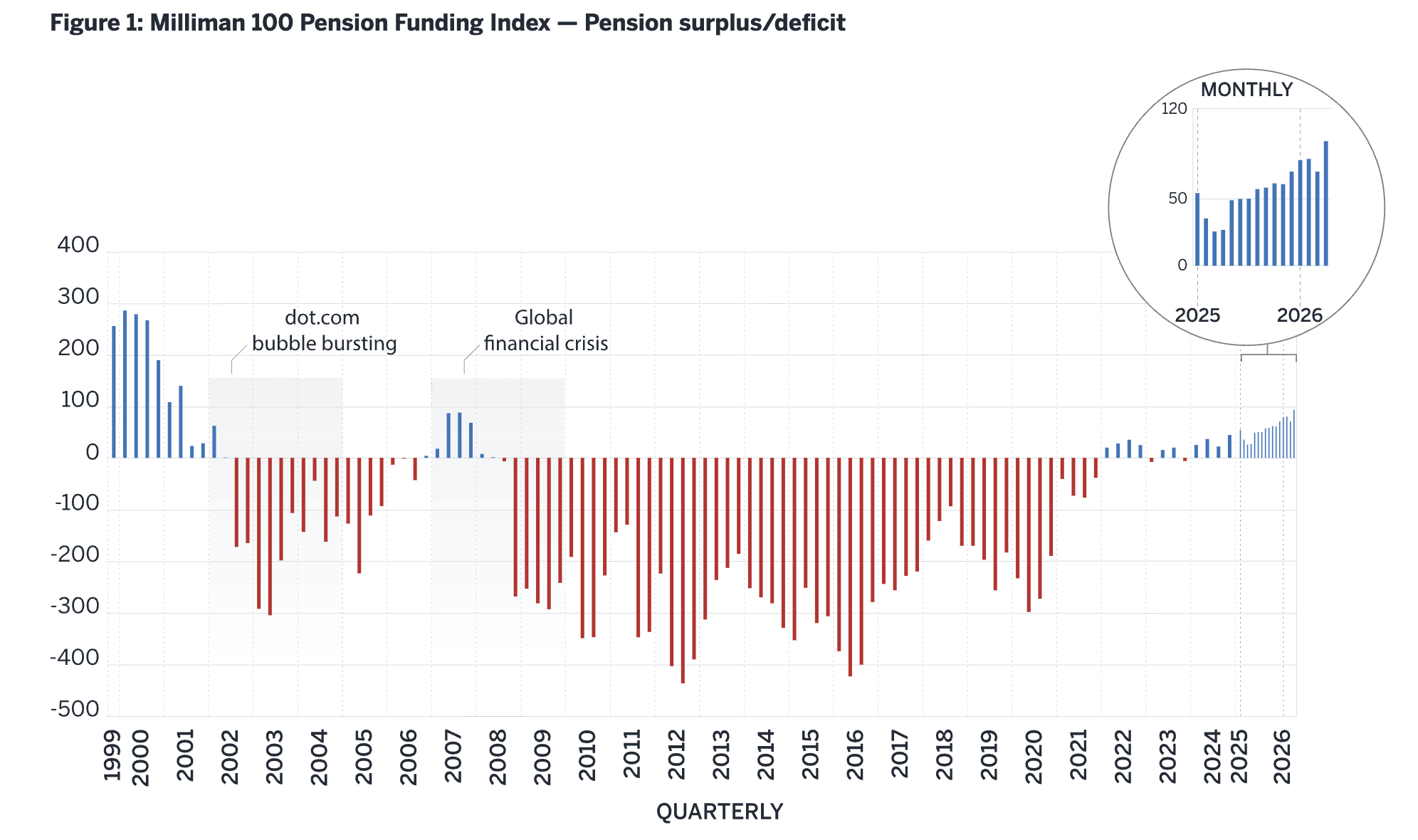
As for today’s members, the Milliman 100 PFI plans showed improved funding by $23 billion during April. These stellar results were driven by strong equity returns as the constituents averaged a 2.13% gain. As a result, the funded ratio dramatically improved from 105.9% at the end of March to 107.8% at the end of April representing the highest level of funding since October 2007, when it stood at 108.1%. Strong investment gains increased assets by $20 billion and now stand at $1.297 trillion, while the projected benefit obligation fell slightly to $1.204 trillion, as the monthly discount rate edged up one basis point, to 5.66% from 5.65%. 

“After a flat first quarter, the funding surplus grew to $94 billion at the end of April, primarily due to strong market returns,” said Zorast Wadia, author of the Milliman 100 PFI. “This means plan sponsors continue to have more pension risk management options as plans move further into surplus territory.”

Plan sponsors would be wise to seek risk reducing strategies. The previous high watermark was achieved in October 2007, just prior to the start of the Great Financial Crisis, which pummeled markets through March of 2009. As the graph below highlights, the Milliman 100 went from a small surplus in the Q3’07 to a major deficit within 6 months. It would be another 13-years before a surplus was once again created.

Plan sponsors should secure the pension promises through a cash flow matching (CFM) strategy and then actively manage surplus assets since they’ve now created a much longer investing horizon for those assets. Ryan ALM, Inc. is always willing to provide a free analysis of what is possible through CFM.

For the full Milliman report, click on the link below.

View this month’s complete Pension Funding Index.

Unique Liabilities Require A Unique Solution

By: Russ Kamp, CEO, Ryan ALM, Inc.

Most pension plans have exposure to fixed income. Perhaps not as much as they did prior to 2000, but today’s common thinking is that the current exposure is enough to act as a buffer should equity markets not continue along this momentum fueled path, and finally, to support the monthly liquidity needs of the fund. But are those the right reasons to use bonds and what type of fixed income should be used to accomplish those objectives?

We observe that most funds use a variety of investment grade bonds (Treasuries, Agencies, Corporates, etc.) and they have that collection benchmarked to a generic index such as the Bloomberg U.S. Aggregate Index (a.k.a. the Agg). As a reminder, the Agg was created by Ron Ryan when he was Head of Research at Lehman Brothers a few years ago. But, again, is this the right approach? We at Ryan ALM, Inc. believe that bonds should only be used for their cash flows (principal and interest) and not as a performance driver. Bonds are perhaps the only asset class with a known cash flow equal to the value at maturity (PAR) and contractual interest payments. Those known cash flows can be modeled to meet the plan’s ongoing liability cash flows (benefits + expenses). 

Which brings me to the point that every pension plan’s liabilities are unique, and as such, no generic index such as the Agg could possibly match a plan’s liabilities. If the asset cash flows don’t match and fund the liability cash flows (benefits and expenses), the plan is subject to unnecessary interest rate risk. Again, given that every pension plan has a unique set of liabilities this would suggest that each pension plan needs to have an investment strategy created specifically for their cash flow needs. Cash Flow Matching (CFM) is an investment strategy with a very long and successful history. An appropriately crafted CFM portfolio will meet and fully fund chronologically the liability cash flows as far into the future as the allocation to the CFM strategy lasts.

We take great pride in our proprietary CFM optimization modeling, which we began using at Ryan ALM’s founding in 2004. Having the ability to tailor unique solutions to client specific issues/requests is a hallmark of our firm, and this capability is being recognized throughout the industry. In fact, we recently received this feedback from an ALM expert at a large asset/liability consulting firm, who stated that I’m “impressed with the team’s ability to build portfolios for such non-standard cashflow streams.” Thank you!

We’d be happy to demonstrate our capability and we’re always willing to provide a free analysis highlighting how your fund could benefit through CFM and Ryan ALM’s expertise. Just call us.

Why Wouldn’t You Prefer a SD of +/-0%?

By: Russ Kamp, CEO, Ryan ALM, Inc.

I continue to be surprised that more pension plans don’t embrace greater certainty in the management of their funds. The Iran War is leading to great uncertainty related to inflation, interest rates, and economic growth. Yes, U.S. equities have enjoyed a healthy recovery following the initial outbreak in the Middle East, but is that sustainable?

Callan does a good job of providing a regular review of what asset allocation would be necessary to achieve a 7% return and the risk (measured as standard deviation) to achieve that return objective. Callan indicated that it was very easy to achieve a 7% return all the way back in 1994 when U.S. interest rates were higher than they are today. In fact, an allocation of 85% to fixed income and small allocations to L.C. equity, SC equity, and int’l stocks would have produced a 7% return with only a 5.6% annual standard deviation.

However, in the most recent update from 2024, Callan suggests the following asset allocation is necessary to achieve a 7% return:

This means that 68% of the time, a plan sponsor should expect an annual return of 7% +/- 8.6%. At two standard deviations (95% of the observations or 19/20 years), the annual return will fall between +/- 17.2% of the 7% target. Would you be comfortable knowing that your fund could generate an annual return of -10.2%? Think about the impact a return like that would have on contributions?

What if I said that cash flow matching (CFM) a portion of your pension fund would result in those assets having an annual SD of 0% barring a default which occurs at a rate of 0.18% annually among investment grade corporate bonds for the last 40-years. How’s that possible? When CFM is implemented, the plan’s asset cash flows and matched agains the plan’s liability cash flows (benefits and expenses). They mover in lockstep with each other no matter where rates go. Today’s U.S. interest environment is attractive and getting more attractive as I write this post, as the 30-year Treasury bond yield has topped 5% (5.02% at 11:47 am DST). Higher rates are great for CFM, as they lower the present value of those future promises.

Furthermore, the use of a CFM portfolio secures the pension promises, dramatically improves plan liquidity, eliminates interest rate risk for the portion of the plan, extends the investing horizon for the residual plan assets, and reduces the cost of those future pension promises. Again, why wouldn’t you embrace an element of certainty?

I’m not sure what the Callan team would identify as the proper allocation to achieve a 7% return today, but I suspect that the annual standard deviation is greater than the 8.6% from 2024. Every time a pension plan falls short of the annual ROA, contributions must increase to make up for the shortfall. Greater investment certainty, like that associated with using CFM, reduces the likelihood that the pension plan sponsor with suffer from a negative surprise associate from increased contributions.

Is Now Really the Time to Buy Stocks?

By: Russ Kamp, CEO, Ryan ALM, Inc.

U.S. equity markets enjoyed a robust April despite myriad economic and geopolitical inputs that might have given investors pause. Should equity investors remain bullish at this time? The graph below caught my attention primarily because of the recent disconnect between the two lines related to the Shiller Excess Cape Yield (ECY) and subsequent 10-year Real Return for equities. There are many, many valuation tools that claim to provide clues about the future direction of stocks, and this is such an example. Those tools can be short-, medium-, and long-term in nature. The ECY happens to be one valuation metric that provides “guidance” for longer time frames. The current reading of 1.60% certainly looks rich relative to its long history.

In case you don’t know, the Shiller excess CAPE yield is a valuation measure that compares the stock market’s earnings yield with the “real” yield on the 10-year Treasury note. In simple terms, it asks how much extra return stocks may offer over inflation-adjusted government bonds.

How it is calculated

  • Take the inverse of the CAPE ratio, which is the market’s “earnings yield.”
  • Subtract the real 10-year Treasury yield.

So, ECY=(1/CAPE)10-year real Treasury yield

A higher excess CAPE yield suggests stocks might look more attractive relative to bonds. A lower reading suggests the equity risk premium is thinner, meaning stocks offer less return versus bonds. As mentioned above, current readings show the S&P 500 Shiller Excess CAPE Yield around 1.60% for April 2026, which is well below its long-term average of 4.60%. Another data source put it at 1.41 as of April 30, 2026.

Investors have historically used the ECY as a long-term asset allocation tool, especially when comparing stocks with Treasury bonds. It is not a short-term trading signal, but rather a rough guide to whether equities look cheap or expensive relative to real bond yields. A CAPE yield below 2% has generally signaled subdued future equity returns over the next 5 to 10 years, providing a valuation warning sign, and not an exact measure.

As a reminder, there are many valuation techniques used to identify opportunities and risk when investing in U.S. equities. Depending on a pension plan’s liquidity needs, funded ratio, willingness to take risk, etc. today’s current environment may be providing an opportunity to reduce risk by trimming equities and using the proceeds along with core fixed income assets to establish a cash flow matching mandate. In the process, the plan’s liquidity is improved, promised benefits secured, and the investing horizon extended for the residual assets. Give us a call. We are always willing to provide a free analysis showcasing how CFM can help your fund.

I’m Prepared! Really?

By: Russ Kamp, CEO, Ryan ALM, Inc.

The Transamerica Center for Retirement Studies has published the findings for its 26th annual survey, “Life and Money: Retirement Security in the USA“. Only 66% of the 10,015 respondents believe that they are on the right path to enjoy a comfortable retirement, including 22% who are very confident and 44% who are somewhat confident, while 22% are not too confident, and 12% are not at all confident. I’m not sure that describing oneself as “somewhat” confident should be an indication of being on the right path, especially when taking into consideration that the median retirement savings for participants in the survey was only $56,000.

According to the findings, those who felt they were currently building or had built a large enough nest egg was at 59% – we seemed to have lost 7% from the right path. Despite the optimism that the proper sized nest egg was being constructed, participants believed that they needed $500,000 in retirement. The difference between $56k currently accumulated and the $500k goal seems like a significant gap that might have led to a much smaller # of responders being confident at this time.

Transamerica found that 69% of respondents saved for retirement through a workplace 401(k) or similar plan, including 81% of employed respondents and 64% of self-employed respondents. Fifteen percent of employed workers indicated that their employer did not offer any retirement benefits. I wonder how many folks without any retirement savings or access to an employer sponsored retirement fund refused to participate in the survey?

Here’s where it gets a little scary for the average American worker. Among those who are not yet retired, the percentage of Americans who plan to continue working after they retire stood at 48% including 13% who plan to work full time and 35% who plan to work part time, and another 19% are “not sure.” So, 67% of the American workforce will at least consider continuing to work after they retire. I guess that’s how you can be comfortable that you are on the right path despite sitting at >$440k below the level of assets needed to retire.

American households are facing unprecedented financial pressures from housing, healthcare, education, childcare, food, energy, transportation, etc. Asking individuals to fund, manage, and then disburse a “retirement benefit” through a defined contribution plan (most of the respondents) is incredibly poor policy. Why do we think that these folks with little disposable income, no investment acumen, and no crystal ball to help with longevity considerations will produce successful outcomes? Regrettably, most won’t.

Pension Plan Sponsor: “I Wish that I could…”

By: Russ Kamp, CEO, Ryan ALM, Inc.

In October, I will celebrate my 45th year in the pension/investment industry. I’ve been truly blessed, but also frustrated by activities that I deem detrimental to the successful management of DB pension plans.

First and foremost, I believe that a majority of folks think that achieving the return on asset assumption (ROA) is the primary objective in managing a DB pension plan. This is an incorrect assumption! Creating an asset allocation targeted at a return only guarantees annual volatility, and NOT success.

Second, meeting monthly liquidity through the sweeping of interest, dividends, capital distributions, and worse, the selling of investments harms the long-term return of your fund.

Third, using core fixed income as a return generator is not a sound strategy, as bonds are highly interest rate sensitive, and who knows the future direction of rates.

That being said, if I were a pension plan sponsor, I’d wish that I could find an investment strategy that provided: All of the plan’s liquidity needs, certainty for a portion of that plan, and a longer investment horizon for my alpha generating assets (non-bonds) so that I enhance the probability of achieving the desired outcome.

Great news – there is such a strategy. Cash Flow Matching (CFM) is designed to use investment-grade bonds for their cash flows of interest and principal (upon maturity) to match liability cash flows of benefits and expenses for as far out as the allocation goes. Furthermore, it extends the investing horizon for the non-bond assets so that they can wade successfully through choppy markets without being a source of liquidity. Finally, there is an element of certainty (minus that rare occurrence of an IG bond default) absent in the management of DB pension plans outside of a pension risk transfer (PRT) or an annuity.

I believe that the primary objective in managing a DB pension plan is to SECURE the pension promise at low cost and with prudent risk. Does focusing on the ROA secure benefits – no. The “sweeping” of dividends, interest, and capital distributions to meet ongoing liquidity needs can negatively impact the plan’s long-term return. Guinness Global (U.K. investment shop) produced a study that said sweeping dividends and not reinvesting them reduced the return to the S&P 500 by 47% over 10-year periods back to 1940 and 57% for 20-year periods.

Finally, bonds are highly interest rate sensitive. After a nearly 40-year decline in U.S. interest rates which drove bond prices up and yields down, we have seen rates rise to more average levels where they are holding leading to very weak fixed income returns for recent performance periods. Matching asset cash flows with liability cash flows eliminates interest rate risk for that portion of the portfolio, as benefits and expenses are future values that are not interest rate sensitive. Furthermore, Ryan ALM’s approach is to use 100% IG corporate bonds to build the CFM portfolio. A 100% IG portfolio will outperform a core active fixed income portfolio by the yield differential given the core portfolio’s exposure to agencies and Treasuries.

Question: If you had the opportunity to bring some certainty to the management of pensions, why wouldn’t you do it? If not, please share with us why not.

March Proves Challenging for Core Fixed Income

By: Russ Kamp, CEO, Ryan ALM, Inc.

March was a difficult month for active core fixed income managers, as the Bloomberg U.S. Aggregate Index fell -1.8%. Uncertainty related to the impact of the Iran War on oil prices and subsequently inflation, pushed rates higher across the Treasury yield curve. The U.S. 10-year Treasury note saw yields rise 38 bps to 4.31%.

Agencies fell -1.7% in line with Treasuries, while the Corporate sector declined -2.0%. Corporate spreads ended March with an option adjusted spread (OAS) of 88.6 bps. The best performing Corporate sector was Financials (-1.7%), while Utilities performed worst at -2.2%.

The greatest risk managing bonds is interest rate risk. Given both geopolitical (Iran, Taiwan, Ukraine) and economic risks (oil, inflation, interest rates), now is the time to significantly reduce risk within your fund, whether that be a DB pension or E&F. Why continue to ride active fixed income through these uncertain markets? One can use a cash flow matching (CFM) strategy to SECURE and fund net liabilities chronologically well into the future. In the process, interest rate risk is eliminated as future benefits and expenses are not interest rate sensitive.

Furthermore, by securing near-term liabilities, the non-bond assets can now grow unencumbered providing more time to wade through these challenging times. I have no idea how long this conflict will last. I also don’t know how much damage has occurred and that which might still happen to oil production in the Middle East. Implementing a strategy that doesn’t rely on forecasting U.S. interest rates should be a high priority today.

Making the switch is easy. Rotate your current core fixed income assets from an active investment strategy to a CFM portfolio. There isn’t a need to revisit the fund’s asset allocation. We’ll even look for opportunities to take-in-kind some of your existing holdings. You’ll appreciate not having to search each month for the liquidity to meet the monthly promises that have been made to your participants, as the CFM strategy will provide all the liquidity that you need. Moreover, the Ryan ALM CFM model is skewed to A/BBB+ corporate bonds which should outyield most generic bond indexes that are skewed to Treasuries (e.g. the AGG).


Trouble Paying the Bills?

By: Russ Kamp, CEO, Ryan ALM, Inc.

“The worst thing that can happen,” Andrew Junkin, CIO, Virginia Retirement System says, “is that you’re a forced seller in any market.”

That quote appeared in a Chief Investment Officer article from March 4, 2026. We couldn’t agree more with Mr. Junkin. Despite improved funding, public funds are being challenged to find adequate cash flow to meet the monthly benefits and expenses. Two factors are at play: 1) improved funding leads to lower annual contributions, and 2) much heavier allocations to alternatives have dried up liquidity, as expected capital distributions fail to materialize.

According to a report by NIRS, from 2001 to 2023, public pension plans shifted roughly 20% of public equity and fixed income into alternatives such as private equity, real estate, and private credit. These are illiquid investments. Despite the “wisdom” of the pension crowd, illiquidity is a RISK and not an alpha generator. As more assets shifted into these illiquid investments, the trades became ever more crowded reducing liquidity further. That is, unless one was willing to take a significant haircut through the secondary markets.

As a reminder, public pension funds are designed to become cash-flow negative over time. Contributions into these funds exceed benefits in earlier decades, building a corpus to be used to fund retirements down the road. They are designed to have the last $ pay the last promised benefit. There is no inheritance waiting for the last few beneficiaries.

You want to have adequate liquidity that isn’t forcing the sale of assets at inopportune times? Develop an asset allocation strategy that bifurcates your assets into two buckets – liquidity and growth – and stop the focus on the ROA as if it were the Holy Grail. It isn’t! Use a cash flow matching (CFM) investment strategy to ensure that abundant liquidity is available from next month as far into the future as your allocation goes. The remainder of the assets go into the growth bucket. If you still want to maintain a heavy allocation to alternatives, they can now grow unencumbered as they are no longer a source of liquidity.

The allocation should be driven by the pension plan’s funded ratio and ability to contribute. We recently provided a large fund with an analysis that showed a plan with <50% funding could still secure the promised NET benefits for the next 33-years, while creating a substantial surplus that could now be managed as aggressively as members of that Board could withstand. Not only are the promised benefits secure, but so are the participants who can now sleep well at night knowing that myriad risks won’t sabotage their golden years.