Milliman: Corporate Pension Funding Highest Since 2007

By: Russ Kamp, CEO, Ryan ALM, Inc.

Milliman has once again released its monthly Milliman 100 Pension Funding Index (PFI), which analyzes the 100 largest U.S. corporate pension plans. It would be fascinating to see how these 100 plans differ from a list just 20-years ago.

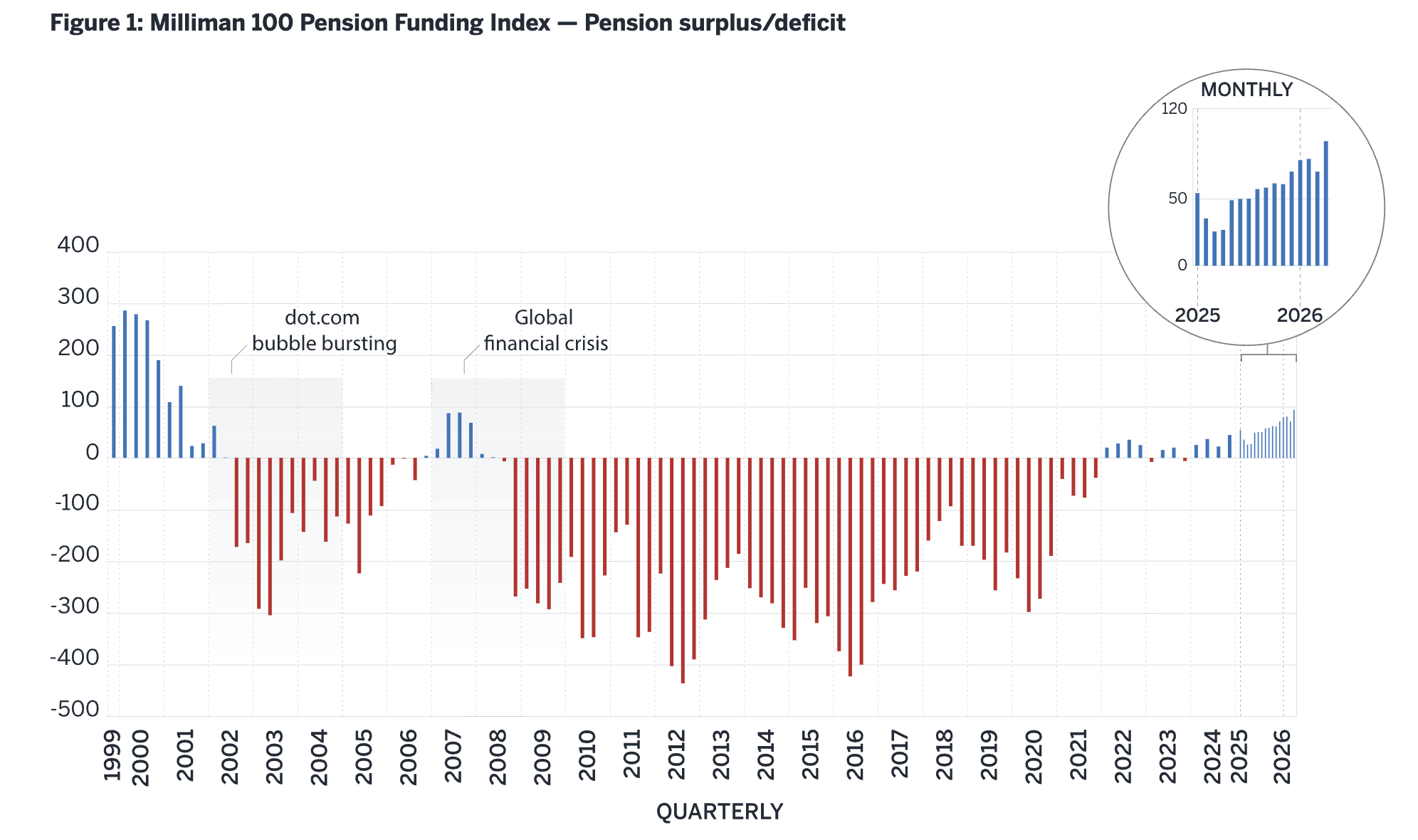
As for today’s members, the Milliman 100 PFI plans showed improved funding by $23 billion during April. These stellar results were driven by strong equity returns as the constituents averaged a 2.13% gain. As a result, the funded ratio dramatically improved from 105.9% at the end of March to 107.8% at the end of April representing the highest level of funding since October 2007, when it stood at 108.1%. Strong investment gains increased assets by $20 billion and now stand at $1.297 trillion, while the projected benefit obligation fell slightly to $1.204 trillion, as the monthly discount rate edged up one basis point, to 5.66% from 5.65%. 

“After a flat first quarter, the funding surplus grew to $94 billion at the end of April, primarily due to strong market returns,” said Zorast Wadia, author of the Milliman 100 PFI. “This means plan sponsors continue to have more pension risk management options as plans move further into surplus territory.”

Plan sponsors would be wise to seek risk reducing strategies. The previous high watermark was achieved in October 2007, just prior to the start of the Great Financial Crisis, which pummeled markets through March of 2009. As the graph below highlights, the Milliman 100 went from a small surplus in the Q3’07 to a major deficit within 6 months. It would be another 13-years before a surplus was once again created.
Plan sponsors should secure the pension promises through a cash flow matching (CFM) strategy and then actively manage surplus assets since they’ve now created a much longer investing horizon for those assets. Ryan ALM, Inc. is always willing to provide a free analysis of what is possible through CFM.

For the full Milliman report, click on the link below.

View this month’s complete Pension Funding Index.

One Can Only Hope!

By: Russ Kamp, CEO, Ryan ALM, Inc.

The title of this post could be used to discuss any number of uncertainties that we are currently facing including geopolitical risk, economic risks associated with potentially disruptive policies, to the economic burdens faced by many Americans. I’ve chosen to apply this title to the prospect that America’s sponsors of defined benefit plans may not be offloading those pension liabilities with the rapidity that they’ve shown in the last decade or so.

There recently appeared an article in PlanSponsor titled, “Fewer Plan Sponsors Terminating DB Plans Amid Risk Management Shifts”. Again, one can only hope that this trend continues. “Half of plan sponsors do not intend to terminate their DB plans, up from 36.7% in 2023 and 28.3% in 2021, according to Mercer’s 2025 CFO Survey,” The survey was based on response from 173 senior finance officers. Unfortunately, it doesn’t undo the harm wrought by all the previous DB terminations, but it is still wonderful news for the American workforce!

As I’ve reported previously, Milliman’s monthly index of the Top 100 corporate plans currently shows a 104.1% funded ratio. Managing surplus assets is now the focus for many of these pension plans. Generating pension earnings, as opposed to living with the burden of pension expense will change one’s perspective. In Ron Ryan’s excellent book, titled, “The U.S. Pension Crisis”, he attributes a lot of the crisis to the accounting rules. For many corporations, pension expenses became a drag on earnings. Sure, they might have said that the company’s primary focus was manufacturing XYZ product and not managing a pension, but the costs associated with managing a DB plan certainly weighed heavily on the decision to freeze, terminate, and eventually transfer the plan.

Now that companies are sitting with a surplus leading to pension earnings, they are reluctant to shift those assets to an insurance company. According to the Mercer survey “70.1% reporting they have implemented dynamic de-risking strategies, an increase of nearly 10 percentage points from 2023. Additionally, 44% have boosted allocations to fixed-income assets to stabilize their funded status.” Let’s hope that they just haven’t engaged a duration strategy to mitigate some of the interest rate sensitivity. As we’ve stated, cash flow matching is a superior strategy to duration matching as every month of the coverage period is duration matched and you get the liquidity as a bonus to meet monthly distributions. Moreover, the Ryan ALM model will outyield ASC 715 discount rates which should enhance pension income or reduce pension expense.

Clearly, this is a positive trend, but we are far from out of the woods in preserving DB pensions. Unfortunately, plan sponsors are still considering risk transfers which continue to “dominate strategic discussions”, as more than 70% of organizations plan to offer lump-sum payments to some portion of their plan beneficiaries in the next two years.” The American workforce is far more interested these days in securing their golden years and a DB plan is the best way to accomplish that objective.

Terrific Issue Brief from the American Academy of Actuaries

By: Russ Kamp, CEO, Ryan ALM, Inc.

An acquaintance of mine shared an issue brief that was produced by the American Academy of Actuaries last April. They Academy describe their organization and role, as follows. “The American Academy of Actuaries is a 20,000-member professional association whose mission is to serve the public and the U.S. actuarial profession. For more than 50 years, the Academy has assisted public policymakers on all levels by providing leadership, objective expertise, and actuarial advice on risk and financial security issues. The Academy also sets qualification, practice, and professionalism standards for actuaries in the United States.”

The brief addressed surplus management for public pension systems. What does it mean and what should be done when a plan is in “surplus”. It is important to understand that a surplus calculation (plan assets – plan liabilities) is a single point in time. Our capital markets (assets) and U.S. interest rates (discounting of liabilities) are constantly changing. A plan that is deemed to be in surplus today could easily fall below 100% the very next day.

The go go decade of the 1990s witnessed public pension’s producing fairly consistent double-digit returns. Instead of locking in these gains through sound surplus management, benefits were often enhanced, contributions trimmed, or both. As a result, once the decade of the ’00s hit and we suffered through two major recessions, the enhancements to the benefits which were contractually protected and the lowered contributions proved tough to reverse.

According to Milliman, they estimate the average public funded ratio at 81.2% (top 100 plans) as of November 30, 2024. This is up substantially from September 30, 2022 when the average funded ratio was roughly 69.8%. But it highlights how much work is still needed to be done. I agree that it is wise to have a surplus management plan should these critically important funds once again achieve a “surplus”. I would hope that the plan is centered on de-risking their traditional asset allocations by using more bonds in a cash flow matching (CFM) strategy to reduce the big swings in funding. Furthermore, it is critically important to secure what has already been promised than to weaken the funded status by enhancing benefits or cutting contributions prematurely.

I’d recommend to everyone involved in pension management that they spend a little time with this report. The demise of DB pension plans in the private sector has created a very uncertain retirement for many of our private sector workforce. Let’s not engage in practices that lead to the collapse of public sector DB plans.