ARPA Update as of July 10, 2026

By: Russ Kamp, CEO, Ryan ALM, Inc.

Another Monday, another ARPA update. If this legislation wasn’t so important to so many American workers promised a benefit that had a very uncertain future, you’d probably say “enough already”. But we know that DB pension benefits provide retirees with some certainty and contribute to a more dignified retirement.

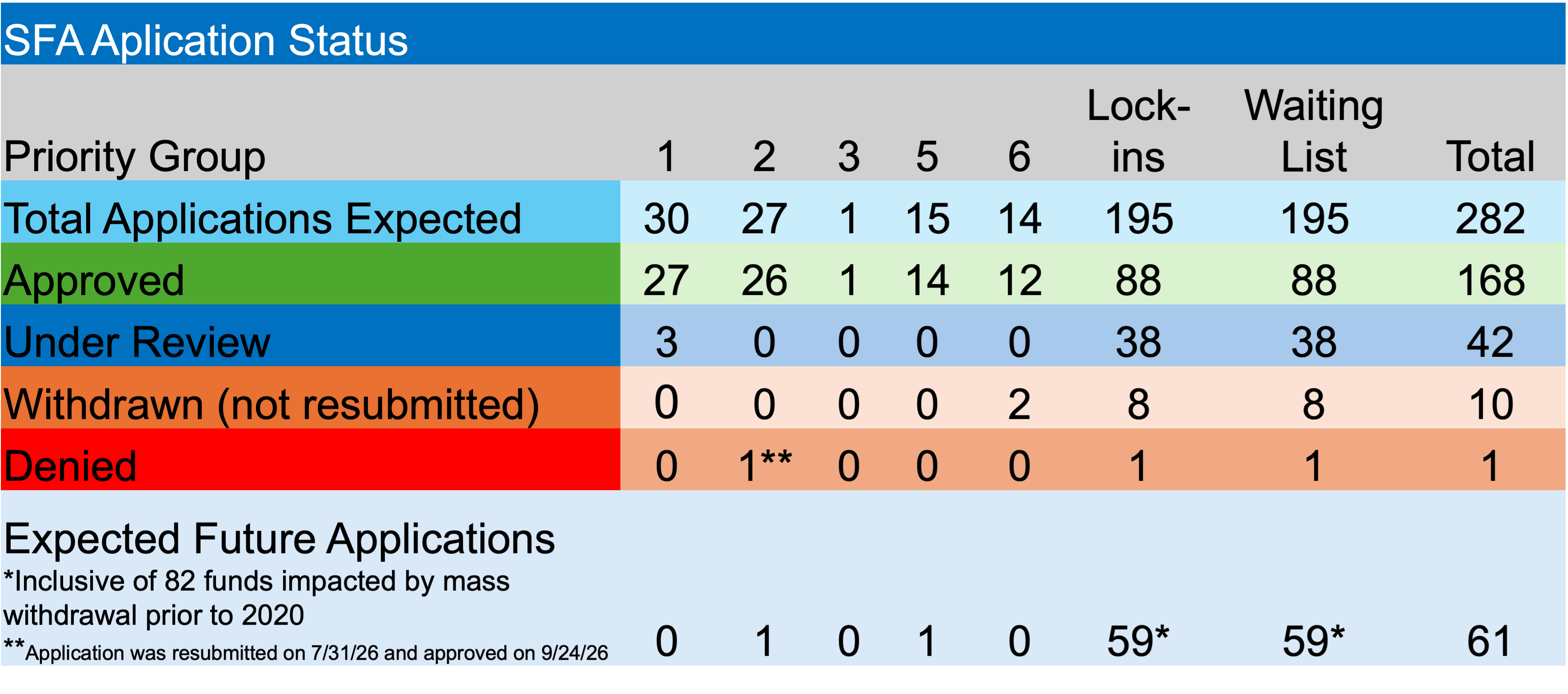
The ARPA legislation, and the PBGC’s implementation of this critical program, is less than 6-months from its completion. As a result, weekly activity is waning. The previous highlights this trend, as only 1 pension fund received approval of its SFA application. Iron Workers-Laborers Pension Plan of Cumberland, Maryland, will receive $22.7 million for the plan’s 754 participants, as this non-priority group member received approval for its revised SFA application on July 8th.

There was no other apparent activity during the previous week, as no applications were received, denied, or withdrawn. The waitlist still has one non-Mass Withdrawal fund that has yet to submit an application to the PBGC.

There are currently eight applications before the PBGC. Roofers and Slaters Local No. 248 Pension Plan’s application must be acted on by July 18th by the PBGC, or they will automatically receive an SFA grant, currently estimated at $5.1 million.

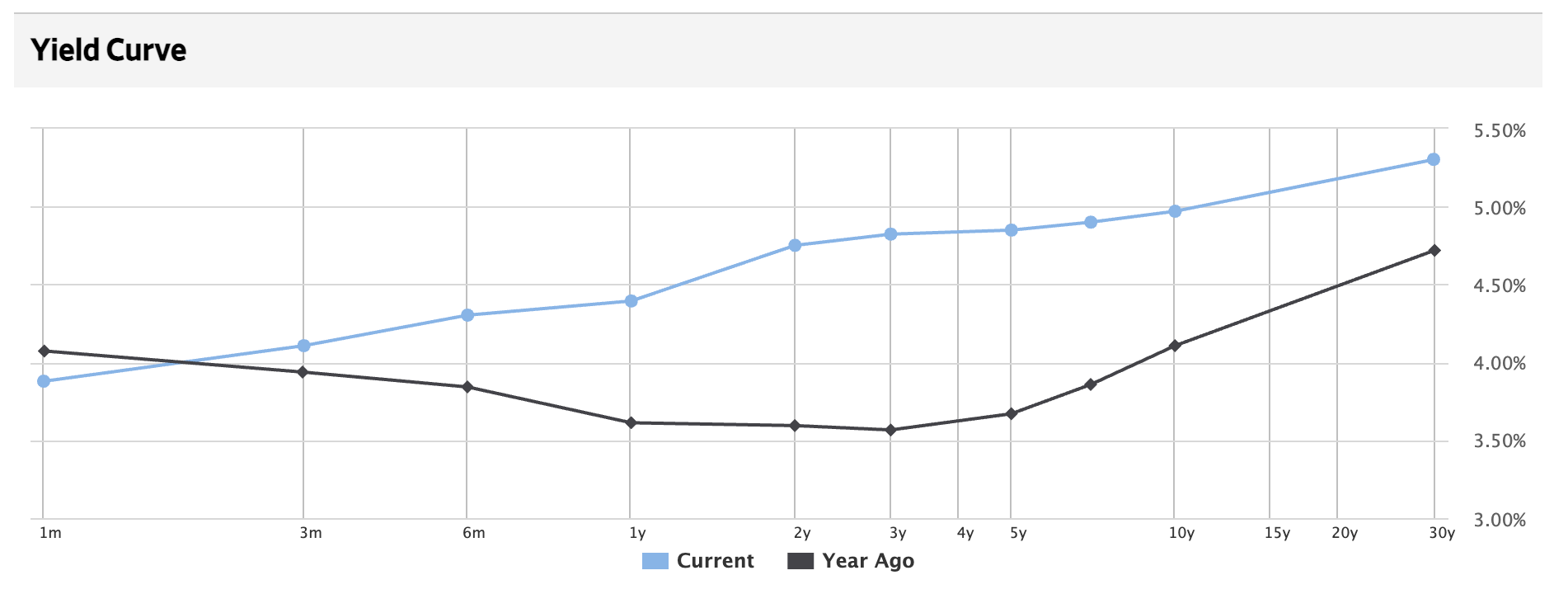
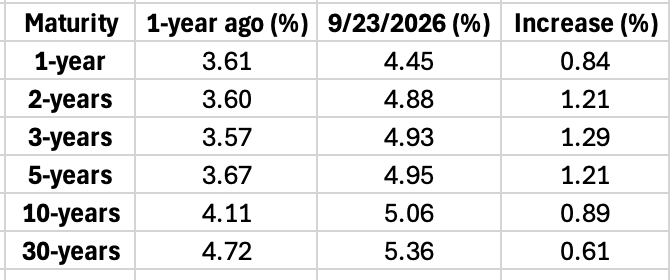
For pension plans still waiting to receive SFA or for those that have recently received their grant, U.S. rates continue to be near cycle highs, providing pension sponsors with the opportunity to secure those future benefits with greater cost reduction.

Lastly, the PBGC continues to codify its rules regarding permissible investments for the SFA proceeds, which seems surprising given that we are 5-years into the program and their oversight. Ron Ryan and I will provide our thoughts on the latest proposed changes in a separate post.

Ryan ALM, Inc. – Q2’26 Newsletter

By: Russ Kamp, CEO, Ryan ALM, Inc.

We are pleased to share with you our insights and perspectives on the relationship of pension assets to pension liabilities (benefits and expenses) through the Q2’26 Newsletter. As you will read, the second quarter produced a nice turnaround for pension funding following a challenging Q1, as asset growth far outpaced liability growth. As a result, funded ratios are at a high point since we began our analysis back in 2020.

As always, we encourage you to reach out to us with any questions or observations. Thank you for taking the time to read our insights.

Complexity Doesn’t Make it Good or Appropriate

By: Russ Kamp, CEO, Ryan ALM, Inc.

We have a serious retirement problem in the U.S. Defined benefit plans have mostly been replaced in the private sector, and rising contribution levels are making public pension offerings problematic for the sponsoring entities. These issues are compounded by the fact that many defined benefit plans have migrated significant assets to opaque, complex, and costly alternative investments. In the process, creating liquidity to meet ongoing benefits and expenses has become more challenging.

Managing a DB pension plan isn’t complicated, yet we continue to make it so. I read an Institutional Investor article with interest, and some alarm, that a public pension system operating with negative cash flow (contributions < benefits and expenses) has decided that the best way to address the liquidity shortfall is to move assets into “”a lot more esoteric lending strategies” like asset-based finance and royalty-based lending in sectors such as entertainment, healthcare, and aircraft engine leasing.” The CIO for this fund continued, “we’re going into a lot of illiquid structures, so we structure the portfolio to make sure we have enough liquidity to meet our benefit payments at all times,” Really????

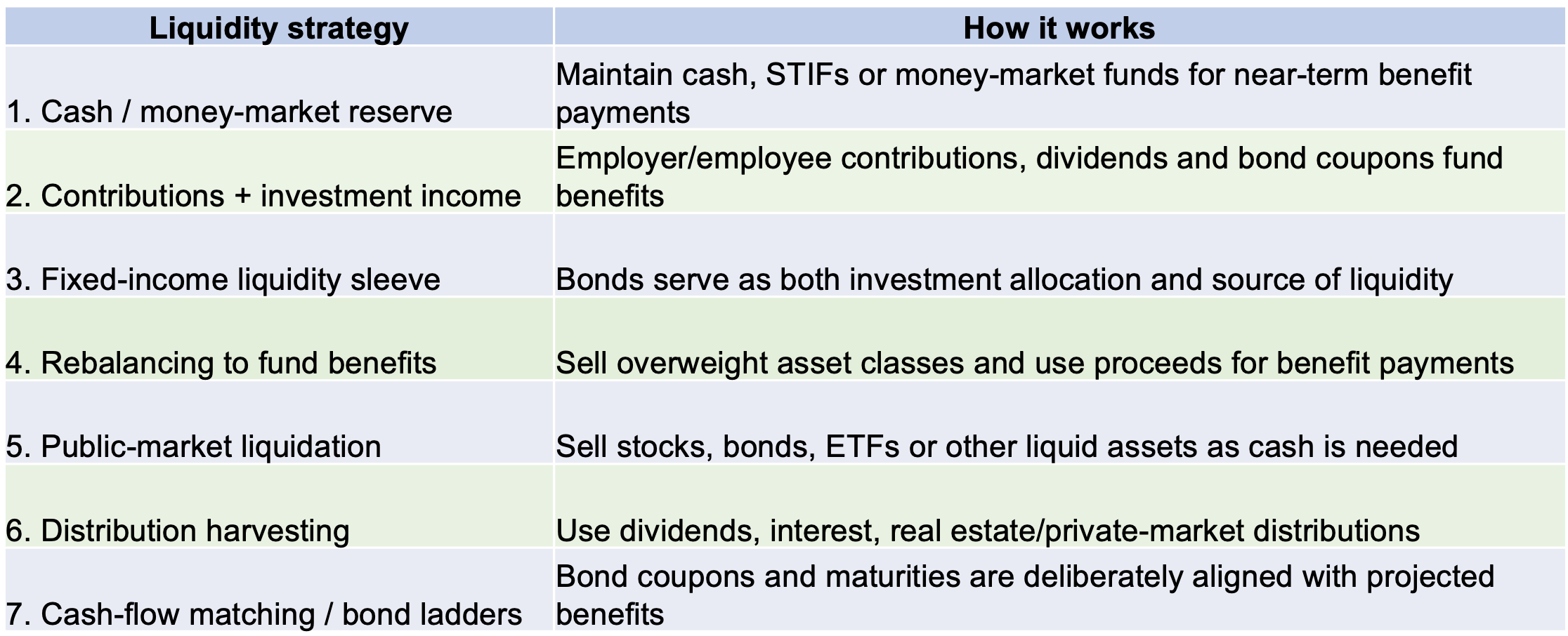
Going into illiquid structures to ensure adequate liquidity seems oxymoronic. We’ve seen what has transpired in both private equity and private debt regarding distributions and the lack thereof. Again, our industry often brings complexity to a problem when there are far simpler ways to tackle an issue. For decades, Cash Flow Matching (CFM) has carefully matched asset cash flows of bond interest and principal with the liability cash flows of benefits and expenses (B&E) chronologically. There is no hoping that the liquidity will be available when needed.

U.S. rates are currently at levels providing plan sponsors with the ability to SECURE future B&E at low cost and with certainty barring any defaults in IG bonds (<0.2%/year for the last 40-years). Why engage in expensive, opaque “solutions” when a CFM strategy can be adopted for pennies on the $. CFM is a-sleep-well-at-night strategy, which will be comforting to not only the plan sponsor but the plan’s participants. Please stop thinking that a solution needs to be complex to be good. Some of the very best approaches are transparent, straight-forward, and inexpensive: like CFM!

It’s The Wrong Benchmark!

By: Russ Kamp, CEO, Ryan ALM, Inc.

Mark Stricherz has penned an article for The Center Square discussing the Pennsylvania Public-School Employees’ pension fund and its $41 billion shortfall. The gist of article centered on the fact that PSERS failed to exceed it’s investment benchmark last years which fund officials blamed on private equity.

A bit of background: As of Dec. 31, PSERS held $85.3 billion in assets, including $10.1 billion in private equity. Long-term return expectations for this asset class were an annual 10.06% return. The precision of the return expectation seems a bit silly and quite modest given the asset class’s poor transparency, lack of liquidity, and excessive fees. As a point of comparison, the S&P 500 returned 11.4% for the 20-years through June 30, 2026. Regrettably, PSERS’ PE funds produced only a 2.59% last year. As ugly as that return is, that is NOT the reason that PSERS is $41 billion in the whole and Pennsylvania taxpayers on the hook.

An investigation by The Center Square found that private equity was the only one of PSERS’ eight asset classes to miss its benchmarks over one-, three-, five-, 10- and 15-year periods. Interesting! I find it hard to believe that the fund had this kind of relative outperformance and yet still must deal with a $41 billion shortfall. Again, I don’t believe that PE is the sole cause.

As I’ve been reporting for years, the primary objective in managing a defined benefit plan is NOT one focused on return (the ROA). It is the SECURING of the promised benefits at a reasonable cost and with prudent risk. It is a LIABILITY objective. It doesn’t matter that a plan’s assets outperform their respective asset class objectives if the plan’s total fund fails to exceed liability growth. Presently, there are roughly 500,000 members and beneficiaries counting on those promised benefits.

A successful DB pension plan understands its commitments. You’ve made a promise: measure it – monitor it – manage it – and SECURE it! Focusing on return only guarantees volatility. Volatility of returns, contributions, and funded status. Get off the performance rollercoaster.


ARPA Update as of July 2, 2026

By: Russ Kamp, CEO, Ryan ALM, Inc.

Whether you celebrated America’s independence on July 2nd or 4th, we hope that you had a wonderful weekend celebrating 250-years with family and friends.

Regarding the PBGC’s implementation of ARPA’s pension legislation, we can report that Albany-based Iron Workers Local No. 12 Pension Fund, a non-priority SFA candidate, will receive $4.7 million in SFA for its 659 members following approval by the PBGC of the revised application.

In other news, the 90 members of the PMPS-ILA Pension Plan and Trust are hoping that the revised application will soon be approved providing the fund with $769k in SFA.

Pleased to report that there were no funds denied the ability to submit an application and no applications before the PBGC were withdrawn. However, Plasterers Local 79 Pension Plan still remains the only non-Mass Withdrawal waitlist candidate to not submit an application at this time.

U.S. interest rates remain at attractive levels providing plan sponsors with the opportunity to significantly reduce the cost of future pension promises, while securing monthly liquidity needs. We would welcome the opportunity to produce a free cash flow analysis on what your fund’s projected SFA could potentially do for your fund.

July 2, 1776 – The Real Independence Day!

By: Russ Kamp, CEO, Ryan ALM, Inc.

We’ll depart from the usual focus on defined benefit pensions for a day to bring you this history lesson.

Hear ye, hear ye: We’ve been celebrating the wrong “Independence Day” for 250-years. How’s that? Well, if it were up to John Adams (and others), we’d be celebrating the 250th anniversary of the United States today.

On July 2, 1776, the Continental Congress voted to approve Richard Henry Lee’s (Virginia) resolution “that these United Colonies are, and of right ought to be, free and independent States, that they are absolved from all allegiance to the British Crown, and that all political connection between them and the State of Great Britain is, and ought to be, totally dissolved”. which is the formal decision to break from Britain.

In fact, this was the second day of voting on this resolution, as the first vote on July 1, 1776, saw Pennsylvania and South Carolina vote no, Delaware’s delegates were split, and New York abstained. Why? Lee’s resolution included three parts:
– Seek independence
– Establish foreign-alliances
– Prepare a plan of confederation

On July 2nd, 1776, the second and third parts of the resolution were deferred paving the way for the vote to be unanimous, except that New York once again abstained. They eventually accepted the resolution. That July 2nd vote was the real political act of independence; July 4th was when Congress adopted the text of the Declaration explaining and announcing that decision. 

To add further intrigue, if not confusion, according to the National Archives and several historians, August 2nd is often cited as Independence Day because that is when the parchment copy of the Declaration was first signed by most delegates, including John Hancock, who was the first delegate to sign in his capacity as the President of the Continental Congress.

As a Fiduciary, Would you…

By: Russ Kamp, CEO, Ryan ALM, Inc.

Regrettably, the investment industry has trained pension fiduciaries to think in terms of returns:

  • “Can we earn 7.25%?”
  • “Can we outperform the benchmark?”
  • “Should we own more equities?”
  • “How about alternatives?”

But we at Ryan ALM, Inc. believe chasing returns is NOT the economic objective of a defined benefit plan. Pursuing a return objective only guarantees volatility and not success. Volatility of returns, volatility of the Funded Ratio, and volatility of contributions! We believe that the objective is much simpler:

Deliver every promised benefit at the lowest sustainable COST to the sponsor.

Given that objective, we help pension plans reduce the cost of delivering every pension promise through our turnkey pension sustainable solutions. Reducing cost and SECURING the promised benefits is what every stakeholder should desire from trustees, to sponsors, and most importantly, plan participants.

As a pension Fiduciary what would you do if given this choice?

Imagine two pension funds that both owe retirees $100 million over the next 30 years. One fund invests with the goal of earning the highest possible return, while the other invests with the goal of meeting every payment at the lowest expected long-term cost.

Which strategy sounds more prudent? We believe that most trustees will immediately recognize that the second action better aligns with their responsibilities as Fiduciaries.

Here’s another example to consider. Lets think about funding your pension like you would a 30-year mortgage on your home.

Would you rather:

  • Put all your money in the stock market and hope it’s there when each payment comes due?

Or:

  • Structure your cash flows so each payment is already funded when it’s due?

I believe (hope) that most people would choose the second option for a monthly obligation they cannot afford to miss. Funding your monthly benefits is the exact same thing. Why not ensure that those benefits have been secured and the liquidity available as far into the future as possible through a cash flow matching (CFM) portfolio. It is absolutely time to get off the performance rollercoaster. Bring some certainty to a very uncertain process.

In conclusion, the primary pension objective is to pay every promised benefit at the lowest sustainable cost. Everything we do at Ryan ALM follows from that premise.

ARPA Update as of June 26, 2026

By: Russ Kamp, CEO, Ryan ALM, Inc.

New Jersey’s current weather is like standing in front of a blast furnace, and it will only get worse, so I flew to Orlando, FL to “cool” off at the FPPTA annual conference (42nd annual event). We live in strange times!

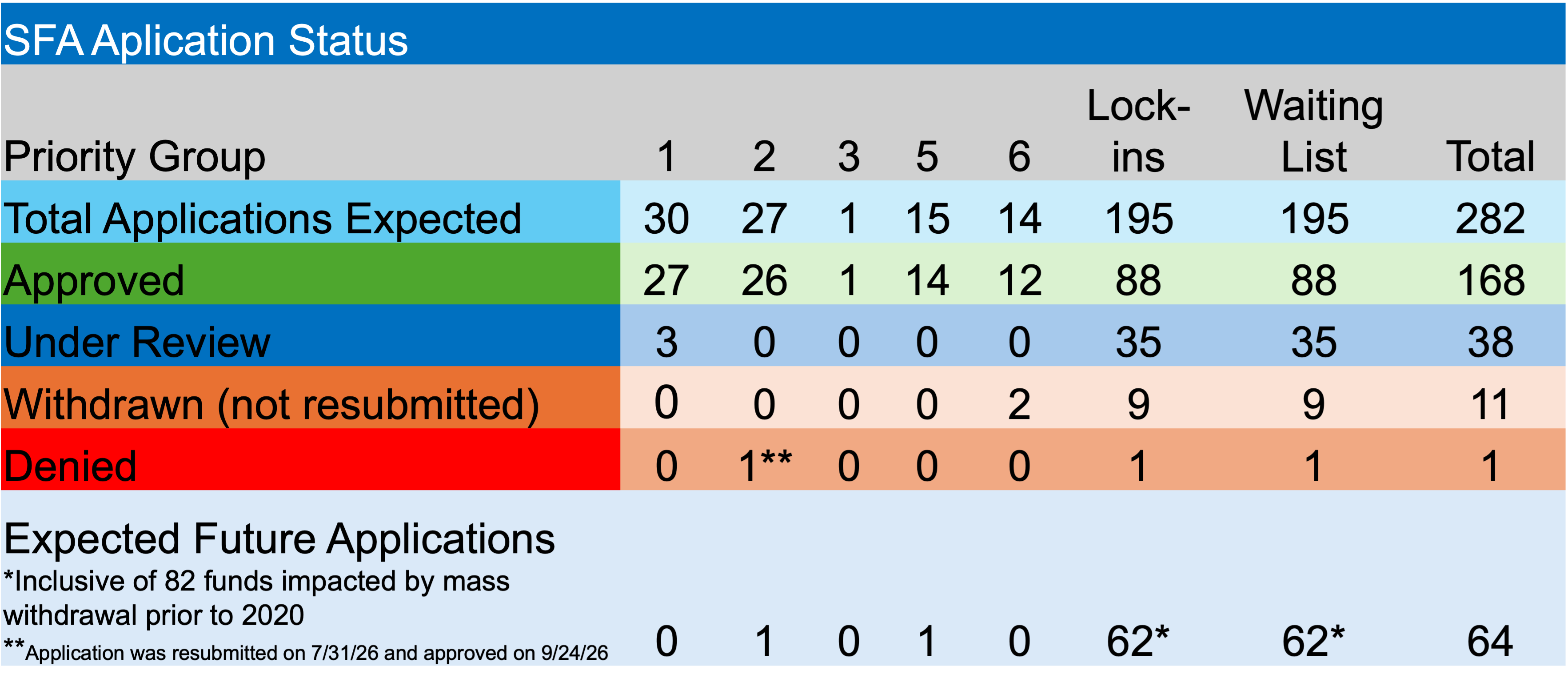
Regarding ARPA and the PBGC’s implementation of this critical legislation, things are heating up a bit, too. There was one application approved for SFA by the PBGC and another resubmitted. Columbus, Oh-based Bricklayers Local No. 55 Pension Plan, a non-priority group member, had its revised application approved that will award the fund with $7.2 million in SFA and interest for its 483 members.

In other news, Pension Plan of International Union of Bricklayers and Allied Craftworkers Local #15 Pennsylvania, an Allentown-based construction fund, has filed a revised application seeking $5.6 million in SFA for its 165 plan participants.

No pension funds were denied the opportunity to file based on eligibility and no funds withdrew applications. There were also no systems added to the waitlist. There remains one non-Mass Withdrawal plan on the waitlist that has yet to file an initial application.

There are 38 funds that could still receive SFA considerations exclusive of the 80 Mass Withdrawal funds residing on the waitlist. Three Priority Group members have yet to file an initial application, which seems strange to me, while 35 others have either applications currently before the PBGC (9) or have withdrawn previously submitted applications.

We will not be providing another ARPA update until after the Fourth of July. We wish for you and your family a wonderful long weekend. Stay safe and happy 250th.

Will You Be Wearing A Bathing Suit?

By: Russ Kamp, CEO, Ryan ALM, Inc.

I’m not asking about your plans for America’s 250th celebration come this Fourth of July. 

I read a very interesting email yesterday that referenced the tragic events in Venezuela by saying that the “earthquake doesn’t write the verdict. It audits the books.” My initial reaction: that’s harsh given the significant deaths and injuries that resulted, but upon reflection the author is correct. It wasn’t the fact that an earthquake of that magnitude hadn’t occurred in 125-years. It was the fact that poor planning, weak building codes, inferior construction, and poor maintenance well before the event created the tragic outcome.

As I contemplated the authors words, I began to reflect on what Warren Buffet had said in his 2001 annual letter to shareholders. He stated, “only when the tide goes out do you discover who’s been swimming naked.” Bringing this post back to investing and the impact on pension plans;

  • Rising markets make almost every strategy appear successful.
  • Cheap credit, abundant liquidity, and investor optimism hide poor decisions and weak fundamentals.
  • Excessive leverage, weak business models, and speculation can all seem to work (think SPCX).

But when the “tide goes out” (markets decline) we are left with the truth, and it can be pretty ugly.

  • Companies with too much debt struggle.
  • Investors who relied on leverage are forced to sell.
  • Weak business models fail (Dot Com bubble).
  • Investment managers, pension plans, and their advisors that took hidden risks are exposed.

Importantly, bear markets don’t create weakness—they expose weakness that was already there.

We witnessed what happened following the go go 1990s, when it seemed as if every investment made money, pension funded ratios were at or near all-time highs, and contributions were well contained. It was that prolonged bull market that made almost any pension investment strategy look successful. But then the piper came calling! By the time the tide had rolled out, we witnessed the crushing impact on America’s pension system that hadn’t done anything to secure the promised benefits, improve liquidity, and reduce risk in very aggressive asset allocations.

So, I ask once more, will you be wearing a bathing suit when the next market crash/event occurs? Have you done enough to protect the promises made to your plan participants? If you are concerned that you haven’t, let us perform the audit before the event occurs. Our turnkey system will:

  • Properly measure your fund’s liabilities and cash flow needs.
  • Generate and maintain sufficient liquidity chronologically.
  • Avoid excessive risk.
  • Manage interest-rate risk.
  • Buy-time for the growth assets to perform.
  • Stabilize the funded status and contribution expenses.

Those plans that prepare ahead of the “event”, will be the ones that are healthy when the tide begins to rise again. Prudent risk management matters much more than chasing returns. The real test of an investment strategy for a pension system isn’t during bull markets—it’s during highly uncertain ones, when hidden vulnerabilities become impossible to ignore. Will your fund pass an audit?

The Great Decoupling!

By: Russ Kamp, CEO, Ryan ALM, Inc.

No, I am not referring to some A-lister’s divorce. 

Unfortunately, for many American workers, inflation and a lack of real wage growth is killing the “American Dream”. Recent increases in consumer inflation, no matter how you measure it, has forced the average worker to cut back on consumption. But is this really a tale of recent inflation eclipsing wages or is there something more earth shattering that has created this situation?

The answer just may be productivity. As a reminder, productivity measures how much output a worker produces per hour worked. Economists generally expect that if workers produce more value, workers should receive a corresponding increase in compensation. From 1948 to 1973, productivity and worker compensation moved nearly in lockstep. This is the era when workers benefitted from greater unionization, healthcare and retirement coverage (DB pension plans) was expanding, and as a result, median household incomes rose rapidly.

Unfortunately, something dramatic occurred during the mid-1970s that broke down this correlation. There was a “great decoupling”, in which productivity rose dramatically while median wage growth failed to keep pace. The exact numbers vary depending on methodology, but virtually every major study finds a significant gap between productivity gains and compensation/wages. As an example:

Since 1973Increase
Productivity+80% to +90%
Median hourly compensation+15% to +30%
Median wagesEven less

Given this reality, who benefitted from these productivity gains?

It appears that a larger share of economic output now goes to corporate profits, shareholders, and business owners instead of workers. This is particularly important because not surprisingly stock ownership is concentrated among higher-income households. Furthermore, CEO pay increased dramatically relative to average worker pay. For instance, in the 1960s CEO pay was roughly 20–30 times worker pay. Today, a CEO’s pay can exceed 300 times worker compensation at large corporations.

The effects of globalization and technology have also impacted wage gains. American workers have been asked to increasingly compete with lower-cost foreign workers which has weakened their bargaining power in many sectors/industries. Technology has certainly increased productivity, but it has a tendency to tamp labor demand thus increasing shareholder value. Lastly, I believe that the fall in union membership from roughly 25% in the 19702 to around 6% today has had a profound impact on real wage growth, as workers generally have less collective bargaining power than in earlier decades.

Why this matters for retirement/retirees

A worker in 1965 had a pretty good chance of participating in a defined benefit pension plan, while also getting employer-paid healthcare, and possibly education support. A worker today is living with slower wage growth concurrent with being asked to fund a “retirement” through a defined contribution account with little disposable income, no investment acumen, and no crystal ball. Today’s workers own all the investment and longevity risk!

As a result, even though the economy is vastly more productive, many (most?) workers do not feel that they are sharing proportionally in that increased prosperity. Yes, the stock market may be at or near all-time highs, but that alone won’t make most Americans feel prosperous until wages truly reflect the output being produced by the average American worker.