What Would You Do?

By: Russ Kamp, CEO, Ryan ALM, Inc.

Happy St. Paddy’s Day to my Irish friends (I’m 1/2 Irish) and those that would like to be. May the luck of the Irish embrace you today.

As many of you know, we are always willing to provide to the pension and E&F communities a free analysis to highlight how a Cash Flow Matching (CFM) mandate could secure the promised benefits/grants for your fund and importantly, provide the necessary liquidity to meet future promises. In many cases, we will produce multiple runs covering a variety of periods usually 5-years to 30-years. Often the sponsor of the fund is shocked by the potential cost reduction of those future obligations.

We recently provided a large pension plan with several potential implementations, as they try to improve the fund’s liquidity profile, while also desiring to secure those future promises. Here are three scenarios that we provided to them and I’d welcome your feedback on what you would do.

Scenario #1 – Provide a CFM portfolio using the core fixed income allocation ($3 billion/15% of total assets) to match and fund the NET (after contributions) liability cash flows of benefits and expenses (B&E). In this scenario, we can cover the next 6-years of B&E through 6/30/32, covering $3.44 billion in FV benefits and expenses for $3.0 billion (a cost reduction of $443.3k or 12.88%). The YTM on the portfolio is 4.09 and the duration 3.09 years, with the average quality being A-. The remaining assets can continue to be managed as they currently are, but they now benefit from a 6-year investing horizon in which they are no longer providing any liquidity to meet monthly obligations.

Scenario #2 – Provide a CFM portfolio using the same $3 billion (only needed $2.96 billion) or 15% of the fund’s total assets, but implement the strategy using a vertical slice of the liabilities going out 30-years. In this example, we can cover 22% of the liability cash flows for the next 30-years. The FV of those liabilities are $6.3 billion (as opposed to the $3.44 billion using 100% CFM for 6-years). We can reduce the FV cost by $3.33 billion or 53%. The remaining 85% of the fund’s assets can be managed as they presently are, but they don’t benefit from the longer investing horizon, as they will be called upon to provide liquidity to meet the residual B&E.

Scenario #3 – 100% CFM covering net liabilities through 6/30/59. In this case we showed that we can cover 100% of the NET B&E for $9.9 billion in assets, while providing the plan with a $4.4 billion surplus. The FV of those B&E through 2059 are reduced by about $13 billion or 56%! The surplus assets now have a 33-year investing horizon to just grow and grow! A modest 6.5% annualized return for that period produces a surplus of $34.2 billion that can be used to fund B&E after 2059, enhance benefits, and/or reduce future contributions. An 8% annualized return produces a surplus >$75 billion. Oh, my! Also, in this scenario, the organization ONLY needs an annual 2.56% return on the remaining assets to fully fund ALL projected B&E well beyond 2059, as determined by our Asset Exhaustion Test (AET).

Importantly, these scenarios only work if the sponsoring entity provides the forecasted contributions, which in this case they have consistently done for the past 10+ years.

So, I ask once again, what would you do? Scenario 1 ($3 billion/15% of total assets) provides a 100% coverage for 6-years while reducing cost by 13%. Scenario 2 reduces the cost of FV B&E by 53% or $3.4 billion, but covers only 22% of the liabilities, while Scenario 3 reduces the FV cost by 56%, while securing the net promises through 2059 for a cost of $9.9 billion resulting in a surplus of $4.4 billion.

I guess that there is a fourth scenario which is to do nothing, but why would you want to continue to ride the proverbial performance rollercoaster that only guarantees volatility and not success when you can secure a portion of the liabilities, significantly reduce the cost of those future promises, improve liquidity, and “buy time” for the residual assets to just grow unencumbered?

As the Irish say – May the most you wish for be the least you get“.
Unfortunately, the Joke Was On Us!

By: Russ Kamp, CEO, Ryan ALM, Inc.

I started raising alarm bells related to DB pension exposure to alternatives – mainly private equity and private credit several years ago, and have produced roughly a dozen blog posts that touch on this issue. You may recall some of the posts from 2024:

The Joke’s On Us!

Good Ideas are Often Overwhelmed!

Kinda Silly Question

Well, unfortunately it appears that it is time to pay the piper! As mentioned in the posts listed above, we as an industry don’t truly appreciate the idea that there is a natural capacity to EVERY investment. As an industry, we DO overwhelm good ideas and those funds that are late to the party are often left with just the crumbs in the chaffing dish.

I stumbled over a good, but scary, list of recent events within private credit. The list was compiled by Ignacio Ramirez Moreno, Host of The Blunt Dollar Podcast:

Cliffwater saw 14% redemption requests.

Morgan Stanley’s fund got 10.9%.

Blackstone hit a record 7.9%.

All three capped withdrawals below what investors requested.

Glendon Capital flagged concerns about Blue Owl’s valuations.

Pimco called it “a crisis of really bad underwriting.”

JPMorgan’s marking down loans and tightening lending to private credit funds.

Partners Group thinks defaults could double.

Pimco’s predicting a “full-blown default cycle.”

Apollo’s saying the pain could last 12-18 months.

Well, that is some list! In addition, I was always quite skeptical of the credit quality that was assigned to these companies, and I guess that I wasn’t too far off given that 43% of private credit borrowers have negative free cash flow. Furthermore, the U.S./Israel vs. Iran war won’t help either, as inflation expectations have ratcheted higher reducing significantly the prospects for Fed action leading to lower rates. In fact, it would not be surprising to see the Fed have to raise rates. If such an action occurs, the higher interest rates could exacerbate the current challenging environment for private debt borrowers and their income statements.

Let’s see how the pension plan sponsor community and their advisors deal with private credit’s first real crisis. It should be both interesting and likely painful.

Another Cockroach!

By: Russ Kamp, CEO, Ryan ALM, Inc.

As most folks were focused on the massive snowstorm that crippled a large swath of the U.S., BlackRock was disclosing another significant loss in one of their private debt funds. In this case, BlackRock TCP Capital, a publicly traded middle-market lending fund, expects to mark down the net value of its assets 19 per cent after a string of troubled loans weighed on results, marking the latest sign of pressure in the private credit market.

BlackRock’s vehicle is a business development company (BDC), which pools together private credit loans and trades like a stock. According to multiple reports, the fund has struggled in part because of its exposure to e-commerce aggregators which are companies that buy and manage Amazon sellers. Furthermore, BDC shares have been hit over the past year. There are currently 156 active BDCs, of which 50 are publicly traded. BDC Investors have concerned over private credit returns, underwriting standards and increased regulatory scrutiny. FINALLY!

Of course, this is not an isolated incident for either private credit/debt in general or specifically BlackRock. As you may recall, BlackRock was forced to reprice a private debt holding from par to zero last November, when Renovo Home Partners, a Dallas-based home-remodeling roll‑up that collapsed into Chapter 7 bankruptcy, triggering a roughly $150 million total loss on a private loan largely held by BlackRock.

Funds managed by BlackRock (notably its TCP Capital Corp. BDC) provided the majority of roughly $150 million in private credit to Renovo, while Apollo’s MidCap Financial and Oaktree held smaller slices. As of late September 2025, lenders were still marking this loan at 100 cents on the dollar, implying expectations of full repayment. This shouldn’t have come as a complete surprise because earlier in 2025, lenders had already agreed to a partial write‑off and debt‑to‑equity swap, trying to stabilize Renovo’s capital structure.

This unfortunate outcome highlights how “mark‑to‑model” valuations in private credit can keep loans at par until very late, then reprice suddenly when a borrower fails. This practice suggest that headline yields in private credit may understate true default and loss severity risk, especially for highly leveraged sponsor‑backed roll‑ups. Yet, it doesn’t seem to have rattled either the market or institutional asset owners who continue to plow significant assets into this opaque and potentially saturated market. It continues to amaze me the number of “searches” being conducted for private credit/debt. Asset classes can get overwhelmed driving down future returns. Do you know what the natural capacity is for this asset class and the manager(s) that you are hiring? Caveat emptor!

Not So Fast

By: Russ Kamp, CEO, Ryan ALM, Inc.

In addition to publishing my thoughts through this blog, I frequently put sound bites out through LinkedIn.com. The following is an example of such a comment: Given Powell’s statement about “balancing dual mandates”, it seems premature to assume that the Fed’s next move on rates is downward. Tariffs have only recently kicked in and their presence could create a very challenging situation for the Fed should inflation continue on its path upward. Market reaction seems overblown. September’s CPI/PPI numbers could be very interesting.

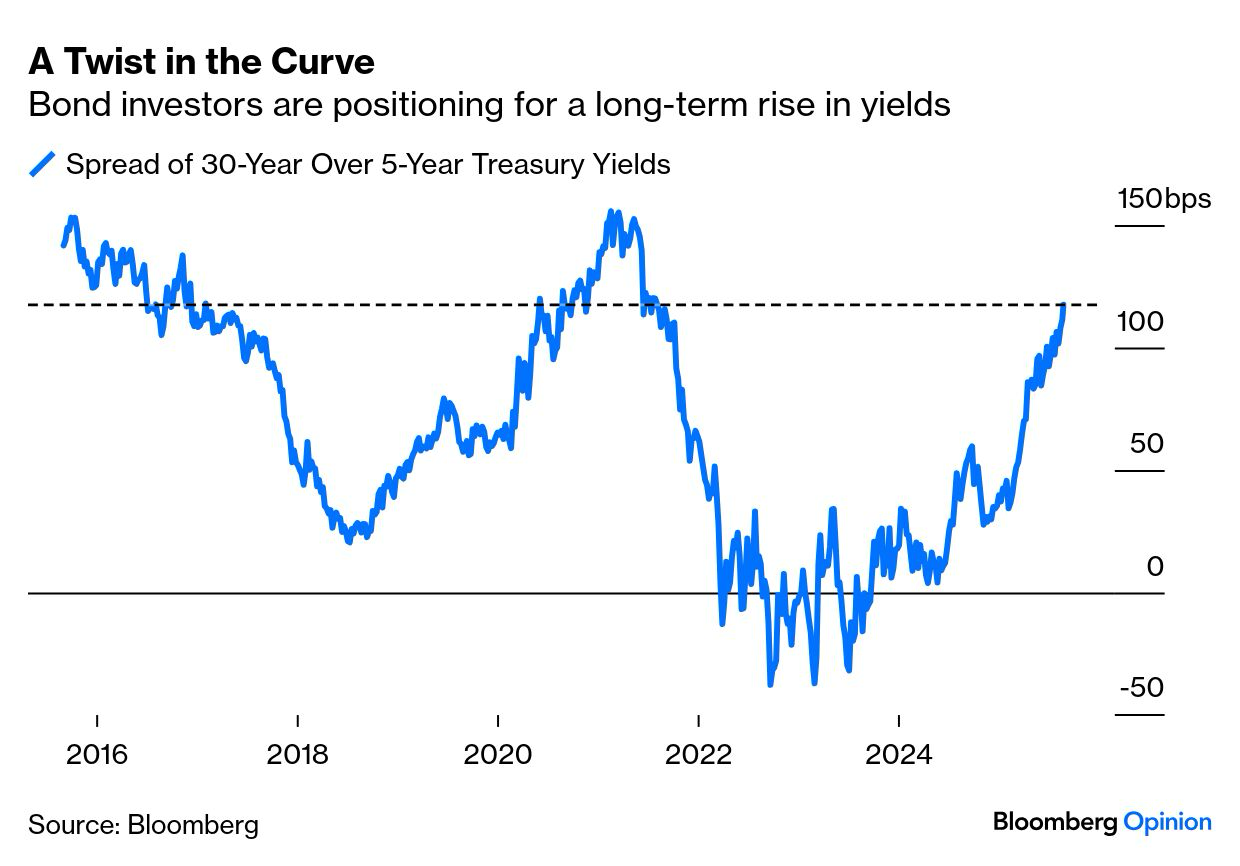
As a follow-up to that comment, here is a graph from Bloomberg highlighting the recent widening in the spread between 5-year and 30-year Treasuries, which is at its widest point in the last 4 years.  This steeping of the yield curve would suggest that inflation is being more heavily anticipated on the long end.

As I mentioned above, the reaction to Powell’s comments from Wyoming last Friday seemed overblown given the rethinking about “dual mandates”. Inflation has recently reversed the downward trajectory and with the impact of tariffs yet to be truly felt, it is doubtful that we’ll see inflation fall to levels that would provide comfort to the U.S. Federal Reserve policy makers. Yes, there may be a small (25 bps) cut in September, but should inflation continue to be a concern the spread in Treasury yields referenced above could continue to widen. President Trump’s goal of jumpstarting the housing market through lower mortgage rates would not likely occur.

From a pension perspective, higher rates reduce the present value of those future promised benefits. They also provide implementers of cash flow matching (CFM) strategies, such as Ryan ALM Advisers, LLC, the opportunity to defease those pension liabilities at a lower cost (greater cost savings). Bond math is very straight forward. The higher the yield and the longer the maturity, the greater the cost savings. Although higher rates might not be good for U.S. equities, especially given their current valuations, the ability to reduce risk at this time through a CFM strategy should be comforting.

Bifurcate your asset allocation into two buckets – liquidity and growth. The liquidity bucket will house the CFM strategy, providing all the necessary liquidity to meet ongoing monthly obligations as far into the future as the allocation will cover. The remaining assets (all non-core bonds) in the growth or alpha portfolio will now have more time to just grow unencumbered, as they are no longer a source of liquidity. Time is a critical investment tenet, and with more time, the probability of meeting the expected return is enhanced.

There is tremendous uncertainty in our markets and economy currently. One can bring an element of certainty to the management of pensions, live with great uncertainty.

20+ Years in the Making!

By: Russ Kamp, CEO, Ryan ALM, Inc.

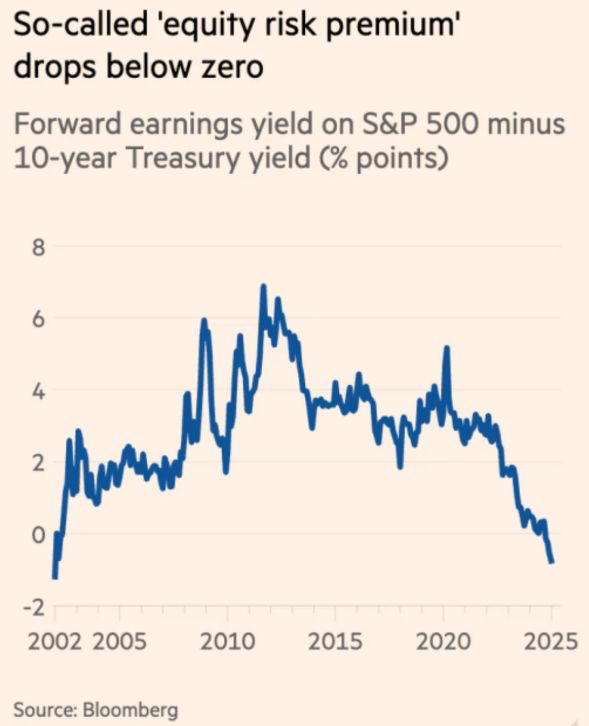
For the first time since the dot.com bubble burst, the equity risk premium on the S&P 500 has fallen below 0. If you are concerned that U.S. large cap equities are looking frothy, this graph certainly supports that sentiment. Is now the time to take some equity profits and migrate those assets to bonds? We believe that the time is right to protect your enhanced funded status from the uncertainty as to where inflation and U.S. interest rates are going and the potential impact on traditional core fixed income strategies that are based on generic market indices instead of funding liability cash flows.

If you are like us (Ryan ALM, Inc.), and prefer not to make one’s living forecasting events that one can’t control, like interest rates, inflation, geopolitical events, etc., we suggest that you don’t engage in fixed income strategies that could be harmed by an upward movement in U.S. interest rates. Take those equity profits and invest in a cash flow matching strategy (CFM) that will secure your fund’s promised benefits, while eliminating interest rate risk since the process defeases future benefit payments that are not interest rate sensitive. A $1,000 monthly benefit payment is $1,000 whether rates are at 2% or 10%. In addition, you’ll be extending the investing horizon for the portfolio’s remaining growth (alpha) assets. CFM is the bridge over potentially troubled waters!