Cash Flow Matching: Bringing Certainty to Pension Plans

By: Russ Kamp, CEO, Ryan ALM, Inc.

Imagine a world, or at least the United States, where pension plans are no longer subject to market swings and the uncertainty those swings create. What if you could “guarantee” (outside of any corporate bond defaults) the promises made to your plan participants, ensuring their financial security with confidence? In today’s highly unpredictable investing environment, relying solely on the pursuit of investment returns is a risky ride—one that guarantees volatility and sleepless nights but not necessarily success. It’s time to rethink how we manage defined benefit (DB) pension plans and embrace a strategy that brings true certainty: Cash Flow Matching (CFM). Discover through the hypothetical conversation below how CFM can transform your investing approach, protect your plan, and deliver peace of mind for everyone involved. Let’s go!

Why are we talking about Cash Flow Matching (CFM) today?

First off, thanks for taking a few minutes to chat with me. As you may have heard me say before, our mission at Ryan ALM, Inc. is simple — to protect and preserve defined benefit (DB) pension plans and to secure the promises made to participants.

We believe that Cash Flow Matching (CFM) is one of the few strategies that can help us keep those promises with real certainty.


Why Now?

Because the world feels more uncertain than ever.

And if we’re honest, most of us don’t like uncertainty. Yet somehow, in the pension world, many plan sponsors have gotten used to it. Why is that?

Over the years, we’ve been taught that managing a DB plan is all about chasing returns. But that’s not really the case. When a plan invests 100% of its assets purely with a return objective, it locks itself into volatility — not stability or success.

That approach also puts your plan on the “asset allocation rollercoaster,” where markets rise and fall, and contributions swing higher and higher along with them. It’s time to step off that ride — at least for part of your portfolio.


So if it’s not all about returns, what is the real objective?

Managing a DB pension plan is all about cash flows — aligning the cash coming in (from principal and interest on bonds) with the cash going out (for benefits and expenses).

The real goal is to secure those promised benefits at a reasonable cost and with prudent risk. That’s the foundation of a healthy plan.


Does bringing more certainty mean I have to change how I manage the plan?

Yes — but only a little. The adjustments are modest and easy to implement.


How can I adopt a CFM strategy without making major changes?

The first step is to reconfigure your asset allocation. Most DB plans are currently 100% focused on returns. It’s time to split your assets into two clear buckets:

  1. Liquidity bucket – designed to provide cash flow to pay benefits and expenses.
  2. Growth bucket – focused on long-term return potential.

What goes into the liquidity bucket?

Most plans already hold some cash and core fixed income. Those assets can move into the liquidity bucket to fund benefit payments and expenses.


And what happens with the remaining assets?

Nothing changes there. Those assets stay in your growth or alpha bucket. The difference is that you’ll no longer need to sell from that bucket during market downturns, which helps protect your fund from the negative impact of forced selling.


Is that all I need to do to create more certainty?

Not quite. You’ll also want to reconfigure your fixed income exposure.

Instead of holding a generic, interest-rate-sensitive bond portfolio (like one tied to the Bloomberg Aggregate Index), you’ll want a portfolio that matches your plan’s specific liabilities — using both principal and income to accomplish the objective.

That’s where true cash flow matching comes in.


How does the matching process work?

We start by creating a Custom Liability Index (CLI) — a model of your plan’s projected benefit payments, expenses, and contributions. This serves as the roadmap for funding your monthly liquidity needs.


What information do you need to build that index?

Your plan’s actuary provides the projected benefits, expenses, and contributions as far out into the future as possible. The more data we have, the stronger the analysis. From there, we can map out your net monthly liquidity needs after accounting for contributions.


Which bonds do you use to match the cash flows?

We invest primarily in U.S. Treasuries and U.S. investment-grade corporate bonds. We stick with these because they provide dependable cash flows without introducing currency risk.

We limit our selections to bonds rated BBB+ or higher, and the longest maturity we’ll buy matches the length of the mandate. For example, if you ask us to secure 10 years of liabilities, the longest bond we’ll buy will mature in 10 years.


Do you build a laddered bond portfolio?

No — a traditional ladder would be inefficient for this purpose.

Here’s why: the longer the maturity and the higher the yield, the lower the overall cost of funding those future liabilities. So instead of a simple ladder, we use a proprietary optimization process to build the portfolio in a way that maximizes efficiency and minimizes cost.


It sounds manageable — not a big overhaul. Am I missing something?

Not at all. That’s exactly right.

Dividing assets into liquidity and growth buckets and reshaping your bond portfolio into a CFM strategy is typically all that’s required to bring more certainty to part of your plan.

Every plan is unique, of course, so each implementation will reflect its own characteristics. But generally speaking, CFM can reduce the cost of future benefits by about 2% per year — or roughly 20% over a 10-year horizon.

On top of that, it helps stabilize your funded status and contribution requirements.


How much should I allocate to CFM?

A good starting point is your existing cash and bond allocation. That’s the least disruptive way to begin.

Alternatively, you can target a specific time horizon — for example, securing 5, 7, or 10 years of benefits. We’ll run an analysis to show what asset levels are needed to meet those payments, which may be slightly more or less than your current fixed income and cash allocations.


Once implemented, do I just let the liquidity bucket run down?

Most clients choose to rebalance annually to maintain the original maturity profile. That keeps the strategy consistent over time. Of course, the rebalancing schedule can be customized to your plan’s needs and the broader market environment.


This all sounds great — but what does it cost?

In line with our mission to provide stability at a reasonable cost and with prudent risk, our fee is about half the cost of a typical core fixed income mandate.

If you’d like, we can discuss your specific plan details and provide a customized proposal.


Final thoughts

Thank you for taking the time to explore CFM. Many plan sponsors haven’t yet heard much about it, but it’s quickly becoming a preferred approach for those who value stability and peace of mind.

At the end of the day, having a “sleep well at night” strategy benefits everyone — especially your participants.

Uncertainty versus Change

By: Russ Kamp, CEO, Ryan ALM, Inc.

Seems like we have a conflict within the management of defined benefit plans. On one hand, human beings (plan sponsors) despise uncertainty. But nearly all public DB pension plans are embracing uncertainty in how they are managed. How? Through a traditional asset allocation framework that focuses the fund’s assets on a performance objective – the return on asset assumption (roughly 7% for the average public plan). Each second that the capital markets are operating, uncertainty is abundant, as price movements are out of one’s control. So let’s change how plans are managed. Not so simple, as those same human beings hate change. Oh, boy.

I have the privilege of speaking at the NCPERS Fall conference tomorrow. The title of my presentation is “Bringing an Element of Certainty to Pension Management”. Folks should absolutely eat up this topic, but given the conflict cited above, it will be interesting to see if the trustees in the audience embrace the concept of achieving some certainty despite having to implement change to their current operating practices.

Given that both uncertainty and change are difficult for humans, what are we to do? Well, psychological research suggests that uncertainty is generally more challenging because it disrupts our ability to predict, control, and prepare for outcomes, and in the process it triggers more anxiety and stress than change itself. According to the research:

  • Uncertainty introduces ambiguity about outcomes, which activates heightened anxiety in the brain. When people lack information about what will happen (such as market movements), they tend to experience more stress and feelings of helplessness.
  • Change, while uncomfortable, becomes easier to adapt to when the outcome is known, even if it’s negative. Humans can plan, adjust, and find coping strategies if they know what to expect. As a result, predictable change is less stressful than unpredictable change.

Why is uncertainty more challenging? Again, according to the research:

  • The human brain is wired to seek patterns and predict the future; uncertainty undermines this process, making adaptation feel more difficult.
  • Studies show that people prefer even certain bad news to ambiguous situations, because they can prepare for and process what’s coming.
  • Chronic uncertainty can lead to anxiety disorders and impaired decision-making, while change tends to prompt growth and learning once people know what they’re facing.

Uncertainty is usually more psychologically challenging than change because it creates anxiety about the unknown, whereas change with a known outcome—though still difficult—allows people to adapt and regain control. Given this reality, it would seem that reducing uncertainty within the management of a DB pension plan would outweigh the changes necessary to accomplish that objective. BTW, the changes needed aren’t great. All one needs to do to bring some certainty to the process is to convert the current core fixed income allocation to a cash flow matching (CFM) strategy that will SECURE the promised benefits for as far into the future as that allocation will cover. In the process you improve the fund’s liquidity profile and extend the investing horizon for the residual assets. A win/win!

How nice would it be to communicate to your plan participants that no matter what happens in the markets (uncertainty) the promised benefits are protected for the next 5-, 7-, 10- or more years. Talk about a “sleep well at night” strategy! Now that’s certainty that even change can live with.

ARPA Update as of October 24, 2025

By: Russ Kamp, CEO, Ryan ALM, Inc.

If it is a Monday, it is ARPA/SFA update day. I’m bringing you this update from Fort Lauderdale, FL, where I’m attending and speaking at the NCPERS Fall conference. It looks like a wonderful agenda for the next few days. Regarding ARPA, how did the PBGC do last week? Let’s explore.

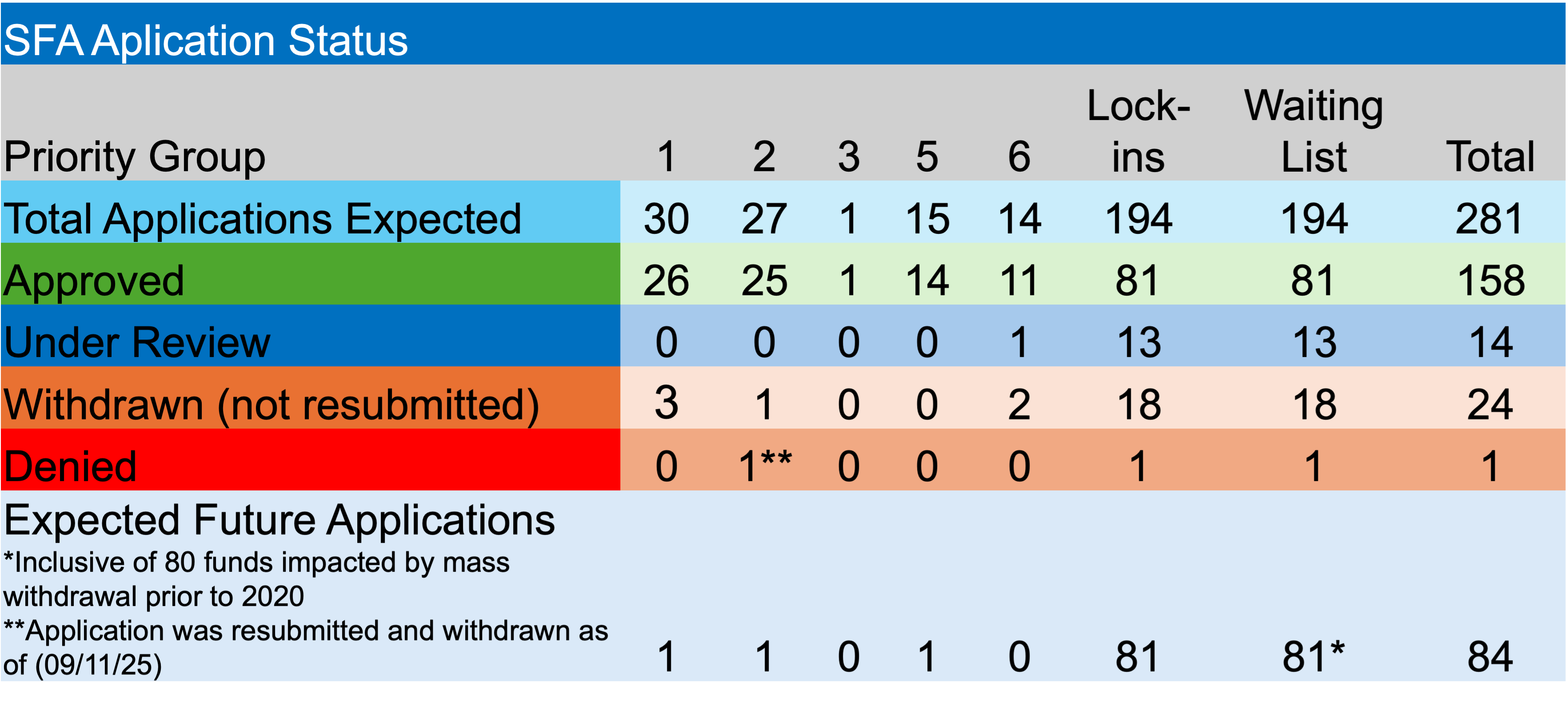
Last week saw limited action with only two applications received, including a revised application from a Priority Group 1 member. As you may recall, this was the first group permitted to submit applications all the way back in July 2021! Only 25 of the 30 members of that cohort have received Special Financial Assistance to date. Richmond, VA based Bricklayers Union Local No. 1 Pension Fund of Virginia, submitted a revised application seeking $12.9 million for its 395 participants, while International Association of Bridge, Structural, Ornamental and Reinforcing Ironworkers Local No. 79 Pension Fund, submitted an initial application hoping to secure $14.6 for 462 members. As an aside, the Ironworkers would be golden if the SFA desired was based on the length of the plan’s name.

In other ARPA news, or lack thereof, there were no applications approved, and fortunately, none denied. There were no pension plans forced to withdraw an application and none asked to repay a portion of the SFA received due to census errors. However, there was one more plan added to the burgeoning waitlist. The Soft Drink Industry Pension Fund is the 178th none-priority group fund to add its name to the list.

The next couple of months should be quite exciting for the PBGC as it works through the abundant list of applications for non-priority group members. U.S. interest rates have pulled back recently reducing some of the potential coverage period through a CFM strategy, but rates are still significantly higher than they were in 2021 when ARPA began to be implemented. Please reach out to us if you’d like to get a free analysis on what is possible once the SFA is received.

Remember: NO Free Lunch!

By: Russ Kamp, CEO, Ryan ALM, Inc.

In 1938, journalist Walter Morrow, Scripps-Howard newspaper chain, wrote the phrase “there ain’t no such thing as a free lunch”. The pension community would be well-served by remembering what Mr. Morrow produced more than eight decades ago. Morrow’s story is a fable about a king who asks his economists to articulate their economic theory in the fewest words. The last of the king’s economists utters the famous phrase above. There have been subsequent uses of the phrase, including Milton Friedman in his 1975 essay collection, titled “There’s No Such Thing as a Free Lunch”, in which he used it to describe the principle of opportunity cost.

I mention this idea today in the context of private credit and its burgeoning forms. I wrote about capacity concerns in private credit and private equity last year. I continue to believe that as an industry we have a tendency to overwhelm good ideas by not understanding the natural capacity of an asset class in general and a manager’s particular capability more specifically. Every insight that a manager brings to a process has a natural capacity. Many managers, if not most, will eventually overwhelm their own ideas through asset growth. Those ideas can, and should be, measured to assess their continuing viability. It is not unusual that good insights get arbitraged away just through sheer assets being managed in the strategy.

Now, we are beginning to see some cracks in the facade of private credit. We have witnessed a significant bankruptcy in First Brands, a major U.S. auto parts manufacturer. Is this event related to having too much money in an asset class, which is now estimated at >$4 trillion.? I don’t know, but it does highlight the fact that there are more significant risks investing in private deals than through public, investment-grade bond offerings. Again, there is no free lunch. Chasing the higher yields provided by private credit and thinking that there is little risk is silly. By the way, as more money is placed into this asset class to be deployed, future returns are naturally depressed as the borrower now has many more options to help finance their business.

In addition, there is now a blurring of roles between private equity and private credit firms, which are increasingly converging into a more unified private capital ecosystem. This convergence is blurring the historic distinction between equity sponsors and debt providers, with private equity firms funding private credit vehicles. Furthermore, we see “pure” credit managers taking equity stakes in the borrowers. So much for diversification. This blurring of roles is raising concerns about valuations, interconnected exposures, and potential conflicts of interest due to a single manager holding both creditor and ownership stakes in the same issue.

As a reminder, public debt markets are providing plan sponsors with a unique opportunity to de-risk their pension fund’s asset allocation through a cash flow matching (CFM) strategy. The defeasement of pension liabilities through the careful matching of bond cash flows of principal and interest SECURES the promised benefits while extending the investing horizon for the non-bond assets. There is little risk in this process outside of a highly unlikely IG default (2/1,000 bonds per S&P). There is no convergence of strategies, no blurring of responsibilities, no concern about valuations, capacity, etc. CFM remains one of the only, if not the only, strategies that provides an element of certainty in pension management. It isn’t a free lunch (we charge 15 bps for our services to the first breakpoint), but it is as close as one will get!

MV versus FV

By: Russ Kamp, CEO, Ryan ALM, Inc.

There seems to be abundant confusion within certain segments of the pension industry regarding the purpose and accounting (performance) of a Cash Flow Matching (CFM) portfolio on a monthly basis. Traditional monthly reports focus on the present value (PV) of assets in marking those assets to month-end prices. However, when utilizing a CFM strategy, one is hoping to defease (secure) promised benefits which are a future value (FV). As a reminder, FVs are not interest rate sensitive. The movement in monthly prices become irrelevant.

If pension plan A owes a participant $1,000 next month or 10-years from now, that promise is $1,000 whether interest rates are at 2% or 8%. However, when converting that FV benefit into a PV using today’s interest rates, one can “lock in” the relationship between assets and liabilities (benefit payment) no matter which way rates go. To accomplish this objective, a CFM portfolio will match those projected liabilities through an optimization process that matches principal, interest, and any reinvested income from bonds to those monthly promises. The allocation to the CFM strategy will determine the length of the mandate (coverage period).

Given the fact that the FV relationship is secured, providing plan sponsors with the only element of certainty within a pension fund, does it really make any sense to mark those bonds used to defease liabilities to market each month? Absolutely, NOT! The only concern one should have in using a CFM strategy is a bond default, which is extremely rare within the investment grade universe (from AAA to BBB-) of bonds. In fact, according to a recent study by S&P, the rate of defaults within the IG universe is only 0.18% annually for the last 40-years or roughly 2/1,000 bonds.

A CFM portfolio must reflect the actuaries latest forecast for projected benefits (and expenses), which means that perhaps once per year a small adjustment must be made to the portfolio. However, most pension plans receive annual contributions which can and should be used to make those modest adjustments minimizing turnover. As a result, most CFM strategies will purchase bonds at the inception of a mandate and hold those same issues until they mature at par. This low turnover locks in the cost reduction or difference in the PV vs. FV of the liabilities from day 1 of the mandate. There is no other strategy that can provide this level of certainty.

To get away from needing or wanting to mark all the plan’s assets to market each month, segregate the CFM assets from the balance of the plan’s assets. This segregation of assets mirrors our recommendation that a pension plan should bifurcate a plan’s asset allocation into two buckets: liquidity and growth. In this case, the CFM portfolio is the liquidity bucket and the remaining assets are the growth or alpha assets. If done correctly, the CFM portfolio will make all the necessary monthly distributions (benefits and expenses), while the alpha assets can just grow unencumbered. It is a very clean separation of the assets by function.

Yes, bond prices move every minute of every day that markets are open. If your bond allocation is being compared to a generic bond index such as the Aggregate index, then calculating a MV monthly return makes sense given that the market value of those assets changes continuously. But if a CFM strategy can secure the cost reduction to fund FVs on day 1, should a changing MV really bother you? Again, NO. You should be quite pleased that a segment of your portfolio has been secured. As the pension plan’s funded status improves, a further allocation should be made to the CFM mandate securing more of the promised benefits. This is a dynamic and responsive asset allocation approach driven by the funded status and not some arbitrary return on asset (ROA) target.

I encourage you to reach out to me, if you’d appreciate the opportunity to discuss this concept in more detail.

An Alternative Pension Funding Formula

By: Russ Kamp, CEO, Ryan ALM, Inc.

I’ve spent the last few days attending and speaking at the FPPTA conference in Sawgrass, Florida. As I’ve reported on multiple occasions, I believe that the FPPTA does as good a job as any public fund organization of providing critical education to public fund trustees. A recent change to the educational content for the FPPTA centers on the introduction of the “pension formula” as one of their four educational pillars. In the pension formula of C+I = B+E, C is contributions, I is investment income (plus principal appreciation or depreciation), B is benefits, and E represents expenses.

To fund B+E, the pension fund needs to contribute an annual sum of money (C) not covered by investment returns (I) to fully fund liability cash flows (B+E). That seems fairly straightforward. If C+I = B+E, we have a pension system in harmony. But is a pension fund truly ever in harmony? With market prices changing every second of every trading day, it is not surprising that the forecasted C may not be enough to cover any shortfall in I, since the C is determined at the start of the year. As a result, pension plans are often dealing with both the annual normal cost (accruing benefits each year) and any shortfall that must be made up through an additional contribution amortized over a period of years.

As a reminder, the I carries a lot of volatility (uncertainty) and unfortunately, that volatility can lead to positive and negative outcomes. As a reminder, if a pension fund is seeking a 7% annual return, many pension funds are managing the plan assets with 12%-15% volatility annually. If we use 12% as the volatility, 1 standard deviation or roughly 68% of the annual observations will fall between 7% plus or minus 12% or 19% to -5%. If one wants to frame the potential range of results at 2 standard deviations or 19 out of every 20-years (95% of the observations), the expected range of results becomes 31% to -17%. Wow, one could drive a couple of Freightliner trucks through that gap.

Are you still comfortable with your current asset allocation? Remember, when the I fails to achieve the 7% ARC the C must make up the shortfall. This is what transpired in spades during the ’00s decade when we suffered through two major market corrections. Yes, markets have recovered, but the significant increase in contributions needed to make up for the investment shortfalls haven’t been rebated!

I mentioned the word uncertainty above. As I’ve discussed on several occasions within this blog, human beings loathe uncertainty, as it has both a physiological and mental impact on us. Yet, the U.S. public fund pension community continues to embrace uncertainty through the asset allocation decisions. As you think about your plan’s asset allocation, is there any element of certainty? I had the chance to touch on this subject at the recent FPPTA by asking those in the room if they could identify any certainty within their plans. Not a single attendee raised their hand. Not surprising!

As I result, I’d like to posit a slight change to the pension formula. I’d like to amend the formula to read C+I+IC = B+E. Doesn’t seem that dramatic – right? So what is IC? IC=(A=L), where A are the plan’s assets, while L= plan liabilities. As you all know, the only reason that a pension plan exists is to fund a promise (benefits) made to the plan participant. Yet, the management of pension funds has morphed from securing the benefits to driving investment performance aka return, return, and return. As a result, we’ve introduced significant funding volatility. My subtle adjustment to the pension formula is an attempt to bring in some certainty.

By carefully matching assets to liabilities (A=L) we’ve created an element of certainty (IC) not currently found in pension asset allocation. By adding some IC to the C+I = B+E, we now have brought in some certainty and reduced the uncertainty and impact of I. The allocation to IC should be driven by the pension plan’s funded status. The better the funding, the greater the exposure to IC. Wouldn’t it be wonderful to create a sleep-well-at-night structure in which I plays an insignificant role and C is more easily controlled?

To begin the quest to reduce uncertainty, bifurcate your plan’s assets into two buckets, as opposed to having the assets focused on the ROA objective. The two buckets will now be liquidity and growth. The liquidity bucket is the IC where assets and liabilities are carefully matched (creating certainty) and providing all of the necessary liquidity to meet the ongoing B+E. The growth portfolio (I) are the remaining plan assets not needed to fund your monthly outflows.

The benefits of this change are numerous. The adoption of IC as part of the pension formula creates certainty, enhances liquidity, buys-time for the growth assets to achieve their expected outcomes, and reduces the uncertainty around having 100% of the assets impacted by events outside of one’s control. It is time to get off the asset allocation and performance rollercoaster. Yes, recent performance has been terrific, but as we’ve seen many times before, there is no guarantee that continues. Adopt this framework before markets take no prisoners and your funded status is once again challenged.

ARPA Update as of October 3, 2025

By: Russ Kamp, CEO, Ryan ALM, Inc.

Welcome to the first update in October. Autumn has been an extension of the summer weather in NJ – dry and hot! I’m writing this post from cloudy Florida (FPPTA) where it is humid and hot! When will I finally get those crisp, clear days that autumn promises?

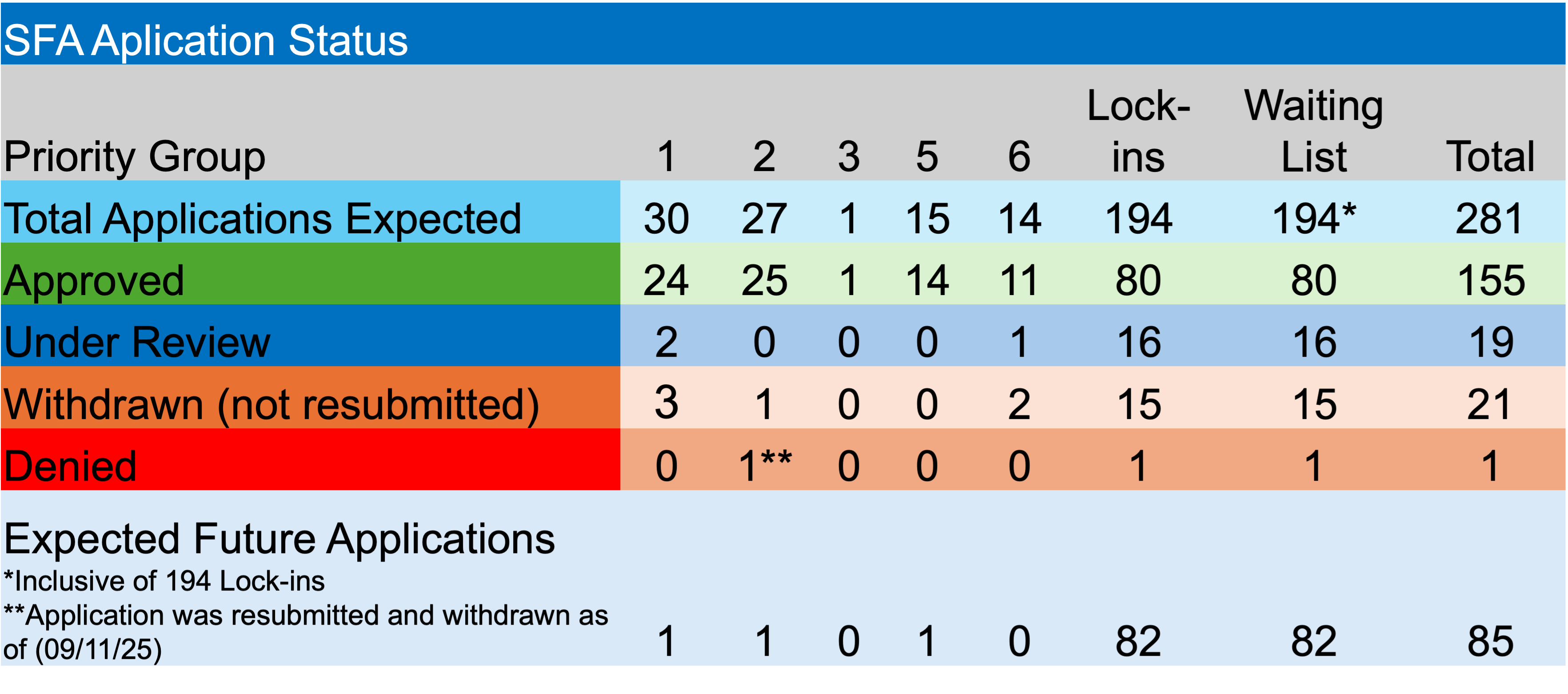
Regarding ARPA news, we are quickly closing in on the end of 2025, and the PBGC still has a significant list of initial applications (73) that have not been submitted for review. As far as I can tell, only those applications that have been submitted by December 31, 2025, can continue to be reviewed until the end of 2026. It should prove to be an interesting time.

So, what did the week of 9/29/25 provide? Access to the PBGC’s eFiling portal is currently defined as “limited” to those funds at the top of the waitlist. They did allow for three funds, Asbestos Workers Local No. 8 Retirement Trust Plan, Iron Workers Local No. 12 Pension Fund, and Bricklayers Local No. 55 Pension Plan to submit initial applications seeking SFA support. The three non-Priority Group plans are seeking modest SFA grants totaling $55.5 million for their combined 1,593 participants. As per the legislation, the PBGC has 120-days to act on these applications.

In other ARPA news, the PBGC did approve the SFA for Retail Food Employers and United Food and Commercial Workers Local 711 Pension Plan, which will receive $77.6 million for their 25,306 members. Also, Building Trades Pension Fund of Western Pennsylvania, a non-Priority Group member, is asking for $55.5 million in SFA for their nearly 4k plan participants.

Finally, there were no non-Priority Group pension plans asking to be added to the waitlist during the past week, but there were three funds currently on the list that have chosen to lock-in their valuation date. Greater St. Louis Service Employees Pension Plan, Twin Cities & Vicinity Conference Board Pension Plan, and Oregon Printing Industry Pension Trust each chose June 30, 2025, for that purpose.

Despite the recent cut in the Fed Funds Rate, yields on longer-dated U.S. Treasuries have risen. As a result, the yield curve has steepened providing plan sponsors and their advisors an opportunity to secure the SFA assets at a time when additional cost savings may be achievable. Furthermore, the greater the cost reduction the longer the coverage period. Please don’t let this opportunity pass you by.

Buy on the Rumor…

By: Russ Kamp, CEO, Ryan ALM, Inc.

After 44-years in the investment industry I’ve pretty much heard most of the sayings, including the phrase “buy on the rumor and sell on the news”. I suspect that most of you have probably heard those words uttered, too. However, it isn’t always easy to point out an example. Here is graph that might just do the trick.

There had been significant anticipation that the U.S Federal Reserve would cut the Fed Funds Rate and last week that expectation was finally realized with a 0.25% trimming. However, it appears that for some of the investment community that reduction wasn’t what they were expecting. As the graph above highlights, the green line representing Treasury yields as of this morning, have risen nicely in just the last 6 days for most maturities 3 months and out, with the exception of the 1-year note. In fact, the 10- and 30-year bonds have seen yields rise roughly 10 bps. Now, we’ve seen more significant moves on a daily basis in the last couple of years, but the timing is what has me thinking.

There are still many who believe that this cut is the first of several between now and the end of 2025. However, there is also some trepidation on the part of some in the bond world given the recent rise in inflation after a prolonged period of decline. As a reminder, the Fed does have a dual mandate focused on both employment and inflation, and although the U.S. labor force has shown signs of weakening, is that weakness creating concerns that dwarf the potential negative impact from rising prices? As stated above, there may also have been some that anticipated the Fed surprising the markets by slicing rates by 0.50% instead of the 0.25% announced.

In any case, the interest rate path is not straight and with curves one’s vision can become obstructed. What we might just see is a steepening of the Treasury yield curve with longer dated maturities maintaining current levels, if not rising, while the Fed does their thing with short-term rates. That steepening in the curve is beneficial for cash flow matching assignments that can span 10- or more years, as the longer the maturity and the higher the yield, the greater the cost reduction to defease future liabilities. Please don’t let this attractive yield environment come and go before securing some of the pension promises.

ARPA Update as of 9/19/25

By: Russ Kamp, CEO, Ryan ALM, Inc.

Good morning and welcome to the first full day of Fall. Autumn has always been my favorite season. How about you?

Regarding the implementation of ARPA’s pension legislation by the PBGC, we are now about 3 1/2 months away from the deadline to have all initial applications seeking Special Financial Assistance (SFA) submitted. Unfortunately, there are still dozens of multiemployer pension plans sitting on the PBGC’s waitlist.

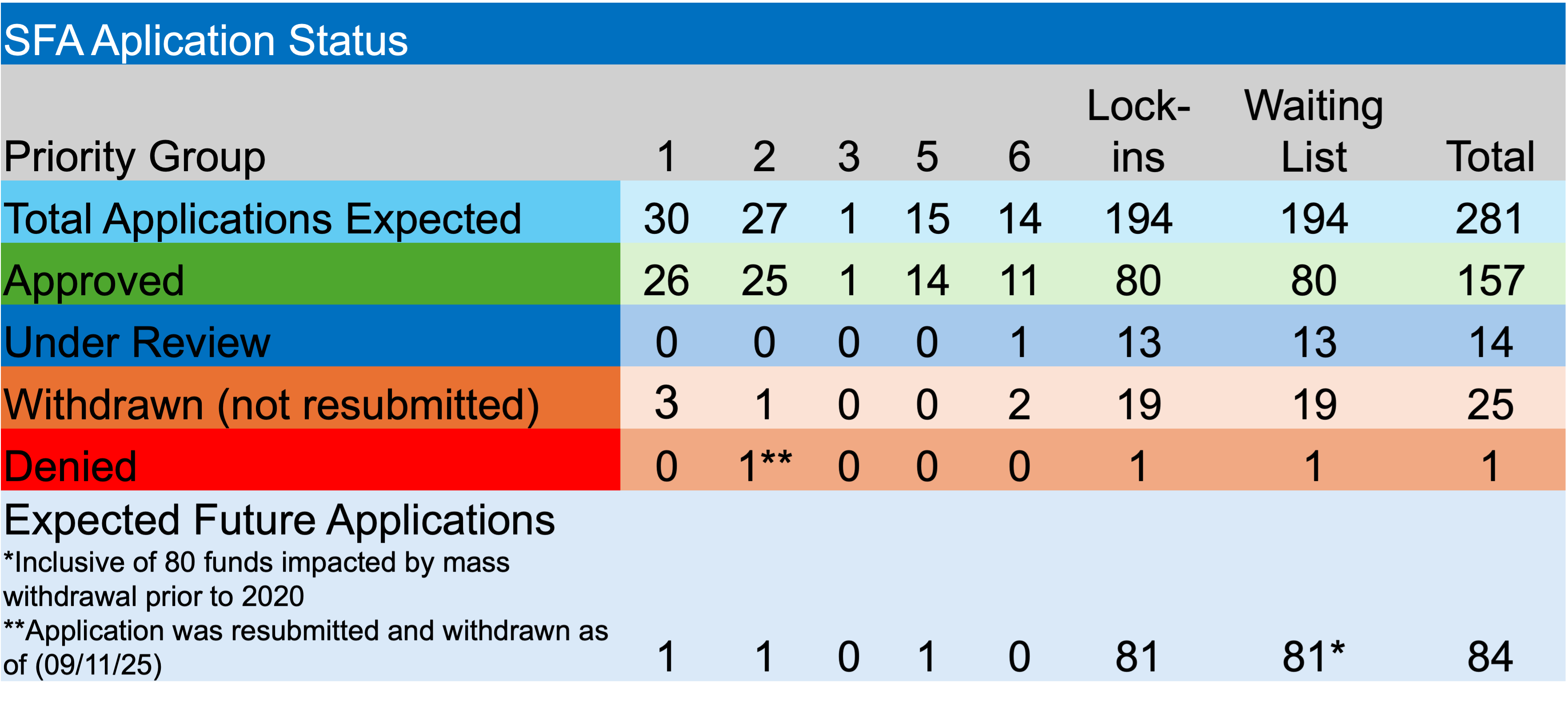
Last week witnessed a slower pace of activity, as the PBGC is only reporting the submission of three applications and the repayment of excess SFA by one fund. There were no applications approved, denied, or withdrawn during the previous week. Furthermore, there were no pension funds seeking to be added to the waitlist and none of the plans currently sitting on that list locked-in the valuation date. We may not see any new plans being added to the list given the rapidly approaching deadline for initial application submission. As a reminder, those plans that submit an application before 12/31/25 can submit a revised application until 12/31/26 – the legislation’s deadline.

Pleased to report that Pension Trust Fund Agreement of St. Louis Motion Picture Machine Operators, Teamsters Local 837 Pension Plan, and Iron Workers’ Pension Trust Fund for Colorado each submitted an initial application seeking SFA. These non-Priority Group members are hoping to secure >$30 million for the nearly 3,200 plan participants. As a reminder, the PBGC has 120-days to act on these applications.

Finally, there was one plan asked to rebate a portion of the SFA based on a census error. Western Pennsylvania Teamsters and Employers Pension Fund, a recipient of $994.6 million has agreed to rebate $8.8 million or 0.89% of the grant. To date, 61 multiemployer pension funds have repaid $260.7 million in excess SFA on grants totaling $53.4 billion or 0.49%.

We hope that you have a great week. Check back in next Monday for the next ARPA legislation update.

Dear Plan Sponsor: Please ask Yourself the Following Questions

By: Russ Kamp, CEO, Ryan ALM, Inc.

Do you believe that your pension plan exists to meet (secure) a promise (benefit) that was given to the plan’s participants?

Are you factoring in that benefit promise when it comes to asset allocation?

Do you presently have exposure to core fixed income, and do you know where U.S. interest rates will be in the next day, month, year, 5-years?

Has liquidity to meet benefits and expenses become more challenging with the significant movement to alternatives – real estate, private equity, private debt, infrastructure, etc.?

Do you believe that providing investment strategies more time is prudent?

So, if you believe that securing benefits, driving asset allocation through a liability lens, improving liquidity, eliminating interest rate risk, and buying-time are important goals when managing a defined benefit plan, how are you accomplishing those objectives today?

Cash Flow Matching (CFM) achieves every one of those goals! By strategically matching asset cash flows of interest and principal from investment-grade bonds against the liability cash flows of benefits and expenses, the DB pension plan’s asset allocation becomes liability focused, liquidity is improved from next month as far out as the allocation covers, interest rate risk is mitigated for the CFM portfolio, the investing horizon is extended for the remaining assets improving the odds of a successful outcome, and most importantly, the promises made to your participants are SECURED!

How much should I invest into a CFM program? The allocation to CFM should be a function of the plan’s funded ratio/status, the ability to contribute, and the level of negative cash flow (contributions falling short of benefits and expenses being paid out). Since all pension plans need liquidity, every DB pension plan should have some exposure to CFM, which provides the necessary liquidity each month of the assignment. There is no forced liquidation of assets in markets that might not provide natural liquidity.

Again, please review these questions. If they resonate with you, call me. We’ll provide you with a good understanding of how much risk you can remove from your current structure before the next market crash hits us.