Problem: Longevity Solution: DB Pension Plan

By: Russ Kamp, CEO, Ryan ALM, Inc.

I occasionally receive emails from Glen Eagle. In their most recent “mailing”, they cited a Capital Group report that highlighted that Americans are living longer than many anticipate. They pointed out that a healthy 65-year-old married couple has a 50% chance that one spouse will reach 94-years-old and a 25% chance that one reaches 98. However, 52% of older Americans do not factor longevity into retirement planning. Geez, I wonder why?

Could it be that they’ve been asked to fund a “retirement” program through a 401(k) – like vehicle, if they were fortunate to work for a company that offered one in the first place. Could it be also that we’ve placed financial burdens on American workers through ever increasing expenditures related to housing, education, healthcare, childcare, utilities, transportation, food, etc? Despite the fact that defined contribution plans have been around for multiple decades, the median account (according to Vanguard) was only $38k (2024), while the median account for someone aged 55-64-years old was only $95.6k. Again, those are median balances for folks that have actually saved for retirement. There are millions of Americans that have not been able to set aside any assets for their “golden years”.

With balances in that range, I would guess that the average American worker is wondering how they’ll afford to get to 75-years-old let alone 95 or older. Unfortunately, most American workers do not have access to a defined benefit plan that would solve the issue of longevity, as the promised monthly benefit spans the participant’s entire life, and perhaps their spouses, too. I’ve never been in a DB plan, but my Dad was fortunate to be in one. He didn’t receive a large monthly payment, but he and my Mom could count on a check each month for the 34-years that he lived in retirement. There was no guessing as to when he would pass or how much he could safely take from a DC balance each month. That certainty was incredibly comforting to them, as it would be to any plan participant.

I reported this morning that Milliman’s monthly study of the top 100 corporate plans showed the highest average funded ratio since before the GFC. Pension earnings are being created because of these surplus assets. Now is the time for Corporate America to rethink their retirement offerings. DC plans were intended to be supplemental to DB funds. Asking the average American to fund, manage, and then disburse a benefit with little disposable income, no investment acumen, and no crystal ball to help with longevity is silly policy that is failing us.

Bring back the defined benefit plan for the masses. In the process, we bring back an element of financial security and a level of certainty not found through DC plans. Those that have worked 40+ years shouldn’t have to worry that they may outlive their financial resources, when they should be enjoying the fruits of their labor.
Milliman: Corporate Pension Funding Highest Since 2007

By: Russ Kamp, CEO, Ryan ALM, Inc.

Milliman has once again released its monthly Milliman 100 Pension Funding Index (PFI), which analyzes the 100 largest U.S. corporate pension plans. It would be fascinating to see how these 100 plans differ from a list just 20-years ago.

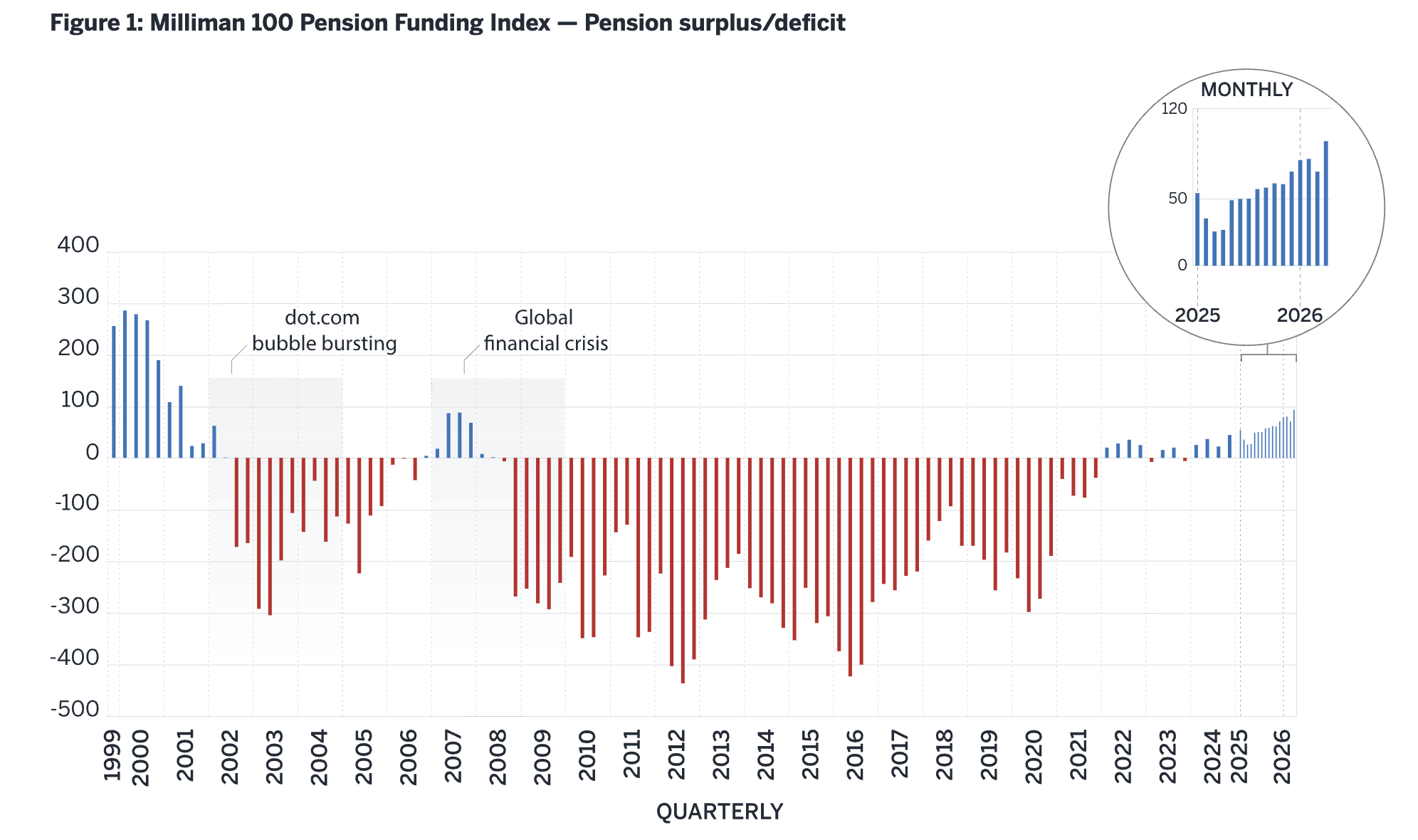
As for today’s members, the Milliman 100 PFI plans showed improved funding by $23 billion during April. These stellar results were driven by strong equity returns as the constituents averaged a 2.13% gain. As a result, the funded ratio dramatically improved from 105.9% at the end of March to 107.8% at the end of April representing the highest level of funding since October 2007, when it stood at 108.1%. Strong investment gains increased assets by $20 billion and now stand at $1.297 trillion, while the projected benefit obligation fell slightly to $1.204 trillion, as the monthly discount rate edged up one basis point, to 5.66% from 5.65%. 

“After a flat first quarter, the funding surplus grew to $94 billion at the end of April, primarily due to strong market returns,” said Zorast Wadia, author of the Milliman 100 PFI. “This means plan sponsors continue to have more pension risk management options as plans move further into surplus territory.”

Plan sponsors would be wise to seek risk reducing strategies. The previous high watermark was achieved in October 2007, just prior to the start of the Great Financial Crisis, which pummeled markets through March of 2009. As the graph below highlights, the Milliman 100 went from a small surplus in the Q3’07 to a major deficit within 6 months. It would be another 13-years before a surplus was once again created.

Plan sponsors should secure the pension promises through a cash flow matching (CFM) strategy and then actively manage surplus assets since they’ve now created a much longer investing horizon for those assets. Ryan ALM, Inc. is always willing to provide a free analysis of what is possible through CFM.

For the full Milliman report, click on the link below.

View this month’s complete Pension Funding Index.

ARPA Update as of May 8, 2026

By: Russ Kamp, CEO, Ryan ALM, Inc.

We hope that you enjoyed a beautiful Mother’s Day weekend.

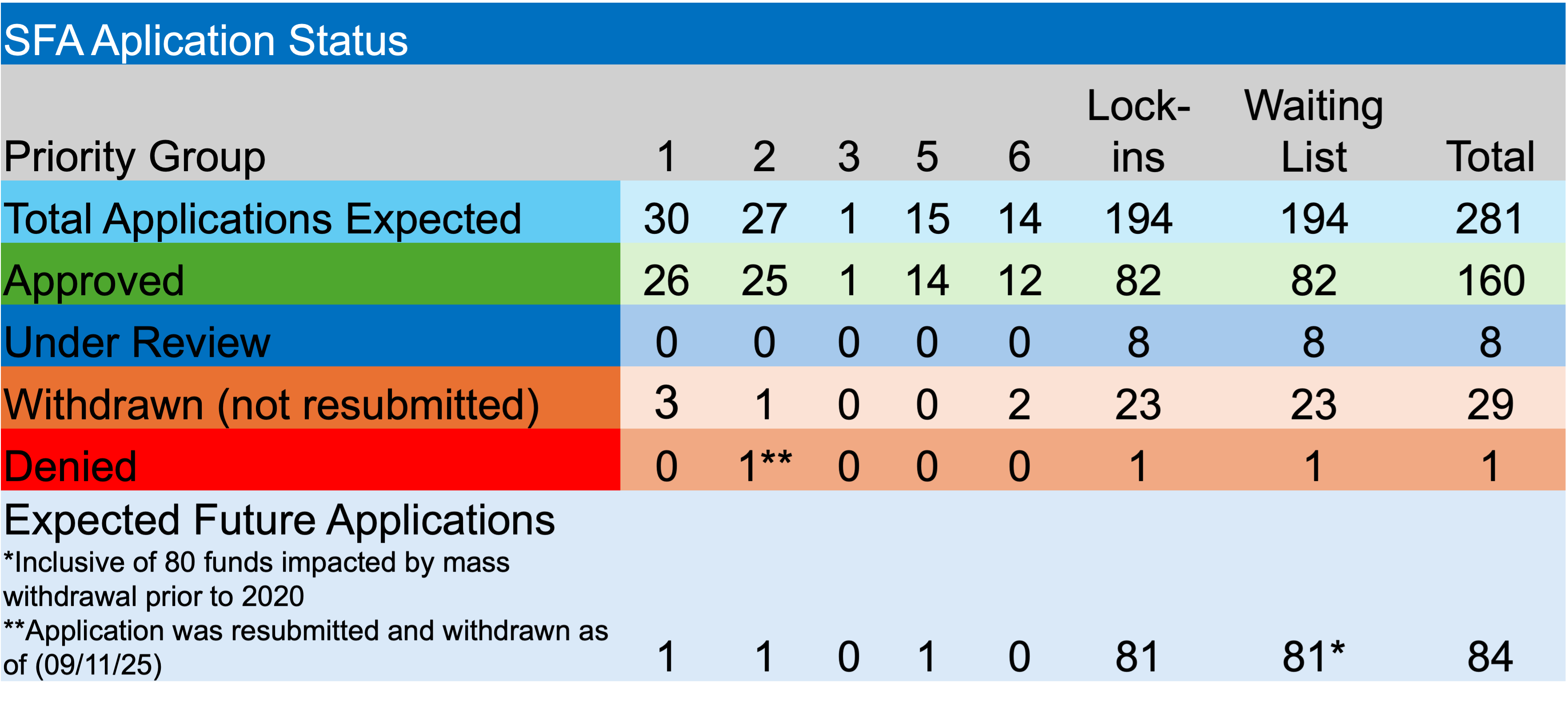
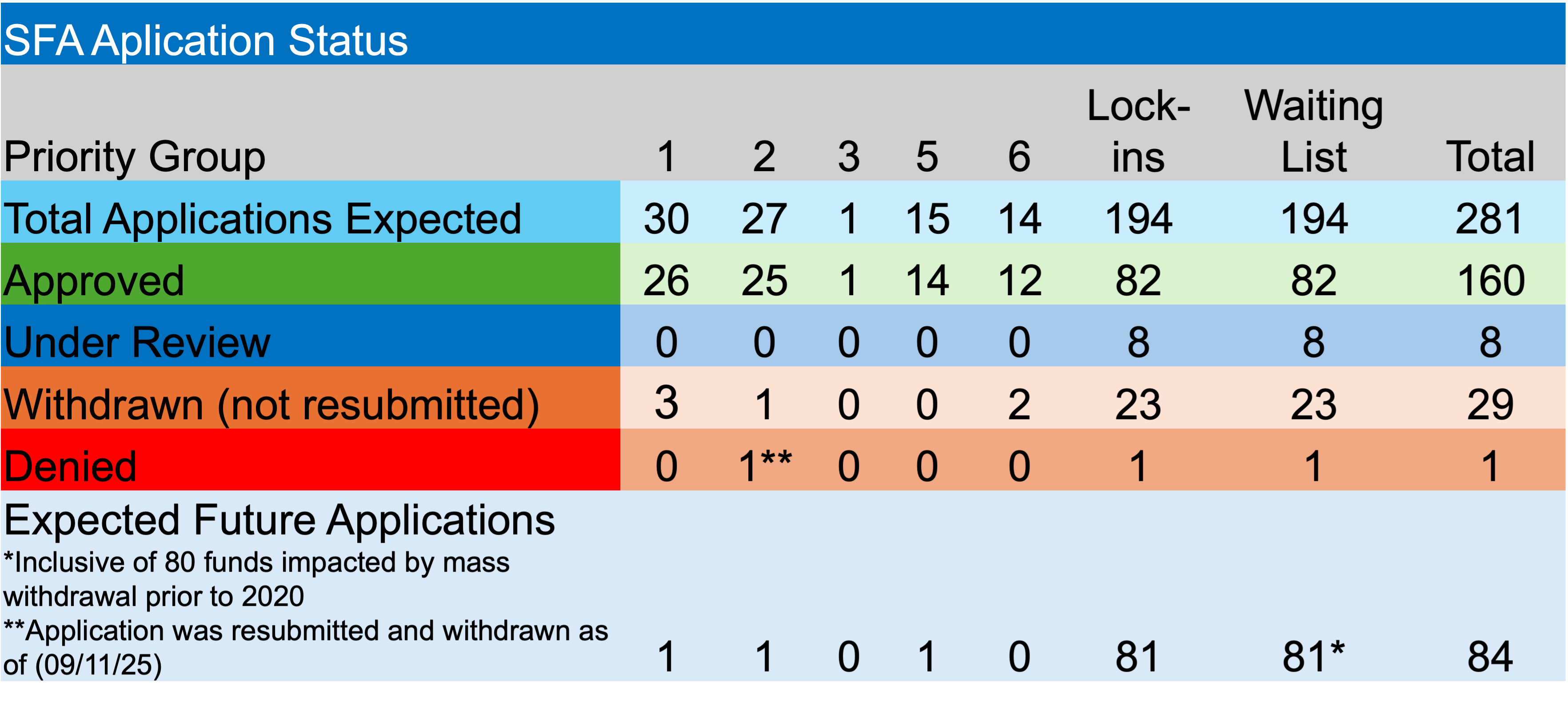
Regarding ARPA, the PBGC continues to work through the remaining pension plans that were not impacted by Mass Withdrawal prior to 2020. According to our tracking, there are 41 plans that could potential receive Special Financial Assistance (SFA) if you don’t include the 80 plans currently on the waitlist that have been designated as Mass Withdrawal casualties. Of those 41 plans, 8 have applications currently under review, including St. Louis-based Retail Bakers’ Pension Trust Fund of St. Louis, which has submitted (5/1/26) a revised application seeking $5.7 million for 566 members.

Another 29 plans, including six with a priority designation, are waiting to resubmit previously withdrawn applications. Lastly, there are four pension plans that have yet to file an initial SFA application. I’d love to know those circumstances, especially for the three plans that have a priority designation. Plasterers Local 79 Pension Plan is the lone fund on the waitlist that has yet to be able to submit an application.

Still no update as to how the 80 Mass Withdrawal plans will be treated. We’ll keep you updated as more information becomes available.

At the end of the day, this legislation has been incredibly successful for the multiemployer sector, with $77.9 billion in SFA grants being awarded to 160 pension funds that will support the promised benefits to 2,017,527 American workers and retirees. These financial resources create economic activity in the pensioners community. That is a lot of economic stimulus!

Unique Liabilities Require A Unique Solution

By: Russ Kamp, CEO, Ryan ALM, Inc.

Most pension plans have exposure to fixed income. Perhaps not as much as they did prior to 2000, but today’s common thinking is that the current exposure is enough to act as a buffer should equity markets not continue along this momentum fueled path, and finally, to support the monthly liquidity needs of the fund. But are those the right reasons to use bonds and what type of fixed income should be used to accomplish those objectives?

We observe that most funds use a variety of investment grade bonds (Treasuries, Agencies, Corporates, etc.) and they have that collection benchmarked to a generic index such as the Bloomberg U.S. Aggregate Index (a.k.a. the Agg). As a reminder, the Agg was created by Ron Ryan when he was Head of Research at Lehman Brothers a few years ago. But, again, is this the right approach? We at Ryan ALM, Inc. believe that bonds should only be used for their cash flows (principal and interest) and not as a performance driver. Bonds are perhaps the only asset class with a known cash flow equal to the value at maturity (PAR) and contractual interest payments. Those known cash flows can be modeled to meet the plan’s ongoing liability cash flows (benefits + expenses). 

Which brings me to the point that every pension plan’s liabilities are unique, and as such, no generic index such as the Agg could possibly match a plan’s liabilities. If the asset cash flows don’t match and fund the liability cash flows (benefits and expenses), the plan is subject to unnecessary interest rate risk. Again, given that every pension plan has a unique set of liabilities this would suggest that each pension plan needs to have an investment strategy created specifically for their cash flow needs. Cash Flow Matching (CFM) is an investment strategy with a very long and successful history. An appropriately crafted CFM portfolio will meet and fully fund chronologically the liability cash flows as far into the future as the allocation to the CFM strategy lasts.

We take great pride in our proprietary CFM optimization modeling, which we began using at Ryan ALM’s founding in 2004. Having the ability to tailor unique solutions to client specific issues/requests is a hallmark of our firm, and this capability is being recognized throughout the industry. In fact, we recently received this feedback from an ALM expert at a large asset/liability consulting firm, who stated that I’m “impressed with the team’s ability to build portfolios for such non-standard cashflow streams.” Thank you!

We’d be happy to demonstrate our capability and we’re always willing to provide a free analysis highlighting how your fund could benefit through CFM and Ryan ALM’s expertise. Just call us.

Why Wouldn’t You Prefer a SD of +/-0%?

By: Russ Kamp, CEO, Ryan ALM, Inc.

I continue to be surprised that more pension plans don’t embrace greater certainty in the management of their funds. The Iran War is leading to great uncertainty related to inflation, interest rates, and economic growth. Yes, U.S. equities have enjoyed a healthy recovery following the initial outbreak in the Middle East, but is that sustainable?

Callan does a good job of providing a regular review of what asset allocation would be necessary to achieve a 7% return and the risk (measured as standard deviation) to achieve that return objective. Callan indicated that it was very easy to achieve a 7% return all the way back in 1994 when U.S. interest rates were higher than they are today. In fact, an allocation of 85% to fixed income and small allocations to L.C. equity, SC equity, and int’l stocks would have produced a 7% return with only a 5.6% annual standard deviation.

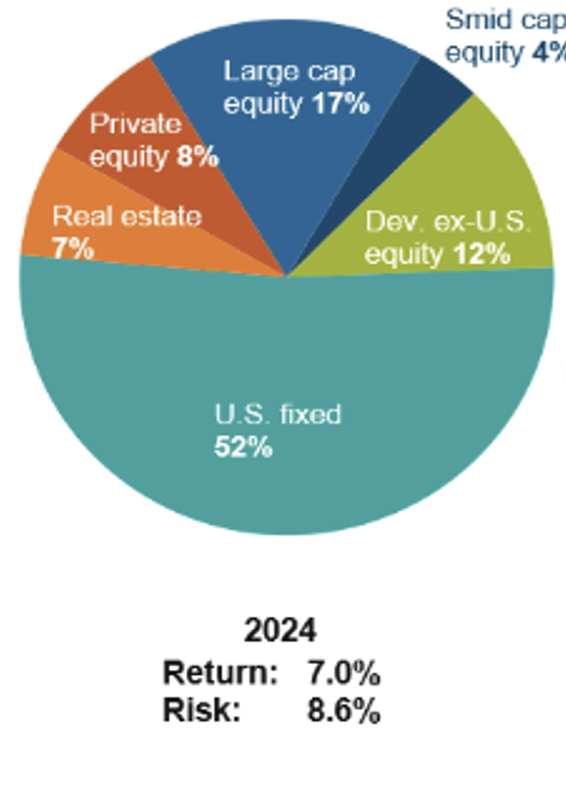
However, in the most recent update from 2024, Callan suggests the following asset allocation is necessary to achieve a 7% return:

This means that 68% of the time, a plan sponsor should expect an annual return of 7% +/- 8.6%. At two standard deviations (95% of the observations or 19/20 years), the annual return will fall between +/- 17.2% of the 7% target. Would you be comfortable knowing that your fund could generate an annual return of -10.2%? Think about the impact a return like that would have on contributions?

What if I said that cash flow matching (CFM) a portion of your pension fund would result in those assets having an annual SD of 0% barring a default which occurs at a rate of 0.18% annually among investment grade corporate bonds for the last 40-years. How’s that possible? When CFM is implemented, the plan’s asset cash flows and matched agains the plan’s liability cash flows (benefits and expenses). They mover in lockstep with each other no matter where rates go. Today’s U.S. interest environment is attractive and getting more attractive as I write this post, as the 30-year Treasury bond yield has topped 5% (5.02% at 11:47 am DST). Higher rates are great for CFM, as they lower the present value of those future promises.

Furthermore, the use of a CFM portfolio secures the pension promises, dramatically improves plan liquidity, eliminates interest rate risk for the portion of the plan, extends the investing horizon for the residual plan assets, and reduces the cost of those future pension promises. Again, why wouldn’t you embrace an element of certainty?

I’m not sure what the Callan team would identify as the proper allocation to achieve a 7% return today, but I suspect that the annual standard deviation is greater than the 8.6% from 2024. Every time a pension plan falls short of the annual ROA, contributions must increase to make up for the shortfall. Greater investment certainty, like that associated with using CFM, reduces the likelihood that the pension plan sponsor with suffer from a negative surprise associate from increased contributions.

ARPA Update as of May 1, 2026

By: Russ Kamp, CEO, Ryan ALM, Inc.

Welcome to May. Yes, it is only the beginning of May, but I’m already looking forward to football season, as my “beloved” Mets can’t find a win! It just goes to show that money alone can’t buy a winner.

But, money, especially Special Financial Assistance (SFA) can buy and SECURE lots of promised benefits. In fact, $77.9 billion in SFA grants have gone to supporting the pensions for 2,017,527 American workers/retirees. Just incredible!

As the program winds down, there is less to highlight in the weekly updates. In fact, this week’s review includes just one action item. PMPS-ILA Pension Plan and Trust, a transportation union from Moss Point, MS, has withdrawn its initial application. They were hoping to secure $666k for the 90 plan participants. They will now go back to the drawing board with a revised application.

Teamsters Local 277 Pension Fund, a Hempstead, NY, fund is waiting on payment of their approved SFA. They will receive $20.6 million in SFA grants and interest.

For those pension plans still hoping to secure an SFA grant, U.S. interest rates continue to rise, with the 30-year U.S. Treasury bond yield hitting 5% this morning (5.01% at 10 am). Higher rates mean greater cost reduction to secure those pension promises. Any plan that received SFA that hasn’t engaged in cash flow matching should seriously consider doing so at this time.

Is Now Really the Time to Buy Stocks?

By: Russ Kamp, CEO, Ryan ALM, Inc.

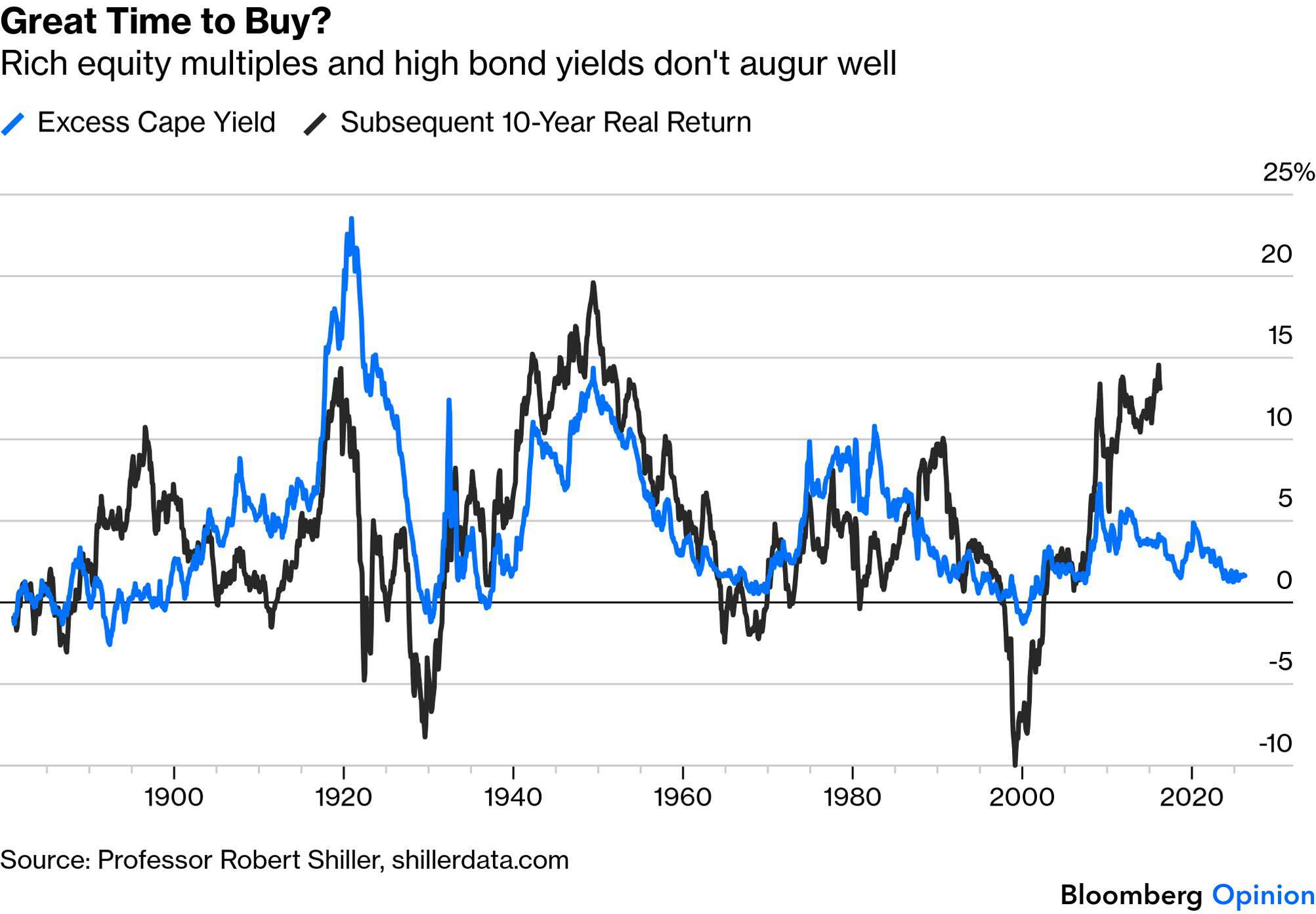
U.S. equity markets enjoyed a robust April despite myriad economic and geopolitical inputs that might have given investors pause. Should equity investors remain bullish at this time? The graph below caught my attention primarily because of the recent disconnect between the two lines related to the Shiller Excess Cape Yield (ECY) and subsequent 10-year Real Return for equities. There are many, many valuation tools that claim to provide clues about the future direction of stocks, and this is such an example. Those tools can be short-, medium-, and long-term in nature. The ECY happens to be one valuation metric that provides “guidance” for longer time frames. The current reading of 1.60% certainly looks rich relative to its long history.

In case you don’t know, the Shiller excess CAPE yield is a valuation measure that compares the stock market’s earnings yield with the “real” yield on the 10-year Treasury note. In simple terms, it asks how much extra return stocks may offer over inflation-adjusted government bonds.

How it is calculated

  • Take the inverse of the CAPE ratio, which is the market’s “earnings yield.”
  • Subtract the real 10-year Treasury yield.

So, ECY=(1/CAPE)10-year real Treasury yield

A higher excess CAPE yield suggests stocks might look more attractive relative to bonds. A lower reading suggests the equity risk premium is thinner, meaning stocks offer less return versus bonds. As mentioned above, current readings show the S&P 500 Shiller Excess CAPE Yield around 1.60% for April 2026, which is well below its long-term average of 4.60%. Another data source put it at 1.41 as of April 30, 2026.

Investors have historically used the ECY as a long-term asset allocation tool, especially when comparing stocks with Treasury bonds. It is not a short-term trading signal, but rather a rough guide to whether equities look cheap or expensive relative to real bond yields. A CAPE yield below 2% has generally signaled subdued future equity returns over the next 5 to 10 years, providing a valuation warning sign, and not an exact measure.

As a reminder, there are many valuation techniques used to identify opportunities and risk when investing in U.S. equities. Depending on a pension plan’s liquidity needs, funded ratio, willingness to take risk, etc. today’s current environment may be providing an opportunity to reduce risk by trimming equities and using the proceeds along with core fixed income assets to establish a cash flow matching mandate. In the process, the plan’s liquidity is improved, promised benefits secured, and the investing horizon extended for the residual assets. Give us a call. We are always willing to provide a free analysis showcasing how CFM can help your fund.