-56.1% – Really?

By: Russ Kamp, CEO, Ryan ALM, Inc.

I truly relish getting feedback related to my blog posts. I wasn’t surprised that there was more activity, and a little skepticism, related to my recent post that discussed the output from a current project. You may recall the post titled, “Bond Math and A Steepening Yield Curve – Perfect Together”, in which I shared that one particular Cash Flow Matching (CFM) implementation resulted in a potential -56.1% reduction in the cost of the future promised pension benefits. A few folks questioned the math, while another made the comment that the “savings” or cost reduction was nothing more than the time value of money. But isn’t that the reason to have pension assets in the first place so you are not funding liabilities at 100 cents on the dollar (pay-as-you-go).

Well, here’s the thing, the use of bonds, the only asset class with a known cash flow (future value at maturity and contractual semi-annual interest payments), brings to the management of pensions an element of certainty not found elsewhere. Yes, it is conceivable that one could cobble together a group of investment strategies that might subsequently achieve a targeted return that would help pay those obligations, but the cash flow volatility associated with this approach may also lead to underperformance and higher contribution expenses in the process.

With CFM, the savings (cost reduction) gets locked in on day one of the assignment. Give us a 5-year, 10-year, or longer assignment to secure the benefits, and we’ll be able to give you the likely return for that entire period. Furthermore, CFM provides liquidity without forced selling or the sweep of dividends, interest, and capital distributions that should be reinvested in those higher returning strategies. In the process, the investing horizon for the plan’s assets is extended enhancing the probability that they will achieve the desired outcome.

In the example used in the previous Blog post, the -56.1% cost reduction was achieved with only 40% of the plan’s assets. By using a vertical slice approach, in which we secure a portion of the monthly obligations, we were able to extend the coverage period from 11-years to 30-years. That extension allowed us to use longer maturity bonds at substantially higher yields, which took advantage of bond math that proclaims that the longer the maturity and the higher the yield, the lower the cost. It’s true!

In today’s interest rate environment in which the average BBB corporate bond is trading at a yield close to 6%, a pension plan can capture roughly 89% of the target return (6.75% average ROA) with little to no volatility. How wonderful! Given that humans hate uncertainty, why don’t plan sponsors adopt the use of CFM to bring some certainty to their pension systems? Why do they choose to continue to ride the rollercoaster of returns provided by markets leading to increased contributions following down markets?

So, if you are still skeptical regarding our ability to provide significant cost reductions specific to your set of liabilities, allow us to provide you with a free analysis highlighting how CFM can support your pension plan and the plan’s participants. There may not be such a thing as a free lunch, but we can provide you with a sleep-well-at-night strategy.

ARPA Update as of December 12, 2025

By: Russ Kamp, CEO, Ryan ALM, Inc.

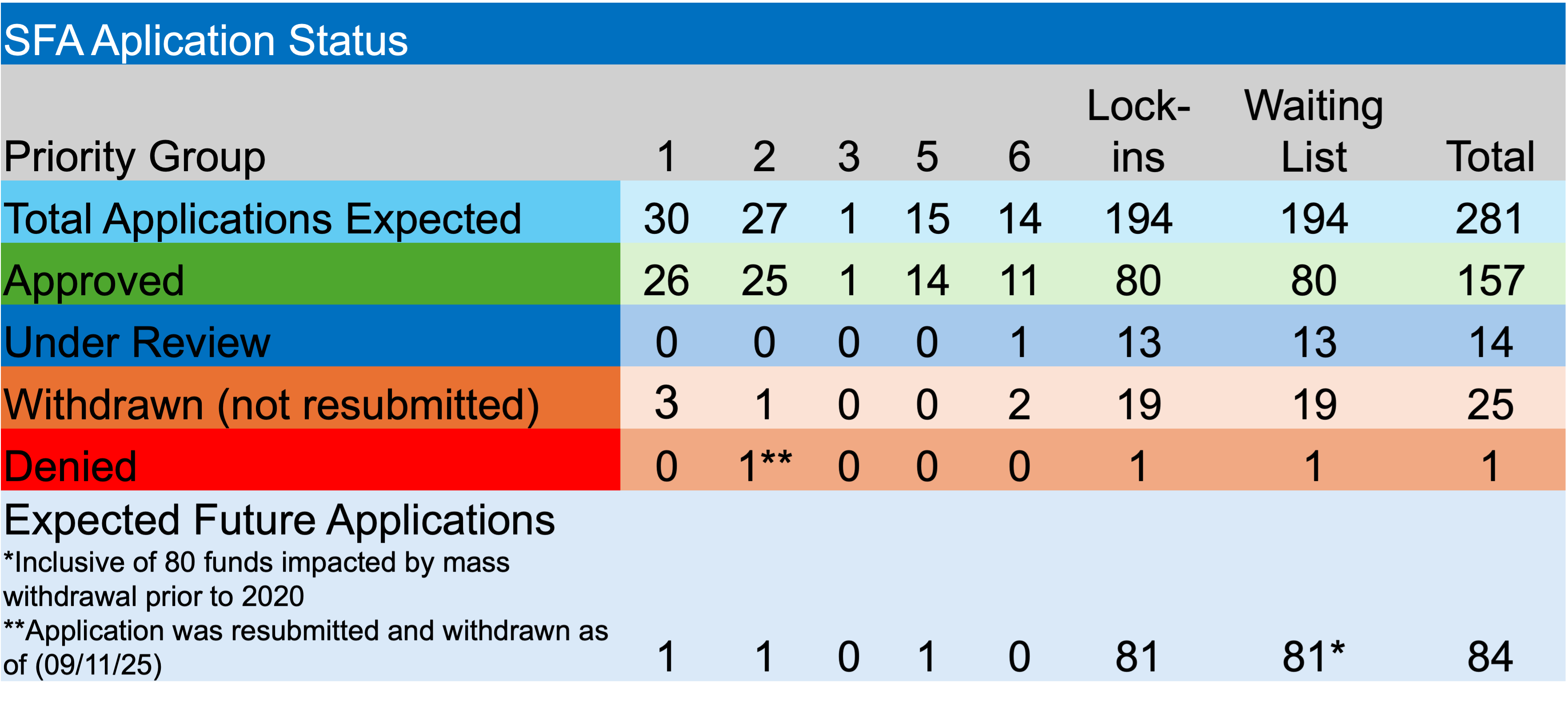
Unlike the Northeast, access to the PBGC’s e-Filing portal is thawing. According to the PBGC’s website, “the e-Filing Portal is open only to plans at the top of the waiting list that have been notified by PBGC that they may submit their applications. Applications from any other plans will not be accepted at this time.” Despite the dozens of multiemployer plans that remain on the waitlist, the floodgates have certainly not opened.

In fact, only two plans were permitted to submit applications last week. UFCW – Northern California Employers Joint Pension Plan, a Priority Group 6 member, submitted a revised application seeking >$2.3 billion for nearly 140k members, while UFCW, Local 23 and Giant Eagle Pension Plan, a non-priority group member, filed an initial application hoping to garner $40 million in SFA for 7,100 plan participants.

In other news, Dairy Industry-Union Pension Plan for Philadelphia and Vicinity, Warehouse Employees Union Local No. 730 Pension Trust Fund, and Cleveland Bakers and Teamsters Pension Plan received approval for SFA grants. Collectively they will receive $303.4 million (including interest and loan repayments) for 13,533 plan participants. There have now been 150 plans approved for SFA totaling just over $75 billion in grants.

Fortunately, there were no plans asked to repay a portion of the SFA due to census errors, no plans denied a filing, and no withdrawals of previously submitted applications. There were two more funds added to the waitlist and nine that locked in their valuation dates, including the two most recent additions to the waitlist. There remain 85 applications that have yet to be submitted to the PBGC.

Recent Federal Reserve interest rate action has rates on the long-end of the yield curve ratcheting higher. The 30-year Treasury Bond’s yield is at 4.83% (12:-5 pm). Comparable 30-year IG corporates are trading at yields close to 6% at this time. It remains an excellent time to secure the promised benefits through a CFM strategy.

Something Has Got to Give

By: Russ Kamp, CEO, Ryan ALM, Inc.

Not surprisingly, the U.S. Federal Reserve’s FOMC lowered rates another 25 bps today. The new target is 3.75%-4.0%, down from 4.5%-4.75% during the last 3 meetings. Currently, the 10-year Treasury yield (4.145% at 3:21 pm EST) is only marginally greater than the median CPI (Latest reading from the Cleveland Fed is 3.5% annually).

Ryan ALM, Inc.’s Head Trader, Steve DeVito put together the following comparison.

Steve is comparing the 10-year Treasury note yield (blue) versus the Median CPI (red) since January 2016. The green line is the “real” yield (10-year Treasury – the median CPI). For this period of time, there has been very little real yield, as U.S. rates were driven to historic lows before inflation spiked due to Covid-19 factors. However, historically (1962-2025), the real yield has average 2%. With rates down and inflation remaining stubbornly steady to increasing slightly, the real yield that investors are willing to take is, and has been, quite modest (0.17% since 2008). Why? Were the historically low rates in reaction to covid-19 an anomaly, or has something changed from an investor standpoint? Given today’s fundamentals, one might assume that investors are anticipating a sudden reversal in inflation, but is that a smart bet?

The WSJ produced the graph in today’s edition highlighting the change in the U.S. Treasury yield curve during the last year. As one can clearly see, the yield curve has gotten much steeper with the 30-year Treasury bond yield 0.4% above last year’s level (at 4.81%). That steepness would indicate to me that there is more risk longer term from inflation potentially rising.

So, it seems as if something has to give. If inflation remains at these levels, the yield on the 10-year Treasury note should be about 1.25% greater than today. If in fact, yields were to rise to that level, active core fixed income managers would see significant principal losses. However, cash flow matching managers and their clients would see the potential for greater cost reduction in the defeasing of pension liabilities, especially for longer-term programs. Bond math is very straight forward. The longer the maturity and the higher the yield, the greater the cost savings.

Managing a pension plan should be all about cash flows. That is asset cash flows versus liability cash flows of benefits and expenses. Higher yields reduce the future value of those promises. Remember, a CFM strategy is unique in that it brings an element of certainty (barring a default) to the management of pensions which live in a world of great uncertainty. Aren’t you ready for a sleep-well-at-night strategy?

The Times They Are A-Changin’

By: Russ Kamp, CEO, Ryan ALM, Inc.

Thank you, Bob Dylan, for the lyric that is just perfect for this blog post. I have just returned from the IFEBP conference in Honolulu, HI. What a great conference, and not just because it was in Hawaii (my first time there). If it wasn’t the location, then what made this one so special? For years I would attend this conference and many others in our industry and never hear the word liability mentioned, as in the pension promise, among any of the presentations.

So pleased that during the last few years, as U.S. interest rates have risen and defined benefit pension funding has improved, not only are liabilities being discussed, but more importantly, asset allocation strategies focused on pension liabilities are being presented much more often. During this latest IFEBP conference there were multiple sessions on ALM or asset allocation that touched on paying heed to the pension plan’s liabilities, including:

“Asset Allocation for Today’s Markets”

“My Pension Plan is Well-Funded – Now What?”

“Asset Liability Matching Investment to Manage the Risk of Unfunded Liabilities”

“Decumulation Strategies for Public Employer Defined Contribution Plans” (they highlighted the fact that these strategies should be employed in DB plans, too)

“Applying Asset Liability Management Strategies to Your Investments” (my session delivered twice)

“Entering the Green Zone and Staying There”

These presentations all touched on the importance of risk management strategies, while encouraging pension plan sponsors to stop riding the performance rollercoaster. Given today’s highly uncertain times and equity valuations that appear stretched under almost any metric, these sessions were incredibly timely and necessary. Chasing a performance objective only ensures volatility. That approach doesn’t guarantee success. On the other hand, securing the pension promise through an ALM strategy at a reasonable cost and with prudent risk does redefine the pension objective appropriately.

I know that human beings are reluctant to embrace change, but we despise uncertainty to a far greater extent. Now is the time to bring an element of certainty to the management of pension assets. By the way, that was the title of my recent presentation to public funds at the NCPERS conference in Fort Lauderdale. Again, understanding pension liabilities and managing to them is not new, but it has certainly been under a bigger and brighter spotlight recently. That is great news!

You Don’t Say!

By: Russ Kamp, CEO, Ryan ALM, Inc.

Morgan Stanley has published the results from their Taft-Hartley survey, in which they have to provided “insights into how Taft-Hartley plans are managing priorities and navigating challenges to strengthen their plans”. I sincerely appreciate MS’s effort and the output that they published. According to MS, T-H plans have as their top priority (67% of respondents) delivering promised benefits without increasing employer’s contributions. That seems quite appropriate. What doesn’t seem to jive with that statement is the fact that only 29% that improving or maintaining the plan’s funded status was important. Sorry to burst your bubble plan trustees, but you aren’t going to be able to accomplish your top priority without stabilizing the funded status/ratio by getting off the performance rollercoaster.

Interestingly, T-H trustees were concerned about market volatility (84%) and achieving desired investment performance while managing risk (69%). Well, again, traditional asset allocation structures guarantee volatility and NOT success. If you want to deliver promised benefits without increasing contributions, you must adopt a new approach to asset allocation and risk management. Doing the same old, same old won’t work.

I agree that the primary objective in managing a DB plan, T-H, public, or private, is to SECURE the promised benefits at a reasonable cost and with prudent risk. It is not a return game. Adopting a new asset allocation in which the assets are divided among two buckets – liquidity and growth, will ensure that the promises (monthly benefits) are met every month chronologically as far into the future that the assets will cover delivering the promised benefits. However, just adopting this bifurcated asset allocation won’t get you off the rollercoaster of returns and reduce market volatility. One needs to adopt an asset/liability focus in which asset cash flows (bond interest and principal) will be matched against liability cash flows of benefits and expenses.

This approach will significantly reduce the volatility associated with markets as your pension plan’s assets and liabilities will now move in lockstep for that portion of the portfolio. As the funded status improves, you can port more assets from the growth portfolio to the liquidity bucket. It will also buys time for the remaining growth assets to help wade through choppy markets. According to the study, 47% of respondents that had an allocation to alternatives had between 20% and 40%. This allocation clearly impacts the liquidity available to the plan’s sponsor to meet those promises. If allocations remain at these levels, it is imperative to adopt this allocation framework.

Furthermore, given today’s equity valuations and abundant uncertainty surrounding interest rates, inflation, geopolitical risk, etc., having a portion of the pension assets in a risk mitigating strategy is critically important. Thanks, again, to MS for conducting this survey and for bubbling up these concerns.

PBGC Increases Premium Rates – Why?

By: Russ Kamp, CEO, Ryan ALM, Inc.

The demise of the defined benefit (DB) plan, most notably within the private sector, is harming the American worker and significantly reducing the odds of a dignified retirement. The Federal government should be doing everything that it can to protect the remaining pensions, including keeping fees low to ensure that these critically important retirement vehicles continue to operate. But unfortunately that doesn’t seem to be the case in this particular situation.

I have been very impressed with and supportive of the PBGC’s effort implementing the ARPA pension legislation, but I question the need to raise premium rates for 2026, which the PBGC has just announced. Why? As of fiscal year-end 2024, the PBGC’s single employer insurance program had a $54.1 BILLION surplus, as assets totaled $146.1 billion and liabilities stood at $92.0 billion. Despite these significant excess resources, the PBGC is increasing rates for the “flat rate premium per participant” in single-employer plans to $111 per participant in 2026 from $106. This 4.7% increase was described in a Chief Investment Officer article as modest! That increase doesn’t seem modest anyway you look at it, but certainly not when one remembers that $54 billion surplus. What is the justification? The rate per $1,000 in “unvested benefits”, not subject to indexing, was frozen by Congress in Section 349 of the SECURE 2.0 Act of 2022 and therefore remains $52. Seems like we need more legislation to freeze the flat-rate premium.

Despite the significant improvement in the multiemployer pension program due to the Special Financial Assistance (SFA) related to ARPA pension reform, that insurance pool is still underwater. As a result, multiemployer plans that only pay a per-participant premium will see the per-participant rate for flat rate premiums rise to $40 from $39 next year. That amounts to an increase of 2.6%. So, the program that is underwater sees a premium increase of 2.6%, while the insurance pool with the massive surplus gets an outsized 4.7% increase? I guess one must work for the government to understand that decision.

Again, we need to do much more to protect DB pensions for all American workers. Asking untrained individuals to fund, manage, and then disburse a “retirement benefit” with little to no disposable income, low investment knowledge, and no crystal ball to help with longevity considerations is just poor policy doomed to failure. We are the wealthiest country in the world, yet we can’t seem to figure out how to control costs associated with retirement, healthcare, education, childcare, etc. and in the process, we are crippling a majority of American families. It isn’t right!

Cash Flow Matching: Bringing Certainty to Pension Plans

By: Russ Kamp, CEO, Ryan ALM, Inc.

Imagine a world, or at least the United States, where pension plans are no longer subject to market swings and the uncertainty those swings create. What if you could “guarantee” (outside of any corporate bond defaults) the promises made to your plan participants, ensuring their financial security with confidence? In today’s highly unpredictable investing environment, relying solely on the pursuit of investment returns is a risky ride—one that guarantees volatility and sleepless nights but not necessarily success. It’s time to rethink how we manage defined benefit (DB) pension plans and embrace a strategy that brings true certainty: Cash Flow Matching (CFM). Discover through the hypothetical conversation below how CFM can transform your investing approach, protect your plan, and deliver peace of mind for everyone involved. Let’s go!

Why are we talking about Cash Flow Matching (CFM) today?

First off, thanks for taking a few minutes to chat with me. As you may have heard me say before, our mission at Ryan ALM, Inc. is simple — to protect and preserve defined benefit (DB) pension plans and to secure the promises made to participants.

We believe that Cash Flow Matching (CFM) is one of the few strategies that can help us keep those promises with real certainty.


Why Now?

Because the world feels more uncertain than ever.

And if we’re honest, most of us don’t like uncertainty. Yet somehow, in the pension world, many plan sponsors have gotten used to it. Why is that?

Over the years, we’ve been taught that managing a DB plan is all about chasing returns. But that’s not really the case. When a plan invests 100% of its assets purely with a return objective, it locks itself into volatility — not stability or success.

That approach also puts your plan on the “asset allocation rollercoaster,” where markets rise and fall, and contributions swing higher and higher along with them. It’s time to step off that ride — at least for part of your portfolio.


So if it’s not all about returns, what is the real objective?

Managing a DB pension plan is all about cash flows — aligning the cash coming in (from principal and interest on bonds) with the cash going out (for benefits and expenses).

The real goal is to secure those promised benefits at a reasonable cost and with prudent risk. That’s the foundation of a healthy plan.


Does bringing more certainty mean I have to change how I manage the plan?

Yes — but only a little. The adjustments are modest and easy to implement.


How can I adopt a CFM strategy without making major changes?

The first step is to reconfigure your asset allocation. Most DB plans are currently 100% focused on returns. It’s time to split your assets into two clear buckets:

  1. Liquidity bucket – designed to provide cash flow to pay benefits and expenses.
  2. Growth bucket – focused on long-term return potential.

What goes into the liquidity bucket?

Most plans already hold some cash and core fixed income. Those assets can move into the liquidity bucket to fund benefit payments and expenses.


And what happens with the remaining assets?

Nothing changes there. Those assets stay in your growth or alpha bucket. The difference is that you’ll no longer need to sell from that bucket during market downturns, which helps protect your fund from the negative impact of forced selling.


Is that all I need to do to create more certainty?

Not quite. You’ll also want to reconfigure your fixed income exposure.

Instead of holding a generic, interest-rate-sensitive bond portfolio (like one tied to the Bloomberg Aggregate Index), you’ll want a portfolio that matches your plan’s specific liabilities — using both principal and income to accomplish the objective.

That’s where true cash flow matching comes in.


How does the matching process work?

We start by creating a Custom Liability Index (CLI) — a model of your plan’s projected benefit payments, expenses, and contributions. This serves as the roadmap for funding your monthly liquidity needs.


What information do you need to build that index?

Your plan’s actuary provides the projected benefits, expenses, and contributions as far out into the future as possible. The more data we have, the stronger the analysis. From there, we can map out your net monthly liquidity needs after accounting for contributions.


Which bonds do you use to match the cash flows?

We invest primarily in U.S. Treasuries and U.S. investment-grade corporate bonds. We stick with these because they provide dependable cash flows without introducing currency risk.

We limit our selections to bonds rated BBB+ or higher, and the longest maturity we’ll buy matches the length of the mandate. For example, if you ask us to secure 10 years of liabilities, the longest bond we’ll buy will mature in 10 years.


Do you build a laddered bond portfolio?

No — a traditional ladder would be inefficient for this purpose.

Here’s why: the longer the maturity and the higher the yield, the lower the overall cost of funding those future liabilities. So instead of a simple ladder, we use a proprietary optimization process to build the portfolio in a way that maximizes efficiency and minimizes cost.


It sounds manageable — not a big overhaul. Am I missing something?

Not at all. That’s exactly right.

Dividing assets into liquidity and growth buckets and reshaping your bond portfolio into a CFM strategy is typically all that’s required to bring more certainty to part of your plan.

Every plan is unique, of course, so each implementation will reflect its own characteristics. But generally speaking, CFM can reduce the cost of future benefits by about 2% per year — or roughly 20% over a 10-year horizon.

On top of that, it helps stabilize your funded status and contribution requirements.


How much should I allocate to CFM?

A good starting point is your existing cash and bond allocation. That’s the least disruptive way to begin.

Alternatively, you can target a specific time horizon — for example, securing 5, 7, or 10 years of benefits. We’ll run an analysis to show what asset levels are needed to meet those payments, which may be slightly more or less than your current fixed income and cash allocations.


Once implemented, do I just let the liquidity bucket run down?

Most clients choose to rebalance annually to maintain the original maturity profile. That keeps the strategy consistent over time. Of course, the rebalancing schedule can be customized to your plan’s needs and the broader market environment.


This all sounds great — but what does it cost?

In line with our mission to provide stability at a reasonable cost and with prudent risk, our fee is about half the cost of a typical core fixed income mandate.

If you’d like, we can discuss your specific plan details and provide a customized proposal.


Final thoughts

Thank you for taking the time to explore CFM. Many plan sponsors haven’t yet heard much about it, but it’s quickly becoming a preferred approach for those who value stability and peace of mind.

At the end of the day, having a “sleep well at night” strategy benefits everyone — especially your participants.

ARPA Update as of October 24, 2025

By: Russ Kamp, CEO, Ryan ALM, Inc.

If it is a Monday, it is ARPA/SFA update day. I’m bringing you this update from Fort Lauderdale, FL, where I’m attending and speaking at the NCPERS Fall conference. It looks like a wonderful agenda for the next few days. Regarding ARPA, how did the PBGC do last week? Let’s explore.

Last week saw limited action with only two applications received, including a revised application from a Priority Group 1 member. As you may recall, this was the first group permitted to submit applications all the way back in July 2021! Only 25 of the 30 members of that cohort have received Special Financial Assistance to date. Richmond, VA based Bricklayers Union Local No. 1 Pension Fund of Virginia, submitted a revised application seeking $12.9 million for its 395 participants, while International Association of Bridge, Structural, Ornamental and Reinforcing Ironworkers Local No. 79 Pension Fund, submitted an initial application hoping to secure $14.6 for 462 members. As an aside, the Ironworkers would be golden if the SFA desired was based on the length of the plan’s name.

In other ARPA news, or lack thereof, there were no applications approved, and fortunately, none denied. There were no pension plans forced to withdraw an application and none asked to repay a portion of the SFA received due to census errors. However, there was one more plan added to the burgeoning waitlist. The Soft Drink Industry Pension Fund is the 178th none-priority group fund to add its name to the list.

The next couple of months should be quite exciting for the PBGC as it works through the abundant list of applications for non-priority group members. U.S. interest rates have pulled back recently reducing some of the potential coverage period through a CFM strategy, but rates are still significantly higher than they were in 2021 when ARPA began to be implemented. Please reach out to us if you’d like to get a free analysis on what is possible once the SFA is received.

And Now Utility Bills!

By: Russ Kamp, CEO, Ryan ALM, Inc.

Electric payment company Payless Power released a report showing how Americans are being forced to choose between keeping the lights on, buying groceries, or paying for medicine. They conducted a survey of 1,069 people, including nearly half of whom came from low-income households, and regrettably 39% said they’d fallen behind on electricity payments in the past year.

Incredibly, more than 30% received at least one shutoff notice, while 11% had their power cut off due to missed payments. “Beyond the financial stress, high electricity prices are creating real safety risks,” Payless Power said. “More than half of low-income households said they went without heat or air conditioning for several days in the past year because they couldn’t afford it.”

The impact of having one’s electricity shut off has led roughly 30% of the respondents to feel physically unsafe at home during extreme temperatures. Not unlike the challenging economic times found during the Great Depression, nearly one in four sent children or pets away from their home to escape dangerous indoor conditions.

More than half (52%) of low-income households cut back on groceries to pay utility bills, while 16% skipped medication or medical care. Another 19% reduced transportation or internet spending, and 5% missed rent or mortgage payments. As you can imagine, larger families are hit hardest, as households with five or more people were nearly twice as likely to fall behind as those homes with two or fewer individuals at home.

Rising utility costs come as households are already stretched thin by higher housing costs and food prices compounded by a deteriorating labor market. Research from Goldman Sachs shows consumers are absorbing >50% of the cost of President Trump’s widespread tariffs. In a Harris/Axios poll, 47% of Americans said groceries are more difficult to afford than they were in September 2024.

Lastly, as of Q2’25, Moody’s and the Federal Reserve estimate that the top 10% of income earners in the U.S. account for 49.2% of the consumption. This is the highest percentage on record dating back to when data collection began in 1989. A level of concentration such as this is NOT good for the long-term viability of the U.S. economy.

Milliman: Another good month for pension funding

By: Russ Kamp, CEO, Ryan ALM, Inc.

Whether one is referring to public pensions or private DB plans, September was a continuation of the positive momentum experienced for most of 2025. Milliman has reported on both the Milliman 100 Pension Funding Index (PFI), which analyzes the 100 largest U.S. corporate pension plans and its Public Pension Funding Index (PPFI), which analyzes data from the nation’s 100 largest public defined benefit plans.

Milliman estimates that public pension funds saw aggregate returns of 1.7%, while corporate plans produced an average return for the month of 2.5%. As a result of these gains (sixth consecutive gain), public pension funded ratios stand at 85.4% up from 84.2% at the end of August. Corporate plans are now showing an aggregate funded ratio of 106.5%, marking the highest level since just before the Great Financial Crisis (GFC).

Public pension fund assets are now $5.66 trillion versus liabilities of $6.63 trillion, while corporate plans added $26 billion to their collective net assets increasing the funded status surplus to $80 billion. For corporate plans, the strong 2.5% estimated return was more than enough to overcome the decline in the discount rate to 5.36%, a pattern that has persisted for much of 2025.

“Robust returns helped corporate pension funding levels improve for the sixth straight month in September,” said Zorast Wadia, author of the Milliman PFI. “With more declines in discount rates likely ahead, funded ratios may lose ground unless plan assets move in lockstep with liabilities.”

“Thanks to continued strong investment performance, public pension funding levels continued to improve in September, and unfunded liabilities are now below the critical $1 trillion threshold for the first time since 2021,” said Becky Sielman, co-author of the Milliman PPFI. “Now, 45 of the 100 PPFI plans are more than 90% funded while only 11 are less than 60% funded, underscoring the continued health of public pensions.”

Discount rates have so far fallen in October. It will be interesting to see if returns can once again prop up funded status for corporate America. It will also be interesting to see how the different accounting standards (GASB vs. FASB) impact October’s results. A small gain for corporate plans may not be enough to overcome the potential growth in liabilities, as interest rates decline, but that small return may look just fine for public pension plans, that don’t mark liabilities to market only assets.

View this Month’s complete Pension Funding Index.

View the Milliman 100 Public Pension Funding Index.