Uncertainty versus Change

By: Russ Kamp, CEO, Ryan ALM, Inc.

Seems like we have a conflict within the management of defined benefit plans. On one hand, human beings (plan sponsors) despise uncertainty. But nearly all public DB pension plans are embracing uncertainty in how they are managed. How? Through a traditional asset allocation framework that focuses the fund’s assets on a performance objective – the return on asset assumption (roughly 7% for the average public plan). Each second that the capital markets are operating, uncertainty is abundant, as price movements are out of one’s control. So let’s change how plans are managed. Not so simple, as those same human beings hate change. Oh, boy.

I have the privilege of speaking at the NCPERS Fall conference tomorrow. The title of my presentation is “Bringing an Element of Certainty to Pension Management”. Folks should absolutely eat up this topic, but given the conflict cited above, it will be interesting to see if the trustees in the audience embrace the concept of achieving some certainty despite having to implement change to their current operating practices.

Given that both uncertainty and change are difficult for humans, what are we to do? Well, psychological research suggests that uncertainty is generally more challenging because it disrupts our ability to predict, control, and prepare for outcomes, and in the process it triggers more anxiety and stress than change itself. According to the research:

  • Uncertainty introduces ambiguity about outcomes, which activates heightened anxiety in the brain. When people lack information about what will happen (such as market movements), they tend to experience more stress and feelings of helplessness.
  • Change, while uncomfortable, becomes easier to adapt to when the outcome is known, even if it’s negative. Humans can plan, adjust, and find coping strategies if they know what to expect. As a result, predictable change is less stressful than unpredictable change.

Why is uncertainty more challenging? Again, according to the research:

  • The human brain is wired to seek patterns and predict the future; uncertainty undermines this process, making adaptation feel more difficult.
  • Studies show that people prefer even certain bad news to ambiguous situations, because they can prepare for and process what’s coming.
  • Chronic uncertainty can lead to anxiety disorders and impaired decision-making, while change tends to prompt growth and learning once people know what they’re facing.

Uncertainty is usually more psychologically challenging than change because it creates anxiety about the unknown, whereas change with a known outcome—though still difficult—allows people to adapt and regain control. Given this reality, it would seem that reducing uncertainty within the management of a DB pension plan would outweigh the changes necessary to accomplish that objective. BTW, the changes needed aren’t great. All one needs to do to bring some certainty to the process is to convert the current core fixed income allocation to a cash flow matching (CFM) strategy that will SECURE the promised benefits for as far into the future as that allocation will cover. In the process you improve the fund’s liquidity profile and extend the investing horizon for the residual assets. A win/win!

How nice would it be to communicate to your plan participants that no matter what happens in the markets (uncertainty) the promised benefits are protected for the next 5-, 7-, 10- or more years. Talk about a “sleep well at night” strategy! Now that’s certainty that even change can live with.

Milliman: Another good month for pension funding

By: Russ Kamp, CEO, Ryan ALM, Inc.

Whether one is referring to public pensions or private DB plans, September was a continuation of the positive momentum experienced for most of 2025. Milliman has reported on both the Milliman 100 Pension Funding Index (PFI), which analyzes the 100 largest U.S. corporate pension plans and its Public Pension Funding Index (PPFI), which analyzes data from the nation’s 100 largest public defined benefit plans.

Milliman estimates that public pension funds saw aggregate returns of 1.7%, while corporate plans produced an average return for the month of 2.5%. As a result of these gains (sixth consecutive gain), public pension funded ratios stand at 85.4% up from 84.2% at the end of August. Corporate plans are now showing an aggregate funded ratio of 106.5%, marking the highest level since just before the Great Financial Crisis (GFC).

Public pension fund assets are now $5.66 trillion versus liabilities of $6.63 trillion, while corporate plans added $26 billion to their collective net assets increasing the funded status surplus to $80 billion. For corporate plans, the strong 2.5% estimated return was more than enough to overcome the decline in the discount rate to 5.36%, a pattern that has persisted for much of 2025.

“Robust returns helped corporate pension funding levels improve for the sixth straight month in September,” said Zorast Wadia, author of the Milliman PFI. “With more declines in discount rates likely ahead, funded ratios may lose ground unless plan assets move in lockstep with liabilities.”

“Thanks to continued strong investment performance, public pension funding levels continued to improve in September, and unfunded liabilities are now below the critical $1 trillion threshold for the first time since 2021,” said Becky Sielman, co-author of the Milliman PPFI. “Now, 45 of the 100 PPFI plans are more than 90% funded while only 11 are less than 60% funded, underscoring the continued health of public pensions.”

Discount rates have so far fallen in October. It will be interesting to see if returns can once again prop up funded status for corporate America. It will also be interesting to see how the different accounting standards (GASB vs. FASB) impact October’s results. A small gain for corporate plans may not be enough to overcome the potential growth in liabilities, as interest rates decline, but that small return may look just fine for public pension plans, that don’t mark liabilities to market only assets.

View this Month’s complete Pension Funding Index.

View the Milliman 100 Public Pension Funding Index.

ARPA Update as of October 17, 2025

By: Russ Kamp, CEO, Ryan ALM, Inc.

The PBGC is doing its best to get through an imposing list of applicants for Special Financial Assistance (SFA). However, it seems more like one step forward, 1 1/2 steps backward for that organization as they grapple with late arrivals to the waitlist. In the latest week, the PBGC didn’t allow any additional applications to be submitted through the eFiling portal, but they did manage to approve two applications for SFA, while a third withdrew its initial application.

Despite the apparent progress, the PBGC saw four additions to the waitlist, which now numbers 176, of which 72 have yet to see any action taken on their potential submission. I can’t see how the PBGC is going to get through the remaining applications by year-end, when the filing of an initial application needs to be completed based on the language within the ARPA legislation.

Those pension funds receiving approval for the SFA in this latest week included, Local 153 Pension Fund and (initial application) Roofers Local 88 Pension Plan (revised application). Together they will collect $239.7 in SFA and interest for 12,335 plan participants. There have now been 144 pension plans approved to receive SFA for a total of $74.5 billion in grants. Amazing!

Happy to report that there were no applications denied and none of the previous SFA recipients were asked to refund a portion of the grant due to census errors. However, there was one plan that withdrew the initial application. Cumberland, Maryland Teamsters Construction and Miscellaneous Pension Plan, is seeking a SFA grant of $8.7 million for its 101 members.

The four latest (late) additions to the waitlist include, Local 29 R.W.D.S.U. Pension Fund, United Optical Workers Local 408 Pension Fund, Millwrights and Machinery Erectors Local No. 1545 Pension Plan, and Painters and Allied Trades Paint Makers Pension Plan. Only the Millwrights plan locked in its valuation date as of July 31, 2025. They were joined by the New Bedford Fish Lumpers Pension Plan which also chose July 31, 2025, for its valuation date. Do you know what a fish lumper is or does? You’ll have to see next week’s ARPA post for the answer, or you can go to your friendly AI app like I did.

Remember: NO Free Lunch!

By: Russ Kamp, CEO, Ryan ALM, Inc.

In 1938, journalist Walter Morrow, Scripps-Howard newspaper chain, wrote the phrase “there ain’t no such thing as a free lunch”. The pension community would be well-served by remembering what Mr. Morrow produced more than eight decades ago. Morrow’s story is a fable about a king who asks his economists to articulate their economic theory in the fewest words. The last of the king’s economists utters the famous phrase above. There have been subsequent uses of the phrase, including Milton Friedman in his 1975 essay collection, titled “There’s No Such Thing as a Free Lunch”, in which he used it to describe the principle of opportunity cost.

I mention this idea today in the context of private credit and its burgeoning forms. I wrote about capacity concerns in private credit and private equity last year. I continue to believe that as an industry we have a tendency to overwhelm good ideas by not understanding the natural capacity of an asset class in general and a manager’s particular capability more specifically. Every insight that a manager brings to a process has a natural capacity. Many managers, if not most, will eventually overwhelm their own ideas through asset growth. Those ideas can, and should be, measured to assess their continuing viability. It is not unusual that good insights get arbitraged away just through sheer assets being managed in the strategy.

Now, we are beginning to see some cracks in the facade of private credit. We have witnessed a significant bankruptcy in First Brands, a major U.S. auto parts manufacturer. Is this event related to having too much money in an asset class, which is now estimated at >$4 trillion.? I don’t know, but it does highlight the fact that there are more significant risks investing in private deals than through public, investment-grade bond offerings. Again, there is no free lunch. Chasing the higher yields provided by private credit and thinking that there is little risk is silly. By the way, as more money is placed into this asset class to be deployed, future returns are naturally depressed as the borrower now has many more options to help finance their business.

In addition, there is now a blurring of roles between private equity and private credit firms, which are increasingly converging into a more unified private capital ecosystem. This convergence is blurring the historic distinction between equity sponsors and debt providers, with private equity firms funding private credit vehicles. Furthermore, we see “pure” credit managers taking equity stakes in the borrowers. So much for diversification. This blurring of roles is raising concerns about valuations, interconnected exposures, and potential conflicts of interest due to a single manager holding both creditor and ownership stakes in the same issue.

As a reminder, public debt markets are providing plan sponsors with a unique opportunity to de-risk their pension fund’s asset allocation through a cash flow matching (CFM) strategy. The defeasement of pension liabilities through the careful matching of bond cash flows of principal and interest SECURES the promised benefits while extending the investing horizon for the non-bond assets. There is little risk in this process outside of a highly unlikely IG default (2/1,000 bonds per S&P). There is no convergence of strategies, no blurring of responsibilities, no concern about valuations, capacity, etc. CFM remains one of the only, if not the only, strategies that provides an element of certainty in pension management. It isn’t a free lunch (we charge 15 bps for our services to the first breakpoint), but it is as close as one will get!

ARPA Update as of October 10, 2025

By: Russ Kamp, CEO, Ryan ALM, Inc.

Welcome to Columbus and Indigenous Peoples’ Day. Bond markets are closed and the equity markets remain open. Columbus Day remains a federal holiday, but with most federal employees already furloughed, it will not be a day to celebrate for many.

Regarding ARPA and the PBGC’s activity implementing this critical legislation, last week proved a busy one as there were three new applications received, two approved, and one withdrawn. There was also a plan added to the burgeoning waitlist. Happy to report that there were no applications denied or required to rebate a portion of the SFA as a result of census errors.

Now for the details. Ironworkers’ Local 340 Retirement Income Plan, Operative Plasterers & Cement Masons Local No. 109 Pension Plan, and Dairy Employees Union Local #17 Pension Plan, each a non-priority group member, filed their initial applications seeking a combined $60.4 million in SFA for nearly 3k plan participants. The PBGC has 120-days to act on these applications.

Pleased to report that two plans, Local 734 Pension Fund and the Retirement Plan of the Millmen’s Retirement Trust of Washington received approval for their initial applications, and they will receive $89.5 and $7.2 million, respectively for their combined 2,597 members. The PBGC has now awarded $74.3 billion in SFA grants to support the pensions for 1.828 million workers.

In other ARPA news, Pension Plan of the Pension Fund for Hospital and Health Care Employees – Philadelphia and Vicinity has withdrawn its initial application seeking $229.8 million in SFA that would support 11,084 members. Finally, the Buffalo Carpenters Pension Fund has added their name to the waitlist. They immediately secured the valuation date as July 31, 2025. Good luck to them as there are 67 plans currently on the waitlist that have yet to submit an application.

I’ve mentioned on several occasions the approaching deadline to file an initial application seeking SFA approval. I do hope that an extension of the filing deadline is approved. There are a lot of American workers who should be provided the full benefits that they have been promised and could secure through the ARPA legislation. This should be a bi-partisan effort.

You Can’t Manage What You Don’t Measure!

By: Russ Kamp, CEO, Ryan ALM, Inc.

Nearly 10 years ago, before joining Ryan ALM, I wrote an article about the idea that plan sponsors need to focus on their fund’s liabilities, as much as, if not more than, their plan’s assets. It shouldn’t be a shocking statement since the only reason that the plan exists is to fund a promise (benefit) that has been granted. Yet I would often get strange looks and frowns every time that concept was mentioned.

Why? Well, for over 50 years, pension sponsors and their consultants have been under the impression that if the return on assets (ROA) objective is achieved or exceeded, then the plan’s funding needs shall be sated. Unfortunately, this is just not true. A plan can achieve the ROA and then some, only to have the Funded Ratio decline and the Funded Status deteriorate, as liability growth exceeds asset growth.

We place liabilities – and the management of plan assets versus those liabilities – at the forefront of our approach to managing DB plans. Pension America has seen a significant demise in the use of DB plans, and we would suggest it has to do, in part, with how they’ve been managed. It will only get worse if we continue to support the notion that only the asset side of the pension equation is relevant. Focusing exclusively on the asset side of the equation with little or no integration with the plan’s liabilities has created an asset allocation that can be completely mismatched versus liabilities. It is time to adopt a new approach before the remaining 23,000 or so DB plans are all gone!

Our Suggestion

As this article’s title suggests, to manage the liability side of the equation, one needs a tool to measure and monitor the growth in liabilities, and it needs to be more frequent than the actuarial report that is an annual document usually available 3-6 months following the end of the calendar or fiscal year.

Such a tool exists – it is readily available, yet under-appreciated and certainly under-utilized! Ryan ALM has provided this tool to DB plan sponsors; namely, a Custom Liability Index (CLI), since 1991. This is a real time (available monthly or quarterly) index based on a plan’s specific projected liabilities. Furthermore, the output from this index should be the primary objective for a DB plan and not asset growth versus some hybrid index. Importantly, the CLI will provide to a plan sponsor (and their consultant) the following summary statistics on the liabilities, including:

  • Term-structure, Duration and Yield to Worst
  • Growth Rate of the Liabilities
  • Interest Rate Sensitivity
  • Present Value based on several discount rates

Different discount rates are used depending on the type of plan. GASB allows the ROA to be used as the discount rate for public pension plans, while FASB has a AA Corporate blended rate (ASC 715) as the primary discount rate for corporate plans. Having the ability (transparency) to see a plan’s liabilities at various discount rates with projected contributions is an incredible tool for both contribution management and asset allocation. Don’t hesitate to reach out to us for more information on how you can get a Custom Liability Index for your pension plan.

Houston, We Have A Problem!

By: Russ Kamp, CEO, Ryan ALM, Inc.

That famous phrase from the movie Apollo 13, is actually modified from the original comment spoken by Jack Swigert, the command module pilot, who said, “Okay, Houston…we’ve had a problem here”. In any case, I am not referencing our space program, the City of Houston or for that matter, any other municipality. However, I am acknowledging that we continue to have an issue with how the debt of companies, municipalities, and other government entities get rated and how those rating agencies get compensated.

There was a comment in New Jersey Spotlight News (a daily email newsletter) that stated “New Jersey is facing uncertain economic times, to say the least, but its state government got a vote of confidence from Wall Street this week.” Of course, I was intrigued to understand what this vote of confidence might be especially given my knowledge of the current economic reality facing my lifelong state of residence. It turns out that Moody’s has elevated NJ’s debt rating. Huh?

Moody’s action in raising the rating to Aa3 follows a similar path that S&P took several months ago. Yes, NJ was able to recently close its budget gap by $600 million through tax increases but given that the state has one of the greatest tax burdens of any U.S. state, the ability to further raise taxes is likely significantly curtailed unless they want to witness a mass exodus of residents, including the author of this post!

According to Steve Church, Piscataqua Research, a highly experienced and thoughtful actuary, “New Jersey’s public employees, teachers, police and fire systems are $96B underfunded by reference to their actuaries’ contribution liability calculations and $154B underfunded using their actuaries’ LDROM calculations!” Ouch! Furthermore, they offer an OPEB that is funded at <10%. In addition, New Jersey, like many states, will be negatively impacted by the cuts in Medicaid and other social safety net programs. These cuts are likely to put significant pressure on the state’s budget, which has already risen significantly in just the last 5 years from $38.3 billion in fiscal year 2020 to nearly $60 billion today.

So, how is it possible that NJ could see a ratings increase given the significant burden that it continues to face in meeting future pension and OPEB funding, while also protecting the social safety net that so many Jersey residents are depending on. Well, here’s the rub. Rating agencies are paid under the practice called “issuer-pays”. This process has often been criticized, especially during the GFC when a host of credit ratings were called into question. Unfortunately, few alternatives have been put into practice today. How likely will a municipality or corporate entity pay an agency for a rating that puts the sponsor in a poor light? We’ve been extremely fortunate to have mostly weathered recent economic storms, but as history has shown, there is likely another just around the corner. How will these bonds hold up during the next crisis?

ARPA Update as of September 12, 2025

By: Russ Kamp, CEO, Ryan ALM, Inc.

Welcome to FOMC week. I wouldn’t ordinarily mention the Federal Reserve in the ARPA update, but we could see an interest rate cut, and perhaps one that is larger than currently anticipated. The implications from falling interest rates are potential large, as it raises the costs to defease pension liabilities (benefits and expenses) that would be secured through the SFA grant by reducing the coverage period. This impact could be potentially diminished if the yield curve were to steepen given recent inflationary news.

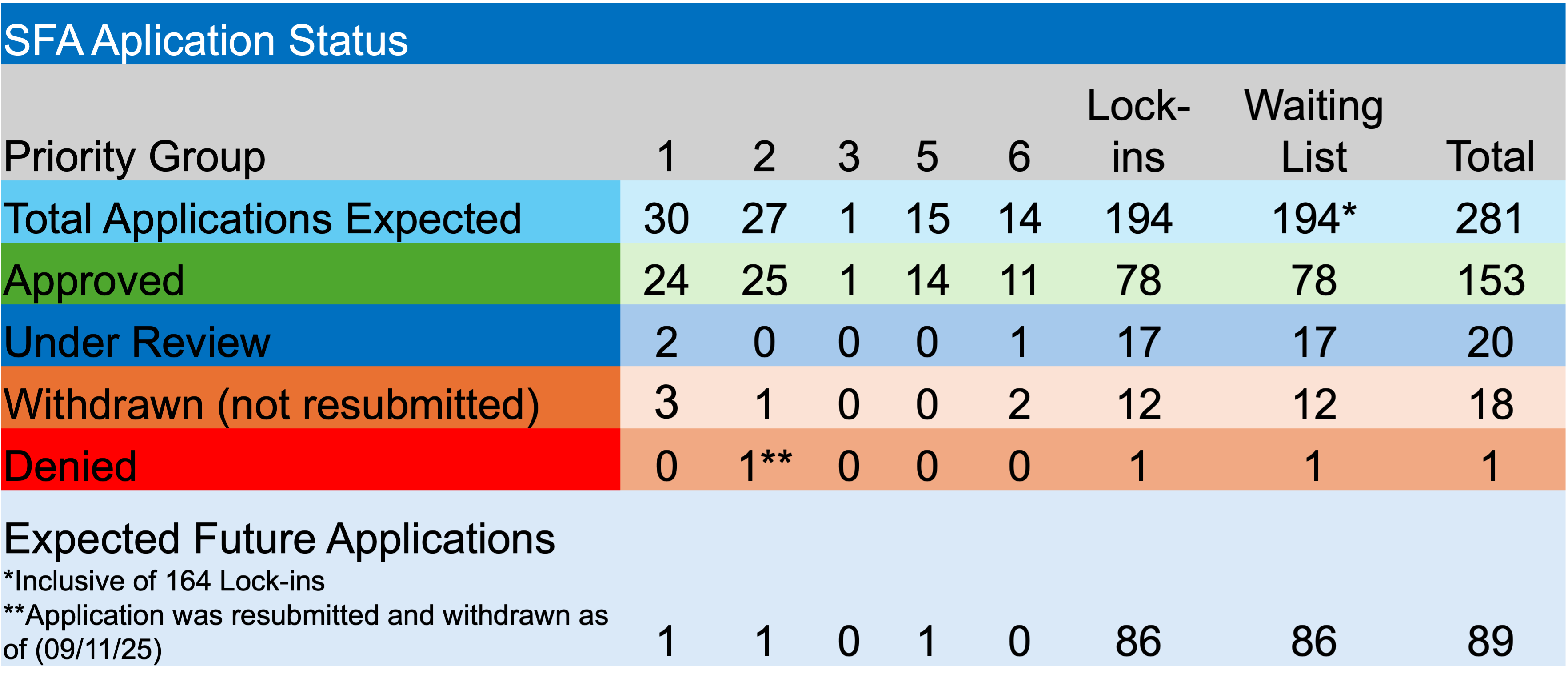
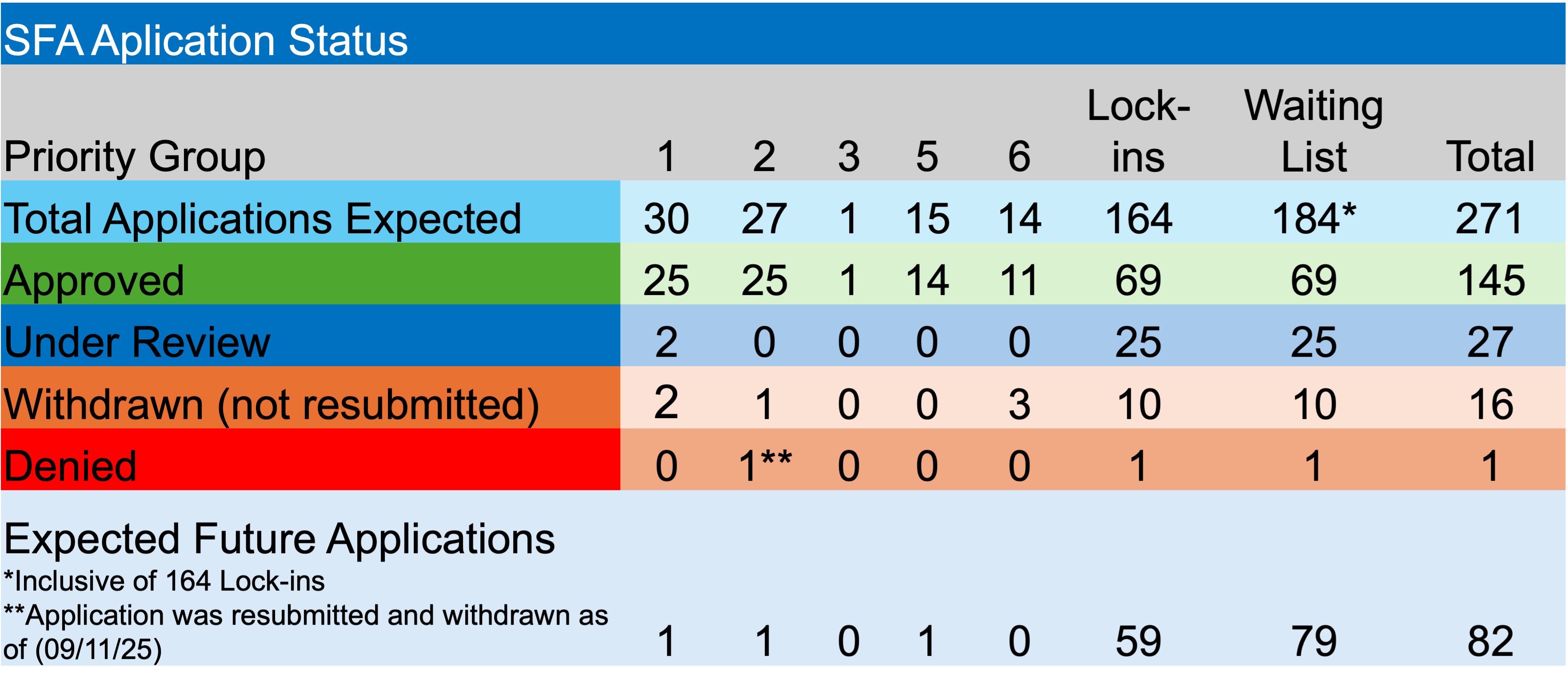
Enough about rates and the Fed. The PBGC is still plugging away on the plethora of applications before them and those yet to be accepted. Currently, there are 20 applications under review. Teamsters Industrial Employees Pension Plan is the latest fund to submit an application seeking SFA. They are hoping to secure $27.4 million for the 1,888 participants. The PBGC has 6-7 applications that must be finalized in each of the next 3 months.

Happy to report that both Alaska Teamster – Employer Pension Plan and Hollow Metal Pension Plan received approval for their applications. The two non-priority pension funds will receive a combined $240.1 million for >13k members.

In other ARPA news, Bakery Drivers Local 550 and Industry Pension Fund, a Priority Group 2 member, whose initial application was originally denied because they were deemed ineligible, has had their revised application denied because of “completeness”. Will three times be the charm? In their latest application they were seeking $125.8 million to support 1,122 plan participants.

Lastly, Greater Cleveland Moving Picture Projector Operators Pension Fund, became the most recent fund added to the waitlist. They are the 167th fund on the waitlist of non-priority members, with 74 still to submit an application. According to the PBGC’s website, their e-Filing portal is limited at this time.

We’ll keep you updated on the activity of the U.S. Federal Reserve and the potential implications from their interest rate decision. Hopefully, concerns related to inflation will offset the current trends related to employment providing future SFA recipients with an environment conducive to defeasing the promised benefits at higher yields and thus, lower costs.

A Peer Group?

By: Russ Kamp, CEO, Ryan ALM, Inc.

Got an email today that got my heart rate up a little. The gist of the article was related to a particular public pension fund that eclipsed its “benchmark” return for the fiscal year ended June 30, 2025. Good job! However, the article went on to state that they failed to match or exceed the median return of 10.2% for the 108 public pension funds with asset >$1 billion. What a silly concept.

Just as there are no two snowflakes alike, there are no two public pension systems that are the same, even within the same state or city. Each entity has a different set of characteristics including its labor force, plan design, risk tolerance, benefit structure, ability to contribute, and much more. The idea that any plan should be compared to another is not right. Again, it is just silly!

As we’ve discussed hundreds of times, the only thing that should matter for any DB pension plan is that plan’s specific liabilities. The fund has made a promise, and it is that promise that should be the “benchmark” not some made up return on asset (ROA) assumption. How did this fund do versus their liabilities? Well, that relationship was not disclosed – what a shocker!

Interestingly, the ROA wasn’t highlighted either. What was mentioned was the fact that the plan’s returns for 3-, 5-, and 10-years were only 6.2%, 6.6%, and 5.4%, respectively (these are net #s), and conveniently, they just happened to beat their policy benchmark in each period.

I’d be interested to know how the funded ratio/status changed? Did contribution expenses rise or fall? Did they secure any of the promised benefits? Did they have to create another tier for new entrants? Were current participants asked to contribute more, work longer, and perhaps get less?

I am a huge supporter of defined benefit plans provided they are managed appropriately. That starts with knowing the true pension objective and then managing to that goal. Nearly all reporting on public pension plans focuses on returns, returns, returns. When not focusing on returns the reporting will highlight asset allocation shifts. The management of a DB pension plan with a focus on returns only guarantees volatility and not success. I suspect that the 3-, 5-, and 10-year return above failed to meet the expected ROA. As a result, contributions likely escalated. Oh, and this fund uses leverage (???) that gives them a 125% notional exposure on their total assets. I hope that leverage can be removed quickly and in time for the next correction.

I’m Concerned! Are You?

By: Russ Kamp, CEO, Ryan ALM, Inc.

I’ve been concerned about the U.S. retirement industry for many years, with a particular focus on traditional pensions. The demise of DB pensions is a major social and economic issue for a significant majority of American workers, who fear that their golden years will be greatly tarnished without the support of a traditional DB pension plan coupled with their inability to fund a supplemental retirement vehicle, such as a defined contribution plan.

I recently had hope that the rising U.S. interest rate environment would bring about a sea change in the use of DB pensions, but I haven’t seen the tidal wave yet. That said, the higher rate environment did (could still) provide plan sponsors with the ability to take some risk off the table, but outside of private pensions, I’ve witnessed little movement away from a traditional asset allocation framework. You see, the higher rate environment reduces the present value cost of those future benefit payments improving both the funded ratio and funded status of DB pensions, while possibly reducing ongoing contributions. Securing those benefits, even for just 10-years dramatically reduces risk.

But, again, I’ve witnessed too few plans engaging in alternative asset allocation strategies. That’s not the same as engaging in alternative strategies, which unfortunately continues to be all the rage despite the significant flows into these products, which will likely diminish future returns, and the lack of distributions from them, too. An alternative asset allocation strategy that Ryan ALM supports and recommends is the bifurcation of assets into two buckets – liquidity and growth – as opposed to having all of the plan’s assets focused on the return on asset (ROA) assumption.

By dividing the assets into two buckets, one can achieve multiple goals simultaneously. The liquidity bucket, constituting investment grade bonds, will be used to defease the liability cash flows of benefits and expenses, while the growth or alpha assets can grow unencumbered with the goal of being used to defease future liabilities (current active lives). One of the most important investment tenets is time. As mentioned above, defeasing pension liabilities for even 10-years dramatically enhances the probability of the alpha assets achieving the desired outcome.

So why am I concerned? The lack of risk mitigation is of great concern. I’m tired of watching pensions ride the rollercoaster of returns up and down until something breaks, which usually means contributions go up and benefits go down! Given the great uncertainty related to both the economy and the labor force, why would anyone embrace the status quo resulting in many sleepless nights? Do something, and not just for the sake of doing something. Really do something! Embrace the asset allocation framework that we espouse. Migrate your current core bond allocation to a defeased bond allocation known as cash flow matching (CFM) to bring an element of certainty to the management of your plan.

Listen, if rates fall as a result of a deteriorating labor force and economy, the present value of pension liabilities will rise. Given that scenario, it is highly likely that asset prices will fall, too. That is a lethal combination, and not unique given how many times I’ve seen that play out during my 44-year career. Reach out to us if you aren’t sure how to start the process. We’d be pleased to take you through a series of scenarios so that you can determine what is possible. Perhaps you’ll sleep like a baby after we talk.