Just Because You Can, Doesn’t Mean…

By: Russ Kamp, CEO, Ryan ALM, Inc.

On Wednesday of this week, I produced a blog post highlighting the dramatic improvement in the Pension Benefit Guaranty Corporation’s (PBGC) financials. I questioned why the premiums paid by both private pensions and mutliemployer pensions needed to be so high given the current strength with a >$64 billion surplus. Furthermore, I considered that these premiums have gone from being a necessity to a burden today. That burden is one contributor to DB pension plans continuing to be frozen, terminated, and the liabilities eventually transferred to an insurance company.

Well, wouldn’t you know. Just yesterday I read that the PBGC has raised the premium rates applicable for plan years beginning in 2027, which they announced on Oct. 14. Those rates were increased in accordance with the indexing rules provided in Section 4006 of ERISA. Just because they can raise those premiums based on Section 4006, should they? Here are the details from the PBGC.

Rates for Single-employer Plans

Per-participant rate for flat-rate premiums. The per-participant rate for flat-rate premiums will be $116 for 2027. The increase in this rate for 2027 are comparable to those the PBGC set for 2026 compared to 2025, as well as those it set for 2025 compared to 2024 and for 2024 compared to 2023. And as with those other years, the increases from 2026-2027 are generally substantially below the increases in the rates from 2022 to 2023. For all those years, the PBGC increased this premium by $5 from year to year.

Per-participant cap. The per-participant cap for 2027 is $783, $32 higher than that the PBGC set for 2026. That’s a slightly smaller increase than the $34 increase from 2025 to 2026, but bigger than the $31 increase from 2024 to 2025.

The premium rate per $1,000 in unfunded vested benefits (UVBs). The last time this rate has increased was from 2022 to 2023; since then, it has been $52 and will be at that rate for 2027 as well.

Rates for Multiemployer Plans

The per-participant rate for flat-rate premium for multiemployer plans increased by much smaller amounts and the rate per $1,000 in UVBs for single-employer plans stayed the most stable. The per-participant rate for flat-rate premiums for 2027 will be $42, a $2 increase over the 2026 rate. This PBGC has increased this rate by $1 to $3 ever since 2018.

Indexation

For 2019 and earlier years, the PBGC premium rates and the variable rate premiums (VRPs) were not indexed; from 2020-2023, all premium rates and the VRP cap were subject to indexing. Starting in 2024, indexing of the VRP rate stopped; however, all other premium rates and the VRP cap still are indexed.

Again, just because they can increase rates, does it mean that they should? The PBGC should not be a profit center. Yes, markets go up and down and surpluses can be impacted, but a $64 billion surplus seems extreme, especially if the burden of supporting a DB plan becomes more challenging. We need DB pension plans, as asking the American worker to fund, manage, and disburse a “retirement” benefit through a DC offering is just silly given their lack of disposable income, investment acumen, and NO crystal ball to help with longevity. We can and should do better as a pension industy.
PBGC Premiums: Helpful Or A Burden?

By: Russ Kamp, CEO, Ryan ALM, Inc.

I’ve written often about the demise of the traditional defined benefit pension plan. We’ve gone from a retirement system in which employers provided workers with a monthly benefit for life to one in which employees are increasingly expected to fund, manage, and then disburse their own retirement benefit. There are many reasons for this transformation. But here’s one that deserves much more attention: Have PBGC premiums helped accelerate the demise of the pension plans the PBGC was created to protect?

The Pension Benefit Guaranty Corporation (PBGC) was established by ERISA in 1974 to protect the retirement incomes of participants in private-sector defined benefit plans. That is an incredibly important mission. But protecting pension promises requires pension plans to exist in the first place. Unfortunately, the cost of maintaining a traditional pension has increased dramatically, and I believe that PBGC premiums have become part of that burden.

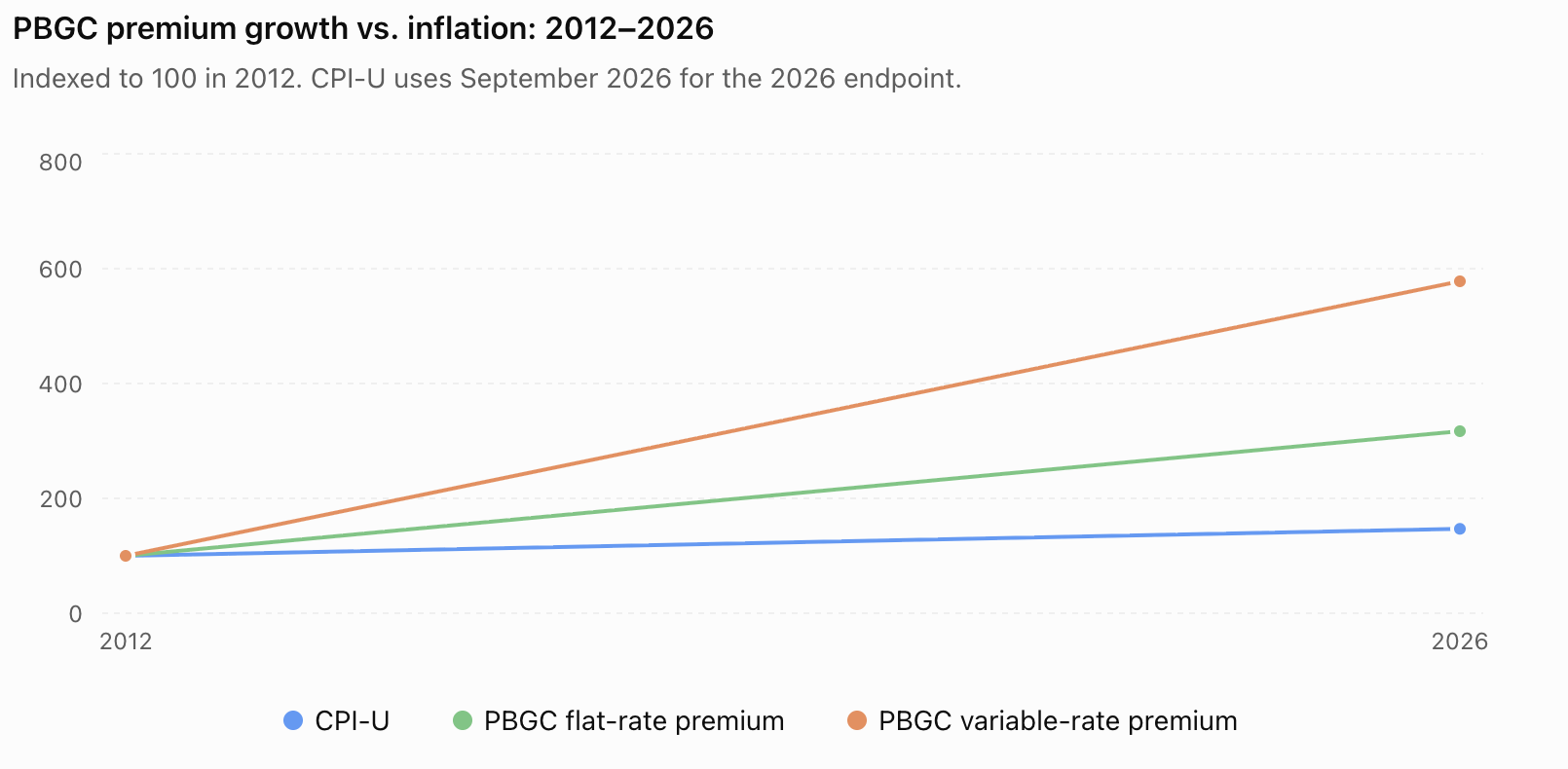
Consider what has happened. In 2012, the flat-rate PBGC premium for a single-employer plan was $35 per participant. By 2026, it is $111. Even more significant is the variable-rate premium assessed on underfunded plans. That charge has risen from $9 per $1,000 of unfunded vested benefits in 2012 to $52 today. In other words, before considering the participant cap, an employer can effectively pay an additional 5.2% annually on its unfunded vested pension liability simply for the privilege of continuing to sponsor the plan.

This image has an empty alt attribute; its file name is image-1.png

Since 2012, consumer prices have risen approximately 47%. Over the same period, PBGC’s flat-rate premium has increased 217%, while its variable-rate premium has increased 478%.

Suppose an employer has $100 million in unfunded vested benefits and isn’t constrained by the per-participant cap. The variable-rate premium alone could theoretically amount to roughly $5.2 million per year. That money doesn’t improve the plan’s funded status. It doesn’t purchase bonds to secure future benefit payments (cash flow matching). It doesn’t generate investment income for the pension trust. And it doesn’t pay a retiree’s monthly pension benefit. It goes to the PBGC.

I’m certainly not suggesting that PBGC premiums are solely responsible for the decline of defined benefit plans. They aren’t. Accounting changes, funding volatility, investment risk, interest-rate movements, longevity risk, regulatory complexity, and the introduction of defined contribution plans have all contributed. Furthermore, the decline in private-sector DB plans began long before today’s higher premiums existed. But those increases have not helped sponsors maintain DB plans.

Interestingly, the PBGC’s single-employer insurance program is no longer in the precarious financial condition that originally helped justify dramatic premium increases. In fact, the PBGC now enjoys a $64.9 billion surplus as of the end of fiscal year 2025, including a $62.2 billion surplus for private pension plans. Wow! Yet employers maintaining DB plans continue to face substantial and ever increasing premiums. We should at least be asking whether those premium levels remain appropriate.

The PBGC was created to protect pension promises. That’s a mission I strongly support. But if the cost of that protection contributes to employers deciding they no longer want to provide those promises, we have a problem worth discussing.

PBGC Increases Premium Rates – Why?

By: Russ Kamp, CEO, Ryan ALM, Inc.

The demise of the defined benefit (DB) plan, most notably within the private sector, is harming the American worker and significantly reducing the odds of a dignified retirement. The Federal government should be doing everything that it can to protect the remaining pensions, including keeping fees low to ensure that these critically important retirement vehicles continue to operate. But unfortunately that doesn’t seem to be the case in this particular situation.

I have been very impressed with and supportive of the PBGC’s effort implementing the ARPA pension legislation, but I question the need to raise premium rates for 2026, which the PBGC has just announced. Why? As of fiscal year-end 2024, the PBGC’s single employer insurance program had a $54.1 BILLION surplus, as assets totaled $146.1 billion and liabilities stood at $92.0 billion. Despite these significant excess resources, the PBGC is increasing rates for the “flat rate premium per participant” in single-employer plans to $111 per participant in 2026 from $106. This 4.7% increase was described in a Chief Investment Officer article as modest! That increase doesn’t seem modest anyway you look at it, but certainly not when one remembers that $54 billion surplus. What is the justification? The rate per $1,000 in “unvested benefits”, not subject to indexing, was frozen by Congress in Section 349 of the SECURE 2.0 Act of 2022 and therefore remains $52. Seems like we need more legislation to freeze the flat-rate premium.

Despite the significant improvement in the multiemployer pension program due to the Special Financial Assistance (SFA) related to ARPA pension reform, that insurance pool is still underwater. As a result, multiemployer plans that only pay a per-participant premium will see the per-participant rate for flat rate premiums rise to $40 from $39 next year. That amounts to an increase of 2.6%. So, the program that is underwater sees a premium increase of 2.6%, while the insurance pool with the massive surplus gets an outsized 4.7% increase? I guess one must work for the government to understand that decision.

Again, we need to do much more to protect DB pensions for all American workers. Asking untrained individuals to fund, manage, and then disburse a “retirement benefit” with little to no disposable income, low investment knowledge, and no crystal ball to help with longevity considerations is just poor policy doomed to failure. We are the wealthiest country in the world, yet we can’t seem to figure out how to control costs associated with retirement, healthcare, education, childcare, etc. and in the process, we are crippling a majority of American families. It isn’t right!