
By: Russ Kamp, CEO, Ryan ALM, Inc.
I’ve written often about the demise of the traditional defined benefit pension plan. We’ve gone from a retirement system in which employers provided workers with a monthly benefit for life to one in which employees are increasingly expected to fund, manage, and then disburse their own retirement benefit. There are many reasons for this transformation. But here’s one that deserves much more attention: Have PBGC premiums helped accelerate the demise of the pension plans the PBGC was created to protect?
The Pension Benefit Guaranty Corporation (PBGC) was established by ERISA in 1974 to protect the retirement incomes of participants in private-sector defined benefit plans. That is an incredibly important mission. But protecting pension promises requires pension plans to exist in the first place. Unfortunately, the cost of maintaining a traditional pension has increased dramatically, and I believe that PBGC premiums have become part of that burden.
Consider what has happened. In 2012, the flat-rate PBGC premium for a single-employer plan was $35 per participant. By 2026, it is $111. Even more significant is the variable-rate premium assessed on underfunded plans. That charge has risen from $9 per $1,000 of unfunded vested benefits in 2012 to $52 today. In other words, before considering the participant cap, an employer can effectively pay an additional 5.2% annually on its unfunded vested pension liability simply for the privilege of continuing to sponsor the plan.
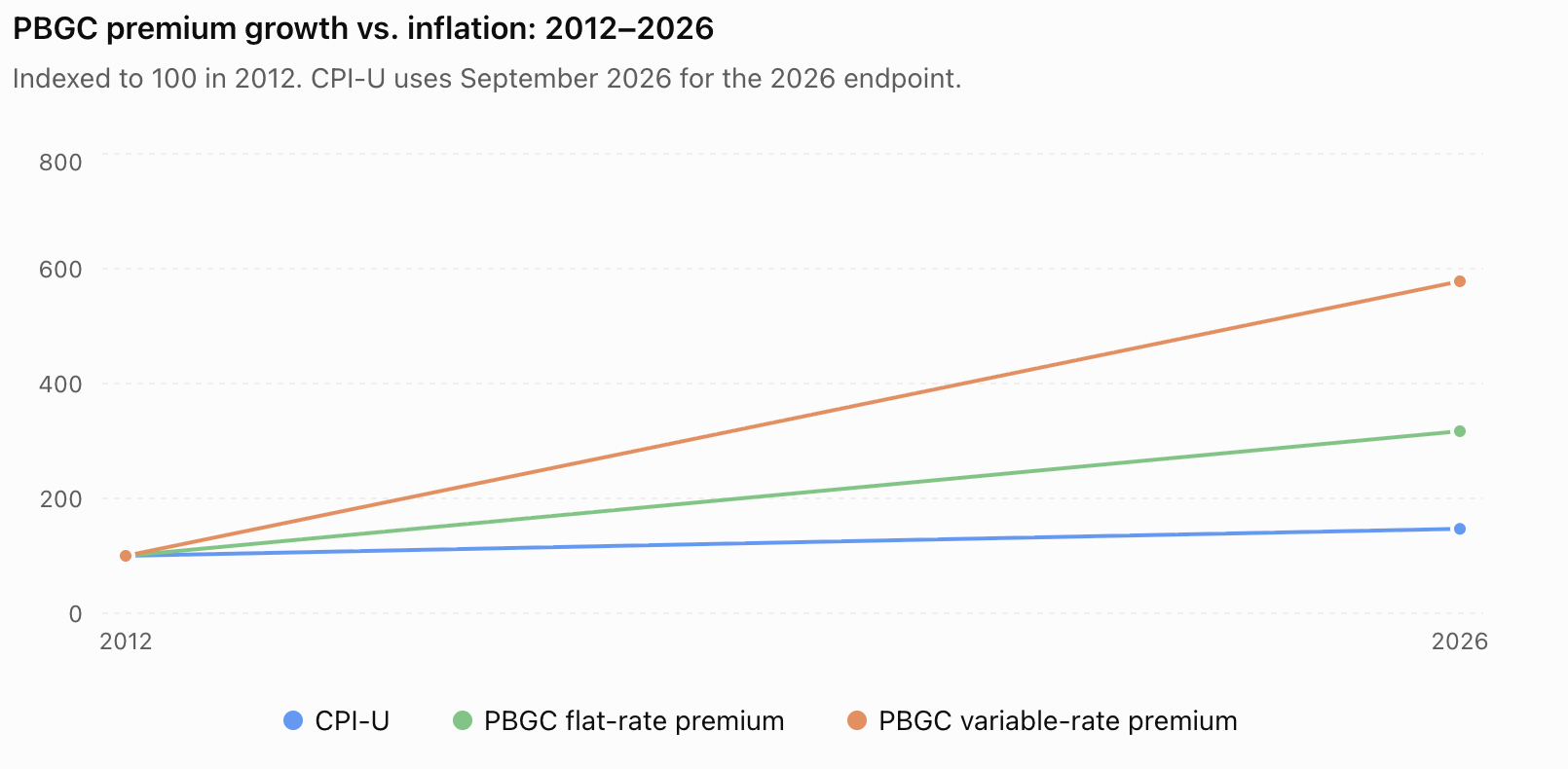
Since 2012, consumer prices have risen approximately 47%. Over the same period, PBGC’s flat-rate premium has increased 217%, while its variable-rate premium has increased 478%.
Suppose an employer has $100 million in unfunded vested benefits and isn’t constrained by the per-participant cap. The variable-rate premium alone could theoretically amount to roughly $5.2 million per year. That money doesn’t improve the plan’s funded status. It doesn’t purchase bonds to secure future benefit payments (cash flow matching). It doesn’t generate investment income for the pension trust. And it doesn’t pay a retiree’s monthly pension benefit. It goes to the PBGC.
I’m certainly not suggesting that PBGC premiums are solely responsible for the decline of defined benefit plans. They aren’t. Accounting changes, funding volatility, investment risk, interest-rate movements, longevity risk, regulatory complexity, and the introduction of defined contribution plans have all contributed. Furthermore, the decline in private-sector DB plans began long before today’s higher premiums existed. But those increases have not helped sponsors maintain DB plans.
Interestingly, the PBGC’s single-employer insurance program is no longer in the precarious financial condition that originally helped justify dramatic premium increases. In fact, the PBGC now enjoys a $64.9 billion surplus as of the end of fiscal year 2025, including a $62.2 billion surplus for private pension plans. Wow! Yet employers maintaining DB plans continue to face substantial and ever increasing premiums. We should at least be asking whether those premium levels remain appropriate.
The PBGC was created to protect pension promises. That’s a mission I strongly support. But if the cost of that protection contributes to employers deciding they no longer want to provide those promises, we have a problem worth discussing.

