Pension Asset Allocation

By: Russ Kamp, CEO, Ryan ALM, Inc.

David Gates, of Bread fame, penned “If” in 1971. One of the more famous lyrics in the song is “if a picture paints a thousand words”. If the average picture paints 1,000 words, the image below paints about 1 million. I believe that the image of a rollercoaster is the perfect metaphor for traditional asset allocation strategies that have pension funds riding markets up and down and up and down until the plan fails. Failure in my opinion is measured by rising contribution expenses, the adoption of multiple tiers requiring employees to contribute more, work longer, and get less, and worse, the migration of new workers to defined contribution offerings, which are an unmitigated disaster for the average American worker.

As you know, Pension America rode markets up in the ’80s (following a very challenging ’70s) and ’90s, only to have the ’00s drive funded ratios into the ground. The ’10s were very good following the Great Financial Crisis. The ’20s have been a mix of both good (’23 and ’24) and bad markets (’20 and ’22). Who knows where the next 5-years will take us. What I do know is that continuing to ride markets up and down is not working for the average public pension plan. The YTD performance for US equities (S&P 500 -13.2% as of 2:30 pm) coupled with a collapse in the Treasury yield curve is damaging pension funded ratios which had shown nice improvement.

Riding these markets up and down without trying to install a strategy to mitigate that undesirable path is imprudent. Subjecting the assets to the whims of the market in pursuit of some return target is silly. By installing a discipline (CFM) that secures the promised benefits, supplies the necessary liquidity, buys time for the growth assets, while stabilizing the funded status and contribution expenses seems to be a no-brainer. Yet, plan sponsors have been reluctant to change. Why?

What is the basis for the reluctance to adopt a modified asset allocation framework that has assets divided into two buckets – liquidity and growth? Do you enjoy the uncertainty of what markets will provide in terms of return? Do you believe that using CFM for a portion of the asset base reduces one’s responsibility? Do you not believe that the primary objective in managing a pension is to secure the promised benefits at a reasonable cost and with prudent risk? The only reason that the DB plan exists is to meet an obligation that has been promised to the plan participant. Like an insurance company or lottery system, why wouldn’t you want to create an investment program that has very little uncertainty?

The Buying Of Time Can Reap Huge Rewards

By: Russ Kamp, CEO, Ryan ALM, Inc.

When we present the list of benefits associated with using Cash Flow Matching (CFM), one of the benefits that we highlight is the buying of time a.k.a. an extended investing horizon. Our pension community tends to fall prey to short-termism despite claiming to be long-term investors. Quarterly observations are presented through the consultants regular performance reviews and managers are often dismissed after a relatively short period of “underperformance”. Actuarial reports tend to be annual which dictate projected contribution expenses. Yet, by extending the investment horizon to something more meaningful like 10-years or more, the probability of achieving the desired outcome is dramatically improved.

I recently played around with some S&P 500 data dating back to 12/31/69 and looked at the return and standard deviation of observations encompassing 1-10-year moving averages and longer periods such as 15-, 20-, 30-, and even 50-year moving averages for the industry’s primary domestic equity benchmark. Living in a one-year timeframe may produce decent annual returns, but is also comes with tremendous volatility. In fact, the average one-year return from 12/69 to 2/25 has been 12.5%, but the annual standard deviation is +/- 16.6%, meaning that 68% of the time your annual return could be +29.1% to -4.1%. Extending the analysis to 2 standard deviations (95% of the observations) means that in 19 out of 20 years the range of results can be as broad as +45.7% to -20.7%.

However, extend out your investing horizon to 10-years, and the average return from 12/69 dips to 11.4%, but the standard deviation collapses to only 5.0% for a much more comfortable range of +16.4% to 6.4%. Extend to 2 standard deviations and you still have a positive observation in 19 out of 20 years at +1.4% as the lower boundary. Extend to 30-years and the volatility craters to only +/-1.2% around an average return of 11.25%.

We, at Ryan ALM, were blessed in 2024 to take on an assignment to cash flow match 30+ years of this plan’s liabilities. We covered all of the projected liability cash flows through 2056 and still had about $8 million in surplus assets, which were invested in two equity funds, that can now just grow and grow and grow since all of the plan’s liquidity needs are being covered by the CFM strategy! So, how important is a long investing runway? Well, if this plan’s surplus assets achieve the average S&P 500 30-year return during the next 30-years, that $8 million will grow to >$195 million.

We often speak with prospects about the importance of bifurcating one’s asset base into two buckets – liquidity and growth. It is critically important that the plan’s liquidity be covered through the asset cash flows of interest and principal produced by bonds since they are the only asset with a known future value. CFM eliminates the need for a cash sweep which would severely reduce the ROA of growth assets. This practice will allow the growth or alpha assets to wade through choppy markets, such as the one we are currently witnessing, without fear that liquidity must be raised to meet benefits at a less than opportune time.

The plan sponsor highlighted above was fortunate to have a well-funded plan, but even plans that are less well-funded need liquidity. Ensuring that benefits and expenses can be met monthly (chronologically) without forcing liquidity that might not naturally exist is critical to the successful operation of a pension plan. CFM can be used over any time frame that the plan sponsor desires or the plan can afford. We believe that extending the investment horizon out to 10-years should be the minimum goal, but every plan is unique and that uniqueness will ultimately drive the decision on the appropriate allocation to CFM.

An Element of Certainty Can Be Achieved

By: Russ Kamp, CEO, Ryan ALM, Inc.

I’ve spent the last few days attending my first GAPPT conference in Braselton, GA. The conference has been terrific as the venue is beautiful, the attendees/trustees delightful, and the speakers/topics topnotch. Senior, highly experienced members of our pension community have been sharing their insights on a variety of subjects. For those addressing the current state of our capital markets and pension asset allocation, the common theme has been uncertainty. Uncertainty as to the direction of equity markets, inflation, and interest rates. Furthermore, given that uncertainty, it should not be surprising that when asked about the direction of asset allocation trends going forward that the speaker would again claim that they don’t know. Of course not.

Regular readers of this blog know that I’ve addressed uncertainty in several blog posts. As human beings we despise uncertainty, yet the approach to pension management within the public sector has been to embrace uncertainty through a traditional asset allocation focused on a return on asset (ROA) target. We learned today that the ROA has fallen for the average public pension from 8% prior to the great financial crisis (GFC) to the current 6.9% today. Given the outsized returns provided by the public equity markets in recent years, funded ratios should have improved, but ironically, they are roughly at the same level they were at prior to the GFC. Yes, the lower discount rate increases the value of plan liabilities, which impacts the funded status, but it also increases contributions that should have offset some of that impact.

Instead of just accepting the fact that markets are uncertain, plan sponsors and their advisors should be seeking strategies to minimize that uncertainty, at least for a portion of the asset base. I know of only a couple of ways to bring certainty to the management of pension assets. One is through a pension risk transfer that shifts the liability from the plan sponsor to an insurance company. Given that public pension plans believe that they are perpetual, there is little appetite to terminate the DB plan. Furthermore, with funded ratios at roughly 75%, the cost to fully fund and then offload the liability would be prohibitive.

We, at Ryan ALM, want to see pensions protected and preserved. We don’t want our public workforce to be forced into managing their own retirements through a defined contribution offering. These vehicles have not worked for a significant majority of the private workforce, as asking untrained individuals to fund, manage, and then disburse a “benefit” with little to no disposable income, investment acumen, or a crystal ball to help with distributions is just poor policy.

So, what can sponsors do? They can adopt a cash flow matching (CFM) strategy that will defease (SECURE) pension liabilities by matching asset cash flows of interest and principal from bonds with the liability cash flows of benefits and expenses. This process is done chronologically from the first month of the assignment as far into the future as the allocation to the strategy will go. In the process of securing these promises, liquidity is enhanced allowing for the balance of the assets (alpha assets) to now grow unencumbered. As we all know, a long investing horizon enhances the probability of success for those alpha assets to achieve the expected outcome.

Isn’t it time to engage in a strategy that will provide the sponsors and their advisors with a better night’s sleep? Wouldn’t it be great if attendees at pension-related conferences learned that there is a strategy that can secure the promises given to plan participants? Given the elevated interest rate environment, CFM should become the core strategy within pension asset allocations. The allocation to CFM should be determined by multiple factors including the current funded status and the plan’s ability to contribute. We witnessed a failure on the part of sponsors back in 1999 to secure the promises when funded ratios were significantly > 100%. We aren’t at that level today, but an element of risk can be reduced and it should be. Let’s get these plans off the asset allocation rollercoaster and volatile funded status.

What’s Your Duration?

By: Russ Kamp, CEO, Ryan ALM, Inc.

The recent rise in U.S. Treasuries had us redoubling our effort to encourage plan sponsors of U.S. pension plans to take some risk off the table by using cash flow matching (CFM) to defease a portion of the plan’s liabilities, given all the uncertainties in the markets and our economy. We were successful in some instances, but for a majority of Pension America, the use of CFM is still not the norm. Instead, many sponsors and their advisors have elected to continue to use highly interest rate sensitive “core” fixed income offerings most likely benchmarked to the Bloomberg Barclays Aggregate Index (Agg).

For those plan sponsors that maintained the let-it-ride mentality, they are probably celebrating the fact that Treasury rates have fallen rather significantly in the last week or so as a result of all of the uncertainties cited above – including inflation, tariffs, geopolitical risk, stretched equity valuations, etc. Their “core” fixed income allocation will have benefited from the decline in rates, but by how much? The Bloomberg Barclays Aggregate Index (Agg) has a duration of 6.1 years and a YTW of 4.58%, as of yesterday. YTD performance had the Agg up 2.78%. Not bad for fixed income 2+ months into the new year, but again, equities have been spanked in the last week, and the S&P 500 is down -3.1% in the last 5 days. So, maintaining that exposure sure hasn’t been beneficial.

Also, remember that the duration of the average DB pension plan is around 12 years. Given the 12-year duration, the price movement of pension liabilities, which are bond-like in nature, is currently twice that of the Aggregate index. A decline in rates might help your core fixed income exposure, but it is doing little to protect your plan’s funded status/funded ratio. The use of CFM would have insulated your plan from the interest rate risk associated with your pension liabilities. As rates fell, both assets and the present value of those liabilities would have appreciated, but in lockstep! The funded status for that segment of your asset allocation would have been insulated.

Why wait to protect your hard work in getting funded ratios to levels not seen in recent years? A CFM strategy provides numerous benefits, including providing liquidity on a monthly basis to ensure that benefits and expenses are met when due, reducing the cost to fund liabilities by 20% to 40% extending the investing horizon allowing for choppy markets to come and go with little impact on the plan, and protecting your funded status which helps mitigate volatility in contributions. Seems pretty compelling to me.

ARPA Update as of February 21, 2025

By: Russ Kamp, CEO, Ryan ALM, Inc.

Welcome to the last week in February. Spring can’t arrive soon enough in New Jersey!

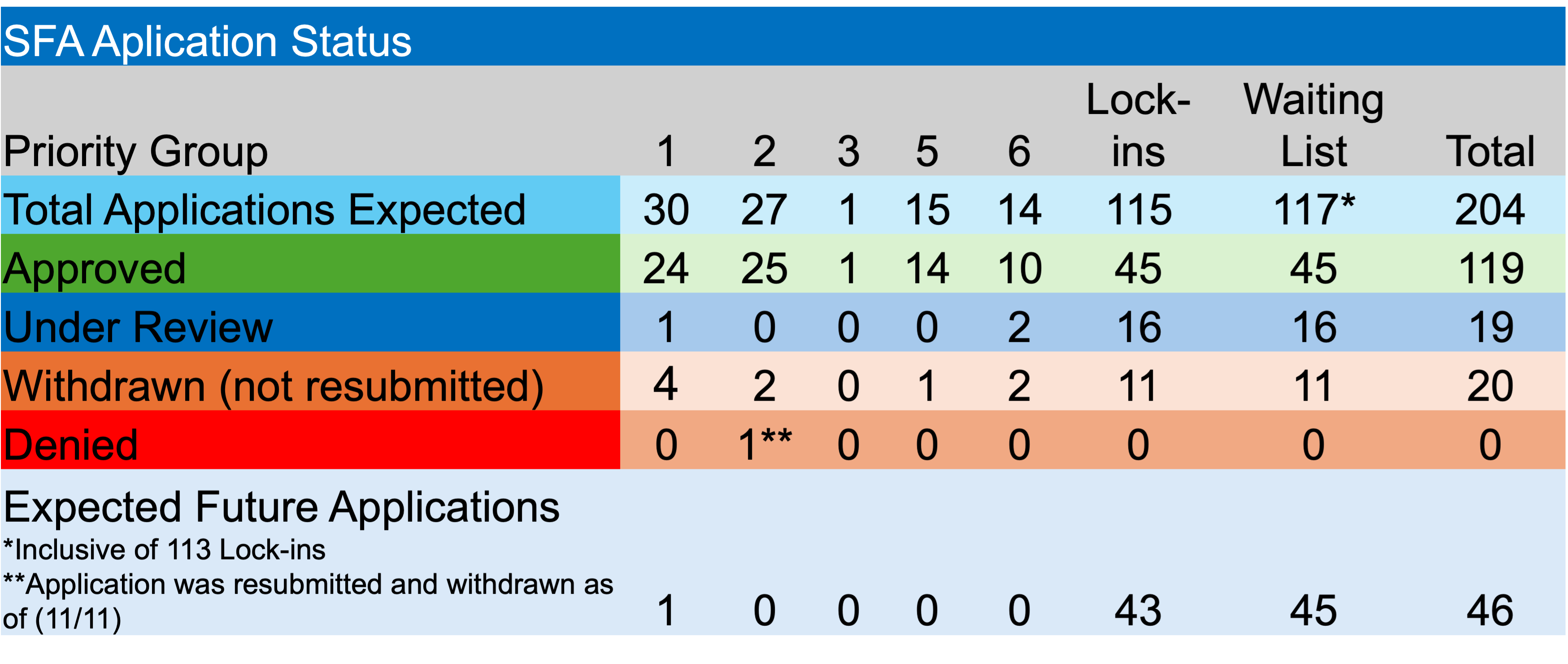
Last week the Milliman organization published its annual review of the state of multiemployer pension plans. The news was quite positive, but in digger deeper, it became apparent that the payment of the Special Financial assistance (SFA) was the primary reason for the improved funding ratios. Given how critically important the SFA is to the ongoing success of many of these plans, let’s look at what transpired during the previous week.

According to the PBGC’s weekly spreadsheet, there were no new applications filed as the eFiling portal remains temporarily closed. In addition, no applications were approved or denied, but there was one application withdrawn, as non-priority plan Aluminum, Brick & Glass Workers International Union, AFL-CIO, CLC, Eastern District Council No. 12 Pension Plan (the plan’s name is longer than the fund’s size is large) pulled its application seeking $10.6 million for 580 participants.

There was some additional activity though, as five plans were asked to repay a portion of the previously agreed SFA due to census errors. In total, these plans repaid $16.3 million representing just 1.06% of the grants received. To date, $180.8 million has been reclaimed from grants totaling $43.6 billion or 0.41%.

In other news, we had Bricklayers & Allied Craftworkers Local No. 3 NY Niagara Falls-Buffalo Chapter Pension Plan, added to the waitlist (#116). This is the first addition to the list since July 2024. This plan did not elect to lock-in the interest rate for discount rate purposes, joining a couple other plans that have kept their options open.

We should witness dramatic improvement in the Milliman funded ratio study next year, as about 7% (85 funds) were funded at <60% in 2024. There are currently 94 plans seeking SFA support. If granted, they should all see meaningful improvement in the funded status of their plans. As a result, we could have a situation in which the multiemployer universe becomes fully funded. How incredible. Now, let’s not do something silly from an investment standpoint that would jeopardize this improved funding.

Parallels to the 1970s?

By: Russ Kamp, CEO, Ryan ALM, Inc.

My recollection of the 1970s has more to do with playing high school sports, graduating from PPHS in 1977, and then going off to Fordham where I would meet my wife in an economics class in 1979. I wasn’t really focused on the economy throughout much of the decade. You see, college was reasonably affordable, and gas and tolls (GWB) were not priced outrageously, so getting back and forth to the Bronx wasn’t crushing for me and my parents.

However, I do recall the two oil embargoes that rocked the economy during the decade. I vividly recall the 1973 oil embargo that was triggered by the Yom Kippur War. I was a newspaper delivery boy for the Hudson Dispatch and was frequently amazed by the long gas lines that would stretch for blocks on both odd and even days, as I drove by on my bike. The Organization of Arab Petroleum Exporting Countries instituted the oil embargo against any country supporting Israel, including the U.S. This led to a dramatic increase in oil prices from about $3/barrel to roughly $12/barrel. This action led to widespread economic disruption, and as you can imagine, significant inflationary pressures.

The 1979 oil crisis was precipitated by the Iranian Revolution which saw the overthrow of the Shah of Iran in February 1979. The Revolution created a significant disruption in oil production in Iran, causing global oil supply issues. Similarly, to the 1973 crisis, oil prices surged from about $14/barrel to nearly $40/barrel. Once again, gasoline shortages materialized and inflation rose rather dramatically. This oil impact would lead to a period of economic stagnation that would eventually be defined as “stagflation”.

Now, I am NOT saying that we are about to face significant oil embargoes. But I am reminding everyone that history does have a tendency to repeat itself even if the players aren’t exactly the same. The graph below is pretty eye-opening, at least to me.

For those of you who can recall the 1970s, you’ll remember that the US Federal Reserve tried to mitigate inflation through aggressive increases in the Fed Funds Rate, which would eventually hit 20% in March 1980. As a result of their action, U.S. Treasury yields rose dramatically, too. For instance, the yield on the US 10-year Treasury note would peak at 15.84% in September 1981. As an FYI, I would enter our industry in October 1981.

Despite the aggressive action by the Fed’s FOMC beginning in March 2022, inflation has not been brought under control. Were they premature in reducing the FFR 3 times and by 1% to end 2024? A case could certainly be made that they were. So, where do we go from here? There certainly appears to be some warning signs that inflation could raise its ugly head once more. We are in the midst of a rebound in food inflation, and not just eggs. I just read this morning that those heating with natural gas will see about a 10% increase in their bills relative to last year – ouch. There are other worrying signs as well without even getting into the potential impact from policy changes brought about by the new administration.

It is quite doubtful that we will witness peaks in inflation and interest rates described above, but who really knows? Given the great uncertainty, and the potentially significant ramifications of a renewed inflationary cycle (2022 was not that long ago), plan sponsors should be working diligently to secure the current funding levels for their plans. Why continue to subject all of the assets to the whims of the markets for which they have no control over? Inflationary concerns rocked both the equity and bond markets in 2022. In fact, the BB Aggregate Index suffered its worst loss (-13%) by more than 4X the previous worst annual return (-2.9% in 1994). Rising rates crush traditional core fixed income strategies, but they are a beautiful benefit when matching asset cash flows (principal and interest) to liability cash flows (benefits and expenses) through CFM.

As a plan sponsor, I’d want to find as much certainty as possible, given the abundant uncertainty of markets each and every day. As Milliman has reported, both private and public pension funded ratios are at levels not seen in years. Don’t blow it now!

Terrific Issue Brief from the American Academy of Actuaries

By: Russ Kamp, CEO, Ryan ALM, Inc.

An acquaintance of mine shared an issue brief that was produced by the American Academy of Actuaries last April. They Academy describe their organization and role, as follows. “The American Academy of Actuaries is a 20,000-member professional association whose mission is to serve the public and the U.S. actuarial profession. For more than 50 years, the Academy has assisted public policymakers on all levels by providing leadership, objective expertise, and actuarial advice on risk and financial security issues. The Academy also sets qualification, practice, and professionalism standards for actuaries in the United States.”

The brief addressed surplus management for public pension systems. What does it mean and what should be done when a plan is in “surplus”. It is important to understand that a surplus calculation (plan assets – plan liabilities) is a single point in time. Our capital markets (assets) and U.S. interest rates (discounting of liabilities) are constantly changing. A plan that is deemed to be in surplus today could easily fall below 100% the very next day.

The go go decade of the 1990s witnessed public pension’s producing fairly consistent double-digit returns. Instead of locking in these gains through sound surplus management, benefits were often enhanced, contributions trimmed, or both. As a result, once the decade of the ’00s hit and we suffered through two major recessions, the enhancements to the benefits which were contractually protected and the lowered contributions proved tough to reverse.

According to Milliman, they estimate the average public funded ratio at 81.2% (top 100 plans) as of November 30, 2024. This is up substantially from September 30, 2022 when the average funded ratio was roughly 69.8%. But it highlights how much work is still needed to be done. I agree that it is wise to have a surplus management plan should these critically important funds once again achieve a “surplus”. I would hope that the plan is centered on de-risking their traditional asset allocations by using more bonds in a cash flow matching (CFM) strategy to reduce the big swings in funding. Furthermore, it is critically important to secure what has already been promised than to weaken the funded status by enhancing benefits or cutting contributions prematurely.

I’d recommend to everyone involved in pension management that they spend a little time with this report. The demise of DB pension plans in the private sector has created a very uncertain retirement for many of our private sector workforce. Let’s not engage in practices that lead to the collapse of public sector DB plans.

Nothing Here! Really?

By: Russ Kamp, CEO, Ryan ALM, Inc.

Yesterday’s financial news delivered an inflation surprise (0.5% vs. 0.3%), at least to me and the bond market, if not to the U.S. equity market. The Federal reserve had recently announced a likely pause in their rate reduction activity given their concerns about the lack of pace in the inflation march back to its 2% target. This came on the heels of “Street” expectations after the first 0.5% cut in the FFR that there were “likely” to be eight (8!) interest rate cuts by the summer of 2025. Oh, well, the two cuts that we’ve witnessed since that first move last September may be all we get for a while. “Ho hum” replied the U.S. stock market.

The discounting of yesterday’s inflation release is pretty astounding. Like you, I’ve read the financial press and the many emails that have addressed the CPI data 52 ways to Sunday. Much of the commentary proclaims this data point as a one-off event. For instance, the impact of egg price increases (13.8% last month alone) is temporary, as bird flu will be contained shortly. Seasonal factors impacting “sticky-priced” products tend to be announced in January. I guess those increases shouldn’t matter since they only impact the consumer in January. As a reminder, Core inflation (minus food and energy) rose from 3.1% to 3.3% last month. That seems fairly significant, but we are told that the other three core readings were down slightly, so no big deal. Again, really? Each of those core measures are >3% or more than 1% greater than the Fed’s target.

Then there are those that say, “what is significant about the Fed’s 2% inflation objective anyway”? It is an arbitrary target. Well, that may be the case, but for the millions of Americans that are marginally getting by, the difference between 2% and 3% inflation is fairly substantial, especially when we come up with all of these measures that exclude food, energy, housing (shelter), etc. Are you kidding?

As mentioned previously, expectations for a massive cut in interest rates due to the perception that inflation was well contained have shifted dramatically. Just look at the graph above (thanks, Bloomberg). Following the Fed’s first FFR cut of 50 bps, inflation expectations plummeted to below 1.5% for the two-year breakeven. Today those same expectations reveal a nearly 3.5% expectation. Rising inflation will certainly keep the Fed in check at this time.

As mentioned earlier in this post, U.S. equities shrugged off the news as if the impact of higher inflation and interest rates have no impact on publicly traded companies. Given current valuations for U.S. stocks, particularly large cap companies, any inflation shock should send a shiver down the spines of the investing community. Should interest rates rise, bonds will surely become a more exciting investment opportunity, especially for pension plans seeking a ROA in the high 6% area. How crazy are equity valuations? Look at the graph below.

The current CAPE reading has only been greater during the late 1990s and we know what happened as we entered 2000. The bursting of the Technology bubble wasn’t just painful for the Information Technology sector. All stocks took a beating. Should U.S. interest rates rise as a result of the current inflationary environment, there is a reasonable (if not good) chance that equities will get spanked. Why live with this uncertainty? It is time to get out of the game of forecasting economic activity. Why place a bet on the direction of rates? Why let your equity “winnings” run? As a reminder, managing a DB pension plan should be all about SECURING the promised benefits at a reasonable cost and with prudent risk. Is maintaining the status quo prudent?

ARPA Update as of February 7, 2025

By: Russ Kamp, CEO, Ryan ALM, Inc.

Welcome to February! I am a day late in reporting on the PBGC’s activity from last week, as I was an instructor at the IFEBP’s Advanced Trustee and Administrator’s Conference. Fortunately, it is in Orlando and not New Jersey, where the weather remains cold, snowy, and wet! For one of the first times in my 43-year professional career I’m hoping for a significant flight delay of perhaps three days!

The PBGC’s eFiling portal is now open but defined as limited. During the previous week there was one new application submitted. The Retail Food Employers and United Food and Commercial Workers Local 711 Pension Plan is seeking $64.2 million in Special Financial Assistance (SFA) for their 25,306 plan participants or $2,538.65 per member, which seemed modest, and in fact it is, as the average SFA payout has been $46,385 per beneficiary on applications that have been approved.

In addition to the one new application, two non-priority plans, Laborers’ Local No. 130 Pension Fund and Pension Plan of the Asbestos Workers Philadelphia Pension Fund each withdrew an initial application. Collectively, they are seeking $72.4 million for 2,124 members.

There were no applications denied or approved during the past week. In addition, there were no plans required to repay an overpayment of SFA due to census errors. There hasn’t been a repayment since December 2024. Finally, there were no plans seeking to be added to the waitlist. There are still 49 plans waiting to submit an initial application to the PBGC.

The U.S. interest rate environment remains favorable for plans looking to defease the pension liabilities with the proceeds from the SFA. Investment-grade corporate bond portfolios are currently producing yields above 5% despite very tight spreads between corporates and the comparable maturity Treasury. Given the elevated valuations for domestic equities, particularly large cap stocks, now is the time to use 100% of the SFA to secure the promises.

Interesting Insights From Ortec Finance

By: Russ Kamp, CEO, Ryan ALM, Inc.

PensionAge’s, Paige Perrin, has produced an article that referenced recent research from Ortec Finance. The research, which surveyed senior pension fund executives in the UK, US, the Netherlands, Canada, and the Nordics, found that 77% believe that risk will be elevated, either dramatically or slightly, in 2025. That’s quite the stat. It also follows on reporting from P&I that referenced heightened uncertainty by U.S. plan sponsors. As regular readers of this blog know, I’ve been suggesting to (pleading with) sponsors that they don’t need to live with uncertainty, which is truly uncomfortable.

Among several risks cited were interest rates, inflation, and market volatility. I can’t say that I blame them for their concerns. Who among us are able to adequately forecast rates and inflation? Seems like most fixed income professionals and bond market participants have been forecasting an aggressive move down in rates. Some of these prognosticators were forecasting as many as 7 rate reductions in 2024 and several others in 2025. We didn’t get 2024’s tally. Who knows about 2025 given that inflation has remained fairly sticky.

There is an easy fix for those of you who are concerned about interest rates and inflation. Adopt a cash flow matching (CFM) strategy that will carefully match asset cash flows of interest and principal with liability cash flows (benefits and expenses). Because benefit payments are future values (FVs), they are not interest rate sensitive. Problem solved! Furthermore, the use of CFM extends the investing horizon for the remainder of the fund’s growth assets, so they now have the appropriate time to grow to meet future liabilities.

One other startling stat caught my attention, as “77 per cent of senior pension fund executives believe the increasing number of retirees relative to the number of new hires in defined benefit (DB) plans pose a “significant” or “slight” risk to the DB pensions industry.” That concern is misplaced. I just wrote a post earlier this week on that subject. DB Pension plans are not Ponzi Schemes. They don’t need more depositors than those receiving payments. It is truly frightening that a significant percentage of our senior plan sponsors don’t understand how these plans are actuarial determined and subsequently funded.

Lastly, I nearly jumped out of my chair with excitement when I read the following quotes from Marnix Engels, Ortec Finance’s managing director for global pension risk, who stated the following:

“We believe assessing the risks of both (the bolding is my emphasis) assets and liabilities in combination is crucial to get the full picture on the health of a pension fund,” he said.

“If the impacts of risk drivers are only understood for one side of the funding health equation, then it is possible to misrepresent the overall effect.”

“If a fund is not assessing both assets and liabilities, then it is difficult to conclude the overall impact of interest rate hikes on the plan’s funding ratio.”

YES!!