Happy Thanksgiving!

By: Russ Kamp, CEO, Ryan ALM, Inc.

I want to wish you and yours a Happy Thanksgiving holiday from my family and me. May the beginning of this holiday season be truly special! I wish that I could thank each person individually who has played such an important and meaningful role in who I am today, but there are just so many. THANK YOU! Your support, encouragement, and opportunities have been amazing.

As a nation, we are blessed in so many ways, but there remain many among us who are in need of a helping hand at this time. During this holiday season, let us ALL strive to do just a little more to help our family members, friends, neighbors, and importantly, perfect strangers, overcome their unique challenges and obstacles.

In 1863, President Abraham Lincoln proclaimed that a day should be set aside to reflect on all our blessings. Lincoln saw the reason for thanks despite incredibly trying times (the country was in the grip of the Civil War). Given the challenging times that many in our country have faced this year, a day such as Thanksgiving is critically important for all of us to reflect on how truly blessed we are. Let us strive to collectively make tomorrow better for all and as good as humanly possible!

Time to Call in the Specialist

By: Russ Kamp, CEO, Ryan ALM, Inc.

Happy Thanksgiving to you and yours from the Ryan ALM, Inc. team. Thank you for what you do everyday to protect and preserve defined benefit pension plans. Ron Ryan has produced a brief research thought piece that should resonate with everyone. Like most of us, Ron is suggesting that we’d prefer to have a specialist, as opposed to a generalist, tackle a medical issue for us. He goes on to say that it shouldn’t be any different for pension plans.

In this case, Ron is suggesting that given the true pension objective to SECURE the promised benefits at a reasonable cost and with prudent risk, one needs to retain a risk mitigation specialist, such as a cash flow matching (CFM) manager. We believe that Ryan ALM is a true CFM specialist as this is our only investment management strategy.

As you may recall from previous blog posts, there are tremendous benefits achieved through the use of a CFM program, including: improved liquidity, extension of the investing horizon for the non-CFM assets, the elimination of interest rate risk for that portion of the assets, lower fees, great certainty, and more. As always, we are willing to provide a free analysis on what could be achieved through a CFM portfolio for your plan. Please don’t hesitate to reach out to us.

Milliman: Public Pension Funding Improves Once More!

By: Russ Kamp, CEO, Ryan ALM, Inc.

Milliman has published an update for their Public Pension Funding Index (PPFI), which analyzes data from our nation’s 100 largest public DB pension plans, and the news continues to be positive!

For the seventh straight month, the PPFI funded ratio improved in October, rising from 85.4% as of September 30, to 86.3% as of October 31. This reading eclipses the previous mark of 85.5% set back in 2021. Since liabilities are “fixed” and not factored into month-to-month measurements, only the return on the PPFI funds’ assets determines the change in the funded status/ratio. October’s collective return was strong at roughly 1.0%.

As a result, assets within the PPFI increased by $64 billion leading to a decline in the deficit between plan assets and liabilities, which now stands at $907 billion. As a reminder, the liabilities are not measured using a market rate, as they are in valuing private DB pension plans. Given the current level of U.S. interest rates, public pension liabilities are likely understated.

Milliman launched the PPFI in 2016. Becky Sielman, co-author of the Milliman PPFI, stated that based on GASB accounting “only 10 of the 100 plans in the study are less than 60% funded while 46 plans are more than 90% funded and 19 of these have a funding surplus.” Given this improved funding, are public pension plans taking some risk from their asset allocations, which have gotten more aggressive with a significant shift into alternatives? I’d hate to see this improvement wasted by just continuing with the same old, same old.

According to this latest update by Milliman, they will be publishing the 2025 Milliman Public Pension Funding Study, an annual analysis of the funded status of the 100 largest U.S. public pension plans, sometime in December.

View the Milliman 100 Public Pension Funding Index.

ARPA Update as of November 21, 2025

By: Russ Kamp, CEO, Ryan ALM, Inc.

Welcome to Thanksgiving week. I don’t think that I’m alone when I say that Thanksgiving is my absolute favorite holiday. I hope that you and your family enjoy a truly special day. I’m thankful that we’ll have all of our kids and grandkids together and also very happy not to have to watch the Giants that day!

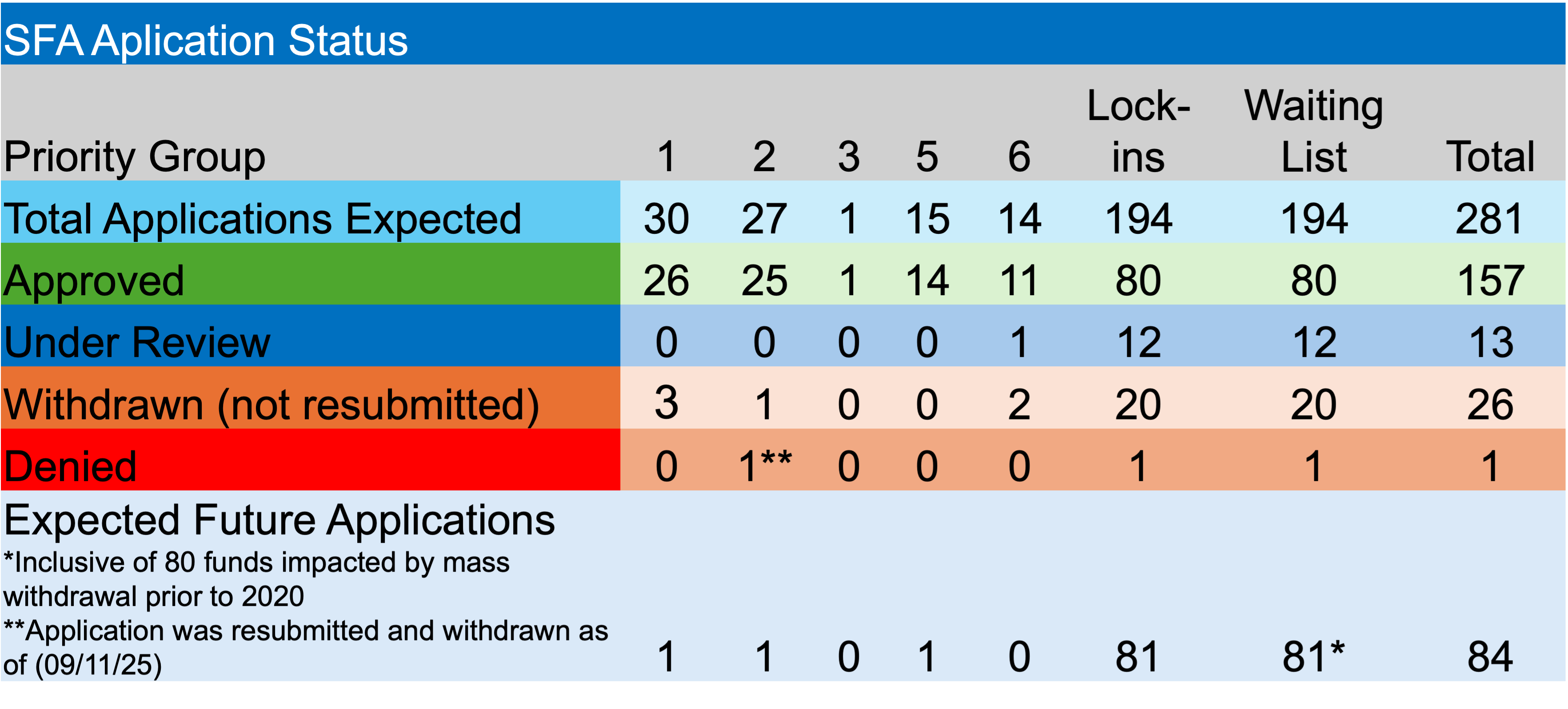
With regard to ARPA and the PBGC’s implementation of this critically important legislation, after a week of “rest”, there was some activity posted by the PBGC through the weekly update on their website. Not as much activity as one would expect, given the significant waiting list (81 funds) of pension plans to submit an initial application.

Happy to report that there was an application approved. It is the first one in more than one month (10/16/25). Emeryville, CA-based, Distributors Association Warehousemen’s Pension Trust, will receive $32.7 million in SFA for 3,358 plan participants. Their revised application was approved on November 20th.

In other ARPA news, Cumberland, Maryland Teamsters Construction and Miscellaneous Pension Plan, has submitted a revised application. They are hoping to get approval for $8.4 million in SFA for 101 members. In addition, there were no pension funds asked to repay a portion of the SFA due to census errors, which has been the case for the last couple of months. There were also no applications denied due to eligibility issues.

I’ve discussed quite often the growing list of funds that have asked to be added to the waitlist. These non-priority funds appear to be running out of time to have their initial application reviewed. Two more funds were added in the last week. By my estimate, there remain 79 pension systems yet to file the initial application. As a reminder, the legislation specifically reads that initial applications must be filed with the PBGC by December 31, 2025. Unfortunately, the PBGC’s e-Filing portal remains temporarily closed.

It Couldn’t Be Any Easier!

By: Russ Kamp, CEO, Ryan ALM, Inc.

I participated this morning in a portfolio review for one of our Cash Flow Matching (CFM) clients. As usual, it couldn’t be any easier for us and the client. Following the Chair’s announcement that it was Ryan ALM’s turn, I stated that all benefits and expenses remain SECURED on a net of contributions basis through 2048 and gross of contributions through 2056. Any questions? That’s it!

There is no guessing as to the future. There is no hand-wringing or pondering regarding the Fed, and what they might do at their next meeting in December. No worries about equity valuations, the impact of AI, the increase in the use of PIKs in private credit portfolios, etc. We built this portfolio in the third quarter of 2024, and it continues to do exactly what it was designed to do. The combination of maturing principal and interest is providing the necessary asset cash flows to meet monthly distributions (liability cash flows of benefits and expenses) like clock-work. How comforting!

The only potential fly in the ointment is a default of an investment grade bond. But according to S&P, that happens at a 0.18% annual clip or roughly 2 / 1,000 bonds (last 40-years). Fortunately for us and our client this has not happened within their portfolio. So, as long as the monthly cash on hand remains greater than the required distribution, we are meeting the requirements of our mandate.

There is no anxiety associated with our management of pension assets. Only an element of certainty rarely found within pension management. How many of your other managers can provide a summary as concise as ours? How many of your managers have built a strategy where the performance for the length of the mandate (5-, 10-, or more years) is known on the day the portfolio is constructed? When we talk about CFM as a “sleep-well-at-night” strategy, this is precisely what we are talking about. Why wouldn’t you want some of this in your fund?

As a reminder, through CFM the liquidity is enhanced, the benefits (promises) SECURED, the investing horizon extended for the non-CFM assets, and certainty established for that portion of the portfolio. Seems like a no brainer.

I’m Confused??

By: Russ Kamp, CEO, Ryan ALM, Inc.

I’ve had the great pleasure of speaking at a number of conferences and events this year. Thank you to those of you who provided me with these opportunities. Regular readers of this blog know that I’ve been discussing the concept of uncertainty and specifically how human beings really despise this state of being.

In the prior two weeks I’ve spoken at both NCPERS in Fort Lauderdale, FL, and at the IFEBP in Honolulu, HI, where I had the opportunity to discuss Cash Flow Matching (CFM) as part of a broader ALM conversation. In both cases I asked the audience, one primarily public fund sponsors (NCPERS) and the other multiemployer, if they could point to any part of their DB pension plan that brought certainty. Not surprisingly, not one hand was raised.

I then commented that if humans, including plan sponsors of DB pension plans, hated uncertainty, why were they continuing to live with the uncertainty imbedded in their current asset allocation structures? These asset allocations place plan sponsors and the plan’s participants on the performance rollercoaster driven by the whims of the markets, which shouldn’t be comfortable for anyone.

So, I ask once more: if folks hate uncertainty and they have the chance to bring a level of certainty into the management of pension plans through CFM, why haven’t they done so? Do they still believe that managing a pension plan is all about generating the ROA? Do they believe that their plan is sustainable (perpetual), so the swings in funded status don’t matter? Do they not worry about where liquidity is going to be derived despite the significant push into alternatives that are sapping plans of liquidity? These are just a few questions for which answers must be furnished. Without an appropriate answer the practice must stop.

A carefully constructed (optimized) CFM program established with IG bonds will SECURE the promises, enhance and provide the necessary liquidity (chronologically), extend the investing horizon for the non-bond assets that can now just grow, and in the process provide the plan sponsor and their members with a “sleep-well-at-night” strategy that is far more certain than anything that they are currently using. We recognize that change isn’t easy, but it is sure better than riding the proverbial performance rollercoaster with the accompanying unknown climbs and dramatic falls.

ARPA Update as of November 14, 2025

By: Russ Kamp, CEO, Ryan ALM, Inc.

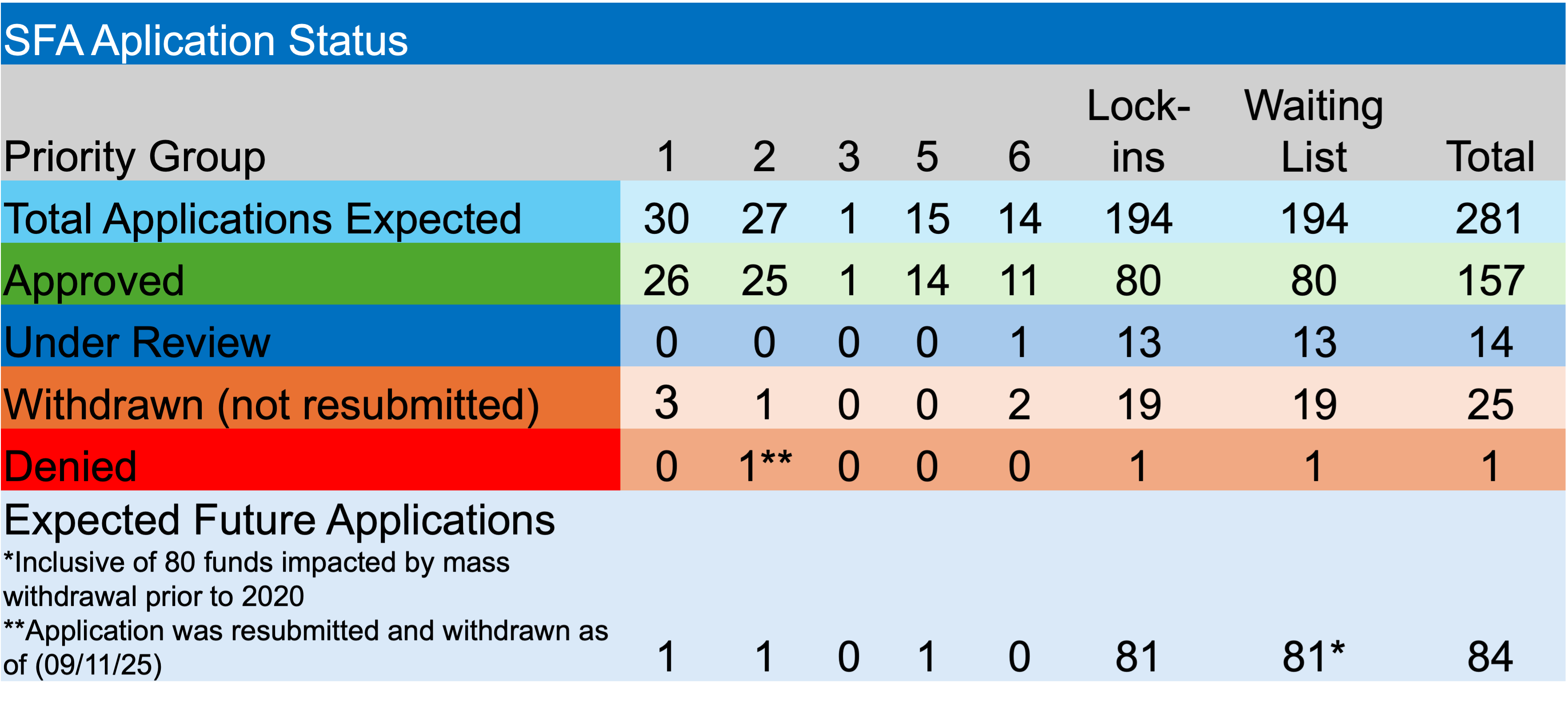
I hope that last week was great for you. I didn’t recognize anyone from the PBGC at the IFEBP in Honolulu last week, but I suspect that there must have been a few attendees. Why? Well, for the first time that I can recall since I began producing these weekly updates, there is nothing to report in terms of the PBGC’s implementation of the ARPA pension legislation. NOTHING!

Now, I’m sure that a lot is going on behind the scenes, especially given the announcement that Janet Dhillon has been confirmed as the 17th Director of the Pension Benefit Guaranty Corporation, but in the weekly update produced as of Friday, November 14th, there were no applications submitted, as the PBGC’s e-Filing portal remains temporarily closed. No pension plans received approval for SFA nor were any denied. There were no withdrawals of previously submitted applications. Lastly, there were no multiemployer plans asking to be added to the growing waitlist.

As we get closer to the legislation’s deadline for new applications to be submitted, we are down to about 6-7 weeks until December 31, 2025. Having a week in which nothing concrete was reported reduces the odds that most of those plans yet to file will actually be given that opportunity.

The graph above reflects the activity through November 7th. Despite the lack of activity last week, the PBGC deserves high praise for their handling of this critical legislation that has helped som many American workers and pensioners. Lastly, at the IFEBP was asked to touch on ARPA/SFA and how best to incorporate ALM strategies to mitigate risk. I’ve had the privilege to speak on this topic numerous times. In summation, the allocation of Special Financial Assistance (SFA) to multiemployer plans is truly of gift. That allocation is not likely to ever be repeated. As such, plans should take every precaution to ensure the maximum coverage of benefits (and expenses) while minimizing the risk through their investments. Call on us (ryanalm.com) if we can help you think through the use of Cash Flow Matching to SECURE those promises.

The Times They Are A-Changin’

By: Russ Kamp, CEO, Ryan ALM, Inc.

Thank you, Bob Dylan, for the lyric that is just perfect for this blog post. I have just returned from the IFEBP conference in Honolulu, HI. What a great conference, and not just because it was in Hawaii (my first time there). If it wasn’t the location, then what made this one so special? For years I would attend this conference and many others in our industry and never hear the word liability mentioned, as in the pension promise, among any of the presentations.

So pleased that during the last few years, as U.S. interest rates have risen and defined benefit pension funding has improved, not only are liabilities being discussed, but more importantly, asset allocation strategies focused on pension liabilities are being presented much more often. During this latest IFEBP conference there were multiple sessions on ALM or asset allocation that touched on paying heed to the pension plan’s liabilities, including:

“Asset Allocation for Today’s Markets”

“My Pension Plan is Well-Funded – Now What?”

“Asset Liability Matching Investment to Manage the Risk of Unfunded Liabilities”

“Decumulation Strategies for Public Employer Defined Contribution Plans” (they highlighted the fact that these strategies should be employed in DB plans, too)

“Applying Asset Liability Management Strategies to Your Investments” (my session delivered twice)

“Entering the Green Zone and Staying There”

These presentations all touched on the importance of risk management strategies, while encouraging pension plan sponsors to stop riding the performance rollercoaster. Given today’s highly uncertain times and equity valuations that appear stretched under almost any metric, these sessions were incredibly timely and necessary. Chasing a performance objective only ensures volatility. That approach doesn’t guarantee success. On the other hand, securing the pension promise through an ALM strategy at a reasonable cost and with prudent risk does redefine the pension objective appropriately.

I know that human beings are reluctant to embrace change, but we despise uncertainty to a far greater extent. Now is the time to bring an element of certainty to the management of pension assets. By the way, that was the title of my recent presentation to public funds at the NCPERS conference in Fort Lauderdale. Again, understanding pension liabilities and managing to them is not new, but it has certainly been under a bigger and brighter spotlight recently. That is great news!

ARPA Update as of November 7, 2025

By: Russ Kamp, CEO, Ryan ALM, Inc.

Aloha from beautiful Waikiki, HI, where the IFEBP annual conference is taking place. I’m so fortunate to be able to speak twice at this amazing event. Fortunately, part of my presentation/session speaks to ARPA and he use of Cash Flow Matching to secure the promised benefits. More on that in a future blog post.

For now, let’s discuss the PBGC’s activity from last week. It was a fairly quiet week, which is a bit surprising given the number of funds that still sit on the PBGC’s waitlist to submit an application seeking SFA. That said, two non-priority group members, including Warehouse Employees Union Local 169 and Employers Joint Pension Plan and the Colorado Cement Masons Pension Trust Fund were permitted to file applications. In the case of the Cement Masons, they withdrew the initial application on 11/4 only to resubmit a revised application on the 7th. Warehouse employees submitted a revised application, too. They are seeking nearly $80 million in SFA for the 3,772 members.

In other ARPA news, there were no applications approved (the last one was 10/16), no pension funds asked to repay a portion of the SFA, and no plans denied for failure to meet the requirements. As mentioned previously, there were two funds that withdrew applications, but the Cement Masons patched up whatever issues were identified.

Lastly, there were no new funds seeking to be added to the waitlist and none of those currently on the waitlist requested to have the valuation date determined. There still remain too many plans seeking SFA with initial applications.

Given the tremendous uncertainty in markets and the economic environment, plan sponsors of DB pensions receiving SFA would be wise to secure as much of their benefits (and expenses) as possible.

Milliman – Corporate Pension Funded Ratios Up Again

By: Russ Kamp, CEO, Ryan ALM, Inc.

Milliman once again released its monthly Milliman 100 Pension Funding Index (PFI), which analyzes the 100 largest U.S. corporate DB pension plans. October marked the seventh straight month that the PFI funded ratio improved, increasing from 106.5% on September 30, to 107.1% as of October 31. Once again it was asset gains that drove this result. Those gains were marginally offset by a 3-basis-point dip in the discount rate, which slipped to 5.33% by the end of October. For the month, the market value of plan assets rose to $1.328 trillion, while the projected benefit obligations rose to $1.240 trillion.

Zorast Wadia, author or the report and my lunch date this past Wednesday, stated “Continued robust investment gains in October pushed corporate pension funded ratios further into surplus territory and up to levels not seen since March 2002, during the dot-com crisis,”. He continued, “however, we’ve seen recent evidence of declining discount rates, and if this continues through the end of 2025, funded ratios may lose ground without prudent asset-liability matching.”

That last statement by Zorast was the main focus of our lunch conversation. We are both thrilled to see the improved funding for private DB pension plans but remain concerned that those plans that haven’t yet de-risked are potentially playing with fire. Furthermore, securing the promised benefits through a cash flow matching strategy, which I believe is the primary objective in management a DB pension plan, gives these private pension plans great flexibility and helps in attracting and retaining talented employees. Yields remain attractive and the potential cost reduction to secure future benefits is still robust.

View this month’s complete Pension Funding Index.