You Don’t Say!

By: Russ Kamp, CEO, Ryan ALM, Inc.

Morgan Stanley has published the results from their Taft-Hartley survey, in which they have to provided “insights into how Taft-Hartley plans are managing priorities and navigating challenges to strengthen their plans”. I sincerely appreciate MS’s effort and the output that they published. According to MS, T-H plans have as their top priority (67% of respondents) delivering promised benefits without increasing employer’s contributions. That seems quite appropriate. What doesn’t seem to jive with that statement is the fact that only 29% that improving or maintaining the plan’s funded status was important. Sorry to burst your bubble plan trustees, but you aren’t going to be able to accomplish your top priority without stabilizing the funded status/ratio by getting off the performance rollercoaster.

Interestingly, T-H trustees were concerned about market volatility (84%) and achieving desired investment performance while managing risk (69%). Well, again, traditional asset allocation structures guarantee volatility and NOT success. If you want to deliver promised benefits without increasing contributions, you must adopt a new approach to asset allocation and risk management. Doing the same old, same old won’t work.

I agree that the primary objective in managing a DB plan, T-H, public, or private, is to SECURE the promised benefits at a reasonable cost and with prudent risk. It is not a return game. Adopting a new asset allocation in which the assets are divided among two buckets – liquidity and growth, will ensure that the promises (monthly benefits) are met every month chronologically as far into the future that the assets will cover delivering the promised benefits. However, just adopting this bifurcated asset allocation won’t get you off the rollercoaster of returns and reduce market volatility. One needs to adopt an asset/liability focus in which asset cash flows (bond interest and principal) will be matched against liability cash flows of benefits and expenses.

This approach will significantly reduce the volatility associated with markets as your pension plan’s assets and liabilities will now move in lockstep for that portion of the portfolio. As the funded status improves, you can port more assets from the growth portfolio to the liquidity bucket. It will also buys time for the remaining growth assets to help wade through choppy markets. According to the study, 47% of respondents that had an allocation to alternatives had between 20% and 40%. This allocation clearly impacts the liquidity available to the plan’s sponsor to meet those promises. If allocations remain at these levels, it is imperative to adopt this allocation framework.

Furthermore, given today’s equity valuations and abundant uncertainty surrounding interest rates, inflation, geopolitical risk, etc., having a portion of the pension assets in a risk mitigating strategy is critically important. Thanks, again, to MS for conducting this survey and for bubbling up these concerns.

AI Needs An Education Regarding ALM/CFM!

By: Russ Kamp, CEO, Ryan ALM, Inc.

I asked an AI tool that I use the following: Asset/Liability Management (ALM) is an effective tool for pensions. What strategies are currently being deployed?

As usual, the response was nearly instantaneous, but was it correct? Here is what I got:

Overview

“Asset/liability management (ALM) remains central to pension fund sustainability, aiming to balance expected pension liabilities with optimal asset growth. In 2025, pension funds deploy a range of strategies to ensure their ability to meet long-term obligations while managing risk efficiently.” No argument there. However, here is a list of the strategies. This is where I have an issue.

Key ALM Strategies Currently in Use

1. Liability-Driven Investing (LDI)

  • Matching Asset Duration to Liabilities: Many corporate pension plans invest in high-quality bonds with durations closely matching those of plan liabilities to mitigate interest rate risk. This ensures that both assets and liabilities react similarly to interest rate changes, stabilizing the funded status from year to year.
  • Glidepath Strategies: Plans gradually shift the asset mix towards more fixed-income securities as funded status improves or as the plan matures, further reducing risk and aligning assets with near-term liabilities.

2. Dynamic Asset Allocation

  • Strategic Shifts in Asset Mix: Pension funds adjust allocations based on changing liabilities, market conditions, and funding status. For instance, U.S. public pension plans have recently shifted asset allocations to maintain return expectations and recover from volatility.
  • Scenario-Based Modeling: Funds use forward-looking models to stress-test outcomes under varying economic scenarios, reviewing assumptions about returns, inflation, and participant demographics.

3. Risk Transfer Solutions

  • Pension Risk Transfer (PRT): Many sponsors employ annuity purchases and lump-sum windows to reduce long-term liability, transferring obligations to insurers. In 2024, settlement payouts (such as annuity buyouts) remained a significant tool for risk management among major pension plans.

4. Liability Modeling Innovations

  • Member-Level Simulation: Advanced models project individual participant cash flows, account for currency exposure, and enable granular liability projections. Such approaches allow more precise matching of assets to future obligations, improving ALM decision-making.
  • Regular Reviews and Assumption Updates: ALM programs, such as those at CalPERS, involve systematic reviews of demographic and financial assumptions (e.g., life expectancy, inflation), with revisions made every four years to incorporate emerging trends.

5. Use of Custom Benchmarks

  • Liability-Mimicking Portfolios: Funds create tailored portfolios (“benchmark” portfolios) that track the liability profile as closely as possible, often blending nominal bonds, inflation-linked bonds, and equities according to the plan’s specifics (such as maturity and inflation sensitivity).

That’s it? Where is Cash Flow Matching (CFM)? In each of these scenarios, liquidity needed to fund benefits and expenses is missing. Duration strategies minimize interest rate risk, but don’t produce timely liquidity to fully fund B+E. Furthermore, duration strategies that use an “average” duration or a few key rates don’t duration match as well as CFM that duration matches EVERY month of the assignment.

In the second set of products – dynamic asset allocation – what is being secured? Forecasts related to future economic scenarios come with a lot of volatility. If anyone had a crystal ball to accomplish this objective with precision, they’d be minting $ billions!

A PRT or risk transfer solution is fine if you don’t want to sustain the plan for future workers, but it can be very expensive to implement depending on the insurance premium, current market conditions (interest rates), and the plan’s funded status

In the liability modeling category, I guess the first example might be a tip of the hat to cash flow matching, but there is no description of how one actually matches assets to those “granular” liability projections. As for part two, updating projections every four years seems like a LONG TIME. In a Ryan ALM CFM portfolio, we use a dynamic process that reconfigures the portfolio every time the actuary updates their liability projections, which are usually annually.

Lastly, the use of Custom benchmarks as described once again uses instruments that have significant volatility associated with them, especially the reference to equities. What is the price of Amazon going to be in 10-years? Given the fact that no one knows, how do you secure cash flow needs? You can’t! Moreover, inflation-linked bonds are not appropriate since the actuary includes an inflation assumption in their projections which is usually different than the CPI.  

Cash Flow Matching is the only ALM strategy that absolutely SECURES the promised benefits and expenses chronologically from the first month as far out as the allocation will go. It accomplishes this objective through maturing principal and interest income. No forced selling to meet those promises. Furthermore, CFM buys time for the residual assets to grow unencumbered. This is particularly important at this time given the plethora of assets that have been migrated to alternative and definitely less liquid instruments.

As mentioned earlier, CFM is a dynamic process that adapts to changes in the pension plan’s funded status. As the Funded ratio improves, allocate more assets from the growth bucket to the CFM portfolio. In the process, the funded status becomes less volatility and contribution expenses are more manageable.

I’m not sure why CFM isn’t the #1 strategy highlighted by this AI tool given its long and successful history in SECURING the benefits and expenses (B&E). Once known as dedication, CFM is the ONLY strategy that truly matches and fully funds asset cash flows (bonds) with liability cash flows (B&E). Again, it is the ONLY strategy that provides the necessary liquidity without having to sell assets to meet ongoing obligations. It doesn’t use instruments that are highly volatile to accomplish the objective. Given that investment-grade defaults are an extremely rare occurrence (2/1,000 bonds), CFM is the closest thing to a sure bet that you can find in our industry with proven performance since the 1970s.

So, if you are using an AI tool to provide you with some perspective on ALM strategies, know that CFM may not be highlighted, but it is by far the most important risk reducing tool in your ALM toolbox.

Don’t Engage in a Cash Sweep – Dividends Matter!

By: Russ Kamp, CEO, Ryan ALM, Inc.

We’ve already shared with you the importance of dividends to the long-term return of the S&P 500 by referencing studies conducted by Guinness Global Investors.

According to the Guinness study, which was last updated as of April 2020, the contribution to return of the S&P 500 from dividends and dividends reinvested for 10-year periods since 1940 was a robust 47% down insignificantly from 48% a decade ago. Extending the measurement period to 20 years from 1940 forward highlights an incredible 57% contribution to the total return of the S&P 500 from dividends. Importantly, this study is on the entirety of the S&P 500, not just those companies that pay dividends. If the universe only included dividend payers, this analysis would reveal strikingly greater contributions since roughly 100 S&P 500 companies are not currently paying a dividend.

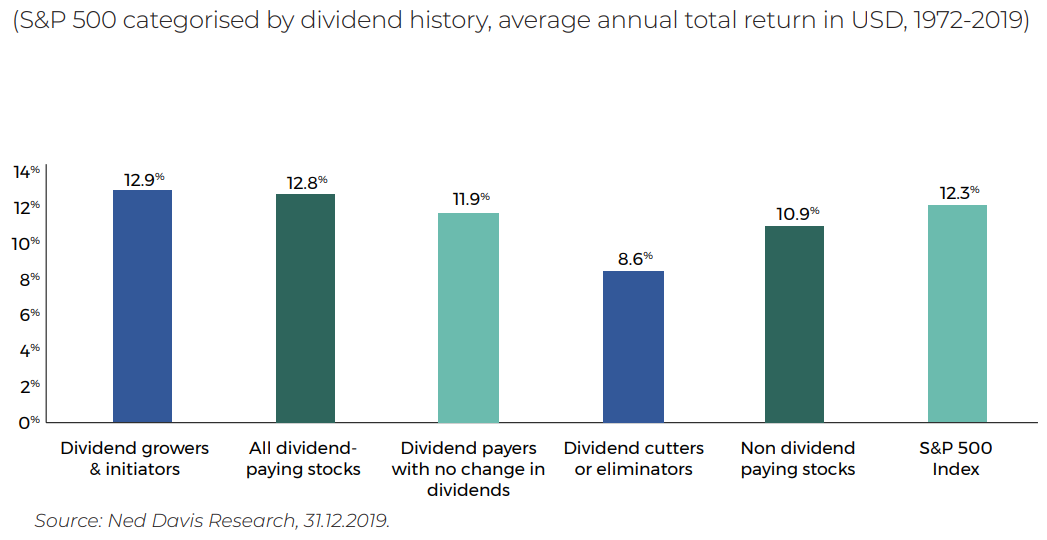
As if this study isn’t enough to convince you of the importance of dividends to the long-term return of stocks, Glen Eagle Trading put out an email today that referenced a recent Wall Street Journal article, titled “Why Investors Are Right to Love Dividends”. The article highlighted the fact that recent studies show S&P 500 dividend-paying stocks returned 9.2% annually over the past 50 years, which is more than double the 4.3% return of non-dividend payers, with lower volatility. Then there is this study by Ned Davis which broke down the contribution of dividends for the 47-years ending December 21, 2019.

Once again, it becomes abundantly clear why investing in companies paying dividends is a terrific long-term strategy. It also begs the question, why do many plan sponsors and their advisors regularly “sweep” income from their equity managers to meet ongoing benefits and expenses? In doing so, instead of structuring the pension plan to have a liquidity bucket to meet those obligations, this activity diminishes the potential long-term contribution to equities from dividends. As longer-term returns are reduced, greater contributions are needed to make up the shortfall compounding the problem.

Please don’t sweep interest and dividend income or capital distributions for that matter, establish an asset allocation that has a dedicated liquidity bucket that uses cash flow matching to secure and fund ongoing benefits and expenses. The remainder of the assets not deployed in the liquidity bucket go into a growth bucket that benefits from the passage of time.

HF Assets Hit Record – Why?

By: Russ Kamp, CEO, Ryan ALM, Inc.

I touched on the subject of hedge funds a few years ago. Unfortunately, results haven’t gotten any better. Yet, P&I is reporting that Hedge Fund assets have reached an all-time high of $5.7 trillion. My simple question – WHY?

I believe that we have overcomplicated the management of DB pension plans and the use of hedge funds is a clear example. If the primary objective is to fund the promised benefits in a cost-efficient manner with prudent risk, why do we continue to waste so much energy buying complicated, opaque products and strategies that often come with ridiculously high fees and little alpha? Furthermore, the management of a DB pension plan has a relative objective – funding the plan’s liabilities of benefits and expenses. It is not an absolute objective which is what a hedge fund strives to produce. It really doesn’t matter if a hedge fund produces a 5% 10-year return if liability growth far exceeds that performance.

Here’s the skinny, the HFRI Composite index reveals that the 10- and 20-year compounded returns are 5.0% and 5.1%, respectively through March 31, 2025. We know that we didn’t get those “robust” returns at either an efficient cost or with prudent risk. What are these products hedging other than returns? Why do we continue to invest in this collection of overpriced and underperforming products? Are they sexy? Does that make them more appealing? Do we think that we are getting a magic elixir that will solve all of our funding issues?

Sadly, the story is even worse when you take a gander at the returns associated with the HFRI Hedge Fund of Funds Composite Index. I shouldn’t have been surprised by the weaker performance given the extra layer of fees. According to HFRI, 10- and 20-year annualized returns fall to 3.5% and 3.3%, respectively. UGH! For those two time frames, the S&P 500 produced returns of 12.5% and 10.2% respectively, and for a few basis points in fees. Furthermore, as U.S. interest rates have risen, bond returns have become competitive with the returns produced by HFs and HF of Funds. In fact, during the 1-year period both T-bills (4.9%) and the BB Aggregate index (5.2%) have outperformed HFs (4.6%), while matching or exceeding the HF of Funds (4.9%) as of March 31, 2025.

While pension systems struggle under growing contribution expenses and plan participants worry about the viability of the pension promise, the hedge fund gurus get to buy sports franchises because of the outrageous fees that are charged and the incredible sums of assets (again, $5.7 trillion!!!) that have been thrown at them? I suspect that the standard fee is no longer 2% plus 20%, but the fees probably haven’t fallen too far from those levels. As Fred Schwed asked with his famous publication in 1952 titled, “Where are the Customers’ Yachts?”, I haven’t been able to find them. Unfortunately, I think that the picture below is more representative of what plan sponsors and the participants have gotten for their investment.

Participant’s yacht – deflated results

Don’t you think that it is time to get back to pension basics? Let’s focus on funding the promised benefits through an enhanced liquidity strategy (cash flow matching) for a portion of the plan’s assets, while allowing the remainder of the portfolio’s assets to enjoy the benefit of time to grow unencumbered (extended investing horizon). This bifurcated approach is superior to the current strategy of placing all of your eggs (assets) into a ROA bucket and hoping that the combination will create a return commensurate with what is needed to meet those current Retired Lives Benefit promises and all future benefits and expenses.

Capital Distributions From Private Equity Collapse

By: Russ Kamp, CEO, Ryan ALM, Inc.

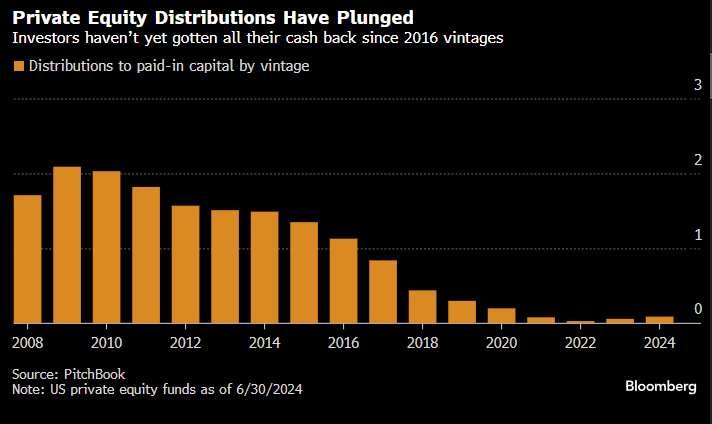
I recently published a blog titled, Problem – Solution: Liquidity, in which I discussed the impact of pension plan sponsors cobbling together interest, dividends, and capital distributions from their roster of managers, and how that practice was not beneficial, especially during periods of stress in the markets. Well, one of those three legs of the “gotta, but how am I gonna, meet my monthly payment of benefits and expenses”, is really falling short at this time.

Dividends are far lower these days than they once were when equities were perceived to be quite risky. In fact, it wasn’t until 1958 that dividend income fell below interest income from bonds. Couple that phenomenon with the fact that capital distributions have plummeted, and plan sponsors are placing far greater emphasis on capturing interest from bonds than ever before. Yes, thankfully interest rates have risen, but the YTM on the BB Aggregate index is still only in the 4.7% range. That is not likely sufficient to meet monthly payouts, which means that bonds will have to be sold, too. The last thing one should want to do in a rising rate environment is to sell securities at a loss.

However, if the plan sponsor engaged a Cash Flow Matching (CFM) manager in lieu of an active core fixed income manager, the necessary liquidity would be made available each and every month of the assignment, as asset cash flows would be carefully matched against liability cash flows. Both interest and maturing principal would be used to meet those benefits and expenses. No forced selling. No scurrying around to “find” liquidity. A far more secure and certain process.

What if my plan isn’t fully funded. Does it make sense to use CFM? Of course, given that benefits and expenses are paid each month whether your plan is fully invested or not, wouldn’t it make more sense to have those flows covered with certainty? Sure, a poorly funded plan may only be able to use CFM for the next 3-5-years, but that’s the beauty of CFM. It is a dynamic process providing a unique solution for each pension plan. No off the shelf products.

What Was The Purpose?

By: Russ Kamp, CEO, Ryan ALM, Inc.

I was introduced to the brilliance of Warren Mosler through my friend and former colleague, Chuck DuBois. It was Chuck who encouraged me to read Mosler’s book, “The 7 Deadly Innocent Frauds of Economic Policy”. I would highly recommend that you take a few hours to dive into what Mosler presents. As I mentioned, I think that his insights are brilliant.

The 7 frauds, innocent or not, cover a variety of subjects including trade, the federal deficit, Social Security, government spending, taxes, etc. Regarding trade and specifically the “deficit”, Mosler would tell you that a trade deficit inures to the benefit of the United States. The general perception is that a trade deficit takes away jobs and reduces output, but Mosler will tell you that imports are “real benefits and exports are real costs”.

Unlike what I was taught as a young Catholic that it is better to give than to receive, Mosler would tell you that in Economics, it is much better to receive than to give. According to Mosler, the “real wealth of a nation is all it produces and keeps for itself, plus all it imports, minus what it exports”. So, with that logic, running a trade deficit enhances the real wealth of the U.S.

Earlier this year, the Atlanta Fed was forecasting GDP annual growth in Q1’25 of 3.9%, today that forecast has plummeted to -2.4%. We had been enjoying near full employment, moderating yields, and inflation. So, what was the purpose of starting a trade war other than the fact that one of Mosler’s innocent frauds was fully embraced by this administration that clearly did not understand the potential ramifications. They should have understood that a tariff is a tax that would add cost to every item imported. Did they not understand that inflation would take a hit? In fact, a recent survey has consumers expecting a 6.7% price jump in goods and services during the next 12-months. This represents the highest level since 1981. Furthermore, Treasury yields, after initially falling in response to a flight to safety, have marched significantly higher.

Again, I ask, what was the purpose? Did they think that jobs would flow back to the U.S.? Sorry, but the folks who suffered job losses as a result of a shift in manufacturing aren’t getting those jobs back. Given the current employment picture, many have been employed in other industries. So, given our full-employment, where would we even get the workers to fill those jobs? Again, we continue to benefit from the trade “imbalance”, as we shipped inflation overseas for decades. Do we now want to import inflation?

It is through fiscal policy (tax cuts and government spending) that we can always sustain our workforce and domestic output. Our spending is not constrained by other countries sending us their goods. In fact, our quality of life is enhanced through this activity.

It is truly unfortunate that the tremendous uncertainty surrounding tariff policy is still impacting markets today. Trillions of $s in wealth have been eroded and long-standing trading alliances broken or severely damaged. All because an “innocent” fraud was allowed to drive a reckless policy initiative. I implore you to stay away from Social Security and Medicare, whose costs can always be met since U.S. federal spending is not constrained by taxes and borrowing. How would you tell the tens of millions of Americans that rely on them to survive that another innocent fraud was allowed to drive economic policy?

Milliman – Corporate Pension Funding Falls in March

By: Russ Kamp, CEO, Ryan ALM, Inc.

Milliman has just released its monthly Milliman 100 Pension Funding Index (PFI), which analyzes the 100 largest U.S. corporate pension plans. Weak investment returns, estimated at -1.4%, drove the PFI asset level down by $25 billion during March. Current assets for the top 100 plans are now $1.3 trillion. The fall in assets was only partially offset by the rise in the discount rate (13 bps) during the month. As a result, the surplus fell by $7 billion to $51 billion as of March 31, 2025.

The discount rate ended the month at 5.49%, which reduced plan liabilities by $18 billion, to $1.25 trillion by the end of March. As a result of assets falling by more than liabilities, the PFI funded ratio dropped from 104.6% at the end of February to 104.1% at the end of March. For the quarter, discount rates fell 10 basis points and the Milliman 100 plans lost $8 billion in funded status.   

“While the slight rise in discount rates in March led to a monthly decline in plan liabilities, plan assets fell even further due to poor market performance, which caused the funded status to fall below the 104.8% level seen at the beginning of 2025,” said Zorast Wadia, author of the PFI. Given market action during the first 10 days of April, it will be interesting to see if the impact from rising rates can offset the dramatic fall in asset values. Inflation fears fueled by tariffs could lead to rising bond yields, which will help mitigate some of the risk to equities given the possibility of declining earnings. As Zorast mentioned in the Milliman release, “plan sponsors will want to consider asset-liability matching strategies to preserve their balance sheet gains from last year”, especially given that 30-year corporates are once again yielding close to 6%.

An Ugly Day For Pension America

By: Russ Kamp, CEO, Ryan ALM, Inc.

Yes, today’s ugliness in the markets is only one day and how many times have we heard or read that you can’t market time or if you miss just the best performing 25-, 50-, or 100-days in the stock market, your return will resemble that of cash or bonds? Those facts are mostly correct. We may not be able to market time, but we can certainly put in place an asset allocation framework that gets DB pension plans off the rollercoaster of performance. We can construct an asset allocation that provides the necessary liquidity when markets may not be able to naturally. An asset allocation that buys time for the growth asset to wade through troubled markets. A framework that secures the promised benefits and stabilizes both funded ratios and contribution expenses for that portion of the fund that has adopted a new strategy.

Yes, today is only one day, but the impact can be significantly negative. See, it isn’t just the loss that has to be made up, as pension plans are counting on a roughly 7% return (ROA) for the year. Every negative event pushes that target further away. Equity values are getting whacked and today’s market activity is just exacerbating the already weak start to the year. While equity markets are falling, U.S. interest rates are down precipitously. The U.S. 10-year Treasury note’s yield is down just about 0.8% since early in January. As a reminder, the average duration of a DB pension is about 12 years or twice the duration of the Bloomberg Barclays Aggregate Index, which is the benchmark for most core fixed income mandates. So, your bond portfolios may be seeing some appreciation today and since the start of 2025, but those portfolios are not growing nearly as fast as your plan’s liabilities, which have grown by about 10.6% (12 year duration x 0.8% + income of 1.0% = 10.6%). As a result, funded ratios are taking a hit.

I wrote this piece back on March 4th reminding everyone that the uncertainty around tariffs and other factors should inspire a course change, an asset allocation rethink. I suspect that it didn’t. So, one can just assume that markets will come back and the underperformance will not have impacted the pension plan, but that just isn’t true. In many cases, equity market corrections take years to recover from and in the process contribution expenses rise, and in some cases dramatically so.

Adopting a new asset allocation framework doesn’t mean changing the entire portfolio. A restructuring can be as simple as converting your highly interest rate sensitive core bond portfolio into a cash flow matching (CFM) portfolio that secures the promised benefits from next month out as far as the allocation can go. In the process you will have improved the plan’s liquidity, extended the investing horizon for the alpha assets, stabilized the funded status for that segment of your plan, and mitigated interest rate risk, as those benefit payments are future values which aren’t interest rate sensitive. You’ll sleep very well once adopted.

FOMC and Powell Deliver Worrying Message

By: Russ Kamp, CEO, Ryan ALM, Inc.

I produced a post recently titled, “Parallels to the 1970s?” in which I discussed the challenging economic environment that existed during the 1970s as a result of two oil shocks and some sketchy decision making on the part of the US Federal Reserve. The decade brought us a new economic condition called stagflation, which was a term coined in 1965 by British politician Lain Macleod, but not widely used or recognized until the first oil embargo in 1973. Stagflation is created when slow economic growth and inflation are evident at the same time.

According to the graph above, the FOMC is beginning to worry about stagflation reappearing in our current economy, as they reduced the expectations for GDP growth (the Atlanta Fed’s GDPNow model has Q1’25 growth at -1.8%), while simultaneously forecasting the likelihood of rising inflation. Not good. If you think that the FOMC is being overly cautious, look at the recent inflation forecasts from several other entities. Seems like a pattern to me.

Yet, market participants absorbed the Powell update as being quite positive for both stocks and bonds, as markets rallied soon after the announcement that the FOMC had held rates steady. Why? There is great uncertainty as to the magnitude and impact of tariffs on US trade and economic growth. If inflation does move as forecasted, why would you want to own an active bond strategy? If growth is moderating, and in some cases forecasted to collapse, why would you want to own stocks? Aren’t earnings going to be hurt in an environment of weaker economic activity? Given current valuations, despite the recent pullback, caution should be the name of the game. But, it seems like risk on.

Given the uncertainty, I would want to engage in a strategy, like cash flow matching (CFM), that brought an element of certainty to this very confusing environment. CFM will fully fund the liability cash flows (benefits and expenses) with certainty providing timely and proper liquidity to meet my near-term obligations, so that I was never in a position where I had to force liquidity where natural liquidity wasn’t available. Protecting the funded ratio of my pension plan would be a paramount objective, especially given how far most plans have come to achieve an improved funding status.

I’ve written on many occasions that the nearly four decades decline in rates was the rocket fuel that drove risk assets to incredible heights. It covered up a lot of sins in how pensions operated. If a decline in rates is the only thing that is going to prop up these markets, I doubt that you’ll be pleased in the near-term. Bifurcate your assets into two buckets – liquidity and growth – and buy time for your pension plan to wade through what might be a very challenging market environment. The FOMC was right to hold rates steady. Who knows what their next move will be, but in the meantime don’t bet the ranch that inflation will be corralled anytime soon.

That Door’s Closed. What’s behind Door #2?

By: Russ Kamp, CEO, Ryan ALM, Inc.

I’ve mentioned often through posts on this blog that we as an industry tend to overwhelm good ideas by allocating ridiculous sums of money in the pursuit of the next great idea. Sure, the idea was terrific several years ago, but today…? We are currently witnessing the negative impact of such an occurrence in private equity. According to many recent reports, the ability to generate liquidity from PE funds is proving to be as challenging as it has ever been. There are only two ways to liquidate holdings in a private fund: 1) a private transaction with a company or another PE fund, and 2) an initial public offering (IPO).

It appears that neither option is readily available to the private equity advisor at this time. Public markets seem to have lost their luster, as there are more than 1,000 fewer companies today than just 10-years ago. Current valuations are also acting as an impediment to going public with portfolio companies. Couple this with the fact that the lack of transactions is limiting the liquidity available to engage in private transactions among PE firms.

Given this situation, one would think that perhaps PE firms and their investors would reduce the demand for product and allow for the natural digestion of the “excess” capital. But no, that does not seem to be the case. According to an article by Claire Ruckin (Bloomberg), private equity firms are “turning to cash-rich credit investors for money to pay dividends to themselves and their backers.” Furthermore, a few are “getting back as much as they first invested, if not more, in effect leaving them with little or no equity in some of their biggest companies.” So much for being equity funds!

According to Claire’s article, more than 20 businesses in the US and Europe have borrowed to make payouts to their owners, according to Bloomberg-compiled data. Ironically, these “dividend recap” deals are a boon to lenders (private creditors) who have lots of cash to deploy. Could this be indicative of another product area overwhelmed by pension cash flows? Private equity firms are happy to take those resources off the creditors hands to return capital to their investors, but is the stacking of additional debt on these companies a good strategy? What happens if the current administrations policies don’t result in growth and worse, lead us into recession? Will these deals prove to be a house of cards?

As we’ve mentioned just shy of 1 million times now, a pension plan’s primary objective should be to SECURE the promised benefits at a reasonable cost and with prudent risk. Do you think that allowing private equity firms, which are already expense investment vehicles, to stack additional debt on top of their equity investments is either a reasonable cost or fiduciarily prudent? Come on! What are we trying to do here?

Defined benefit plans are critically important for the American worker. Continuing to place bets on the success of a PE firm to identify “attractive” equity investments in an environment as challenging as this one and then allowing them to “double down” by adding layers of debt just to pretend that capital is being returned to the investor is just wrong. Let’s get back to pension basics when we used the plan’s specific liabilities to drive asset allocation decisions that centered around securing the promised benefits. You want to gamble – go to Atlantic City. DB pensions plans aren’t the place.