ARPA Update as of June 20, 2025

By: Russ Kamp, CEO, Ryan ALM, Inc.

Despite the chaotic nature of our markets and geopolitics, it is comforting that I can report weekly on the progress being made by the PBGC implementing the critical ARPA legislation. That is not to say, that the 2nd Circuit’s recent ruling isn’t creating a bit of chaos, too.

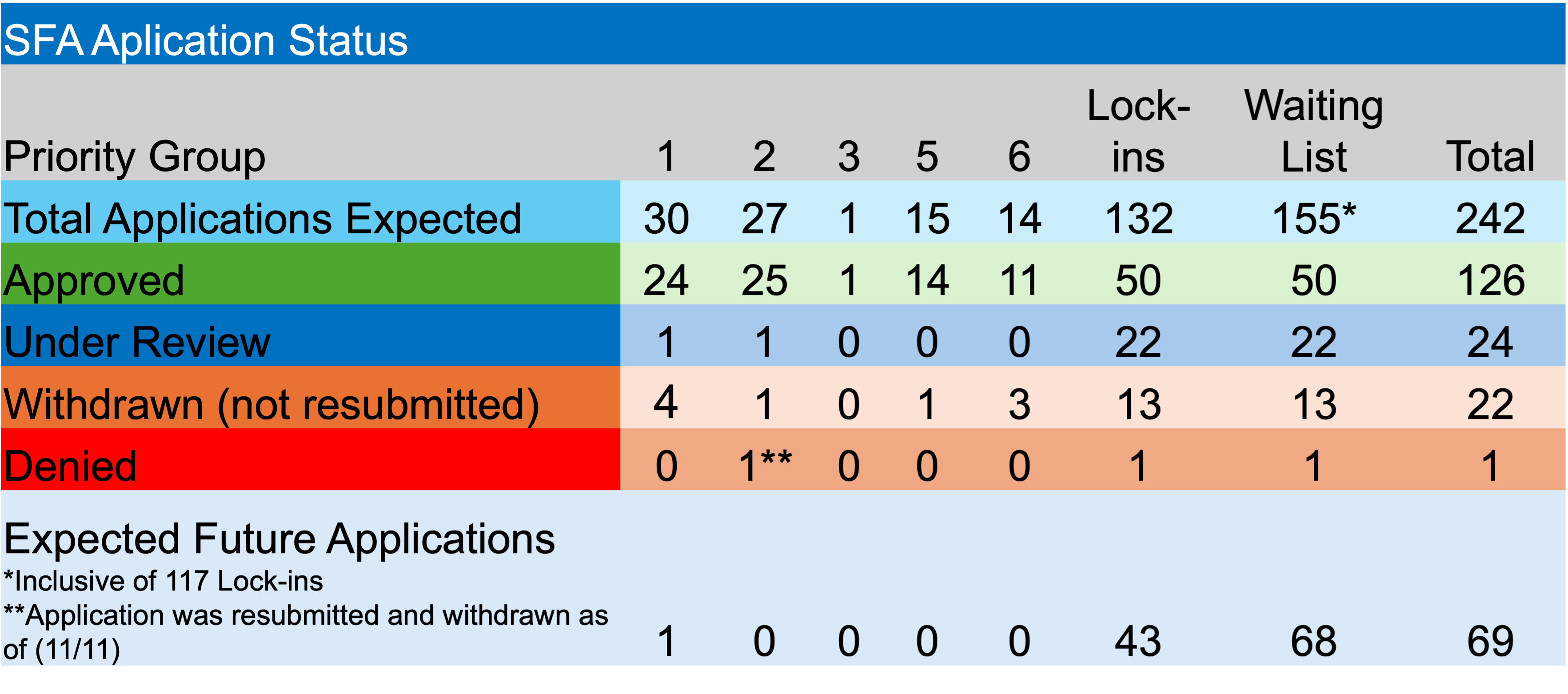
Regarding last week’s activity, the PBGC’s efiling portal must have been wide open, as they accepted initial applications from 5 pension plans residing on the waitlist. The PBGC will now have 120-days to act on these submissions.

There were no applications approved, denied, or withdrawn last week, but that isn’t to say that the PBGC rested on its laurels. There were two more plans that repaid a portion of the SFA received, as census errors were corrected. International Association of Machinists Motor City Pension Plan and Western States Office and Professional Employees Pension Fund repaid 1.61% and 1.08% of the SFA, respectively. In total, 57 plans have “settled” with the PBGC, including four funds that had no census errors. To date, $219 million was repaid from grants exceeding $48 billion or 0.45% of the grant.

In other ARPA news, another 16 funds have been added to the waitlist resulting from the 2nd Circuit’s determination that previously terminated plans can seek SFA. We do believe that it will prove beneficial for these plans, but it will stress the resources of the PBGC to meet ARPA imposed deadlines.

Given the highly unpredictable nature of war and tariffs on inflation and U.S interest rates, it isn’t surprising that the U.S. Federal Reserve held the Fed Funds Rate steady last week. We encourage those plans receiving SFA grants to secure the promised benefits through a cash flow matching strategy. Who knows how markets will impact bonds and stocks for the remainder of the year.

$6 billion – Is That All?

By: Russ Kamp, CEO, Ryan ALM, Inc.

A recent ruling by the 2nd Circuit has opened the door for roughly 100+ multiemployer plans to pursue Special Financial Assistance (SFA) that were originally deemed ineligible because the plans had terminated. The PBGC’s inspector general, in a “risk advisory”, has estimated that the cost to provide the SFA to these newly eligible plans could be as much as $6 billion. Is that all? Let’s not focus on the $s, but the number of American workers and their families that this additional expenditure will support.

As I reported last week in my weekly update related to ARPA’s pension reform, the PBGC had denied the application for the Bakery Drivers Local 550 and Industry Pension Fund, a New York-based terminated pension plan, because it had terminated. The plan covered 1,094 participants in 2022 and was 6.3% funded, according to their Form 5500. Regrettably, the plan terminated in 2016 by mass withdrawal after Hostess Brands, Inc., its largest contributor, went bankrupt. However, the court stated, that despite terminating in 2016, the plan “continued to perform audits, conduct valuations, file annual reports, and make payments to more than 1,100 beneficiaries.”

As of June 13, 2025, the PBGC had already received 223 applications for SFA with $73.0 billion approved supporting the retirements for 1.75 million American workers. What an incredible outcome! However, according to the inspector general’s letter, the potential $6 billion in added cost would include $3.5 billion to repay the PBGC’s earlier loans to approximately 91 terminated plans, which was described as a “potential waste”. He went on to state that the potential repayment to the PBGC would be a waste of taxpayer funds due to the positive current and projected financial condition of the multiemployer program. “PBGC’s multiemployer program is in the best financial condition it has been in for many years. PBGC’s 2023 Projections Report states that PBGC’s multiemployer program is projected to ‘likely remain solvent for at least 40 years.’” GREAT!

Perhaps the repayment of $3.5 billion in loans could enable the PBGC to lower the annual premiums on the cost to insure each participant, which might keep some plans from seeking termination due to excessive costs to administer the program. Something needs to be done with private DB plans, too, as those costs per participant are far greater, but that’s a story for another blog post.

As regular readers of this blog know, we’ve celebrated the success of this program since its inception (July 2021). The fact that 1.75 million American workers to date have had their promised benefits secured, and in some cases, restored, is wonderful. Think of the economic impact that receiving and spending a monthly pension check has on their communities. Furthermore, think about what the cost would have been for each of these folks had the Federal government been needed to provide social services. None of these workers/retirees did anything wrong, yet they bore the brunt.

The estimated $6 billion in additional “investment” in American workers is a drop in the bucket relative to the annual budget deficit, which has been running from $1-$2 trillion annually. Restoring and supporting the earned retirement benefits is the right thing to do.

Ryan ALM: Problem/Solution

By: Ronald J. Ryan, CFA, Chairman, Ryan ALM, Inc.

Problem:  Pension Liabilities… MIA

Solution:  Cash Flow Matching (CFM)

The true objective of a pension is to secure and fully fund benefits (and expenses) in a cost-efficient manner with prudent risk. Although funding liabilities (benefits and expenses (B+E)) is the pension objective, it is hard to find liabilities in anything that pertains to pension assets. Asset allocation is more focused on achieving a ROA (return on assets target return), and performance measurement compares assets versus assets, as the asset index benchmarks are void of any liability growth calculations. If you outperform your index benchmark does that mean asset growth exceeded liability growth? Perhaps NOT.

Pension liabilities behave like bonds since their discount rate is most similar to a zero-coupon bond yield curve (especially ASC 715 discount rates which are a AA corporate yield curve). Yes, public and multiemployer pension plans use the ROA as the discount rate to price their liabilities but even then it is not shown in any performance measurement reports. In fact, what shows up in the CAFR annual report is the GASB requirement of an interest rate sensitivity test by moving the discount rate up and down 100 basis points to determine the volatility of the present value of liabilities and the funded ratio. But a total return or growth rate comparison of assets versus liabilities seems to be MIA.

Ryan ALM solves this problem through our asset liability management (ALM) suite of synergistic products:

  1. Custom Liability Index (CLI) – The management of assets should actually start with liabilities. In reality, assets need to fund NET liabilities defined as (benefits + expenses) – contributions. Contributions are the first source to fund B+E. Assets must fund the net or residual. This is never calculated so assets start with little or no knowledge of what there job really is. Moreover, B+E are monthly payments, which are also not calculated, as the actuary provides an annual update. The CLI performs all of these calculations including total return and interest rate sensitivity as monthly reports.
  1. ASC 715 Discount Rates – Ryan ALM is one of very few vendors who provide ASC 715 discount rates, and we’ve done so since FAS 158 was enacted (2006). We provide a zero-coupon yield curve of AA corporate bonds as a monthly excel file for our subscribers including a Big Four accounting firm and several actuarial firms.
  1. Liability Beta Portfolio™ (LBP) – The LBP is the proprietary cash flow matching model of Ryan ALM. The LBP is a portfolio of investment grade bonds whose cash flows match and fully fund the monthly liability cash flows of B+E. Our LBP has many benefits including reducing funding costs by about 2% per year (20% for 1-10 year liabilities). The intrinsic value of bonds is the certainty of their cash flows. That is why bonds have always been chosen as the assets for cash flow matching or dedication since the 1970s. We believe that bonds are not performance or growth assets but liquidity assets. By installing a LBP, pensions can remove a cash sweep from the growth assets, which negatively impact their growth rates. We urge pension plan sponsors to use bonds for their cash flow value and transfer the bond allocation from a total return focus to a liquidity allocation. Moreover, the Ryan ALM LBP product is skewed to A/BBB+ corporate bonds which should outyield the traditional bond manager who is usually managing versus an index which is heavily skewed to Treasuries and higher rated securities that are much lower in yield. The LBP should enhance the probability of achieving the ROA by the extra yield advantage (usually 75 to 100 basis points). The LBP should also reduce the volatility of the funded ratio and contributions. In fact, it should help reduce contribution cost by the extra yield enhancement. 

For more info on the Ryan ALM product line, please contact Russ Kamp at  rkamp@ryanalm.com.

Eligible For SFA

By: Russ Kamp, CEO, Ryan ALM, Inc.

Regular followers of this blog know that I provide a weekly update on the ARPA pension legislation and the PBGC’s progress implementing this critical support for multiemployer pension plans. We reported way back in January 2023 that the Bakery Drivers Local 550 and Industry Pension Fund’s application seeking Special Financial Assistance (SFA) had been denied due to ineligibility. We also reported that the Bakery Drivers had submitted a revised application on May 30, 2025. We observed at the time that unlike all the other applications that had been submitted, this one did not have a 120-day window for the PBGC to act on the submission. We now know why.

The Bakers were cooking up an argument that was presented to the courts on why their application seeking SFA was appropriate and they were right. “The U.S. 2nd Circuit Court of Appeals says that a multiemployer pension plan that qualifies for a grant under the Pension Benefit Guaranty Corporation’s (PBGC) Special Financial Assistance (SFA) program cannot be excluded just because that plan was previously terminated.”

“Because we do not read the pertinent provision of the SFA statute to exclude plans based solely on a prior termination,” the court ruled, the plan should be eligible for a SFA grant. As a result, the court ruled in favor of the fund, “vacated the PBGC’s denial and remanded the application to the PBGC for reconsideration.”

A little history. The Bakery Drivers Local 550 and Industry Pension Fund, a fund based in Floral Park, NY. The plan covered 1,094 participants in 2022 and was 6.3% funded, according to their Form 5500. Regrettably, the plan terminated in 2016 by mass withdrawal after Hostess Brands, Inc., its largest contributor, went bankrupt. However, the court stated, that despite terminating in 2016, the plan “continued to perform audits, conduct valuations, file annual reports, and make payments to more than 1,100 beneficiaries.”

The court ruled that the statute said that any multiemployer plan that was in critical and declining status from 2020 to 2022 was potentially eligible, and the plan was in critical and declining status in Sept. 2022 when it applied. Importantly, “these provisions do not, by their terms, exclude a plan that was terminated by mass withdrawal.”

According to the PBGC’s status of applications weekly report, the United Food and Commercial Workers Unions and Employers Pension Plan, a non-priority group member, is the only other applicant to have its submission denied due to ineligibility. I wonder if they will have a similar argument as the Bakery Drivers. More to come.

The Power of Bond Math

By: Ronald J. Ryan, CFA, Chairman, Ryan ALM, Inc.

Bonds are the only asset class with the certainty of its cash flows. That is why bonds have always been used to cash flow match and defease liabilities. Given this certainty, bonds provide a secure way to reduce the cost to fund liabilities. This benefit is not as transparent or valued as one might think. If you could save 20% to 50% on almost anything, most people would jump at the opportunity? But when it comes to pre-funding pension liabilities there seems to be a hesitation to capture this prudent benefit.

Bond math tells us that the higher the yield and the longer the maturity… the lower the cost. Usually there is a positive sloping yield curve such that when you extend maturity you pick up yield. What may not be evident is the fact that extending maturity is the best way to reduce costs even if yields were not increased. Here are examples of what it would cost to fund a $100,000 liability payment with a bond(s) whose maturity matches the liability payment date:

Cost savings is measured as the difference between Cost and the liability payment of $100k. As you can see, extending maturity produces a much greater cost reduction than an increase in yield. More importantly, the cost reduction is significant no matter what maturity you invest at, even if yields are unchanged. The cost savings range from 21.9% (5-years) to 38.1% (10-years) and 62.8% (20-years) with rates unchanged. Why wouldn’t a pension want to reduce funding costs by 21.9% to 62.8% with certainty instead of using bonds for a volatile and uncertain total return objective? Given the large asset bases in many pensions, such a funding cost reduction should be a primary budget consideration.

Ryan ALM is a leader in Cash Flow Matching (CFM) through our proprietary Liability Beta Portfolio™ (LBP) model. We believe that the intrinsic value in bonds is the certainty of their cash flows. We urge pensions to transfer their fixed income allocation from a total return objective versus a generic market index (whose cash flows look nothing like the clients’ liability cash flows) to a CFM strategy. The benefits are numerous:

Secures benefits for time horizon LBP is funding (1-10 years)

Buys time for alpha assets to grow unencumbered 

Reduces Funding costs (roughly 2% per year)

Reduces Volatility of Funded Ratio/Status

Reduces Volatility of Contribution costs

Outyields active bond management

Mitigates Interest Rate Risk 

Low fee = 15 bps

For more info on our Cash Flow Matching model (LBP) or a free analysis to highlight what CFM can do for your plan, please contact Russ Kamp, CEO at rkamp@ryanalm.com

ARPA Update as of June 13, 2025

By: Russ Kamp, CEO, Ryan ALM, Inc.

I hope that you and/or the men in your life had a wonderful Father’s Day.

Regarding the ARPA legislation and the PBGC’s oversight, last week was fairly tame in terms of activity. There weren’t exciting developments such as approvals or submissions of applications, as access to the PBGC’s eFiling portal remains “limited”, which means that it “is open only to plans at the top of the waiting list that have been notified by PBGC that they may submit their applications. Applications from any other plans will not be accepted at this time.”

There were no applications denied, withdrawn, and no further recipients of the SFA required to repay a portion of the grant due to census errors. It has been a little over a month (5/5/25) since the last plan repaid a portion of the SFA. As I’ve mentioned several times, there likely aren’t many plans that still might be asked to return a portion of the grant monies.

So what did transpire during the previous week? Well, mutliemployer plans continue to be added to the waitlist. In fact, since April 30, 2025, twenty pension plans have been added to the list. In total, 136 pension plans have sought Special Financial Assistance through the waitlist path with 56 of those yet to file an application with the PBGC. Two of the recent waiting list additions to the waitlist have locked in the valuation date as of March 31, 2025. As a reminder, a “lock-in application will set the plan’s SFA measurement date and base data but has no impact on the process PBGC follows for accepting complete SFA applications for review”, per the PBGC.

Continuing uncertainty surrounding economic policies and geopolitical risks has U.S. Treasury yields hovering around cycle highs. This rising rate environment is not helpful to active core fixed income managers, but it is quite helpful to plan sponsors looking to secure the promised benefits through the SFA grants.

One Can Only Hope!

By: Russ Kamp, CEO, Ryan ALM, Inc.

The title of this post could be used to discuss any number of uncertainties that we are currently facing including geopolitical risk, economic risks associated with potentially disruptive policies, to the economic burdens faced by many Americans. I’ve chosen to apply this title to the prospect that America’s sponsors of defined benefit plans may not be offloading those pension liabilities with the rapidity that they’ve shown in the last decade or so.

There recently appeared an article in PlanSponsor titled, “Fewer Plan Sponsors Terminating DB Plans Amid Risk Management Shifts”. Again, one can only hope that this trend continues. “Half of plan sponsors do not intend to terminate their DB plans, up from 36.7% in 2023 and 28.3% in 2021, according to Mercer’s 2025 CFO Survey,” The survey was based on response from 173 senior finance officers. Unfortunately, it doesn’t undo the harm wrought by all the previous DB terminations, but it is still wonderful news for the American workforce!

As I’ve reported previously, Milliman’s monthly index of the Top 100 corporate plans currently shows a 104.1% funded ratio. Managing surplus assets is now the focus for many of these pension plans. Generating pension earnings, as opposed to living with the burden of pension expense will change one’s perspective. In Ron Ryan’s excellent book, titled, “The U.S. Pension Crisis”, he attributes a lot of the crisis to the accounting rules. For many corporations, pension expenses became a drag on earnings. Sure, they might have said that the company’s primary focus was manufacturing XYZ product and not managing a pension, but the costs associated with managing a DB plan certainly weighed heavily on the decision to freeze, terminate, and eventually transfer the plan.

Now that companies are sitting with a surplus leading to pension earnings, they are reluctant to shift those assets to an insurance company. According to the Mercer survey “70.1% reporting they have implemented dynamic de-risking strategies, an increase of nearly 10 percentage points from 2023. Additionally, 44% have boosted allocations to fixed-income assets to stabilize their funded status.” Let’s hope that they just haven’t engaged a duration strategy to mitigate some of the interest rate sensitivity. As we’ve stated, cash flow matching is a superior strategy to duration matching as every month of the coverage period is duration matched and you get the liquidity as a bonus to meet monthly distributions. Moreover, the Ryan ALM model will outyield ASC 715 discount rates which should enhance pension income or reduce pension expense.

Clearly, this is a positive trend, but we are far from out of the woods in preserving DB pensions. Unfortunately, plan sponsors are still considering risk transfers which continue to “dominate strategic discussions”, as more than 70% of organizations plan to offer lump-sum payments to some portion of their plan beneficiaries in the next two years.” The American workforce is far more interested these days in securing their golden years and a DB plan is the best way to accomplish that objective.

ARPA Update as of June 6, 2025

By: Russ Kamp, CEO, Ryan ALM, Inc.

Pleased to provide you with another weekly update on the PBGC’s implementation of the critically important ARPA pension legislation. We are roughly 1 1/2 years from the completion of this program and yet, more pension funds are seeking to be added to the waitlist. In just the past week, another six funds were added to the list, including Bakery and Sales Drivers’ Local 33 Partitioned Pension Fund, Oregon Printing Industry Pension Trust, Local No. 171 Pension Plan, Licensed Tugmen’s and Pilots’ Pension Fund, San Diego Plasterers Pension Trust, and the Ironworkers Local No. 6 Pension Plan. In total 132 funds sought SFA that weren’t part of the original six priority groups that became five after further review.

There were no new applications submitted during the prior 7-day period, as the PBGC’s eFiling portal remains temporarily closed. There are currently 19 applications with the PBGC, including one Priority Group 1 member and a recently submitted Priority Group 2 application. There remains one application with a June 2025 deadline for action. Happy to report that two funds received approval for their applications, including New Bedford Longshoremen’s Pension Plan and Cement Masons Local No. 524 Pension Plan, both of which are non-priority group members. In total, they will receive just under $6 million in SFA plus interest for the 280 plan participants.

There were no plans asked to repay a portion of the SFA due to census errors and no plans had their applications denied. There were two plans running up against the PBGC’s 120-day window that withdrew applications, including Teamsters Local 277 Pension Fund and Laborers National Pension Fund.

Given uncertainty related to the impact of the tariffs on consumption, jobs, earnings, etc. The Federal Reserve remains cautious in its approach to future rate movements. As a result, U.S. interest rates have migrated higher providing plan sponsors with a wonderful opportunity to defease the promised benefit payments and in the process extend the potential coverage period. As always, we are willing to provide a free analysis to help any SFA recipient think through an appropriate asset allocation framework.

Problem – Solution: Liquidity

By: Russ Kamp, CEO, Ryan ALM, Inc.

Plan Sponsors of defined benefit pension plans don’t have an easy job! The current focus on return/performance and the proliferation of new, and in some cases, complicated and opaque products, make navigating today’s market environment as challenging as it has ever been.

At Ryan ALM, Inc. we want to be our clients’ and prospects’ first call for anything related to de-risking/defeasing pension liabilities. Ryan ALM is a specialty firm focused exclusively on Asset/Liability Management (ALM) and how best to SECURE the pension promise. For those of you who know Ron Ryan and the team, you know that this have been his/our focus for 50+ years. I think that it is safe to say that we’ve learned a thing or two about managing pension liabilities along the way. Have a problem? We may just have the solution. For instance:

Problem – Plan sponsors need liquidity to meet monthly benefits and expense. How is this best achieved since many plan sponsors today cobble together monthly liquidity by taking dividends, interest, and capital distributions from their roster of investment advisors or worse, sell securities to meet the liquidity needs?

Solution – Create an asset allocation framework that has a dedicated liquidity bucket. Instead of having all of the plan’s assets focused on the return on asset (ROA) assumption, bifurcate the assets into two buckets – liquidity and growth. The liquidity bucket will consist of investment grade bonds whose cash flows of interest and principal will be matched against the liability cash flows of benefits and expenses through a sophisticated cost-optimization model. Liquidity will be available from the first month of the assignment as far out as the allocation to this bucket will secure – could be 5-years, 10-years, or longer. In reality, the allocation should be driven by the plan’s funded status. The better the funding, the more one can safely allocate to this strategy. Every plan needs liquidity, so even poorly funded plans should take this approach of having a dedicated liquidity bucket to meet monthly cash flows.

By adopting this framework, a plan sponsor no longer must worry where the liquidity is going to come from, especially for those plans that are in a negative cash flow situation. Also, removing dividend income from your equity managers has a long-term negative effect on the performance of your equity assets. Finally, during periods of market dislocation, a dedicated liquidity bucket will eliminate the need to transact in less than favorable markets further preserving assets.

We’re often asked what percentage of the plan’s assets should be dedicated to the liquidity bucket. As mentioned before, funded status plays an important role, but so does the sponsors ability to contribute, the current asset allocation, and the risk profile of the sponsor. We normally suggest converting the current core fixed income allocation, with all of the interest rate risk, to a cash flow matching (CFM) portfolio that will be used to fund liquidity as needed.

We’ll be producing a Problem – Solution blog on a variety of DB plan topics. Keep an eye out for the next one in the series. Also, if you have a problem, don’t hesitate to reach out to us. We might just have an answer. Don’t delay.

ARPA Update as of May 30, 2025

By: Russ Kamp, CEO, Ryan ALM, Inc.

Welcome to the last update for May 2025. It sure seems like the year is flying by. Are we having fun yet?

It has been nearly four years (July 2021) since the PBGC began implementing the ARPA pension legislation. Despite a few stumbles, I think that the program has been a huge success. Somewhat surprisingly, we are still seeing multiemployer pension plans being added to the waitlist as they seek a share of the Special Financial Assistance (SFA). In fact, an additional 5 funds were added to the waitlist in the last week.

In other news, there were no applications submitted to the PBGC for review, as their eFiling portal remains temporarily closed. There are currently 24 applications in the PBGC’s queue, with seven needing to be completed in some way by the end of June and another seven by the end of July. There was one application approved, as Sheet Metal Workers’ Local No. 40 Pension Plan received approval for an SFA grant of $9.9 million including interest for the plan’s nearly 1,000 participants.

There was one application withdrawn, as Retail Food Employers and United Food and Commercial Workers Local 711 Pension Plan withdrew a revised application seeking $64.2 million in SFA for the plans 25,306 participants. Perhaps the third submission will prove successful. Lastly, there were no applications denied nor asked to repay a portion of the SFA grant. As I’ve been reporting, we are likely very near the end of the census error issue repayments.

When the original Butch Lewis Act (BLA) was being legislated it was estimated that approximately 114 multiemployer plans would be eligible for a “loan”. There are currently 100 more funds seeking support. If I remember correctly, everything needs to wrap up regarding this legislation by December 31, 2026. Clearly, there is still a ton of work ahead for the PBGC.