Cash Flow Matching: Bringing Certainty to Pension Plans

By: Russ Kamp, CEO, Ryan ALM, Inc.

Imagine a world, or at least the United States, where pension plans are no longer subject to market swings and the uncertainty those swings create. What if you could “guarantee” (outside of any corporate bond defaults) the promises made to your plan participants, ensuring their financial security with confidence? In today’s highly unpredictable investing environment, relying solely on the pursuit of investment returns is a risky ride—one that guarantees volatility and sleepless nights but not necessarily success. It’s time to rethink how we manage defined benefit (DB) pension plans and embrace a strategy that brings true certainty: Cash Flow Matching (CFM). Discover through the hypothetical conversation below how CFM can transform your investing approach, protect your plan, and deliver peace of mind for everyone involved. Let’s go!

Why are we talking about Cash Flow Matching (CFM) today?

First off, thanks for taking a few minutes to chat with me. As you may have heard me say before, our mission at Ryan ALM, Inc. is simple — to protect and preserve defined benefit (DB) pension plans and to secure the promises made to participants.

We believe that Cash Flow Matching (CFM) is one of the few strategies that can help us keep those promises with real certainty.


Why Now?

Because the world feels more uncertain than ever.

And if we’re honest, most of us don’t like uncertainty. Yet somehow, in the pension world, many plan sponsors have gotten used to it. Why is that?

Over the years, we’ve been taught that managing a DB plan is all about chasing returns. But that’s not really the case. When a plan invests 100% of its assets purely with a return objective, it locks itself into volatility — not stability or success.

That approach also puts your plan on the “asset allocation rollercoaster,” where markets rise and fall, and contributions swing higher and higher along with them. It’s time to step off that ride — at least for part of your portfolio.


So if it’s not all about returns, what is the real objective?

Managing a DB pension plan is all about cash flows — aligning the cash coming in (from principal and interest on bonds) with the cash going out (for benefits and expenses).

The real goal is to secure those promised benefits at a reasonable cost and with prudent risk. That’s the foundation of a healthy plan.


Does bringing more certainty mean I have to change how I manage the plan?

Yes — but only a little. The adjustments are modest and easy to implement.


How can I adopt a CFM strategy without making major changes?

The first step is to reconfigure your asset allocation. Most DB plans are currently 100% focused on returns. It’s time to split your assets into two clear buckets:

  1. Liquidity bucket – designed to provide cash flow to pay benefits and expenses.
  2. Growth bucket – focused on long-term return potential.

What goes into the liquidity bucket?

Most plans already hold some cash and core fixed income. Those assets can move into the liquidity bucket to fund benefit payments and expenses.


And what happens with the remaining assets?

Nothing changes there. Those assets stay in your growth or alpha bucket. The difference is that you’ll no longer need to sell from that bucket during market downturns, which helps protect your fund from the negative impact of forced selling.


Is that all I need to do to create more certainty?

Not quite. You’ll also want to reconfigure your fixed income exposure.

Instead of holding a generic, interest-rate-sensitive bond portfolio (like one tied to the Bloomberg Aggregate Index), you’ll want a portfolio that matches your plan’s specific liabilities — using both principal and income to accomplish the objective.

That’s where true cash flow matching comes in.


How does the matching process work?

We start by creating a Custom Liability Index (CLI) — a model of your plan’s projected benefit payments, expenses, and contributions. This serves as the roadmap for funding your monthly liquidity needs.


What information do you need to build that index?

Your plan’s actuary provides the projected benefits, expenses, and contributions as far out into the future as possible. The more data we have, the stronger the analysis. From there, we can map out your net monthly liquidity needs after accounting for contributions.


Which bonds do you use to match the cash flows?

We invest primarily in U.S. Treasuries and U.S. investment-grade corporate bonds. We stick with these because they provide dependable cash flows without introducing currency risk.

We limit our selections to bonds rated BBB+ or higher, and the longest maturity we’ll buy matches the length of the mandate. For example, if you ask us to secure 10 years of liabilities, the longest bond we’ll buy will mature in 10 years.


Do you build a laddered bond portfolio?

No — a traditional ladder would be inefficient for this purpose.

Here’s why: the longer the maturity and the higher the yield, the lower the overall cost of funding those future liabilities. So instead of a simple ladder, we use a proprietary optimization process to build the portfolio in a way that maximizes efficiency and minimizes cost.


It sounds manageable — not a big overhaul. Am I missing something?

Not at all. That’s exactly right.

Dividing assets into liquidity and growth buckets and reshaping your bond portfolio into a CFM strategy is typically all that’s required to bring more certainty to part of your plan.

Every plan is unique, of course, so each implementation will reflect its own characteristics. But generally speaking, CFM can reduce the cost of future benefits by about 2% per year — or roughly 20% over a 10-year horizon.

On top of that, it helps stabilize your funded status and contribution requirements.


How much should I allocate to CFM?

A good starting point is your existing cash and bond allocation. That’s the least disruptive way to begin.

Alternatively, you can target a specific time horizon — for example, securing 5, 7, or 10 years of benefits. We’ll run an analysis to show what asset levels are needed to meet those payments, which may be slightly more or less than your current fixed income and cash allocations.


Once implemented, do I just let the liquidity bucket run down?

Most clients choose to rebalance annually to maintain the original maturity profile. That keeps the strategy consistent over time. Of course, the rebalancing schedule can be customized to your plan’s needs and the broader market environment.


This all sounds great — but what does it cost?

In line with our mission to provide stability at a reasonable cost and with prudent risk, our fee is about half the cost of a typical core fixed income mandate.

If you’d like, we can discuss your specific plan details and provide a customized proposal.


Final thoughts

Thank you for taking the time to explore CFM. Many plan sponsors haven’t yet heard much about it, but it’s quickly becoming a preferred approach for those who value stability and peace of mind.

At the end of the day, having a “sleep well at night” strategy benefits everyone — especially your participants.

I’m Concerned! Are You?

By: Russ Kamp, CEO, Ryan ALM, Inc.

I’ve been concerned about the U.S. retirement industry for many years, with a particular focus on traditional pensions. The demise of DB pensions is a major social and economic issue for a significant majority of American workers, who fear that their golden years will be greatly tarnished without the support of a traditional DB pension plan coupled with their inability to fund a supplemental retirement vehicle, such as a defined contribution plan.

I recently had hope that the rising U.S. interest rate environment would bring about a sea change in the use of DB pensions, but I haven’t seen the tidal wave yet. That said, the higher rate environment did (could still) provide plan sponsors with the ability to take some risk off the table, but outside of private pensions, I’ve witnessed little movement away from a traditional asset allocation framework. You see, the higher rate environment reduces the present value cost of those future benefit payments improving both the funded ratio and funded status of DB pensions, while possibly reducing ongoing contributions. Securing those benefits, even for just 10-years dramatically reduces risk.

But, again, I’ve witnessed too few plans engaging in alternative asset allocation strategies. That’s not the same as engaging in alternative strategies, which unfortunately continues to be all the rage despite the significant flows into these products, which will likely diminish future returns, and the lack of distributions from them, too. An alternative asset allocation strategy that Ryan ALM supports and recommends is the bifurcation of assets into two buckets – liquidity and growth – as opposed to having all of the plan’s assets focused on the return on asset (ROA) assumption.

By dividing the assets into two buckets, one can achieve multiple goals simultaneously. The liquidity bucket, constituting investment grade bonds, will be used to defease the liability cash flows of benefits and expenses, while the growth or alpha assets can grow unencumbered with the goal of being used to defease future liabilities (current active lives). One of the most important investment tenets is time. As mentioned above, defeasing pension liabilities for even 10-years dramatically enhances the probability of the alpha assets achieving the desired outcome.

So why am I concerned? The lack of risk mitigation is of great concern. I’m tired of watching pensions ride the rollercoaster of returns up and down until something breaks, which usually means contributions go up and benefits go down! Given the great uncertainty related to both the economy and the labor force, why would anyone embrace the status quo resulting in many sleepless nights? Do something, and not just for the sake of doing something. Really do something! Embrace the asset allocation framework that we espouse. Migrate your current core bond allocation to a defeased bond allocation known as cash flow matching (CFM) to bring an element of certainty to the management of your plan.

Listen, if rates fall as a result of a deteriorating labor force and economy, the present value of pension liabilities will rise. Given that scenario, it is highly likely that asset prices will fall, too. That is a lethal combination, and not unique given how many times I’ve seen that play out during my 44-year career. Reach out to us if you aren’t sure how to start the process. We’d be pleased to take you through a series of scenarios so that you can determine what is possible. Perhaps you’ll sleep like a baby after we talk.

5.6% 10-year forecast for US All-Cap

By: Russ Kamp, Managing Director, Ryan ALM, Inc.

Fiducient Advisors has published its 2025 Outlook. Given the strong performance in US equity markets, future returns have been adjusted downward – rightfully so. Here are some of the highlights:

Full valuations, concentrated U.S. large-cap indexes and the risk of reigniting inflation are shaping the key themes we believe will drive markets and portfolio positioning in 2025.

-Recent market successes have pushed our 2025 10-year forecasts lower across most major asset classes. Long-term return premium for equities over fixed income is now at its narrowest since 2007, sparking important conversations about portfolio posture and risk allocation.

Rising reinflation risk leads us to increase our allocation to more flexible fixed income strategies (dynamic bonds) and TIPS while eliminating our global bond allocation.

US stock market performance has been heavily influenced by the “Magnificent Seven”, creating concentration risk not seen in decades, if ever. The outperformance of US markets vis-a-vis international markets is unprecedented. As stated above, valuations are stretched. Most metrics used to measure “value” in our markets are at extreme levels, if not historical. How much more can one squeeze from this market? As a result, Fiducient is forecasting that US All-Cap (Russell 3000?) will appreciate an annualized 5.6% for the next 10-years.

Nearly as weak are the forecasts for private equity, which Fiducient believes will produce only an annualized 8.6% return through the next 10-years. What happened to the significant “premium” that investing privately would provide? Are the massive flows into these products finally catching up with this asset class? Sure seems like it.

With regard to the comment about fixed income, I’m not sure that I know what “flexible fixed income strategies” are and the reference to dynamic escapes me, too. I do know that bonds benefit from lower interest rates and get harmed when rates rise. We have been very consistent in our messaging that we don’t forecast interest rates as a firm, but we have also written extensively that the inflation fight was far from over and that US growth was more likely to surprise on the upside than reflect a recessionary environment. Today, the third and final installment of the Q3’24 GDP forecast was revised up to 3.1% annual growth. The Q4’24 estimate produced by the Atlanta Fed through its GDPNow model is forecasting 3.2% annual growth. What recession?

Given that US growth is likely to be stronger, employment and wage growth still robust, and sticky inflation just that, bonds SHOULDN’T be used as a performance instrument. Bonds should be used for their cash flows of interest and principal. BTW, one can buy an Athene Holding Ltd (ATH) bond maturing 1/15/34 with a YTW of 5.62% today. Why invest in US All-Caps with a projected 5.6% return with all of that annual standard deviation when you can buy a bond, barring a default and held to maturity, will absolutely provide you with a 5.62% return? This is the beauty in bonds! Those contractual cash flows can be used, and have been for decades, to defease liabilities (pension benefits, grants, etc.) and to SECURE the promises made to your participants.

It is time to rethink the approach to pension management and asset allocation. Use a cash flow matching strategy to secure your benefits for the next 10-years that buys time for the growth assets to GROW, as they are no longer a source of liquidity. Equity markets may not provide the same level of appreciation as they have during the last decade (+13.4% annualized for the S&P 500 for 10-years through 11/30/24), but a defeased bond portfolio will certainly provide you with the necessary liquidity, an extended investing horizon, and the security (peace of mind) of knowing that your benefits will be paid as promised and when due! Who needs “flexible and dynamic” bonds when you have the security of a defeased cash flow matching strategy?

The Joke’s On Us!

By: Russ Kamp, Managing Director, Ryan ALM, Inc.

According to a P&I article, the ECB has undertaken an “exploratory review of bank exposures to private equity and private credit funds in order to better understand these channels and to assess banks’ risk management approaches.” According to P&I, the overarching message was that “complex exposures to private equity and credit funds require sophisticated risk management.”

Yesterday, there was a FundFire article that questioned the effectiveness of the “Yale Model” given the heavy dependence on alternatives and the weak performance associated with those products in recent periods. According to the article, the greater the alts exposure the likely weaker fiscal performance.

In a recent article by Richard Ennis, founder and former chairman of investment consultant EnnisKnupp, he estimates that Harvard University, with about 80% of its endowment assets in alternative investments, spends roughly 3% of endowment value on money management fees annually, including the operation of its investment office.

Given the concerns noted above with respect to fees, risk management, and the overall success of investing in alternative strategies, one would believe that a cautionary tone would be delivered at this time. But alas that isn’t the case when it comes to forging ahead with plans to introduce alternatives into DC plans where the individual participant lacks the necessary sophistication to undertake a review of such investments. According to yet another FundFire article in recent days, Apollo and Franklin are plowing forward with plans to make available alternative investments to the DC participant through a new CIT. Shameful!

I’ve commented numerous times that it is pure madness to believe that the average American worker has the disposable income, investment acumen, and/or the necessary crystal ball to effectively manage distributions upon retirement through a DC offering. Given this lack of investment knowledge, I find it so distasteful that “Wall Street” continues to look at these plans as just another source of high fees and revenue. Where are the FIDUCIARIES?

If the ECB doesn’t believe that their banks have the necessary tools in place to handle these complex investments, how on Earth will my neighbor, family member, former teacher, etc.? Can we please stop this madness!

What Will Their Performance be? Continued

By: Russ Kamp, Managing Director, Ryan ALM, Inc.

I recently published a post titled, “What Will Their Performance be in About 11 Years?” I compared the Ryan ALM, Inc. cash flow matching (CFM) strategy to a relative return fixed income manager, and I raised the question about future performance. Barring any defaults within the investment grade universe, which historically average about 2/1,000 bonds, we can tell you on day one of the portfolio’s construction what the performance will be for the entire period of a CFM mandate.

In my previous post, I stated, “now, let me ask you, do you think that a core fixed income manager running a relative return portfolio can lay claim to the same facts? Absolutely, not! They may have benefitted in the most recent short run due to falling interest rates, but that future performance would clearly depend on multiple decisions/factors, including the duration of the portfolio, changes in credit spreads, the shape of the yield curve, the allocation among corporates, Treasuries, agencies, and other bonds, etc. Let’s not discount the direction of future interest rate movements and the impact those changes may have on a bond strategy. In reality, the core fixed income manager has no idea how that portfolio will perform between now and March 31, 2035.

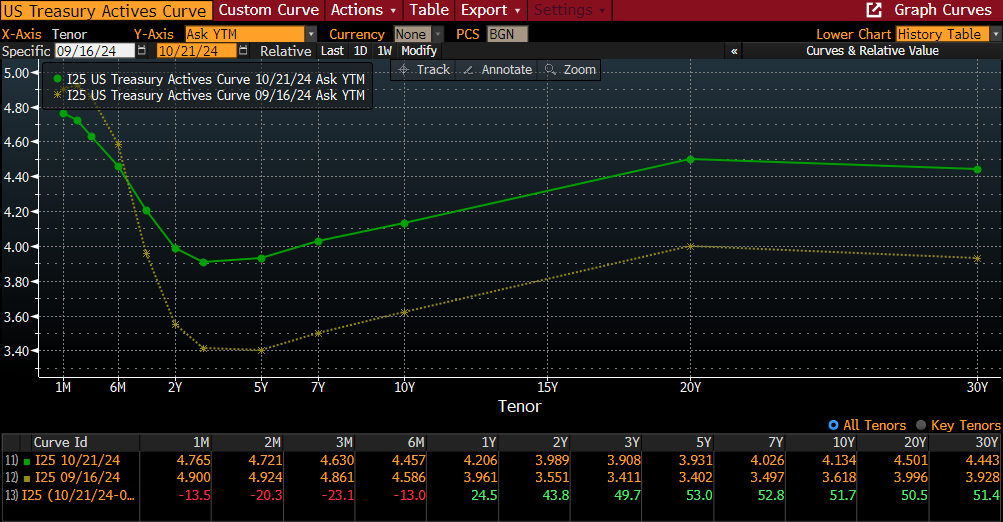
Whatever benefit the active relative-return fixed income manager might have gotten from those declining rates earlier this year has now been erased, as Treasury yields have risen rapidly across all maturities since the Fed announced its first cut in the FFR. Including today’s trading, the US 10-year Treasury note yield has backed up 67 bps since the yield bottomed out at 3.5% in mid-September (currently 4.17% at 11:40 am). The duration of the 10-year note is 8.18 years, as of this morning. That equates to a loss of principal of -5.48% in roughly 1 month. Wow!

Again, wouldn’t you want the certainty of a CFM portfolio instead of the very uncertain performance of the relative return fixed income manager? Especially when one realizes that the active fixed income manager’s portfolio won’t likely cover the liquidity needed to meet benefits and expenses. Having to “sell” bonds in a rising rate environment locks in losses for the active manager, while the CFM portfolio is designed to meet ALL of the liquidity through maturing principal and income – no selling. This seems like a no-brainer!

Falling Rates – Not A Panacea For Pensions

By: Russ Kamp, Managing Director, Ryan ALM, Inc.

Milliman has reported that pension funding for Corporate plans declined in August. The Milliman 100 Pension Funding Index (PFI) recorded its most significant decline of 2024, as the funded ratio fell from 103.6% to 102.8% as of August 31, 2024. No, it wasn’t because markets behaved poorly, as the month’s investment gains of 1.81% lifted the combined plans’ market value by $17 billion, to $1.347 trillion at the end of the period. It was the result of falling US interest rates that impacted the liability discount rate on those future promises.

According to Milliman, the discount rate fell from 5.3% in July to 5.1% by the end of August. That 20 basis points move in rates increased the projected benefit obligations (PBO) for the index constituents by $27 billion. As a result, the $10 billion decline in funded status reduced the funded ratio by 0.8%. The index’s surplus is now at $36 billion.

Markets seem to be cheering the prospects of lower US interest rates that may be announced as early as September 18, 2024 following the next FOMC. Remember, falling rates may be good for consumers and businesses, but they aren’t necessarily good for defined benefit pension plans unless the fall in rates rallies markets to a greater extent than the drop in rates impacts the growth in pension liabilities.

“With markets falling from all-time highs and discount rates starting to show declines, pension funded status volatility is likely in the months ahead, underscoring the prudence of asset-liability matching strategies for plan sponsors”, said Zorast Wadia, author of the PFI. We couldn’t agree more with Zorast. As we’ve discussed many times, Pension America’s typical asset allocation places the funded status for DB pension on an uncomfortable rollercoaster. Prudent asset-liability strategies can significantly reduce the uncertainty tied to current asset allocation practices. Thanks, Milliman and Zorast, for continuing to remind the pension community of the impact that interest rates have on a plan’s funded status.