DB Pension Plan “Absolute Truths” Revisited

By: Russ Kamp, CEO, Ryan ALM, Inc.

This post may be familiar to some of you, as I originally published it in October 2024. Given today’s great uncertainty related to geopolitics, markets, and the economy, I thought it relevant to share once again. Please don’t hesitate to reach out to me if you want to challenge any part of this list. We always welcome your feedback.

The four senior members at Ryan ALM, Inc. have collectively more than 160 years of pension/investment experience. We’ve lived through an incredible array of markets during our tenures. We have also witnessed many attempts on the part of Pension America to try various strategies to meet the promises that have been made to the pension plan participants.

Regrettably, defined benefit (DB) pension plans continue to be tossed aside by corporate America in favor of defined contribution (DC) plans. Both public and multiemployer plan sponsors would be wise to adopt a strategy that seeks more certainty to protect and preserve these critically important retirement vehicles before they are subject to a similar fate.

We’ve compiled a list of DB pension “Absolute Truths” that we believe return the management of pension plans back to its roots when SECURING the promised benefits at a reasonable cost and with prudent risk was the primary objective. The dramatic move away from the securing of benefits to the arms race focused on the return on asset assumption (ROA) has eliminated any notion of certainty in favor of far greater variability in likely outcomes.

Here are the Ryan ALM DB Truths:

  • Defined Benefit (DB) pension plans are the best retirement vehicle!
  • They exist to fulfill a financial promise that has been made to the plan participant upon retirement.
  • The primary objective in managing a DB plan is to SECURE the promised benefits at a reasonable cost and with prudent risk.
  • The promised benefit payments are liabilities of the pension plan sponsor.
  • Liabilities need to be measured, monitored, and managed more than just once per year.
  • Liabilities are future value (FV) obligations – a $1,000 monthly benefit is $1,000 no matter what interest rates do. As a result, they are not interest rate sensitive.
  • Pension inflation is not equal to the CPI but a rate unique to each plan sponsor.
  • Best way to hedge pension inflation is through Cash Flow Matching (CFM) since inflation is in the actuarial projections
  • Plan assets (stocks, bonds, real estate, etc.) are present value (PV) or market value (MV) calculations. We do not know the FV of assets except for bonds cash flows (interest and principal at maturity).
  • To measure and monitor the funded status, liabilities need to be converted from FV to PV – a Custom Liability Index (CLI) is absolutely needed.
  • A discount rate is used to create a PV for liabilities – ROA (publics), ASC 715 (corps), STRIPS, etc.
  • Liabilities are bond-like in nature. The PV of future liabilities rises and falls with changes in the discount rate (interest rates).
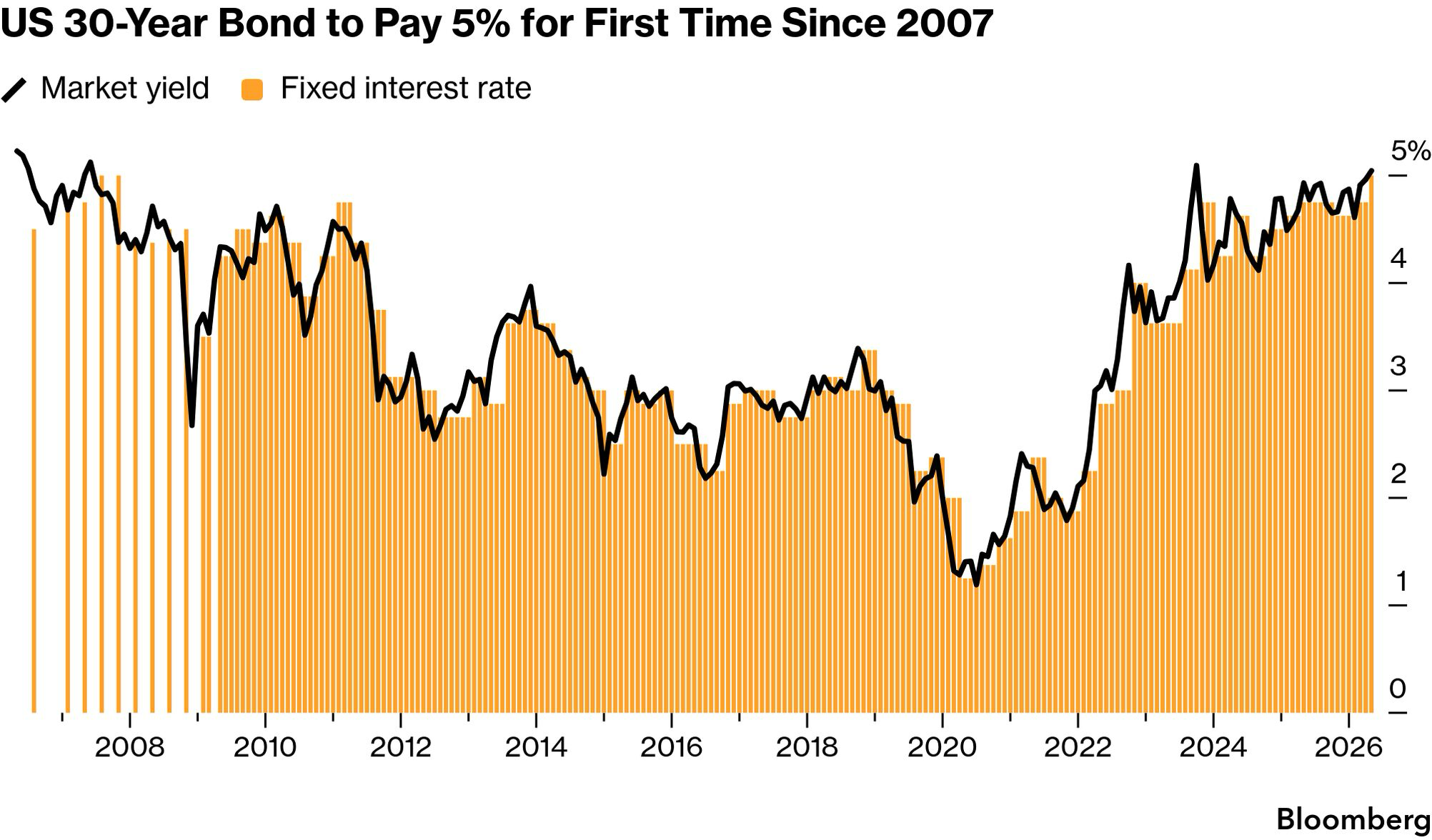
  • The nearly 40-year decline in US interest rates beginning in 1982 crushed pension funding, as the growth rate for future liabilities far exceeded the growth rate of assets.
  • The allocation of plan assets should be separated into two buckets – Liquidity (beta) and Growth (alpha).
  • The liquidity assets should consist of a bond portfolio that matches (defeases) asset cash flows with the plan’s liability cash flows (benefits and expenses (B&E)).
  • This task is best accomplished through a CFM investment process.
  • The liquidity assets should be used to fund B&E chronologically buying time for the alpha assets to grow unencumbered in their quest to meet those faraway future liabilities not yet defeased by the liquidity assets.
  • The Growth assets will consist of all non-bonds, which can now grow unencumbered, as they are no longer a source of liquidity. Growth assets will fund those remaining future liabilities not yet defeased by the liquidity assets.
  • The Return on asset (ROA) assumption should be a calculated # derived through an Asset Exhaustion Test (AET)
  • The pension plan’s asset allocation should be responsive to the plan’s funded status and not the ROA.
  • As the funded status improves, port alpha (profits) from the Growth portfolio into the Liquidity bucket (de-risk) extending the cash flow matching assignment and securing more promises.
  • This de-risking ensures that plans don’t continue to ride the asset allocation rollercoaster leading to volatile contribution costs.
  • DB plans are a great recruiting and retention tool for managing a sponsor’s labor force.
  • DB plans need to be protected and preserved, as asking untrained individuals to fund, manage, and then disburse a “benefit” through a Defined Contribution plan is poor policy.
  • Unfortunately, doing the same thing over and over and over is not working. A return to pension basics is critical.

You’ve made a promise: measure it – monitor it – manage it – and SECURE it…   

Get off the pension funding rollercoaster – sleep well!

Milliman: Corporate Pension Funding now at 109.4%

By: Russ Kamp, CEO, Ryan ALM, Inc.

Milliman has released the latest monthly report on the Milliman 100 Pension Funding Index (PFI). As a reminder, this index analyzes the 100 largest U.S. corporate pension plans.

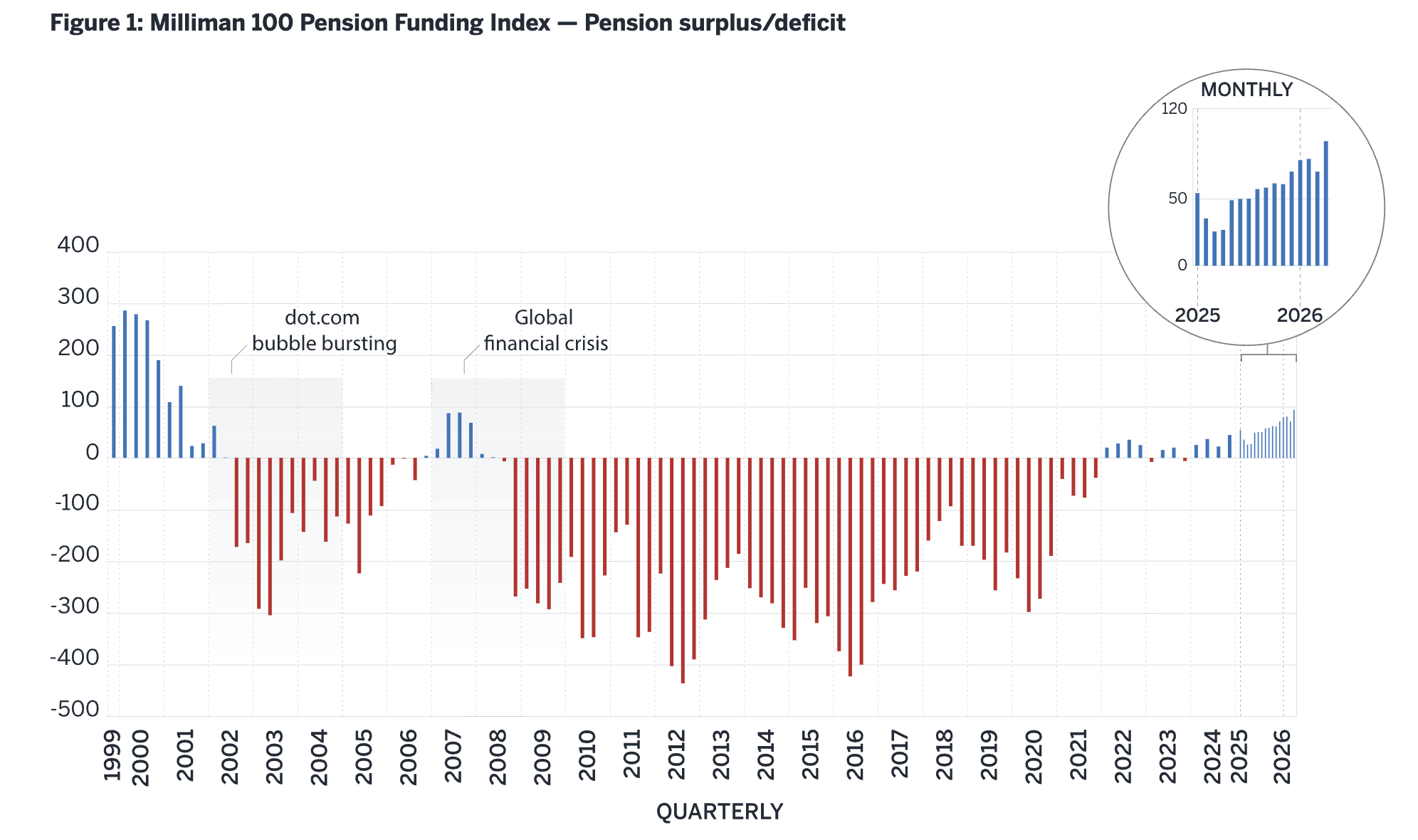
For February, the PFI funded ratio rose from 109.1% as of January 31, to 109.4% as of February 28, marking the highest collective funded ratio since the 109.9% mark observed in July 2001. However, the funding improvement was solely a result of asset performance, as declining discount rates of 14 basis points reduced the discount rate to 5.33% and raised the PFI projected benefit obligation (liabilities) to $1.235 trillion. Fortunately, monthly returns of 2.15% offset the impact of falling U.S. interest rates leading to growth in the market value of plan assets by $22 billion, to $1.351 trillion.

“February’s investment performance drove the month’s $5 billion gain in funding levels,” said Zorast Wadia, author of the Milliman PFI. He went on to say that “while this marks 11 straight months of funding improvements, further declines in interest rates may occur, and ongoing market volatility makes it vital for plan sponsors to undertake surplus-management strategies focused on both sides of the balance sheet.” We continue to support Zorast in recommending that managing assets to liabilities is critical for DB pension plans in all market environments, but especially given the significant uncertainty under which markets are currently operating. As a reminder, the primary objective in managing a DB pension is to SECURE the promised benefits at a reasonable cost and with prudent risk. It is NOT a return objective.

We, at Ryan ALM, do not forecast interest rates, but the impact of rising oil prices (WTI currently up 30.7% as of 9:13 am EST since Friday) will likely have an impact on inflation and interest rates. It will be interesting to see if a potential fall in the value of liabilities proves greater than the potential impact that rising rates might have on equity markets and other assets. Will we see the 12th consecutive month of improved funding levels?

Please click on the link below for a look at the complete Milliman corporate pension funding report.

View this month’s complete Pension Funding Index.

Here’s Another Example – Why, Oh Why?

By: Russ Kamp, CEO, Ryan ALM, Inc.

In October 2022, I wrote the following: “I believe that we have overcomplicated the management of DB pension plans. If the primary objective is to fund the promised benefits in a cost-efficient manner and with prudent risk, why do we continue to waste so much energy buying complicated products and strategies that often come with ridiculously high fees and little alpha?”

I still believe that our industry continues to build complicated asset allocation structures unnecessarily. In a recent P&I article, the following was reported: that a public pension system will adjust their asset allocation to reflect new targets including a 4% allocation to hedge funds and 3% to opportunistic credit, alongside increases in private equity to 13.5% from 8% and private debt to 8% from 6.5% — funded by reductions in domestic equities, international equities, and infrastructure.

This action is occurring after the investment consultant ABC recommended the changes following an asset-liability study, with the goal of enhancing protection against volatility and drawdowns while maintaining sufficient liquidity. Can you get more complicated? Are they really claiming that this structure will maintain sufficient liquidity? Sure, there may be a reduction in “volatility” because these strategies are not marked-to-market, as opposed to the public markets, but claiming that sufficient liquidity will be maintained is a joke!

I’ve been arguing for quite some time that the private markets are overbought. As assets continue to flow into these strategies, liquidity has dried up with little capital flowing back to the investor, which is why the secondary markets have flourished. Too many assets in any strategy deflate future returns, which we have witnessed. Regarding hedge funds, which are not aligned with the primary objective in managing a DB pension plan which is a relative objective (assets versus pension liabilities and NOT the ROA) they continue to be extremely expensive offerings that have produced subpar returns for the better part of the last two decades.

If the objective is to maintain sufficient liquidity look no further than cash flow matching (CFM) which will ensure that the necessary liquidity to meet benefits and expenses is available each month of the assignment as far out as the allocation goes without a need for a cash sweep of growth assets. Furthermore, one doesn’t have to pay hedge fund fees to get that “liquidity”. You can get a CFM strategy for 15 bps or less. While your liquidity needs are being met, the CFM portfolio will also extend the investing horizon for the remainder of the fund’s assets enhancing the probability that those less liquid, highly opaque offerings have time to produce the forecasted returns.

Afraid that you are going to give up “return” by using a CFM strategy? We recently completed an analysis for a large public pension system that believed they were <50% funded. We proved that we could fully fund and SECURE the NET liabilities (after contributions) of benefits and expenses (B&E) through 2059! Yes, a CFM portfolio with a YTM of 5.4% was able to fully fund the net B&E for 33-years. In addition, we were able to produce a surplus in excess of $4 billion, which can now just grow and grow and grow. In fact, investing that surplus in an S&P 500 index fund would grow those assets at a 6.5% annual return (the fund’s target ROA) to $35.3 billion by 2059. If the index produced an 8% nominal return for that period those surplus assets grow to >$75 billion that can be used to reduce future contributions, meet future liabilities, and perhaps enhance benefits.

Oh, wait, it gets even better. By investing in just the CFM strategy and the S&P 500 index fund, this plan can reduce annual investment fees from nearly $50 million per year to <$4 million, a reduction of 93%. Those fee savings add another $1.5 billion to the surplus before any return is generated on those savings. As Ripley would say, “BELIEVE IT OR NOT”!

Again, the management of a DB plan is not rocket science. Fund the annual required contributions, focus on the primary objective to SECURE the promised benefits at low cost and prudent risk, and you have a program that is neither complicated nor expensive to administer. When will we learn?

Eliminate the Uncertainty

By: Russ Kamp, CEO, Ryan ALM, Inc.

There are many benefits to using Cash Flow Matching (CFM) for your pension plan, endowment or foundation. The obvious benefit is the liquidity that is created to meet ongoing expenditures, whether benefit payments or grants. That liquidity comes at a premium today for many entities that have migrated significant financial resources to alternative investments, which are having a difficult time providing their investors with capital distributions.

The other significant benefit is the certainty that comes from using CFM. I’ve appreciated the opportunity to speak at NCPERS, IFEBP, LATEC, and OPAL in the last few months and in each case, I asked the audience if there was any investment strategy within their fund that brought certainty? Not a single hand was raised. They could have mentioned cash reserves as an example, but that is an expensive long-term strategy because of the low short-term yields available today.

The cloud of uncertainty under which we live is not comfortable! Yes, both pension funds and E&Fs are long-term investors, but the riding of markets up and down often leads to a significant increase in the contributions necessary to maintain their funding. That activity is not helpful to anyone. Who knows what will transpire as our country navigates through several potential geopolitical landmines. Combine that reality with uncertain economic growth, weaker labor markets, sticky inflation, and equity valuations that seem stretched, and markets could be in for a rocky period.

Wouldn’t it be a blessing to have CFM in place that not only provides the necessary liquidity so that assets aren’t forced to be sold at less than opportune times, but a strategy (service) that provides certainty since your obligations (liability cash flows) are matched with asset cash flows of bond principal and interest income for as far out as the bond and cash allocation will provide. It isn’t often that we are presented with an investment strategy that is truly a sleep-well-at-night offering for the long term. 

As a reminder, humans hate uncertainty, as it impacts us in both psychological and physiological ways. Yet, in the management of pensions and E&Fs, sponsors have wholeheartedly embraced uncertainty. The disconnect is quite surprising. Again, I don’t know what will transpire in markets today, tomorrow, or next year. I don’t know how the Iran situation will impact shipping lanes and the price of oil and inflation or worse, destabilize the entire region by bringing into the conflict Iran’s friends, such as Russia and China. I’m not a gambler and I don’t believe that managers of pension assets should be either.

I think it is critically important to SECURE the promises given to your plan’s participants and to achieve that objective with low cost and prudent risk. Riding the asset allocation rollercoaster accomplishes neither objective. Now’s the time to act. Not after markets have been rocked.

New Jersey’s Pension System’s “High” Investment Return

By: Russ Kamp, CEO, Ryan ALM, Inc.

As a taxpaying resident in New Jersey and a huge supporter of defined benefit plans who has a daughter in the system, I was happy to read that NJ’s pension systems generated strong investment returns in fiscal year 2025, reporting a nearly 11% return. Terrific. Yet, despite the above target return (7.0% ROA), the impact on the system’s funded status was negative. Yes, the funded ratio improved (assets/liabilities), but the funded status further deteriorated (funding gap in $s). Since the system is striving for 7% and the combined funded ratio of the various plans is <50%, a system like NJ’s would need to double the annual return on asset target just to keep the $ deficit stable.

It is great to see that NJ is finally bringing some financial discipline to the management of its pensions, with contributions at least matching the Actuarial Determined Contribution (ADC), but after decades of failing to do so (I think since Washington slept here), the systems are in need of significant funding improvement. Trying to generate outsized gains through a riskier asset allocation is not a long-term winning formula, often leading to greater annually required contributions when markets behave badly and assets get whacked.

The management of DB pension plans is not rocket science if the basics of sound pension management are followed. For instance, plans receiving the full ADC have on average an 80% funded ratio, while those not receiving the full ADC sit with funded ratios <70% (NCPERS study). Plans sitting with funded ratios below 50% are not likely to create enough excess return relative to the annual ROA to be able to close the funding gap. This often leads to plans making difficult decisions such as creating plans with multiple tiers, which I really despise.

Plans should focus on meeting the ADC, securing the promised benefits in the near-term, which buys time for the growth or alpha assets to perform, and reduce costs of administration, including management fees. DB plans are critical to the creation of a dignified retirement. Having a significant percentage of our seniors lacking the financial wherewithal to remain active in our economy is a major problem with long-term implications.

The Median Account May Not Be <$1k, But It Is Still A Crisis!

By: Russ Kamp, CEO, Ryan ALM, Inc.

There has been some debate within the investment industry related to National Institute on Retirement Security’s (NIRS) recent release of their report titled, “Retirement in America: An Analysis of Retirement Preparedness Among Working-Age Americans”. A report that claimed that “across all workers (21-64), including those with no savings, the median amount saved was only $955.”

Those complaining about the findings cited as issues the inclusion of young workers, while also citing that the information used in the analysis was self-reported. Furthermore, there was mention of the fact that there is an impending massive wealth transfer from both the Silent and Baby Boomer generations to Millennials that will act to mitigate retirement savings shortfalls. Really? Let’s explore.

Including young workers will skew the results, as most haven’t had the chance to establish households and begin to save. Let’s focus on more mature workers, such as those age 55-64. How are they doing? According to Vanguard, the median (I hate averages) 401(k) balance for participants in that age cohort is only $95,642, as reported in Vanguard’s How America Saves 2025 report. That certainly doesn’t seem like a significant sum to carry one through a 20+ year retirement.

Furthermore, >30% of eligible DC participants are not contributing at all, while only 2% (according to Fidelity) have account balances exceeding $1 million. If one applies the 4% rule to an account balance with only $95,642, that participant can “safely” withdraw $3,826 per year to fund their retirement. That coupled with an average Social Security payout ($24.8k annually) is not going to get you too far. Heck, my property taxes in Midland Park are >$32k per year.

How about the impact of the great wealth transfer? Millennials must be set to receive a significant windfall – right? Not so fast, as the typical millennial can expect little or nothing from the “great wealth transfer”. For those who do receive something, amounts in the low five figures are a reasonable estimation: that certainly is not a life‑changing windfall. But aren’t the estimates regarding the transfer ranging from $84-$90 trillion with some estimates as significant as $100 trillion? Where is all that wealth going?

  • Fewer than one‑third of U.S. households receive any inheritance at all; 70–80% inherit nothing.
  • Inheritances are disproportionately a feature of affluent families: in one analysis, inheritances are passed in about half of top‑5% households versus only 12% in the bottom 50%.
  • Wealthier boomers are more than twice as likely to leave inheritances as poorer Americans, implying the transfer will largely reinforce existing inequalities.
  • Across all households that receive something, the average inheritance is about $46,000, but this is heavily skewed by very large bequests at the top.
  • For the bottom 50% of households that receive an inheritance, the average is around $9,700.
  • For those in the broad “middle” (roughly the next 40% by wealth), the average inheritance is around $45,900.

So, in terms of expectation for the typical millennial, a large share will receive nothing, as their parents lack assets, too. Unfortunately, the “headline” trillions mostly reflect very large transfers to a relatively small share of already‑wealthy households. In short, the great wealth transfer is real in aggregate, but for the median millennial it looks less like a solution to a retirement shortfall!

The demise of defined benefit plans and the nearly exclusive use of defined contribution plans is creating a crisis. The current situation may not be as scary as the headline that the median amount saved is only $955, but $95,642 (or <$4k/year) is not going to help one navigate through a long retirement, especially as inflation associated with healthcare costs continues to rise rapidly.

Again, asking individuals to fund, manage, and then disburse a retirement benefit without the necessary disposable income, investment acumen, and NO crystal ball to help with longevity issues, is poor policy, at best. Everyday expenses are overwhelming family finances. The prospect of a dignified retirement is evaporating. Debating whether to include private/alternative investments and cryptos in 401(k) offerings is certainly not the answer. We need real solutions to this crisis. Where are the adults in the room?

Good Question!

By: Russ Kamp, CEO, Ryan ALM, Inc.

We occasionally post questions received in reaction to our blogs in new blog posts since many of our readers might have similar thoughts/ideas. In reaction to yesterday’s post, “All-time High Funded Ratio” a reader calling themselves LoudlyObservant (great name) stated the following:

Why wouldn’t such well-funded plans take steps to lock in the funding of their beneficiary payments through a cash flow matching portfolio? Isn’t the first fiduciary duty of loyalty expressed in controlling the relevant risk to the beneficiaries, which involves BOTH securing adequate assets and then actually funding the payments? Many of these plans have hit the first goal but are still exposed to funding risk. With a ready solution at hand, the plan sponsors open themselves to criticism for not acting on their second responsibility.

Thank you, Loudly! Great questions and observations. We often talk about the fact that pension plans at all funding levels need liquidity, not just well-funded plans, but when you have a universe of plans that on average are fully funded, why not dramatically reduce risk. We witnessed what happened to DB pension plans at the end of 1999, when most plans were well overfunded only to see the funded status plummet and contribution expenses explode following two major market corrections.

I’m neither smart enough nor is my crystal ball better than anyone else’s to know if a major market correction is on the horizon but why take the chance unnecessarily. We’ve seen a significant percentage of Special Financial Assistance (SFA) recipients engage in cash flow matching to secure the SFA assets and the benefits that they will protect. Why not adopt CFM for the legacy assets, too? As we’ve mentioned, we are providing a service to you and your plan participants. It isn’t just another product. Time to get off the proverbial rollercoaster of returns and secure the promises and your plan’s funded status.

It Should Be Relative and NOT Absolute

By: Russ Kamp, CEO, Ryan ALM, Inc.

I was participating on a panel at the Opal/LATEC conference yesterday. The moderator asked a question about the importance of process. In my response, I mentioned a number of process elements that are critical to the successful management of pension plans. Here is one point that I made that doesn’t get the attention that it deserves. Many, if not most, defined benefit pension plans have created an investment policy statement (IPS) that specifically restricts certain investments and their respective weights within the pension fund. The plan sponsor and their consultant likely allow investments in public equities and certain styles of equity management (i.e. value and growth, large and small cap, etc.). However, in many cases they restrict the exposure to any one security by an absolute amount such as 5%. This is the wrong approach.

Limiting exposures does reduce the risk that any one stock could have an outsized impact on the pension plan’s return, but by doing so, the plan sponsor is potentially negatively impacting the investment manager. Not all U.S. equity benchmarks are the same and treating them as such is potentially damaging to the manager and fund.

If a large cap growth manager has been retained and they are asked to manage a portfolio relative to the Russell 1000 Growth Index, limiting exposure in a stock to 5% would mean forcing that manager to make a negative bet against any stock in the index that has a weight greater than 5%. As of today, there are three stocks – Nvidia (12.9%), Apple (11.6%), and Microsoft (8.8%) – that the manager couldn’t own at benchmark weight, let alone own them above the index weight. This index is cap weighted, and as the stocks perform well their weight in the index grows. Not being able to own the stock at its index weight is harmful.

Worse, if the investment manager wants to make a positive bet on the stock, they can’t, forcing them to potentially choose weaker companies to round out their portfolio. When a manager is chosen, they are often picked because of their past track record of producing an excess return for a level of risk (tracking error). Restricting exposures to an absolute weight may render those previous return/risk characteristics moot. Furthermore, the exposure to a single stock should be relative to the weight in the index +/- band, which would be very dependent on the amount of tracking error that is comfortable to the plan sponsor.

For instance, a good information ratio (excess return/tracking error) is 0.33%. Meaning that for every 1% excess return, the manager is taking 3% tracking error. If the manager is hoping to add 2% above the benchmark over a cycle, that manager is going to have a tracking error close to 6%. The relative weight of a stock in a portfolio must reflect that level of potential tracking error. Higher tracking error portfolios need more flexibility. In this case, it would make sense to allow the manager to invest in Nvidia at the index weight +/- 2%. For lower risk strategies such as an enhanced index that only has 1% tracking error, perhaps the index weight +/- 0.5% would be appropriate.

Now, the Russell 1000 Growth Index is one of the more concentrated indexes with nearly 60% of the weight of the index in just the top 10 holdings, but it isn’t the only one. Currently, the S&P 500 has the same three stocks (Nvidia, Apple, and Microsoft) at weights greater than 5% and two others, Amazon and Alphabet, at weights >3%. If the manager wants to overweight a holding in the S&P 500 by +/- 2%, they would be restricted with a 5% absolute restriction and no ability to overweight.

I recommend that you review your IPS and make sure that your “risk control” objectives are not restricting your manager’s ability to produce an excess return. Remove any absolute constraint and replace it with a relative weighting based on the tracking error that the manager produces. Again, lower risk enhanced index managers will only need a +/- 0.5% to +/-1% restriction, while higher tracking managers will need greater flexibility.

It’s Not A Product – It’s A Service!

By: Russ Kamp, CEO, Ryan ALM, Inc.

Anyone who has read my blogs (>1,700 to date) knows that my personal mission and that of Ryan ALM, Inc. is to protect and preserve defined benefit pension plans. How is our collective mission pursued? It is through the implementation of unique client-specific cash flow matching (CFM) assignments. Since every pension plan has liabilities unlike any other fund, a unique solution must be created unlike most investment management products sold today.

Here is the reality: There are a lot of wonderful people in our industry, representing impressive investment organizations, tasked with introducing a variety of investment products. Plan sponsor trustees, with the help of their investment consultants, must determine which products are necessary for their plan to help reach the goal of funding the promised benefits. This is an incredibly challenging exercise if the goal is to cobble together a collection of investment managers whose objective is to achieve a return on asset assumption (ROA). This exercise often places pension funds on the proverbial rollercoaster of returns. The pursuit of a return as the primary goal doesn’t guarantee success, but it does create volatility.

On the other hand, wouldn’t it be wonderful if one could invest in strategy that brings an element of certainty to the management of pension plans? What if that strategy solved the problem of producing ALL of the necessary liquidity needed to fund monthly benefits and expenses without having to sell securities or sweep cash (dividends and capital distributions) from higher earning products? Wouldn’t it be incredible if in the process of providing the liquidity for some period of time, say 10-years, you’ve now extended the investing horizon for the residual assets not needed in the liquidity bucket? Impossible! Hardly. Cash flow matching does all that and more.

I recently had the privilege of introducing CFM to someone in our industry. The individual was incredibly curious and asked many questions. Upon receiving my replies, they instinctively said “why isn’t everyone using this”? That person then said you aren’t selling a product: it is a SERVICE. How insightful. Yes, unlike most investment strategies that are sold to fill a gap in a traditional asset allocation in pursuit of the “Holy Grail” (ROA), CFM is solving many serious issues for the plan sponsor: liquidity and certainty being just two.

Substituting one small cap manager for another, or shifting 3% from one asset class or strategy to another is not going to make a meaningful impact on that pension plan. You get the beta of that asset class plus or minus some alpha. None of these actions solve the problem of providing the necessary liquidity, with certainty, when needed. None of them are creating a longer investing horizon for the residual assets to just grow and grow. None of those products are supporting the primary pension objective which is to SECURE the promised benefits at low cost and with prudent risk.

So, Ryan ALM, Inc. is providing a critical service in support of our mission which is to protect and preserve your DB pension plan. Why aren’t you and others (everyone) taking advantage of this unique service?

Milliman: Corporate Pension Funding Soars

By: Russ Kamp, CEO, Ryan ALM, Inc.

Milliman has once again released its monthly Milliman 100 Pension Funding Index (PFI), which analyzes the 100 largest U.S. corporate pension plans, and the news continues to be quite good.

Market appreciation of 1.05% during January lifted the market value of PFI plan assets by $8 billion increasing total AUM to $1.327 trillion. A slight 1 bp rise in the discount rate to 5.47% lowered plan liabilities marginally to $1.217 trillion at the end of January. As a result, the PFI funded ratio climbed from 108.2% at the beginning of the year to 109.0% as of January 31, 2026. 

“January’s strong returns contributed $8 billion to the PFI plans’ funding surplus, while declining liabilities contributed another $2 billion,” said Zorast Wadia, author of the Milliman 100 PFI. “Although funded ratios have now improved for 10 straight months, managing this surplus will continue to be a central theme for many plan sponsors as they employ asset-liability matching strategies going forward.” We couldn’t agree more, Zorast! Given significant uncertainty regarding the economy, inflation, interest rates, and geopolitical events, now is the time to modify plan asset allocations by reducing risk through a cash flow matching strategy (CFM).

CFM will secure the promised benefits, provide the necessary monthly liquidity, extend the investing horizon for the non-CFM assets, while stabilizing the funded status and contribution expenses. Corporate plan sponsors have worked diligently tom improve funding and markets have cooperated in this effort. Now is not the time to “let it ride”. Ryan ALM will provide a free analysis to any plan sponsor that would like to see how CFM can help them accomplish all that I mentioned above. Don’t be shy!

Click on the link below for a look at Milliman’s January funding report.

View this month’s complete Pension Funding Index.

For more on Ryan ALM, Inc.