Are Investors About to Get Their Comeuppance?

By: Russ Kamp, CEO, Ryan ALM, Inc.

As we’ve discussed in this blog on many occasions, the U.S. interest rate decline from 1982 to 2022 fueled risk assets well beyond their fundamentals. During the rate decline, investors became accustomed to the US Federal Reserve stepping in when markets and the economy looked dicey. There seems to be a massive expectation that the “Fed” will once again support those same risk assets by initiating another rally through a rate decline perhaps as soon as September. Is that action justified? I think not!

Recent inflation data, including today’s PPI that came in at 0.9% vs. 0.2% expected, should give pause to the crowd screaming for lower rates. Yes, employment #s published last week were very weak, and they got weaker when Erika McEntarfer, the commissioner of the Bureau of Labor Statistics, was fired after releasing a jobs report that angered President Donald Trump. In addition, we have Secretary of the Treasury, Scott Bessent, demanding rates be cut by as much as 150-175 bps, claiming that all forecasting “models” suggest the same direction for rates. Is that true? Again, I think not.

You may recall that I published a blog post on July 10, 2025 titled “Taylor-Made”, in which I wrote that the Taylor Rule is an economic formula that provides guidance on how central banks, such as the Federal Reserve, should set interest rates in response to changes in inflation and economic output. The rule is designed to help stabilize an economy by systematically adjusting the central bank’s key policy rate based on current economic conditions. It is designed to take the “guess work” out of establishing interest rate policy.

In John Authers (Bloomberg) blog post today, he shared the following chart:

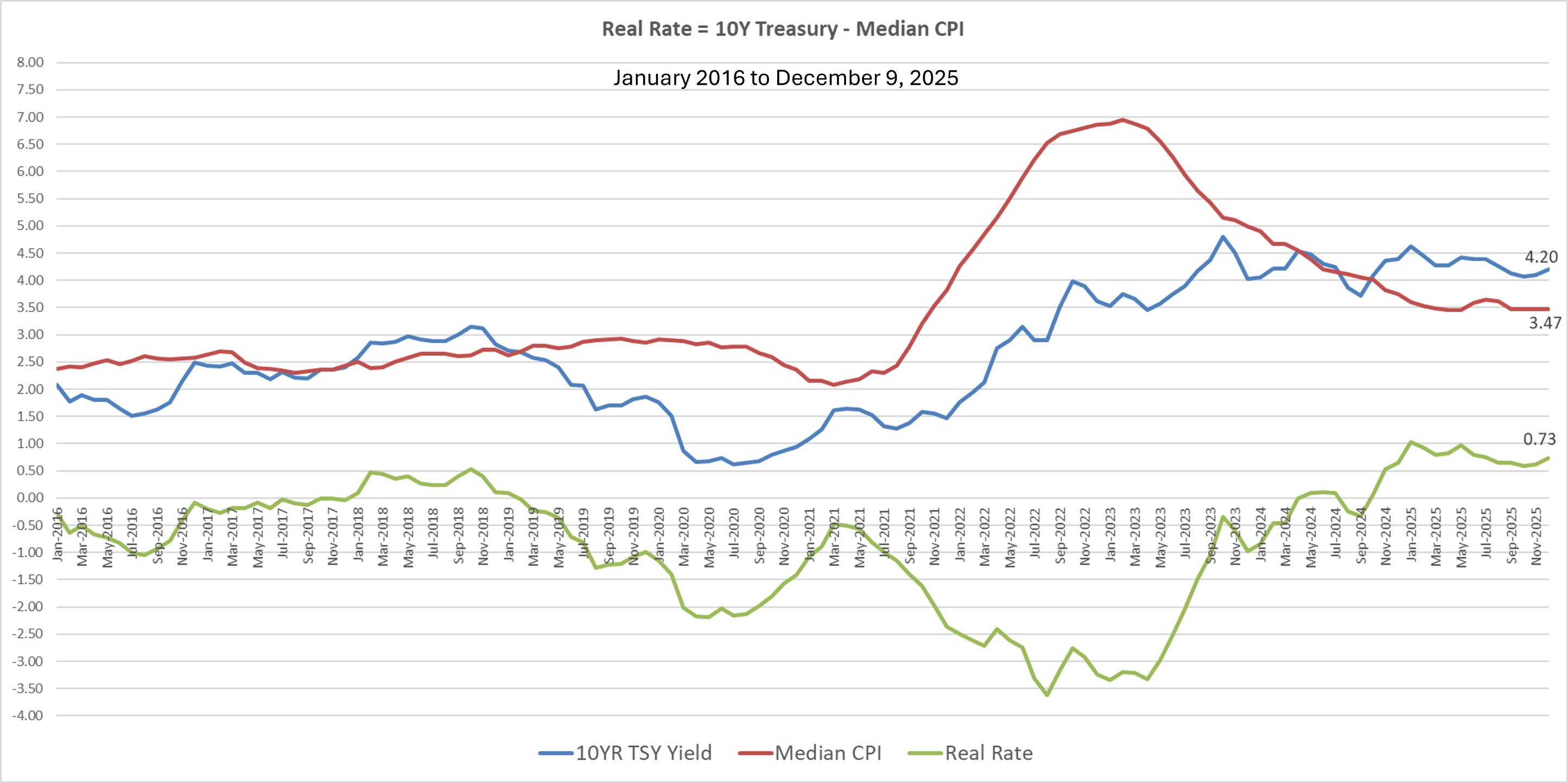
Calling for a roughly 2.6% Fed Funds rate in an environment of 3% or more core and sticky inflation is not prudent, and it is not supported by history. Furthermore, the potential impact from tariffs will only begin to be felt as most went into effect as of August 1, 2025.

Getting back to the Taylor Rule, Authers also provided an updated graph suggesting that the Fed Funds rate should be higher today. In fact, it should be at a level about 100 bps above the current 4.3% and more than 270 bps above the level that Bessent desires.

Investors would be wise to exit the lower interest rate train before it fuels a significant increase in U.S. rates as inflation once again rises. The impact of higher rates will negatively impact all risk assets. Given that a Cash Flow Matching (CFM) strategy eliminates interest rate risk through the defeasement of benefits and expenses that are future values and thus not interest rate sensitive, one could bring an element of certainty to this very uncertain economic environment before investors get their comeuppance! Don’t wait for the greater inflation to appear, as it might just be too late at that point to get off the lower interest rate train before it plummets into a ravine.

A few Observations from Newport

By: Russ Kamp, CEO, Ryan ALM, Inc.

As I mentioned in my ARPA update on Monday, I had the pleasure of attending the Opal Public Fund Forum East in beautiful Newport, RI, and neither the conference nor Newport disappointed. I don’t attend every session during the conference, but I do try to attend most. In all honesty, I can’t listen to another private equity discussion.

As always, there were terrific insights shared by the speakers/moderators, but there were also some points being made that are just wrong. With this being my first day back in the office this week, I don’t have the time to get into great detail regarding some of my concerns about what was shared, but I’ll give you the headline and perhaps link a previous blog post that addressed the issue.

First, DB pension plans are not Ponzi Schemes that need more new participants than retirees to keep those systems well-funded and functioning. Actuaries determine benefits and contributions based on each individual’s unique characteristics. If managed appropriately, systems with fewer new members can function just fine. Yes, plans that find themselves in a negative cash flow situation need to rethink the plan’s asset allocation, but they can continue to serve their participants just fine. Remember: a DB pension plan’s goal is to pay the last benefit payment with the last $. It is not designed to provide an inheritance.

Another topic that was mentioned several times was the U.S. deficit and the impending economic doom as a result. The impact of the U.S. deficit is widely misunderstood. I was fortunate to work with a brilliant individual at Invesco – Charles DuBois – who took the time to educate me on the subject. As a result of his teaching, I now understand that the U.S. has a potential demand problem. Not a debt issue. I wrote a blog post on this subject back in 2017. Please take the time to read anything from Bill Mitchell, Warren Mosler, Stephanie Kelton, and other disciples of MMT.

Lastly, the issue of flows into strategies/asset classes seems not to be understood. The only reason we have cycles in our markets is through the movement of assets into and out of various products/strategies. Too much money chasing too few good ideas creates an environment in which those flows can overwhelm future returns. It is the same for individual asset management firms. Many of the larger asset management firms have become sales organizations in lieu of investment management organizations as they long ago eclipsed the natural capacity of their strategies. In the process, they have arbitraged away their insights which may have provided the basis for some value-added in the past. I believe that too much money is chasing many of the alternative/private strategies. In the process, future returns and liquidity will be negatively impacted. We’ve already seen that within private equity. Is private debt next?

Again, always enjoy seeing friends and industry colleagues at this conference. I continue to learn from so many of the presenters even after 44-years in the industry. However, not everything that you hear will be correct. It is up to you to challenge a lot of the “common wisdom” being shared.

U.S. $ Decline and the Impact on Inflation

By: Russ Kamp, CEO, Ryan ALM, Inc.

As I was contemplating my next blog post, I took a look at how many of my previous >1,625+ posts mentioned currencies, and specifically the U.S. $. NEVER had I written about the U.S. $ other than referencing the fact that we enjoy the benefit of a fiat currency. I did mention Bitcoin and other cryptos, but stated that I didn’t believe that they were currencies and still don’t. Why mention them now? Well, the U.S. $ has been falling relative to nearly all currencies for most of 2025. According to the WSJ’s Dollar Index (BUXX), the $ has fallen by 8.5% for the first half of 2025.

Relative to the Euro, the $ has fallen nearly 14% and the trend isn’t much better against the Pound (-9.6%) and the Yen (-8.7%). So, what are the implications for the U.S. given the weakening currency? First, the cost of imports rises. When the $ loses value, it costs more to buy goods and services from abroad. The likely outcome is that the increased costs get passed onto the consumer, who is already dealing with the implications from uncertain tariff policies.

Yes, exports become cheaper, which would hopefully increase demand for our goods, but the heightened demand could also lead to greater demand for U.S. workers in order to meet that demand leading to rising wages (great), but that is also potentially inflationary.

What have we seen so far? Well, first quarter’s GDP (-0.5%) reflected an increase in imports spurred on by fear of price increases due to the potential for tariffs. Q2’25 is currently forecasted to be 2.5% according to the Atlanta Fed’s GDPNow model, as U.S. imports have fallen. According to the BLS, import prices have risen in 4 of 5 months in 2025, with March’s sharp decline the only outlier.

The potential inflationary impact from rising costs could lead to higher U.S. interest rates, which have been swinging back and forth depending on the day of the week and the news cycle. Furthermore, there is fear that the proposed “Big Beautiful Bill” could also drive rates higher due to the potential increase in the federal deficit by nearly $5 trillion due to the stimulative nature of deficits. Obviously, higher U.S rates are great for individual savers, but they don’t help bonds as principal values fall.

We recommend that plan sponsors and their advisors use bonds for the cash flows (interest and principal) and not as a performance driver. Use the fixed income exposure as a liquidity bucket designed to meet monthly benefits and expenses through the use of Cash Flow Matching (CFM), which will orchestrate a careful match of asset cash flows funding the projected liabilities cash flows. The remaining assets (alpha bucket) now benefit from time, as the investment horizon is extended.

Price increases on imports due to a weakening $ can impact U.S. inflation, but there are other factors, too. I’ve already mentioned tariffs and wage growth, but there other factors, including productivity and global supply chains. Some of these drivers may take more time to hash out. There are many uncertainties that could potentially impact markets, why not bring an element of certainty to your pension fund through CFM.

Capital Distributions From Private Equity Collapse

By: Russ Kamp, CEO, Ryan ALM, Inc.

I recently published a blog titled, Problem – Solution: Liquidity, in which I discussed the impact of pension plan sponsors cobbling together interest, dividends, and capital distributions from their roster of managers, and how that practice was not beneficial, especially during periods of stress in the markets. Well, one of those three legs of the “gotta, but how am I gonna, meet my monthly payment of benefits and expenses”, is really falling short at this time.

Dividends are far lower these days than they once were when equities were perceived to be quite risky. In fact, it wasn’t until 1958 that dividend income fell below interest income from bonds. Couple that phenomenon with the fact that capital distributions have plummeted, and plan sponsors are placing far greater emphasis on capturing interest from bonds than ever before. Yes, thankfully interest rates have risen, but the YTM on the BB Aggregate index is still only in the 4.7% range. That is not likely sufficient to meet monthly payouts, which means that bonds will have to be sold, too. The last thing one should want to do in a rising rate environment is to sell securities at a loss.

However, if the plan sponsor engaged a Cash Flow Matching (CFM) manager in lieu of an active core fixed income manager, the necessary liquidity would be made available each and every month of the assignment, as asset cash flows would be carefully matched against liability cash flows. Both interest and maturing principal would be used to meet those benefits and expenses. No forced selling. No scurrying around to “find” liquidity. A far more secure and certain process.

What if my plan isn’t fully funded. Does it make sense to use CFM? Of course, given that benefits and expenses are paid each month whether your plan is fully invested or not, wouldn’t it make more sense to have those flows covered with certainty? Sure, a poorly funded plan may only be able to use CFM for the next 3-5-years, but that’s the beauty of CFM. It is a dynamic process providing a unique solution for each pension plan. No off the shelf products.

P&I: “Not The Time To Panic” – Frost

By: Russ Kamp, CEO, Ryan ALM, Inc.

There is hardly ever a good time to panic when managing a defined benefit pension plan. No one ever wants to be a forced seller because liquidity is needed and not available. Too often what looks like a well-diversified portfolio suddenly has all assets correlating to 1. I’ve seen that unfold many times during my nearly 44-years in the business.

It is critically important that the appropriate asset allocation framework be put in place long before one might be tempted to panic. As we’ve mentioned many times before, having all of your eggs (assets) in one basket focused on a return objective (ROA) is NOT the correct approach. Dividing assets among two buckets – liquidity and growth – is the correct approach. It ensures that you have the necessary liquidity to meet benefits and expenses as incurred, and it creates a bridge over uncertain markets by extending the investing horizon, as those growth assets are no longer needed to fund monthly payments.

Furthermore, the liquidity portfolio should be managed against the plans liabilities from the first month as far out as the allocation to the liquidity bucket will take you. Why manage against the liabilities? First, the only reason the plan exists is to meet a promise given to the participant. The primary objective managing a pension should be to SECURE the promised benefits at a reasonable cost and with prudent risk. Second, a cash bucket, laddered bond portfolio or generic core portfolio is very inefficient. You want to create a portfolio that defeases those promises with certainty. A traditional bond portfolio managed against a generic index is subject to tremendous interest rate risk, and there certainly seems to be a lot of that in the current investing environment.

The beauty of Cash Flow Matching (CFM) is the fact that bonds (investment grade corporate bonds in our case) are used to defease liabilities for each and every month of the assignment (5-, 10-, 20- or more years). Liabilities are future values (FV) and as such, are not interest rate sensitive. A $1,000 benefit payment next month or any month thereafter is $1,000 whether rates are at 2% or 10%. If one had this structure in place before the market turbulence created by the tariff confusion, one could sleep very comfortably knowing that liquidity was available when needed (no forced selling) and a bridge over trouble waters had been built providing ample time for markets to recover, which they will.

Yes, now is not the time to panic, but continuing to ride the rollercoaster of performance created by a very inefficient asset allocation structure is not the answer either. Rethink your current asset allocation framework. Allow your current funded status to dictate the allocation to liquidity and growth. The better funded your plan, the less risk you should be taking. DB pension plans need to be protected and preserved. Creating an environment in which only volatility is assured makes little sense. It is time to bring an element of certainty to the management of pensions.

The Buying Of Time Can Reap Huge Rewards

By: Russ Kamp, CEO, Ryan ALM, Inc.

When we present the list of benefits associated with using Cash Flow Matching (CFM), one of the benefits that we highlight is the buying of time a.k.a. an extended investing horizon. Our pension community tends to fall prey to short-termism despite claiming to be long-term investors. Quarterly observations are presented through the consultants regular performance reviews and managers are often dismissed after a relatively short period of “underperformance”. Actuarial reports tend to be annual which dictate projected contribution expenses. Yet, by extending the investment horizon to something more meaningful like 10-years or more, the probability of achieving the desired outcome is dramatically improved.

I recently played around with some S&P 500 data dating back to 12/31/69 and looked at the return and standard deviation of observations encompassing 1-10-year moving averages and longer periods such as 15-, 20-, 30-, and even 50-year moving averages for the industry’s primary domestic equity benchmark. Living in a one-year timeframe may produce decent annual returns, but is also comes with tremendous volatility. In fact, the average one-year return from 12/69 to 2/25 has been 12.5%, but the annual standard deviation is +/- 16.6%, meaning that 68% of the time your annual return could be +29.1% to -4.1%. Extending the analysis to 2 standard deviations (95% of the observations) means that in 19 out of 20 years the range of results can be as broad as +45.7% to -20.7%.

However, extend out your investing horizon to 10-years, and the average return from 12/69 dips to 11.4%, but the standard deviation collapses to only 5.0% for a much more comfortable range of +16.4% to 6.4%. Extend to 2 standard deviations and you still have a positive observation in 19 out of 20 years at +1.4% as the lower boundary. Extend to 30-years and the volatility craters to only +/-1.2% around an average return of 11.25%.

We, at Ryan ALM, were blessed in 2024 to take on an assignment to cash flow match 30+ years of this plan’s liabilities. We covered all of the projected liability cash flows through 2056 and still had about $8 million in surplus assets, which were invested in two equity funds, that can now just grow and grow and grow since all of the plan’s liquidity needs are being covered by the CFM strategy! So, how important is a long investing runway? Well, if this plan’s surplus assets achieve the average S&P 500 30-year return during the next 30-years, that $8 million will grow to >$195 million.

We often speak with prospects about the importance of bifurcating one’s asset base into two buckets – liquidity and growth. It is critically important that the plan’s liquidity be covered through the asset cash flows of interest and principal produced by bonds since they are the only asset with a known future value. CFM eliminates the need for a cash sweep which would severely reduce the ROA of growth assets. This practice will allow the growth or alpha assets to wade through choppy markets, such as the one we are currently witnessing, without fear that liquidity must be raised to meet benefits at a less than opportune time.

The plan sponsor highlighted above was fortunate to have a well-funded plan, but even plans that are less well-funded need liquidity. Ensuring that benefits and expenses can be met monthly (chronologically) without forcing liquidity that might not naturally exist is critical to the successful operation of a pension plan. CFM can be used over any time frame that the plan sponsor desires or the plan can afford. We believe that extending the investment horizon out to 10-years should be the minimum goal, but every plan is unique and that uniqueness will ultimately drive the decision on the appropriate allocation to CFM.

Markets Hate Uncertainty

By: Russ Kamp, CEO, Ryan ALM, Inc.

I’ve published many posts on the impact of uncertainty on the well-being of individuals and our capital markets. In neither case are the outcomes positive.

What we are witnessing in the last several trading days is the direct result of policy flip-flopping that is creating abundant uncertainty. As a result, the business environment is deteriorating. One can argue the merits of tariffs, but it is the flip-flopping of these policy decisions that is wreaking havoc. How can a business react to these policies when they change daily, if not hourly.

The impact so far has been to create an environment in which both investment and employment have suffered. Economic uncertainty is currently at record levels only witness during the pandemic. Rarely have we witnessed an environment in which capital expenditures are falling while prices are increasing, but that is exactly what we have today. Regrettably, we are now witnessing expectations for rising input prices, which track consumer goods inflation. It has been more than four decades since we were impacted by stagflation, but we are on the cusp of a repeat last seen in the ’70s. How comfortable are you?

We just got a glimpse of how bad things might become for our economy when the Atlanta Fed published a series of updates driving GDP growth expectations down from a high of +3.9% earlier in the quarter to the current -2.4% published today. The key drivers of this recalibration were trade and consumer spending. The uncertainty isn’t just impacting the economy. As mentioned above, our capital markets don’t like uncertainty either.

I had the opportunity to speak on a panel last week at Opal/LATEC discussing Risk On or Risk Off. At that point I concluded that little had been done to reduce risk within public pension plans, as traditional asset allocation frameworks had not been adjusted in any meaningful way. It isn’t too late to start the process today. Action should be taken to reconfigure the plan’s asset allocation into two buckets – liquidity and growth. The liquidity bucket will provide the necessary cash flow in the near future, while buying time for the growth assets to wade through these troubled waters. Doing nothing subjects the entire asset base to the whims of the markets, and we know how that can turn out.

One of Only Two – Time For Change

By: Russ Kamp, Managing Director, Ryan ALM, Inc.

The United States of America and Denmark share several commonalities. Both countries have democratic political systems. Each country enjoys a high standard of living. Both have a commitment to human rights and environmental concerns, with Denmark being a leader in renewable energy and sustainability, while the U.S. is witnessing a growing movement on those fronts. Both countries value education, enjoying high literacy rates. There is also a shared military alliance through NATO. What you might not realize is that the U.S. and Denmark are the ONLY countries that have a self-imposed statutory debt limit. Sure, there are other countries, such as Switzerland, that have mandatory balanced budget provisions which effectively limit the amount of debt , but they aren’t specified debt limits.

The U.S. first instituted a statutory debt limit with the Second Liberty Bond Act of 1917, setting the aggregate amount of debt that could be accumulated through individual categories like bonds and bills. The purpose in creating this legislation was to finance the country’s involvement in World War 1. The legislation allowed the U.S. to raise $9.5 billion in bonds that would be issued by the U.S. government. These bonds were marketed to the general population and to institutional investors to gain their support for the war. Was there a First Liberty Bond Act? Yes, that act had been passed earlier in 1917 allowing the government to issue $2 billion in bonds in order to support the war.

Importantly, and why we are where we are today with regard to the current deficit, the Second Liberty Bond Act program continued after the war. It set a precedent for public financing of government initiatives through bond sales. Although the debt limit was established in 1917 which allowed the Treasury to issue bonds without specific Congressional approval, the “limit” has been raised more than 100 times since then and roughly 78 times since 1960 alone. As a result, the US debt has risen from around $250 billion during World War II, to about $2.1 trillion during the Reagan years, to $5.6 trillion at the conclusion of the 1990s, and to today’s $36 trillion. So, why do we have a debt limit when it has been elevated so many times previously and to a magnitude certainly not contemplated in 1917?

The political brinkmanship associated with the debt limit debate rarely serves a purpose, often unnecessarily frightening Americans and our capital market participants. As we brace for another “discussion”, is maintaining a debt “limit” at all necessary? NO! Today’s federal deficit is in no way constraining to future generations. I’ve referenced Warren Mosler and his book, “The 7 Deadly Innocent Frauds of Economic Policy” on many occasions. He covers the topic of our government debt and whether we are leaving our debt-burden to our children, grandkids, etc. Mosler states, “the idea of our children being somehow necessarily deprived of real goods and services in the future because of what’s called the national debt is nothing less than ridiculous.”

As Mosler explains, that the financing of deficit spending is of “no consequence”. He further explains that when the “government spends, it just changes numbers up in our bank accounts.” The government doesn’t borrow money, it moves funds from checking accounts at the Fed to savings accounts (Treasury securities) at the Fed. The good news, is that the entire federal deficit ($36 trillion or so) is nothing more than the economy’s total holdings of savings accounts at the Federal Reserve. The private sector now has an asset equivalent to the deficit. How wonderful! Can you imagine if we didn’t have the ability to deficit spend. Think of all the stimulus that would have been removed from our economy that supported jobs, wages, and demand for goods and services.

The major issue with our ability to deficit spend has nothing to do with financing it, but everything to do with providing too much stimulus that creates demand for goods and services that exceeds our economy’s ability to meet such demand. So, I ask again, does having a debt limit (ceiling) make sense? No, unless you enjoy all the grandiose speeches from the halls of Congress based on little knowledge of how our monetary system truly works. Finally, I’d like to give a special nod to Charles DuBois, my former colleague at Invesco, who spent hours educating me on this subject. Thanks, Chuck!

Are We Witnessing a Heavy Weight Fight?

By: Russ Kamp, Managing Director, Ryan ALM, Inc.

Most everyone is aware that monetary policy has gotten much tighter than we’ve witnessed in multiple decades, especially on the heels of the Fed’s zero interest rate policy (ZIRP). As a reminder, the Federal Reserve began raising the Fed Funds Rate (FFR) on March 17, 2022. After 2 years of their tightening action designed to combat inflation, the Fed Funds Rate sits at 5.25%-5.5%, where it has been for the last 1/2 year. Has the Fed’s action achieved its primary objective of price stability? No, but they’ve certainly made strides toward that quest seeing inflation fall from a high of 8.4% in July 2022 to February’s 3.2% reading. Furthermore, neither the economy nor the labor force have collapsed.

I recall when the Fed first began raising the FFR, they anticipated that both the economy and labor force would be impacted. In fact, I remember seeing estimates that the unemployment rate would likely elevate to between 4.5% and 5% as a result of this action, and the economy would most likely fall into recession. Thankfully, neither event has occurred. Why? Despite the aggressive Fed action to raise interest rates, financial conditions are not that tight. In fact, as I wrote in yesterday’s post, by some measures, financial conditions are actually easier than they were before the first rate increase.

Could it be that the Federal government’s budget is the reason behind the economy and labor market’s strength despite “aggressive” monetary policy? The Office of Management and Budget (OMB) estimates that the Federal budget for fiscal year 2024 will ultimately produce a deficit of roughly $1.6 trillion. Furthermore, 2025’s budget is forecast to create a deficit of $1.8 trillion. This is incredible stimulus that is being provided to the US economy. It is in direct conflict to what the Fed is trying to accomplish. First, I don’t believe that the current level of interest rates is that high, especially by historical standards, but they definitely aren’t high enough to combat the government’s deficit spending at this time.

As a reminder, when the government deficit spends, those $s flow into the private sector in the form of income which leads to greater spending and corporate profits, which we are witnessing at this time. This conflict between monetary policy and fiscal policy is what I’m defining as the heavyweight battle. Which policy action will ultimately prevail? Back in the 1970’s monetary policy became quite aggressive leading to double digit interest rates that bled into the early 1980s. There were many factors that created the excessive inflation that ultimately had to be curtailed with unprecedented Fed action. What the Fed didn’t have to do was fight the Federal government budget.

During the 1970s, the average budget deficit was only $35 billion. Yes, that is correct. The peak deficit occurred in 1976 at $74.7 billion , while 1970’s deficit of $2.8 billion was the lowest. In case you are wondering, the $35 billion average deficit would equate to roughly $153 billion in today’s $s or <1/10th of 2024’s expected deficit. Clearly, there was little excess spending/stimulus created by the Federal government at that time for which monetary policy had to combat. So, again, the US doesn’t have a debt problem. It has an income problem! The excess stimulus is elevating economic activity, keeping workers employed and spending, while corporate America produces the goods and services that are being demanded, leading to excess profit growth that continue to fuel the stock market.

As you can see, this tug of war or heavy weight battle is far from decided. I don’t believe that US interest rates are high enough to truly impact economic activity and the labor force, which continues to enjoy sub 4% unemployment rates. We either need rates to rise more, government deficits to shrink, or a combination of both before we see the Fed achieve its goal of a 2% sustained inflation rate. Let’s pray that our very uncertain geopolitical environment doesn’t take a turn for the worse with further escalation of the Ukraine/Russia war or worse yet, conflict in Southeast Asia between China and Taiwan. Our inflation story could get much worse under those scenarios.