A few Observations from Newport

By: Russ Kamp, CEO, Ryan ALM, Inc.

As I mentioned in my ARPA update on Monday, I had the pleasure of attending the Opal Public Fund Forum East in beautiful Newport, RI, and neither the conference nor Newport disappointed. I don’t attend every session during the conference, but I do try to attend most. In all honesty, I can’t listen to another private equity discussion.

As always, there were terrific insights shared by the speakers/moderators, but there were also some points being made that are just wrong. With this being my first day back in the office this week, I don’t have the time to get into great detail regarding some of my concerns about what was shared, but I’ll give you the headline and perhaps link a previous blog post that addressed the issue.

First, DB pension plans are not Ponzi Schemes that need more new participants than retirees to keep those systems well-funded and functioning. Actuaries determine benefits and contributions based on each individual’s unique characteristics. If managed appropriately, systems with fewer new members can function just fine. Yes, plans that find themselves in a negative cash flow situation need to rethink the plan’s asset allocation, but they can continue to serve their participants just fine. Remember: a DB pension plan’s goal is to pay the last benefit payment with the last $. It is not designed to provide an inheritance.

Another topic that was mentioned several times was the U.S. deficit and the impending economic doom as a result. The impact of the U.S. deficit is widely misunderstood. I was fortunate to work with a brilliant individual at Invesco – Charles DuBois – who took the time to educate me on the subject. As a result of his teaching, I now understand that the U.S. has a potential demand problem. Not a debt issue. I wrote a blog post on this subject back in 2017. Please take the time to read anything from Bill Mitchell, Warren Mosler, Stephanie Kelton, and other disciples of MMT.

Lastly, the issue of flows into strategies/asset classes seems not to be understood. The only reason we have cycles in our markets is through the movement of assets into and out of various products/strategies. Too much money chasing too few good ideas creates an environment in which those flows can overwhelm future returns. It is the same for individual asset management firms. Many of the larger asset management firms have become sales organizations in lieu of investment management organizations as they long ago eclipsed the natural capacity of their strategies. In the process, they have arbitraged away their insights which may have provided the basis for some value-added in the past. I believe that too much money is chasing many of the alternative/private strategies. In the process, future returns and liquidity will be negatively impacted. We’ve already seen that within private equity. Is private debt next?

Again, always enjoy seeing friends and industry colleagues at this conference. I continue to learn from so many of the presenters even after 44-years in the industry. However, not everything that you hear will be correct. It is up to you to challenge a lot of the “common wisdom” being shared.

What Was The Purpose?

By: Russ Kamp, CEO, Ryan ALM, Inc.

I was introduced to the brilliance of Warren Mosler through my friend and former colleague, Chuck DuBois. It was Chuck who encouraged me to read Mosler’s book, “The 7 Deadly Innocent Frauds of Economic Policy”. I would highly recommend that you take a few hours to dive into what Mosler presents. As I mentioned, I think that his insights are brilliant.

The 7 frauds, innocent or not, cover a variety of subjects including trade, the federal deficit, Social Security, government spending, taxes, etc. Regarding trade and specifically the “deficit”, Mosler would tell you that a trade deficit inures to the benefit of the United States. The general perception is that a trade deficit takes away jobs and reduces output, but Mosler will tell you that imports are “real benefits and exports are real costs”.

Unlike what I was taught as a young Catholic that it is better to give than to receive, Mosler would tell you that in Economics, it is much better to receive than to give. According to Mosler, the “real wealth of a nation is all it produces and keeps for itself, plus all it imports, minus what it exports”. So, with that logic, running a trade deficit enhances the real wealth of the U.S.

Earlier this year, the Atlanta Fed was forecasting GDP annual growth in Q1’25 of 3.9%, today that forecast has plummeted to -2.4%. We had been enjoying near full employment, moderating yields, and inflation. So, what was the purpose of starting a trade war other than the fact that one of Mosler’s innocent frauds was fully embraced by this administration that clearly did not understand the potential ramifications. They should have understood that a tariff is a tax that would add cost to every item imported. Did they not understand that inflation would take a hit? In fact, a recent survey has consumers expecting a 6.7% price jump in goods and services during the next 12-months. This represents the highest level since 1981. Furthermore, Treasury yields, after initially falling in response to a flight to safety, have marched significantly higher.

Again, I ask, what was the purpose? Did they think that jobs would flow back to the U.S.? Sorry, but the folks who suffered job losses as a result of a shift in manufacturing aren’t getting those jobs back. Given the current employment picture, many have been employed in other industries. So, given our full-employment, where would we even get the workers to fill those jobs? Again, we continue to benefit from the trade “imbalance”, as we shipped inflation overseas for decades. Do we now want to import inflation?

It is through fiscal policy (tax cuts and government spending) that we can always sustain our workforce and domestic output. Our spending is not constrained by other countries sending us their goods. In fact, our quality of life is enhanced through this activity.

It is truly unfortunate that the tremendous uncertainty surrounding tariff policy is still impacting markets today. Trillions of $s in wealth have been eroded and long-standing trading alliances broken or severely damaged. All because an “innocent” fraud was allowed to drive a reckless policy initiative. I implore you to stay away from Social Security and Medicare, whose costs can always be met since U.S. federal spending is not constrained by taxes and borrowing. How would you tell the tens of millions of Americans that rely on them to survive that another innocent fraud was allowed to drive economic policy?

Real GDP Exceeding Real Potential GDP

By: Russ Kamp, CEO, Ryan ALM, Inc.

I was introduced to the St. Louis Fed’s amazing data base – FRED – many years ago by a former Invesco colleague. What is FRED? According to the St. Louis Fed’s website, “FRED is short for Federal Reserve Economic Data, and FRED is an online database consisting of hundreds of thousands of economic data time series (presently >825k) from scores of national, international, public, and private sources. FRED, created and maintained by the Research Department at the Federal Reserve Bank of St. Louis, goes far beyond simply providing data: It combines data with a powerful mix of tools that help the user understand, interact with, display, and disseminate the data.”

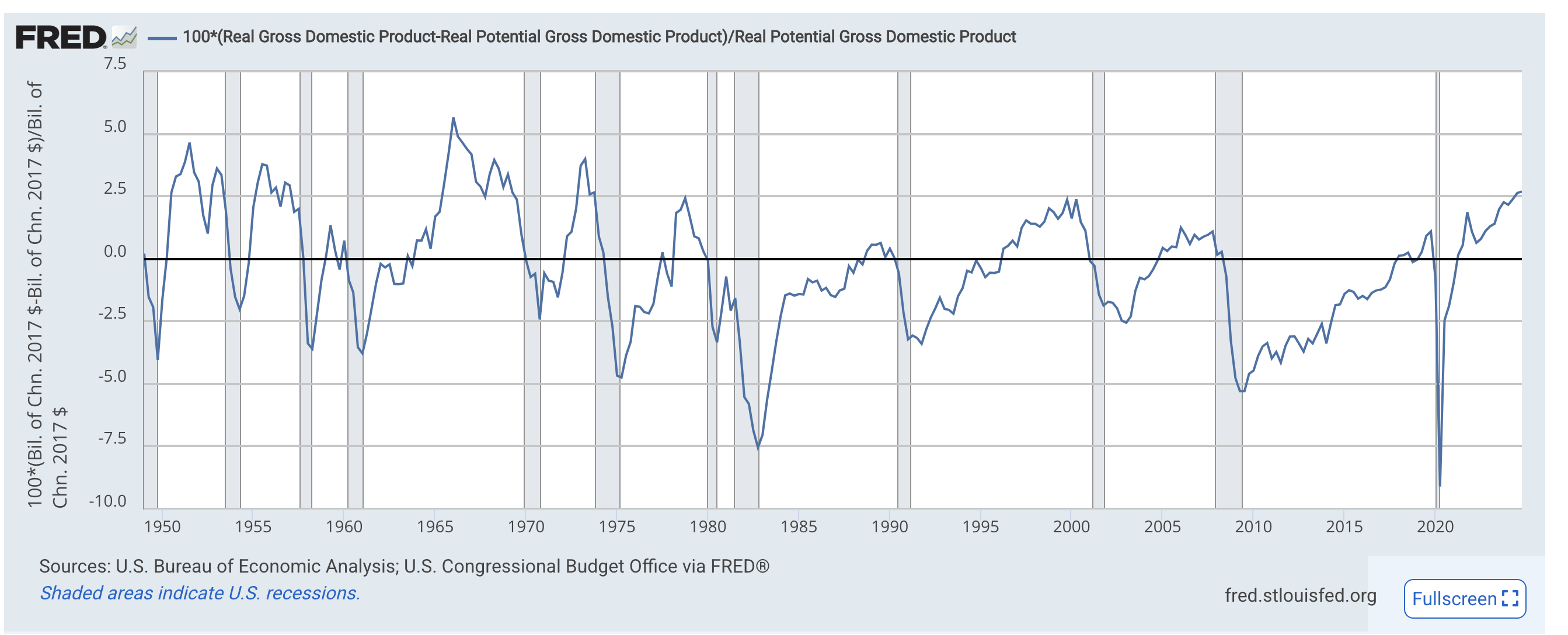
FRED is an amazing tool, but the purpose of this blog today is not to laud FRED, but to highlight two data series that I have followed for several years – Real GDP and Real Potential GDP. Real GDP is self-explanatory, but what is Real Potential GDP? “Real potential GDP is the CBO’s estimate of the output the economy would produce with a high rate of use of its capital and labor resources. The data is adjusted to remove the effects of inflation.” The data series starts in Q1’49 and currently runs to Q4’2034, which forecasts Real GDP to be $27.8 trillion at that time. Real GDP is currently (Q4’24) at $23.5 trillion.

Currently, Real GDP is exceeding what the CBO believes is the Real Potential GDP for our economy by a record amount of $616 billion in $ terms or about 2.5%. If you believe that the CBO’s estimate of potential GDP is close to reality, then it shouldn’t be surprising that inflation remains an issue, despite the marginal improvement disclosed earlier this week (core CPI at 3.1%). As my former colleague and mentor, Charles DuBois has said, “if government spending (or private spending, for that matter) exceeds the economy’s real resources available to absorb that spending, then inflation will likely result.” That’s where we are today, folks.

The growing and fairly consistent fiscal deficit continues to provide stimulus to the private sector (all spending = all income) creating demand for goods and services that exceeds the natural capacity of our economy as measured by the CBO despite the Fed’s aggressive action to temper some of that demand through elevated interest rates, which began in March 2022. While this relationship exists, it makes sense for the Fed to pause its easing of rates, which they seem to have at this time, but we’ll get more insight when they meet next week.

Also reflected in the graph above, previous peaks in Real GDP exceeding the CBO’s Real Potential GDP (’73, ’78, ’89, ’99, ’07) have been followed by economic and market disruptions, some quite significant. What does that portend for today’s market given the current levels?

One of Only Two – Time For Change

By: Russ Kamp, Managing Director, Ryan ALM, Inc.

The United States of America and Denmark share several commonalities. Both countries have democratic political systems. Each country enjoys a high standard of living. Both have a commitment to human rights and environmental concerns, with Denmark being a leader in renewable energy and sustainability, while the U.S. is witnessing a growing movement on those fronts. Both countries value education, enjoying high literacy rates. There is also a shared military alliance through NATO. What you might not realize is that the U.S. and Denmark are the ONLY countries that have a self-imposed statutory debt limit. Sure, there are other countries, such as Switzerland, that have mandatory balanced budget provisions which effectively limit the amount of debt , but they aren’t specified debt limits.

The U.S. first instituted a statutory debt limit with the Second Liberty Bond Act of 1917, setting the aggregate amount of debt that could be accumulated through individual categories like bonds and bills. The purpose in creating this legislation was to finance the country’s involvement in World War 1. The legislation allowed the U.S. to raise $9.5 billion in bonds that would be issued by the U.S. government. These bonds were marketed to the general population and to institutional investors to gain their support for the war. Was there a First Liberty Bond Act? Yes, that act had been passed earlier in 1917 allowing the government to issue $2 billion in bonds in order to support the war.

Importantly, and why we are where we are today with regard to the current deficit, the Second Liberty Bond Act program continued after the war. It set a precedent for public financing of government initiatives through bond sales. Although the debt limit was established in 1917 which allowed the Treasury to issue bonds without specific Congressional approval, the “limit” has been raised more than 100 times since then and roughly 78 times since 1960 alone. As a result, the US debt has risen from around $250 billion during World War II, to about $2.1 trillion during the Reagan years, to $5.6 trillion at the conclusion of the 1990s, and to today’s $36 trillion. So, why do we have a debt limit when it has been elevated so many times previously and to a magnitude certainly not contemplated in 1917?

The political brinkmanship associated with the debt limit debate rarely serves a purpose, often unnecessarily frightening Americans and our capital market participants. As we brace for another “discussion”, is maintaining a debt “limit” at all necessary? NO! Today’s federal deficit is in no way constraining to future generations. I’ve referenced Warren Mosler and his book, “The 7 Deadly Innocent Frauds of Economic Policy” on many occasions. He covers the topic of our government debt and whether we are leaving our debt-burden to our children, grandkids, etc. Mosler states, “the idea of our children being somehow necessarily deprived of real goods and services in the future because of what’s called the national debt is nothing less than ridiculous.”

As Mosler explains, that the financing of deficit spending is of “no consequence”. He further explains that when the “government spends, it just changes numbers up in our bank accounts.” The government doesn’t borrow money, it moves funds from checking accounts at the Fed to savings accounts (Treasury securities) at the Fed. The good news, is that the entire federal deficit ($36 trillion or so) is nothing more than the economy’s total holdings of savings accounts at the Federal Reserve. The private sector now has an asset equivalent to the deficit. How wonderful! Can you imagine if we didn’t have the ability to deficit spend. Think of all the stimulus that would have been removed from our economy that supported jobs, wages, and demand for goods and services.

The major issue with our ability to deficit spend has nothing to do with financing it, but everything to do with providing too much stimulus that creates demand for goods and services that exceeds our economy’s ability to meet such demand. So, I ask again, does having a debt limit (ceiling) make sense? No, unless you enjoy all the grandiose speeches from the halls of Congress based on little knowledge of how our monetary system truly works. Finally, I’d like to give a special nod to Charles DuBois, my former colleague at Invesco, who spent hours educating me on this subject. Thanks, Chuck!

KCS Fireside Chat – 403 (b) Plans: Oldies but Goodies!

KCSThis month’s Fireside Chat was crafted by our partner, Dave Murray, the former plan sponsor for Conrail’s DB and DC plans.  Dave has become a real expert in all things DC.  Dave’s focus this month is on the 403(B) space, and specifically those plan’s dealing with non-profits.  Many of our colleagues, friends and associates volunteer at non-profits, with many holding board or finance positions.  With this great responsibility comes the need to stay on top of legislative changes.  We hope that you find this piece educational.

Youth unemployment’s second derivative effect

Much has been written about the growing unemployment crisis for those under 30 in the US, with <50% of that cohort working a full-time job, but there is a secondary effect that hasn’t gotten much notice.  With the demise of defined benefit plans as the primary source of retirement income, defined contribution plans are rapidly becoming the only retirement game in town.  However, for DC plans to be effective, employees need to fund as much as they can, as early as they can, in order to build a nest egg that will accumulate the necessary assets for a 20-25 year retirement.  With the younger workers not entering the workforce until they are in their late 20s, they are missing out on several years of contributions and compounding.  Unfortunately, managing a DC plan has proven difficult enough for most of us.  We certainly don’t need further impediments exacerbating an already tough situation.