Do the Analysis! Remove the Guess Work.

By: Russ Kamp, CEO, Ryan ALM, Inc.

I am truly blessed working for an organization such as Ryan ALM, Inc. I am awed by the folks that I get to work with and the product/strategy that I get to represent. As a reminder, we’ve created a cash flow matching (CFM) strategy that brings an element of certainty to the management of pensions that should be welcomed by pension plan sponsors and their advisors far and wide. What other strategy can inform you on the day that the portfolio is constructed what the performance of that strategy will be for the full-term of the assignment (barring any defaults within investment grade bonds)? Name another strategy that can lay out the liquidity with certainty for each month (chronologically) of that assignment.

Given that liquidity is becoming a challenge as pension plans (mostly public) adopt a more aggressive asset allocation favoring alternative investments, using a CFM strategy that provides ALL the liquidity to meet ongoing benefits and expenses should be a decision that is easily embraced. Yet, our conversations with key decision makers often stall as other parties get involved in the “review”. To this day, I’m not sure what is involved in most of those conversations.

Are they attempting to determine that a traditional core fixed income strategy benchmarked to a generic index such as the BB Aggregate is capable of producing the same outcome? If so, let me tell you that they can’t and it won’t. Any fixed income product that is not managed against your plan’s specific liabilities will not provide the same benefits as CFM. It will be a highly interest rate sensitive product and performance will be driven by changes in interest rates. Do you know where U.S. rates are headed? Furthermore, the liquidity provided by a “core” fixed income strategy is not likely to be sufficient resulting in other investment products needing to be swept of their liquidity (dividends and capital distributions), reducing the potential returns from those strategies.  Such a cash sweep will reduce the ROA of these non-bond investments. Guinness Global’s study of S&P data for the last 85 years has shown that dividends and reinvestment of dividends account for 50% or more of the S&P returns for rolling 10- and 20-year periods dating back to 1940.

Are they trying to determine if the return produced by the CFM mandate will be sufficient to meet the return on asset assumption (ROA)? Could be, but all they need to realize is that the CFM portfolio’s yield will likely be much higher than the YTM of a core fixed income strategy given CFM’s 100% exposure to corporate bonds versus a heavy allocation to lower yielding Treasuries and agencies in an Agg-type portfolio. In this case, the use of a CFM strategy to replace a core fixed income mandate doesn’t impact the overall asset allocation and it certainly doesn’t reduce the fund’s ability to meet the long-term return of the program.

Instead of trying to incorporate all these unknown variables/inputs into the decision, just have Ryan ALM do the analysis. We love to work on projects that help the plan sponsor and their advisors come to sound decisions based on facts. There is no guess work. Importantly, we will construct for FREE multiple CFM portfolios, if necessary, to help frame the decision. Each plan’s liabilities are unique and as such, each CFM portfolio must be built to meet that plan’s unique liability cash flows.

All that is required for us to complete our analysis are the projected liability cash flows of benefits and expenses (contributions, too) as far into the future as possible. The further into the future, the greater the insights that we will create for you. We can use the current allocation to fixed income as the AUM for the analysis or you can choose a different allocation. We will use 100% IG corporates or you can ask us to use either 100% Treasuries/STRIPS or some combination of Treasuries and corporate bonds. We can defease 100% of the plan’s liabilities for a period of time, such as the next 10-years or do a vertical slice of a % of the liabilities, such as 50%, which will allow the CFM program to extend coverage further into the future and benefit from using longer maturity bonds with greater YTMs. Isn’t that exciting!

So, I ask again, why noodle over a bunch of unknowns, when you could have Ryan ALM provide you with a nearly precise evaluation of the benefits of CFM for your pension plan? When you hire other managers in a variety of asset classes, do they provide you with a portfolio up front? One that can give you the return that will be generated over a specific timeframe? No? Not surprised. Oh, and BTW, we provide our investment management services at a significantly lower fee than traditional core fixed income managers and we cap our annual fee once a certain AUM is reached. Stop the guess work. Have us do the work for you. It will make for a much better conversation when considering using CFM. Call me at 201/675-8797 or email me at rkamp@ryanalm.com for your free analysis. I look forward to speaking with you!

ARPA Updated as of November 28, 2025

By: Russ Kamp, CEO, Ryan ALM, Inc.

We hope that you enjoyed a fabulous Thanksgiving holiday with your family and friends. This update is the last one for November. Wow, that month went by quickly.

Regarding the ARPA legislation, have we entered the last month for new applications to be received by the PBGC? As I’ve mentioned multiple times, the ARPA pension legislation specifically states that initial applications must be submitted to the PBGC by 12/31/25. Revised applications can be submitted through 12/31/26. If this is the case, we have roughly 83 applications yet to be submitted. Compounding this issue is the fact that the PBGC’s e-Filing portal is temporarily closed.

The PBGC’s recorded activity was light last week which shouldn’t surprise anyone given the holiday last week. There were no applications received, denied, or withdrawn. Furthermore, there were no recipients of Special Financial Assistance (SFA) requested to rebate a portion of the grant payment due to census issues. Thankfully, it has been more than two months since we last had a plan pay back a small percentage of the proceeds.

There was some good news, as Exhibition Employees Local 829 Pension Fund, a non-priority group member, received approval of its initial application. The fund will receive $14.2 million in SFA for the 242 plan participants. This pension plan became the 70th non-priority plan to receive SFA and the 145th overall. To-date, $72.8 billion in SFA grants have been awarded!

Despite the near unanimity by market participants that U.S. Treasury yields will fall as the Fed’s FOMC prepares another Fed Funds Rate cut, interest rates are rising today. The current level of Treasury yields and bonds that price off that curve are still providing SFA recipients with attractive rates in which to secure the promised benefits through a cash flow matching (CFM) strategy. Don’t subject the SFA to the whims of the markets, especially given so much uncertainty and currently high valuations.

Buy on the Rumor…

By: Russ Kamp, CEO, Ryan ALM, Inc.

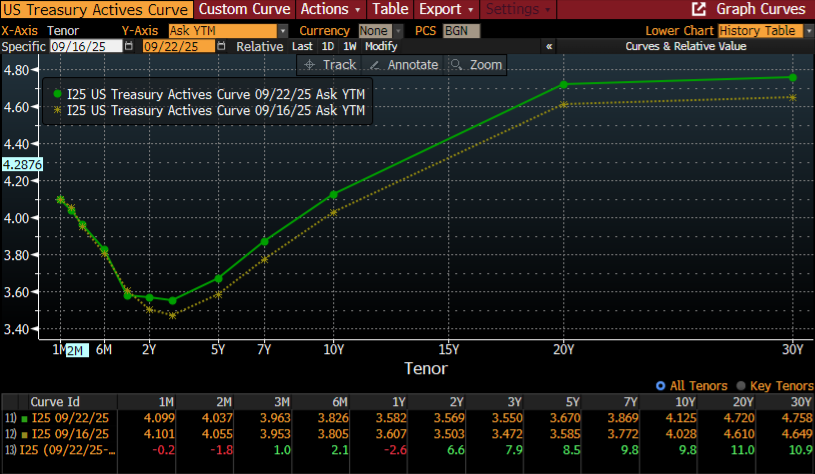
After 44-years in the investment industry I’ve pretty much heard most of the sayings, including the phrase “buy on the rumor and sell on the news”. I suspect that most of you have probably heard those words uttered, too. However, it isn’t always easy to point out an example. Here is graph that might just do the trick.

There had been significant anticipation that the U.S Federal Reserve would cut the Fed Funds Rate and last week that expectation was finally realized with a 0.25% trimming. However, it appears that for some of the investment community that reduction wasn’t what they were expecting. As the graph above highlights, the green line representing Treasury yields as of this morning, have risen nicely in just the last 6 days for most maturities 3 months and out, with the exception of the 1-year note. In fact, the 10- and 30-year bonds have seen yields rise roughly 10 bps. Now, we’ve seen more significant moves on a daily basis in the last couple of years, but the timing is what has me thinking.

There are still many who believe that this cut is the first of several between now and the end of 2025. However, there is also some trepidation on the part of some in the bond world given the recent rise in inflation after a prolonged period of decline. As a reminder, the Fed does have a dual mandate focused on both employment and inflation, and although the U.S. labor force has shown signs of weakening, is that weakness creating concerns that dwarf the potential negative impact from rising prices? As stated above, there may also have been some that anticipated the Fed surprising the markets by slicing rates by 0.50% instead of the 0.25% announced.

In any case, the interest rate path is not straight and with curves one’s vision can become obstructed. What we might just see is a steepening of the Treasury yield curve with longer dated maturities maintaining current levels, if not rising, while the Fed does their thing with short-term rates. That steepening in the curve is beneficial for cash flow matching assignments that can span 10- or more years, as the longer the maturity and the higher the yield, the greater the cost reduction to defease future liabilities. Please don’t let this attractive yield environment come and go before securing some of the pension promises.

I’m Concerned! Are You?

By: Russ Kamp, CEO, Ryan ALM, Inc.

I’ve been concerned about the U.S. retirement industry for many years, with a particular focus on traditional pensions. The demise of DB pensions is a major social and economic issue for a significant majority of American workers, who fear that their golden years will be greatly tarnished without the support of a traditional DB pension plan coupled with their inability to fund a supplemental retirement vehicle, such as a defined contribution plan.

I recently had hope that the rising U.S. interest rate environment would bring about a sea change in the use of DB pensions, but I haven’t seen the tidal wave yet. That said, the higher rate environment did (could still) provide plan sponsors with the ability to take some risk off the table, but outside of private pensions, I’ve witnessed little movement away from a traditional asset allocation framework. You see, the higher rate environment reduces the present value cost of those future benefit payments improving both the funded ratio and funded status of DB pensions, while possibly reducing ongoing contributions. Securing those benefits, even for just 10-years dramatically reduces risk.

But, again, I’ve witnessed too few plans engaging in alternative asset allocation strategies. That’s not the same as engaging in alternative strategies, which unfortunately continues to be all the rage despite the significant flows into these products, which will likely diminish future returns, and the lack of distributions from them, too. An alternative asset allocation strategy that Ryan ALM supports and recommends is the bifurcation of assets into two buckets – liquidity and growth – as opposed to having all of the plan’s assets focused on the return on asset (ROA) assumption.

By dividing the assets into two buckets, one can achieve multiple goals simultaneously. The liquidity bucket, constituting investment grade bonds, will be used to defease the liability cash flows of benefits and expenses, while the growth or alpha assets can grow unencumbered with the goal of being used to defease future liabilities (current active lives). One of the most important investment tenets is time. As mentioned above, defeasing pension liabilities for even 10-years dramatically enhances the probability of the alpha assets achieving the desired outcome.

So why am I concerned? The lack of risk mitigation is of great concern. I’m tired of watching pensions ride the rollercoaster of returns up and down until something breaks, which usually means contributions go up and benefits go down! Given the great uncertainty related to both the economy and the labor force, why would anyone embrace the status quo resulting in many sleepless nights? Do something, and not just for the sake of doing something. Really do something! Embrace the asset allocation framework that we espouse. Migrate your current core bond allocation to a defeased bond allocation known as cash flow matching (CFM) to bring an element of certainty to the management of your plan.

Listen, if rates fall as a result of a deteriorating labor force and economy, the present value of pension liabilities will rise. Given that scenario, it is highly likely that asset prices will fall, too. That is a lethal combination, and not unique given how many times I’ve seen that play out during my 44-year career. Reach out to us if you aren’t sure how to start the process. We’d be pleased to take you through a series of scenarios so that you can determine what is possible. Perhaps you’ll sleep like a baby after we talk.

When Should I Use CFM?

By: Russ Kamp, CEO, Ryan ALM, Inc.

Good morning. I’m currently in Chicago in the midst of several meetings. Yesterday’s meetings were outstanding. As you’d expect, the conversations were centered on DB pension plans and the opportunity to de-risk through a Cash Flow Matching strategy (CFM) in today’s economic environment. The line of questioning that I received from each of my meeting hosts was great. However, there does seem to be a misconception on when and how to use CFM as a de-risking tool. Most believe that you engage CFM for only the front-end of the yield curve, while others think that CFM is only useful when a plan is at or near full funding. Yes, both of those implementations are useful, but that represents a small sampling of when and how to implement CFM. For instance:

As a plan sponsor you need to make sure that you have the liquidity necessary to meet you monthly benefits (and expenses). Do you have a liquidity policy established that clearly defines the source(s) of liquidity or are you scurrying around each month sweeping dividends, interest, and if lucky, capital distributions from your alternative portfolio? Unfortunately, most plan sponsors do not have a formal liquidity policy as part of their Investment Policy Statement (IPS). CFM ensures that the necessary liquidity is available every month of the assignment. There is not forced selling!

Do you currently have a core fixed income allocation? According to a P&I asset allocation survey, public pension plans have an average 18.9% in public fixed income. How are you managing that interest rate risk, which remains the greatest risk for an actively managed fixed income portfolio? As an industry, we enjoyed the benefits of a nearly four decades decline in U.S. interest rates beginning in 1982. However, the prior 28-years witnessed rising rates. Who knows if the current rise in rates is a blip or the start of another extended upward trend? CFM defeases future benefit payments which are not interest rate sensitive. A $2,000 payment next month or 10-years from now is $2,000 whether rates rise or fall. As a result, CFM mitigates interest rate risk.

As you have sought potentially greater returns from a move into alternatives and private investments, not only has the available liquidity dried up, but you need a longer time horizon for those investments to mature and produce the expected outcome. Have you created a bridge within your plan’s asset allocation that will mitigate normal market gyrations? A 10-year CFM allocation will not only provide your plan with the necessary monthly liquidity, but it is essentially a bridge over volatile periods as it is the sole source of liquidity allowing the “alpha” assets to just grow and grow. That 10-year program coincides nicely with many of the lock-ins for alternative strategies.

There has been improvement in the funded status of public pension plans. According to Milliman, as of June 30, 2025, the average funded ratio for the constituents in their top 100 public pension index is now 82.9%, which is the highest level since December 2021. That’s terrific to see. Don’t you want to preserve that level of funding and the contribution expenses that coincide with that level? Riding the rollercoaster of performance can’t be comforting. Given what appears to be excessive valuations within equity markets and great uncertainty as it relates to the economic environment, are you willing to let your current exposures just ride? By allocating to a CFM program, you stabilize a portion of your plan’s funded status and the contributions associated with those Retired Lives Liability. Bringing a level of certainty to a very uncertain process should be a desirable goal for all plan sponsors and their advisors.

If I engage a CFM mandate, don’t I negatively impact my plan’s ability to meet the return objective (ROA) that we have established? NO! The Ryan ALM CFM portfolio will be heavily skewed to investment-grade corporate bonds (most portfolios are 100% corporates) that enjoy a significant premium yield relative to Treasuries and agencies. As mentioned previously, public pension plans already have an exposure to fixed income. That exposure is already included in the ROA calculation. By substituting a higher yielding CFM portfolio for a lower yielding core fixed income program benchmarked to the Aggregate index, you are enhancing the plan’s ability to achieve the ROA while also eliminating interest rate risk. A win-win in my book!

So, given these facts, how much should I allocate to a CFM mandate? The answer is predicated on many factors, including the plan’s current funded status, the ability to contribute, whether or not the plan is in a negative cash flow situation, the Board’s risk appetite, the current ROA, and others. Given that all pension systems’ liabilities are unique, there is no one correct answer. At Ryan ALM, we are happy to provide a detailed analysis on what could be done and at what cost to the plan. We do this analysis for free. When can we do yours?

Problem/Solution: Generic Indexes

By: Ronald J. Ryan, CFA, Chairman, Ryan ALM, Inc.

We challenge you to find Pension Liabilities in any Generic Bond Index. We’re confident that you won’t. As a result, we’ve developed an appropriate solution, which we call the Custom Liability Index (CLI).

Pension liabilities (benefits and expenses (B+E)) are unique to each plan sponsor… different workforces, different longevity characteristics, different salaries, benefits, expenses, contributions, inflation assumptions, plan amendments, etc. To capture and calculate the true liability objective, the Ryan team created the first CLI in 1991 as the proper pension benchmark for asset liability management (ALM). We take the actuarial projections of (B+E) for each client and then subtract forecasted Contributions since contributions are the initial source to fund B+E. This net total becomes the true liability cash flows that assets have to fund. We then calculate the monthly liability cash flows as (B+E) – C. The CLI is a monthly report that includes the calculations of:

  • Net future values broken out by term structure
  • Net present values broken out by term structure
  • Total returns broken out by term structure
  • Summary statistics (yield, duration, etc.)
  • Interest rate sensitivity 

We recommend that the Ryan ALM CLI be installed as the index benchmark for total assets, as well as any bond program dedicated to matching assets and liabilities. This action should be the first step in asset allocation. The CLI can be broken out into any time segment that bond assets are directed to fund (i.e. 1-3 years, 1-10 years, etc.). Moreover, total assets should be compared versus total liabilities to know if the funded ratio and funded status have improved over time. If all asset managers outperform their generic index benchmarks but lose to liability growth rate the pension plan loses and must pay a higher contribution.   

Since the CLI is a monthly report, plan sponsors can compare assets versus liabilities monthly. Furthermore, we suggest that there should never be an investment update of just assets versus assets (generic index benchmarks), which unfortunately is common practice today. It is hard to understand in today’s sophisticated finance world why liabilities are missing as a pension index. It should be clear that no generic bond index could ever properly represent the liability cash flows that assets are required to fund. It is apples versus oranges, at a minimum. 

“Given the wrong index benchmark… you will get the wrong risk/reward”

For more info on the Ryan ALM CLI please contact Russ Kamp, CEO at  rkamp@ryanalm.com

Ryan ALM: Problem/Solution

By: Ronald J. Ryan, CFA, Chairman, Ryan ALM, Inc.

Problem:  Pension Liabilities… MIA

Solution:  Cash Flow Matching (CFM)

The true objective of a pension is to secure and fully fund benefits (and expenses) in a cost-efficient manner with prudent risk. Although funding liabilities (benefits and expenses (B+E)) is the pension objective, it is hard to find liabilities in anything that pertains to pension assets. Asset allocation is more focused on achieving a ROA (return on assets target return), and performance measurement compares assets versus assets, as the asset index benchmarks are void of any liability growth calculations. If you outperform your index benchmark does that mean asset growth exceeded liability growth? Perhaps NOT.

Pension liabilities behave like bonds since their discount rate is most similar to a zero-coupon bond yield curve (especially ASC 715 discount rates which are a AA corporate yield curve). Yes, public and multiemployer pension plans use the ROA as the discount rate to price their liabilities but even then it is not shown in any performance measurement reports. In fact, what shows up in the CAFR annual report is the GASB requirement of an interest rate sensitivity test by moving the discount rate up and down 100 basis points to determine the volatility of the present value of liabilities and the funded ratio. But a total return or growth rate comparison of assets versus liabilities seems to be MIA.

Ryan ALM solves this problem through our asset liability management (ALM) suite of synergistic products:

  1. Custom Liability Index (CLI) – The management of assets should actually start with liabilities. In reality, assets need to fund NET liabilities defined as (benefits + expenses) – contributions. Contributions are the first source to fund B+E. Assets must fund the net or residual. This is never calculated so assets start with little or no knowledge of what there job really is. Moreover, B+E are monthly payments, which are also not calculated, as the actuary provides an annual update. The CLI performs all of these calculations including total return and interest rate sensitivity as monthly reports.
  1. ASC 715 Discount Rates – Ryan ALM is one of very few vendors who provide ASC 715 discount rates, and we’ve done so since FAS 158 was enacted (2006). We provide a zero-coupon yield curve of AA corporate bonds as a monthly excel file for our subscribers including a Big Four accounting firm and several actuarial firms.
  1. Liability Beta Portfolio™ (LBP) – The LBP is the proprietary cash flow matching model of Ryan ALM. The LBP is a portfolio of investment grade bonds whose cash flows match and fully fund the monthly liability cash flows of B+E. Our LBP has many benefits including reducing funding costs by about 2% per year (20% for 1-10 year liabilities). The intrinsic value of bonds is the certainty of their cash flows. That is why bonds have always been chosen as the assets for cash flow matching or dedication since the 1970s. We believe that bonds are not performance or growth assets but liquidity assets. By installing a LBP, pensions can remove a cash sweep from the growth assets, which negatively impact their growth rates. We urge pension plan sponsors to use bonds for their cash flow value and transfer the bond allocation from a total return focus to a liquidity allocation. Moreover, the Ryan ALM LBP product is skewed to A/BBB+ corporate bonds which should outyield the traditional bond manager who is usually managing versus an index which is heavily skewed to Treasuries and higher rated securities that are much lower in yield. The LBP should enhance the probability of achieving the ROA by the extra yield advantage (usually 75 to 100 basis points). The LBP should also reduce the volatility of the funded ratio and contributions. In fact, it should help reduce contribution cost by the extra yield enhancement. 

For more info on the Ryan ALM product line, please contact Russ Kamp at  rkamp@ryanalm.com.

The Power of Bond Math

By: Ronald J. Ryan, CFA, Chairman, Ryan ALM, Inc.

Bonds are the only asset class with the certainty of its cash flows. That is why bonds have always been used to cash flow match and defease liabilities. Given this certainty, bonds provide a secure way to reduce the cost to fund liabilities. This benefit is not as transparent or valued as one might think. If you could save 20% to 50% on almost anything, most people would jump at the opportunity? But when it comes to pre-funding pension liabilities there seems to be a hesitation to capture this prudent benefit.

Bond math tells us that the higher the yield and the longer the maturity… the lower the cost. Usually there is a positive sloping yield curve such that when you extend maturity you pick up yield. What may not be evident is the fact that extending maturity is the best way to reduce costs even if yields were not increased. Here are examples of what it would cost to fund a $100,000 liability payment with a bond(s) whose maturity matches the liability payment date:

Cost savings is measured as the difference between Cost and the liability payment of $100k. As you can see, extending maturity produces a much greater cost reduction than an increase in yield. More importantly, the cost reduction is significant no matter what maturity you invest at, even if yields are unchanged. The cost savings range from 21.9% (5-years) to 38.1% (10-years) and 62.8% (20-years) with rates unchanged. Why wouldn’t a pension want to reduce funding costs by 21.9% to 62.8% with certainty instead of using bonds for a volatile and uncertain total return objective? Given the large asset bases in many pensions, such a funding cost reduction should be a primary budget consideration.

Ryan ALM is a leader in Cash Flow Matching (CFM) through our proprietary Liability Beta Portfolio™ (LBP) model. We believe that the intrinsic value in bonds is the certainty of their cash flows. We urge pensions to transfer their fixed income allocation from a total return objective versus a generic market index (whose cash flows look nothing like the clients’ liability cash flows) to a CFM strategy. The benefits are numerous:

Secures benefits for time horizon LBP is funding (1-10 years)

Buys time for alpha assets to grow unencumbered 

Reduces Funding costs (roughly 2% per year)

Reduces Volatility of Funded Ratio/Status

Reduces Volatility of Contribution costs

Outyields active bond management

Mitigates Interest Rate Risk 

Low fee = 15 bps

For more info on our Cash Flow Matching model (LBP) or a free analysis to highlight what CFM can do for your plan, please contact Russ Kamp, CEO at rkamp@ryanalm.com

ARPA Update as of May 9, 2025

By: Russ Kamp, CEO, Ryan ALM, Inc.

Happy belated Mother’s Day to all the Moms. We hope that you had a special day.

Pleased to report that the PBGC had a very productive week ending last Friday. There were several actions taken including the filing of three initial applications from the waitlist. Alaska United Food and Commercial Workers Pension Fund, Local 73 Retirement Plan, and Local 807 Labor-Management Pension Fund are hoping to secure nearly $300 million for just over 10k plan participants. With these filings, the PBGC currently has 29 applications under review. As a result, their eFiling portal is temporarily closed. As per the legislation, they must act on an application within 120 days. The United Food and Commercial Workers Unions and Employers Pension Plan application reaches that milestone on May 17th. As a reminder, they are seeking $54 million in SFA for there more than 15k members. The PBGC will have its hands full during the next month, as 10 pension plans have applications hitting their 120-day window during June.

In other ARPA news, there were no applications approved, denied, or withdrawn during the past week. However, there was one more fund that repaid a portion of the SFA grant received due to census errors. Local Union No. 863 I.B. of T. Pension Plan repaid $3.2 million in SFA or about 1% of the grant received. To date, 55 plans have reported on potential census errors prior to the PBGC having access to the Social Security Master Death File. Of those 55, 51 have repaid a portion of the proceeds received totaling $214.8 million or 0.44% of the $48.4 billion in SFA received by those funds.

Lastly, there was one more plan added to the waitlist. Greenville Plumbers and Pipefitters Pension Fund becomes the 119th pension fund to seek SFA without being a priority group member. As reflected below, there are 38 pension funds from the waitlist that have yet to file an application with the PBGC.

Recent activity within the U.S. Treasury market have pushed long-term rates up. As of this morning, the 30-year Treasury Bond yield is at 4.89%, while the 10-year Treasury Note’s yield is at 4.48%. Both are quite attractive for a plan looking to secure the promised benefits through the SFA grant.

Opportunity Cost Goes Both Ways

By: Russ Kamp, CEO, Ryan ALM, Inc.

I had an interesting conversation at the IFEBP Investment forum. It wasn’t the first time that this topic has been raised and I am willing to state that it won’t be the last. I was discussing the benefits of cash flow matching (CFM) with a trustee who raised concern about locking in the asset / liability match, suggesting that by defeasing a period longer than 3-5-years may lead to “regret” if there had been an opportunity to generate a greater return from those assets used to defease a portion of the liabilities.

Anytime an asset allocation decision is taken, there is always the possibility that some combination of asset classes and products would have produced a greater return in the short-term. However, opportunity cost can easily be opportunity lost. When one engages in a CFM strategy, one does so because they understand that the primary objective in managing a DB pension is to SECURE the promised benefits at a reasonable cost and with prudent risk. Managing a pension fund is not a return game despite the prevailing orthodoxy in our industry.

Why would one not want to secure a portion of the asset base providing the necessary liquidity to meet benefits and expenses? It is so comforting, or it should be, not to have to worry about raising liquidity in challenging markets. At the same time, the CFM strategy is buying time for the alpha (risk) assets to grow unencumbered. We normally suggest that a 10-year CFM be implemented, but that decision is predicated on a number of factors specific to that plan. We can, and have, engaged in assignments shorter than 10-years, and CFM provides the same benefits, even if the cost savings may be less than that provided by a longer assignment.

Furthermore, there is always the question of maintaining the maturity of the assignment (5-, 7-, 10- or more years) once the program is up and running. Plan sponsors must decide if the assignment should be allowed to run out after the initial allocation, be maintained at the same maturity, or extended given improved funding. If markets don’t behave there is no obligation to extend the program. If markets get crushed and the sponsor feels that liquidating the CFM portfolio assets could be used to buy “low” that is available given the liquidity profile of investment grade bonds. We don’t understand why one would want to do that since the matching of assets and liabilities creates certainty, which is missing in traditional pension management.

DB pension plans are critical to the long-term financial security of the participants. Securing the promised benefits reduces the possibility that adverse outcomes don’t result in the fund having to take dramatic action such as additional tiers or worse, the freezing of the plan. CFM stabilizes both the funded status for that portion of the fund and contributions. I would think that getting as much into CFM and reducing the uncertainty of managing the plan given our volatile markets should be an unquestionable goal.