Ryan ALM: Problem/Solution

By: Ronald J. Ryan, CFA, Chairman, Ryan ALM, Inc.

Problem:  Pension Liabilities… MIA

Solution:  Cash Flow Matching (CFM)

The true objective of a pension is to secure and fully fund benefits (and expenses) in a cost-efficient manner with prudent risk. Although funding liabilities (benefits and expenses (B+E)) is the pension objective, it is hard to find liabilities in anything that pertains to pension assets. Asset allocation is more focused on achieving a ROA (return on assets target return), and performance measurement compares assets versus assets, as the asset index benchmarks are void of any liability growth calculations. If you outperform your index benchmark does that mean asset growth exceeded liability growth? Perhaps NOT.

Pension liabilities behave like bonds since their discount rate is most similar to a zero-coupon bond yield curve (especially ASC 715 discount rates which are a AA corporate yield curve). Yes, public and multiemployer pension plans use the ROA as the discount rate to price their liabilities but even then it is not shown in any performance measurement reports. In fact, what shows up in the CAFR annual report is the GASB requirement of an interest rate sensitivity test by moving the discount rate up and down 100 basis points to determine the volatility of the present value of liabilities and the funded ratio. But a total return or growth rate comparison of assets versus liabilities seems to be MIA.

Ryan ALM solves this problem through our asset liability management (ALM) suite of synergistic products:

  1. Custom Liability Index (CLI) – The management of assets should actually start with liabilities. In reality, assets need to fund NET liabilities defined as (benefits + expenses) – contributions. Contributions are the first source to fund B+E. Assets must fund the net or residual. This is never calculated so assets start with little or no knowledge of what there job really is. Moreover, B+E are monthly payments, which are also not calculated, as the actuary provides an annual update. The CLI performs all of these calculations including total return and interest rate sensitivity as monthly reports.
  1. ASC 715 Discount Rates – Ryan ALM is one of very few vendors who provide ASC 715 discount rates, and we’ve done so since FAS 158 was enacted (2006). We provide a zero-coupon yield curve of AA corporate bonds as a monthly excel file for our subscribers including a Big Four accounting firm and several actuarial firms.
  1. Liability Beta Portfolio™ (LBP) – The LBP is the proprietary cash flow matching model of Ryan ALM. The LBP is a portfolio of investment grade bonds whose cash flows match and fully fund the monthly liability cash flows of B+E. Our LBP has many benefits including reducing funding costs by about 2% per year (20% for 1-10 year liabilities). The intrinsic value of bonds is the certainty of their cash flows. That is why bonds have always been chosen as the assets for cash flow matching or dedication since the 1970s. We believe that bonds are not performance or growth assets but liquidity assets. By installing a LBP, pensions can remove a cash sweep from the growth assets, which negatively impact their growth rates. We urge pension plan sponsors to use bonds for their cash flow value and transfer the bond allocation from a total return focus to a liquidity allocation. Moreover, the Ryan ALM LBP product is skewed to A/BBB+ corporate bonds which should outyield the traditional bond manager who is usually managing versus an index which is heavily skewed to Treasuries and higher rated securities that are much lower in yield. The LBP should enhance the probability of achieving the ROA by the extra yield advantage (usually 75 to 100 basis points). The LBP should also reduce the volatility of the funded ratio and contributions. In fact, it should help reduce contribution cost by the extra yield enhancement. 

For more info on the Ryan ALM product line, please contact Russ Kamp at  rkamp@ryanalm.com.

The Power of Bond Math

By: Ronald J. Ryan, CFA, Chairman, Ryan ALM, Inc.

Bonds are the only asset class with the certainty of its cash flows. That is why bonds have always been used to cash flow match and defease liabilities. Given this certainty, bonds provide a secure way to reduce the cost to fund liabilities. This benefit is not as transparent or valued as one might think. If you could save 20% to 50% on almost anything, most people would jump at the opportunity? But when it comes to pre-funding pension liabilities there seems to be a hesitation to capture this prudent benefit.

Bond math tells us that the higher the yield and the longer the maturity… the lower the cost. Usually there is a positive sloping yield curve such that when you extend maturity you pick up yield. What may not be evident is the fact that extending maturity is the best way to reduce costs even if yields were not increased. Here are examples of what it would cost to fund a $100,000 liability payment with a bond(s) whose maturity matches the liability payment date:

Cost savings is measured as the difference between Cost and the liability payment of $100k. As you can see, extending maturity produces a much greater cost reduction than an increase in yield. More importantly, the cost reduction is significant no matter what maturity you invest at, even if yields are unchanged. The cost savings range from 21.9% (5-years) to 38.1% (10-years) and 62.8% (20-years) with rates unchanged. Why wouldn’t a pension want to reduce funding costs by 21.9% to 62.8% with certainty instead of using bonds for a volatile and uncertain total return objective? Given the large asset bases in many pensions, such a funding cost reduction should be a primary budget consideration.

Ryan ALM is a leader in Cash Flow Matching (CFM) through our proprietary Liability Beta Portfolio™ (LBP) model. We believe that the intrinsic value in bonds is the certainty of their cash flows. We urge pensions to transfer their fixed income allocation from a total return objective versus a generic market index (whose cash flows look nothing like the clients’ liability cash flows) to a CFM strategy. The benefits are numerous:

Secures benefits for time horizon LBP is funding (1-10 years)

Buys time for alpha assets to grow unencumbered 

Reduces Funding costs (roughly 2% per year)

Reduces Volatility of Funded Ratio/Status

Reduces Volatility of Contribution costs

Outyields active bond management

Mitigates Interest Rate Risk 

Low fee = 15 bps

For more info on our Cash Flow Matching model (LBP) or a free analysis to highlight what CFM can do for your plan, please contact Russ Kamp, CEO at rkamp@ryanalm.com

ARPA Update as of May 9, 2025

By: Russ Kamp, CEO, Ryan ALM, Inc.

Happy belated Mother’s Day to all the Moms. We hope that you had a special day.

Pleased to report that the PBGC had a very productive week ending last Friday. There were several actions taken including the filing of three initial applications from the waitlist. Alaska United Food and Commercial Workers Pension Fund, Local 73 Retirement Plan, and Local 807 Labor-Management Pension Fund are hoping to secure nearly $300 million for just over 10k plan participants. With these filings, the PBGC currently has 29 applications under review. As a result, their eFiling portal is temporarily closed. As per the legislation, they must act on an application within 120 days. The United Food and Commercial Workers Unions and Employers Pension Plan application reaches that milestone on May 17th. As a reminder, they are seeking $54 million in SFA for there more than 15k members. The PBGC will have its hands full during the next month, as 10 pension plans have applications hitting their 120-day window during June.

In other ARPA news, there were no applications approved, denied, or withdrawn during the past week. However, there was one more fund that repaid a portion of the SFA grant received due to census errors. Local Union No. 863 I.B. of T. Pension Plan repaid $3.2 million in SFA or about 1% of the grant received. To date, 55 plans have reported on potential census errors prior to the PBGC having access to the Social Security Master Death File. Of those 55, 51 have repaid a portion of the proceeds received totaling $214.8 million or 0.44% of the $48.4 billion in SFA received by those funds.

Lastly, there was one more plan added to the waitlist. Greenville Plumbers and Pipefitters Pension Fund becomes the 119th pension fund to seek SFA without being a priority group member. As reflected below, there are 38 pension funds from the waitlist that have yet to file an application with the PBGC.

Recent activity within the U.S. Treasury market have pushed long-term rates up. As of this morning, the 30-year Treasury Bond yield is at 4.89%, while the 10-year Treasury Note’s yield is at 4.48%. Both are quite attractive for a plan looking to secure the promised benefits through the SFA grant.

Opportunity Cost Goes Both Ways

By: Russ Kamp, CEO, Ryan ALM, Inc.

I had an interesting conversation at the IFEBP Investment forum. It wasn’t the first time that this topic has been raised and I am willing to state that it won’t be the last. I was discussing the benefits of cash flow matching (CFM) with a trustee who raised concern about locking in the asset / liability match, suggesting that by defeasing a period longer than 3-5-years may lead to “regret” if there had been an opportunity to generate a greater return from those assets used to defease a portion of the liabilities.

Anytime an asset allocation decision is taken, there is always the possibility that some combination of asset classes and products would have produced a greater return in the short-term. However, opportunity cost can easily be opportunity lost. When one engages in a CFM strategy, one does so because they understand that the primary objective in managing a DB pension is to SECURE the promised benefits at a reasonable cost and with prudent risk. Managing a pension fund is not a return game despite the prevailing orthodoxy in our industry.

Why would one not want to secure a portion of the asset base providing the necessary liquidity to meet benefits and expenses? It is so comforting, or it should be, not to have to worry about raising liquidity in challenging markets. At the same time, the CFM strategy is buying time for the alpha (risk) assets to grow unencumbered. We normally suggest that a 10-year CFM be implemented, but that decision is predicated on a number of factors specific to that plan. We can, and have, engaged in assignments shorter than 10-years, and CFM provides the same benefits, even if the cost savings may be less than that provided by a longer assignment.

Furthermore, there is always the question of maintaining the maturity of the assignment (5-, 7-, 10- or more years) once the program is up and running. Plan sponsors must decide if the assignment should be allowed to run out after the initial allocation, be maintained at the same maturity, or extended given improved funding. If markets don’t behave there is no obligation to extend the program. If markets get crushed and the sponsor feels that liquidating the CFM portfolio assets could be used to buy “low” that is available given the liquidity profile of investment grade bonds. We don’t understand why one would want to do that since the matching of assets and liabilities creates certainty, which is missing in traditional pension management.

DB pension plans are critical to the long-term financial security of the participants. Securing the promised benefits reduces the possibility that adverse outcomes don’t result in the fund having to take dramatic action such as additional tiers or worse, the freezing of the plan. CFM stabilizes both the funded status for that portion of the fund and contributions. I would think that getting as much into CFM and reducing the uncertainty of managing the plan given our volatile markets should be an unquestionable goal.

Hey, Pension Community – We Have Liftoff!

By: Russ Kamp, CEO, Ryan ALM, Inc.

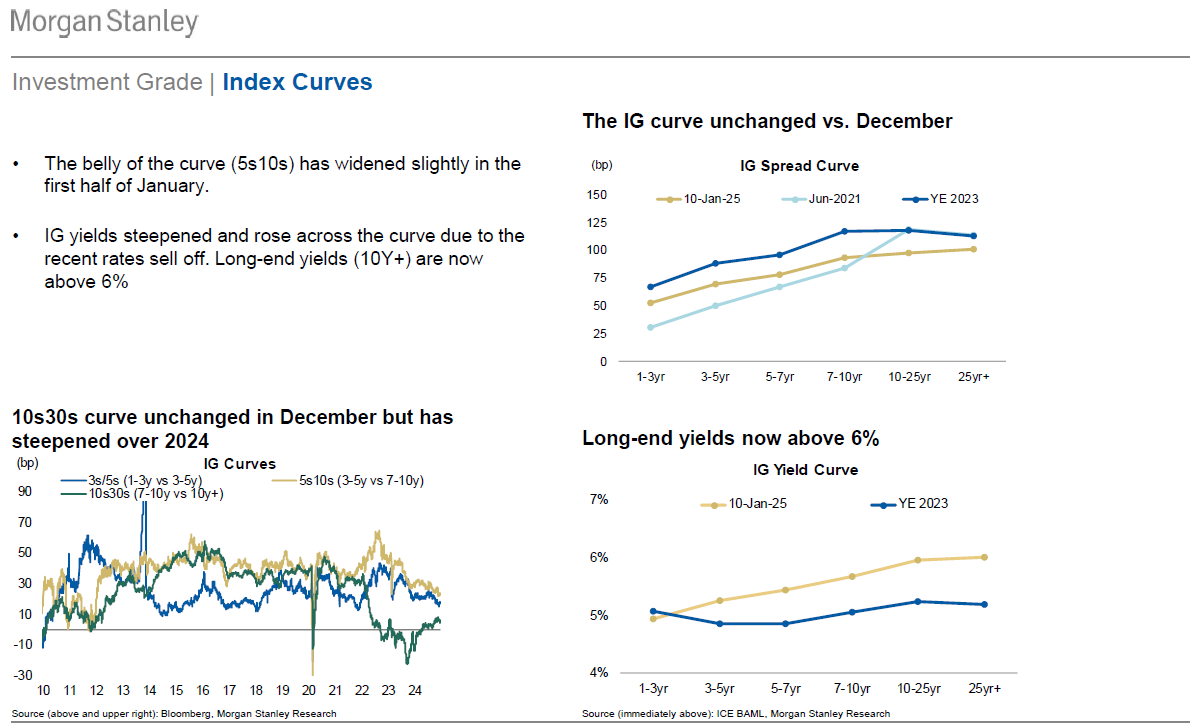
Not since October of 2023 have we seen long-dated Treasury yields at these levels. Currently, the 30-year Treasury bond yield is 5% (12:47 pm EST) and the 10-year Treasury Note’s yield has eclipsed 4.8%. Despite tight credit spreads, long-dated (25+ years) IG corporate bond yields are above 6% today (chart in the lower right corner).

Securing pension liabilities, whether your DB plan is private, public, or a multiemployer plan, should be the primary objective. All the better if that securing (defeasement strategy) can be accomplished at a reasonable cost and with prudent risk. The good news: the current rate environment is providing plan sponsors with a wonderful opportunity to accomplish all of those goals, whether you engage in a cash flow matching (CFM) for a relatively short period (5-years), intermediate, (10ish-years) or longer-term (15- or more years) your portfolio of IG corporate bonds will produce a YTM of > 5.5%. This represents a significant percentage of the target ROA.

Furthermore, as we’ve explained, pension liabilities are future values (FVs), and FVs are not interest rate sensitive. Your portfolio will lock in the cost savings on day one, and barring any defaults (about 2/1,000 in IG bonds), the YTM is what your portfolio will earn throughout the relationship. That is exciting given the fact that traditional fixed income core mandates bleed performance during rising rate regimes. In fact, the IG index is already off 1.2% YTD (<10 trading days).

Who knows when the high equity valuations will finally lead to a repricing. Furthermore, who knows if US inflation will continue to be sticky, the Fed will raise or lower rates, geopolitical risks will escalate, and on and on. With CFM one doesn’t need a crystal ball. You can SECURE the promised benefits for a portion of your portfolio and in the process you’d be stabilizing the funded status and contribution expenses associated with those assets. Don’t let this incredibly attractive rate environment come and go without doing anything. We saw inertia keep plans from issuing POBs when rates were historically low. It is time to act.

ARPA Update as of January 10, 2025

By: Russ Kamp, CEO, Ryan ALM, Inc.

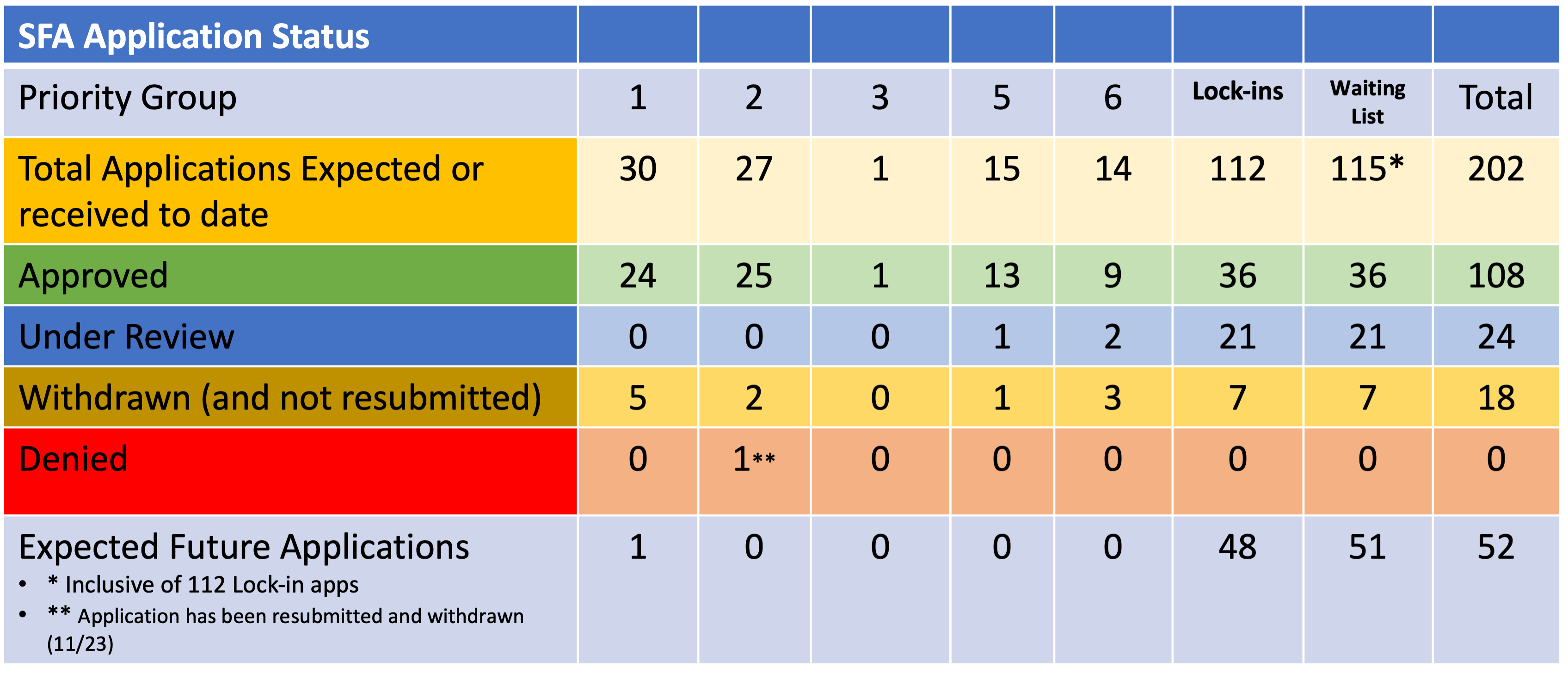
Welcome to the second full week of January. Although the PBGC’s efiling portal remains temporarily closed, there was still some good activity last week, including the approval of another three applications seeking Special Financial Assistance (SFA). Pleased to report that Laborers’ Local No. 265 Pension Plan, Local 734 Pension Plan, and Upstate New York Engineers Pension Fund each a non-priority group member received approval for their revised applications. In total, they will receive $244.6 million in SFA for the 11,374 plan participants. What an exciting way to begin 2025.

In other news, there was one application withdrawn, Warehouse Employees Union Local 169 and Employers Joint Pension Plan, from Elkins Park, PA, withdrew its initial application seeking nearly $90 million in SFA for just over 3,600 members of the plan.

The 108 funds receiving SFA to date have been awarded grants exceeding $70 billion benefiting the quality of life for more than 1.4 million American workers. There is still much more to do (possibly another 94 funds will get SFA), but the program has already been an incredible success. Finally, US Treasury yields continue to rise, providing pension plans with the wonderful opportunity to further de-risk the SFA assets received and those to come. IG corporate bond yields exceeding 6% are not rare. Let us know how we can help you.

5.6% 10-year forecast for US All-Cap

By: Russ Kamp, Managing Director, Ryan ALM, Inc.

Fiducient Advisors has published its 2025 Outlook. Given the strong performance in US equity markets, future returns have been adjusted downward – rightfully so. Here are some of the highlights:

Full valuations, concentrated U.S. large-cap indexes and the risk of reigniting inflation are shaping the key themes we believe will drive markets and portfolio positioning in 2025.

-Recent market successes have pushed our 2025 10-year forecasts lower across most major asset classes. Long-term return premium for equities over fixed income is now at its narrowest since 2007, sparking important conversations about portfolio posture and risk allocation.

Rising reinflation risk leads us to increase our allocation to more flexible fixed income strategies (dynamic bonds) and TIPS while eliminating our global bond allocation.

US stock market performance has been heavily influenced by the “Magnificent Seven”, creating concentration risk not seen in decades, if ever. The outperformance of US markets vis-a-vis international markets is unprecedented. As stated above, valuations are stretched. Most metrics used to measure “value” in our markets are at extreme levels, if not historical. How much more can one squeeze from this market? As a result, Fiducient is forecasting that US All-Cap (Russell 3000?) will appreciate an annualized 5.6% for the next 10-years.

Nearly as weak are the forecasts for private equity, which Fiducient believes will produce only an annualized 8.6% return through the next 10-years. What happened to the significant “premium” that investing privately would provide? Are the massive flows into these products finally catching up with this asset class? Sure seems like it.

With regard to the comment about fixed income, I’m not sure that I know what “flexible fixed income strategies” are and the reference to dynamic escapes me, too. I do know that bonds benefit from lower interest rates and get harmed when rates rise. We have been very consistent in our messaging that we don’t forecast interest rates as a firm, but we have also written extensively that the inflation fight was far from over and that US growth was more likely to surprise on the upside than reflect a recessionary environment. Today, the third and final installment of the Q3’24 GDP forecast was revised up to 3.1% annual growth. The Q4’24 estimate produced by the Atlanta Fed through its GDPNow model is forecasting 3.2% annual growth. What recession?

Given that US growth is likely to be stronger, employment and wage growth still robust, and sticky inflation just that, bonds SHOULDN’T be used as a performance instrument. Bonds should be used for their cash flows of interest and principal. BTW, one can buy an Athene Holding Ltd (ATH) bond maturing 1/15/34 with a YTW of 5.62% today. Why invest in US All-Caps with a projected 5.6% return with all of that annual standard deviation when you can buy a bond, barring a default and held to maturity, will absolutely provide you with a 5.62% return? This is the beauty in bonds! Those contractual cash flows can be used, and have been for decades, to defease liabilities (pension benefits, grants, etc.) and to SECURE the promises made to your participants.

It is time to rethink the approach to pension management and asset allocation. Use a cash flow matching strategy to secure your benefits for the next 10-years that buys time for the growth assets to GROW, as they are no longer a source of liquidity. Equity markets may not provide the same level of appreciation as they have during the last decade (+13.4% annualized for the S&P 500 for 10-years through 11/30/24), but a defeased bond portfolio will certainly provide you with the necessary liquidity, an extended investing horizon, and the security (peace of mind) of knowing that your benefits will be paid as promised and when due! Who needs “flexible and dynamic” bonds when you have the security of a defeased cash flow matching strategy?

P&I: Asset Owner CIOs See Uncertainty in 2025

By: Russ Kamp, Managing Director, Ryan ALM, Inc.

P&I is out with a story today about asset owner CIOs “forecasting” uncertainty for 2025. The capital markets are always uncertain. It only takes a “surprise” to disrupt even the most obvious trend. Given a new regime in Washington, stubborn inflation, geopolitical risks throughout the globe, and equity valuations that are stretched (that’s putting it mildly), CIOs have reason to be uncertain, especially over a short timeframe, such as a calendar year or two.

The lack of certainty can be destabilizing to individuals and investment strategies. I covered the psychology of uncertainty in a post earlier this year. Here were a few highlights:

  • When facing ongoing uncertainty, our bodies stay at a high level of physiological arousal, exerting considerable wear and tear.
  • Uncertainty exerts a strong pull on our thoughts and inhibits our ability to act, leaving us in a suspended waiting game.
  • We can manage uncertainty by figuring out what we can control, distracting ourselves from negative thoughts, and reaching out to others.

The last point is particularly important. We can manage “uncertainty” by figuring out what we can control. As a plan sponsor, we can utilize an investment strategy (cash flow matching or CFM) that creates certainty for the portion of the portfolio that uses CFM. In the following post, I question the significant use of equity and equity-like product in public pension systems that are accompanied by tremendous annual volatility. Again, this produces great uncertainty.

Adopting the use of greater fixed income exposure also doesn’t ensure less uncertainty, as changes in US interest rates can play havoc on fixed income strategies. ONLY with a CFM strategy do you bring certainty of cash flows (absent any defaults) to the management of pension plans. Traditional fixed income strategies benefited from a nearly 4-decade move down in rates, but there is currently great uncertainty as to the future direction of inflation and as a result, rates. With CFM one knows what the performance will look like a decade from now. With a fixed income strategy focused on a generic index, such as the BB Aggregate, one has no idea how that portfolio will perform 10 or more years from now.

Lastly, there is no reason to live with the uncertainty that many CIOs currently foresee. I wrote a piece just recently on achieving “peace of mind“. Uncertainty won’t help you in your quest for a good night’s sleep, but achieving peace of mind is very much achievable once you adopt a CFM strategy and secure the promised benefits (or grants) for some period of time. Call us. We want to remove as much uncertainty from your professional life as possible.

“Peace of Mind” – How Beneficial Would That Be?

By: Russ Kamp, Managing Director, Ryan ALM, Inc.

As a member of the investment community do you often feel stressed, worried, insecure, uneasy, or are you just simply too busy to be at peace? In the chaotic world of pension management, finding peace of mind can sometimes be hard, if not impossible. How much would it mean to you if you could identify an investment strategy that provides you with just that state of being?

At Ryan ALM, Inc. our mission is to protect and preserve DB pension plans through a cash flow matching (CFM) strategy that ensures, barring any defaults, that the liabilities (benefits and expenses) that YOU choose to cover are absolutely secured chronologically. You’ll have the liquidity to meet those obligations in the amounts and at the time that they are to be used. There is no longer the worry and frustration about finding the necessary “cash” to meet those promises. CFM provides you with that liquidity and certainty of cash flows.

Furthermore, you are buying time for the growth (alpha or non-bond) assets to now grow unencumbered, as they are no longer a source of liquidity. You don’t have to worry about drawdowns, as the CFM portfolio creates a bridge over the challenging markets with no fear of locking in losses due to cash flow needs. Don’t you just feel yourself nodding off with the knowledge that there is a way to get a better night’s sleep?

How much would you “spend” to achieve such peace of mind? Most pension systems cobble together disparate asset classes and products, many which come with hefty price tags, in the HOPE of achieving the desired outcome. With CFM, YOU choose the coverage period to be defeased, which could be as short as 3-5 years or as long as it takes to cover the last liability. The longer the time horizon the greater the potential cost reduction. As an FYI, most of our clients have chosen a coverage period of roughly 10-years. Knowing that you have SECURED your plan’s obligations for the next 10-years, and locked in the cost reduction, which can be substantial (2% per year = 20% for 1-10 years), on the very first day in which the portfolio is constructed, has to be just an incredible feeling compared to living in an environment in which traditional pension asset allocations can have significant annual volatility and no certainty of providing either the desired return or cash flow when needed.

Remember, the amount of peace of mind is driven by your decisions. If you desire abundant restful nights, use CFM for longer timeframes. If you believe that you only need “peace of mind” in the near-term, engage a CFM strategy for a shorter 3-5 years. In any case, I guarantee that the pension plan’s exposure to CFM won’t be the reason why you are restless when you put your head on the pillow. Oh, and by the way, we offer the CFM strategy at fee rates that are substantially below traditional fixed income strategies, let alone, non-bond capabilities. Call us. We want to be your sleep doctor!

ARPA Update as of October 4, 2024

By: Russ Kamp, Managing Director, Ryan ALM, Inc.

Welcome to October. It is always a beautiful time of year in New Jersey.

With regard to the PBGC’s implementation of the ARPA legislation, there was some activity last week. After a short pause in accepting applications, the PBGC accepted two initial applications from two non-Priority Group members. Cement Masons Local No. 524 Pension Plan and the Roofers Local No. 75 Pension Plan, both Ohio-based, filed applications seeking $11.3 million combined in SFA for 486 plan participants. As a reminder, the PBGC has 120 days to act on those applications.

In addition to the 2 new applications, the PBGC recouped another $1.2 million in SFA overpayments due to census errors. This brings the repayment to of excess SFA to $144.1 million for 19 plans. The recovery of SFA amounts to 0.37% of the grant monies awarded. In other news, there were no applications approved, denied or withdrawn during the last week. There also were no funds seeking to be added to the waitlist.

As the chart above highlights, there are 110 funds yet to have applications approved. US Treasury yields are once again on the rise after a dramatic retreat as bond investors plowed into bonds anticipating very aggressive rate cuts by the Federal Reserve. Higher rates reduce the PV cost of those FV payments of benefits and expenses. A defeasement strategy significantly reduces interest rate risk as FVs are not interest sensitive. As we’ve discussed on many occasions, using a cash flow matching strategy to meet those benefits and expenses reduces the uncertainty associated with a traditional benchmark relative fixed income product. We are happy to discuss this subject in far greater detail.