Source Ryan – Question of the Day.

By: Russ Kamp, CEO, Ryan ALM, Inc.

We often get comments and questions following the posting of a blog. We welcome the opportunity to exchange ideas with interested readers. Here is a recent comment/question from a LinkedIn.com exchange.

Question: In reviewing the countless reports, reading past agendas, and meeting minutes for these 20 plans, I did not notice any CFM or dedicated fixed income strategies employed by any of them. Perhaps there are a couple that I missed that do, or perhaps some have since embarked on such a strategy. Why wouldn’t public fund plan sponsors use Cash Flow Matching (CFM)?

There really isn’t a reason why they shouldn’t as pointed out by Dan Hougard, Verus, in his recent excellent piece, but unfortunately, they likely haven’t begun to use a strategy that has been used effectively for decades within the insurance industry, by lottery systems, and early on in pension management. Regrettably, plan sponsors must enjoy being on the rollercoaster of returns that only guarantees volatility and not necessarily success. Furthermore, they must get excited about trying to find liquidity each month to meet the promised benefits by scrambling to capture dividend income, bond interest, or capital distributions. If this doesn’t prove to be enough to meet the promises, they then get to liquidate a holding whether it is the right time or not.

In addition, there must be a particular thrill about losing sleep at night during periods of major market disruptions. Otherwise, they’d use CFM in lieu of a core fixed income strategy that rides its own rollercoaster of returns mostly driven by changes in interest rates. Do you know where rates are going? I certainly don’t, but I do know that next month, the month after that, followed by the one after that, and all the way to the end of the coverage period, that my clients will have the liquidity to meet the benefit promises without having to force a sale in an environment that isn’t necessarily providing appropriate liquidity.

The fact that a CFM strategy also eliminates interest rate risk because benefit payments are future values, while also extending the investing horizon for the fund’s growth assets are two additional benefits. See, there really is NO reason not to retain a cash flow matching expert like Ryan ALM, Inc. to bring certainty to the management of pensions that have lived with great uncertainty. In doing so, many plans have had to dramatically increase contributions, alter asset allocation frameworks to take on significantly more risk, while unfortunately asking participants to increase employee contributions, work more years, and receive less at retirement under the guise of pension reform. Let’s stop doing the same old same old and explore the tremendous benefits of Cash Flow Matching. Your plan participants will be incredibly grateful.

ARPA Update as of May 2, 2025

By: Russ Kamp, CEO, Ryan ALM, Inc.

I think someone forgot that the calendar flipped from April to May. The April showers have been followed by the May monsoons in New Jersey. The May flowers may be washed out to see!

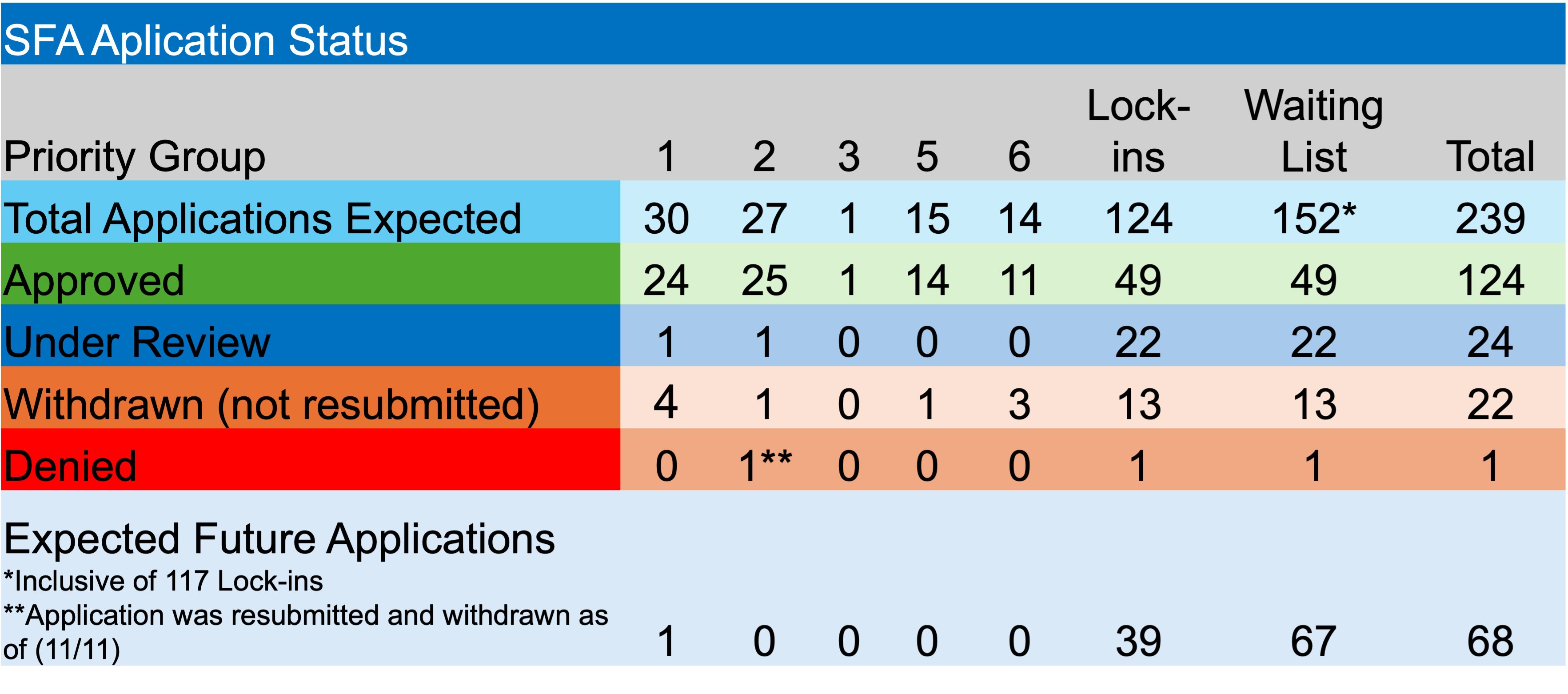
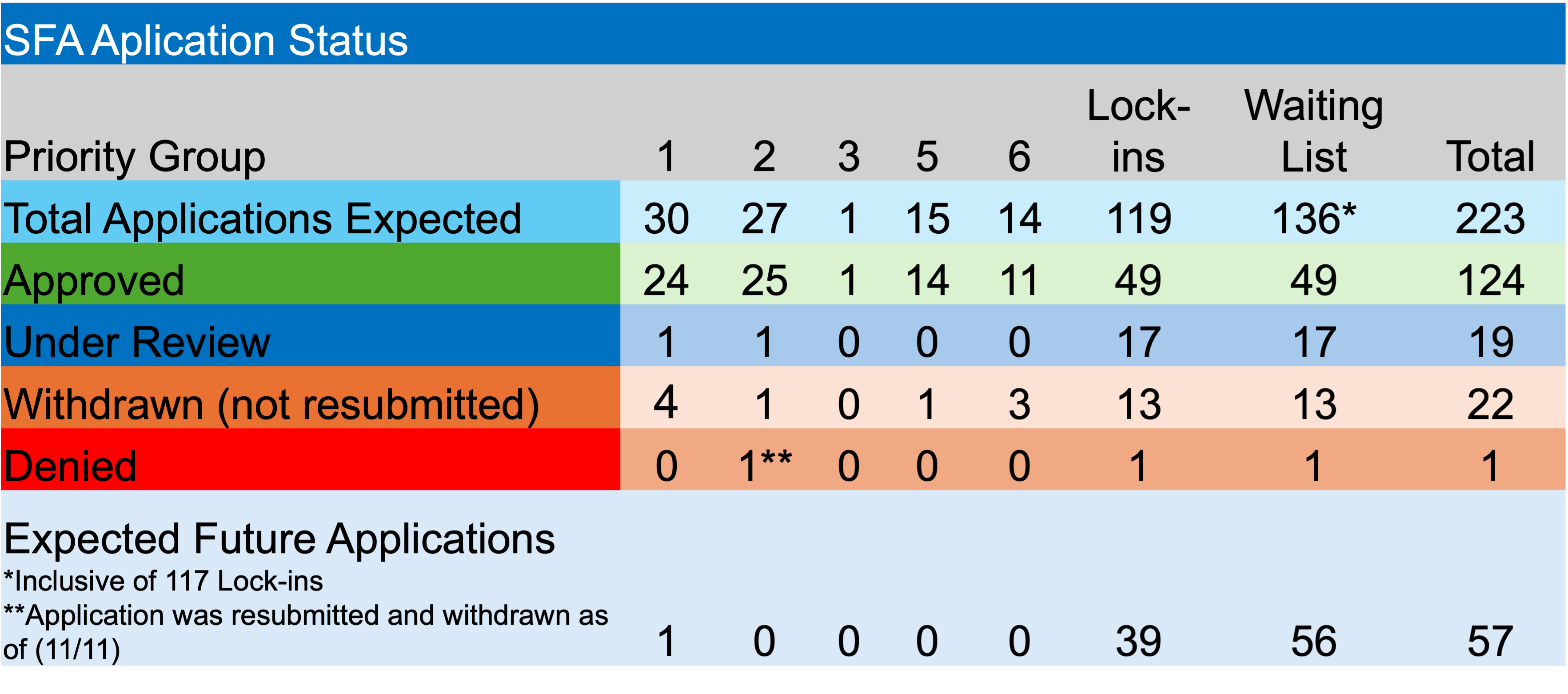
Regarding the ARPA implementation by the PBGC, the current efiling portal is describes as limited, which is certainly far better than the frequently mentioned “temporarily closed” status. As a result, there were three new applications submitted during the past week. Local 1102 Retirement Trust, IBEW Eastern States Pension Plan, and Local 1922 Pension Plan are each classified as non-priority group members. In the case of Local 1922, its application was revised. In total, these three funds are seeking $53.7 million in special financial assistance (SFA) for just over 6k participants.

In other ARPA news, Aluminum, Brick & Glass Workers International Union, AFL-CIO, CLC, Eastern District Council No. 12 Pension Plan, a Wyomissing, PA based plan, has received approval of its revised application. They will receive $8.5 million for the 580 members of its pension plan. This was the first application approved in nearly a month.

Happy to mention that there were no applications denied, withdrawn, or asked to repay excess SFA during the last week. However, there were two additional plans added to the waitlist. Sports Arena Employees Local 137 Retirement Fund and Retirement Plan of Local 1102 Retirement Fund have been added to the waitlist. In total, 119 non-priority funds have sought SFA through the waitlist process. Neither of these funds locked-in a date for valuation purposes on the discount rate. Four funds have not currently chosen a lock-in date.

There are still 43 plans that have yet to submit an application for review, with all but one of those a non-priority group member. Despite significant recent volatility, U.S. Treasury interest rates, particularly 10- and 30-year maturities, are enjoying fairly robust yields. The 30-year yield is once again above 4.8%. This level of rates provides pension plans receiving the SFA some additional cost reduction to defease benefit payments.

Benefits of Cash Flow Matching (CFM)

By: Ronald J. Ryan, CFA, Chairman, Ryan ALM, Inc.

The true objective of a pension is to secure and fund benefits in a cost-efficient manner with prudent risk. This is best accomplished by cash flow matching (CFM). In the 1970s and 1980s it was greatly in vogue and called Dedication. CFM aligns the cash flows of assets to match and fully fund the liability cash flows (benefits + expenses (B+E)) chronologically. Since bonds are the only asset class with the certainty of cash flows (principal and interest), bonds have always been the choice to CFM liability cash flows. The benefits of the Ryan ALM CFM approach are numerous and significant:

Reduces Risk – Risk is best defined as the uncertainty of achieving the objective. CFM will secure the objective of paying benefits with certainty.

    Reduces Cost – The cost to fund future B+E is reduced by about 2% per year (1-10 years = 20%).

    Enhances the ROA – There is a ROA for each asset class. For bonds, it is usually the YTM of a generic bond index. The Ryan ALM CFM is heavily skewed to A/BBB+ corporate bonds and will outyield these bond indexes thereby enhancing the ROA for the bond allocation.

    Mitigates Interest Rate Risk – CFM matches and funds actuarial projections of B+E which are all future values. Importantly, future values are not interest rate sensitive. Future values of B+E should be the focus of a pension objective. Present values are interest rate sensitive but that is not the objective. Since CFM will match the liability cash flows it will have the same or similar duration profile and present value interest rate sensitivity. 

    Eliminates Cash Sweep– Many pensions do a cash sweep of all assets to find the liquidity needed to fund current B+E. CFM will provide this liquidity so there is no need for a cash sweep that harms asset growth. This should enhance the ROA of growth assets whose dividends may have been used to fund current B+E. According to a Guinness Global study of the S&P 500 dating back to 1940, dividends + dividends reinvested accounted for about 49% of the S&P 500 total return for rolling 10-year periods and 57% for 20-year periods. CFM buys time for the growth assets to grow unencumbered.

        Reduces Volatility of Funded Ratio and Contributions – CFM will match and fully fund the liability cash flows chronologically thereby reducing or eliminating any funding ratio volatility for the period it is funding. This should help reduce the volatility of contributions as well.

          Provides Accurate Pension Inflation Hedge – The actuarial projections of B+E include inflation. As a result, CFM not only is the proper liability cash flow hedge but is the only accurate way to hedge pension inflation (benefits, expenses, salary, etc.). Please note that pension inflation is not equal to the CPI but can vary greatly.

          Reduces Pension Expense – For corporations, the present value growth of assets versus the present value growth of liabilities in $s creates a line item called pension expense. Corporations want asset growth to match liability growth in $s to avoid a hit to earnings and use a duration match strategy to hedge. CFM will provide a more accurate duration match since it funds monthly liability cash flows and not an average duration. Public plans do not have this earnings issue.

          Don’t hesitate to reach out to us if you’d like to learn more about how Ryan ALM’s Cash Flow Matching capability can benefit your plan. You can always visit RyanALM.com to get additional research insights . Finally, we are always willing to provide a free analysis. All we need are the projected benefits, expenses, and contributions. The further into the future those projection cover the greater the insights.

              WHY?

              By: Russ Kamp, CEO, Ryan ALM, Inc.

              Why do we have two different accounting standards in the U.S. for valuing pension liabilities?

              Why does it make sense to value liabilities at a rate (ROA) that can’t be used to defease pension liabilities in this interest rate environment?

              Why do we continue to create an asset allocation framework that only guarantees volatility and not success?

              Why do we think that the pension objective is a return objective (ROA) when it is the liabilities that need to be funded and secured?

              Why haven’t we realized that plowing tons of plan assets into an asset class/strategy will negatively impact future returns?

              Why are we willing to pay ridiculous sums of money in asset management fees with no guaranteed outcome?

              Why is liquidity to meet benefits an afterthought until it becomes a major issue?

              Why does it make sense that two plans with wildly different funded ratios have the same ROA?

              Why are plan sponsors willing to live with interest rate risk in the core bond allocations?

              Why do we think that placing <5% in any asset class is going to make a difference on the long-term success of that plan?

              Why do we think that moving small percentages of assets among a variety of strategies is meaningful?

              Why do we think that having a funded ratio of 80% is a successful outcome?

              Why are we incapable of rethinking the management of pensions with the goal to bring an element of certainty to the process, especially given how humans hate uncertainty?

              WHY, WHY, WHY?

              If you are as confused as I am with our current approach to DB pension management, try cash flow matching (CFM) a portion of your plan. With CFM you’ll get a product that SECURES the promised benefits at low cost and with prudent risk. You will have a carefully constructed liquidity bucket to meet benefits and expenses when needed – no forced selling in challenging market environments. Importantly, your investing horizon will be extended for the growth (alpha) assets that haven’t been used to defease liabilities. We know that by buying time one dramatically improves the probability of a successful outcome. Furthermore, your pension plan’s funded status will be stabilized for that portion of the assets that uses CFM. This is a dynamic asset allocation process that should respond to improvement in the plan’s funded status. Lastly, you will be happy to sit back and watch the mayhem in markets unfold knowing that you don’t have to do anything except sleep very well at night.

              P&I: “Not The Time To Panic” – Frost

              By: Russ Kamp, CEO, Ryan ALM, Inc.

              There is hardly ever a good time to panic when managing a defined benefit pension plan. No one ever wants to be a forced seller because liquidity is needed and not available. Too often what looks like a well-diversified portfolio suddenly has all assets correlating to 1. I’ve seen that unfold many times during my nearly 44-years in the business.

              It is critically important that the appropriate asset allocation framework be put in place long before one might be tempted to panic. As we’ve mentioned many times before, having all of your eggs (assets) in one basket focused on a return objective (ROA) is NOT the correct approach. Dividing assets among two buckets – liquidity and growth – is the correct approach. It ensures that you have the necessary liquidity to meet benefits and expenses as incurred, and it creates a bridge over uncertain markets by extending the investing horizon, as those growth assets are no longer needed to fund monthly payments.

              Furthermore, the liquidity portfolio should be managed against the plans liabilities from the first month as far out as the allocation to the liquidity bucket will take you. Why manage against the liabilities? First, the only reason the plan exists is to meet a promise given to the participant. The primary objective managing a pension should be to SECURE the promised benefits at a reasonable cost and with prudent risk. Second, a cash bucket, laddered bond portfolio or generic core portfolio is very inefficient. You want to create a portfolio that defeases those promises with certainty. A traditional bond portfolio managed against a generic index is subject to tremendous interest rate risk, and there certainly seems to be a lot of that in the current investing environment.

              The beauty of Cash Flow Matching (CFM) is the fact that bonds (investment grade corporate bonds in our case) are used to defease liabilities for each and every month of the assignment (5-, 10-, 20- or more years). Liabilities are future values (FV) and as such, are not interest rate sensitive. A $1,000 benefit payment next month or any month thereafter is $1,000 whether rates are at 2% or 10%. If one had this structure in place before the market turbulence created by the tariff confusion, one could sleep very comfortably knowing that liquidity was available when needed (no forced selling) and a bridge over trouble waters had been built providing ample time for markets to recover, which they will.

              Yes, now is not the time to panic, but continuing to ride the rollercoaster of performance created by a very inefficient asset allocation structure is not the answer either. Rethink your current asset allocation framework. Allow your current funded status to dictate the allocation to liquidity and growth. The better funded your plan, the less risk you should be taking. DB pension plans need to be protected and preserved. Creating an environment in which only volatility is assured makes little sense. It is time to bring an element of certainty to the management of pensions.

              Milliman – Corporate Pension Funding Falls in March

              By: Russ Kamp, CEO, Ryan ALM, Inc.

              Milliman has just released its monthly Milliman 100 Pension Funding Index (PFI), which analyzes the 100 largest U.S. corporate pension plans. Weak investment returns, estimated at -1.4%, drove the PFI asset level down by $25 billion during March. Current assets for the top 100 plans are now $1.3 trillion. The fall in assets was only partially offset by the rise in the discount rate (13 bps) during the month. As a result, the surplus fell by $7 billion to $51 billion as of March 31, 2025.

              The discount rate ended the month at 5.49%, which reduced plan liabilities by $18 billion, to $1.25 trillion by the end of March. As a result of assets falling by more than liabilities, the PFI funded ratio dropped from 104.6% at the end of February to 104.1% at the end of March. For the quarter, discount rates fell 10 basis points and the Milliman 100 plans lost $8 billion in funded status.   

              “While the slight rise in discount rates in March led to a monthly decline in plan liabilities, plan assets fell even further due to poor market performance, which caused the funded status to fall below the 104.8% level seen at the beginning of 2025,” said Zorast Wadia, author of the PFI. Given market action during the first 10 days of April, it will be interesting to see if the impact from rising rates can offset the dramatic fall in asset values. Inflation fears fueled by tariffs could lead to rising bond yields, which will help mitigate some of the risk to equities given the possibility of declining earnings. As Zorast mentioned in the Milliman release, “plan sponsors will want to consider asset-liability matching strategies to preserve their balance sheet gains from last year”, especially given that 30-year corporates are once again yielding close to 6%.

              Pension Asset Allocation

              By: Russ Kamp, CEO, Ryan ALM, Inc.

              David Gates, of Bread fame, penned “If” in 1971. One of the more famous lyrics in the song is “if a picture paints a thousand words”. If the average picture paints 1,000 words, the image below paints about 1 million. I believe that the image of a rollercoaster is the perfect metaphor for traditional asset allocation strategies that have pension funds riding markets up and down and up and down until the plan fails. Failure in my opinion is measured by rising contribution expenses, the adoption of multiple tiers requiring employees to contribute more, work longer, and get less, and worse, the migration of new workers to defined contribution offerings, which are an unmitigated disaster for the average American worker.

              As you know, Pension America rode markets up in the ’80s (following a very challenging ’70s) and ’90s, only to have the ’00s drive funded ratios into the ground. The ’10s were very good following the Great Financial Crisis. The ’20s have been a mix of both good (’23 and ’24) and bad markets (’20 and ’22). Who knows where the next 5-years will take us. What I do know is that continuing to ride markets up and down is not working for the average public pension plan. The YTD performance for US equities (S&P 500 -13.2% as of 2:30 pm) coupled with a collapse in the Treasury yield curve is damaging pension funded ratios which had shown nice improvement.

              Riding these markets up and down without trying to install a strategy to mitigate that undesirable path is imprudent. Subjecting the assets to the whims of the market in pursuit of some return target is silly. By installing a discipline (CFM) that secures the promised benefits, supplies the necessary liquidity, buys time for the growth assets, while stabilizing the funded status and contribution expenses seems to be a no-brainer. Yet, plan sponsors have been reluctant to change. Why?

              What is the basis for the reluctance to adopt a modified asset allocation framework that has assets divided into two buckets – liquidity and growth? Do you enjoy the uncertainty of what markets will provide in terms of return? Do you believe that using CFM for a portion of the asset base reduces one’s responsibility? Do you not believe that the primary objective in managing a pension is to secure the promised benefits at a reasonable cost and with prudent risk? The only reason that the DB plan exists is to meet an obligation that has been promised to the plan participant. Like an insurance company or lottery system, why wouldn’t you want to create an investment program that has very little uncertainty?

              An Ugly Day For Pension America

              By: Russ Kamp, CEO, Ryan ALM, Inc.

              Yes, today’s ugliness in the markets is only one day and how many times have we heard or read that you can’t market time or if you miss just the best performing 25-, 50-, or 100-days in the stock market, your return will resemble that of cash or bonds? Those facts are mostly correct. We may not be able to market time, but we can certainly put in place an asset allocation framework that gets DB pension plans off the rollercoaster of performance. We can construct an asset allocation that provides the necessary liquidity when markets may not be able to naturally. An asset allocation that buys time for the growth asset to wade through troubled markets. A framework that secures the promised benefits and stabilizes both funded ratios and contribution expenses for that portion of the fund that has adopted a new strategy.

              Yes, today is only one day, but the impact can be significantly negative. See, it isn’t just the loss that has to be made up, as pension plans are counting on a roughly 7% return (ROA) for the year. Every negative event pushes that target further away. Equity values are getting whacked and today’s market activity is just exacerbating the already weak start to the year. While equity markets are falling, U.S. interest rates are down precipitously. The U.S. 10-year Treasury note’s yield is down just about 0.8% since early in January. As a reminder, the average duration of a DB pension is about 12 years or twice the duration of the Bloomberg Barclays Aggregate Index, which is the benchmark for most core fixed income mandates. So, your bond portfolios may be seeing some appreciation today and since the start of 2025, but those portfolios are not growing nearly as fast as your plan’s liabilities, which have grown by about 10.6% (12 year duration x 0.8% + income of 1.0% = 10.6%). As a result, funded ratios are taking a hit.

              I wrote this piece back on March 4th reminding everyone that the uncertainty around tariffs and other factors should inspire a course change, an asset allocation rethink. I suspect that it didn’t. So, one can just assume that markets will come back and the underperformance will not have impacted the pension plan, but that just isn’t true. In many cases, equity market corrections take years to recover from and in the process contribution expenses rise, and in some cases dramatically so.

              Adopting a new asset allocation framework doesn’t mean changing the entire portfolio. A restructuring can be as simple as converting your highly interest rate sensitive core bond portfolio into a cash flow matching (CFM) portfolio that secures the promised benefits from next month out as far as the allocation can go. In the process you will have improved the plan’s liquidity, extended the investing horizon for the alpha assets, stabilized the funded status for that segment of your plan, and mitigated interest rate risk, as those benefit payments are future values which aren’t interest rate sensitive. You’ll sleep very well once adopted.

              That Door’s Closed. What’s behind Door #2?

              By: Russ Kamp, CEO, Ryan ALM, Inc.

              I’ve mentioned often through posts on this blog that we as an industry tend to overwhelm good ideas by allocating ridiculous sums of money in the pursuit of the next great idea. Sure, the idea was terrific several years ago, but today…? We are currently witnessing the negative impact of such an occurrence in private equity. According to many recent reports, the ability to generate liquidity from PE funds is proving to be as challenging as it has ever been. There are only two ways to liquidate holdings in a private fund: 1) a private transaction with a company or another PE fund, and 2) an initial public offering (IPO).

              It appears that neither option is readily available to the private equity advisor at this time. Public markets seem to have lost their luster, as there are more than 1,000 fewer companies today than just 10-years ago. Current valuations are also acting as an impediment to going public with portfolio companies. Couple this with the fact that the lack of transactions is limiting the liquidity available to engage in private transactions among PE firms.

              Given this situation, one would think that perhaps PE firms and their investors would reduce the demand for product and allow for the natural digestion of the “excess” capital. But no, that does not seem to be the case. According to an article by Claire Ruckin (Bloomberg), private equity firms are “turning to cash-rich credit investors for money to pay dividends to themselves and their backers.” Furthermore, a few are “getting back as much as they first invested, if not more, in effect leaving them with little or no equity in some of their biggest companies.” So much for being equity funds!

              According to Claire’s article, more than 20 businesses in the US and Europe have borrowed to make payouts to their owners, according to Bloomberg-compiled data. Ironically, these “dividend recap” deals are a boon to lenders (private creditors) who have lots of cash to deploy. Could this be indicative of another product area overwhelmed by pension cash flows? Private equity firms are happy to take those resources off the creditors hands to return capital to their investors, but is the stacking of additional debt on these companies a good strategy? What happens if the current administrations policies don’t result in growth and worse, lead us into recession? Will these deals prove to be a house of cards?

              As we’ve mentioned just shy of 1 million times now, a pension plan’s primary objective should be to SECURE the promised benefits at a reasonable cost and with prudent risk. Do you think that allowing private equity firms, which are already expense investment vehicles, to stack additional debt on top of their equity investments is either a reasonable cost or fiduciarily prudent? Come on! What are we trying to do here?

              Defined benefit plans are critically important for the American worker. Continuing to place bets on the success of a PE firm to identify “attractive” equity investments in an environment as challenging as this one and then allowing them to “double down” by adding layers of debt just to pretend that capital is being returned to the investor is just wrong. Let’s get back to pension basics when we used the plan’s specific liabilities to drive asset allocation decisions that centered around securing the promised benefits. You want to gamble – go to Atlantic City. DB pensions plans aren’t the place.

              Lessons Learned?

              By: Russ Kamp, CEO, Ryan ALM, Inc.

              My wife and I are rewatching The West Wing, and we are often amazed (disappointed) by how many of the social issues discussed 20 years ago when the show first aired that are still being debated today. It really just seems like we go around in circles. Well, unfortunately, the same can be said about pensions and supposed pension reforms. We need to reflect on what lessons were learned following the Great Financial Crisis of 2007-2009, when pension America saw its funded status plummet and contribution expense dramatically escalate. Have we made positive strides?

              Unfortunately, with regard to the private sector, we continued to witness an incredible exodus from defined benefit plans and the continued greater reliance on defined contribution plans, which is proving to be a failed model. That activity appears to have benefited corporate America, but how did that action work for plan participants, who are now forced to fund, manage, and then disburse a “retirement” benefit through their own actions, which is asking a lot from untrained individuals, who in many cases don’t have the discretionary income to fund these programs in the first place.

              With regard to public pension systems, we saw a lot of “action”. There were steps to reduce the return on asset assumption (ROA) for many systems – fine. But, that forced contributions to rise rapidly, creating a greater burden on state and municipal budgets that resulted in the siphoning off of precious financial resources needed to fund other social issues. In addition, there was great activity in creating additional benefit “tiers” (tears?), in which newer plan participants, and some existing members, were asked to fund more of their benefit through new or greater employee contributions, longer tenures before retirement, and more modest benefits to be paid out at retirement. Again, I would argue are not pension lessons learned, but are in fact benefit cuts for plan participants.

              Fortunately, for multiemployer plans, ARPA pension legislation has gone a long way to securing the funded status and benefits for 110 plans that were once labeled as Critical or worse, Critical and Declining. There are another 90 pension plans or so to go through the application process in the hopes of securing special financial assistance. But have we seen true pension reform within these funds and the balance of plans that had not fallen into critical status?

              It seems to me that most of the “lessons learned” have nothing to do with how DB pension plans are managed, but rather asks that plan participants bear the consequences of a failed pension model. A model that has focused on the ROA as if it were the Holy Grail. Pension plans should have been focused on the promise (benefit) that was made to their participants, and not on how much return they could generate. The focusing on a return target has certainly created a lot more uncertainty and volatility. As we’ve been reporting, equity and equity-like exposure within multiemployer and public pension systems was greater coming into 2025 then the levels that they were in 2007. What lesson was learned?

              Pension America is once again suffering under the weight of declining asset values and falling interest rates. When will we truly learn that continuing to manage DB plans with a focus on return is NOT correct? The primary objective needs to be the securing of the promised benefits at a reasonable cost and with prudent risk. Shifting wads of money into private equity or private credit and thinking that you’ve diversified away equity exposure is just silly. I don’t know what the new administration’s policies will do for growth, inflation, interest rates, etc. I do know that they are currently creating a lot of angst among the investment community. Bring some certainty to the management of pensions through a focus on the promise is superior to continuing to ride the rollercoaster of performance.