MV versus FV

By: Russ Kamp, CEO, Ryan ALM, Inc.

There seems to be abundant confusion within certain segments of the pension industry regarding the purpose and accounting (performance) of a Cash Flow Matching (CFM) portfolio on a monthly basis. Traditional monthly reports focus on the present value (PV) of assets in marking those assets to month-end prices. However, when utilizing a CFM strategy, one is hoping to defease (secure) promised benefits which are a future value (FV). As a reminder, FVs are not interest rate sensitive. The movement in monthly prices become irrelevant.

If pension plan A owes a participant $1,000 next month or 10-years from now, that promise is $1,000 whether interest rates are at 2% or 8%. However, when converting that FV benefit into a PV using today’s interest rates, one can “lock in” the relationship between assets and liabilities (benefit payment) no matter which way rates go. To accomplish this objective, a CFM portfolio will match those projected liabilities through an optimization process that matches principal, interest, and any reinvested income from bonds to those monthly promises. The allocation to the CFM strategy will determine the length of the mandate (coverage period).

Given the fact that the FV relationship is secured, providing plan sponsors with the only element of certainty within a pension fund, does it really make any sense to mark those bonds used to defease liabilities to market each month? Absolutely, NOT! The only concern one should have in using a CFM strategy is a bond default, which is extremely rare within the investment grade universe (from AAA to BBB-) of bonds. In fact, according to a recent study by S&P, the rate of defaults within the IG universe is only 0.18% annually for the last 40-years or roughly 2/1,000 bonds.

A CFM portfolio must reflect the actuaries latest forecast for projected benefits (and expenses), which means that perhaps once per year a small adjustment must be made to the portfolio. However, most pension plans receive annual contributions which can and should be used to make those modest adjustments minimizing turnover. As a result, most CFM strategies will purchase bonds at the inception of a mandate and hold those same issues until they mature at par. This low turnover locks in the cost reduction or difference in the PV vs. FV of the liabilities from day 1 of the mandate. There is no other strategy that can provide this level of certainty.

To get away from needing or wanting to mark all the plan’s assets to market each month, segregate the CFM assets from the balance of the plan’s assets. This segregation of assets mirrors our recommendation that a pension plan should bifurcate a plan’s asset allocation into two buckets: liquidity and growth. In this case, the CFM portfolio is the liquidity bucket and the remaining assets are the growth or alpha assets. If done correctly, the CFM portfolio will make all the necessary monthly distributions (benefits and expenses), while the alpha assets can just grow unencumbered. It is a very clean separation of the assets by function.

Yes, bond prices move every minute of every day that markets are open. If your bond allocation is being compared to a generic bond index such as the Aggregate index, then calculating a MV monthly return makes sense given that the market value of those assets changes continuously. But if a CFM strategy can secure the cost reduction to fund FVs on day 1, should a changing MV really bother you? Again, NO. You should be quite pleased that a segment of your portfolio has been secured. As the pension plan’s funded status improves, a further allocation should be made to the CFM mandate securing more of the promised benefits. This is a dynamic and responsive asset allocation approach driven by the funded status and not some arbitrary return on asset (ROA) target.

I encourage you to reach out to me, if you’d appreciate the opportunity to discuss this concept in more detail.

An Alternative Pension Funding Formula

By: Russ Kamp, CEO, Ryan ALM, Inc.

I’ve spent the last few days attending and speaking at the FPPTA conference in Sawgrass, Florida. As I’ve reported on multiple occasions, I believe that the FPPTA does as good a job as any public fund organization of providing critical education to public fund trustees. A recent change to the educational content for the FPPTA centers on the introduction of the “pension formula” as one of their four educational pillars. In the pension formula of C+I = B+E, C is contributions, I is investment income (plus principal appreciation or depreciation), B is benefits, and E represents expenses.

To fund B+E, the pension fund needs to contribute an annual sum of money (C) not covered by investment returns (I) to fully fund liability cash flows (B+E). That seems fairly straightforward. If C+I = B+E, we have a pension system in harmony. But is a pension fund truly ever in harmony? With market prices changing every second of every trading day, it is not surprising that the forecasted C may not be enough to cover any shortfall in I, since the C is determined at the start of the year. As a result, pension plans are often dealing with both the annual normal cost (accruing benefits each year) and any shortfall that must be made up through an additional contribution amortized over a period of years.

As a reminder, the I carries a lot of volatility (uncertainty) and unfortunately, that volatility can lead to positive and negative outcomes. As a reminder, if a pension fund is seeking a 7% annual return, many pension funds are managing the plan assets with 12%-15% volatility annually. If we use 12% as the volatility, 1 standard deviation or roughly 68% of the annual observations will fall between 7% plus or minus 12% or 19% to -5%. If one wants to frame the potential range of results at 2 standard deviations or 19 out of every 20-years (95% of the observations), the expected range of results becomes 31% to -17%. Wow, one could drive a couple of Freightliner trucks through that gap.

Are you still comfortable with your current asset allocation? Remember, when the I fails to achieve the 7% ARC the C must make up the shortfall. This is what transpired in spades during the ’00s decade when we suffered through two major market corrections. Yes, markets have recovered, but the significant increase in contributions needed to make up for the investment shortfalls haven’t been rebated!

I mentioned the word uncertainty above. As I’ve discussed on several occasions within this blog, human beings loathe uncertainty, as it has both a physiological and mental impact on us. Yet, the U.S. public fund pension community continues to embrace uncertainty through the asset allocation decisions. As you think about your plan’s asset allocation, is there any element of certainty? I had the chance to touch on this subject at the recent FPPTA by asking those in the room if they could identify any certainty within their plans. Not a single attendee raised their hand. Not surprising!

As I result, I’d like to posit a slight change to the pension formula. I’d like to amend the formula to read C+I+IC = B+E. Doesn’t seem that dramatic – right? So what is IC? IC=(A=L), where A are the plan’s assets, while L= plan liabilities. As you all know, the only reason that a pension plan exists is to fund a promise (benefits) made to the plan participant. Yet, the management of pension funds has morphed from securing the benefits to driving investment performance aka return, return, and return. As a result, we’ve introduced significant funding volatility. My subtle adjustment to the pension formula is an attempt to bring in some certainty.

By carefully matching assets to liabilities (A=L) we’ve created an element of certainty (IC) not currently found in pension asset allocation. By adding some IC to the C+I = B+E, we now have brought in some certainty and reduced the uncertainty and impact of I. The allocation to IC should be driven by the pension plan’s funded status. The better the funding, the greater the exposure to IC. Wouldn’t it be wonderful to create a sleep-well-at-night structure in which I plays an insignificant role and C is more easily controlled?

To begin the quest to reduce uncertainty, bifurcate your plan’s assets into two buckets, as opposed to having the assets focused on the ROA objective. The two buckets will now be liquidity and growth. The liquidity bucket is the IC where assets and liabilities are carefully matched (creating certainty) and providing all of the necessary liquidity to meet the ongoing B+E. The growth portfolio (I) are the remaining plan assets not needed to fund your monthly outflows.

The benefits of this change are numerous. The adoption of IC as part of the pension formula creates certainty, enhances liquidity, buys-time for the growth assets to achieve their expected outcomes, and reduces the uncertainty around having 100% of the assets impacted by events outside of one’s control. It is time to get off the asset allocation and performance rollercoaster. Yes, recent performance has been terrific, but as we’ve seen many times before, there is no guarantee that continues. Adopt this framework before markets take no prisoners and your funded status is once again challenged.

Actuaries of DB Pension Plans Prefer Higher Interest Rates

By: Russ Kamp, CEO, Ryan ALM, Inc.

I produced a post yesterday, titled “U.S. Rates Likely to Fall – Here’s the Good and Bad”. In that blog post I wrote, “I’d recommend that you not celebrate a potential decline in rates if you are a plan sponsor or asset consultant, unless you are personally looking for a loan.” Falling rates have historically benefited plan assets, and not just bonds, but risk assets, too. But lower rates cause the present value (PV) of liabilities to grow. A 50 bp decline in rates would cause the PV of liabilities to grow by 6% assuming a duration of 12-years. NOT GOOD!

Not being a trained actuary, although I spend a great deal of time communicating with them and working with actuarial output, I was hesitant to make that broad assessment. But subsequent research has provided me with the insights to now make that claim. Yes, unlike plan sponsors and asset consultants that are likely counting down the minutes to a rate cut next week, actuaries do indeed prefer higher interest rates.

Actuaries of DB pension plans, all else being equal, generally prefer higher interest rates when it comes to funding calculations and the plan’s financial position.

Impact of Higher Interest Rates

  • Lower Liabilities: When interest rates (used as the discount rate for future benefit payments) increase, the (PV) of the plan’s obligations may sharply decrease depending on the magnitude of the rate change, making the plan look better funded.
  • Lower Required Contributions: Higher discount rates mean lower calculated required annual contributions for plan sponsors and often lead to lower ongoing pension costs, such as PBGC costs per participant.
  • Potential for Surplus: Sustained periods of higher rates can create or increase pension plan surpluses, improving the financial health of the DB plan and providing flexibility for sponsors.

Why This Preference Exists

  • Discount Rate Role: Actuaries discount future benefit payments using an assumed interest rate tied to high-grade bond yields. The higher this rate, the less money is needed on hand today to meet future obligations.
  • Plan Health: Lower required contributions and lower projected liabilities mean sponsors are less likely to face funding shortfalls or regulatory intervention. Plans become much more sustainable and plan participants can sleep better knowing that the plan is financially healthy.
  • Plan Sponsor Perspective: While actuaries may remain neutral in advising on appropriate economic assumptions (appropriate ROA), almost all calculations and required reports look stronger with higher interest rates. What plan sponsor wouldn’t welcome that reality.

Consequences of Lower Interest Rates

  • Increase in Liabilities: Contrary to the impact of higher rates, lower rates drive up the PV of projected payments, potentially causing underfunded positions and/or the need for larger contributions.
  • Challenge for Plan Continuation: Persistently low interest rates have made DB plans less attractive or sustainable and contributed to a trend of plan terminations, freezes, or conversions to defined contribution or hybrid structures. The sustained U.S. interest rate decline, which spanned nearly four decades (1982-2021), crushed pension funding and led to the dramatic reduction in the use of traditional pension plans.

In summary, actuaries valuing DB pension plans almost always prefer higher interest rates because they result in lower reported liabilities, lower costs, and less financial pressure on employers. Given that 100% of the plan’s liabilities are impacted by movements in rates, everyone associated with DB pensions should be hoping that current interest rate levels are maintained, providing plan sponsors with the opportunity to secure the funded ratio/status through de-risking strategies. A DB pension plan is the gold standard of retirement vehicles and maintaining them is critical in combating the current retirement crisis.

Enhancing the Probability of Achieving the ROA

By: Russ Kamp, CEO, Ryan ALM, Inc.

We are often confronted by plan sponsors and their advisors with the objection of using cash flow matching (CFM) because the “expected return” is lower than the plan’s return on asset assumption (ROA). Given that objection, we often point out that each asset class has its own expected return. The ROA target is developed by weighting each asset class’s exposure by the forecasted return. In the case of the bond allocation, the YTW is used as the target return.

If the plan sponsor has an allocation to “core” fixed income, there is a fairly great probability that our CFM portfolio, which we call the Liability Beta Portfolio (LBP), will outyield the core fixed income allocation thus enhancing the probability of achieving the ROA. This is accomplished through our heavy concentration in A/BBB+ investment grade corporate bonds that will outyield comparable maturity Treasuries and Agencies, which are a big and growing percentage of the Aggregate Index. In most cases, the yield advantage will be 50-100 bps depending on the maturities.

Ron Ryan, Ryan ALM’s Chairman, has produced a very thoughtful research piece on this subject. He also discusses the negative impact on a plan’s ability to achieve the ROA through the practice of sweeping dividend income, interest income, and capital distributions from the plan’s investment programs. Those distributions are better used when reinvested in the investment strategies from which they were derived, as they get reinvested at higher expected growth rates. The CFM program should be the only source to fund net benefits and expenses, as there is no forced selling when benefits and expenses are due.

There is no viable excuse to not use CFM. The benefits from this strategy are plentiful, especially the securing of the promised benefits which is the primary objective for any pension plan. We encourage you to visit RyanALM.com to read the plentiful research on this subject and other aspects of cash flow matching.

The Buying Of Time Can Reap Huge Rewards

By: Russ Kamp, CEO, Ryan ALM, Inc.

When we present the list of benefits associated with using Cash Flow Matching (CFM), one of the benefits that we highlight is the buying of time a.k.a. an extended investing horizon. Our pension community tends to fall prey to short-termism despite claiming to be long-term investors. Quarterly observations are presented through the consultants regular performance reviews and managers are often dismissed after a relatively short period of “underperformance”. Actuarial reports tend to be annual which dictate projected contribution expenses. Yet, by extending the investment horizon to something more meaningful like 10-years or more, the probability of achieving the desired outcome is dramatically improved.

I recently played around with some S&P 500 data dating back to 12/31/69 and looked at the return and standard deviation of observations encompassing 1-10-year moving averages and longer periods such as 15-, 20-, 30-, and even 50-year moving averages for the industry’s primary domestic equity benchmark. Living in a one-year timeframe may produce decent annual returns, but is also comes with tremendous volatility. In fact, the average one-year return from 12/69 to 2/25 has been 12.5%, but the annual standard deviation is +/- 16.6%, meaning that 68% of the time your annual return could be +29.1% to -4.1%. Extending the analysis to 2 standard deviations (95% of the observations) means that in 19 out of 20 years the range of results can be as broad as +45.7% to -20.7%.

However, extend out your investing horizon to 10-years, and the average return from 12/69 dips to 11.4%, but the standard deviation collapses to only 5.0% for a much more comfortable range of +16.4% to 6.4%. Extend to 2 standard deviations and you still have a positive observation in 19 out of 20 years at +1.4% as the lower boundary. Extend to 30-years and the volatility craters to only +/-1.2% around an average return of 11.25%.

We, at Ryan ALM, were blessed in 2024 to take on an assignment to cash flow match 30+ years of this plan’s liabilities. We covered all of the projected liability cash flows through 2056 and still had about $8 million in surplus assets, which were invested in two equity funds, that can now just grow and grow and grow since all of the plan’s liquidity needs are being covered by the CFM strategy! So, how important is a long investing runway? Well, if this plan’s surplus assets achieve the average S&P 500 30-year return during the next 30-years, that $8 million will grow to >$195 million.

We often speak with prospects about the importance of bifurcating one’s asset base into two buckets – liquidity and growth. It is critically important that the plan’s liquidity be covered through the asset cash flows of interest and principal produced by bonds since they are the only asset with a known future value. CFM eliminates the need for a cash sweep which would severely reduce the ROA of growth assets. This practice will allow the growth or alpha assets to wade through choppy markets, such as the one we are currently witnessing, without fear that liquidity must be raised to meet benefits at a less than opportune time.

The plan sponsor highlighted above was fortunate to have a well-funded plan, but even plans that are less well-funded need liquidity. Ensuring that benefits and expenses can be met monthly (chronologically) without forcing liquidity that might not naturally exist is critical to the successful operation of a pension plan. CFM can be used over any time frame that the plan sponsor desires or the plan can afford. We believe that extending the investment horizon out to 10-years should be the minimum goal, but every plan is unique and that uniqueness will ultimately drive the decision on the appropriate allocation to CFM.

An Element of Certainty Can Be Achieved

By: Russ Kamp, CEO, Ryan ALM, Inc.

I’ve spent the last few days attending my first GAPPT conference in Braselton, GA. The conference has been terrific as the venue is beautiful, the attendees/trustees delightful, and the speakers/topics topnotch. Senior, highly experienced members of our pension community have been sharing their insights on a variety of subjects. For those addressing the current state of our capital markets and pension asset allocation, the common theme has been uncertainty. Uncertainty as to the direction of equity markets, inflation, and interest rates. Furthermore, given that uncertainty, it should not be surprising that when asked about the direction of asset allocation trends going forward that the speaker would again claim that they don’t know. Of course not.

Regular readers of this blog know that I’ve addressed uncertainty in several blog posts. As human beings we despise uncertainty, yet the approach to pension management within the public sector has been to embrace uncertainty through a traditional asset allocation focused on a return on asset (ROA) target. We learned today that the ROA has fallen for the average public pension from 8% prior to the great financial crisis (GFC) to the current 6.9% today. Given the outsized returns provided by the public equity markets in recent years, funded ratios should have improved, but ironically, they are roughly at the same level they were at prior to the GFC. Yes, the lower discount rate increases the value of plan liabilities, which impacts the funded status, but it also increases contributions that should have offset some of that impact.

Instead of just accepting the fact that markets are uncertain, plan sponsors and their advisors should be seeking strategies to minimize that uncertainty, at least for a portion of the asset base. I know of only a couple of ways to bring certainty to the management of pension assets. One is through a pension risk transfer that shifts the liability from the plan sponsor to an insurance company. Given that public pension plans believe that they are perpetual, there is little appetite to terminate the DB plan. Furthermore, with funded ratios at roughly 75%, the cost to fully fund and then offload the liability would be prohibitive.

We, at Ryan ALM, want to see pensions protected and preserved. We don’t want our public workforce to be forced into managing their own retirements through a defined contribution offering. These vehicles have not worked for a significant majority of the private workforce, as asking untrained individuals to fund, manage, and then disburse a “benefit” with little to no disposable income, investment acumen, or a crystal ball to help with distributions is just poor policy.

So, what can sponsors do? They can adopt a cash flow matching (CFM) strategy that will defease (SECURE) pension liabilities by matching asset cash flows of interest and principal from bonds with the liability cash flows of benefits and expenses. This process is done chronologically from the first month of the assignment as far into the future as the allocation to the strategy will go. In the process of securing these promises, liquidity is enhanced allowing for the balance of the assets (alpha assets) to now grow unencumbered. As we all know, a long investing horizon enhances the probability of success for those alpha assets to achieve the expected outcome.

Isn’t it time to engage in a strategy that will provide the sponsors and their advisors with a better night’s sleep? Wouldn’t it be great if attendees at pension-related conferences learned that there is a strategy that can secure the promises given to plan participants? Given the elevated interest rate environment, CFM should become the core strategy within pension asset allocations. The allocation to CFM should be determined by multiple factors including the current funded status and the plan’s ability to contribute. We witnessed a failure on the part of sponsors back in 1999 to secure the promises when funded ratios were significantly > 100%. We aren’t at that level today, but an element of risk can be reduced and it should be. Let’s get these plans off the asset allocation rollercoaster and volatile funded status.

FOMC and Powell Deliver Worrying Message

By: Russ Kamp, CEO, Ryan ALM, Inc.

I produced a post recently titled, “Parallels to the 1970s?” in which I discussed the challenging economic environment that existed during the 1970s as a result of two oil shocks and some sketchy decision making on the part of the US Federal Reserve. The decade brought us a new economic condition called stagflation, which was a term coined in 1965 by British politician Lain Macleod, but not widely used or recognized until the first oil embargo in 1973. Stagflation is created when slow economic growth and inflation are evident at the same time.

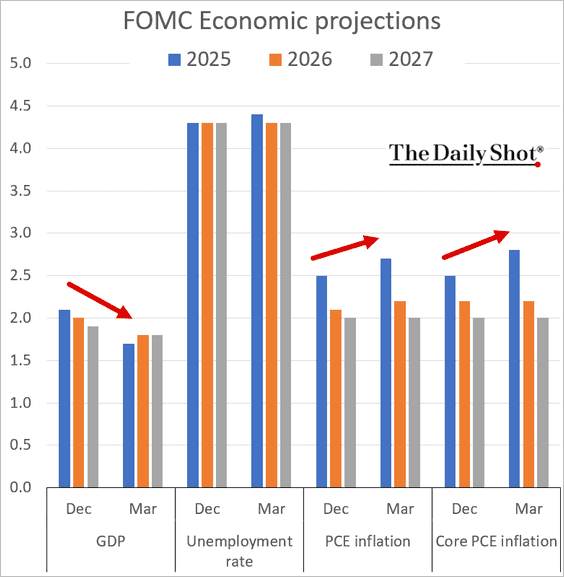
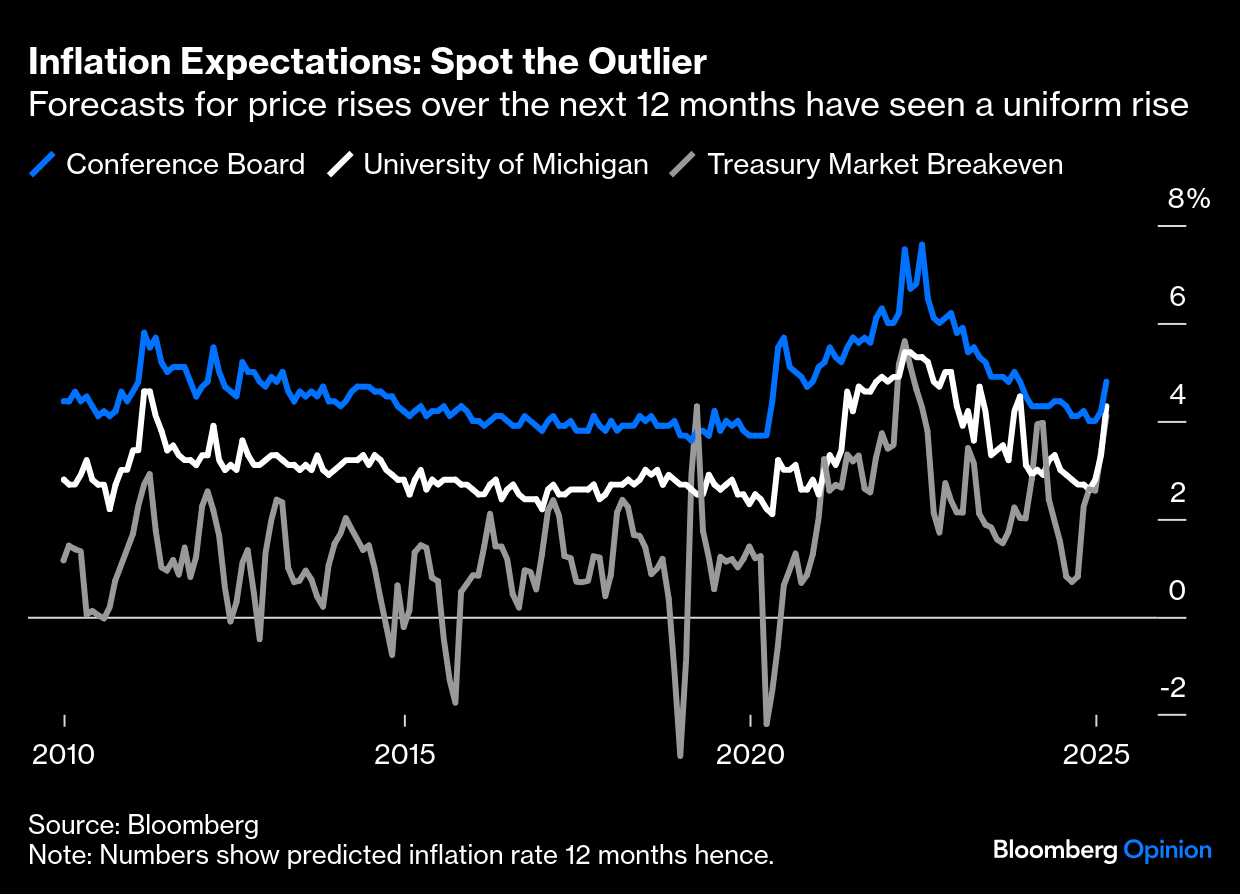
According to the graph above, the FOMC is beginning to worry about stagflation reappearing in our current economy, as they reduced the expectations for GDP growth (the Atlanta Fed’s GDPNow model has Q1’25 growth at -1.8%), while simultaneously forecasting the likelihood of rising inflation. Not good. If you think that the FOMC is being overly cautious, look at the recent inflation forecasts from several other entities. Seems like a pattern to me.

Yet, market participants absorbed the Powell update as being quite positive for both stocks and bonds, as markets rallied soon after the announcement that the FOMC had held rates steady. Why? There is great uncertainty as to the magnitude and impact of tariffs on US trade and economic growth. If inflation does move as forecasted, why would you want to own an active bond strategy? If growth is moderating, and in some cases forecasted to collapse, why would you want to own stocks? Aren’t earnings going to be hurt in an environment of weaker economic activity? Given current valuations, despite the recent pullback, caution should be the name of the game. But, it seems like risk on.

Given the uncertainty, I would want to engage in a strategy, like cash flow matching (CFM), that brought an element of certainty to this very confusing environment. CFM will fully fund the liability cash flows (benefits and expenses) with certainty providing timely and proper liquidity to meet my near-term obligations, so that I was never in a position where I had to force liquidity where natural liquidity wasn’t available. Protecting the funded ratio of my pension plan would be a paramount objective, especially given how far most plans have come to achieve an improved funding status.

I’ve written on many occasions that the nearly four decades decline in rates was the rocket fuel that drove risk assets to incredible heights. It covered up a lot of sins in how pensions operated. If a decline in rates is the only thing that is going to prop up these markets, I doubt that you’ll be pleased in the near-term. Bifurcate your assets into two buckets – liquidity and growth – and buy time for your pension plan to wade through what might be a very challenging market environment. The FOMC was right to hold rates steady. Who knows what their next move will be, but in the meantime don’t bet the ranch that inflation will be corralled anytime soon.

That’s Not Right!

By: Russ Kamp, Managing Director, Ryan ALM, Inc.

I’ve recently had a series of terrific meetings with consultants, actuaries, and asset owners (mostly pension plans) about cash flow matching (CFM). I believe that most folks see the merit in using CFM for liquidity purposes, but often fail to see the benefit of bringing certainty to a portfolio for that segment that is defeasing asset cash flows relative to liability cash flows (benefits and expenses). I’m not entirely sure why that is the case, but one question comes up regularly. Question: If I use 30% of my assets on lower yielding fixed income, how am I supposed to meet my ROA objective? I guess that they believe that the current 4.75% to 5% yielding investment grade corporate portfolio will be an anchor on the portfolio’s return.

What these folks fail to understand is the fact that the segment of the portfolio that is defeasing liability cash flows is matched as precisely as possible. The pension game has been won! If the defeased bond portfolio represents 30% of the total plan, the ROA objective is now only needed to be achieved for the 70% of assets not used to SECURE your plan’s liabilities. The capital markets are highly uncertain. Using CFM for a portion of the plan brings greater certainty to the management of these programs. Furthermore, we know that time (investing horizon) is one of the most important investment tenets. The greater the investing horizon the higher the probability of achieving the desired outcome, as those assets can now grow unencumbered as they are no longer a source of liquidity.  It bears repeating… a major benefit of CFM is that it buys time for the growth assets to grow unencumbered.

Plan sponsors should be looking to secure as much of the liability cash flows (through a CFM portfolio) as possible eliminating the rollercoaster return pattern that ultimately leads to higher contribution expenses. As mentioned above, capital markets are highly uncertain. The volatility associated with a traditional asset allocation framework has recently been calculated by Callan as +/-33.6% (2 standard deviations or 95% of observations). Why live with that uncertainty? In addition, Goldman Sachs equity strategy team “citing today’s high concentration in just a few stocks and a lofty starting valuation” forecasts that the S&P 500 “will produce an annualized nominal total return of just 3% the next 10 years, according to the team led by David Kostin, which would rank in just the 7th percentile of 10-year returns since 1930.” (CNBC)

Given that forecast, I wouldn’t worry about the 5% fixed income YTW securing my pension liabilities. Instead, I’d worry about all the “growth” assets not used to secure the promises, as they will likely be struggling to even match the YTW on a CFM corporate bond portfolio.

Hall of Famer? She Absolutely is!

By: Russ Kamp, Managing Director, Ryan ALM, Inc.

Markets Group has published an interview that Christine Giordano conducted with Robin Diamonte, CIO, RTX. In addition, Markets Group will hold a ceremony inducting Robin into the Chief Investment Officer Hall of Fame in Boston during the 11th Annual New England Institutional Forum on Sept 25-26. I wish that I could be there to help celebrate Robin’s splendid career.

The interview should be required reading for anyone in the pension arena. She got a wonderful start in this industry working for and with Britt Harris, another outstanding CIO, while they were at Verizon (I knew them when it was GTE).

Here are a couple of quotes that truly speak to her knowledge of the space. They just so happen to echo what we at Ryan ALM, Inc. have been espousing for decades. “It’s about understanding what the focus is or the mission of your group. Back in the 1990s, chief investment officers and investment teams really didn’t understand what liabilities were. All we were really is a moneymaker for the company. We provided great returns. We outperformed our liabilities.” There are still a lot of plans that pay little heed to the promises that have been given, focusing instead on achieving the ROA, which even if attained, doesn’t guarantee success.

Robin added, “Then over time, we had a couple of crises. We had the tech bubble bust, and then the global financial crisis. We had perfect storms during those periods where equity markets went down and interest rates went down at the same time. Many of the corporations found that their funded status went from well over 100% down into the 70s, and that happened with UTC (United Technologies).” Yes, markets can behave like rollercoasters leading to significant swings in the plan’s funded status and contribution expenses.

She continued, “I think it was the immediate realization of our mission is not to get great investment returns, our mission is to get great investment returns, but also understand what our liabilities were.” Yes, you, as a plan sponsors, have made a promise and we believe that the promise is what should drive asset allocation decisions and not some ROA that is often chosen for other reasons.

That realization lead her to this conclusion, “the mission at that point when our funded level was only 70% was, “Let’s fill in the gap so that we get to 100% or 110% or whatever is needed. We do that in a way that we’re not taking a lot of risk versus our liabilities.” Absolutely right! That is why she is a Hall of Famer in my book.

I also want to commend her for the outstanding work she did as a member of the PBGC’s Advisory Committee. She was instrumental in bringing ALM/LDI insights to the PBGC which has helped them to greatly improve this organizations balance sheet. Congratulations, Robin. There is no finer plan sponsor to induct into the CIO hall of fame than you.

POB Discussions Back on the Table?

By: Russ Kamp, Managing Director, Ryan ALM, Inc.

Cash Flow Matching (CFM) has enjoyed a renaissance within the pension community since US interest rates began rising in March 2022. The expanded use has not been limited to the beneficiaries of the Special Financial Assistance (SFA) paid through grants as a result of the ARPA pension reform being passed in March 2021. As a reminder, SFA proceeds are to be used exclusively to fund benefits (and expenses) as far into the future as the allocation will go. Protecting the precious grant proceeds has led to multiemployer pension plan sponsors and their advisors mostly using the 67+% in fixed income in defeasement strategies. We, at Ryan ALM, have certainly benefitted from this trend and applaud them for this decision.

In addition to multiemployer plans, both public and private (corporate) pension plans, as well as E&Fs have used CFM to bring an element of cash flow certainty (barring any defaults) to the management of pension assets and the generation of liquidity without being forced to sell assets, which can be very painful during periods of great uncertainty/volatility. These entities join insurance companies and lottery systems that have engaged in CFM activities for decades.

However, there remains a belief that CFM strategies only work during periods of high interest rates. We disagree, since liquidity is needed on a continuous basis. We believe that the use of CFM should be dictated by a number of factors, such as the entities funded status, ability to contribute, and the current fixed income exposure, as well as those liquidity needs. Unfortunately, it appears that interest rates have peaked for the time being. During the Summer of 2023, we were constructing CFM portfolios with a 6+% YTW, capturing most of the average ROA with little volatility. It was a wonderful scenario that unfortunately was not taken advantage of by most sponsors.

Today we are still able to build through our investment grade corporate bond focus portfolios with a YTW around 4.6%. Given the aggressive move down in Treasury yields during the last few months, we think that bond investors have gotten ahead of the Fed at this point as they are discounting about 150 bps of Fed rate cutting. Despite progress in the inflation fight, “sticky” inflation remains in excess of 4%. The US labor market’s unemployment rate is only 4.2%. Wage growth remains above 4%, while initial jobless claims remain at modest levels. Furthermore, the Atlanta Fed’s GDPNow model is forecasting growth for Q3’24 at 3.0% as of September 17, 2024. None of these metrics signal recession to me. How about you?

If you are of the mindset that a 4.6% YTW isn’t providing you with enough return, just think what you’d get from traditional active fixed income portfolios should rates rise once more. Please remember 2022’s -13% total return for the BB Aggregate Index. We frequently write about the need for plan sponsors to think outside the box as it relates to the allocation of assets. We believe that your plan’s assets should be bifurcated into two buckets – liquidity and growth. While the CFM portfolio is providing your plan with the necessary liquidity on a monthly basis, the growth assets can now grow unencumbered. These assets will be used at a later date to meet future benefits and expenses. With a CFM portfolio, plan sponsors can reduce or eliminate the need to do a “cash sweep” that takes away reinvestment in the growth portfolio.

In addition to believing that CFM is still a viable strategy in this environment, the decline in US Treasury yields is once again opening a door for sponsors to consider a pension obligation bond (POB). The 10-year Treasury Note yield is only 3.66% as of 6 pm EST (9/17) or roughly slightly more than half of the average public fund ROA. Estimates place the average funded ratio for public plans at 80%. For a plan striving for 7%, an 8.4% annual return must be created, or the plan’s funded status will continue to deteriorate unless contributions are increased to offset the shortfall. For plans that have funded ratios below the “average” plan, it is imperative that the deficit is closed more quickly. Issuing a POB and using the proceeds to close that gap is a very effective strategy. Corporate plans frequently issue debt and use the proceeds for a number of purposes, including the funding of pension funds.

We’d recommend once again that the proceeds received from a POB be used in a defeasement strategy to meet current liquidity needs and not invested in a traditional asset allocation framework with all of the uncertainty that comes from investing in our capital markets. Why risk potential losses on those assets when a CFM strategy can secure the Retired Lives Liability? It is truly unfortunate that most plan sponsors with underfunded plans didn’t take advantage of the historically low interest rates in 2020 and 2021. Cheap money was available for the taking. It is also unfortunate, that those plans that did take advantage of the rate environment likely invested those proceeds into the existing asset allocation. As you might recall, not only did the BB Aggregate decline -13% in 2022, the S&P 500 fell -18% that year, too.

Managing a DB pension plan comes with a lot of uncertainty. At Ryan ALM, we are trying to bring investment strategies to your attention that will provide certainty of cash flows, which will help stabilize the fund’s contributions and funded status. Don’t be the victim of big shifts in US interest rate policy. Use bonds for their cash flows and secure the promises for which your plan exists in the first place. A defeasment strategy mitigates interest rate risk because the promises (benefits and expenses) are future values, which are not interest rate sensitive. That should be quite comforting. Let us know how we can help you. We stand ready to roll.