-56.1% – Really?

By: Russ Kamp, CEO, Ryan ALM, Inc.

I truly relish getting feedback related to my blog posts. I wasn’t surprised that there was more activity, and a little skepticism, related to my recent post that discussed the output from a current project. You may recall the post titled, “Bond Math and A Steepening Yield Curve – Perfect Together”, in which I shared that one particular Cash Flow Matching (CFM) implementation resulted in a potential -56.1% reduction in the cost of the future promised pension benefits. A few folks questioned the math, while another made the comment that the “savings” or cost reduction was nothing more than the time value of money. But isn’t that the reason to have pension assets in the first place so you are not funding liabilities at 100 cents on the dollar (pay-as-you-go).

Well, here’s the thing, the use of bonds, the only asset class with a known cash flow (future value at maturity and contractual semi-annual interest payments), brings to the management of pensions an element of certainty not found elsewhere. Yes, it is conceivable that one could cobble together a group of investment strategies that might subsequently achieve a targeted return that would help pay those obligations, but the cash flow volatility associated with this approach may also lead to underperformance and higher contribution expenses in the process.

With CFM, the savings (cost reduction) gets locked in on day one of the assignment. Give us a 5-year, 10-year, or longer assignment to secure the benefits, and we’ll be able to give you the likely return for that entire period. Furthermore, CFM provides liquidity without forced selling or the sweep of dividends, interest, and capital distributions that should be reinvested in those higher returning strategies. In the process, the investing horizon for the plan’s assets is extended enhancing the probability that they will achieve the desired outcome.

In the example used in the previous Blog post, the -56.1% cost reduction was achieved with only 40% of the plan’s assets. By using a vertical slice approach, in which we secure a portion of the monthly obligations, we were able to extend the coverage period from 11-years to 30-years. That extension allowed us to use longer maturity bonds at substantially higher yields, which took advantage of bond math that proclaims that the longer the maturity and the higher the yield, the lower the cost. It’s true!

In today’s interest rate environment in which the average BBB corporate bond is trading at a yield close to 6%, a pension plan can capture roughly 89% of the target return (6.75% average ROA) with little to no volatility. How wonderful! Given that humans hate uncertainty, why don’t plan sponsors adopt the use of CFM to bring some certainty to their pension systems? Why do they choose to continue to ride the rollercoaster of returns provided by markets leading to increased contributions following down markets?

So, if you are still skeptical regarding our ability to provide significant cost reductions specific to your set of liabilities, allow us to provide you with a free analysis highlighting how CFM can support your pension plan and the plan’s participants. There may not be such a thing as a free lunch, but we can provide you with a sleep-well-at-night strategy.

Bond Math and A Steepening Yield Curve – Perfect Together!

By: Russ Kamp, CEO, Ryan ALM, Inc.

We are in the midst of a project for a DB pension plan in which we were asked to model a series of liability cash flows (benefits and expenses) using cash flow matching (CFM) to defease and secure those liabilities. The plan sponsor is looking to allocate 40% of the plan’s assets initially to begin to de-risk the fund.

We first approached the assignment by looking to defease 100% of the liabilities as far into the future as that 40% allocation would cover those benefits and expenses. As it turns out, we can defease the next 11-years of projected B&E beginning 1/1/26 and carrying through to 10/31/37. As we’ve written many times in this blog and in other Ryan ALM research (ryanalm.com), we expect to reduce the cost of future liabilities by about 2% per year in this interest rate environment. Well, as it turns out, we can reduce that future cost today by 23.96% today.

Importantly, not only is the liquidity enhanced through this process and the future expenses covered for the next 11-years, we’ve now extended the investing horizon for the remaining assets (alpha assets) that can now just grow unencumbered without needing to tap them for liquidity purposes – a wonderful win/win!

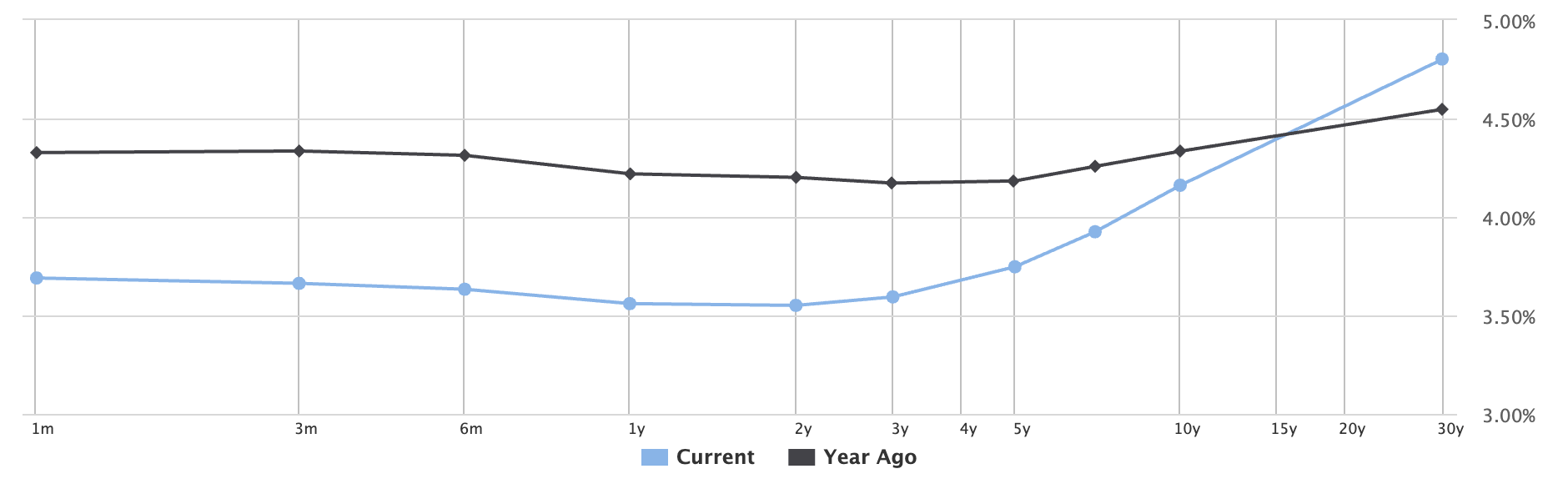
As impressive as that analysis proved to be, we know that bond math is very straightforward: the longer the maturity and the higher the yield, the greater the potential cost savings. Couple this reality with the fact that the U.S. Treasury yield curve has steepened during the last year, and you have the formula for far greater savings/cost reduction. In fact, the spread between 2-year Treasury notes and 30-year bonds has gone from 0.35% to 1.35% today. That extra yield is the gift that keeps on giving.

So, how does one use only 40% of the plan’s assets to take advantage of both bond math and the steepening yield curve when you’ve already told everyone that a full implementation CFM only covers the next 11-years? You do a vertical slice! A what? A vertical slice of the liabilities in which you use 40% of the assets to cover all of the future liabilities. No, you are not providing all of the liquidity necessary to meet monthly benefits and expenses, but you are providing good coverage while extending the defeasement out 30-years. Incredibly, by using this approach, we are able to reduce the future cost of those benefits not by an impressive 24%, but by an amazing 56.1%. In fact, we are reducing the future cost of those pension promises by a greater sum than the amount of assets used in the strategy.

Importantly, this savings or cost reduction is locked-in on day one. Yes, the day that the portfolio is built, that cost savings is created provided that we don’t experience a default. As an FYI, investment-grade corporate bonds have defaulted at a rate of 0.18% or about 2/1,000 bonds for the last 40-years according to S&P.

Can you imagine being able to reduce the cost of your future obligations by that magnitude and with more certainty than through any other strategy currently in your pension plan? What a great gift it is to yourself (sleep-well-at-night) and those plan participants for whom you are responsible. Want to see what a CFM strategy implemented by Ryan ALM can do for you? Just provide us with some basic info (call me at 201/675-8797 to find out what we need) and we’ll provide you with a free analysis. No gimmicks!

Do the Analysis! Remove the Guess Work.

By: Russ Kamp, CEO, Ryan ALM, Inc.

I am truly blessed working for an organization such as Ryan ALM, Inc. I am awed by the folks that I get to work with and the product/strategy that I get to represent. As a reminder, we’ve created a cash flow matching (CFM) strategy that brings an element of certainty to the management of pensions that should be welcomed by pension plan sponsors and their advisors far and wide. What other strategy can inform you on the day that the portfolio is constructed what the performance of that strategy will be for the full-term of the assignment (barring any defaults within investment grade bonds)? Name another strategy that can lay out the liquidity with certainty for each month (chronologically) of that assignment.

Given that liquidity is becoming a challenge as pension plans (mostly public) adopt a more aggressive asset allocation favoring alternative investments, using a CFM strategy that provides ALL the liquidity to meet ongoing benefits and expenses should be a decision that is easily embraced. Yet, our conversations with key decision makers often stall as other parties get involved in the “review”. To this day, I’m not sure what is involved in most of those conversations.

Are they attempting to determine that a traditional core fixed income strategy benchmarked to a generic index such as the BB Aggregate is capable of producing the same outcome? If so, let me tell you that they can’t and it won’t. Any fixed income product that is not managed against your plan’s specific liabilities will not provide the same benefits as CFM. It will be a highly interest rate sensitive product and performance will be driven by changes in interest rates. Do you know where U.S. rates are headed? Furthermore, the liquidity provided by a “core” fixed income strategy is not likely to be sufficient resulting in other investment products needing to be swept of their liquidity (dividends and capital distributions), reducing the potential returns from those strategies.  Such a cash sweep will reduce the ROA of these non-bond investments. Guinness Global’s study of S&P data for the last 85 years has shown that dividends and reinvestment of dividends account for 50% or more of the S&P returns for rolling 10- and 20-year periods dating back to 1940.

Are they trying to determine if the return produced by the CFM mandate will be sufficient to meet the return on asset assumption (ROA)? Could be, but all they need to realize is that the CFM portfolio’s yield will likely be much higher than the YTM of a core fixed income strategy given CFM’s 100% exposure to corporate bonds versus a heavy allocation to lower yielding Treasuries and agencies in an Agg-type portfolio. In this case, the use of a CFM strategy to replace a core fixed income mandate doesn’t impact the overall asset allocation and it certainly doesn’t reduce the fund’s ability to meet the long-term return of the program.

Instead of trying to incorporate all these unknown variables/inputs into the decision, just have Ryan ALM do the analysis. We love to work on projects that help the plan sponsor and their advisors come to sound decisions based on facts. There is no guess work. Importantly, we will construct for FREE multiple CFM portfolios, if necessary, to help frame the decision. Each plan’s liabilities are unique and as such, each CFM portfolio must be built to meet that plan’s unique liability cash flows.

All that is required for us to complete our analysis are the projected liability cash flows of benefits and expenses (contributions, too) as far into the future as possible. The further into the future, the greater the insights that we will create for you. We can use the current allocation to fixed income as the AUM for the analysis or you can choose a different allocation. We will use 100% IG corporates or you can ask us to use either 100% Treasuries/STRIPS or some combination of Treasuries and corporate bonds. We can defease 100% of the plan’s liabilities for a period of time, such as the next 10-years or do a vertical slice of a % of the liabilities, such as 50%, which will allow the CFM program to extend coverage further into the future and benefit from using longer maturity bonds with greater YTMs. Isn’t that exciting!

So, I ask again, why noodle over a bunch of unknowns, when you could have Ryan ALM provide you with a nearly precise evaluation of the benefits of CFM for your pension plan? When you hire other managers in a variety of asset classes, do they provide you with a portfolio up front? One that can give you the return that will be generated over a specific timeframe? No? Not surprised. Oh, and BTW, we provide our investment management services at a significantly lower fee than traditional core fixed income managers and we cap our annual fee once a certain AUM is reached. Stop the guess work. Have us do the work for you. It will make for a much better conversation when considering using CFM. Call me at 201/675-8797 or email me at rkamp@ryanalm.com for your free analysis. I look forward to speaking with you!

The Times They Are A-Changin’

By: Russ Kamp, CEO, Ryan ALM, Inc.

Thank you, Bob Dylan, for the lyric that is just perfect for this blog post. I have just returned from the IFEBP conference in Honolulu, HI. What a great conference, and not just because it was in Hawaii (my first time there). If it wasn’t the location, then what made this one so special? For years I would attend this conference and many others in our industry and never hear the word liability mentioned, as in the pension promise, among any of the presentations.

So pleased that during the last few years, as U.S. interest rates have risen and defined benefit pension funding has improved, not only are liabilities being discussed, but more importantly, asset allocation strategies focused on pension liabilities are being presented much more often. During this latest IFEBP conference there were multiple sessions on ALM or asset allocation that touched on paying heed to the pension plan’s liabilities, including:

“Asset Allocation for Today’s Markets”

“My Pension Plan is Well-Funded – Now What?”

“Asset Liability Matching Investment to Manage the Risk of Unfunded Liabilities”

“Decumulation Strategies for Public Employer Defined Contribution Plans” (they highlighted the fact that these strategies should be employed in DB plans, too)

“Applying Asset Liability Management Strategies to Your Investments” (my session delivered twice)

“Entering the Green Zone and Staying There”

These presentations all touched on the importance of risk management strategies, while encouraging pension plan sponsors to stop riding the performance rollercoaster. Given today’s highly uncertain times and equity valuations that appear stretched under almost any metric, these sessions were incredibly timely and necessary. Chasing a performance objective only ensures volatility. That approach doesn’t guarantee success. On the other hand, securing the pension promise through an ALM strategy at a reasonable cost and with prudent risk does redefine the pension objective appropriately.

I know that human beings are reluctant to embrace change, but we despise uncertainty to a far greater extent. Now is the time to bring an element of certainty to the management of pension assets. By the way, that was the title of my recent presentation to public funds at the NCPERS conference in Fort Lauderdale. Again, understanding pension liabilities and managing to them is not new, but it has certainly been under a bigger and brighter spotlight recently. That is great news!

Cash Flow Matching: Bringing Certainty to Pension Plans

By: Russ Kamp, CEO, Ryan ALM, Inc.

Imagine a world, or at least the United States, where pension plans are no longer subject to market swings and the uncertainty those swings create. What if you could “guarantee” (outside of any corporate bond defaults) the promises made to your plan participants, ensuring their financial security with confidence? In today’s highly unpredictable investing environment, relying solely on the pursuit of investment returns is a risky ride—one that guarantees volatility and sleepless nights but not necessarily success. It’s time to rethink how we manage defined benefit (DB) pension plans and embrace a strategy that brings true certainty: Cash Flow Matching (CFM). Discover through the hypothetical conversation below how CFM can transform your investing approach, protect your plan, and deliver peace of mind for everyone involved. Let’s go!

Why are we talking about Cash Flow Matching (CFM) today?

First off, thanks for taking a few minutes to chat with me. As you may have heard me say before, our mission at Ryan ALM, Inc. is simple — to protect and preserve defined benefit (DB) pension plans and to secure the promises made to participants.

We believe that Cash Flow Matching (CFM) is one of the few strategies that can help us keep those promises with real certainty.


Why Now?

Because the world feels more uncertain than ever.

And if we’re honest, most of us don’t like uncertainty. Yet somehow, in the pension world, many plan sponsors have gotten used to it. Why is that?

Over the years, we’ve been taught that managing a DB plan is all about chasing returns. But that’s not really the case. When a plan invests 100% of its assets purely with a return objective, it locks itself into volatility — not stability or success.

That approach also puts your plan on the “asset allocation rollercoaster,” where markets rise and fall, and contributions swing higher and higher along with them. It’s time to step off that ride — at least for part of your portfolio.


So if it’s not all about returns, what is the real objective?

Managing a DB pension plan is all about cash flows — aligning the cash coming in (from principal and interest on bonds) with the cash going out (for benefits and expenses).

The real goal is to secure those promised benefits at a reasonable cost and with prudent risk. That’s the foundation of a healthy plan.


Does bringing more certainty mean I have to change how I manage the plan?

Yes — but only a little. The adjustments are modest and easy to implement.


How can I adopt a CFM strategy without making major changes?

The first step is to reconfigure your asset allocation. Most DB plans are currently 100% focused on returns. It’s time to split your assets into two clear buckets:

  1. Liquidity bucket – designed to provide cash flow to pay benefits and expenses.
  2. Growth bucket – focused on long-term return potential.

What goes into the liquidity bucket?

Most plans already hold some cash and core fixed income. Those assets can move into the liquidity bucket to fund benefit payments and expenses.


And what happens with the remaining assets?

Nothing changes there. Those assets stay in your growth or alpha bucket. The difference is that you’ll no longer need to sell from that bucket during market downturns, which helps protect your fund from the negative impact of forced selling.


Is that all I need to do to create more certainty?

Not quite. You’ll also want to reconfigure your fixed income exposure.

Instead of holding a generic, interest-rate-sensitive bond portfolio (like one tied to the Bloomberg Aggregate Index), you’ll want a portfolio that matches your plan’s specific liabilities — using both principal and income to accomplish the objective.

That’s where true cash flow matching comes in.


How does the matching process work?

We start by creating a Custom Liability Index (CLI) — a model of your plan’s projected benefit payments, expenses, and contributions. This serves as the roadmap for funding your monthly liquidity needs.


What information do you need to build that index?

Your plan’s actuary provides the projected benefits, expenses, and contributions as far out into the future as possible. The more data we have, the stronger the analysis. From there, we can map out your net monthly liquidity needs after accounting for contributions.


Which bonds do you use to match the cash flows?

We invest primarily in U.S. Treasuries and U.S. investment-grade corporate bonds. We stick with these because they provide dependable cash flows without introducing currency risk.

We limit our selections to bonds rated BBB+ or higher, and the longest maturity we’ll buy matches the length of the mandate. For example, if you ask us to secure 10 years of liabilities, the longest bond we’ll buy will mature in 10 years.


Do you build a laddered bond portfolio?

No — a traditional ladder would be inefficient for this purpose.

Here’s why: the longer the maturity and the higher the yield, the lower the overall cost of funding those future liabilities. So instead of a simple ladder, we use a proprietary optimization process to build the portfolio in a way that maximizes efficiency and minimizes cost.


It sounds manageable — not a big overhaul. Am I missing something?

Not at all. That’s exactly right.

Dividing assets into liquidity and growth buckets and reshaping your bond portfolio into a CFM strategy is typically all that’s required to bring more certainty to part of your plan.

Every plan is unique, of course, so each implementation will reflect its own characteristics. But generally speaking, CFM can reduce the cost of future benefits by about 2% per year — or roughly 20% over a 10-year horizon.

On top of that, it helps stabilize your funded status and contribution requirements.


How much should I allocate to CFM?

A good starting point is your existing cash and bond allocation. That’s the least disruptive way to begin.

Alternatively, you can target a specific time horizon — for example, securing 5, 7, or 10 years of benefits. We’ll run an analysis to show what asset levels are needed to meet those payments, which may be slightly more or less than your current fixed income and cash allocations.


Once implemented, do I just let the liquidity bucket run down?

Most clients choose to rebalance annually to maintain the original maturity profile. That keeps the strategy consistent over time. Of course, the rebalancing schedule can be customized to your plan’s needs and the broader market environment.


This all sounds great — but what does it cost?

In line with our mission to provide stability at a reasonable cost and with prudent risk, our fee is about half the cost of a typical core fixed income mandate.

If you’d like, we can discuss your specific plan details and provide a customized proposal.


Final thoughts

Thank you for taking the time to explore CFM. Many plan sponsors haven’t yet heard much about it, but it’s quickly becoming a preferred approach for those who value stability and peace of mind.

At the end of the day, having a “sleep well at night” strategy benefits everyone — especially your participants.

An Alternative Pension Funding Formula

By: Russ Kamp, CEO, Ryan ALM, Inc.

I’ve spent the last few days attending and speaking at the FPPTA conference in Sawgrass, Florida. As I’ve reported on multiple occasions, I believe that the FPPTA does as good a job as any public fund organization of providing critical education to public fund trustees. A recent change to the educational content for the FPPTA centers on the introduction of the “pension formula” as one of their four educational pillars. In the pension formula of C+I = B+E, C is contributions, I is investment income (plus principal appreciation or depreciation), B is benefits, and E represents expenses.

To fund B+E, the pension fund needs to contribute an annual sum of money (C) not covered by investment returns (I) to fully fund liability cash flows (B+E). That seems fairly straightforward. If C+I = B+E, we have a pension system in harmony. But is a pension fund truly ever in harmony? With market prices changing every second of every trading day, it is not surprising that the forecasted C may not be enough to cover any shortfall in I, since the C is determined at the start of the year. As a result, pension plans are often dealing with both the annual normal cost (accruing benefits each year) and any shortfall that must be made up through an additional contribution amortized over a period of years.

As a reminder, the I carries a lot of volatility (uncertainty) and unfortunately, that volatility can lead to positive and negative outcomes. As a reminder, if a pension fund is seeking a 7% annual return, many pension funds are managing the plan assets with 12%-15% volatility annually. If we use 12% as the volatility, 1 standard deviation or roughly 68% of the annual observations will fall between 7% plus or minus 12% or 19% to -5%. If one wants to frame the potential range of results at 2 standard deviations or 19 out of every 20-years (95% of the observations), the expected range of results becomes 31% to -17%. Wow, one could drive a couple of Freightliner trucks through that gap.

Are you still comfortable with your current asset allocation? Remember, when the I fails to achieve the 7% ARC the C must make up the shortfall. This is what transpired in spades during the ’00s decade when we suffered through two major market corrections. Yes, markets have recovered, but the significant increase in contributions needed to make up for the investment shortfalls haven’t been rebated!

I mentioned the word uncertainty above. As I’ve discussed on several occasions within this blog, human beings loathe uncertainty, as it has both a physiological and mental impact on us. Yet, the U.S. public fund pension community continues to embrace uncertainty through the asset allocation decisions. As you think about your plan’s asset allocation, is there any element of certainty? I had the chance to touch on this subject at the recent FPPTA by asking those in the room if they could identify any certainty within their plans. Not a single attendee raised their hand. Not surprising!

As I result, I’d like to posit a slight change to the pension formula. I’d like to amend the formula to read C+I+IC = B+E. Doesn’t seem that dramatic – right? So what is IC? IC=(A=L), where A are the plan’s assets, while L= plan liabilities. As you all know, the only reason that a pension plan exists is to fund a promise (benefits) made to the plan participant. Yet, the management of pension funds has morphed from securing the benefits to driving investment performance aka return, return, and return. As a result, we’ve introduced significant funding volatility. My subtle adjustment to the pension formula is an attempt to bring in some certainty.

By carefully matching assets to liabilities (A=L) we’ve created an element of certainty (IC) not currently found in pension asset allocation. By adding some IC to the C+I = B+E, we now have brought in some certainty and reduced the uncertainty and impact of I. The allocation to IC should be driven by the pension plan’s funded status. The better the funding, the greater the exposure to IC. Wouldn’t it be wonderful to create a sleep-well-at-night structure in which I plays an insignificant role and C is more easily controlled?

To begin the quest to reduce uncertainty, bifurcate your plan’s assets into two buckets, as opposed to having the assets focused on the ROA objective. The two buckets will now be liquidity and growth. The liquidity bucket is the IC where assets and liabilities are carefully matched (creating certainty) and providing all of the necessary liquidity to meet the ongoing B+E. The growth portfolio (I) are the remaining plan assets not needed to fund your monthly outflows.

The benefits of this change are numerous. The adoption of IC as part of the pension formula creates certainty, enhances liquidity, buys-time for the growth assets to achieve their expected outcomes, and reduces the uncertainty around having 100% of the assets impacted by events outside of one’s control. It is time to get off the asset allocation and performance rollercoaster. Yes, recent performance has been terrific, but as we’ve seen many times before, there is no guarantee that continues. Adopt this framework before markets take no prisoners and your funded status is once again challenged.

Source Ryan – Question of the Day.

By: Russ Kamp, CEO, Ryan ALM, Inc.

We often get comments and questions following the posting of a blog. We welcome the opportunity to exchange ideas with interested readers. Here is a recent comment/question from a LinkedIn.com exchange.

Question: In reviewing the countless reports, reading past agendas, and meeting minutes for these 20 plans, I did not notice any CFM or dedicated fixed income strategies employed by any of them. Perhaps there are a couple that I missed that do, or perhaps some have since embarked on such a strategy. Why wouldn’t public fund plan sponsors use Cash Flow Matching (CFM)?

There really isn’t a reason why they shouldn’t as pointed out by Dan Hougard, Verus, in his recent excellent piece, but unfortunately, they likely haven’t begun to use a strategy that has been used effectively for decades within the insurance industry, by lottery systems, and early on in pension management. Regrettably, plan sponsors must enjoy being on the rollercoaster of returns that only guarantees volatility and not necessarily success. Furthermore, they must get excited about trying to find liquidity each month to meet the promised benefits by scrambling to capture dividend income, bond interest, or capital distributions. If this doesn’t prove to be enough to meet the promises, they then get to liquidate a holding whether it is the right time or not.

In addition, there must be a particular thrill about losing sleep at night during periods of major market disruptions. Otherwise, they’d use CFM in lieu of a core fixed income strategy that rides its own rollercoaster of returns mostly driven by changes in interest rates. Do you know where rates are going? I certainly don’t, but I do know that next month, the month after that, followed by the one after that, and all the way to the end of the coverage period, that my clients will have the liquidity to meet the benefit promises without having to force a sale in an environment that isn’t necessarily providing appropriate liquidity.

The fact that a CFM strategy also eliminates interest rate risk because benefit payments are future values, while also extending the investing horizon for the fund’s growth assets are two additional benefits. See, there really is NO reason not to retain a cash flow matching expert like Ryan ALM, Inc. to bring certainty to the management of pensions that have lived with great uncertainty. In doing so, many plans have had to dramatically increase contributions, alter asset allocation frameworks to take on significantly more risk, while unfortunately asking participants to increase employee contributions, work more years, and receive less at retirement under the guise of pension reform. Let’s stop doing the same old same old and explore the tremendous benefits of Cash Flow Matching. Your plan participants will be incredibly grateful.

WHY?

By: Russ Kamp, CEO, Ryan ALM, Inc.

Why do we have two different accounting standards in the U.S. for valuing pension liabilities?

Why does it make sense to value liabilities at a rate (ROA) that can’t be used to defease pension liabilities in this interest rate environment?

Why do we continue to create an asset allocation framework that only guarantees volatility and not success?

Why do we think that the pension objective is a return objective (ROA) when it is the liabilities that need to be funded and secured?

Why haven’t we realized that plowing tons of plan assets into an asset class/strategy will negatively impact future returns?

Why are we willing to pay ridiculous sums of money in asset management fees with no guaranteed outcome?

Why is liquidity to meet benefits an afterthought until it becomes a major issue?

Why does it make sense that two plans with wildly different funded ratios have the same ROA?

Why are plan sponsors willing to live with interest rate risk in the core bond allocations?

Why do we think that placing <5% in any asset class is going to make a difference on the long-term success of that plan?

Why do we think that moving small percentages of assets among a variety of strategies is meaningful?

Why do we think that having a funded ratio of 80% is a successful outcome?

Why are we incapable of rethinking the management of pensions with the goal to bring an element of certainty to the process, especially given how humans hate uncertainty?

WHY, WHY, WHY?

If you are as confused as I am with our current approach to DB pension management, try cash flow matching (CFM) a portion of your plan. With CFM you’ll get a product that SECURES the promised benefits at low cost and with prudent risk. You will have a carefully constructed liquidity bucket to meet benefits and expenses when needed – no forced selling in challenging market environments. Importantly, your investing horizon will be extended for the growth (alpha) assets that haven’t been used to defease liabilities. We know that by buying time one dramatically improves the probability of a successful outcome. Furthermore, your pension plan’s funded status will be stabilized for that portion of the assets that uses CFM. This is a dynamic asset allocation process that should respond to improvement in the plan’s funded status. Lastly, you will be happy to sit back and watch the mayhem in markets unfold knowing that you don’t have to do anything except sleep very well at night.

Oh, The Games That Are Played!

By: Russ Kamp, Managing Director, Ryan ALM, Inc.

Managing a defined benefit pension plan should be fairly straightforward. The plan sponsor has made a promise to each participant which is based on time of service, salary, and a multiplier as the primary inputs. The plan sponsor hires an actuary to do the nearly impossible of predicting the future benefits, administrative expenses, salaries, mortality, etc., which for the most part, they do a terrific job. Certainly in the short-term. Since we have a reasonable understanding of what that promise looks like, the objective should be to SECURE that promise at a reasonable cost and with prudent risk. Furthermore, sufficient contributions should be made to lessen the dependence on investment returns, which can be quite unstable.

Yet, our industry has adopted an approach to the allocation of assets that has morphed from focusing on this benefit promise to one designed to generate a target return on assets (ROA). In the process, we have placed these critically important pension funds on a rollercoaster of uncertainty. How many times do we have to ride markets up and down before we finally realize that this approach isn’t generating the desired outcomes? Not only that, it is causing pension systems to contribute more and more to close the funding gap.

Through this focus on only the asset-side of the equation, we’ve introduced “benchmarks” that make little sense. The focus of every consultant’s quarterly performance report should be a comparison of the total assets to total liabilities. When was the last time you saw that? Never? It just doesn’t happen. Instead, we get total fund performance being compared to something like this:

Really?

Question: If each asset class and investment manager beat their respective benchmark, but lost to liability growth, as we witnessed during most of the 2000s: did you win? Of course not! The only metric that matters is how the plan’s assets performed relative to that same plan’s liabilities. It really doesn’t matter how the S&P 500 performed or the US Govt/Credit index, or worse, a peer group. Why should it matter how pension fund XYZ performed when ABC fund has an entirely different work force, funded status, ability (desire) to contribute, and set of liabilities?

It is not wrong to compare one’s equity managers to an S&P or Russell index, but at some point, assets need to know what they are funding (cash flows) and when, which is why it is imperative that a Custom Liability Index (CLI) be constructed for your pension plan. Given the uniqueness of each pension liability stream, no generic index can ever replicate your liabilities.

Another thing that drives me crazy is the practice of using the same asset allocation whether the plan is 60% funded or 90% funded. It seems that if 7% is the return target, then the 7% will determine the allocation of assets and not the funded status. That is just wrong. A plan that is 90% funded has nearly won the game. It is time to take substantial risk out of the asset allocation. For a plan that is 60% funded, secure your liquidity needs in the short-term allowing for a longer investment horizon for the alpha assets that can now grow unencumbered. As the funded status improves continue to remove more risk from the asset allocation.

DB plans are too critically important to continue to inject unnecessary risk and uncertainty into the process of managing that fund. As I’ve written on a number of occasions, bringing certainty to the process allows for everyone involved to sleep better at night. Isn’t it time for you to feel great when you wake up?

Different Levels of Certainty

By: Russ Kamp, Managing Director, Ryan ALM, Inc.

A friend of mine in the industry emailed me a copy of Howard Marks’ latest memo titled, “The Folly of Certainty”. As they normally are, this piece is excellent. As regular readers of this blog know, I’ve encouraged plan sponsors and their advisors to bring more certainty to defined benefit plans through a defeasement strategy known as cash flow matching. I paused when I read the title, thinking, “oh, boy”, I’m at odds with Mr. Marks and his thoughts. But I’m glad to say after reading the piece that I’m not.

What Howard is referring to are the forecasts, predictions, and/or estimates made with little to no doubt concerning the outcome. He cited a few examples of predictions that were given with 100% certainty. How silly. Forecasts always come with some degree of uncertainty (standard deviation around the observation), and it is the humble individual who should doubt, to some degree, those predictions. I’ve often said that hope isn’t an effective investment strategy, but that thought doesn’t seem to have resonated with a majority of the investment community.

Ryan ALM’s pursuit of greater certainty is brought about through our ability to create investment grade bond portfolios whose cash flows match with certainty (barring a default) the liability cash flows of benefits and expenses. We accomplish this objective through our highly sophisticated and trade-marked optimization model. We are not building our portfolios with interest rate forecasts, based on economic variables that come with a very high degree of uncertainty. No, we build our portfolios based on the client’s specific liability cash flows and implement them in chronological order. Importantly, once those portfolios are created, we’ve locked in a significant cost reduction that is a function of the rate environment and the length of the mandate.

As stated previously, I have a great appreciation for Howard Marks and what he’s accomplished. He is absolutely correct when he questions any forecast that has little expectation for being wrong. In most cases, the forecaster is not in control of the outcome, which should lend itself to being more cautious. In the case of the Ryan ALM cash flow matching strategy, we are in control. Having the ability to bring some certainty in our pursuit of securing the promised benefits should be greatly appreciated by the plan sponsor community. Because of the uncertain economic environment that we are currently living in, bringing some certainty should be an immediate goal. Care to learn more?