ARPA Update as of December 20, 2024

By: Russ Kamp, Managing Director, Ryan ALM, Inc.

Happy Holidays from all of us at Ryan ALM, Inc. We wish you and yours a joyous holiday season and a spectacular 2025 filled with great health, abundant friendships, and calm markets.

Despite the onset of the holiday season, the PBGC was still at work implementing the ARPA legislation. Santa arrived early for one plan, as Roofers Local No. 75 Pension Fund received approval for its SFA grant. They will receive $6.8 million for the 275 plan participants. This was the initial filing for this non-priority group member. Congrats!

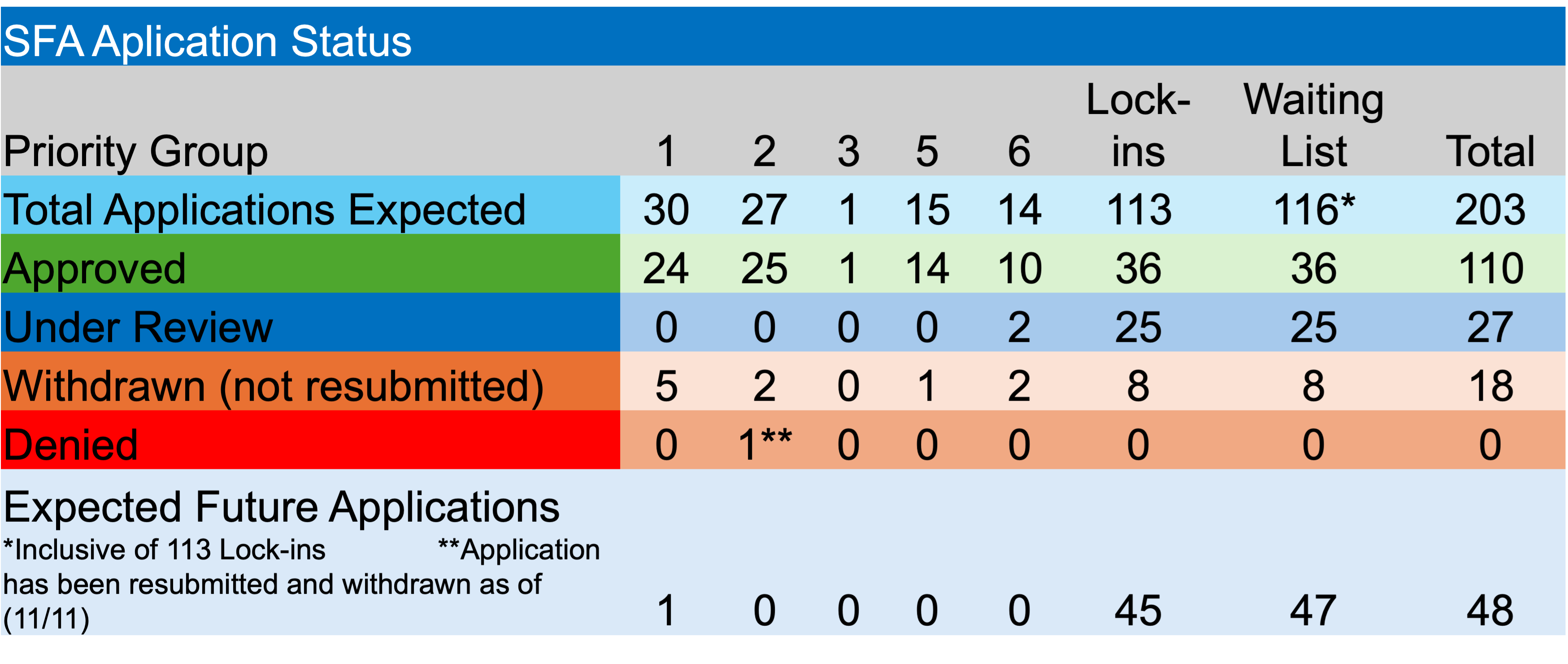
In other ARPA-related news, there were no new applications submitted as the PBGC’s efiling portal remains temporarily closed. There are currently 28 applications under review, including one Priority Group 5 member and two Priority Group 6 members. Fortunately, there were no applications denied or withdrawn during the previous week.

Lastly, there was one fund that repaid excess SFA assets due to census errors. Gastronomical Workers Union Local 610 and Metropolitan Hotel Association Pension Fund repaid $696k (or 2.09%) after receiving $33.3 million in SFA. This fund is one of only 3 to repay SFA in excess of 2% of the grant received. In total, $159.3 million has been repaid on grants of more than $41 billion or 0.38% of the allocations.

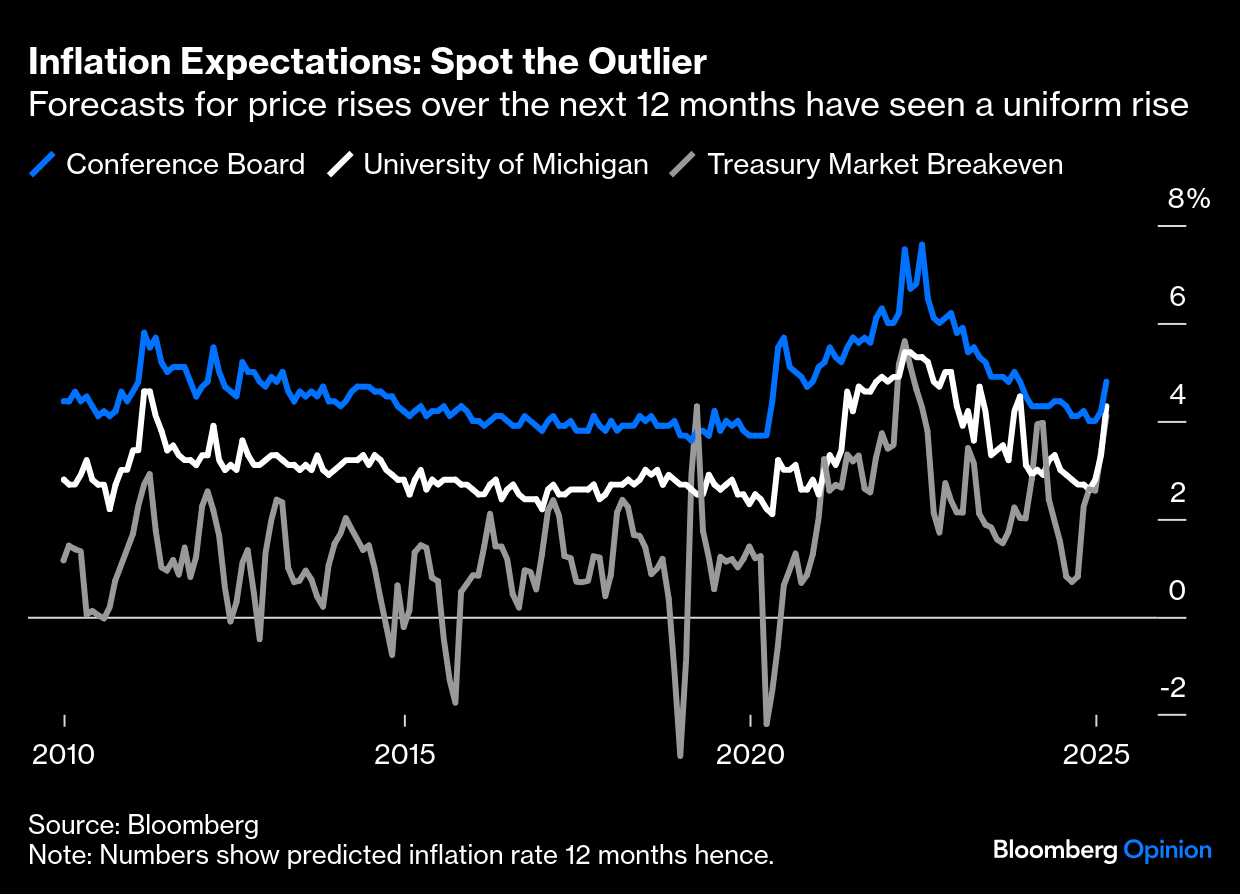
The Bloomberg chart below demonstrates the significant rise in U.S. rates during the last month. Recipients of SFA funds would be wise to secure the promised benefits with 100% of the grant money. Equity markets appear to be quite frothy. Time to reduce risk, while taking full advantage of the higher interest rates.

U.S. Avoids Shutdown – No Agreement on Debt Ceiling Limit

Congress avoided an unnecessary shutdown on Friday evening. Regrettably, they did not address the debt limit kicking the can once more. They now have until March 14, 2025 to address the silliness of a debt ceiling. See my post from Friday that speaks to the idiocy of a debt limit.

One of Only Two – Time For Change

By: Russ Kamp, Managing Director, Ryan ALM, Inc.

The United States of America and Denmark share several commonalities. Both countries have democratic political systems. Each country enjoys a high standard of living. Both have a commitment to human rights and environmental concerns, with Denmark being a leader in renewable energy and sustainability, while the U.S. is witnessing a growing movement on those fronts. Both countries value education, enjoying high literacy rates. There is also a shared military alliance through NATO. What you might not realize is that the U.S. and Denmark are the ONLY countries that have a self-imposed statutory debt limit. Sure, there are other countries, such as Switzerland, that have mandatory balanced budget provisions which effectively limit the amount of debt , but they aren’t specified debt limits.

The U.S. first instituted a statutory debt limit with the Second Liberty Bond Act of 1917, setting the aggregate amount of debt that could be accumulated through individual categories like bonds and bills. The purpose in creating this legislation was to finance the country’s involvement in World War 1. The legislation allowed the U.S. to raise $9.5 billion in bonds that would be issued by the U.S. government. These bonds were marketed to the general population and to institutional investors to gain their support for the war. Was there a First Liberty Bond Act? Yes, that act had been passed earlier in 1917 allowing the government to issue $2 billion in bonds in order to support the war.

Importantly, and why we are where we are today with regard to the current deficit, the Second Liberty Bond Act program continued after the war. It set a precedent for public financing of government initiatives through bond sales. Although the debt limit was established in 1917 which allowed the Treasury to issue bonds without specific Congressional approval, the “limit” has been raised more than 100 times since then and roughly 78 times since 1960 alone. As a result, the US debt has risen from around $250 billion during World War II, to about $2.1 trillion during the Reagan years, to $5.6 trillion at the conclusion of the 1990s, and to today’s $36 trillion. So, why do we have a debt limit when it has been elevated so many times previously and to a magnitude certainly not contemplated in 1917?

The political brinkmanship associated with the debt limit debate rarely serves a purpose, often unnecessarily frightening Americans and our capital market participants. As we brace for another “discussion”, is maintaining a debt “limit” at all necessary? NO! Today’s federal deficit is in no way constraining to future generations. I’ve referenced Warren Mosler and his book, “The 7 Deadly Innocent Frauds of Economic Policy” on many occasions. He covers the topic of our government debt and whether we are leaving our debt-burden to our children, grandkids, etc. Mosler states, “the idea of our children being somehow necessarily deprived of real goods and services in the future because of what’s called the national debt is nothing less than ridiculous.”

As Mosler explains, that the financing of deficit spending is of “no consequence”. He further explains that when the “government spends, it just changes numbers up in our bank accounts.” The government doesn’t borrow money, it moves funds from checking accounts at the Fed to savings accounts (Treasury securities) at the Fed. The good news, is that the entire federal deficit ($36 trillion or so) is nothing more than the economy’s total holdings of savings accounts at the Federal Reserve. The private sector now has an asset equivalent to the deficit. How wonderful! Can you imagine if we didn’t have the ability to deficit spend. Think of all the stimulus that would have been removed from our economy that supported jobs, wages, and demand for goods and services.

The major issue with our ability to deficit spend has nothing to do with financing it, but everything to do with providing too much stimulus that creates demand for goods and services that exceeds our economy’s ability to meet such demand. So, I ask again, does having a debt limit (ceiling) make sense? No, unless you enjoy all the grandiose speeches from the halls of Congress based on little knowledge of how our monetary system truly works. Finally, I’d like to give a special nod to Charles DuBois, my former colleague at Invesco, who spent hours educating me on this subject. Thanks, Chuck!

5.6% 10-year forecast for US All-Cap

By: Russ Kamp, Managing Director, Ryan ALM, Inc.

Fiducient Advisors has published its 2025 Outlook. Given the strong performance in US equity markets, future returns have been adjusted downward – rightfully so. Here are some of the highlights:

Full valuations, concentrated U.S. large-cap indexes and the risk of reigniting inflation are shaping the key themes we believe will drive markets and portfolio positioning in 2025.

-Recent market successes have pushed our 2025 10-year forecasts lower across most major asset classes. Long-term return premium for equities over fixed income is now at its narrowest since 2007, sparking important conversations about portfolio posture and risk allocation.

Rising reinflation risk leads us to increase our allocation to more flexible fixed income strategies (dynamic bonds) and TIPS while eliminating our global bond allocation.

US stock market performance has been heavily influenced by the “Magnificent Seven”, creating concentration risk not seen in decades, if ever. The outperformance of US markets vis-a-vis international markets is unprecedented. As stated above, valuations are stretched. Most metrics used to measure “value” in our markets are at extreme levels, if not historical. How much more can one squeeze from this market? As a result, Fiducient is forecasting that US All-Cap (Russell 3000?) will appreciate an annualized 5.6% for the next 10-years.

Nearly as weak are the forecasts for private equity, which Fiducient believes will produce only an annualized 8.6% return through the next 10-years. What happened to the significant “premium” that investing privately would provide? Are the massive flows into these products finally catching up with this asset class? Sure seems like it.

With regard to the comment about fixed income, I’m not sure that I know what “flexible fixed income strategies” are and the reference to dynamic escapes me, too. I do know that bonds benefit from lower interest rates and get harmed when rates rise. We have been very consistent in our messaging that we don’t forecast interest rates as a firm, but we have also written extensively that the inflation fight was far from over and that US growth was more likely to surprise on the upside than reflect a recessionary environment. Today, the third and final installment of the Q3’24 GDP forecast was revised up to 3.1% annual growth. The Q4’24 estimate produced by the Atlanta Fed through its GDPNow model is forecasting 3.2% annual growth. What recession?

Given that US growth is likely to be stronger, employment and wage growth still robust, and sticky inflation just that, bonds SHOULDN’T be used as a performance instrument. Bonds should be used for their cash flows of interest and principal. BTW, one can buy an Athene Holding Ltd (ATH) bond maturing 1/15/34 with a YTW of 5.62% today. Why invest in US All-Caps with a projected 5.6% return with all of that annual standard deviation when you can buy a bond, barring a default and held to maturity, will absolutely provide you with a 5.62% return? This is the beauty in bonds! Those contractual cash flows can be used, and have been for decades, to defease liabilities (pension benefits, grants, etc.) and to SECURE the promises made to your participants.

It is time to rethink the approach to pension management and asset allocation. Use a cash flow matching strategy to secure your benefits for the next 10-years that buys time for the growth assets to GROW, as they are no longer a source of liquidity. Equity markets may not provide the same level of appreciation as they have during the last decade (+13.4% annualized for the S&P 500 for 10-years through 11/30/24), but a defeased bond portfolio will certainly provide you with the necessary liquidity, an extended investing horizon, and the security (peace of mind) of knowing that your benefits will be paid as promised and when due! Who needs “flexible and dynamic” bonds when you have the security of a defeased cash flow matching strategy?

P&I: Asset Owner CIOs See Uncertainty in 2025

By: Russ Kamp, Managing Director, Ryan ALM, Inc.

P&I is out with a story today about asset owner CIOs “forecasting” uncertainty for 2025. The capital markets are always uncertain. It only takes a “surprise” to disrupt even the most obvious trend. Given a new regime in Washington, stubborn inflation, geopolitical risks throughout the globe, and equity valuations that are stretched (that’s putting it mildly), CIOs have reason to be uncertain, especially over a short timeframe, such as a calendar year or two.

The lack of certainty can be destabilizing to individuals and investment strategies. I covered the psychology of uncertainty in a post earlier this year. Here were a few highlights:

  • When facing ongoing uncertainty, our bodies stay at a high level of physiological arousal, exerting considerable wear and tear.
  • Uncertainty exerts a strong pull on our thoughts and inhibits our ability to act, leaving us in a suspended waiting game.
  • We can manage uncertainty by figuring out what we can control, distracting ourselves from negative thoughts, and reaching out to others.

The last point is particularly important. We can manage “uncertainty” by figuring out what we can control. As a plan sponsor, we can utilize an investment strategy (cash flow matching or CFM) that creates certainty for the portion of the portfolio that uses CFM. In the following post, I question the significant use of equity and equity-like product in public pension systems that are accompanied by tremendous annual volatility. Again, this produces great uncertainty.

Adopting the use of greater fixed income exposure also doesn’t ensure less uncertainty, as changes in US interest rates can play havoc on fixed income strategies. ONLY with a CFM strategy do you bring certainty of cash flows (absent any defaults) to the management of pension plans. Traditional fixed income strategies benefited from a nearly 4-decade move down in rates, but there is currently great uncertainty as to the future direction of inflation and as a result, rates. With CFM one knows what the performance will look like a decade from now. With a fixed income strategy focused on a generic index, such as the BB Aggregate, one has no idea how that portfolio will perform 10 or more years from now.

Lastly, there is no reason to live with the uncertainty that many CIOs currently foresee. I wrote a piece just recently on achieving “peace of mind“. Uncertainty won’t help you in your quest for a good night’s sleep, but achieving peace of mind is very much achievable once you adopt a CFM strategy and secure the promised benefits (or grants) for some period of time. Call us. We want to remove as much uncertainty from your professional life as possible.

ARPA Update as of December 13, 2024

By: Russ Kamp, Managing Director, Ryan ALM, Inc.

Welcome to the last full week before the Christmas season kicks off. Most investors will be sorry to see 2024 come and go. For the PBGC, 2024 has been a year of great accomplishments, with the approval of Special Financial Assistance (SFA) for 35 multiemployer plans covering 458,171 participants with SFA grants totaling $16.2 billion – wow!

The last week was a continuation of the PBGC’s activity with seven more funds submitting applications seeking $638.2 million for nearly 27k members. The applications included five new submissions and 2 revised applications. The applicants included the Dairy Industry-Union Pension Plan for Philadelphia and Vicinity, Bricklayers Pension Fund of West Virginia, United Wire, Metal and Machine Pension Plan, Distributors Association Warehousemen’s Pension Trust, Local 945 I.B. of T. Pension Plan, Alaska Teamster – Employer Pension Plan, and the Local 888 Pension Fund. Grant requests ranged from United Wire’s $228.5 million to the Bricklayers $1.96 million for their 170 participants.

In addition to the new submissions, there was one approval. Teamsters Local 11 Pension Plan will receive $29.3 million for the 2,012 members of its plan. This North Haledon, NJ fund submitted a revised application on August 29, 2024. In other ARPA news, there were no applications denied or withdrawn during the previous 7 days. In addition, there were no new plans added to the waitlist or forced to repay a portion of the SFA due to census errors.

US Treasury interest rates backed up fairly significantly last week as inflation data came in a little higher than recent trends giving bonds investors reason to challenge the narrative that the Fed would continue pushing down the Fed Funds rate. The higher rates are providing plan sponsors with greater cost savings on future benefits through cash flow matching strategies.

Kamp Named CEO of Ryan ALM, Inc.

By: Ronald J. Ryan, CFA, CEO, Ryan ALM, Inc.

Press Release

________________________________________________________________________________

Russ Kamp Named CEO of Ryan ALM, Inc.

Effective 1/01/25 Russ Kamp will be the new CEO of Ryan ALM, Inc.

Ronald J. Ryan, CFA will become the Chairman and CFO. Ron announces “Ryan ALM has prospered in a rather difficult environment for fixed income asset managers in the last 20 years. As founder and CEO, it is time to pass the torch to someone who has the vision and talent to take us forward. Russ has demonstrated a professionalism and integrity that is most respected by his peers. His attention to client needs is unsurpassed. His resume is proof of his abilities and success. It is an honor to work with Russ. I will remain as head of research and a member of our asset management team. I look forward to the best years ahead for Ryan ALM working with Russ and our highly experienced team.”

Steve deVito, head of trading, will also become the Chief Compliance Officer of Ryan ALM. Steve has nearly 40 years of fixed income experience and serves as an important member of the asset management team.

Martha Monteagudo, head of product development, will continue in her position. She started with Ryan ALM in 2004 and is a valuable member of the asset management team.

As our name implies, Ryan ALM is an Asset Liability Manager (ALM) specializing in cash flow matching. We strongly believe that cash flow matching is the best fit for any liability objective. Our cash flow matching product (Liability Beta Portfolio™) can reduce funding costs by about 2% per year (about 20% on 1-10-year liabilities). Our turnkey system is unique in the industry including:

  1.  Custom Liability Index (CLI)
  2. ASC 715 Discount Rates
  3. Liability Beta Portfolio™ (LBP)
  4. Modified Asset Exhaustion Test (AET)

The Ryan ALM asset management team has over 160 years of experience making us one of the most experienced teams in the fixed income industry. For more information, please go to our web site at www.RyanALM.com.

How Comforting is $1,305.54/year?

By: Russ Kamp, Managing Director, Ryan ALM, Inc.

One doesn’t have to spend much time on LinkedIn.com these days without seeing a discussion about the pros and cons of Defined Benefit (DB) vs. Defined Contribution (DC) aka 401(k) plans. Anyone who has read just a few of the >1,500+ posts on this blog know that I and Ryan ALM, Inc. are huge supporters of DB plans. Based on the following, it becomes apparent why that is the case.

One topic frequently mentioned among our peers is financial literacy. As a former member of two boards of education (11 years in total), I have witnessed first-hand how little financial literacy is shared with our high school students, especially as it relates to saving and investing. That said, as important as education is, the greatest issue for me is the lack of disposable income for the average American worker.

Frequently we read about the spending habits of younger generations, including being the “avocado toast” crowd. Examples often used include the daily purchase of a Starbucks drink or two, the use of Uber Eats, and similar examples of perceived wasteful spending. They fail to mention that even “well-paid” workers (>$100k) are burdened by a mortgage or rent payment, they likely have student loan debt, they have to buy insurance in order to use their car, which is also a very expensive purchase, they are required to have health insurance, homeowners or rental insurance, and God forbid that they have a spouse and a couple of kids. Childcare expenses have gotten to be insane. Is there any wonder that funding one’s own retirement has proven to be incredibly challenging?

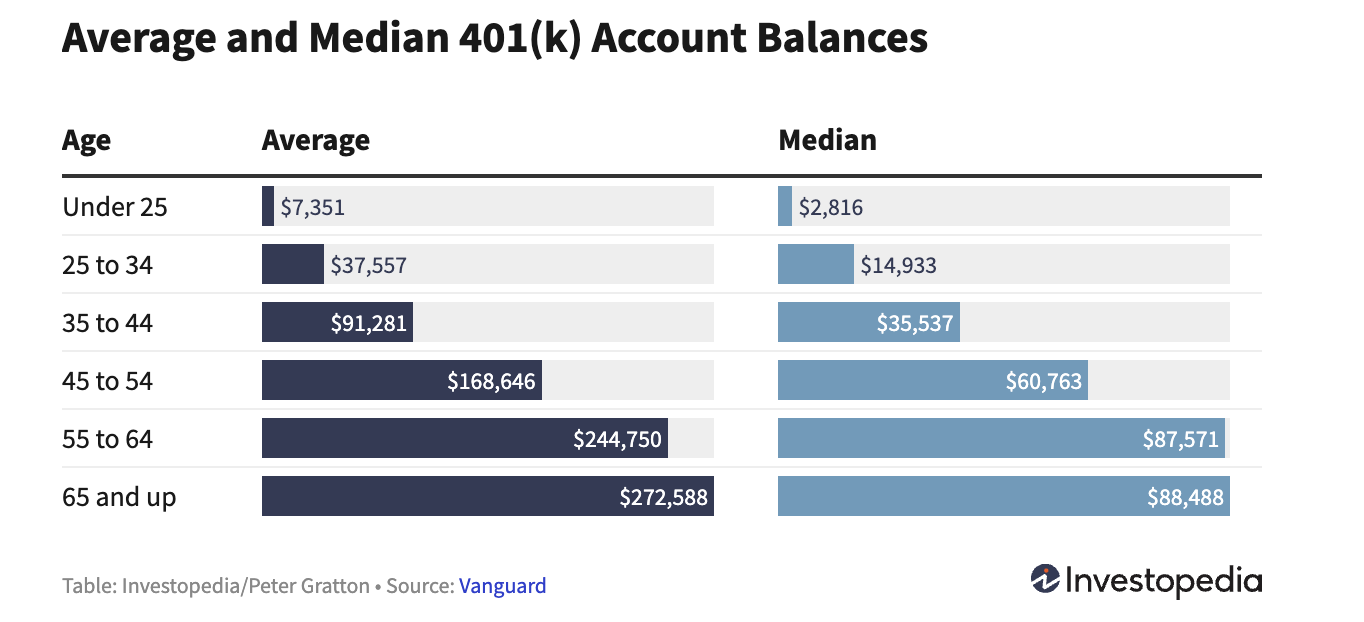
So how are we doing? Unfortunately, most of the literature on the subject uses average balances to represent 401(k) savings. This practice needs to stop. According to Vanguard the average balance in 2024 is $134,128, but the median balance is $35,285. In addition, Morningstar has just published an article stating that retirees should use only a 3.7% withdrawal rate (no longer 4%) to safely use a 401(k) retirement balance given the recent performance of equity markets and the current interest rate environment. Let’s see: 3.7% * $35,285 = $1,305.54. That is an annual withdrawal, although it looks like it should be a monthly payout! What kind of retirement will that level of annual withdrawals provide? For comparison purposes, the average DB payout in the private sector is $11k and nearly $25k in public pensions.

As a reminder, DC plans were intended to be supplemental to DB plans. It is highly regrettable that they have morphed into most everyone’s primary means of “accumulating” retirement resources. This migration in proving to be an unmitigated failure and the consequences will be untenable. The American worker needs access to a DB plan. Let’s work together to protect and preserve those that remain, while encouraging former sponsors of these plans to rethink the decision to freeze or terminate. There are also state sponsored entities that afford employees in smaller companies access to a DB-like plan. That said, please manage them with a focus on the pension promise (securing benefits). Don’t rely on markets and all the volatility that comes with that exposure to “fund” these essential programs. That strategy hasn’t worked!

Corporate Pension Funding Improves, Again: Milliman

By: Russ Kamp, Managing Director, Ryan ALM, Inc.

The Milliman 100 Pension Funding Index (PFI) has once again been produced (View the complete Pension Funding Index). The index, which includes the largest 100 U.S. corporate pension plans, reveals a positive change in the funded ratio for November 2024. Asset growth of 1.88% lifted the combined assets of these 100 plans by $18 billion, which was more than enough to overcome growth in the present value of the future benefit payments ($13 billion). The funded ratio improved to 103.5% from October’s 103.2%.

The discount rate for valuing pension liabilities now stands at 5.21% as of November 30, 2024. The current rate represents a 10 basis point decline from the end of October. “November saw the second consecutive month of improvement in the PFI funded ratio, with the 1.88% investment gain more than offsetting the rise in plan liabilities caused by falling discount rates,” said Zorast Wadia, author of the PFI.

Given the incredible performance of risk assets during the last two years, valuations appear very stretched. Many corporate plans have reduced risk through ALM strategies, including cash flow matching (CFM). It may be time to reduce asset allocation risk to a greater extent, especially for those plans that continue to manage the pension’s assets in a more traditional approach.

ARPA Update as of December 6, 2024

By: Russ Kamp, Managing Director, Ryan ALM, Inc.

You have to be excited as a Mets fan given yesterday’s news that Juan Soto will be joining the organization on a massive contract. The $765 million is a staggering figure. Let’s see what happens to ticket prices and TV streaming services from a cost standpoint.

Since ARPA was passed in 2021 and signed into law in March of that year, there have been folks upset that the government is using “tax revenue” to rescue pensions for multiemployer plans. Well, in the latest update provided by the PBGC, we note that the Pressroom Unions’ Pension Plan, a non-priority group member, will receive $63.7 million to protect and preserve the promised pensions for 1,344 plan participants. That seems very reasonable since this grant will likely cover these benefit payments for roughly the same time frame that Soto will be a Met (15 years), at only $12.7 million more than just one year of Soto’s contract.

In other ARPA news, the e-filing portal is listed as “limited”, which according to the PBGC means that “the e-Filing Portal is open only to plans at the top of the waiting list that have been notified by PBGC that they may submit their applications. Applications from any other plans will not be accepted at this time.” PA Local 47 Bricklayers and Allied Craftsmen Pension Plan was the only plan to file an application (revised) last week. They are seeking $8.3 million in SFA for 296 members in the fund.

In other news, three funds, including Toledo Roofers Local No. 134 Pension Plan, Freight Drivers and Helpers Local Union No. 557 Pension Plan, and PACE Industry Union-Management Pension Plan, were asked to repay a total of $7 million in excess SFA due to census issues. The rebate represented 0.45% of the $1.6 billion received in SFA grants. Happy to report that there were no applications denied or withdrawn during the prior 7-day period.

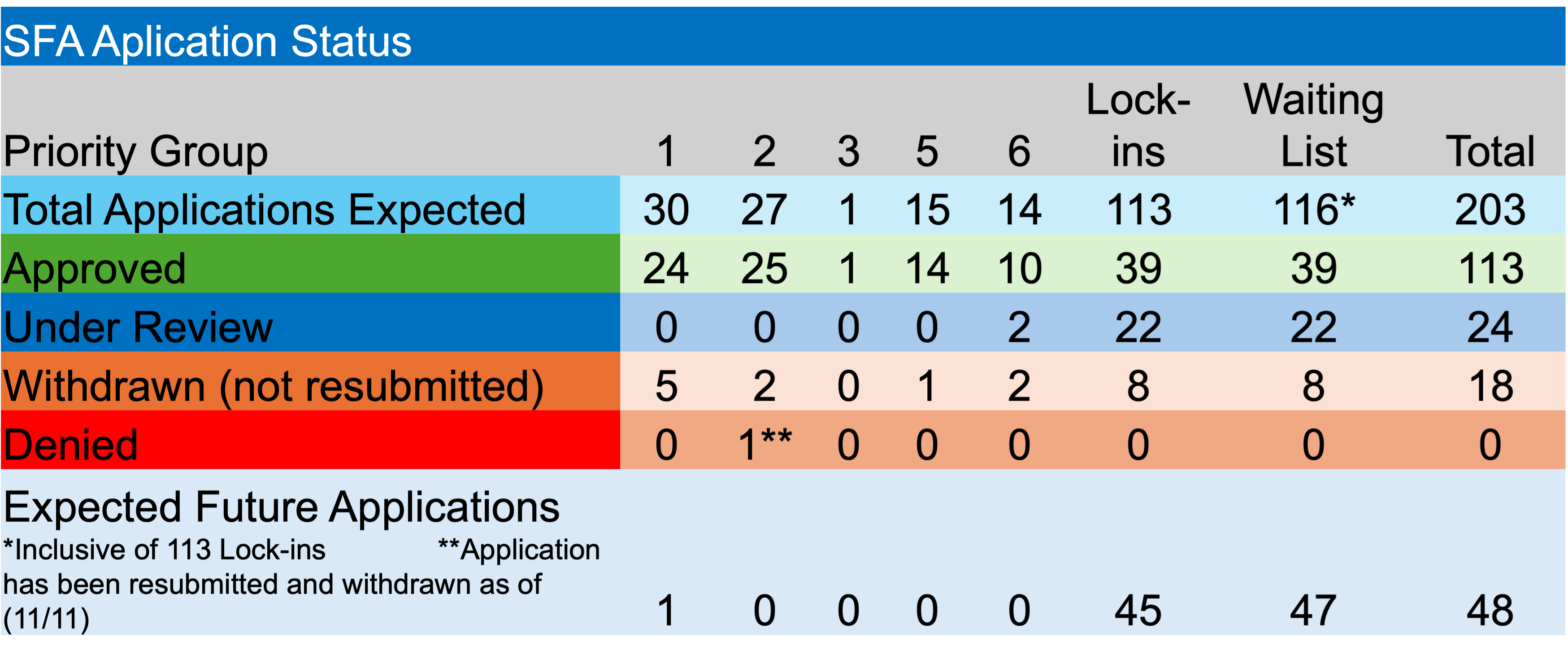
As the chart above highlights, there are still 57 plans that have yet to file an application seeking SFA support. Estimates range from another $10 – $20 billion being allocated to the remaining entities.