Real GDP Exceeding Real Potential GDP

By: Russ Kamp, CEO, Ryan ALM, Inc.

I was introduced to the St. Louis Fed’s amazing data base – FRED – many years ago by a former Invesco colleague. What is FRED? According to the St. Louis Fed’s website, “FRED is short for Federal Reserve Economic Data, and FRED is an online database consisting of hundreds of thousands of economic data time series (presently >825k) from scores of national, international, public, and private sources. FRED, created and maintained by the Research Department at the Federal Reserve Bank of St. Louis, goes far beyond simply providing data: It combines data with a powerful mix of tools that help the user understand, interact with, display, and disseminate the data.”

FRED is an amazing tool, but the purpose of this blog today is not to laud FRED, but to highlight two data series that I have followed for several years – Real GDP and Real Potential GDP. Real GDP is self-explanatory, but what is Real Potential GDP? “Real potential GDP is the CBO’s estimate of the output the economy would produce with a high rate of use of its capital and labor resources. The data is adjusted to remove the effects of inflation.” The data series starts in Q1’49 and currently runs to Q4’2034, which forecasts Real GDP to be $27.8 trillion at that time. Real GDP is currently (Q4’24) at $23.5 trillion.

Currently, Real GDP is exceeding what the CBO believes is the Real Potential GDP for our economy by a record amount of $616 billion in $ terms or about 2.5%. If you believe that the CBO’s estimate of potential GDP is close to reality, then it shouldn’t be surprising that inflation remains an issue, despite the marginal improvement disclosed earlier this week (core CPI at 3.1%). As my former colleague and mentor, Charles DuBois has said, “if government spending (or private spending, for that matter) exceeds the economy’s real resources available to absorb that spending, then inflation will likely result.” That’s where we are today, folks.

The growing and fairly consistent fiscal deficit continues to provide stimulus to the private sector (all spending = all income) creating demand for goods and services that exceeds the natural capacity of our economy as measured by the CBO despite the Fed’s aggressive action to temper some of that demand through elevated interest rates, which began in March 2022. While this relationship exists, it makes sense for the Fed to pause its easing of rates, which they seem to have at this time, but we’ll get more insight when they meet next week.

Also reflected in the graph above, previous peaks in Real GDP exceeding the CBO’s Real Potential GDP (’73, ’78, ’89, ’99, ’07) have been followed by economic and market disruptions, some quite significant. What does that portend for today’s market given the current levels?

Lessons Learned?

By: Russ Kamp, CEO, Ryan ALM, Inc.

My wife and I are rewatching The West Wing, and we are often amazed (disappointed) by how many of the social issues discussed 20 years ago when the show first aired that are still being debated today. It really just seems like we go around in circles. Well, unfortunately, the same can be said about pensions and supposed pension reforms. We need to reflect on what lessons were learned following the Great Financial Crisis of 2007-2009, when pension America saw its funded status plummet and contribution expense dramatically escalate. Have we made positive strides?

Unfortunately, with regard to the private sector, we continued to witness an incredible exodus from defined benefit plans and the continued greater reliance on defined contribution plans, which is proving to be a failed model. That activity appears to have benefited corporate America, but how did that action work for plan participants, who are now forced to fund, manage, and then disburse a “retirement” benefit through their own actions, which is asking a lot from untrained individuals, who in many cases don’t have the discretionary income to fund these programs in the first place.

With regard to public pension systems, we saw a lot of “action”. There were steps to reduce the return on asset assumption (ROA) for many systems – fine. But, that forced contributions to rise rapidly, creating a greater burden on state and municipal budgets that resulted in the siphoning off of precious financial resources needed to fund other social issues. In addition, there was great activity in creating additional benefit “tiers” (tears?), in which newer plan participants, and some existing members, were asked to fund more of their benefit through new or greater employee contributions, longer tenures before retirement, and more modest benefits to be paid out at retirement. Again, I would argue are not pension lessons learned, but are in fact benefit cuts for plan participants.

Fortunately, for multiemployer plans, ARPA pension legislation has gone a long way to securing the funded status and benefits for 110 plans that were once labeled as Critical or worse, Critical and Declining. There are another 90 pension plans or so to go through the application process in the hopes of securing special financial assistance. But have we seen true pension reform within these funds and the balance of plans that had not fallen into critical status?

It seems to me that most of the “lessons learned” have nothing to do with how DB pension plans are managed, but rather asks that plan participants bear the consequences of a failed pension model. A model that has focused on the ROA as if it were the Holy Grail. Pension plans should have been focused on the promise (benefit) that was made to their participants, and not on how much return they could generate. The focusing on a return target has certainly created a lot more uncertainty and volatility. As we’ve been reporting, equity and equity-like exposure within multiemployer and public pension systems was greater coming into 2025 then the levels that they were in 2007. What lesson was learned?

Pension America is once again suffering under the weight of declining asset values and falling interest rates. When will we truly learn that continuing to manage DB plans with a focus on return is NOT correct? The primary objective needs to be the securing of the promised benefits at a reasonable cost and with prudent risk. Shifting wads of money into private equity or private credit and thinking that you’ve diversified away equity exposure is just silly. I don’t know what the new administration’s policies will do for growth, inflation, interest rates, etc. I do know that they are currently creating a lot of angst among the investment community. Bring some certainty to the management of pensions through a focus on the promise is superior to continuing to ride the rollercoaster of performance.

ARPA Update as of March 7, 2025

By: Russ Kamp, CEO, Ryan ALM, Inc.

It is often said that March comes in like a lion and goes out like a lamb. This phrase is typically associated with weather patterns, but it may just be appropriate in describing the PBGC’s effort last week. As you will soon find out, there was a little bit of nearly everything last week.

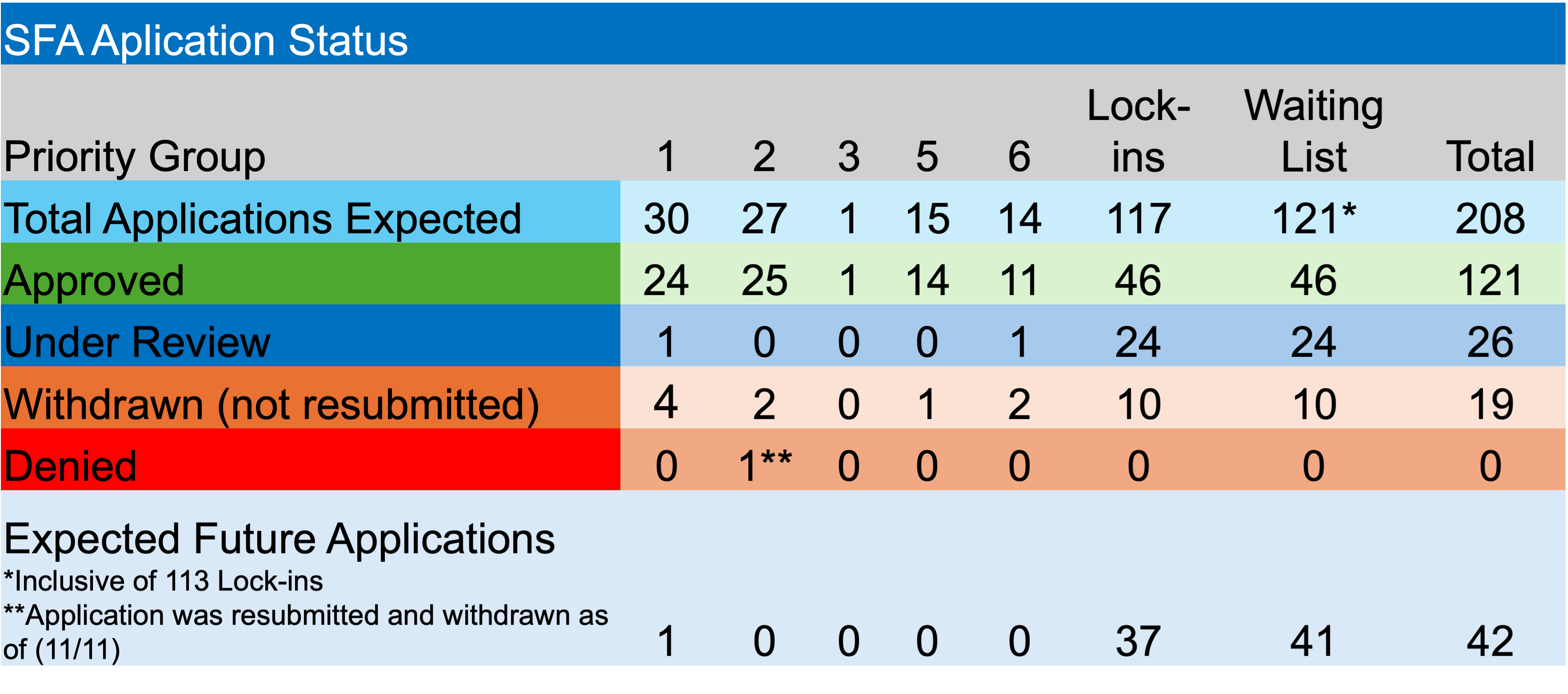
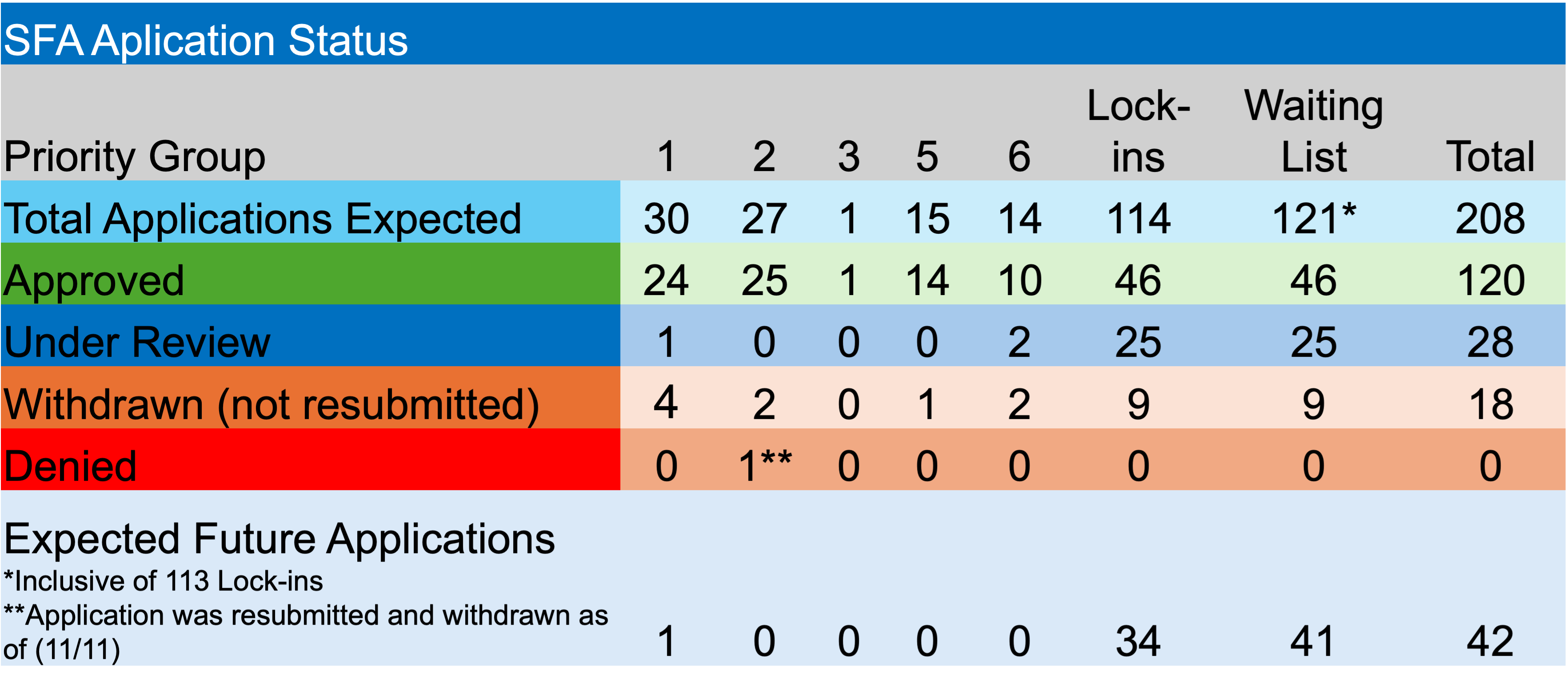
The good news, Southwestern Pennsylvania and Western Maryland Area Teamsters and Employers Pension Fund, a Priority Group 5 member, received approval for the revised application. They are expected to receive $131.1 million in SFA for their 2,759 members. There have now been 14 of 15 Group 5 members to receive approval. One application needs to be refiled after having been withdrawn some time ago.

In other news, the PBGC’s eFiling portal remained open long enough for U.F.C.W. District Union Local Two and Employers Pension Fund to submit a revised application seeking $125.5 million plus interest for 5,546. This plan had withdrawn its non-priority group application earlier on that day (3/5/25). The PBGC’s note indicates that this application’s review is being expedited, although they have still given themselves the 120-days to complete the review (7/3/25).

In addition to this filing, Local 584 Pension Trust Fund repaid a portion of the SFA as a result of census errors. They returned just over $1 million from the $225.8 million that they received or 0.46%. There have now been 43 plans, from 60 that potentially received excess funds, that have combined to repay $181.9 million from the total of $43.9 billion that was initially paid to these plans. That represents 0.41% of the SFA grants. Furthermore, it only represents 0.26% of the total SFA paid to date ($71.02 billion).

Despite the significant effort to date, the PBGC still has approximately 93 applications to get through, including 48 yet to be submitted. This process needs to be completed by the end of 2026.

Reminder: Pension Liabilities are Bond-like

By: Russ Kamp, CEO, Ryan ALM, Inc.

Milliman has released the results for their corporate pension index. The Milliman 100 Pension Funding Index (PFI), which tracks the 100 largest U.S. corporate pension plans showed deterioration in the funded ratio dropping from 106.0% to the 104.8% as of month-end. This was the first decline following four consecutive months of improvement. It was the fall in the discount rate from 5.60% to 5.36% during the month that lead to growth in the combined liabilities for the index constituents. As a reminder, pension liabilities (benefit payments) are just like bonds in terms of their interest rate sensitivity. As yields fall, the present value of those future promises escalate.

Milliman reported an asset gain of $18 billion during the month, but that wasn’t nearly enough to offset the growth in liabilities creating a $13 billion decline in funded status. “Gains in fixed income investments helped shore up the Milliman 100 pension assets, but were not strong enough to counter the sharp discount rate decline,” said Zorast Wadia, author of the PFI. Given the uncertain economic and capital markets environments, it is prudent to engage at this time in a strategy to effectively match asset and liability cash flows to reduce the volatility in the funded ratio. Great strides have been made by America’s private pensions. Allowing the assets and liabilities to move independently could result in significant volatility of the funded status leading to greater contribution expenses.

You can view the complete pension funding report here.

Markets Hate Uncertainty

By: Russ Kamp, CEO, Ryan ALM, Inc.

I’ve published many posts on the impact of uncertainty on the well-being of individuals and our capital markets. In neither case are the outcomes positive.

What we are witnessing in the last several trading days is the direct result of policy flip-flopping that is creating abundant uncertainty. As a result, the business environment is deteriorating. One can argue the merits of tariffs, but it is the flip-flopping of these policy decisions that is wreaking havoc. How can a business react to these policies when they change daily, if not hourly.

The impact so far has been to create an environment in which both investment and employment have suffered. Economic uncertainty is currently at record levels only witness during the pandemic. Rarely have we witnessed an environment in which capital expenditures are falling while prices are increasing, but that is exactly what we have today. Regrettably, we are now witnessing expectations for rising input prices, which track consumer goods inflation. It has been more than four decades since we were impacted by stagflation, but we are on the cusp of a repeat last seen in the ’70s. How comfortable are you?

We just got a glimpse of how bad things might become for our economy when the Atlanta Fed published a series of updates driving GDP growth expectations down from a high of +3.9% earlier in the quarter to the current -2.4% published today. The key drivers of this recalibration were trade and consumer spending. The uncertainty isn’t just impacting the economy. As mentioned above, our capital markets don’t like uncertainty either.

I had the opportunity to speak on a panel last week at Opal/LATEC discussing Risk On or Risk Off. At that point I concluded that little had been done to reduce risk within public pension plans, as traditional asset allocation frameworks had not been adjusted in any meaningful way. It isn’t too late to start the process today. Action should be taken to reconfigure the plan’s asset allocation into two buckets – liquidity and growth. The liquidity bucket will provide the necessary cash flow in the near future, while buying time for the growth assets to wade through these troubled waters. Doing nothing subjects the entire asset base to the whims of the markets, and we know how that can turn out.

A Retirement is Out of the Question for Many – Unfortunately!

By: Russ Kamp, CEO, Ryan ALM, Inc.

Is there such a thing as a retirement anymore? According to Fidelity’s Q4 2024 Retirement Analysis, 41% of “retirees” are working, have worked, or are currently seeking work. I would guess that the need to work is strongly correlated to the demise of the DB pension plan.

In other Fidelity news, a big deal was made out of the fact that 527k participants had account balances >$1 million (2.2% of their account holders), but despite those attractive balances, the “average” balance was still only 131k at year-end following two incredible years of growth for the S&P 500 specifically, and equities generally, especially if you rode the tech sector.

Regrettably, there was once again NO mention of the median account balance, which we know is rather anemic. Can the providers of 401(k)s, IRAs, and 403(b)s, please stop highlighting average accounts which are clearly skewed by the much larger balances of a few participants? According to an analysis provided earlier this year by Investopedia, median account balances at Vanguard were dramatically lower than average accounts. As the chart below highlights, there was not a median balance within 40% of the average balance. In fact, those 65-years-old and up had an account balance at 32% of the average balance. I can’t imagine that this ratio would be much different at Fidelity or any other provider of defined contribution accounts.

It is truly unfortunate that a significant percentage of the American workforce will never enjoy the rewards of a dignified retirement. My Dad, who just recently passed at age 95, enjoyed a 34-year retirement as a result of receiving a modest DB pension benefit. That monthly payment coupled with my parents Social Security enabled them to enjoy their golden years. Providing this opportunity for everyone needs to be the goal of our retirement industry.


Note: Fidelity’s 401(k) analysis covers 26,700 corporate DC plans and 24.5 million participants.

What’s Your Duration?

By: Russ Kamp, CEO, Ryan ALM, Inc.

The recent rise in U.S. Treasuries had us redoubling our effort to encourage plan sponsors of U.S. pension plans to take some risk off the table by using cash flow matching (CFM) to defease a portion of the plan’s liabilities, given all the uncertainties in the markets and our economy. We were successful in some instances, but for a majority of Pension America, the use of CFM is still not the norm. Instead, many sponsors and their advisors have elected to continue to use highly interest rate sensitive “core” fixed income offerings most likely benchmarked to the Bloomberg Barclays Aggregate Index (Agg).

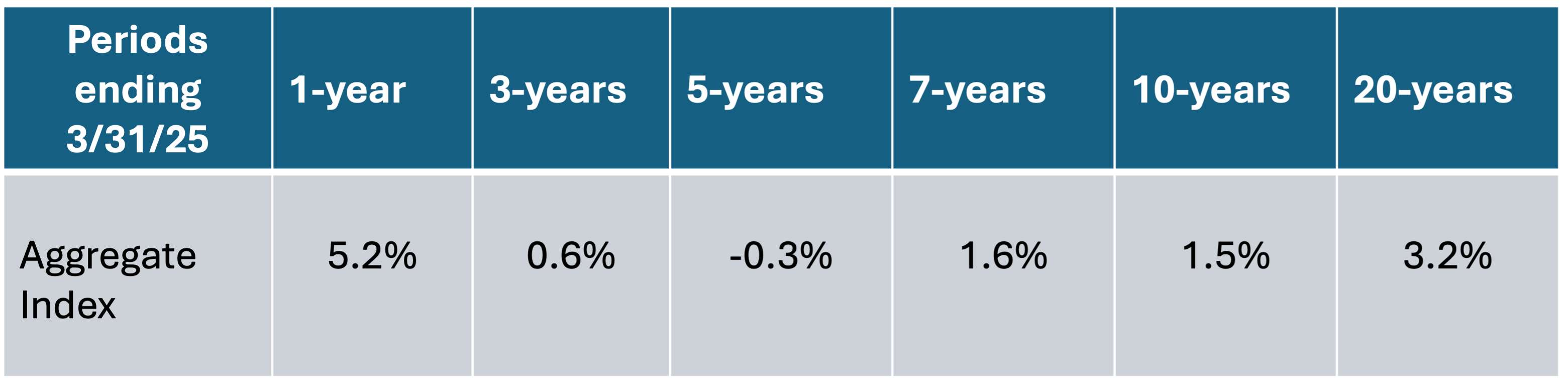
For those plan sponsors that maintained the let-it-ride mentality, they are probably celebrating the fact that Treasury rates have fallen rather significantly in the last week or so as a result of all of the uncertainties cited above – including inflation, tariffs, geopolitical risk, stretched equity valuations, etc. Their “core” fixed income allocation will have benefited from the decline in rates, but by how much? The Bloomberg Barclays Aggregate Index (Agg) has a duration of 6.1 years and a YTW of 4.58%, as of yesterday. YTD performance had the Agg up 2.78%. Not bad for fixed income 2+ months into the new year, but again, equities have been spanked in the last week, and the S&P 500 is down -3.1% in the last 5 days. So, maintaining that exposure sure hasn’t been beneficial.

Also, remember that the duration of the average DB pension plan is around 12 years. Given the 12-year duration, the price movement of pension liabilities, which are bond-like in nature, is currently twice that of the Aggregate index. A decline in rates might help your core fixed income exposure, but it is doing little to protect your plan’s funded status/funded ratio. The use of CFM would have insulated your plan from the interest rate risk associated with your pension liabilities. As rates fell, both assets and the present value of those liabilities would have appreciated, but in lockstep! The funded status for that segment of your asset allocation would have been insulated.

Why wait to protect your hard work in getting funded ratios to levels not seen in recent years? A CFM strategy provides numerous benefits, including providing liquidity on a monthly basis to ensure that benefits and expenses are met when due, reducing the cost to fund liabilities by 20% to 40% extending the investing horizon allowing for choppy markets to come and go with little impact on the plan, and protecting your funded status which helps mitigate volatility in contributions. Seems pretty compelling to me.

ARPA Update as of February 28, 2025

By: Russ Kamp, CEO, Ryan ALM, Inc.

Welcome to March!

We are pleased to provide you with the latest update on the PBGC’s implementation of the ARPA pension legislation. The last week saw moderate activity, as the PBGC’s eFiling portal was temporarily open providing three funds, Local 810 Affiliated Pension Plan, Aluminum, Brick & Glass Workers International Union, AFL-CIO, CLC, Eastern District Council No. 12 Pension Plan, and Sheet Metal Workers’ Local No. 40 Pension Plan the opportunity to submit revised applications seeking Special Financial Assistance. The PBGC has until June 26, 2025, to act on the applications that combined are seeking $112.6 million in SFA for 3,001 plan participants.

In addition to the above-mentioned filings, one pension fund, Roofers and Slaters Local No. 248 Pension Plan, a Chicopee, MA-based fund, withdrew its initial application that was looking for roughly $8.4 million in SFA for 202 members of the plan. As I said, there was moderate activity last week. Fortunately, no multiemployer pension plans were denied SFA and no other plans repaid excess SFA as a result of census issues. There were also no plans approved or added to the waitlist, which contains the names of 116 plans, of which 47 have yet to submit an application.

As you may recall, I wrote a post last week titled, “A Little Late to the Party!“. The gist of the article had to do with an effort on the part of a couple of Congressmen to get the Justice Department involved in the repayment of any excess SFA funds that have been distributed to the 60 funds that received SFA prior to the use by the PBGC of the Social Security Administrations Death File Master. As I’ve reported, this process is well underway (41 funds have repaid a portion of the SFA to date), having begun back in April with the Central States plan. It is unfortunate that pension plans used to have access to this master file, but that ability was rescinded years ago over privacy concerns. ARPA has been a huge success. The repayment of excess SFA should not taint the tremendous benefit that this legislation has brought.

Milliman Reports on Public Pension Funding

By: Russ Kamp, CEO, Ryan ALM, Inc.

Milliman has released details related to the recent update of its Milliman 100 Public Pension Funding Index (PPFI) covering both December 2024 and January 2025. The index consisting of the U.S.’s largest 100 public pension funds revealed a slight decline in the average funded ratio at the end of 2024 to 80.0% from 81.7% at November 30. An average return of -1.7% on assets drove the funded ratio down. However, January’s result highlighted a 1.9% average gain and an improvement in the average funded ratio to 81.1% at month-end.

It was also reported that the deficit between plan assets and liabilities grew by $44 billion, as a deficit of $1.184 trillion at the beginning of December 2024 became $1.227 trillion at the end of January 2025. These mega funds experienced combined outflows of about $9 billion/month. Importantly, 31 of the index constituents have funded ratios greater than 90% with 7 of those plans registering a funded ratio of 105% or better. Unfortunately, 9 of the plans have funded ratios <50%. As a reminder, a plan with a 50% funded status and a 7% ROA objective actually needs to produce a return of 14% just to keep the funded status from deteriorating…and a 80% funded status requires an actual ROA of 8.75%.

It would be interesting to know what asset allocation changes, if any, have been adopted by those plans with funded ratios >90%. Given significant uncertainty in the markets and the U.S. economy, plans should be looking to reduce risk and improve liquidity at this time. We’ve seen considerable improvement in the funded status of a number of large public pension systems. It would be a tragedy to see this improved funding go to waste should markets enter a period of weakness.

Risk On or Risk Off?

By: Russ Kamp, CEO, Ryan ALM, Inc.

I have the pleasure of speaking at the Opal/LATEC conference on Thursday. My panel has been given the topic of Risk On or Risk Off: How Are You Adjusting Your Portfolio, and Which Investment Risks Concern You Most? I think it is an incredibly timely discussion given the many cross-currents in the markets today.

Generally speaking, what is risk? At Ryan ALM, Inc. we would say that risk is the failure to achieve the objective. What is the objective in managing a defined benefit pension plan? We believe that the primary objective is to secure the promised benefits at a reasonable cost and with prudent risk. We don’t believe that it is a return objective.

However, most DB pension systems are NOT focused on securing the promised benefits, but they are engaged in developing an asset allocation framework that cobbles together diversified (overly perhaps) asset classes and investment strategies designed to achieve an annual return (ROA) target that has been established through the contributions of the asset consultant, actuary, board of trustees, and perhaps internal staff, if the plan is of sufficient size to warrant (afford) an internal management capability.

Once that objective has been defined, the goal(s) will be carefully addressed in the plan’s investment policy statement (IPS), which is a road map for the trustees and their advisors to follow. It should be reviewed often to ensure that those goals still reflect the trustees’ wishes. The review should also incorporate an assessment of the current market environment to make sure that the exposures to the various asset classes reflect today’s best thinking.

There are numerous potential risks that must be assessed from an investment standpoint. Some of those include market (beta), credit, liquidity, interest rates, and inflation. For your international managers, currency and geopolitical risk must be addressed. From the pension management standpoint, one must deal with both operational and regulatory risk. Some of these risks carry greater weight, such as market risk, but each can have an impact on the performance of your pension plan.

However, there are going to be times when a risk such as inflation will dominate the investing landscape (see 2022). Understanding where inflation MAY be headed and its potential impact on interest rates and corporate earnings is a critical input into how both bonds and stocks will likely perform in the near-term. Being able to assess these potential risks as a tool to adjust your funds asset allocation could reduce risk and help mitigate the negative impact of significant drawdowns that will impact the plan’s funded status and contribution expenses. Of course, the ability to reduce or increase exposures will depend on the ranges that have been established around asset class exposures (refer to your IPS).

So, where are we today? Is it risk on or risk off as far as the investing community is concerned? It certainly appears to me that most investors continue to take on risk despite extreme equity valuations, sticky, and perhaps worsening inflation, leading to an uncertain path for U.S. interest rates, and geopolitical risk that can be observed in multiple locations from the Middle East, to Ukraine/Russia, and China/Taiwan. The recent change in the administration and policy changes related to the use of tariffs has created uncertainty, if not anxiety, among the investment community.

So, how are you adjusting your portfolio? If your plan is managed similarly to most where all the assets are focused on the ROA, the ability to adjust allocations based on the current environment is likely limited to those ranges that I described above. Also, who can market time? I would suggest that the best way to adjust your portfolio given today’s uncertainty is to adopt an entirely different asset allocation framework. Instead of having all of the assets focused on that ROA objective, bifurcate your asset allocation into liquidity and growth buckets.

By adopting this strategy, liquidity is guaranteed to be available when needed to make those pesky monthly benefit payments. In addition, you’ve just bought time, an extremely important investment tenet, for the remainder of the assets (growth/alpha) to now grow unencumbered. The liquidity bucket will provide a bridge over choppy waters churned up by underperforming markets. Yes, there appears to be significant uncertainty in today’s investment environment. Instead of throwing up your hands and accepting the risks because you have limited means to act, adopt the new asset allocation structure before it is too late to protect your plan’s funded status.