ARPA Update as of April 11, 2025

By: Russ Kamp, CEO, Ryan ALM, Inc.

For those observing, may you have a good Passover and a Happy Easter. I was busy this past weekend stuffing 220 eggs with goodies for our 11 grandkids! Let’s hope that weather cooperates. I’m not overly confident on that happening given that we actually had snow during the weekend in northern NJ.

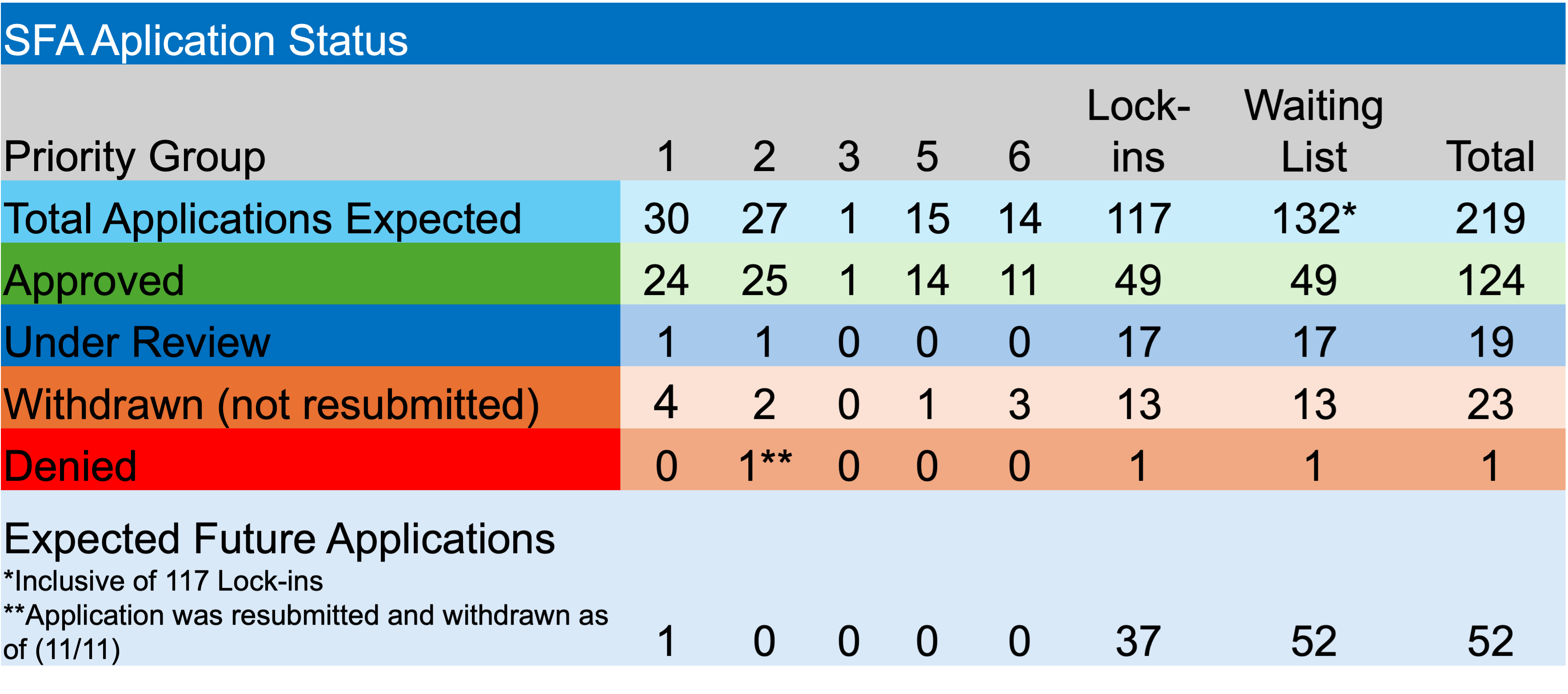
With regard to ARPA and the PBGC’s implementation of this critical legislation, three more plans received approval of their applications during the past week. Bricklayers Pension Fund of West Virginia (revised), United Wire, Metal and Machine Pension Plan (initial), and Local 945 I.B. of T. Pension Plan (revised), all non-priority group members, will receive a combined $289.1 million in Special Financial Assistance (SFA), including interest and FA loan repayments. This brings the total number of pension plans receiving SFA to 119 funds and more than $71.6 billion in grants.

There was no apparent activity beyond the approvals mentioned above, as the PBGC’s eFiling portal remains temporarily closed. The prior week also saw no applications withdrawn or denied, no excess SFA repaid, and no new plans added to the waitlist.

Of the 87 pension plans with a priority designation, 74 have now received approval for an SFA grant (85%) – outstanding! The PBGC still has quite a bit of work to do with 85 plans still in the queue for approval. Fortunately, the challenging capital markets have seen U.S. interest rates rise providing plan sponsors recipients of the SFA to realize greater cost savings and extended coverage through cash flow matching strategies. There is little reason to take on unnecessary risk while uncertainty rules the day.

What Was The Purpose?

By: Russ Kamp, CEO, Ryan ALM, Inc.

I was introduced to the brilliance of Warren Mosler through my friend and former colleague, Chuck DuBois. It was Chuck who encouraged me to read Mosler’s book, “The 7 Deadly Innocent Frauds of Economic Policy”. I would highly recommend that you take a few hours to dive into what Mosler presents. As I mentioned, I think that his insights are brilliant.

The 7 frauds, innocent or not, cover a variety of subjects including trade, the federal deficit, Social Security, government spending, taxes, etc. Regarding trade and specifically the “deficit”, Mosler would tell you that a trade deficit inures to the benefit of the United States. The general perception is that a trade deficit takes away jobs and reduces output, but Mosler will tell you that imports are “real benefits and exports are real costs”.

Unlike what I was taught as a young Catholic that it is better to give than to receive, Mosler would tell you that in Economics, it is much better to receive than to give. According to Mosler, the “real wealth of a nation is all it produces and keeps for itself, plus all it imports, minus what it exports”. So, with that logic, running a trade deficit enhances the real wealth of the U.S.

Earlier this year, the Atlanta Fed was forecasting GDP annual growth in Q1’25 of 3.9%, today that forecast has plummeted to -2.4%. We had been enjoying near full employment, moderating yields, and inflation. So, what was the purpose of starting a trade war other than the fact that one of Mosler’s innocent frauds was fully embraced by this administration that clearly did not understand the potential ramifications. They should have understood that a tariff is a tax that would add cost to every item imported. Did they not understand that inflation would take a hit? In fact, a recent survey has consumers expecting a 6.7% price jump in goods and services during the next 12-months. This represents the highest level since 1981. Furthermore, Treasury yields, after initially falling in response to a flight to safety, have marched significantly higher.

Again, I ask, what was the purpose? Did they think that jobs would flow back to the U.S.? Sorry, but the folks who suffered job losses as a result of a shift in manufacturing aren’t getting those jobs back. Given the current employment picture, many have been employed in other industries. So, given our full-employment, where would we even get the workers to fill those jobs? Again, we continue to benefit from the trade “imbalance”, as we shipped inflation overseas for decades. Do we now want to import inflation?

It is through fiscal policy (tax cuts and government spending) that we can always sustain our workforce and domestic output. Our spending is not constrained by other countries sending us their goods. In fact, our quality of life is enhanced through this activity.

It is truly unfortunate that the tremendous uncertainty surrounding tariff policy is still impacting markets today. Trillions of $s in wealth have been eroded and long-standing trading alliances broken or severely damaged. All because an “innocent” fraud was allowed to drive a reckless policy initiative. I implore you to stay away from Social Security and Medicare, whose costs can always be met since U.S. federal spending is not constrained by taxes and borrowing. How would you tell the tens of millions of Americans that rely on them to survive that another innocent fraud was allowed to drive economic policy?

Milliman – Corporate Pension Funding Falls in March

By: Russ Kamp, CEO, Ryan ALM, Inc.

Milliman has just released its monthly Milliman 100 Pension Funding Index (PFI), which analyzes the 100 largest U.S. corporate pension plans. Weak investment returns, estimated at -1.4%, drove the PFI asset level down by $25 billion during March. Current assets for the top 100 plans are now $1.3 trillion. The fall in assets was only partially offset by the rise in the discount rate (13 bps) during the month. As a result, the surplus fell by $7 billion to $51 billion as of March 31, 2025.

The discount rate ended the month at 5.49%, which reduced plan liabilities by $18 billion, to $1.25 trillion by the end of March. As a result of assets falling by more than liabilities, the PFI funded ratio dropped from 104.6% at the end of February to 104.1% at the end of March. For the quarter, discount rates fell 10 basis points and the Milliman 100 plans lost $8 billion in funded status.   

“While the slight rise in discount rates in March led to a monthly decline in plan liabilities, plan assets fell even further due to poor market performance, which caused the funded status to fall below the 104.8% level seen at the beginning of 2025,” said Zorast Wadia, author of the PFI. Given market action during the first 10 days of April, it will be interesting to see if the impact from rising rates can offset the dramatic fall in asset values. Inflation fears fueled by tariffs could lead to rising bond yields, which will help mitigate some of the risk to equities given the possibility of declining earnings. As Zorast mentioned in the Milliman release, “plan sponsors will want to consider asset-liability matching strategies to preserve their balance sheet gains from last year”, especially given that 30-year corporates are once again yielding close to 6%.

Ryan ALM, Inc. Q1’25 Newsletter

By: Russ Kamp, CEO, Ryan ALM, Inc.

We are pleased to provide you with the latest Ryan ALM, Inc. Newsletter as of March 31, 2025. As you will read, private DB pension plan funded ratios fell during the quarter as asset growth tumbled while interest rates (discount rates) fell leading liability growth during the previous 3 months. For public pension plans, asset losses lead to the average plan’s funded ratio to also decline versus a 7.0% (ROA) discount rate.

Q2’25 may prove to have a much more significant impact on pension funding, although rising interest rates will offset falling asset values for corporate plans. The use of the ROA for discounting purposes by public pension funds will not help them if current asset performance trends persist.

We hope that you find our insights related to pension funding useful. Please don’t hesitate to let us know if there is anything that you’d like to see added to our quarterly update. Thank you for your interest in and support of Ryan ALM, Inc.

ARPA Update as of April 4, 2025

By: Russ Kamp, CEO, Ryan ALM, Inc.

Kudos to the PBGC that put their collective heads down and got to work despite the turmoil in the global markets. The placement of tariffs on basically everyone and everything has created significant uncertainty for our markets. Let’s hope that the legacy assets in these ARPA eligible plans don’t get crushed.

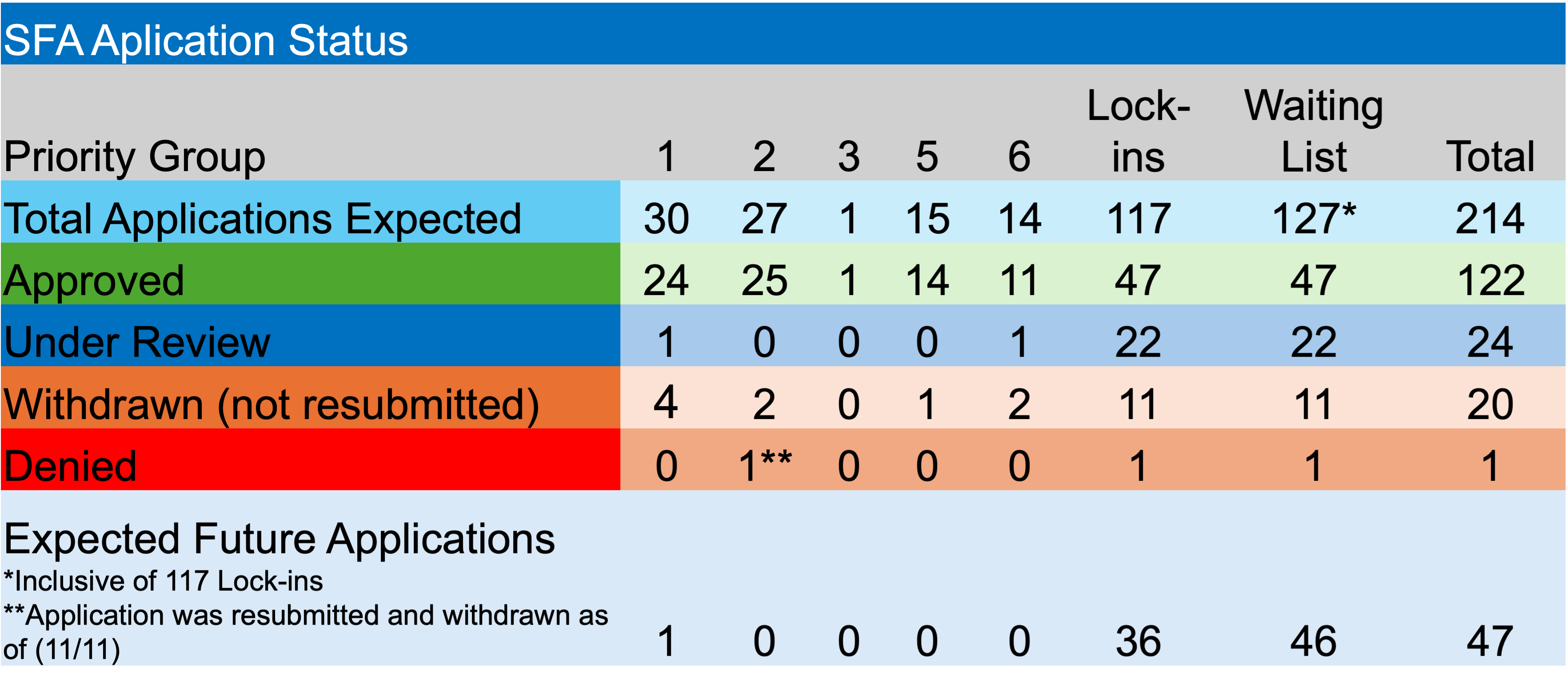
Regarding last week’s activity, the PBGC allowed the submission of two revised applications. Laborers’ Local No. 130 Pension Fund, a non-priority group member is seeking $30.2 million in Special Financial Assistance (SFA), and Southern California United Food and Commercial Workers Unions and Food Employers Joint Pension Plan, a priority group 6 plan is hoping to secure $1.19 billion in SFA. In addition, PA Local 47 Bricklayers and Allied Craftsmen Pension Plan, a non-priority group member was approved for $9.1 million in SFA and interest.

Fortunately, there were no applications denied, but there were two applications withdrawn, including Dairy Industry-Union Pension Plan for Philadelphia and Vicinity, a non-priority group member seeking roughly $51 million in SFA with an initial application, and Southern California United Food and Commercial Workers Unions and Food Employers Joint Pension Plan, a Priority Group 6 applicant, which was seeking $1.19 billion in SFA through a revised application.

Lastly, three additional plans have repaid a portion of the SFA received due to census errors. Local 408 International Brotherhood of Teamsters, Chauffeurs, Warehousemen and Helpers of America Pension Plan, Plasterers Local 82 Pension Fund, and Plasterers and Cement Masons Local No. 94 Pension Fund agreed to return $1.35 million from grants totaling $131.2 million or 1.03% of the award. To date, 48 funds have repaid a portion of the SFA totaling $202 million or just 0.43% of the grants. Four other plans did not have errors with their census data. There are roughly 8 plans that still need to go through a death audit.

The recent market activity is making it challenging for plans that are expecting to receive grants in the near future. The decline in U.S. interest rates will impact what is achievable through fixed income. Lower rates will increase the cost to defease liabilities and reduce the coverage period of secured benefits. But potential equity investments, which can be as much as 33% during any 12-month period, may not yet have bottomed given the uncertain impact of tariffs on inflation, corporate profits, and consumer behavior.

Pension Asset Allocation

By: Russ Kamp, CEO, Ryan ALM, Inc.

David Gates, of Bread fame, penned “If” in 1971. One of the more famous lyrics in the song is “if a picture paints a thousand words”. If the average picture paints 1,000 words, the image below paints about 1 million. I believe that the image of a rollercoaster is the perfect metaphor for traditional asset allocation strategies that have pension funds riding markets up and down and up and down until the plan fails. Failure in my opinion is measured by rising contribution expenses, the adoption of multiple tiers requiring employees to contribute more, work longer, and get less, and worse, the migration of new workers to defined contribution offerings, which are an unmitigated disaster for the average American worker.

As you know, Pension America rode markets up in the ’80s (following a very challenging ’70s) and ’90s, only to have the ’00s drive funded ratios into the ground. The ’10s were very good following the Great Financial Crisis. The ’20s have been a mix of both good (’23 and ’24) and bad markets (’20 and ’22). Who knows where the next 5-years will take us. What I do know is that continuing to ride markets up and down is not working for the average public pension plan. The YTD performance for US equities (S&P 500 -13.2% as of 2:30 pm) coupled with a collapse in the Treasury yield curve is damaging pension funded ratios which had shown nice improvement.

Riding these markets up and down without trying to install a strategy to mitigate that undesirable path is imprudent. Subjecting the assets to the whims of the market in pursuit of some return target is silly. By installing a discipline (CFM) that secures the promised benefits, supplies the necessary liquidity, buys time for the growth assets, while stabilizing the funded status and contribution expenses seems to be a no-brainer. Yet, plan sponsors have been reluctant to change. Why?

What is the basis for the reluctance to adopt a modified asset allocation framework that has assets divided into two buckets – liquidity and growth? Do you enjoy the uncertainty of what markets will provide in terms of return? Do you believe that using CFM for a portion of the asset base reduces one’s responsibility? Do you not believe that the primary objective in managing a pension is to secure the promised benefits at a reasonable cost and with prudent risk? The only reason that the DB plan exists is to meet an obligation that has been promised to the plan participant. Like an insurance company or lottery system, why wouldn’t you want to create an investment program that has very little uncertainty?

An Ugly Day For Pension America

By: Russ Kamp, CEO, Ryan ALM, Inc.

Yes, today’s ugliness in the markets is only one day and how many times have we heard or read that you can’t market time or if you miss just the best performing 25-, 50-, or 100-days in the stock market, your return will resemble that of cash or bonds? Those facts are mostly correct. We may not be able to market time, but we can certainly put in place an asset allocation framework that gets DB pension plans off the rollercoaster of performance. We can construct an asset allocation that provides the necessary liquidity when markets may not be able to naturally. An asset allocation that buys time for the growth asset to wade through troubled markets. A framework that secures the promised benefits and stabilizes both funded ratios and contribution expenses for that portion of the fund that has adopted a new strategy.

Yes, today is only one day, but the impact can be significantly negative. See, it isn’t just the loss that has to be made up, as pension plans are counting on a roughly 7% return (ROA) for the year. Every negative event pushes that target further away. Equity values are getting whacked and today’s market activity is just exacerbating the already weak start to the year. While equity markets are falling, U.S. interest rates are down precipitously. The U.S. 10-year Treasury note’s yield is down just about 0.8% since early in January. As a reminder, the average duration of a DB pension is about 12 years or twice the duration of the Bloomberg Barclays Aggregate Index, which is the benchmark for most core fixed income mandates. So, your bond portfolios may be seeing some appreciation today and since the start of 2025, but those portfolios are not growing nearly as fast as your plan’s liabilities, which have grown by about 10.6% (12 year duration x 0.8% + income of 1.0% = 10.6%). As a result, funded ratios are taking a hit.

I wrote this piece back on March 4th reminding everyone that the uncertainty around tariffs and other factors should inspire a course change, an asset allocation rethink. I suspect that it didn’t. So, one can just assume that markets will come back and the underperformance will not have impacted the pension plan, but that just isn’t true. In many cases, equity market corrections take years to recover from and in the process contribution expenses rise, and in some cases dramatically so.

Adopting a new asset allocation framework doesn’t mean changing the entire portfolio. A restructuring can be as simple as converting your highly interest rate sensitive core bond portfolio into a cash flow matching (CFM) portfolio that secures the promised benefits from next month out as far as the allocation can go. In the process you will have improved the plan’s liquidity, extended the investing horizon for the alpha assets, stabilized the funded status for that segment of your plan, and mitigated interest rate risk, as those benefit payments are future values which aren’t interest rate sensitive. You’ll sleep very well once adopted.

What Happened to… Reversion to the Mean?

By: Ronald J. Ryan, CFA, Chairman, Ryan ALM, Inc.

Most asset allocation models use the historical mean average for each asset class as the basis for predicting future average returns… in particular, the Return On Assets (ROA) forecast. Currently, most ROAs are in the 6.50% to 7.00% range. A discipline commonly used is the “reversion to the mean”. This principle suggests that any current annual returns that deviate from the historical mean return (outliers) would be corrected over the near-term to conform or revert to the mean. Perhaps that is what is happening in 2025 to the stock market.

The historical (beginning 12/31/69) mean returns for the S&P 500 as of 03/31/25 are as follows:

Q1’25     2024      2023      5 years    10 years    20 years    30 years

-4.3%    25.0%    26.3%    11.3%       11.4%        11.2%         11.3%

Noticeably, the years 2024 and 2023 seem to be outliers or way above average returns suggesting that they are due for a near-term correction. This pattern was evident in 2022 when the S&P 500 had a correction of -18.1% after the prosperous years of 30.9% (2021), 18.4% (2020) and 31.5% (2019). For 2025 returns to revert to the 20-year mean for the last three years it would need a return of -14.77% in 2025. So far 2025 has produced a return of -4.3% as of March 31 for the S&P 500. So, the question remains… will the S&P 500 continue to revert to the mean?

Thought for the day:  Trees do NOT grow to the sky!

The Buying Of Time Can Reap Huge Rewards

By: Russ Kamp, CEO, Ryan ALM, Inc.

When we present the list of benefits associated with using Cash Flow Matching (CFM), one of the benefits that we highlight is the buying of time a.k.a. an extended investing horizon. Our pension community tends to fall prey to short-termism despite claiming to be long-term investors. Quarterly observations are presented through the consultants regular performance reviews and managers are often dismissed after a relatively short period of “underperformance”. Actuarial reports tend to be annual which dictate projected contribution expenses. Yet, by extending the investment horizon to something more meaningful like 10-years or more, the probability of achieving the desired outcome is dramatically improved.

I recently played around with some S&P 500 data dating back to 12/31/69 and looked at the return and standard deviation of observations encompassing 1-10-year moving averages and longer periods such as 15-, 20-, 30-, and even 50-year moving averages for the industry’s primary domestic equity benchmark. Living in a one-year timeframe may produce decent annual returns, but is also comes with tremendous volatility. In fact, the average one-year return from 12/69 to 2/25 has been 12.5%, but the annual standard deviation is +/- 16.6%, meaning that 68% of the time your annual return could be +29.1% to -4.1%. Extending the analysis to 2 standard deviations (95% of the observations) means that in 19 out of 20 years the range of results can be as broad as +45.7% to -20.7%.

However, extend out your investing horizon to 10-years, and the average return from 12/69 dips to 11.4%, but the standard deviation collapses to only 5.0% for a much more comfortable range of +16.4% to 6.4%. Extend to 2 standard deviations and you still have a positive observation in 19 out of 20 years at +1.4% as the lower boundary. Extend to 30-years and the volatility craters to only +/-1.2% around an average return of 11.25%.

We, at Ryan ALM, were blessed in 2024 to take on an assignment to cash flow match 30+ years of this plan’s liabilities. We covered all of the projected liability cash flows through 2056 and still had about $8 million in surplus assets, which were invested in two equity funds, that can now just grow and grow and grow since all of the plan’s liquidity needs are being covered by the CFM strategy! So, how important is a long investing runway? Well, if this plan’s surplus assets achieve the average S&P 500 30-year return during the next 30-years, that $8 million will grow to >$195 million.

We often speak with prospects about the importance of bifurcating one’s asset base into two buckets – liquidity and growth. It is critically important that the plan’s liquidity be covered through the asset cash flows of interest and principal produced by bonds since they are the only asset with a known future value. CFM eliminates the need for a cash sweep which would severely reduce the ROA of growth assets. This practice will allow the growth or alpha assets to wade through choppy markets, such as the one we are currently witnessing, without fear that liquidity must be raised to meet benefits at a less than opportune time.

The plan sponsor highlighted above was fortunate to have a well-funded plan, but even plans that are less well-funded need liquidity. Ensuring that benefits and expenses can be met monthly (chronologically) without forcing liquidity that might not naturally exist is critical to the successful operation of a pension plan. CFM can be used over any time frame that the plan sponsor desires or the plan can afford. We believe that extending the investment horizon out to 10-years should be the minimum goal, but every plan is unique and that uniqueness will ultimately drive the decision on the appropriate allocation to CFM.

Misleading Indicators

By: Ron Ryan, Chairman, Ryan ALM, Inc.

The Commerce Department reports with some glee that sales and income figures show an easing up of the rate of which business is easing off, which is taken as proof that there is a slow down as well as a noticeable slowing up of a slowdown.

In order to clarify the cautious terminology of the experts, it should be noted that a slowing up of the slowdown is not as good as an upturn in the down curve, but it is a good deal better than either a speedup of the slowdown or a deepening of the down curve, and it does suggest that the climate is about right for an adjustment to the readjustment.

Turning to unemployment, we find a definite decrease in the rate of increase, which clearly shows that there is a letting up of the letdown. Of course, if the slowdown should speed up, the decrease in the rate of increase of unemployment would turn into an increase in the rate of decrease of unemployment. In other words, the deceleration would be accelerated.

But the indicators suggest a leveling off, referred to on Wall Street as a bumping along rock bottom. This will be followed by a gentle pickup, then a faster pickup, a slowdown of the pickup, and finally a leveling off again.

It is hard to tell, before the slowdown is completed, whether a particular pickup is going to be fast. At any rate, the climate is right for a pickup this season, especially if you are about twenty-five, unmarried, and driving a red convertible.

It’s April 1… don’t be fooled!