How Many Words Do You Need?

By: Russ Kamp, Managing Director, Ryan ALM, Inc.

In 1971, David Gates, singer-songwriter for the band Bread, published the song “IF”. The song begins with the lyrics, “If a picture paints a thousand words…”. If David was correct and a picture does in fact paint 1,000 words, then how many words do you think that the picture below is producing? First, I don’t think that you need many words, certainly not 1,000, to know precisely what is being conveyed in the graph below. But, on the other hand, you could probably write 1 million words about the current state of the US equity market, especially large cap stocks, which have performed exceptionally well for the second consecutive year basically on the back of mega technology stocks benefitting from the “promise” of AI.
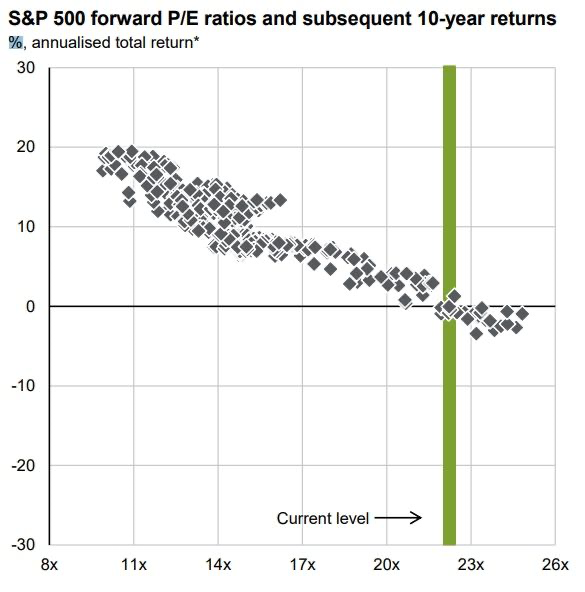
The S&P 500 has now advanced more than 20% in each of the last two calendar years and four of the last six years. According to Glen Eagle trading, “only three times in history has it done so for a third: 1935-36 (followed by a 39% plunge in 1937), 1954-55 (a 2.6% rise in 1956), and 1995-98 (nearly 20% in 1999)”. But, please don’t forget that the NASDAQ 100 collapsed by more than -80% beginning in March 2000 – 2002. Those stats portend some potentially serious consequences if no action is taken now.

The graph above was produced by Mike Zaccardi, CFA, CMP, who highlights the fact that the current level of the S&P’s forward looking P/E multiple is likely to produce a 10-year annualized return for the S&P 500 that is likely to be negative. If not negative, certainly not robust enough to support US pension plans hoping to generate a roughly 7% annualized return on assets (ROA). That’s the bad news!

The good news is that there is an alternative to letting the equity exposure ride. As I’ve written about recently, US Treasury bond and note yields have risen to levels last witnessed earlier this year. Comparable maturity investment grade corporate bonds have historically average a roughly 1.2% yield premium. If the average spread were realized (they are tight today), one could get a roughly 5.75%-6.00% YTW with little volatility. Adopt a cash flow matching strategy as the core holding creating a level of certainty that is not possible through a traditional asset allocation framework.

Don’t subject the pension assets to unnecessary risk. Regrettably, periods of significant negative returns are not unheard of and often lead to dramatically increased levels of contributions needed to improve the plan’s funded status. As always, we are more than willing to produce a FREE analysis on what could possibly be achieved through the adoption of a CFM strategy. The time to act is now and not after the S&P 500 suffers a correction.
ARPA Update as of December 27, 2024

By: Russ Kamp, Managing Director, Ryan ALM, Inc.

We, at Ryan ALM, Inc., wish for you a happy, healthy, and prosperous New Year in 2025. May the markets continue to treat you well. However, nothing grows to the heavens, so it may be wise to alter one’s asset allocation and reduce risk as the year begins given inflated valuations, particularly for large cap US equities.

Regarding ARPA and the PBGC’s on-going effort implementing this critical legislation, there was a pause in activity during the last week. Good for them, as 2024 has been an incredibly busy and successful year. Regarding last week, the PBGC’s eFiling portal remains temporarily closed, so there were no new applications filed. There also weren’t any applications denied, withdrawn, or approved. Finally, there were no repayments made by funds that had received excess SFA.

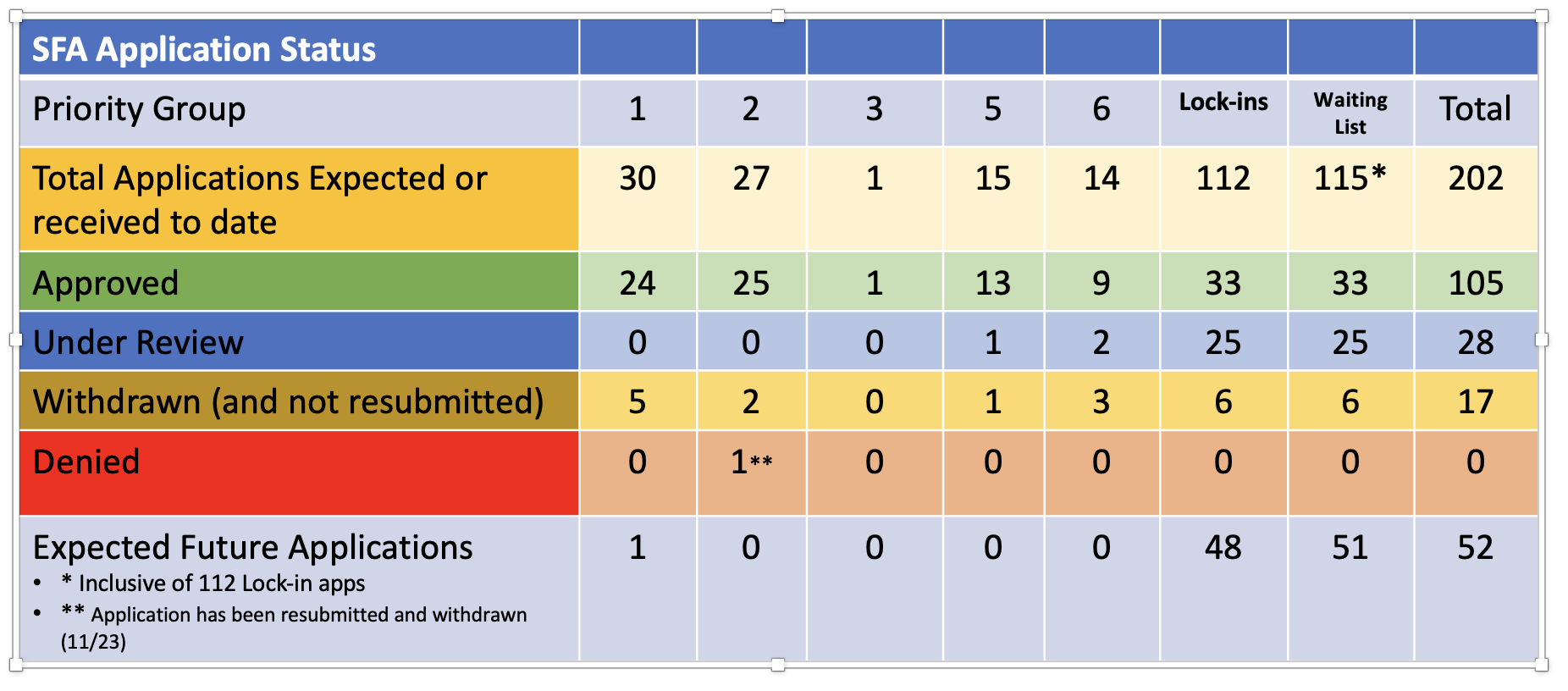
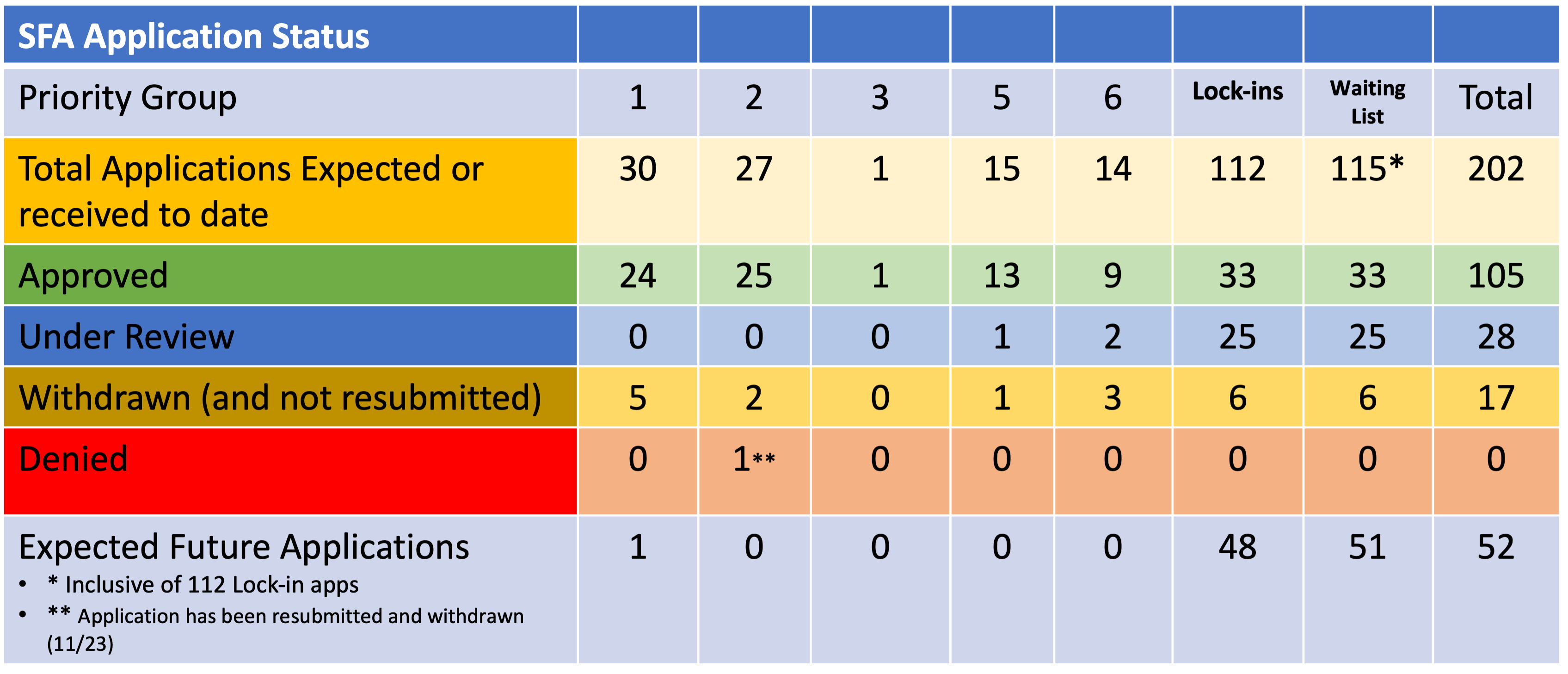
To recap 2024, the PBGC approved 36 applications, awarding more than $16.2 billion in SFA grants that went to support the promised benefits for 458,446 plan participants. WOW! As the chart below highlights, only 15 of the 87 Priority Group members have yet to have the applications for SFA approved. Three of those applications are currently under review. Of the 115 funds seeking support that weren’t initially identified as a Priority Group member, 64 pension plans have participated to some extent in this program with 33 of those applications approved.

US Treasury note and bond yields (longer maturities) have risen sharply in the last few months. They are at levels not witnessed since early this year. As a result, they are providing plan sponsors with a wonderful opportunity to reduce risk without giving up potentially higher returns. We’d be happy to provide a free analysis on what could be achieved within your plan. Don’t hesitate to reach out to us.

Again, Happy New Year!

Pension Strategy: Play Football

By: Russ Kamp, CEO, Ryan ALM, Inc.

We are happy to share with you the latest thoughts from Ron Ryan, Chairman, Ryan ALM, Inc. However, before we do, I’d like to wish Ron a happy birthday – hope that it is a terrific day!

His latest research focuses on the idea that pension management should be approached in a similar fashion to how a football coach prepares for an opponent. Attack the opponent’s weaknesses, while staying clear of their strengths. The primary objective in managing a pension plan should be to secure the promised benefits at the lowest cost possible. It shouldn’t be a return focus, which only ensures greater volatility, but not necessarily success.

All of Ryan ALM’s research and blog posts can be found at RyanALM.com. We hope that you’ll invest some time to go through the many insightful pieces that Ron and the team have produced throughout the years. Finally, we wish for you and yours a wonderful 2025.

Is Now The Time To Act?

By: Russ Kamp, Managing Director, Ryan ALM, Inc.

Equity market participants were recently reminded of the fact that markets can fall, and unfortunately they usually don’t decline with any kind of notice. The impetus behind the markets’ most recent challenging day was the Fed’s relatively tame forecast for likely interest rate moves in 2025. There is no question in my mind that the nearly 4-decade decline in rates from lofty heights achieved in the early ’80s, when the Fed Funds Rate eclipsed 20%, to the covid-fueled bottom reached in early 2020, when the yield on the 10-year Treasury Note was at 0.5%, made bond returns a lot stronger than anyone’s forecast.

It certainly seemed that the US Federal Reserve provided the security blanket any time there was a wobble in the markets. This action allowed “investors” to keep their collective foot on the gas with little fear. Sure, there were major corrections during that lengthy period, but the Fed was always there to lend a hand and a ton of stimulus that propped up the economy and markets, and ultimately the investment community. As we saw in 2022, the Fed had run out of dry powder and ultimately had to raise US interest rates to stem a vicious inflationary spike. Rates rose rather dramatically, and the result was an equity market, as measured by the S&P 500, that declined 18% for the calendar year. Bonds faired only marginally better as rising rates impacted bond principals creating a collective -12.1% return for the BB Aggregate Index.

As we enter 2025, do we once again have a situation in which the Fed’s ability to reduce rates has been curtailed due to a stronger economy than anticipated? Will the continued strength and massive government stimulus drive inflation and rates higher? According to a blog post from Apollo’c CIO, here are his list of the potential risks and the probabilities:

Risks to global markets in 2025

Interesting that he feels, like we do at Ryan ALM, Inc., that the economy is likely to be stronger than most suspect (#6) leading to higher inflation, rising rates (#7), and a 10-year Treasury Note yield in excess of 5% (#8). That yield is currently at 4.6% (as of 3:06 pm).

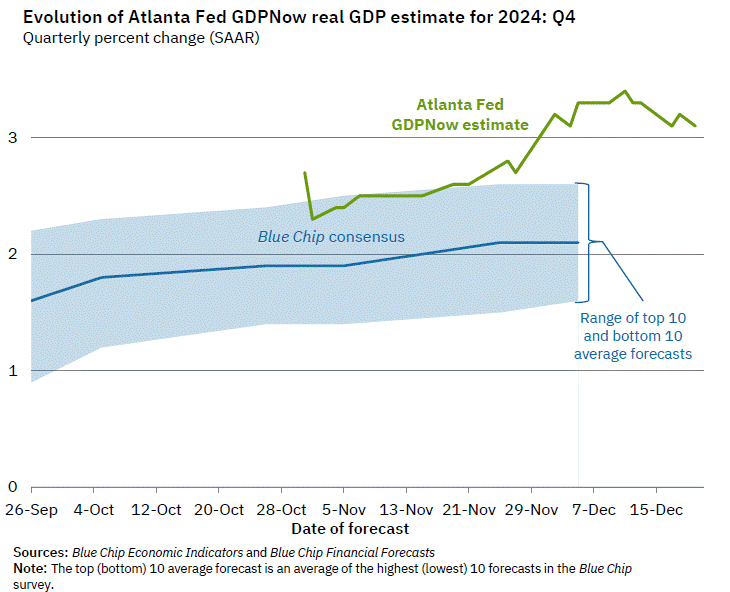
For those that might be skeptical, the Atlanta Fed’s GDPNow model is currently forecasting GDP growth for Q4’24 at 3.1% annualized. They have done a wonderful job forecasting quarterly growth rates. Their forecasts have consistently been above the “street’s” and as a result, much more accurate.

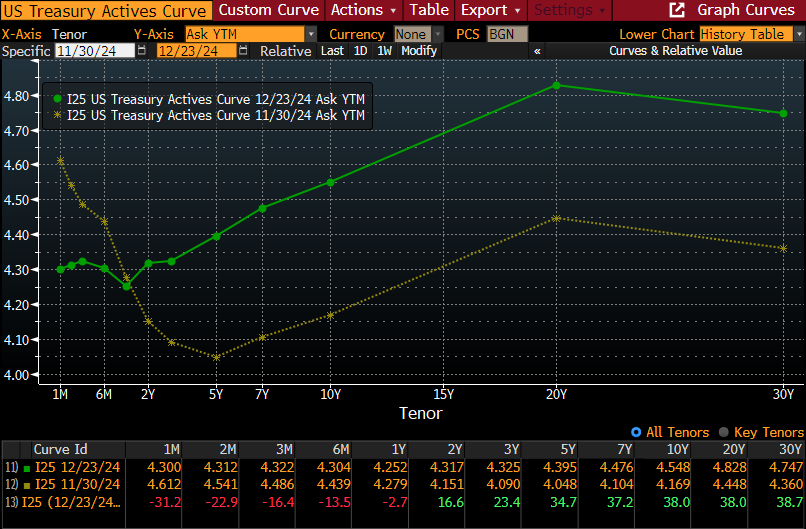
In addition, despite the third rate cut by the Federal Reserve at the most recent FOMC meeting of their benchmark Fed Funds Rate (-1.0% since the easing began), interest rates on longer dated maturities have risen quite significantly, as reflected below.

Rising US rates, stronger growth, and greater inflation may just be the formula for a significant contraction in equity valuations, especially given the current level. Be proactive. Reduce risk. Secure the promised benefits. Under no circumstance should you just let your “winnings” ride.

ARPA Update as of December 20, 2024

By: Russ Kamp, Managing Director, Ryan ALM, Inc.

Happy Holidays from all of us at Ryan ALM, Inc. We wish you and yours a joyous holiday season and a spectacular 2025 filled with great health, abundant friendships, and calm markets.

Despite the onset of the holiday season, the PBGC was still at work implementing the ARPA legislation. Santa arrived early for one plan, as Roofers Local No. 75 Pension Fund received approval for its SFA grant. They will receive $6.8 million for the 275 plan participants. This was the initial filing for this non-priority group member. Congrats!

In other ARPA-related news, there were no new applications submitted as the PBGC’s efiling portal remains temporarily closed. There are currently 28 applications under review, including one Priority Group 5 member and two Priority Group 6 members. Fortunately, there were no applications denied or withdrawn during the previous week.

Lastly, there was one fund that repaid excess SFA assets due to census errors. Gastronomical Workers Union Local 610 and Metropolitan Hotel Association Pension Fund repaid $696k (or 2.09%) after receiving $33.3 million in SFA. This fund is one of only 3 to repay SFA in excess of 2% of the grant received. In total, $159.3 million has been repaid on grants of more than $41 billion or 0.38% of the allocations.

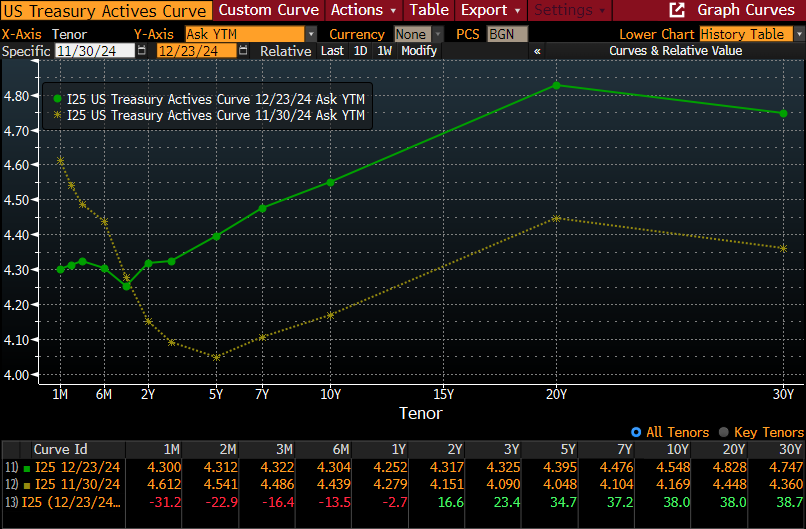
The Bloomberg chart below demonstrates the significant rise in U.S. rates during the last month. Recipients of SFA funds would be wise to secure the promised benefits with 100% of the grant money. Equity markets appear to be quite frothy. Time to reduce risk, while taking full advantage of the higher interest rates.

U.S. Avoids Shutdown – No Agreement on Debt Ceiling Limit

Congress avoided an unnecessary shutdown on Friday evening. Regrettably, they did not address the debt limit kicking the can once more. They now have until March 14, 2025 to address the silliness of a debt ceiling. See my post from Friday that speaks to the idiocy of a debt limit.

One of Only Two – Time For Change

By: Russ Kamp, Managing Director, Ryan ALM, Inc.

The United States of America and Denmark share several commonalities. Both countries have democratic political systems. Each country enjoys a high standard of living. Both have a commitment to human rights and environmental concerns, with Denmark being a leader in renewable energy and sustainability, while the U.S. is witnessing a growing movement on those fronts. Both countries value education, enjoying high literacy rates. There is also a shared military alliance through NATO. What you might not realize is that the U.S. and Denmark are the ONLY countries that have a self-imposed statutory debt limit. Sure, there are other countries, such as Switzerland, that have mandatory balanced budget provisions which effectively limit the amount of debt , but they aren’t specified debt limits.

The U.S. first instituted a statutory debt limit with the Second Liberty Bond Act of 1917, setting the aggregate amount of debt that could be accumulated through individual categories like bonds and bills. The purpose in creating this legislation was to finance the country’s involvement in World War 1. The legislation allowed the U.S. to raise $9.5 billion in bonds that would be issued by the U.S. government. These bonds were marketed to the general population and to institutional investors to gain their support for the war. Was there a First Liberty Bond Act? Yes, that act had been passed earlier in 1917 allowing the government to issue $2 billion in bonds in order to support the war.

Importantly, and why we are where we are today with regard to the current deficit, the Second Liberty Bond Act program continued after the war. It set a precedent for public financing of government initiatives through bond sales. Although the debt limit was established in 1917 which allowed the Treasury to issue bonds without specific Congressional approval, the “limit” has been raised more than 100 times since then and roughly 78 times since 1960 alone. As a result, the US debt has risen from around $250 billion during World War II, to about $2.1 trillion during the Reagan years, to $5.6 trillion at the conclusion of the 1990s, and to today’s $36 trillion. So, why do we have a debt limit when it has been elevated so many times previously and to a magnitude certainly not contemplated in 1917?

The political brinkmanship associated with the debt limit debate rarely serves a purpose, often unnecessarily frightening Americans and our capital market participants. As we brace for another “discussion”, is maintaining a debt “limit” at all necessary? NO! Today’s federal deficit is in no way constraining to future generations. I’ve referenced Warren Mosler and his book, “The 7 Deadly Innocent Frauds of Economic Policy” on many occasions. He covers the topic of our government debt and whether we are leaving our debt-burden to our children, grandkids, etc. Mosler states, “the idea of our children being somehow necessarily deprived of real goods and services in the future because of what’s called the national debt is nothing less than ridiculous.”

As Mosler explains, that the financing of deficit spending is of “no consequence”. He further explains that when the “government spends, it just changes numbers up in our bank accounts.” The government doesn’t borrow money, it moves funds from checking accounts at the Fed to savings accounts (Treasury securities) at the Fed. The good news, is that the entire federal deficit ($36 trillion or so) is nothing more than the economy’s total holdings of savings accounts at the Federal Reserve. The private sector now has an asset equivalent to the deficit. How wonderful! Can you imagine if we didn’t have the ability to deficit spend. Think of all the stimulus that would have been removed from our economy that supported jobs, wages, and demand for goods and services.

The major issue with our ability to deficit spend has nothing to do with financing it, but everything to do with providing too much stimulus that creates demand for goods and services that exceeds our economy’s ability to meet such demand. So, I ask again, does having a debt limit (ceiling) make sense? No, unless you enjoy all the grandiose speeches from the halls of Congress based on little knowledge of how our monetary system truly works. Finally, I’d like to give a special nod to Charles DuBois, my former colleague at Invesco, who spent hours educating me on this subject. Thanks, Chuck!

5.6% 10-year forecast for US All-Cap

By: Russ Kamp, Managing Director, Ryan ALM, Inc.

Fiducient Advisors has published its 2025 Outlook. Given the strong performance in US equity markets, future returns have been adjusted downward – rightfully so. Here are some of the highlights:

Full valuations, concentrated U.S. large-cap indexes and the risk of reigniting inflation are shaping the key themes we believe will drive markets and portfolio positioning in 2025.

-Recent market successes have pushed our 2025 10-year forecasts lower across most major asset classes. Long-term return premium for equities over fixed income is now at its narrowest since 2007, sparking important conversations about portfolio posture and risk allocation.

Rising reinflation risk leads us to increase our allocation to more flexible fixed income strategies (dynamic bonds) and TIPS while eliminating our global bond allocation.

US stock market performance has been heavily influenced by the “Magnificent Seven”, creating concentration risk not seen in decades, if ever. The outperformance of US markets vis-a-vis international markets is unprecedented. As stated above, valuations are stretched. Most metrics used to measure “value” in our markets are at extreme levels, if not historical. How much more can one squeeze from this market? As a result, Fiducient is forecasting that US All-Cap (Russell 3000?) will appreciate an annualized 5.6% for the next 10-years.

Nearly as weak are the forecasts for private equity, which Fiducient believes will produce only an annualized 8.6% return through the next 10-years. What happened to the significant “premium” that investing privately would provide? Are the massive flows into these products finally catching up with this asset class? Sure seems like it.

With regard to the comment about fixed income, I’m not sure that I know what “flexible fixed income strategies” are and the reference to dynamic escapes me, too. I do know that bonds benefit from lower interest rates and get harmed when rates rise. We have been very consistent in our messaging that we don’t forecast interest rates as a firm, but we have also written extensively that the inflation fight was far from over and that US growth was more likely to surprise on the upside than reflect a recessionary environment. Today, the third and final installment of the Q3’24 GDP forecast was revised up to 3.1% annual growth. The Q4’24 estimate produced by the Atlanta Fed through its GDPNow model is forecasting 3.2% annual growth. What recession?

Given that US growth is likely to be stronger, employment and wage growth still robust, and sticky inflation just that, bonds SHOULDN’T be used as a performance instrument. Bonds should be used for their cash flows of interest and principal. BTW, one can buy an Athene Holding Ltd (ATH) bond maturing 1/15/34 with a YTW of 5.62% today. Why invest in US All-Caps with a projected 5.6% return with all of that annual standard deviation when you can buy a bond, barring a default and held to maturity, will absolutely provide you with a 5.62% return? This is the beauty in bonds! Those contractual cash flows can be used, and have been for decades, to defease liabilities (pension benefits, grants, etc.) and to SECURE the promises made to your participants.

It is time to rethink the approach to pension management and asset allocation. Use a cash flow matching strategy to secure your benefits for the next 10-years that buys time for the growth assets to GROW, as they are no longer a source of liquidity. Equity markets may not provide the same level of appreciation as they have during the last decade (+13.4% annualized for the S&P 500 for 10-years through 11/30/24), but a defeased bond portfolio will certainly provide you with the necessary liquidity, an extended investing horizon, and the security (peace of mind) of knowing that your benefits will be paid as promised and when due! Who needs “flexible and dynamic” bonds when you have the security of a defeased cash flow matching strategy?

P&I: Asset Owner CIOs See Uncertainty in 2025

By: Russ Kamp, Managing Director, Ryan ALM, Inc.

P&I is out with a story today about asset owner CIOs “forecasting” uncertainty for 2025. The capital markets are always uncertain. It only takes a “surprise” to disrupt even the most obvious trend. Given a new regime in Washington, stubborn inflation, geopolitical risks throughout the globe, and equity valuations that are stretched (that’s putting it mildly), CIOs have reason to be uncertain, especially over a short timeframe, such as a calendar year or two.

The lack of certainty can be destabilizing to individuals and investment strategies. I covered the psychology of uncertainty in a post earlier this year. Here were a few highlights:

  • When facing ongoing uncertainty, our bodies stay at a high level of physiological arousal, exerting considerable wear and tear.
  • Uncertainty exerts a strong pull on our thoughts and inhibits our ability to act, leaving us in a suspended waiting game.
  • We can manage uncertainty by figuring out what we can control, distracting ourselves from negative thoughts, and reaching out to others.

The last point is particularly important. We can manage “uncertainty” by figuring out what we can control. As a plan sponsor, we can utilize an investment strategy (cash flow matching or CFM) that creates certainty for the portion of the portfolio that uses CFM. In the following post, I question the significant use of equity and equity-like product in public pension systems that are accompanied by tremendous annual volatility. Again, this produces great uncertainty.

Adopting the use of greater fixed income exposure also doesn’t ensure less uncertainty, as changes in US interest rates can play havoc on fixed income strategies. ONLY with a CFM strategy do you bring certainty of cash flows (absent any defaults) to the management of pension plans. Traditional fixed income strategies benefited from a nearly 4-decade move down in rates, but there is currently great uncertainty as to the future direction of inflation and as a result, rates. With CFM one knows what the performance will look like a decade from now. With a fixed income strategy focused on a generic index, such as the BB Aggregate, one has no idea how that portfolio will perform 10 or more years from now.

Lastly, there is no reason to live with the uncertainty that many CIOs currently foresee. I wrote a piece just recently on achieving “peace of mind“. Uncertainty won’t help you in your quest for a good night’s sleep, but achieving peace of mind is very much achievable once you adopt a CFM strategy and secure the promised benefits (or grants) for some period of time. Call us. We want to remove as much uncertainty from your professional life as possible.

ARPA Update as of December 13, 2024

By: Russ Kamp, Managing Director, Ryan ALM, Inc.

Welcome to the last full week before the Christmas season kicks off. Most investors will be sorry to see 2024 come and go. For the PBGC, 2024 has been a year of great accomplishments, with the approval of Special Financial Assistance (SFA) for 35 multiemployer plans covering 458,171 participants with SFA grants totaling $16.2 billion – wow!

The last week was a continuation of the PBGC’s activity with seven more funds submitting applications seeking $638.2 million for nearly 27k members. The applications included five new submissions and 2 revised applications. The applicants included the Dairy Industry-Union Pension Plan for Philadelphia and Vicinity, Bricklayers Pension Fund of West Virginia, United Wire, Metal and Machine Pension Plan, Distributors Association Warehousemen’s Pension Trust, Local 945 I.B. of T. Pension Plan, Alaska Teamster – Employer Pension Plan, and the Local 888 Pension Fund. Grant requests ranged from United Wire’s $228.5 million to the Bricklayers $1.96 million for their 170 participants.

In addition to the new submissions, there was one approval. Teamsters Local 11 Pension Plan will receive $29.3 million for the 2,012 members of its plan. This North Haledon, NJ fund submitted a revised application on August 29, 2024. In other ARPA news, there were no applications denied or withdrawn during the previous 7 days. In addition, there were no new plans added to the waitlist or forced to repay a portion of the SFA due to census errors.

US Treasury interest rates backed up fairly significantly last week as inflation data came in a little higher than recent trends giving bonds investors reason to challenge the narrative that the Fed would continue pushing down the Fed Funds rate. The higher rates are providing plan sponsors with greater cost savings on future benefits through cash flow matching strategies.