Taylor-Made?

By: Russ Kamp, CEO, Ryan ALM, Inc.

The Federal Reserve meeting notes have been published, and there seems to be little appetite among the Fed Governors to reduce U.S. interest rates at the next meeting. They continue to believe that the recently inflated tariffs and current trade policy actions could lead to greater inflationary pressures. These notes do not support the current administration’s push to see the Fed Funds Rate dropped significantly – perhaps as much as 3%.

In a very informative Bloomberg post from this morning, John Authers reminded everyone that President Trump selected Jerome Powell over John Taylor, Stanford University, in 2017 to become Chairman of the Federal Reserve. I must admit that I didn’t remember that being the case, while also not recalling that it is John Taylor who is credited with developing the Taylor Rule in 1993. When I think of famous Taylors, John isn’t at the top of my list. I might have believed that it had something to do with Lawrence Taylor’s dominance on the football field where he “ruled” for 13 Hall of Fame seasons and is considered by many the greatest defensive player in NFL history (yes, I am a Giants’ fan).

So, what is the Taylor Rule? The Taylor Rule is an economic formula that provides guidance on how central banks, such as the Federal Reserve, should set interest rates in response to changes in inflation and economic output. The rule is designed to help stabilize an economy by systematically adjusting the central bank’s key policy rate based on current economic conditions. It is designed to take the “guess work” out of establishing interest rate policy.

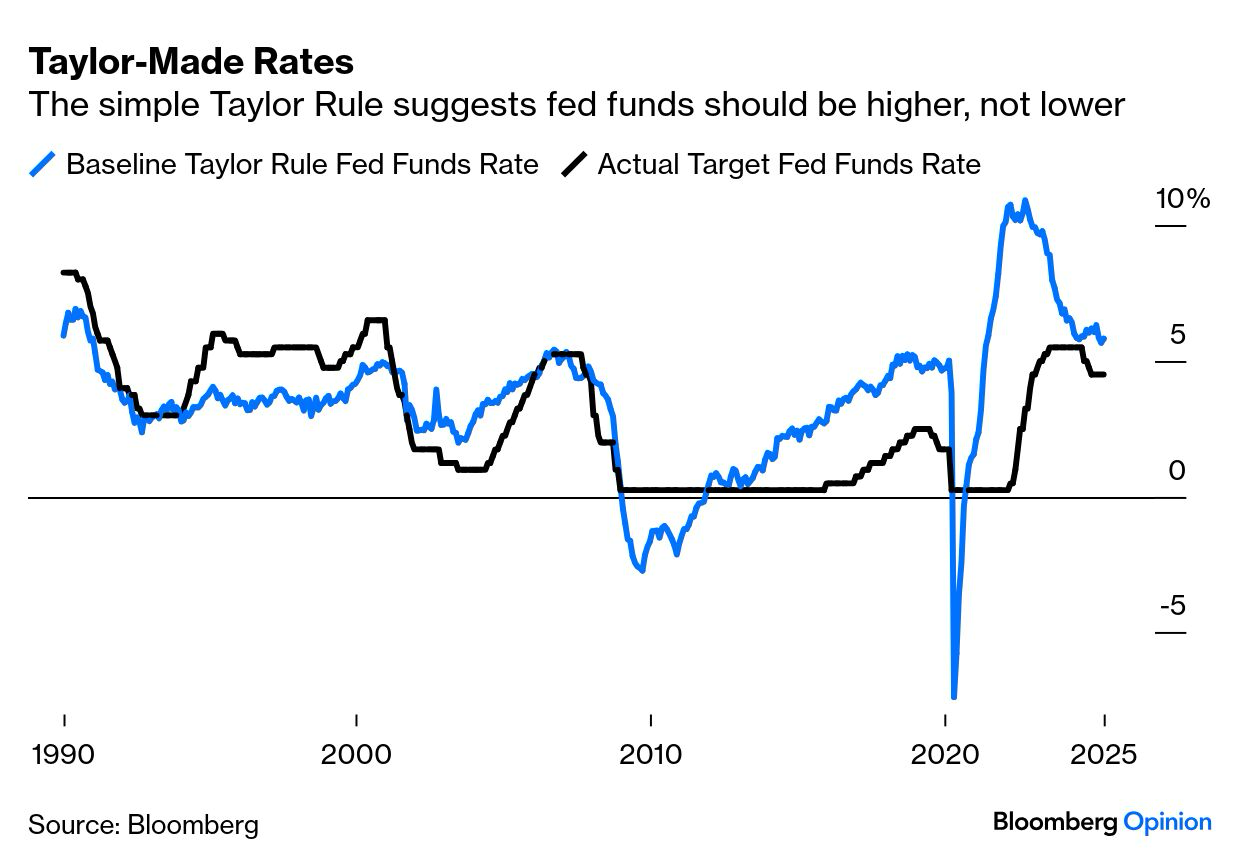
The Taylor rule suggests that the central bank should raise interest rates when inflation is above its target (currently 2%) or when GDP is growing faster than its estimated potential (overheating). Conversely, it suggests lowering interest rates when inflation is below target or when GDP is below potential (economy is underperforming). Ironically, President Trump’s dissatisfaction with Jerome Powell’s reluctance to reduce rates given significant economic uncertainty, may have been magnified by John Taylor’s model, which would have had rates higher at this time as reflected in the graph below.

As a reminder, Ryan ALM, Inc. does not forecast interest rates as part of our cash flow matching (CFM) strategy. In fact, the use of CFM to defease pension liabilities (benefits and expenses (B&E)) eliminates interest rate risk once the portfolio is built since future values (B&E) aren’t interest rate sensitive. That said, the currently higher rate environment is great for pension plan sponsors who desire to bring an element of certainty to the management of pensions which tend to live in a very uncertain existence. By funding a CFM portfolio, plan sponsors can ensure that proper liquidity is available each month of the assignment, while providing the residual assets time to grow. There are many other benefits, as well.

Since we don’t know where rates are likely to go, we highly recommend engaging a CFM program sooner rather than later before we find that lower interest rates have caused the potential benefits (cost savings) provided by CFM to fall.

U.S. $ Decline and the Impact on Inflation

By: Russ Kamp, CEO, Ryan ALM, Inc.

As I was contemplating my next blog post, I took a look at how many of my previous >1,625+ posts mentioned currencies, and specifically the U.S. $. NEVER had I written about the U.S. $ other than referencing the fact that we enjoy the benefit of a fiat currency. I did mention Bitcoin and other cryptos, but stated that I didn’t believe that they were currencies and still don’t. Why mention them now? Well, the U.S. $ has been falling relative to nearly all currencies for most of 2025. According to the WSJ’s Dollar Index (BUXX), the $ has fallen by 8.5% for the first half of 2025.

Relative to the Euro, the $ has fallen nearly 14% and the trend isn’t much better against the Pound (-9.6%) and the Yen (-8.7%). So, what are the implications for the U.S. given the weakening currency? First, the cost of imports rises. When the $ loses value, it costs more to buy goods and services from abroad. The likely outcome is that the increased costs get passed onto the consumer, who is already dealing with the implications from uncertain tariff policies.

Yes, exports become cheaper, which would hopefully increase demand for our goods, but the heightened demand could also lead to greater demand for U.S. workers in order to meet that demand leading to rising wages (great), but that is also potentially inflationary.

What have we seen so far? Well, first quarter’s GDP (-0.5%) reflected an increase in imports spurred on by fear of price increases due to the potential for tariffs. Q2’25 is currently forecasted to be 2.5% according to the Atlanta Fed’s GDPNow model, as U.S. imports have fallen. According to the BLS, import prices have risen in 4 of 5 months in 2025, with March’s sharp decline the only outlier.

The potential inflationary impact from rising costs could lead to higher U.S. interest rates, which have been swinging back and forth depending on the day of the week and the news cycle. Furthermore, there is fear that the proposed “Big Beautiful Bill” could also drive rates higher due to the potential increase in the federal deficit by nearly $5 trillion due to the stimulative nature of deficits. Obviously, higher U.S rates are great for individual savers, but they don’t help bonds as principal values fall.

We recommend that plan sponsors and their advisors use bonds for the cash flows (interest and principal) and not as a performance driver. Use the fixed income exposure as a liquidity bucket designed to meet monthly benefits and expenses through the use of Cash Flow Matching (CFM), which will orchestrate a careful match of asset cash flows funding the projected liabilities cash flows. The remaining assets (alpha bucket) now benefit from time, as the investment horizon is extended.

Price increases on imports due to a weakening $ can impact U.S. inflation, but there are other factors, too. I’ve already mentioned tariffs and wage growth, but there other factors, including productivity and global supply chains. Some of these drivers may take more time to hash out. There are many uncertainties that could potentially impact markets, why not bring an element of certainty to your pension fund through CFM.

An Ugly Day For Pension America

By: Russ Kamp, CEO, Ryan ALM, Inc.

Yes, today’s ugliness in the markets is only one day and how many times have we heard or read that you can’t market time or if you miss just the best performing 25-, 50-, or 100-days in the stock market, your return will resemble that of cash or bonds? Those facts are mostly correct. We may not be able to market time, but we can certainly put in place an asset allocation framework that gets DB pension plans off the rollercoaster of performance. We can construct an asset allocation that provides the necessary liquidity when markets may not be able to naturally. An asset allocation that buys time for the growth asset to wade through troubled markets. A framework that secures the promised benefits and stabilizes both funded ratios and contribution expenses for that portion of the fund that has adopted a new strategy.

Yes, today is only one day, but the impact can be significantly negative. See, it isn’t just the loss that has to be made up, as pension plans are counting on a roughly 7% return (ROA) for the year. Every negative event pushes that target further away. Equity values are getting whacked and today’s market activity is just exacerbating the already weak start to the year. While equity markets are falling, U.S. interest rates are down precipitously. The U.S. 10-year Treasury note’s yield is down just about 0.8% since early in January. As a reminder, the average duration of a DB pension is about 12 years or twice the duration of the Bloomberg Barclays Aggregate Index, which is the benchmark for most core fixed income mandates. So, your bond portfolios may be seeing some appreciation today and since the start of 2025, but those portfolios are not growing nearly as fast as your plan’s liabilities, which have grown by about 10.6% (12 year duration x 0.8% + income of 1.0% = 10.6%). As a result, funded ratios are taking a hit.

I wrote this piece back on March 4th reminding everyone that the uncertainty around tariffs and other factors should inspire a course change, an asset allocation rethink. I suspect that it didn’t. So, one can just assume that markets will come back and the underperformance will not have impacted the pension plan, but that just isn’t true. In many cases, equity market corrections take years to recover from and in the process contribution expenses rise, and in some cases dramatically so.

Adopting a new asset allocation framework doesn’t mean changing the entire portfolio. A restructuring can be as simple as converting your highly interest rate sensitive core bond portfolio into a cash flow matching (CFM) portfolio that secures the promised benefits from next month out as far as the allocation can go. In the process you will have improved the plan’s liquidity, extended the investing horizon for the alpha assets, stabilized the funded status for that segment of your plan, and mitigated interest rate risk, as those benefit payments are future values which aren’t interest rate sensitive. You’ll sleep very well once adopted.