Must We Continue to Just Shift Deck Chairs on the Titanic?

By: Russ Kamp, Managing Director, Ryan ALM, Inc.

You may not have been following Ryan ALM’s blog through the many years that I have been producing posts in which I’ve touched on this subject. We at Ryan ALM continue to question the logic of focusing on the return on asset assumption (ROA) as the pension plan’s primary objective.  We especially challenge the notion that shifting a couple of percent from one asset class to another produces meaningful results for the pension system’s asset allocation and long-term funding success.

Day after day, I read, as I’m sure that you do, articles, blogs, emails, etc. highlighting a new product or twist to an existing one that will just “rock your world” and assist you on the road to achieving the return on asset (ROA) assumption. It doesn’t matter whether your plan is a public fund, multiemployer pension, or a private plan, the continued focus on the ROA as the primary objective for both plan sponsors and their asset consultants is leading everyone down the wrong path. You see, most of the retirement community has been sold a bag of rotten goods claiming that a plan needs to generate the ROA, or it will not meet its funding goals. I say, “Hogwash”! I’d actually like to say something else, but you get my drift.

So, when valuations for most asset classes seem to be stretched, as they do today, where does a pension plan go to allocate their plan’s assets? Well, this “issue” has plan sponsors once again scratching their collective heads and doing the Curly shuffle.  You see, they have once again through the presumed support of their consultants, begun to approach asset allocation as nothing more than rearranging the deck chairs on the Titanic.

Despite tremendous gains from both equity and fixed income bull markets, these plans are willing to “let it ride” instead of altering their approach to possibly reduce risk, stabilize the funded status, and moderate contribution expense. Can you believe that one of the country’s largest public plans has recently decided (I’m sure that it took a long time, too) to roll back fixed income exposure by 2% and equity exposure by 1% from 55% to 54%?  Are you kidding me? Is that truly meaningful or heroic?

Please note that generating a return commensurate with the ROA is not going to guarantee success. Furthermore, since most public pension plans are currently underfunded on an actuarial basis (let alone one based on market values) meeting this ROA objective will only further exacerbate the UAAL, as the funded status continues to slip. You see, if your plan is 80% funded, and that is the “average” funded ratio based on Milliman’s latest work, you need to outperform your plan’s 7% ROA objective by 1.75% in order to maintain the current funded status. Here’s a simple example as a proof statement:

Assets = $80   Liabilities = $100   ROA = 7.00%   Asset growth = $5.60   Liability growth = $7.00

In order for asset growth = $7.00, assets would need a 8.75% ROA

Given that reality, these plans don’t need the status quo approach that has been tried for decades. Real pension reform must be implemented before these plans are no longer sustainable, despite the claim that they are perpetual.  As an industry, we have an obligation to ensure the promised benefits are there when needed. Doing the same old, same old places our ability to meet this responsibility in jeopardy. If valuations are truly stretched, don’t leave your allocations basically stagnant. Take the opportunity to try something truly unique.

It is time to approach asset allocation with a renewed focus. Instead of having all of your plan’s assets tied to achieving the ROA, divide them into two buckets – liquidity and growth. The liquidity bucket will utilize a cash flow matching (CFM) strategy to ensure that monthly payments of benefits and expenses (B+E) are available, as needed, chronologically. The asset cash flows from the CFM strategy will be carefully matched against the liability cash flows of B+E providing the necessary liquidity. This provides the growth bucket (all non-bond assets) with an extended investing horizon, and we all know how important a long time horizon is for investing. Importantly, the growth assets will be used down the road to meet future pension liabilities and not in the short-term to meet liquidity needs. The practice of a cash sweep to meet ongoing liquidity has negatively impacted long-term returns for many pension systems.  Let bonds fund B+E so the growth assets can grow unencumbered.

Focusing on products and minor asset class shifts will waste a lot of your time and not produce the results that our pension plans need. Ensuring the appropriate funding to meet the promises given to the plan participant takes real reform. It starts with eliminating the single focus on the ROA. Pension plan liabilities need to be invited to the asset allocation dance, since paying a benefit is the only reason that the fund exists in the first place.

Pension Myth #1: Earn the ROA…All is Well!

By: Russ Kamp, Managing Director, Ryan ALM, Inc.

We are pleased to share with you a recent white paper produced by Ron Ryan, Ryan ALM’s CEO. In this excellent piece, Ron reminds us of the fallacy that achieving the ROA as an underfunded DB pension system will make everything good – it won’t! As he correctly points out, the funded ratio may remain the same, but the funded status will continue to deteriorate. If the pension plan is 60% funded, at a market value of $100, that system has a funded status deficit of $40. If that 60% funded plan achieves the 7% ROA, assets will grow by $4.20. However, liabilities at that same discount rate will grow at $7. After 5 years, the funded status will have deteriorated by >40% and the deficit will now be >$56.

DB Pension systems that are poorly funded need to work extra hard to keep pace with the growth in the promised benefits or contribute significantly more to close the funding gap. There aren’t many plan sponsors in a position to contribute whatever is necessary to keep the plan in good funded status. Ron also discusses the need for plan sponsors to produce an Asset Exhaustion Test (AET), which is a requirement under GASB 67/68. It is a test of solvency. Ryan ALM modifies the AET to accurately determine the required ROA to fully fund the liability cash flows. Has your actuary produced the AET for your plan? If not, would you like Ryan ALM to calculate the ROA needed to fully fund your plan?

Please don’t hesitate to reach out to us with any questions that you might have regarding this white paper. Also, don’t hesitate to go to RyanALM.com for all the research that we’ve produced throughout the years. We look forward to being a resource for you.

ARPA Update as of July 26, 2024

By: Russ Kamp, Managing Director, Ryan ALM, Inc.

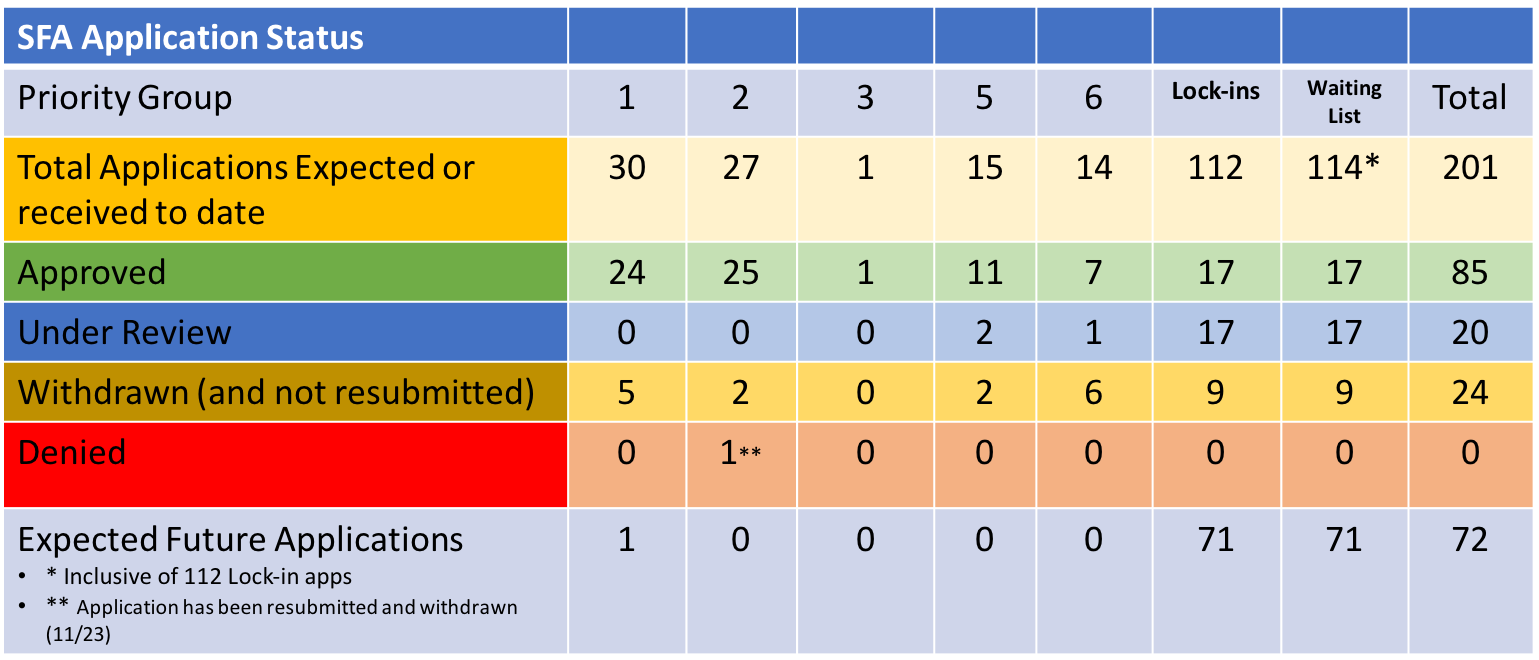
The “dog days” of summer don’t seem to be impacting the activity level at the PBGC, as we had a plethora of activity last week. As mentioned on the PBGC website, the e-filing website is open, but limited. “The e-Filing Portal is open only to plans at the top of the waiting list that have been notified by PBGC that they may submit their applications. Applications from any other plans will not be accepted at this time.” That’s interesting, as there are still 16 pension plans in Priority Groups 1-6 that have potential applications that are not currently being reviewed. Are they excluded, too?

During the week, three funds that had been on the waitlist submitted applications, including, Local 810 Affiliated Pension Plan, the Upstate New York Engineers Pension Fund, and the Alaska Plumbing and Pipefitting Industry Pension Plan. They are seeking a total of $282.1 million for the 9,620 plan participants. This is each plan’s initial submission. As always, the PBGC has 120 from the filing date to conclude the review.

In other news, two plans received approval of their applications, including the Pension Plan of the Moving Picture Machine Operators Union Local 306, a Priority Group 5 member, and the New England Teamsters Pension Plan, that was a Priority Group 6 member. The Moving Picture machinists will receive $20.7 million to support its 542 members, while the NE Teamsters get a whopping $5.7 billion for just over 72k participants. With these latest approvals, the PBGC has now granted through ARPA $67.7 billion in Special Financial Assistance (SFA) that will support the financial futures of 1.34 million American retirees.

On July 23, the Production Workers Pension Plan was added to the waitlist, becoming the 115th member on that list, with 47 having seen some activity (approved, under review, or withdrawn) regarding their applications. In other news, there were no applications denied or withdrawn. Furthermore, none of the previous SFA recipients were asked to repay a portion of the grant due to overpayment. Have a great week, and don’t hesitate to reach out to us if we can provide any assistance to you as you think through your investment strategy as it relates to the SFA grant.

ARPA Update as of July 19, 2024

By: Russ Kamp, Managing Director, Ryan ALM, Inc.

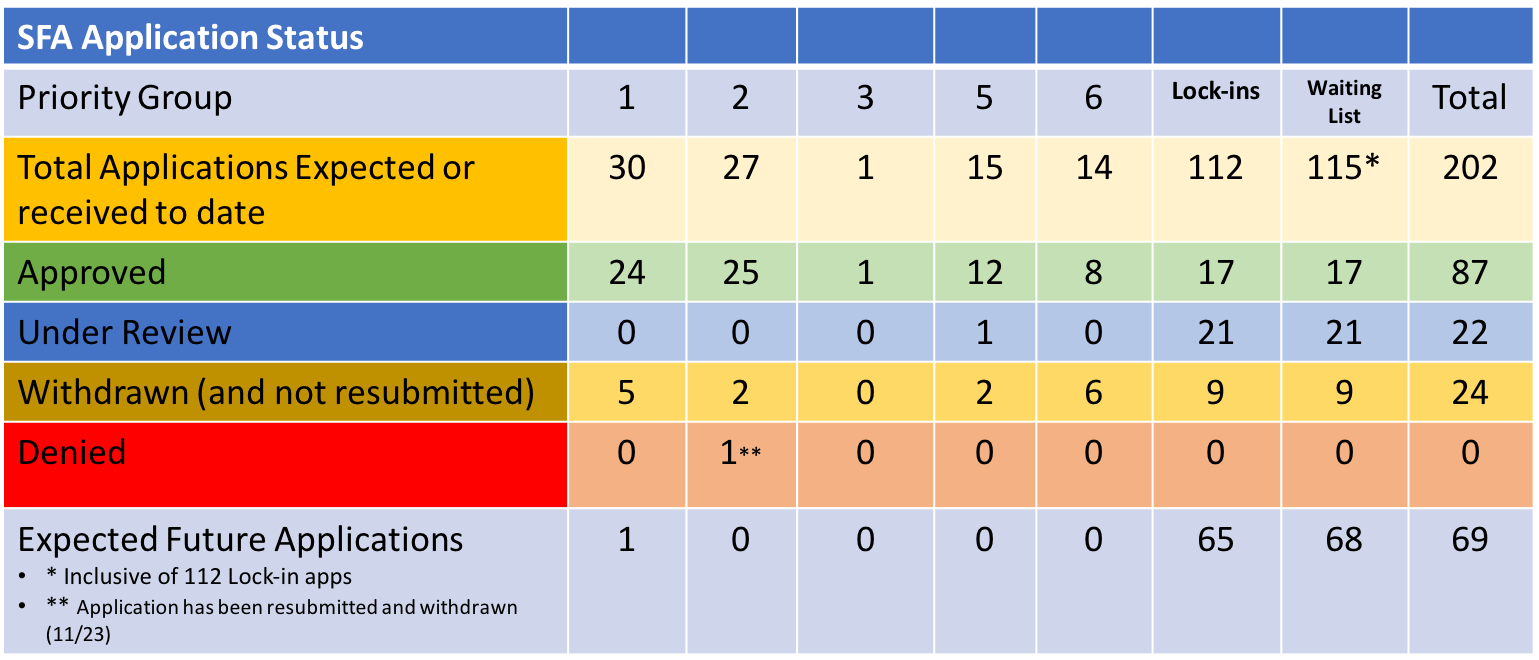
After a very hectic June, in which the PBGC approved nine applications for SFA, July has seen a replenishing of submitted applications seeking SFA grant money with 9 being filed in the first three weeks of the month. In the last week alone, we had Local 734 Pension Plan, Teamsters Local 210 Affiliated Pension Plan, Pension Plan of the Marine Carpenters Pension Fund, and the Pension Plan of the Automotive Machinists Pension Trust submit applications seeking nearly $411.5 million for the combined 20,111 plan participants.

There is really nothing else of note to those of us on the outside of this process. According to the PBGC’s website, there were no applications for SFA approved or denied in the previous week. No funds were asked to return excess payments, no multiemployer plans were added to the waitlist, and no applications were withdrawn.

There are still 16 funds with Priority Group standing (1-6) that are not currently under review, including 1 Priority Group 1 member that hasn’t filed an initial application, while all the others have withdrawn at least initial applications. In addition, there are still 71 waiting list applicants that have not yet submitted an initial application. Despite the successful implementation of ARPA to date, the PBGC still has a ton of work to do.

Ryan ALM, Inc. Celebrates 20th Anniversary!

By: Russ Kamp, Managing Director, Ryan ALM, Inc.

Congratulations to Ron Ryan, a true visionary, and the Ryan ALM, Inc. team as they (we) celebrate the 20th anniversary of the firm. Ryan ALM was incorporated in Delaware on June 15, 2004. Ronald J, Ryan, founder, says that “we created our company to be dedicated to asset liability management (ALM) as our name suggests. We are quite proud of our progress and achievements in ALM. We have built a turnkey system of products that are quite unique in the ALM industry”.

We strive every day to protect and preserve defined benefit plans for the American worker. We continue to believe that the primary objective in managing a pension is to SECURE the promised benefits at low cost and with prudent risk. We thank all of our clients and their advisors who have provided us with the opportunity to support their efforts on a daily basis. Please don’t hesitate to reach out to us. We’ll work with you to find a unique solution to your specific issue(s).

Here’s to the next 20!

Healthier Than Ever? Nah!

By: Russ Kamp, Managing Director, Ryan ALM, Inc.

P&I produced an article yesterday titled, “Corporate Pension Funds Are Fully Funded, Healthier Than Ever. Now What?” According to Milliman, corporate pension plans are averaging roughly a funded ratio of 106%. This represents a healthy funded status, but it is by no means the healthiest ever. One may recall that corporate plans were funded in excess of 120% as recently as 2000. In what might be more shocking news, public pension plans were too when using a market discount rate (ASC 715 discount rate). Today, those public pension plans have a funded status of roughly 80% according to Milliman’s latest public fund report.

The question, “Now what”? is absolutely the right question to be asking. Many corporate plans have already begun de-risking, as the average exposure to fixed income is >45% according to P&I’s asset allocation survey through November 2023. Unfortunately, public pension systems still sit with only about 18% exposure to US fixed income, preferring a “let it ride” mentality as equities and alternatives account for more than 75% of the average plan’s asset allocation. Is this the right move? No. The move into alternatives has dried up liquidity, increased fees, and reduced transparency. Furthermore, just because a public plan believes that its sponsor is perpetual, does that make the system sustainable? You may want to be reminded about Jacksonville Police and Fire. There are other examples, too.

Whether the pension plan is corporate, multiemployer, or public, the asset allocation should reflect the funded status. There is no reason that a 60% funded plan should have the same asset allocation as one that is 90% or better funded. All plans should have both liquidity and growth buckets. The liquidity bucket will be a bond allocation (investment grade corporates in our case) that matches asset cash flows to liability cash flows of benefits and expenses. That bucket will provide all of the necessary liquidity as far into the future as the pension system can afford. The remaining assets will be focused on outperforming future liability growth. These assets will be non-bonds that now have the benefit of an extended investing horizon to grow unencumbered. Forcing liquidity in environments in which natural liquidity has been compromised only serves to exacerbate the downward spiral.

Pension America has the opportunity to stabilize the funded status and contribution expenses. They also have the chance to SECURE a portion of the promises. How comforting! We saw this movie a little more than 20 years ago. Are we going to treat this opportunity as a Ground Hog Day event and do nothing or are we going to be thoughtful in taking appropriate measures to reduce risk before the markets bludgeon the funded status? The time to act is now. Not after the fact.

Tricky? Not Sure Why!

By: Russ Kamp, Managing Director, Ryan ALM, Inc.

The WSJ produced an article on April 22, 2024 titled, “Path for 10-Year U.S. Treasury Yield to 5% Is Possible but Tricky” At the time of publication, the 10-year Treasury note yield was just under 4.7%. It is currently at 4.66%. Those providing commentary talked about the need to further reduce expectations for potential rate cuts of another 25 to 40 basis points. As you may recall, there were significantly greater forecasts of rate cuts at the beginning of 2024, but those have been scaled back in dramatic fashion.

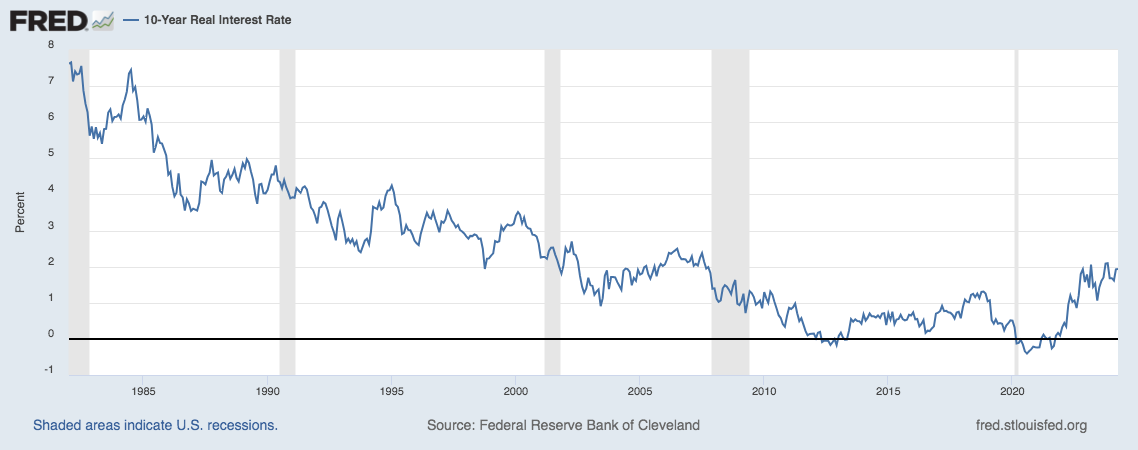
Given the current inflationary landscape in which the Consumer Price Index for All Urban Consumers (CPI-U) increased 0.4 percent in March and 3.5% annually, a move toward 5% for the US 10-year Treasury note’s yield shouldn’t be surprising or tricky. According to the graph below, the US 10-year yield has averaged a “real” yield of nearly 2% (1.934%) since 1984. A 2% inflation premium would place today’s 10-year Treasury note yield at roughly 5.6%.

Given the current economic conditions (2.9% GDP growth for Q1’24) and labor market strength (3.8% unemployment rate), it certainly doesn’t seem like the Fed’s “aggressive” action elevating the Fed Funds Rate from 0 to 5.5% today has had the impact that was anticipated. Inflation in 2024 has been sticky and may in fact be increasing. Should geopolitical issues grow in magnitude, inflation may get worse. These current conditions don’t say to me that a move to a 5% 10-year Treasury note yield should be tricky at all. As a reminder, the yield on this note hit 4.99% in late October 2023. Financial conditions have not gotten more restrictive since then.

Should the Treasury yield curve ratchet higher, with the 10-year eventually eclipsing 5%, plan sponsors would have a wonderful opportunity to secure the future promised benefits at significantly reduced cost in present value terms, especially if the cash flow matching portfolio used investment grade corporate bonds with premium yields. Although US corporate bond spreads are tight relative to average spreads, they still provide a healthy premium. Don’t let this rate environment pass without taking some risk from your plan’s asset allocation. We’ve seen that scenario unfold before and the outcome is scary.

What Are the Stats Telling Us?

By: Russ Kamp, Managing Director, Ryan ALM, Inc.

Mark Twain quoted Benjamin Disraeli in his 1907 autobiography, when he stated “Lies, damned lies, and statistics” as a phrase used to describe the persuasive power of statistics to support weak arguments. Folks who regularly read my posts know that I am a frequent user of statistics to support my arguments, whether they are strong or weak. As a young man, I would study the sports section box scores and the backs of my baseball cards for every possible stat. It is just who I am. I love #s!

The investment management industry is inundated with statistics. You can’t go a day without a meaningful insight being shared in reference to our industry, the economy, interest rates, politics, companies, commodities, etc. I try to absorb as many of these stats as possible. However, it is easy to fall prey to confirmation bias, which humans are prone. Putting a series of statistics together and building an investment case is never easy. That said, we at Ryan ALM, Inc. have been saying since the onset of higher rates that the US Federal Reserve would likely be forced to keep rates higher for longer, as inflation would remain stickier than originally forecast.

We also didn’t see a recession on the horizon due to an incredibly strong US labor market, which continues to witness near historic lows for unemployment. Despite the retiring of the Baby Boomer generation, the labor participation rate is up marginally during this period of higher rates, indicating that more folks are looking for employment opportunities at this time. They are being supported by the fact that job openings remain quite elevated relative to pre-Covid-19 levels at roughly 880k. When people work, they spend! Wage growth recently surprised to the upside. Will demand for goods and services follow? It usually does.

Furthermore, as we’ve disclosed on many occasions, financial conditions are NOT tight despite the rapid rise in US interest rates from the depths induced by the pandemic. Long-term US rates remain below the 50-year average, and in the case of the US 10-year Treasury note, the yield difference is roughly -2.1%. Does that give the Fed some room to possibly increase rates should inflation remain elusive?

In just the past week, we’ve had oil touch $85/barrel, the Atlanta Fed’s GDPNow model increase its forecast for Q1’24 growth from 2.3% to 2.8%, a Baltimore bridge collapse that will impact shipping and create additional expense and delays, housing that once again exceeded expectations, Fed (Powell) announcements that a recession wasn’t on the horizon, job growth (ADP) that was the highest in 8 months, manufacturing that stopped contracting for the first time since 2022 (17 months), and on and on and… Am I kidding myself that our case for higher for longer is the right call? Am I only using certain stats to “confirm” the Ryan ALM argument?

We don’t know. But here is the good news. Our investment strategy doesn’t care. As cash flow matching experts, we are agnostic as to the direction of rates. Yes, higher rates mean lower costs to defease those future benefit promises, so higher rates are good. However, once we match asset cashflows of interest and principal to the liability cash flows (benefit payments and expenses), the direction of rates becomes irrelevant, as future values are not interest rate sensitive. Building an investment case for cash flow matching was challenging when rates were at historic lows. It is much easier today, as one can invest in high quality investment-grade corporate bonds and get yields in the range of 5%-5.5%, which is a significant percent of the average return on asset assumption (ROA) with much less risk and volatility of investing in equities and other alternatives.

I don’t personally see a case for the Fed to cut rates in the near future. I think that it would be a huge mistake to once again ease monetary policy before the Fed’s objective has been achieved. I lived through the ’70s and witnessed first-hand the impact on the economy when the Fed took its collective foot off the brake. As a result, I entered this industry in 1981 when the 10-year Treasury yield was at 14.9%. The Fed can’t afford to repeat the sins of the past. I believe that they know that and as a result, they won’t act impulsively this time.

ARPA Update as of March 29, 2024

By: Russ Kamp, Managing Director, Ryan ALM, Inc.

Good morning, and welcome to a new month/quarter. Still feels like winter in the northeast! But there has been a thaw with regard to activity at the PBGC as they implement the ARPA legislation.

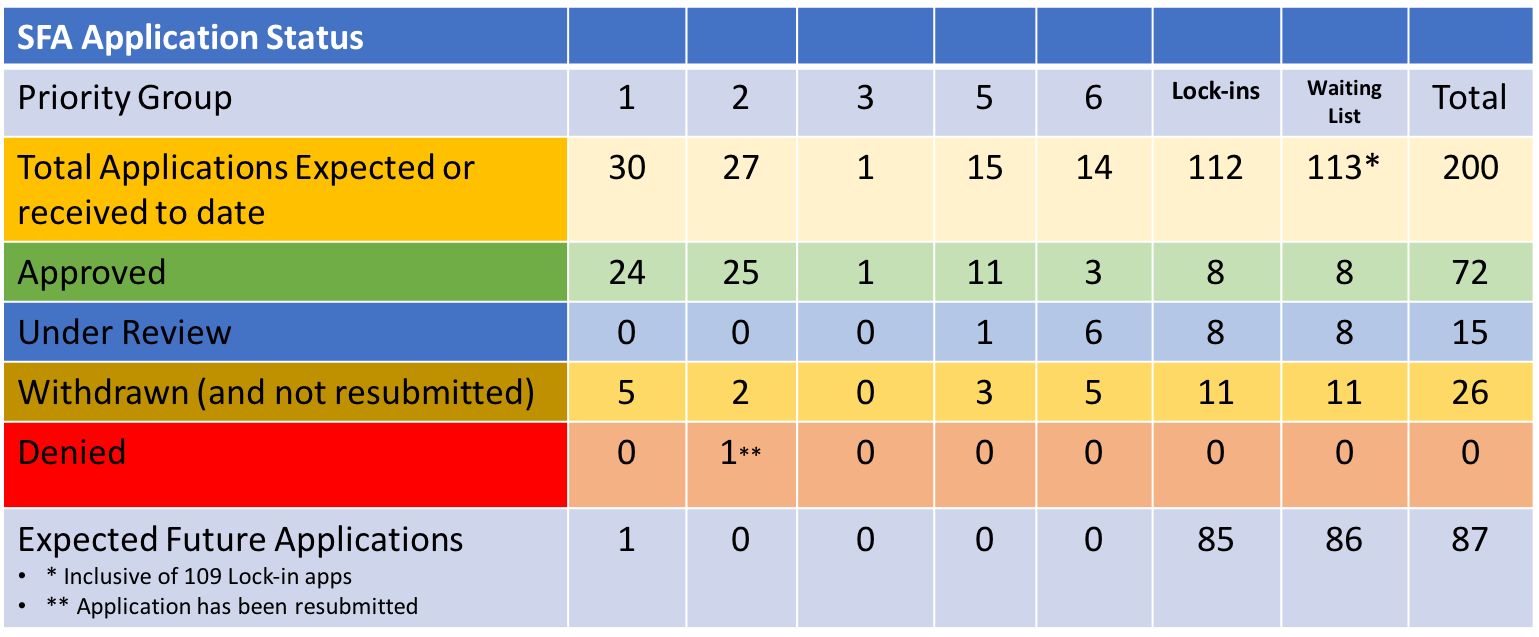
Happy to report that the Pension Plan of the Moving Picture Machine Operators Union Local 306 and the New England Teamsters Pension Plan both submitted applications seeking SFA. The Machine Operators, a priority group 5 member, is seeking $19.4 million for its 542 participants, while the NE Teamsters are hoping to capture more than $5.4 billion in SFA for just over 72k plan members. If the NE Teamsters are successful, they will have received the second largest grant to date only trailing the Central States Teamsters whopping $35.8 billion. To date, there have been 5 awards of greater than $1 billion. Currently, there are four plans seeking >$1 billion that are under review including the NE Teamsters.

In other news, the United Food and Commercial Workers Union Local 152 Retail Meat Pension Plan, had its application approved for an SFA grant of $279.3 million which will support the benefits for 10,252 members. There were no applications denied or withdrawn during the previous week. In addition, there were no pension funds added to the waitlist that continues to have 86 potential applications waiting to submit an application from the initial 113 members.

The upcoming week will provide some insight into the continuing strength of the US labor market with the ADP and US employment releases as well as the weekly initial claims data. However, it doesn’t appear that market participants are waiting to see what those data sets reveal as US Treasury bonds and notes are seeing a big move up in yields today. This movement hurts total return focused fixed income products, but it provides those pension plans with more attractive yields for cash flow matching assignments. Higher yields mean lower cost to defease future benefit payments. Very nice!

The Importance of Liquidity

By: Russ Kamp, Managing Director, Ryan ALM, Inc.

I recently came across an article written by a friend of mine in the industry. Jack Boyce, former Head of Distribution for Insight, penned a terrific article for Treasury and Risk in July 2020. The title of Jack’s article was “We Need to Talk About the Armadillo in the Room”. It isn’t just a funny title, but an incredible simile for the two primary stages of a pension plan, notably the accumulation and decumulation stages of pension cash flows. The move from a positive cash flow environment to a negative cash flow environment creates a hump that is reminiscent of the shape of an armadillo.

I stumbled on an armadillo at TexPERS last summer and truthfully didn’t think at that time that I was looking at a pension funding cycle, but I’ll never look at an armadillo again without thinking about Jack’s comparison. But the most important aspect of Jack’s writing wasn’t that he correctly associated the funding cycle with a less than cuddly animal, it was the fact that he highlighted a critically important need for pension plan sponsors of all types – liquidity! I’ve seen far too often the negative impact on pension plans and endowments and foundations when appropriate and necessary liquidity is not available to meet the promises, whether they be a monthly benefit, grant, or support of operations.

The last thing that you want to have happen when cash is needed is to be forced to raise liquidity when natural liquidity is absent from the market. There have been many times when even something as liquid as a Treasury note can’t be sold. Just harken back to 2008, if you want a prime example of not being able to transact in even the most liquid of instruments. Bid/ask spreads all of a sudden resemble the Grand Canyon. As we, at Ryan ALM have been saying, sponsors of these funds should bring certainty to a process that has become anything but certain. Jack correctly points out that “a typical LDI approach focuses on making sure the market value of a plan’s assets and the present value of its liabilities move in lockstep.” However, too often “these calculations fail to factor in the timing of cash flows.” We couldn’t agree more. Where is the certainty?

His recommendation mirrors ours, in that cash flow matching should be a cornerstone of any LDI program. Using the cash flow of interest and principal from investment grade bonds to carefully match (defease) the liability cash flows secures the necessary liquidity chronologically for as long as the allocation is sustained. By creating a liquidity bucket, one buys time for the remaining assets in the corpus to now grow unencumbered. As we all know, time is an extremely important attribute when investing. I wouldn’t feel comfortable counting on a certain return over a day, week, month, year, or even 5 years. But give me 10-years or more and I’m fairly confident that the expected return profile will be achieved.

Jack wrote, “pension plan sponsors need thoughtful solutions”. We couldn’t agree more and have been bringing ideas such as this to the marketplace for decades. Like Jack, “we believe a CDI approach can simultaneously improve a plan’s overall efficiency and the certainty of reaching its long-term outcome.” Certainty is safety! We should all be striving for this attribute.