Milliman Reports on Public Pension Funding

By: Russ Kamp, CEO, Ryan ALM, Inc.

Milliman has released details related to the recent update of its Milliman 100 Public Pension Funding Index (PPFI) covering both December 2024 and January 2025. The index consisting of the U.S.’s largest 100 public pension funds revealed a slight decline in the average funded ratio at the end of 2024 to 80.0% from 81.7% at November 30. An average return of -1.7% on assets drove the funded ratio down. However, January’s result highlighted a 1.9% average gain and an improvement in the average funded ratio to 81.1% at month-end.

It was also reported that the deficit between plan assets and liabilities grew by $44 billion, as a deficit of $1.184 trillion at the beginning of December 2024 became $1.227 trillion at the end of January 2025. These mega funds experienced combined outflows of about $9 billion/month. Importantly, 31 of the index constituents have funded ratios greater than 90% with 7 of those plans registering a funded ratio of 105% or better. Unfortunately, 9 of the plans have funded ratios <50%. As a reminder, a plan with a 50% funded status and a 7% ROA objective actually needs to produce a return of 14% just to keep the funded status from deteriorating…and a 80% funded status requires an actual ROA of 8.75%.

It would be interesting to know what asset allocation changes, if any, have been adopted by those plans with funded ratios >90%. Given significant uncertainty in the markets and the U.S. economy, plans should be looking to reduce risk and improve liquidity at this time. We’ve seen considerable improvement in the funded status of a number of large public pension systems. It would be a tragedy to see this improved funding go to waste should markets enter a period of weakness.

Risk On or Risk Off?

By: Russ Kamp, CEO, Ryan ALM, Inc.

I have the pleasure of speaking at the Opal/LATEC conference on Thursday. My panel has been given the topic of Risk On or Risk Off: How Are You Adjusting Your Portfolio, and Which Investment Risks Concern You Most? I think it is an incredibly timely discussion given the many cross-currents in the markets today.

Generally speaking, what is risk? At Ryan ALM, Inc. we would say that risk is the failure to achieve the objective. What is the objective in managing a defined benefit pension plan? We believe that the primary objective is to secure the promised benefits at a reasonable cost and with prudent risk. We don’t believe that it is a return objective.

However, most DB pension systems are NOT focused on securing the promised benefits, but they are engaged in developing an asset allocation framework that cobbles together diversified (overly perhaps) asset classes and investment strategies designed to achieve an annual return (ROA) target that has been established through the contributions of the asset consultant, actuary, board of trustees, and perhaps internal staff, if the plan is of sufficient size to warrant (afford) an internal management capability.

Once that objective has been defined, the goal(s) will be carefully addressed in the plan’s investment policy statement (IPS), which is a road map for the trustees and their advisors to follow. It should be reviewed often to ensure that those goals still reflect the trustees’ wishes. The review should also incorporate an assessment of the current market environment to make sure that the exposures to the various asset classes reflect today’s best thinking.

There are numerous potential risks that must be assessed from an investment standpoint. Some of those include market (beta), credit, liquidity, interest rates, and inflation. For your international managers, currency and geopolitical risk must be addressed. From the pension management standpoint, one must deal with both operational and regulatory risk. Some of these risks carry greater weight, such as market risk, but each can have an impact on the performance of your pension plan.

However, there are going to be times when a risk such as inflation will dominate the investing landscape (see 2022). Understanding where inflation MAY be headed and its potential impact on interest rates and corporate earnings is a critical input into how both bonds and stocks will likely perform in the near-term. Being able to assess these potential risks as a tool to adjust your funds asset allocation could reduce risk and help mitigate the negative impact of significant drawdowns that will impact the plan’s funded status and contribution expenses. Of course, the ability to reduce or increase exposures will depend on the ranges that have been established around asset class exposures (refer to your IPS).

So, where are we today? Is it risk on or risk off as far as the investing community is concerned? It certainly appears to me that most investors continue to take on risk despite extreme equity valuations, sticky, and perhaps worsening inflation, leading to an uncertain path for U.S. interest rates, and geopolitical risk that can be observed in multiple locations from the Middle East, to Ukraine/Russia, and China/Taiwan. The recent change in the administration and policy changes related to the use of tariffs has created uncertainty, if not anxiety, among the investment community.

So, how are you adjusting your portfolio? If your plan is managed similarly to most where all the assets are focused on the ROA, the ability to adjust allocations based on the current environment is likely limited to those ranges that I described above. Also, who can market time? I would suggest that the best way to adjust your portfolio given today’s uncertainty is to adopt an entirely different asset allocation framework. Instead of having all of the assets focused on that ROA objective, bifurcate your asset allocation into liquidity and growth buckets.

By adopting this strategy, liquidity is guaranteed to be available when needed to make those pesky monthly benefit payments. In addition, you’ve just bought time, an extremely important investment tenet, for the remainder of the assets (growth/alpha) to now grow unencumbered. The liquidity bucket will provide a bridge over choppy waters churned up by underperforming markets. Yes, there appears to be significant uncertainty in today’s investment environment. Instead of throwing up your hands and accepting the risks because you have limited means to act, adopt the new asset allocation structure before it is too late to protect your plan’s funded status.

A Little Late to the Party!

By: Russ Kamp, CEO, Ryan ALM, Inc.

P&I is running a story today about two U.S. Congressmen, Representatives Tim Walberg, R-Mich., and Rick Allen, R-Ga., who have produced a Feb. 20 letter to Attorney General Pam Bondi regarding excess Special Financial Assistance (SFA) payments to multiemployer plans under the ARPA pension legislation that has been implemented/overseen by the PBGC. They are demanding that the Justice Department look into the erroneous payments made to some of the SFA recipients base on incorrect census data.

This issue was first raised by the PBGC’s Office of Inspector General back in November 2023 when they found that while the agency required the pension fund to provide a list of all plan participants and proof of a search for deceased participants, “the PBGC did not cross-check that information with the Social Security Administration’s Death Master File — the source recommended by the Government Accountability Office for reducing improper payments to dead people.” Good catch, PBGC. Clearly, no one wants to see incorrect payments made, but for these Congressman to be encouraging a review at this time seems a little misplaced, as the repayment of excess funds has been ongoing since last April when Central States, Southeast & Southwest Areas Pension Plan repaid $126.7 million representing 0.35% of the SFA grant received.

Since the repayment by Central States, the PBGC has worked diligently with 60 pension plans that received SFA prior to the use of the SSA’s DMF to make sure that any excess SFA is recaptured. As of February 21, 2025, 38 plans have repaid $180 million in excess SFA from total grants paid of $43.6 billion or 0.41%. The 38 plans represent 63% of the cohort that might have received excess grant money. Is the $180 million earth-shattering? No. Will it dramatically impact the Federal budget deficit running at roughly $2 trillion per year? Again, no. Might this unfortunate situation tarnish the huge success that ARPA has been? Unfortunately, it just might.

For these Congressman to only now seek to get the Justice Department involved seems misplaced as nothing more than a political hit job. Instead of creating waves, they should be celebrating the fact that ARPA has helped to secure the rightfully earned retirement benefits for 1.53 million American workers and retirees (oh, and they are taxpayers, too) through nearly $71 billion in SFA grants to date. The amount of economic activity created from these monthly benefits will support local businesses and jobs for years to come. Fortunately, there are still more than 90 multiemployer plans that might yet collect some SFA grant money. Let’s hope that they do.

None of the members of these plans ever wanted to be in a situation where their earned benefits might be slashed or worse, eliminated. Yet, that’s exactly where they found themselves following the passage of MPRA. Thank goodness that ARPA was signed into law in March 2021 before more damage was done to struggling multiemployer funds. I’m not sure that I can point to another piece of pension legislation enacted during my 43-year career that has had such a beneficial impact on our pensioners. Most of what I’ve witnessed is the whittling away of benefits.

ARPA Update as of February 21, 2025

By: Russ Kamp, CEO, Ryan ALM, Inc.

Welcome to the last week in February. Spring can’t arrive soon enough in New Jersey!

Last week the Milliman organization published its annual review of the state of multiemployer pension plans. The news was quite positive, but in digger deeper, it became apparent that the payment of the Special Financial assistance (SFA) was the primary reason for the improved funding ratios. Given how critically important the SFA is to the ongoing success of many of these plans, let’s look at what transpired during the previous week.

According to the PBGC’s weekly spreadsheet, there were no new applications filed as the eFiling portal remains temporarily closed. In addition, no applications were approved or denied, but there was one application withdrawn, as non-priority plan Aluminum, Brick & Glass Workers International Union, AFL-CIO, CLC, Eastern District Council No. 12 Pension Plan (the plan’s name is longer than the fund’s size is large) pulled its application seeking $10.6 million for 580 participants.

There was some additional activity though, as five plans were asked to repay a portion of the previously agreed SFA due to census errors. In total, these plans repaid $16.3 million representing just 1.06% of the grants received. To date, $180.8 million has been reclaimed from grants totaling $43.6 billion or 0.41%.

In other news, we had Bricklayers & Allied Craftworkers Local No. 3 NY Niagara Falls-Buffalo Chapter Pension Plan, added to the waitlist (#116). This is the first addition to the list since July 2024. This plan did not elect to lock-in the interest rate for discount rate purposes, joining a couple other plans that have kept their options open.

We should witness dramatic improvement in the Milliman funded ratio study next year, as about 7% (85 funds) were funded at <60% in 2024. There are currently 94 plans seeking SFA support. If granted, they should all see meaningful improvement in the funded status of their plans. As a result, we could have a situation in which the multiemployer universe becomes fully funded. How incredible. Now, let’s not do something silly from an investment standpoint that would jeopardize this improved funding.

Milliman’s Multiemployer Study Released

By: Russ Kamp, CEO, Ryan ALM, Inc.

Milliman released the 2024 year-end results of its Multiemployer Pension Funding Study (MPFS). The MPFS analyzes the funded status of ALL U.S. multiemployer DB pension plans. As of December 31, 2024, Milliman estimated multiemployer plans have an aggregate funded ratio of 97%, up from 89% as of December 31, 2023. Impressive!

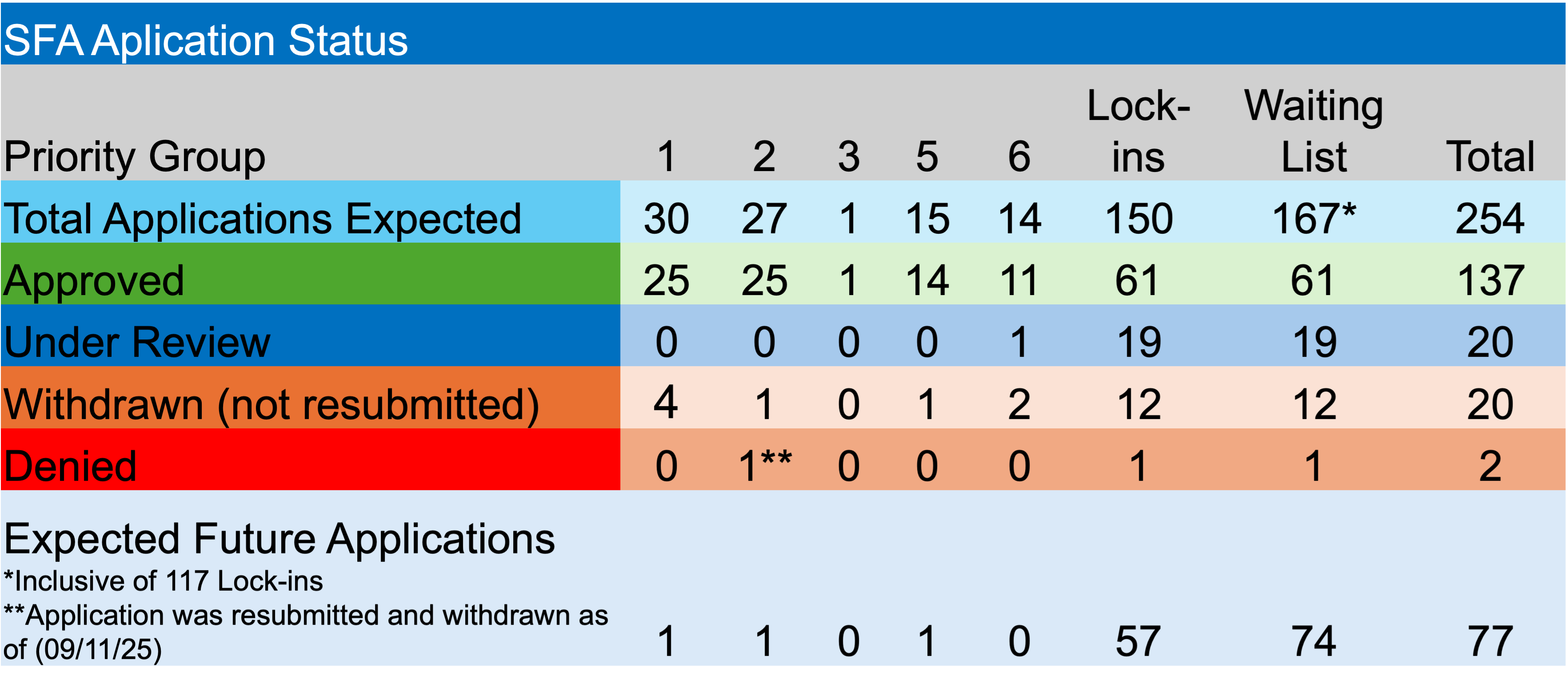
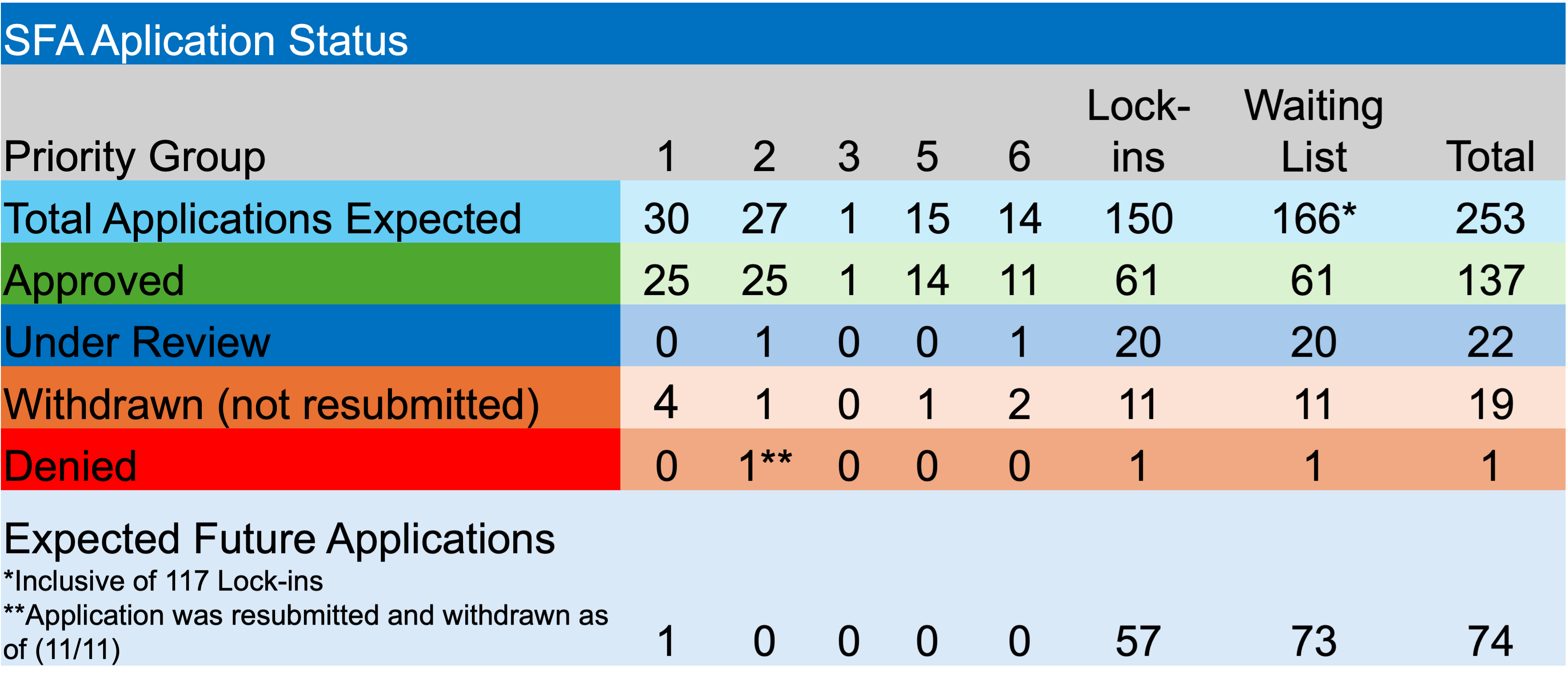
Milliman determined that the improved funded status was largely due to investment gains, but they also highlighted the critical contribution from the special financial assistance (SFA) granted under the ARPA. Milliman highlighted that as of year-end 2024, 102 plans have received nearly $70 billion in SFA funding, including $16 billion paid during 2024. Incredibly, without the support of SFA grants, the MPFS plans’ aggregate funded percentage at year-end 2024 would be approximately 89% or the same as the end of December 2023. As my chart below highlights, as of today, 109 plans have now received $71 billion in SFA grants.

Chart provided by Ryan ALM, Inc.

According to Milliman, “53% (627 of 1,193 plans) are 100% funded or more, and 84% (1,005) are 80% funded or better.” They also highlighted the more challenged members of this cohort, stating that “7% of plans (85) are below 60% funded and may be headed toward insolvency. Many are likely eligible and expected to apply for SFA in 2025.” As the chart above highlights, there still 93 plans going through the process of submitting applications with the PBGC to receive SFA support.

ARPA’s pension reform legislation has clearly been a godsend to many struggling multiemployer plans (roughly 10% of ME plans to date). That said, a review of the universe of all multiemployer plans points to terrific stewardship of the retirement assets on the part of a significant percentage of plans. My one concern is that the use of the return on Asset (ROA) assumption by most of these plans as the discount rate for plan liabilities is overstating the true funded status relative to a discount rate of a blended AA corporate rate used by the private sector. Milliman’s other DB pension plan studies have public sector plans at an 81.2% funded ratio and private plans at 105.8%.

Friend or Foe?

By: Russ Kamp, CEO, Ryan ALM, Inc.

At hearings yesterday, President Trump’s nominee for secretary of labor, Lori Chavez-DeRemer, faced questions from members of the U.S. Senate Committee on Health, Education, Labor and Pensions. During the questioning, Ms. Chavez-DeRemer did state that she was supportive of the Butch Lewis Act (BLA).

NO candidate for Secretary of Labor should ever be considered who isn’t in favor of the BLA. To date, $70.9 billion in Special Financial Assistance (SFA) and interest has been awarded to 109 multiemployer pension plans. Oh, and roughly 1.53 MILLION American workers and retirees have seen their promised pensions secured. This legislation has been a HUGE success, and there are more than 90 plans still going through the process.

Just think about all of the economic activity that will be produced by these retirees who can remain active participants in our economy. Without BLA, they were doomed to become reliant on state and federal social safety nets. Who wants to be forced to live like that, especially when you’ve been a productive member of society for an entire career? You don’t believe that they were doomed to economic hardship? Please read about those pensioners impacted by the passage of the Multiemployer Pension Relief Act of 2014 (MPRA) (eventually 18 plans received DOL support to slash benefits) that saw benefits, which were already being collected, slashed by more than 50% in some cases. Talk about lives being turned upside down!

Ms. Chavez-DeRemer, if you have any questions about why BLA is so critical, may I encourage you to go to my blog at kampconsultingblog.com and read about Carol. All you must do is put her name in my search bar (upper right corner). I believe that you’ll be as shocked as I was that our government sanctioned the action that came from MPRA. We can’t allow BLA to become a political football at this time. There are too many American workers and retirees counting on the benefits that they worked hard for and those that were promised. If you support BLA – great. If you do not – please step aside! The Labor Department and American workers need someone else!

Parallels to the 1970s?

By: Russ Kamp, CEO, Ryan ALM, Inc.

My recollection of the 1970s has more to do with playing high school sports, graduating from PPHS in 1977, and then going off to Fordham where I would meet my wife in an economics class in 1979. I wasn’t really focused on the economy throughout much of the decade. You see, college was reasonably affordable, and gas and tolls (GWB) were not priced outrageously, so getting back and forth to the Bronx wasn’t crushing for me and my parents.

However, I do recall the two oil embargoes that rocked the economy during the decade. I vividly recall the 1973 oil embargo that was triggered by the Yom Kippur War. I was a newspaper delivery boy for the Hudson Dispatch and was frequently amazed by the long gas lines that would stretch for blocks on both odd and even days, as I drove by on my bike. The Organization of Arab Petroleum Exporting Countries instituted the oil embargo against any country supporting Israel, including the U.S. This led to a dramatic increase in oil prices from about $3/barrel to roughly $12/barrel. This action led to widespread economic disruption, and as you can imagine, significant inflationary pressures.

The 1979 oil crisis was precipitated by the Iranian Revolution which saw the overthrow of the Shah of Iran in February 1979. The Revolution created a significant disruption in oil production in Iran, causing global oil supply issues. Similarly, to the 1973 crisis, oil prices surged from about $14/barrel to nearly $40/barrel. Once again, gasoline shortages materialized and inflation rose rather dramatically. This oil impact would lead to a period of economic stagnation that would eventually be defined as “stagflation”.

Now, I am NOT saying that we are about to face significant oil embargoes. But I am reminding everyone that history does have a tendency to repeat itself even if the players aren’t exactly the same. The graph below is pretty eye-opening, at least to me.

For those of you who can recall the 1970s, you’ll remember that the US Federal Reserve tried to mitigate inflation through aggressive increases in the Fed Funds Rate, which would eventually hit 20% in March 1980. As a result of their action, U.S. Treasury yields rose dramatically, too. For instance, the yield on the US 10-year Treasury note would peak at 15.84% in September 1981. As an FYI, I would enter our industry in October 1981.

Despite the aggressive action by the Fed’s FOMC beginning in March 2022, inflation has not been brought under control. Were they premature in reducing the FFR 3 times and by 1% to end 2024? A case could certainly be made that they were. So, where do we go from here? There certainly appears to be some warning signs that inflation could raise its ugly head once more. We are in the midst of a rebound in food inflation, and not just eggs. I just read this morning that those heating with natural gas will see about a 10% increase in their bills relative to last year – ouch. There are other worrying signs as well without even getting into the potential impact from policy changes brought about by the new administration.

It is quite doubtful that we will witness peaks in inflation and interest rates described above, but who really knows? Given the great uncertainty, and the potentially significant ramifications of a renewed inflationary cycle (2022 was not that long ago), plan sponsors should be working diligently to secure the current funding levels for their plans. Why continue to subject all of the assets to the whims of the markets for which they have no control over? Inflationary concerns rocked both the equity and bond markets in 2022. In fact, the BB Aggregate Index suffered its worst loss (-13%) by more than 4X the previous worst annual return (-2.9% in 1994). Rising rates crush traditional core fixed income strategies, but they are a beautiful benefit when matching asset cash flows (principal and interest) to liability cash flows (benefits and expenses) through CFM.

As a plan sponsor, I’d want to find as much certainty as possible, given the abundant uncertainty of markets each and every day. As Milliman has reported, both private and public pension funded ratios are at levels not seen in years. Don’t blow it now!

Terrific Issue Brief from the American Academy of Actuaries

By: Russ Kamp, CEO, Ryan ALM, Inc.

An acquaintance of mine shared an issue brief that was produced by the American Academy of Actuaries last April. They Academy describe their organization and role, as follows. “The American Academy of Actuaries is a 20,000-member professional association whose mission is to serve the public and the U.S. actuarial profession. For more than 50 years, the Academy has assisted public policymakers on all levels by providing leadership, objective expertise, and actuarial advice on risk and financial security issues. The Academy also sets qualification, practice, and professionalism standards for actuaries in the United States.”

The brief addressed surplus management for public pension systems. What does it mean and what should be done when a plan is in “surplus”. It is important to understand that a surplus calculation (plan assets – plan liabilities) is a single point in time. Our capital markets (assets) and U.S. interest rates (discounting of liabilities) are constantly changing. A plan that is deemed to be in surplus today could easily fall below 100% the very next day.

The go go decade of the 1990s witnessed public pension’s producing fairly consistent double-digit returns. Instead of locking in these gains through sound surplus management, benefits were often enhanced, contributions trimmed, or both. As a result, once the decade of the ’00s hit and we suffered through two major recessions, the enhancements to the benefits which were contractually protected and the lowered contributions proved tough to reverse.

According to Milliman, they estimate the average public funded ratio at 81.2% (top 100 plans) as of November 30, 2024. This is up substantially from September 30, 2022 when the average funded ratio was roughly 69.8%. But it highlights how much work is still needed to be done. I agree that it is wise to have a surplus management plan should these critically important funds once again achieve a “surplus”. I would hope that the plan is centered on de-risking their traditional asset allocations by using more bonds in a cash flow matching (CFM) strategy to reduce the big swings in funding. Furthermore, it is critically important to secure what has already been promised than to weaken the funded status by enhancing benefits or cutting contributions prematurely.

I’d recommend to everyone involved in pension management that they spend a little time with this report. The demise of DB pension plans in the private sector has created a very uncertain retirement for many of our private sector workforce. Let’s not engage in practices that lead to the collapse of public sector DB plans.

ARPA Update as of February 14, 2025

By: Russ Kamp, CEO, Ryan ALM, Inc.

Credit to the PBGC for not letting Valentine’s Day get in the way of a productive week, as they continue to implement the ARPA legislation, which is quickly approaching its fourth anniversary!

The eFiling portal has been sporadically open since the beginning of the year. Last week they turned the spigot on a little more, as three non-priority group plans submitted applications, including Teamsters Local 277 Pension Fund, Teamsters Local 210 Affiliated Pension Plan and Cement Masons Local No. 524 Pension Plan. In the case of Local 277, this was the initial filing, while the other two submitted revised applications. In total, these three pension plans are seeking $153.2 million in SFA for the nearly 10k participants.

In other news, the checks are no longer in the mail, as Laborers’ Local No. 265 Pension Plan, Local 734 Pension Plan, Upstate New York Engineers Pension Fund, and The Legacy Plan of the UNITE HERE Retirement Fund received the approved SFA plus interest and FA loan repayments. The $800 million gorilla within this group was Unite Here receiving $868.8 million from a total distribution of $1.1 billion. I suspect that the 103,118 members of these plans slept pretty well this weekend knowing that the promised benefits had been secured.

I’m pleased to report that no applications were denied during the past week. In addition, there were no plans required to repay excess SFA on account of census issues. Lastly, there were no new funds seeking inclusion on the waitlist. The chart below highlights where we are in the process. Despite the significant progress to date, there remains quite a bit of work for the PBGC.

Don’t forget, the legislation requires pension funds receiving SFA to rebalance the allocation between fixed income and equities back to 67%/33% one day every 12-months. Given the significant outperformance of equities vis-a-vis bonds plus the monthly benefit payments most likely coming from the fixed income program, there should be some significant rebalancing needs. It seems like a good time to reduce risk and take some profits.

Nothing Here! Really?

By: Russ Kamp, CEO, Ryan ALM, Inc.

Yesterday’s financial news delivered an inflation surprise (0.5% vs. 0.3%), at least to me and the bond market, if not to the U.S. equity market. The Federal reserve had recently announced a likely pause in their rate reduction activity given their concerns about the lack of pace in the inflation march back to its 2% target. This came on the heels of “Street” expectations after the first 0.5% cut in the FFR that there were “likely” to be eight (8!) interest rate cuts by the summer of 2025. Oh, well, the two cuts that we’ve witnessed since that first move last September may be all we get for a while. “Ho hum” replied the U.S. stock market.

The discounting of yesterday’s inflation release is pretty astounding. Like you, I’ve read the financial press and the many emails that have addressed the CPI data 52 ways to Sunday. Much of the commentary proclaims this data point as a one-off event. For instance, the impact of egg price increases (13.8% last month alone) is temporary, as bird flu will be contained shortly. Seasonal factors impacting “sticky-priced” products tend to be announced in January. I guess those increases shouldn’t matter since they only impact the consumer in January. As a reminder, Core inflation (minus food and energy) rose from 3.1% to 3.3% last month. That seems fairly significant, but we are told that the other three core readings were down slightly, so no big deal. Again, really? Each of those core measures are >3% or more than 1% greater than the Fed’s target.

Then there are those that say, “what is significant about the Fed’s 2% inflation objective anyway”? It is an arbitrary target. Well, that may be the case, but for the millions of Americans that are marginally getting by, the difference between 2% and 3% inflation is fairly substantial, especially when we come up with all of these measures that exclude food, energy, housing (shelter), etc. Are you kidding?

As mentioned previously, expectations for a massive cut in interest rates due to the perception that inflation was well contained have shifted dramatically. Just look at the graph above (thanks, Bloomberg). Following the Fed’s first FFR cut of 50 bps, inflation expectations plummeted to below 1.5% for the two-year breakeven. Today those same expectations reveal a nearly 3.5% expectation. Rising inflation will certainly keep the Fed in check at this time.

As mentioned earlier in this post, U.S. equities shrugged off the news as if the impact of higher inflation and interest rates have no impact on publicly traded companies. Given current valuations for U.S. stocks, particularly large cap companies, any inflation shock should send a shiver down the spines of the investing community. Should interest rates rise, bonds will surely become a more exciting investment opportunity, especially for pension plans seeking a ROA in the high 6% area. How crazy are equity valuations? Look at the graph below.

The current CAPE reading has only been greater during the late 1990s and we know what happened as we entered 2000. The bursting of the Technology bubble wasn’t just painful for the Information Technology sector. All stocks took a beating. Should U.S. interest rates rise as a result of the current inflationary environment, there is a reasonable (if not good) chance that equities will get spanked. Why live with this uncertainty? It is time to get out of the game of forecasting economic activity. Why place a bet on the direction of rates? Why let your equity “winnings” run? As a reminder, managing a DB pension plan should be all about SECURING the promised benefits at a reasonable cost and with prudent risk. Is maintaining the status quo prudent?