Corporate Pension Funding Up, Again!

By: Russ Kamp, CEO, Ryan ALM, Inc.

Milliman released its monthly Milliman 100 Pension Funding Index (PFI), which analyzes the 100 largest U.S. corporate pension plans. Again, the news was positive.

For August, strong investment performance overcame a decline in discount rates to power the PFI funded ratio from 105.5% at the end of July to 106.2%, as of August 31. As previously mentioned, discount rates slipped during the period from 5.55% to 5.53%, as U.S. interest rates ticked lower, while the index participants enjoyed gains of 1.25%. The collective market value of plan assets rose by $10 billion during August, to $1.290 trillion. Importantly, the index participants experienced a funded status improvement of $8 billion, marking the fifth consecutive monthly rise in funding levels.  

““After strong investment performance, corporate pension plans moved further into surplus territory during August,” said Zorast Wadia, author of the PFI. “However, with the expectation of rate cuts on the horizon, plan sponsors should take steps now to preserve funded status gains and institute prudent asset-liability management strategies.”” (bolding is my addition to the text)

We, Ryan ALM, couldn’t agree more with Zorast’s recommendation. Managing a DB pension plan’s primary objective is to SECURE the promised benefits at a reasonable cost and with prudent risk. It is NOT a performance game. With the great uncertainty surrounding the current economic environment with cross-currents such as job losses and inflation, why wait to remove risk from the plan’s current asset allocation. By doing so, you are minimizing the chance of a significant market decline impacting the pension plan’s funded status/ratio and contributions both taking a hit.

You can read the complete Milliman report in the link below. It’s a good read!

View this Month’s complete Pension Funding Index.

A Peer Group?

By: Russ Kamp, CEO, Ryan ALM, Inc.

Got an email today that got my heart rate up a little. The gist of the article was related to a particular public pension fund that eclipsed its “benchmark” return for the fiscal year ended June 30, 2025. Good job! However, the article went on to state that they failed to match or exceed the median return of 10.2% for the 108 public pension funds with asset >$1 billion. What a silly concept.

Just as there are no two snowflakes alike, there are no two public pension systems that are the same, even within the same state or city. Each entity has a different set of characteristics including its labor force, plan design, risk tolerance, benefit structure, ability to contribute, and much more. The idea that any plan should be compared to another is not right. Again, it is just silly!

As we’ve discussed hundreds of times, the only thing that should matter for any DB pension plan is that plan’s specific liabilities. The fund has made a promise, and it is that promise that should be the “benchmark” not some made up return on asset (ROA) assumption. How did this fund do versus their liabilities? Well, that relationship was not disclosed – what a shocker!

Interestingly, the ROA wasn’t highlighted either. What was mentioned was the fact that the plan’s returns for 3-, 5-, and 10-years were only 6.2%, 6.6%, and 5.4%, respectively (these are net #s), and conveniently, they just happened to beat their policy benchmark in each period.

I’d be interested to know how the funded ratio/status changed? Did contribution expenses rise or fall? Did they secure any of the promised benefits? Did they have to create another tier for new entrants? Were current participants asked to contribute more, work longer, and perhaps get less?

I am a huge supporter of defined benefit plans provided they are managed appropriately. That starts with knowing the true pension objective and then managing to that goal. Nearly all reporting on public pension plans focuses on returns, returns, returns. When not focusing on returns the reporting will highlight asset allocation shifts. The management of a DB pension plan with a focus on returns only guarantees volatility and not success. I suspect that the 3-, 5-, and 10-year return above failed to meet the expected ROA. As a result, contributions likely escalated. Oh, and this fund uses leverage (???) that gives them a 125% notional exposure on their total assets. I hope that leverage can be removed quickly and in time for the next correction.

ARPA Update as of September 5, 2025

By: Russ Kamp, CEO, Ryan ALM, Inc.

Football season is upon us, but if you are a NY Giants fan, as I am, you are already looking forward to hockey and basketball beginning in October! The Giants truly have an “offensive” line. Enough of that, let’s get to the important stuff.

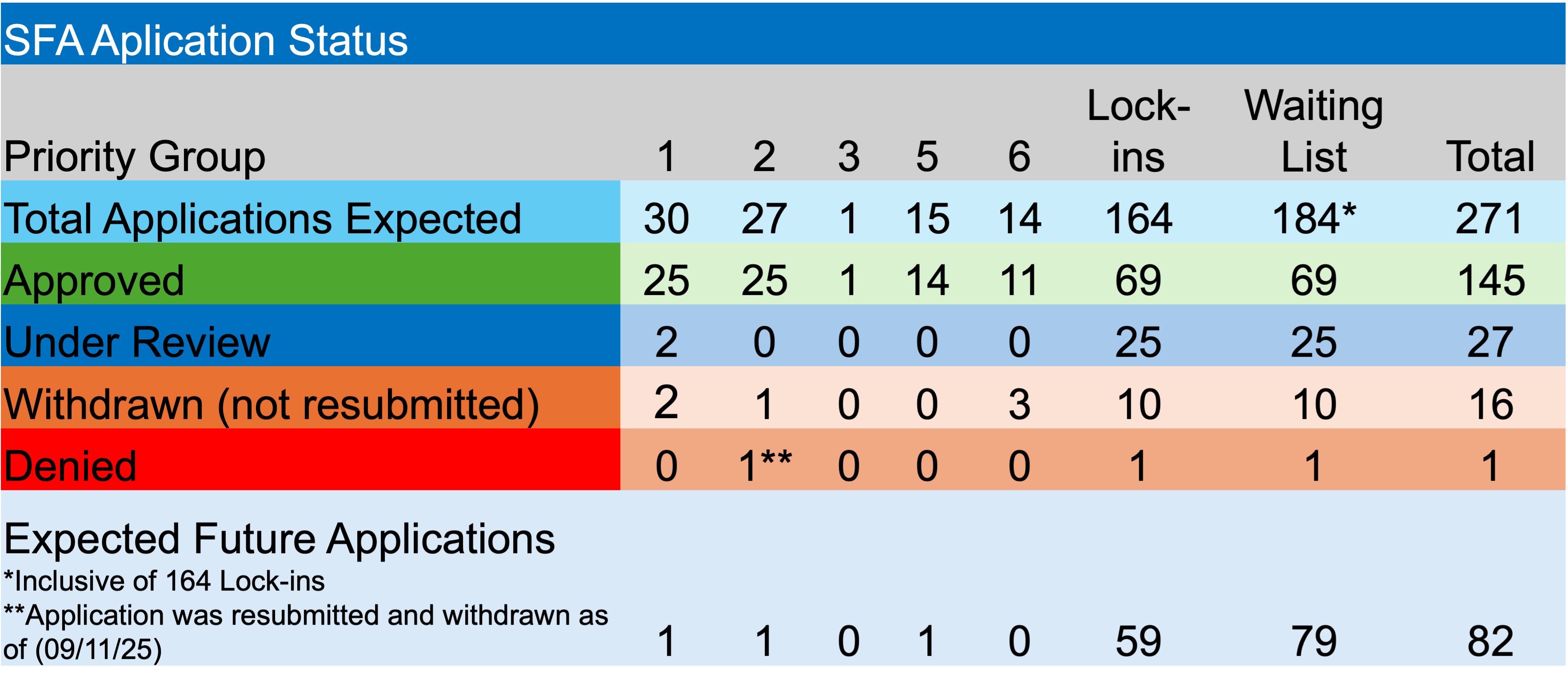
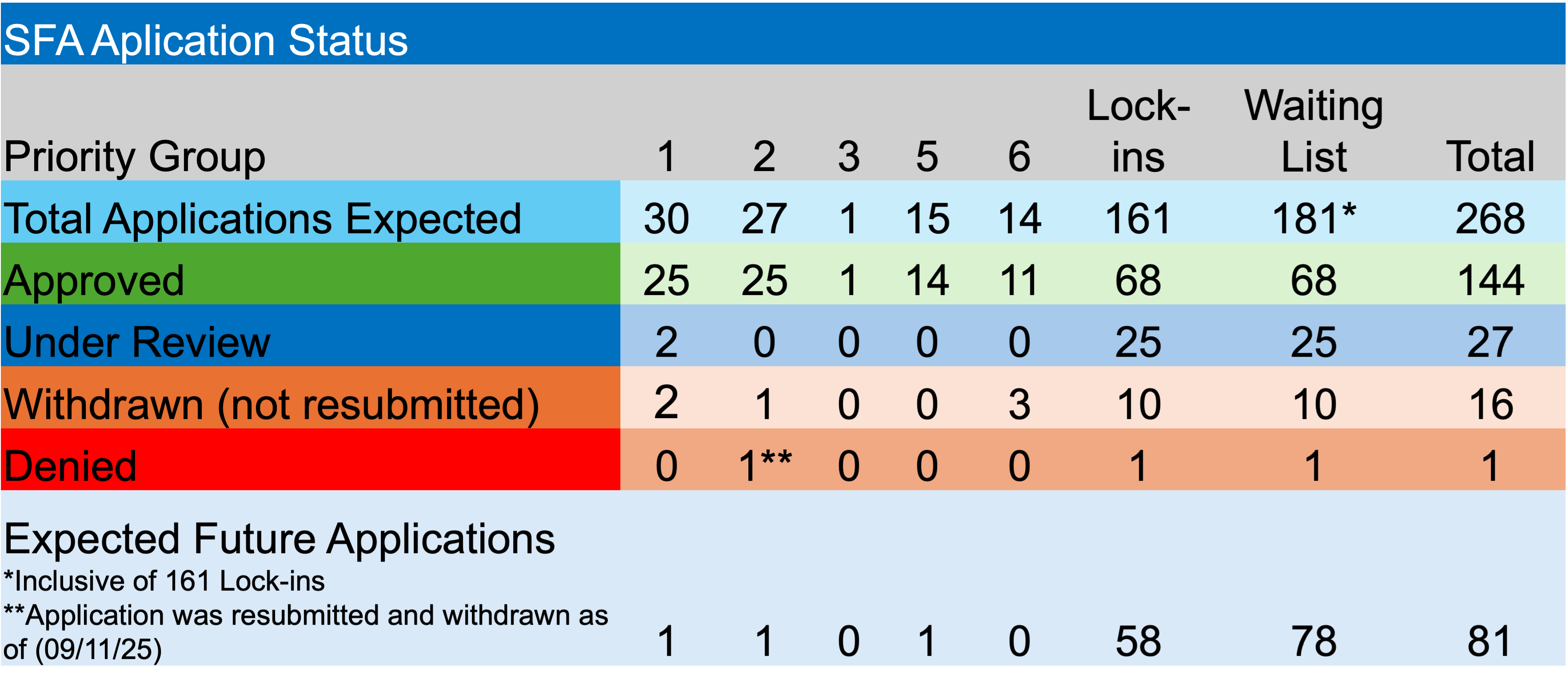
Following significant activity leading into the Labor Day Weekend, the prior 4 days were very quiet, as the PBGC did not receive, deny, or approve any applications seeking Special Financial Assistance (SFA). In addition, there were no plans seeking to be added to the waitlist. However, there was one plan, Council 30 Retirement Fund Sanders, a recent addition to the waitlist, locked-in their valuation date as June 30, 2025.

In addition, there was one activity from the prior week that was added to this week’s PBGC spreadsheet. Graphic Communications Union Local 2-C Retirement Benefit Plan, a recipient of $59.3 million in SFA, was required to refund $152k in excess grant money due to census errors. This repayment amounted to 0.26% of the original grant. To date, $251.9 million in excess grants has been returned on $52.4 billion (0.48%) that had been awarded to 65 of the applicants. This repayment process has to be nearing completion.

According to the PBGC’s website, the e-Filing portal is temporarily closed. As mentioned in prior updates, there remain 105 non-priority applications yet to be approved. More importantly, 73 have yet to file, and the 12/31/25 deadline is fast approaching. More to come.

I’m Concerned! Are You?

By: Russ Kamp, CEO, Ryan ALM, Inc.

I’ve been concerned about the U.S. retirement industry for many years, with a particular focus on traditional pensions. The demise of DB pensions is a major social and economic issue for a significant majority of American workers, who fear that their golden years will be greatly tarnished without the support of a traditional DB pension plan coupled with their inability to fund a supplemental retirement vehicle, such as a defined contribution plan.

I recently had hope that the rising U.S. interest rate environment would bring about a sea change in the use of DB pensions, but I haven’t seen the tidal wave yet. That said, the higher rate environment did (could still) provide plan sponsors with the ability to take some risk off the table, but outside of private pensions, I’ve witnessed little movement away from a traditional asset allocation framework. You see, the higher rate environment reduces the present value cost of those future benefit payments improving both the funded ratio and funded status of DB pensions, while possibly reducing ongoing contributions. Securing those benefits, even for just 10-years dramatically reduces risk.

But, again, I’ve witnessed too few plans engaging in alternative asset allocation strategies. That’s not the same as engaging in alternative strategies, which unfortunately continues to be all the rage despite the significant flows into these products, which will likely diminish future returns, and the lack of distributions from them, too. An alternative asset allocation strategy that Ryan ALM supports and recommends is the bifurcation of assets into two buckets – liquidity and growth – as opposed to having all of the plan’s assets focused on the return on asset (ROA) assumption.

By dividing the assets into two buckets, one can achieve multiple goals simultaneously. The liquidity bucket, constituting investment grade bonds, will be used to defease the liability cash flows of benefits and expenses, while the growth or alpha assets can grow unencumbered with the goal of being used to defease future liabilities (current active lives). One of the most important investment tenets is time. As mentioned above, defeasing pension liabilities for even 10-years dramatically enhances the probability of the alpha assets achieving the desired outcome.

So why am I concerned? The lack of risk mitigation is of great concern. I’m tired of watching pensions ride the rollercoaster of returns up and down until something breaks, which usually means contributions go up and benefits go down! Given the great uncertainty related to both the economy and the labor force, why would anyone embrace the status quo resulting in many sleepless nights? Do something, and not just for the sake of doing something. Really do something! Embrace the asset allocation framework that we espouse. Migrate your current core bond allocation to a defeased bond allocation known as cash flow matching (CFM) to bring an element of certainty to the management of your plan.

Listen, if rates fall as a result of a deteriorating labor force and economy, the present value of pension liabilities will rise. Given that scenario, it is highly likely that asset prices will fall, too. That is a lethal combination, and not unique given how many times I’ve seen that play out during my 44-year career. Reach out to us if you aren’t sure how to start the process. We’d be pleased to take you through a series of scenarios so that you can determine what is possible. Perhaps you’ll sleep like a baby after we talk.

Today is National 401(k) Day. Where is National DB Pension Plan Day?

By: Russ Kamp, CEO, Ryan ALM, Inc.

I suspect that most of us have no idea that today, September 5, 2025, is National 401(k) Day. This day is recognized every year on the Friday following Labor Day. The day is supposed to be an opportunity for retirement savings education and for companies to inform their employees about their ability to invest in company sponsored 401(k)s. Did you get your update today? Unfortunately, like many small company employees, I don’t have access to one or a DB plan.

For the uninformed, 401(k) plans are defined contribution plans (DC). This plan type was created in the late 1970s (Revenue Act of 1978) as a “supplemental” benefit. Corporate America liked the idea of a DC offering because it helped them recruit middle and senior management types who wouldn’t accrue enough time in the company’s traditional pension plan. Again, the benefit was supplemental to the traditional monthly pension payment and not in lieu of it!

I think that defined contribution plans are fine as long as they remain supplemental to a DB plan. Asking untrained individuals to fund, manage, and then disburse a retirement benefit is a ridiculous exercise, especially given their lack of disposable income, investment acumen, and NO crystal ball to help with longevity issues. In fact, why do we think that 99.9% of Americans have this ability? Regrettably, we have a significant percentage (estimated at 28%) of our population living within 200% of the poverty line. Do you think that they have any discretionary income that would permit them to fund a retirement benefit when housing, health insurance, food, education, childcare, and transportation costs eat up most, if not all, of an individual’s take home pay? Remember, these plans are only “successful” based on what is contributed. Sure, there may be a company match of some kind, but we witnessed what can happen during difficult economic times, when the employer contribution suddenly vanishes.

Defined benefit plans are the gold standard of retirement vehicles. They once covered more than 40% of the private sector workforce, most union employees, and roughly 85% of public sector workers. What happened? Did we lose focus on the primary objective in managing a DB plan which is to SECURE the promised benefits in a cost-effective manner with prudent risk? Did our industry’s focus on the return on asset assumption (ROA) create an untenable environment? Yes, we got more volatility and less liquidity! Did we did we get the commensurate return? Not consistently. It was this volatility of the funded ratio/status that impacted the financial statements and led to the decision to freeze and terminate a significant percentage of private DB plans. It is a tragic outcome!

What we have today is a growing economic divide among the haves and haves-not. This schism continues to grow, and the lack of retirement security is only making matters worse. DB plans can be managed effectively where excess volatility is not tolerated, where the focus is on the promised benefit and not some made up ROA, and where decisions that are made relative to investment structure and asset allocation are predicated on the financial health of the plan: mainly the funded status. We need DB plans more than ever and ONLY a return to pension basics will help us in this quest. Forget about all the newfangled investment products being sold. Replacing one strategy for another is no better than shifting deck chairs on the Titanic. We need improved governance and a renewed focus on why pensions were provided in the first place.

Ryan ALM discount rates: ASC 715 and ASC 842

By: Russ Kamp, CEO, Ryan ALM, Inc.

As we enter the final third of 2025 (how is that possible?), actuaries, accounting firms, and pension plan sponsors may begin reviewing their current discount rate relationship(s). If you are one of those, you may want to speak with us about the Ryan ALM discount rates. Since FAS 158 became effective December 15, 2006, Ryan ALM has created a series of discount rates in conformity to then FAS 158 (now ASC 715). Our initial and continuous client is a BIG 4 accounting firm, which hopefully testifies to the integrity of our data.

The benefits of the Ryan ALM ASC 715 Discount Rates are:

  1. Selection – we provide four yield curves: High End Select (top 10% yields), Top 1/3, Above Median (top 50%), Full Universe
  2. Transparency – we provide very detailed info for auditors to assess accuracy and acceptability of our rates
  3. Precision – precise and consistent reflection of current/changing market environment (more maturity range buckets, uses actual bond yields rather than spreads added to Treasury yield curve, no preconceived curve shape/slope bias relative to maturity/duration) than most other discount rate alternatives  
  4. Competitive Cost – our discount rates are quite competitive versus other vendors and can be purchased with a monthly, quarterly, or annual subscription
  5. Flexibility – we react monthly to market environment (downgrades, gaps at certain maturities) with flexibility in model parameters to better reflect changing environment through variable outlier exclusion rules, number of maturity range buckets, and minimum numbers of bonds in each maturity range bucket to better capture observed nuances in the shape of the curve, especially at/near the 30 year maturity point where the market is sparse or nonexistent at times.
  6. Clients – our rates are used by individual plan sponsors, several actuarial and accounting firms including, as stated above, a Big 4 accounting firm
  7. Integration into Ryan ALM products – we use ASC 715 discount rates for our Custom Liability Index and Liability Beta Portfolio™ (cash flow matching) products

Development of our discount rates is the first step in our turnkey system to defease pension liabilities through a cash flow matching (CFM) implementation. Our Custom Liability Index (CLI) and Liability Beta Portfolio (LBP) are the other two critical products in our de-risking process/capability.

In addition to ASC 715, Ryan ALM provides ASC 842 rates, which is the lease accounting standard issued by the Financial Accounting Standards Board (FASB). This standard supersedes ASC 840 and became effective December 15, 2018, for public companies and December 15, 2021, for private companies and nonprofit organizations. Given the widespread prevalence of off-balance sheet leasing activities, the revised lease accounting rules are intended to improve financial reporting and increase transparency and comparability across organizations. ASC 842 will provide management better insight into the true extent of their lease obligations and lead to improvements in capital allocation, budgeting and lease versus buy decisions.

The discount rate to be used is the rate implicit in each lease. This could be difficult and not readily determined. In that case ASC 842 requires the lessee to use the rate that the company borrows at based on their credit rating. Ryan ALM can provide the ASC 842 discount rates based on each lessee borrowing rate or credit rating (i.e. A or BBB). We can provide these discount rates monthly, quarterly or whatever frequency is needed.

We’d be pleased to discuss with you our discount rates or any element of this state-of-the-art capability.

ARPA Update as of August 29, 2025

By: Russ Kamp, CEO, Ryan ALM, Inc.

We are pleased to share with you the last update for August 2025. Welcome to the final third of the calendar year. We wish for you and your children heading back to school a great year! Always an exciting time of year despite some understandable anxiousness. I still have a daughter heading off to her last year of grad school and six of our 11 grandkids going to grammar school.

The PBGC certainly ramped up activity during the prior week. They absolutely earned their Labor Day break. We’ll provide more detail, but in summary there was one revised application received, five applications approved, two applications withdrawn, and two waitlisted plans decided to lock-in their valuation date.

Alaska United Food and Commercial Workers Pension Fund and Local 73 Retirement Plan, both non-Priority Group members withdrew initial applications. However, Alaska United resubmitted a revised application three days later. They are seeking $95.3 million in SFA for 6,106 plan participants. The PBGC has until December 27, 2025, to act on this submission.

I’m not sure that I remember a week in which the PBGC approved five applications, but as we’ve been saying, with 105 applications yet to be approved and in many cases, even submitted, the PBGC’s pace of approval is bound to speed up. Pension funds receiving approval included Local 1102 Retirement Trust, IBEW Eastern States Pension Plan, Local 1922 Pension Plan, Local 888 Pension Fund (Elmwood Park, NJ), and Local 807 Labor-Management Pension Fund. They are seeking a combined $349.6 million for 13,441 members. The PBGC has now approved the SFA application for 137 funds.

Lastly, two plans, Employee Pension Benefit Plan of Local 640 IATSE and Southern Council of Industrial Workers United Brotherhood of Carpenters and Joiners of America AFL-CIO Pension Plan have locked in their valuation date as of May 31, 2025. Given the number of funds still on the waitlist, there should be some doubt as to whether these initial applications will even be submitted before the December 31, 2025 deadline for initial applications.

Earn the ROA…and Contributions Go Up?

By: Russ Kamp, CEO, Ryan ALM, Inc.

Ron has produced an interesting piece of research that might just enlighten, if not confuse, some pension folks. I suspect that most folks would believe that a plan’s funded status remains consistent if the desired return on asset (ROA) assumption is achieved annually. However, that is definitely not the case for a plan that is in a deficit position (assets less than the plan’s liabilities).

In fact, a plan with a 70% funded ratio (a 30% deficit to plan liabilities) striving for a 7% ROA can achieve that target each of the next 5-years and the funded status deficit will have grown by 42.3%, while maintaining that 70% funded ratio. A 50% funded plan striving for the 7% return target actually needs to achieve a 14% return just to maintain the funded status. Despite maintaining a level Funded Ratio, contributions into the plan will need to rise in order to keep the funded status from continually growing.

When we see reports that public pension funds have an “average” funded ratio of 83%, understand that the collective funded status is likely getting worse unless a significant outperformance occurs relative to the ROA objective, given the 17% funded status deficit. As a result, contributions into these pension plans will be rising.

Milliman: Public Pension Funding at 83%

By: Russ Kamp, CEO, Ryan ALM, Inc.

Milliman’s Public Pension Funding Index (PPFI) has been released for July 2025. As a reminder, the PPFI compiles and analyzes data from the nation’s 100 largest public DB plans.

For the fourth consecutive month, investment gains have led to improved funded ratios for America’s largest public DB funds. July’s investment gain produced a $5 billion increase in the PPFI funded status, and saw the funded ratio improve from 82.9% as of June 30, to 83.0% as of July 31. The indexes constituents produced an estimated market gain of 0.5% during the month, with individual plans’ returns ranging from -0.2% to 1.2%. As a result, total assets for the members of the index are now $5.477 trillion as of July 31. A $20 million increase from the prior month.

Given the static accounting for public fund liabilities, the deficit between plan assets and liabilities shrank with the growth in assets decreasing from $1.127 trillion at the end of June to $1.122 trillion at the end of July. Importantly, there are now 38 plans that are more than 90% funded at month-end. Unfortunately, 11 plans remain at less than 60% funded.

According to Becky Sielman, co-author of the Milliman PPFI, there are 14 plans with a funding “surplus”, which sounds great, but the plan’s ROA is the discount rate permitted under GASB accounting, which is likely substantially higher than the discount rate for corporate DB plan liabilities that utilize a AA corporate blended rate. As a result, pension liabilities are understated. One can only hope that U.S. interest rates remain stable or rise from their current levels, as a declining rate environment would put additional funding pressure on liabilities, which are bond-like in nature. Please click on the link below to view the entire report.

View the Milliman 100 Public Pension Funding Index.

Not So Fast

By: Russ Kamp, CEO, Ryan ALM, Inc.

In addition to publishing my thoughts through this blog, I frequently put sound bites out through LinkedIn.com. The following is an example of such a comment: Given Powell’s statement about “balancing dual mandates”, it seems premature to assume that the Fed’s next move on rates is downward. Tariffs have only recently kicked in and their presence could create a very challenging situation for the Fed should inflation continue on its path upward. Market reaction seems overblown. September’s CPI/PPI numbers could be very interesting.

As a follow-up to that comment, here is a graph from Bloomberg highlighting the recent widening in the spread between 5-year and 30-year Treasuries, which is at its widest point in the last 4 years.  This steeping of the yield curve would suggest that inflation is being more heavily anticipated on the long end.

As I mentioned above, the reaction to Powell’s comments from Wyoming last Friday seemed overblown given the rethinking about “dual mandates”. Inflation has recently reversed the downward trajectory and with the impact of tariffs yet to be truly felt, it is doubtful that we’ll see inflation fall to levels that would provide comfort to the U.S. Federal Reserve policy makers. Yes, there may be a small (25 bps) cut in September, but should inflation continue to be a concern the spread in Treasury yields referenced above could continue to widen. President Trump’s goal of jumpstarting the housing market through lower mortgage rates would not likely occur.

From a pension perspective, higher rates reduce the present value of those future promised benefits. They also provide implementers of cash flow matching (CFM) strategies, such as Ryan ALM Advisers, LLC, the opportunity to defease those pension liabilities at a lower cost (greater cost savings). Bond math is very straight forward. The higher the yield and the longer the maturity, the greater the cost savings. Although higher rates might not be good for U.S. equities, especially given their current valuations, the ability to reduce risk at this time through a CFM strategy should be comforting.

Bifurcate your asset allocation into two buckets – liquidity and growth. The liquidity bucket will house the CFM strategy, providing all the necessary liquidity to meet ongoing monthly obligations as far into the future as the allocation will cover. The remaining assets (all non-core bonds) in the growth or alpha portfolio will now have more time to just grow unencumbered, as they are no longer a source of liquidity. Time is a critical investment tenet, and with more time, the probability of meeting the expected return is enhanced.

There is tremendous uncertainty in our markets and economy currently. One can bring an element of certainty to the management of pensions, live with great uncertainty.