Interesting Insights From Ortec Finance

By: Russ Kamp, CEO, Ryan ALM, Inc.

PensionAge’s, Paige Perrin, has produced an article that referenced recent research from Ortec Finance. The research, which surveyed senior pension fund executives in the UK, US, the Netherlands, Canada, and the Nordics, found that 77% believe that risk will be elevated, either dramatically or slightly, in 2025. That’s quite the stat. It also follows on reporting from P&I that referenced heightened uncertainty by U.S. plan sponsors. As regular readers of this blog know, I’ve been suggesting to (pleading with) sponsors that they don’t need to live with uncertainty, which is truly uncomfortable.

Among several risks cited were interest rates, inflation, and market volatility. I can’t say that I blame them for their concerns. Who among us are able to adequately forecast rates and inflation? Seems like most fixed income professionals and bond market participants have been forecasting an aggressive move down in rates. Some of these prognosticators were forecasting as many as 7 rate reductions in 2024 and several others in 2025. We didn’t get 2024’s tally. Who knows about 2025 given that inflation has remained fairly sticky.

There is an easy fix for those of you who are concerned about interest rates and inflation. Adopt a cash flow matching (CFM) strategy that will carefully match asset cash flows of interest and principal with liability cash flows (benefits and expenses). Because benefit payments are future values (FVs), they are not interest rate sensitive. Problem solved! Furthermore, the use of CFM extends the investing horizon for the remainder of the fund’s growth assets, so they now have the appropriate time to grow to meet future liabilities.

One other startling stat caught my attention, as “77 per cent of senior pension fund executives believe the increasing number of retirees relative to the number of new hires in defined benefit (DB) plans pose a “significant” or “slight” risk to the DB pensions industry.” That concern is misplaced. I just wrote a post earlier this week on that subject. DB Pension plans are not Ponzi Schemes. They don’t need more depositors than those receiving payments. It is truly frightening that a significant percentage of our senior plan sponsors don’t understand how these plans are actuarial determined and subsequently funded.

Lastly, I nearly jumped out of my chair with excitement when I read the following quotes from Marnix Engels, Ortec Finance’s managing director for global pension risk, who stated the following:

“We believe assessing the risks of both (the bolding is my emphasis) assets and liabilities in combination is crucial to get the full picture on the health of a pension fund,” he said.

“If the impacts of risk drivers are only understood for one side of the funding health equation, then it is possible to misrepresent the overall effect.”

“If a fund is not assessing both assets and liabilities, then it is difficult to conclude the overall impact of interest rate hikes on the plan’s funding ratio.”

YES!!

DB Pensions Are NOT Ponzi Schemes!

By: Russ Kamp, CEO, Ryan ALM, Inc.

I recently stumbled onto an article that was highlighting the impending pension crisis (disaster) that is unfolding in Florida. The author’s primary reason for concern is the fact that there are now more beneficiaries collecting (659,333) than workers paying in (459,428). Briefly mentioned was the fact that the pension system currently has a funded ratio of 83.7% up from 82.4% last year. The fact that there are more recipients than those paying into the system is irrelevant. DB pension systems are not Ponzi Schemes, which in nothing more than a fraudulent vehicle that relies on a continuous influx of new “investors” (substitute plan participants) to pay the existing members of the pool.

A DB pension’s promises (benefit payments) are calculated by actuaries who have an incredibly challenging job of forecasting each individual’s career path (tenure), salary growth, longevity, etc. They do a great job, but they’ll be the first to tell you that they don’t get the individual participant calculations correct, but they do an amazing job of getting the total universe of payments nearly spot on. An acquaintance of mine, who happens to be an excellent actuary shared the following, “pension plans are funded over an active member’s career so that there will be sufficient funds to pay retirement benefits for life.  The funding rules in Florida require contributions to get the plan 100% funded over time.”

Granted, there are states that have not made the annual required contribution, in some cases for decades, and those plans are suffering (poorly funded) as a result. That isn’t the actuary’s issue, but they are left to try to make up the difference by forecasting the need for greater contributions and more significant returns. The payment of contributions comes with little uncertainty, while the reliance on greater investment performance comes with a huge amount of uncertainty over short time frames. I wouldn’t want my pension fund or livelihood (Executive Director, CIO, etc.) dependent on the capital markets.

I frequently hear the concern expressed about negative cash flow plans (i.e. contributions do not fully fund benefits). Why? If pension systems are truly designed based on each participant’s forecasted benefit, mature plans are bound to eventually fall into negative cash flow situations. These plans are designed to pay the last plan participant the last $1 of assets. These pension systems aren’t designed to be an inheritance for some small collection of beneficiaries who make it to the finish line. Importantly, there should be different investment strategies used for plans that are collecting more than they are paying out versus those in negative cash flow situation.

DB pensions are critically important retirement vehicles that need to be protected and preserved. Fabricating a crisis based on an incorrect observation is not helpful. If plan sponsors contribute the necessary amount each year and manage the assets prudently, these pension systems should be perpetual. Neglect the basics and all bets are off!

Not Crunch Time, But the Program is Nearing Its End

By: Russ Kamp, CEO, Ryan ALM, Inc.

I frequently get terrific questions following the publishing of one of my blog posts. Today’s question of the day was related to the ARPA pension legislation. I was asked, “Russ when does this legislation expire and when is the final date that a plans application must be submitted?” Terrific question. I’ve been meaning to provide this information as part of one of my weekly ARPA updates. Thanks for the prompt.

According to the final language in the Bill, ‘‘(f) APPLICATION DEADLINE.—Any application by a plan for special financial assistance under this section shall be submitted to the corporation (and, in the case of a plan to which section 432(k)(1)(D) of the Internal Revenue Code of 1986 applies, to the Secretary of the Treasury) no later than December 31, 2025, and any revised application for special financial assistance shall be submitted no later than December 31, 2026.

Furthermore, “The corporation (PBGC) shall not pay any special financial assistance after September 30, 2030.” As an aside, I’m not quite sure how a “revised” application that must be filed by 12/31/26 would not be paid before 2030 is beyond me, especially given the 120-day window to have an application acted on.

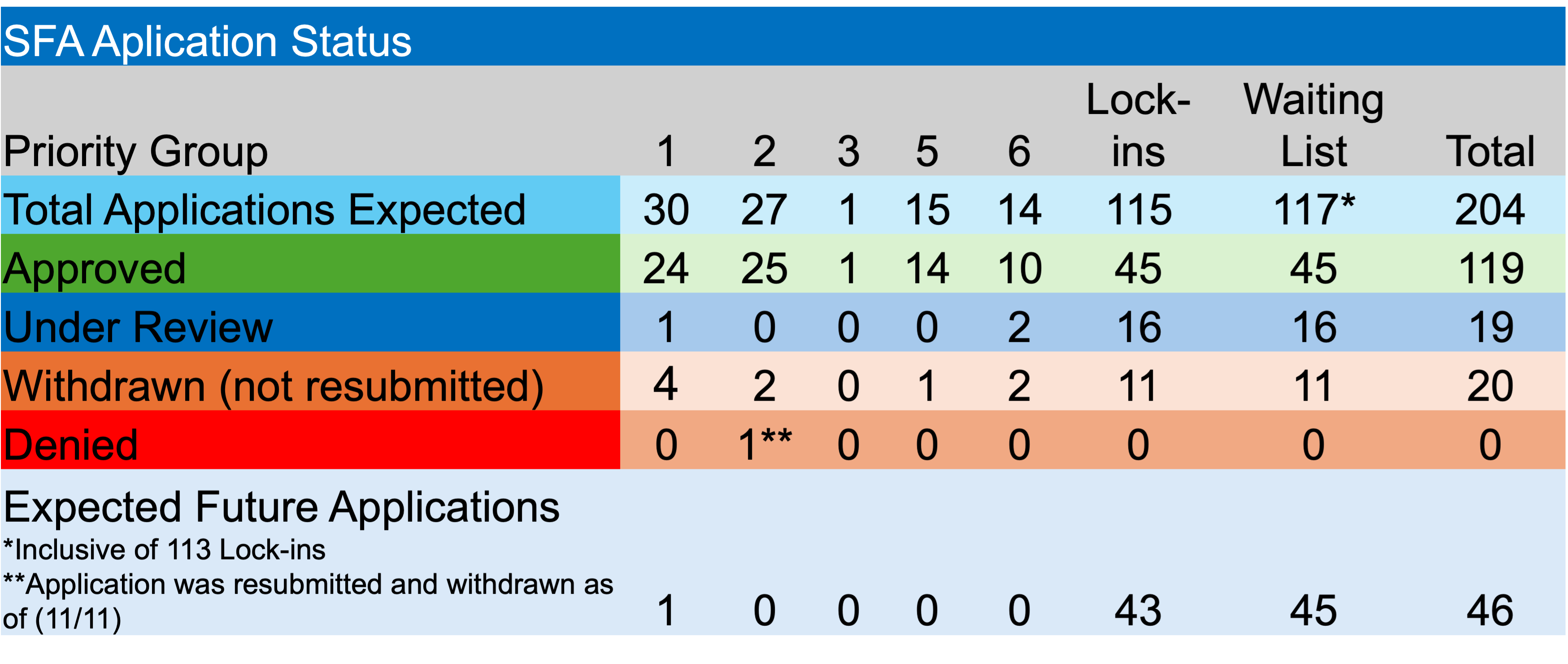
As reported in yesterday’s blog post, of the potential 202 applications, 109 have been approved, 21 are currently under review, while another 21 plans have withdrawn the applications. That leaves 51 plans that have yet to file (remember the 12/31/25 deadline) including a Priority Group 1 fund.

So, despite the terrific effort to date, the PBGC clearly has its work cut out for it. Currently, the eFiling portal to submit applications is closed. The PBGC has been opening and closing access to the filing portal based on its ability to meet the 120-day deadline. They may need to accelerate the pace of submissions and approvals in the coming months in order to complete the process by 12/31/26. Obviously, more to come from the PBGC. Also, keep your questions coming!

ARPA Update as of January 31, 2025

By: Russ Kamp, CEO, Ryan ALM, Inc.

Somewhat shockingly, one month of 2025 is now in the books. That said, the PBGC continues to implement the ARPA legislation, which will soon celebrate its fourth anniversary since being signed into law on March 11, 2021. By all measures, this has been an incredibly successful program, with much yet to be accomplished with 93 pension plans still in the process of securing Special Financial Assistance (SFA).

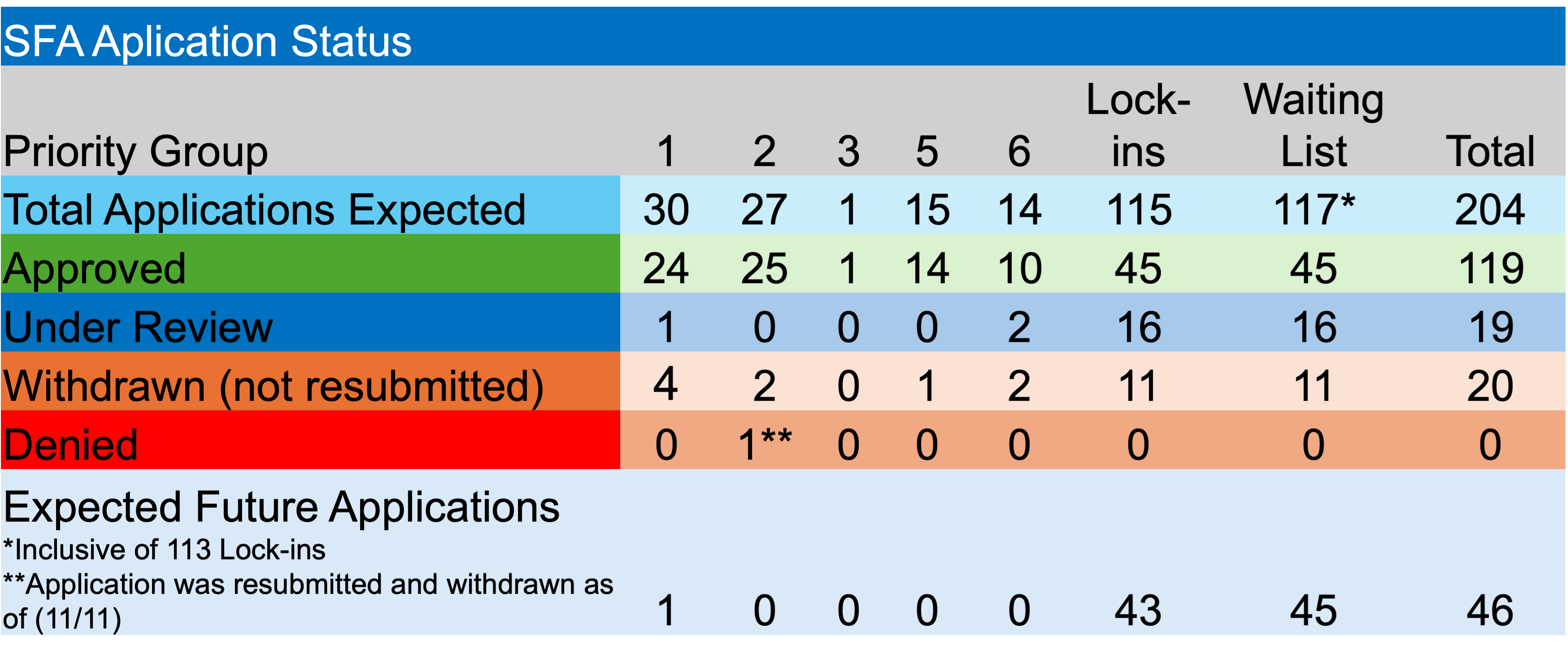
The last few weeks have witnessed a moderation in the pace of implementation. The prior week saw no new applications received or approved. There was one application withdrawn, as Rocky Hill, CT-based, Sheet Metal Workers’ Local No. 40 Pension Plan withdrew their initial application seeking $18.8 million in SFA for 984 plan participants. In addition, there was one plan, St. Louis Motion Picture Machine Operators Pension Fund, that locked in the measurement date (liability valuation) as of October 31, 2024. They submitted the request as of January 24, 2025. With this action, there are only 2 plans of the 115 non-priority plans to have not locked in a valuation date.

I’ve previously mentioned the onerous impact of MPRA which passed in 2014. Fortunately, the PBGC/ARPA provided SFA of $477 million to restore to the 18 plans affecting 11 unions that under MPRA had reduced benefits an average of 22% for 60,620 retirees in pay status with some plans reducing benefits as much as 55 percent. These plans received an additional $3.5 billion in SFA to help ensure they remain solvent and able to pay all 87,862 participants in those plans their full retirement benefits through at least 2051.

20+ Years in the Making!

By: Russ Kamp, CEO, Ryan ALM, Inc.

For the first time since the dot.com bubble burst, the equity risk premium on the S&P 500 has fallen below 0. If you are concerned that U.S. large cap equities are looking frothy, this graph certainly supports that sentiment. Is now the time to take some equity profits and migrate those assets to bonds? We believe that the time is right to protect your enhanced funded status from the uncertainty as to where inflation and U.S. interest rates are going and the potential impact on traditional core fixed income strategies that are based on generic market indices instead of funding liability cash flows.

If you are like us (Ryan ALM, Inc.), and prefer not to make one’s living forecasting events that one can’t control, like interest rates, inflation, geopolitical events, etc., we suggest that you don’t engage in fixed income strategies that could be harmed by an upward movement in U.S. interest rates. Take those equity profits and invest in a cash flow matching strategy (CFM) that will secure your fund’s promised benefits, while eliminating interest rate risk since the process defeases future benefit payments that are not interest rate sensitive. A $1,000 monthly benefit payment is $1,000 whether rates are at 2% or 10%. In addition, you’ll be extending the investing horizon for the portfolio’s remaining growth (alpha) assets. CFM is the bridge over potentially troubled waters!

What A Challenging Job!

By: Russ Kamp, CEO, Ryan ALM, Inc.

I’m going to divert from my normal focus on cash flow matching (CFM) and the defeasing of pension liabilities to write about a subject that I love and one that doesn’t get nearly the air time that it should. I was reminded of this topic at the FPPTA’s latest TLC program in Orlando, which I’ve thoroughly enjoyed participating. If you aren’t aware of the TLC (Thought Leadership Council) this is the FPPTA’s newest advanced educational program for experienced pension trustees. The program is limited to 20-25 trustees who get to roll up their sleeves with highly experienced coaches/mentors. I’m grateful to be included.

On Monday, one of the discussions centered on active managers, particularly US domestic equity managers, who have an incredibly challenging job trying to outperform their respective benchmarks, especially given the concentrated nature of the U.S. equity stock market during the last couple of years. Asset consultants have an even more challenging job trying to figure out which of those active asset managers will actually provide alpha NET of fees. As mentioned during one particular session, there are many aspects of the investment management process that are evaluated by consultants in an attempt to try and identify those few outperformers. These screening criteria may include the depth and consistency of staff, overall experience in managing the strategy, AUM in the product, and of course, performance. However, just because a manager outperformed (provided an excess return vis-a-vis the benchmark) an index at one point doesn’t mean it will happen again. Was the outperformance the result of skill or luck or a little of both?

As I explained to the TLC participants, stock selection factors (indicators or ideas) used to “pick” stocks to be included in the manager’s portfolio have an information content that can be measured. The “value-added” from an idea/factor can ebb and flow depending on a number of factors. Is the “deterioration” in the information coefficient (IC) an indication that the factor is losing it’s forecasting ability or is it just currently out of favor? As investment management firms get larger, the AUM that they control can overwhelm those insights diminishing the forecasting ability of that idea. Other investment management firms have bright people looking for an edge, too. They might just capture the same or similar insights rendering everyone’s use of that idea less robust, which I witnessed first hand in 2007’s quant manager meltdown. Below are two posts that touch on this topic. I hope that my ideas prove useful to you. 

and,

In a previous life, I was the CEO of Invesco’s quant business, which featured roughly 50 incredibly bright team members located both here and abroad and we managed about $30 billion in AUM. During our time together, we developed roughly 55 different strategies (optimizations), mostly U.S. equity mandates for which we had specific return/risk characteristics such as our Structured Core Equity product that was designed to achieve a 2% return for a 3% tracking error or a 0.67 information ratio versus the S&P 500.

We also thought that it was critically important to determine what we believed was the natural capacity of each strategy, as we didn’t want to arbitrage away our own insights. For instance, our Small Value product’s capacity was <$500 million, while many of the larger cap offerings had abundant capacity equal to billions of $s. Trustees should ask their managers what they believe is the natural capacity of the strategy(ies) that they are invested in and how they determined it.

Lastly, I would ask each manager to discuss a stock selection idea (factor / indicator) that they once used, but no longer do and why. Furthermore, I’d ask them to discuss an idea that they are now using to help them choose their portfolio constituents that they might not have been using 3-5 years ago. I’d make sure to understand how often they review every aspect of their investment management process. If that isn’t a normal part of their process, I’d be very concerned. For standing pat means that you are likely falling behind. It will be interesting to hear the replies.

Given how challenging it is to identify value-added managers as a consultant or consistently add value as an investment manager, I’m glad that Ryan ALM focuses on defeasing pension liability cash flows of benefits and expenses with asset cash flows from bonds (principal and interest). There is little uncertainty in our process. It is truly a sleep well at night strategy for all involved.

ARPA Update as of January 24, 2025

By: Russ Kamp, CEO, Ryan ALM, Inc.

We are pleased to bring you our weekly update of the PBGC’s implementation of the ARPA legislation. What has been a busy start to 2025 came to a screeching halt during the last week. The freeze gripping much of the United States clearly impacted the activity out of DC, as there is nothing to report.

The PBGC’s e-Filing portal remains closed to new applications being submitted. As mentioned previously, the PBGC will accept applications “in a manner that facilitates an expeditious and thorough review process and provides every eligible plan an opportunity to file its SFA application with the PBGC.” Importantly, the PBGC will only accept as many applications as the agency estimates it can process within the statutory 120-day review period. Currently, the PBGC has 22 applications under review. Two of those will have the 120-day review period eclipsed in February and another 10 funds in March.

The activity surrounding the repayment of “excess” SFA has slowed down, too. To date, 33 funds have repaid a portion of the grant that they received. In total, $164.5 million has been repaid representing 0.39% of the total assets received. I’m not sure how many more funds might be required to rebate some of the grant money.

That Step Isn’t Necessary!

By: Russ Kamp, CEO, Ryan ALM, Inc

I recently stumbled over a brief article that touched on LDI. I’m always interested in absorbing everything that I can on this subject. I was particularly thrilled when the author stated, “since LDI was recognized as best practice for defined benefit (DB) plans…” – YES! I’m not sure where that proclamation came from, but I agree with the sentiments. The balance of that sentence read, “…sponsors have implemented investment strategies as a journey.”

The initial steps on this journey were for plan sponsors to “simply extend the duration of their fixed income using longer duration market-based benchmarks.” Clearly, the author is referencing duration matching strategies as the LDI product of choice during that phase. According to the author, the next phase in this LDI journey was the use of both credit and Treasuries to better align the portfolio with a plan’s liability risk profile.

Well, we are supposedly entering a third phase in this LDI journey given the improved funded status and “outsized” allocations to fixed income. The question they posed: “How do we diversify the growing fixed income allocation?” Their answer, add a host of non-traditional LDI fixed income products, including private debt and securitized products, to the toolkit to add further yield and return. No, no, and no!

As mentioned previously, funded status/ratios have improved dramatically. According to this report, corporate plans have a funded ratio of 111% at the end of 2024 based on their firm’s Pension Solutions Monitor. Given that level of funding, the only thing that these plans should be doing is engaging a cash flow matching (CFM) strategy to SECURE all the promises that have been given to the plan participants. You’ve WON the pension game. Congratulations! There is no reason for a third phase in the LDI journey. There likely wasn’t a need for the second phase, but that’s water over the dam.

We, at Ryan ALM, believe that CFM is a superior offering within the array of LDI strategies, as it not only provides the necessary liquidity to meet monthly liability cash flows, but it duration matches each and every month of an assignment. Ask us to CFM the next 10 years, we will have 120 duration matches. Most duration matching strategies use either an average duration or a few key rates along the yield curve. Since duration is price sensitive, it changes constantly.  In addition, yield curves do not move in parallel shifts making the management of duration a difficult target.

With CFM you can use STRIPS, Treasuries, investment grade corporates or a combination of these highly liquid assets. You don’t need to introduce less liquid and more complex products. A CFM strategy is all you need to accomplish the pension objective. A CFM strategy provides certainty of the cash flows which is a critical and necessary feature to fully fund liabilities. This feature does not exist in private debt and securitized products. As a reminder, the pension objective is not a return target. It is the securing of the promised benefits at a reasonable cost and with prudent risk. Don’t risk what you’ve achieved. Lock in your funded status and secure the benefits. This strategy is designed as a “sleep well at night” offering. I think that you deserve to sleep like a baby!

It May Not Be the Iron Gwazi, But…

By: Russ Kamp, CEO, Ryan ALM, Inc.

I was fortunate to enter the investment industry in October 1981. The 10-year Treasury note’s yield was around 15% at that time. U.S. interest rates would fall (collapse?) for most of the next four decades until they bottomed during the beginning of Covid-19. Oh, it was great to be a bond manager during those decades. You could basically be long duration relative to the Aggregate index with little worry that rates would rise. It was a time to “mint” money in fixed income. Then, it wasn’t!

The beginning of Covid-19 brought about a substantial reaction to the collapse of our economy through major federal stimulus programs. The historic infusion of financial support created excess demand for goods and services at the same time that many of those services were temporarily restricted. The result was the worst inflation shock since the 1970s, which led to the double digit yields mentioned above.

It wasn’t surprising that inflation would appear after decades of it being well contained. It was perhaps the magnitude (9.1% inflation at the peak) of the move that grabbed everyone’s attention. For bond managers, the revival of inflation created an environment that forced the U.S. Federal Reserve to initiate the most aggressive policy shift in quite some time beginning in March 2022. As a result of the Fed’s action, bond managers suffered their worst year ever as represented by the BB Aggregate Index (-13%). The average fixed income manager faired only slightly better than the index according to eVestment’s database, as the median core bond manager produced a -12.8% result for all of 2022.

The following two years have been incredibly volatile for U.S. bond managers. Calendar year 2023 was looking to be a very poor year until the investing community was certain that the Fed had accomplished its objective by the end of that year, and as a result, interest rates fell. For the year, the median fixed income manager was up 6.1%, or a little bit less than 1/2 what they had lost in the previous year. This past year was no better, except that markets were rosier to begin 2024, only to have a challenging conclusion to the year as inflation proved much stickier. The median manager produced only a 2% return for the year, holding on to <1/2 the income while seeing principal losses. Given the topsy turvy nature of the bond market during the last three years, it shouldn’t come as a surprise that the median manager has only generated a -1.9% 3-year annualized result.

The rollercoaster of fixed income returns observed during the last several years may not be as extreme as those we witness in other asset classes, mainly equities, but it is not helpful to the long-term funding of pension plans or endowments and foundations. As most know, changes in interest rates are the greatest risk to fixed income strategies. The 4-decade decline in rates was preceded by a nearly 3-decade rise in rates beginning in the early 1950s. Does the significant rise in rates starting in 2022 mark the beginning of another long-term secular upward trend or is this just a head fake? I wouldn’t want to have to bet on the future of interest rates in order to manage a successful program and you shouldn’t either.

Cash flow matching (CFM) mitigates interest rate risk. The defeasing of benefit payments, which are future values, are not interest rate sensitive since a $1,000 monthly payment in the future is $1k whether rates rise or fall. Furthermore, the cost savings that are produced on the day that the CFM portfolio is built will be maintained whether rates rise or fall. We are seeing at least a -2% reduction in cost per year in our model. Ask us to defease your benefit payments for 10 years and you’ll see a roughly 20% reduction. Longer-term programs (such as 30-years) can see substantial cost savings and annual reductions >-2%/year.

So, I ask, why invest in a core bond product, the success of which is predicated mostly on the direction of interest rates, when one can invest in a CFM strategy that provides the certainty of cash flows to meet benefit payments? Furthermore, CFM portfolios mitigate interest rate risk and extend the investing horizon for your plan’s alpha (growth) assets, while getting you off the rollercoaster of annual returns. Lastly, given the recent rise in U.S. interest rates, building a CFM portfolio with investment grade corporate bonds can produce a YTW of 5.5% or better. Seems like a sleep well at night strategy to me.

BTW, the Iron Gwazi is the world’s steepest and fastest hybrid rollercoaster found at Busch Gardens in Florida. It has a height of 206 feet and a 91 degree drop. It might just rival the feeling one got going through the Great Financial Crisis. That wasn’t any fun!

ARPA Update as of January 17, 2025

By: Russ Kamp, CEO, Ryan ALM, Inc.

I hope that you enjoyed the long holiday weekend. For many of us on the East coast, the holiday’s days and nights were likely spent inside given the frigid temps. Unfortunately, the upcoming week is not going to provide any weather relief.

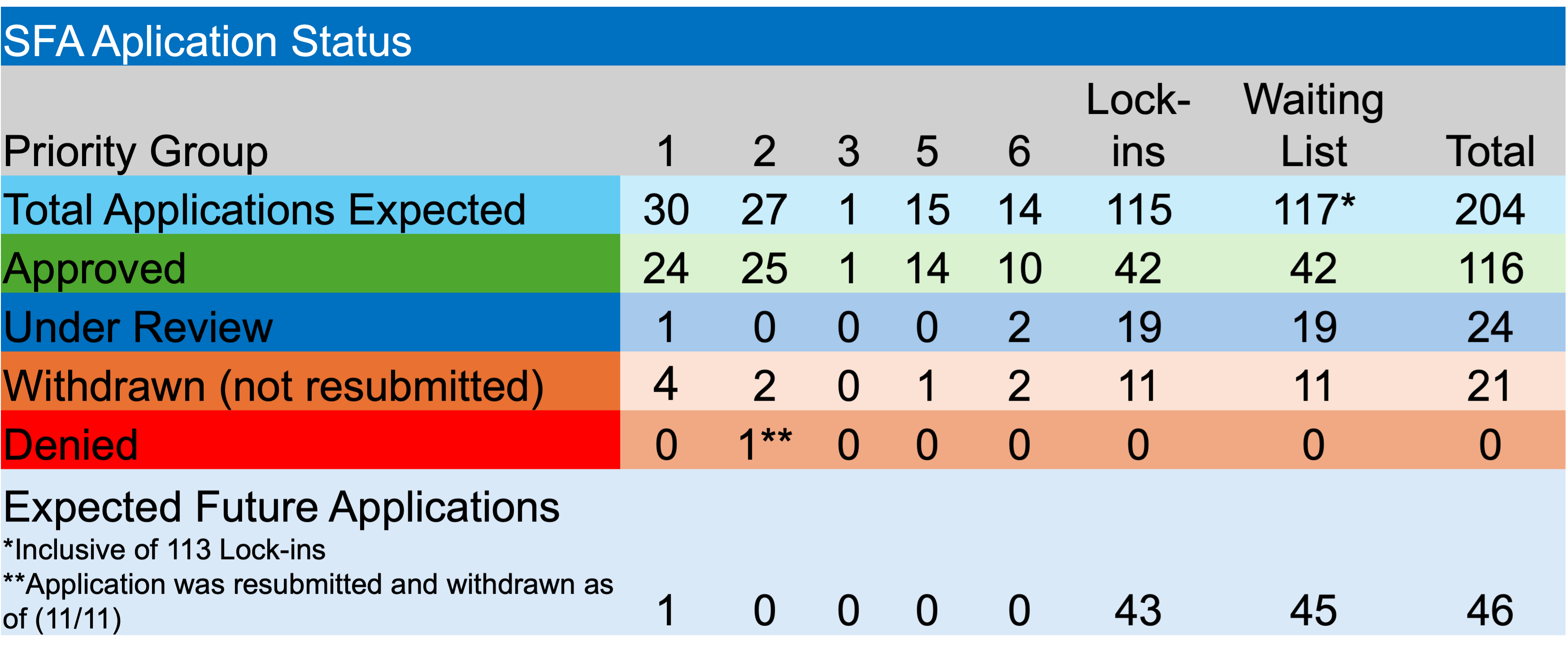
However, this should warm your heart, as the PBGC continued to be active implementing the ARPA legislation that is nearing its fourth anniversary (3/11/21). To date, the PBGC has approved the Special Financial Assistance (SFA) for 109 multiemployer plans. The grants have totaled $70.9 billion and 1,528,409 American workers/retirees have had the promised pension benefit protected, and in some cases, restored.

During the last week, the PBGC accepted one new application, as Greendale, WI based United Food and Commercial Workers Unions and Employers Pension Plan filed a revised application seeking $54.3 million for its 15,420 plan participants. In other news, two funds, Cement Masons Local No. 524 Pension Plan and Local 1922 Pension Plan each withdrew their initial application. The two funds were seeking just over $20 million for roughly 2k members. Finally, the Legacy Plan of the UNITE HERE Retirement Fund, a Priority Group 6 member, received approval of its revised application. They have been awarded $868.8 million in SFA and interest that will go to protecting the retirements for 91,744 participants. Congrats!

The PBGC’s eFiling portal is temporarily closed. According to the PBGC’s website, “the PBGC will accept as many applications as the agency estimates it can process within the statutory 120-day review period. When the number of applications under review reaches that level, the application e-Filing Portal will temporarily close until PBGC has capacity to receive more applications.” There are still an estimated 93 funds going through the process of filing applications SFA grants.