ARPA Updated as of November 28, 2025

By: Russ Kamp, CEO, Ryan ALM, Inc.

We hope that you enjoyed a fabulous Thanksgiving holiday with your family and friends. This update is the last one for November. Wow, that month went by quickly.

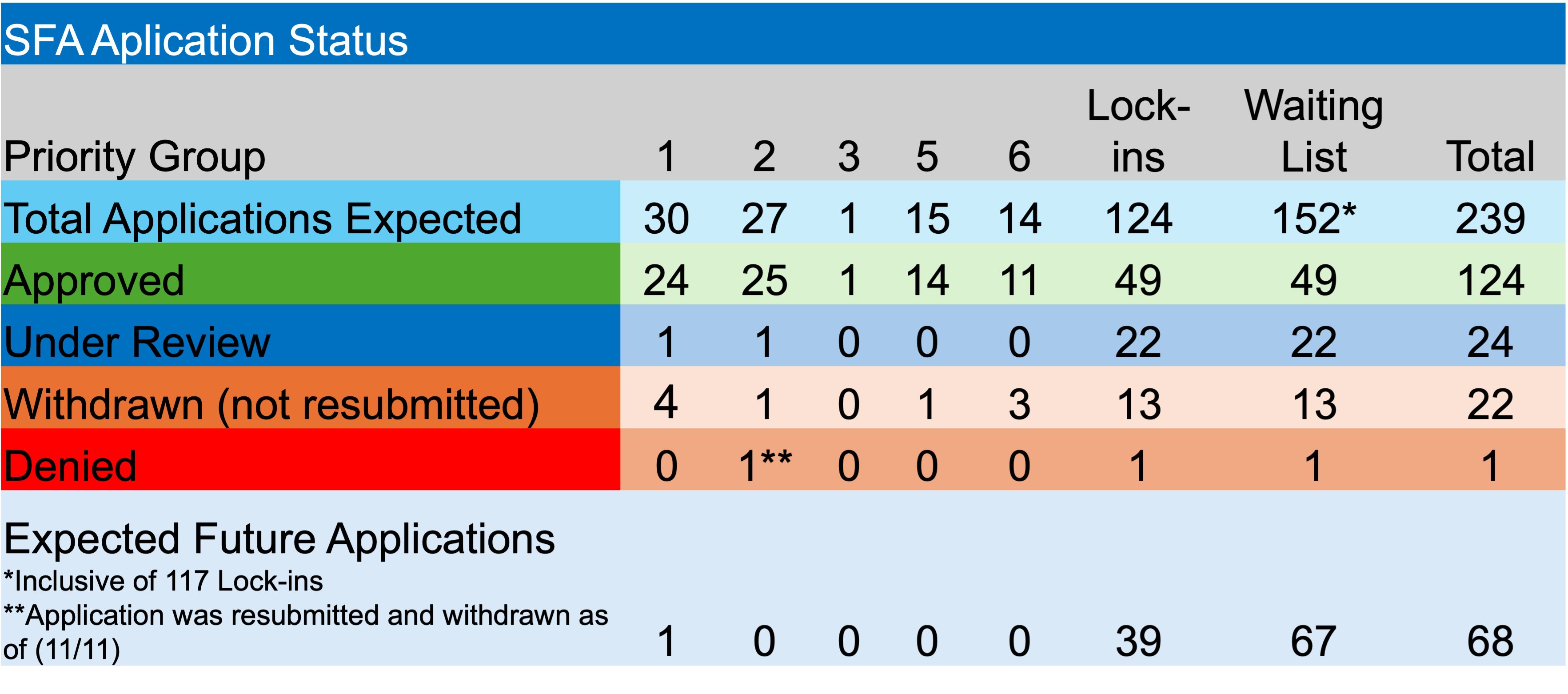
Regarding the ARPA legislation, have we entered the last month for new applications to be received by the PBGC? As I’ve mentioned multiple times, the ARPA pension legislation specifically states that initial applications must be submitted to the PBGC by 12/31/25. Revised applications can be submitted through 12/31/26. If this is the case, we have roughly 83 applications yet to be submitted. Compounding this issue is the fact that the PBGC’s e-Filing portal is temporarily closed.

The PBGC’s recorded activity was light last week which shouldn’t surprise anyone given the holiday last week. There were no applications received, denied, or withdrawn. Furthermore, there were no recipients of Special Financial Assistance (SFA) requested to rebate a portion of the grant payment due to census issues. Thankfully, it has been more than two months since we last had a plan pay back a small percentage of the proceeds.

There was some good news, as Exhibition Employees Local 829 Pension Fund, a non-priority group member, received approval of its initial application. The fund will receive $14.2 million in SFA for the 242 plan participants. This pension plan became the 70th non-priority plan to receive SFA and the 145th overall. To-date, $72.8 billion in SFA grants have been awarded!

Despite the near unanimity by market participants that U.S. Treasury yields will fall as the Fed’s FOMC prepares another Fed Funds Rate cut, interest rates are rising today. The current level of Treasury yields and bonds that price off that curve are still providing SFA recipients with attractive rates in which to secure the promised benefits through a cash flow matching (CFM) strategy. Don’t subject the SFA to the whims of the markets, especially given so much uncertainty and currently high valuations.

ARPA Update as of June 20, 2025

By: Russ Kamp, CEO, Ryan ALM, Inc.

Despite the chaotic nature of our markets and geopolitics, it is comforting that I can report weekly on the progress being made by the PBGC implementing the critical ARPA legislation. That is not to say, that the 2nd Circuit’s recent ruling isn’t creating a bit of chaos, too.

Regarding last week’s activity, the PBGC’s efiling portal must have been wide open, as they accepted initial applications from 5 pension plans residing on the waitlist. The PBGC will now have 120-days to act on these submissions.

There were no applications approved, denied, or withdrawn last week, but that isn’t to say that the PBGC rested on its laurels. There were two more plans that repaid a portion of the SFA received, as census errors were corrected. International Association of Machinists Motor City Pension Plan and Western States Office and Professional Employees Pension Fund repaid 1.61% and 1.08% of the SFA, respectively. In total, 57 plans have “settled” with the PBGC, including four funds that had no census errors. To date, $219 million was repaid from grants exceeding $48 billion or 0.45% of the grant.

In other ARPA news, another 16 funds have been added to the waitlist resulting from the 2nd Circuit’s determination that previously terminated plans can seek SFA. We do believe that it will prove beneficial for these plans, but it will stress the resources of the PBGC to meet ARPA imposed deadlines.

Given the highly unpredictable nature of war and tariffs on inflation and U.S interest rates, it isn’t surprising that the U.S. Federal Reserve held the Fed Funds Rate steady last week. We encourage those plans receiving SFA grants to secure the promised benefits through a cash flow matching strategy. Who knows how markets will impact bonds and stocks for the remainder of the year.

The Power of Bond Math

By: Ronald J. Ryan, CFA, Chairman, Ryan ALM, Inc.

Bonds are the only asset class with the certainty of its cash flows. That is why bonds have always been used to cash flow match and defease liabilities. Given this certainty, bonds provide a secure way to reduce the cost to fund liabilities. This benefit is not as transparent or valued as one might think. If you could save 20% to 50% on almost anything, most people would jump at the opportunity? But when it comes to pre-funding pension liabilities there seems to be a hesitation to capture this prudent benefit.

Bond math tells us that the higher the yield and the longer the maturity… the lower the cost. Usually there is a positive sloping yield curve such that when you extend maturity you pick up yield. What may not be evident is the fact that extending maturity is the best way to reduce costs even if yields were not increased. Here are examples of what it would cost to fund a $100,000 liability payment with a bond(s) whose maturity matches the liability payment date:

Cost savings is measured as the difference between Cost and the liability payment of $100k. As you can see, extending maturity produces a much greater cost reduction than an increase in yield. More importantly, the cost reduction is significant no matter what maturity you invest at, even if yields are unchanged. The cost savings range from 21.9% (5-years) to 38.1% (10-years) and 62.8% (20-years) with rates unchanged. Why wouldn’t a pension want to reduce funding costs by 21.9% to 62.8% with certainty instead of using bonds for a volatile and uncertain total return objective? Given the large asset bases in many pensions, such a funding cost reduction should be a primary budget consideration.

Ryan ALM is a leader in Cash Flow Matching (CFM) through our proprietary Liability Beta Portfolio™ (LBP) model. We believe that the intrinsic value in bonds is the certainty of their cash flows. We urge pensions to transfer their fixed income allocation from a total return objective versus a generic market index (whose cash flows look nothing like the clients’ liability cash flows) to a CFM strategy. The benefits are numerous:

Secures benefits for time horizon LBP is funding (1-10 years)

Buys time for alpha assets to grow unencumbered 

Reduces Funding costs (roughly 2% per year)

Reduces Volatility of Funded Ratio/Status

Reduces Volatility of Contribution costs

Outyields active bond management

Mitigates Interest Rate Risk 

Low fee = 15 bps

For more info on our Cash Flow Matching model (LBP) or a free analysis to highlight what CFM can do for your plan, please contact Russ Kamp, CEO at rkamp@ryanalm.com

ARPA Update as of October 25, 2024

By: Russ Kamp, Managing Director, Ryan ALM, Inc.

Welcome to the last week of October. Like many of us, I can’t wait to see my children’s and grandchildren’s costumes on Thursday. The weather in NJ will be more like June than the end of October. Enjoy!

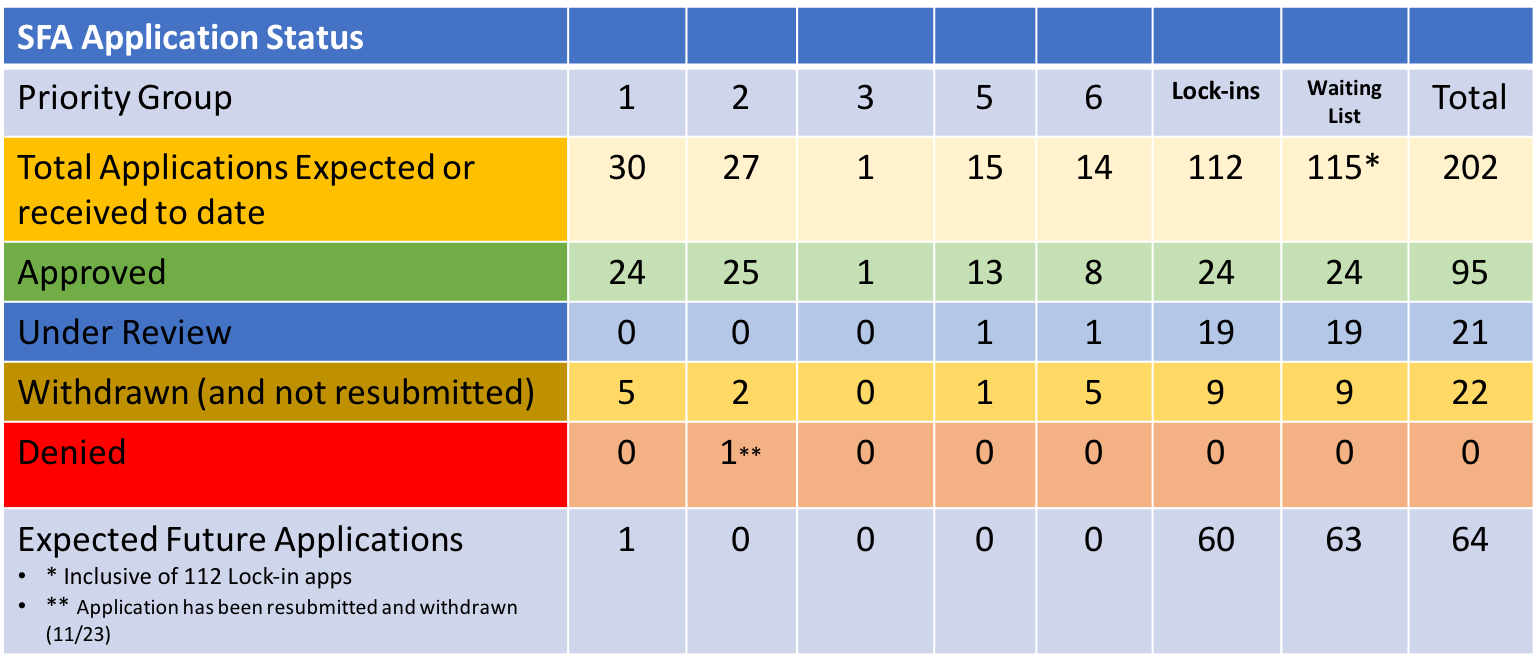
With regard to the PBGC’s effort to implement the ARPA pension legislation, last week’s activity was rather muted. I’m happy to report that we had one plan’s application approved, as I.B.E.W. Pacific Coast Pension Fund will receive $75.5 million in SFA and interest for 3,318 plan participants. This brings the number of approved applications to 95 and the total award of SFA to $68.8 billion. There are still 107 applications that are in the queue to eventually (hopefully) receive special financial assistance, with 64 yet to file an initial application.

Also, during the past week, we had the Laborers’ Local No. 265 Pension Plan withdraw its application. That plan is seeking $55.6 million for 1,460 members of its plan. This was the initial application for this fund which had been filed on July 11, 2024. There has been a total of 117 applications filed and withdrawn throughout the ARPA implementation. Some funds have seen multiple applications withdrawn and resubmitted.

Given the limited activity last week, it isn’t surprising to learn that the eFiling Portal remains temporarily closed. There is still much to accomplish with this legislation and time, although not currently an issue, will become one should this process linger beyond 2025.

Lastly, the recent move up in US Treasury rates bodes well for those plans receiving SFA and wanting to use cash flow matching to secure the promised benefits. Ryan ALM is always willing to produce an initial analysis on what can be achieved through CFM in terms of a coverage period. Don’t hesitate to reach out to us.

Another Challenging Month for US Fixed Income

By: Russ Kamp, Managing Director, Ryan ALM, Inc.

S&P Dow Jones is out with its monthly “Dash Board” on a variety of benchmarks, both domestic and foreign. April proved challenging for both US equities and bonds. With regard to stocks, the S&P 500 was down -4.1% bringing the YTD performance to +6.04%. It was a tougher environment for both mid cap (-6.0%) and small cap (-5.6%). Small caps (S&P 600) continue to be pressured and the index is now down -3.3% YTD. As US interest rates continue on a course higher, US equities will continue to be challenged.

The higher US rates are also continuing to pressure US fixed income. The Aggregate Index produced a -1.8% April, and the index is now down -2.4% since the start of 2024 despite the rather robust YTM of 5.3%. As we’ve discussed on many occasions, bonds are the only asset class with a known cash flow of a terminal value and contractual coupon payments. As a result, bonds should be used for the certainty of those cash flows and specifically to defease pension liabilities. As a reminder, pension liabilities are bond-like in nature and they will move with changes in interest rates. Don’t use bonds as a total return strategy, as they will not perform in a rising rate environment. Sure, the nearly 40-year decline in rates made bonds and their historical performance look wonderful, but that secular trend is over.

Use the fixed income allocation to match asset cash flows of interest and principal to the liability cash flows of benefits and expenses. As a result, that portion of the total assets portfolio will have mitigated interest rate risk, while SECURING the promised benefits. Having ample liquidity is essential. Using bonds to defease pension liabilities ensures that the necessary liquidity will be available as needed. The current US interest rate environment may be pressuring total return-seeking fixed income managers, but it is proving cash flow matching programs with a very healthy YTM that dramatically reduces the cost of those future value payments. Don’t waste this golden opportunity.

The Importance of Liquidity

By: Russ Kamp, Managing Director, Ryan ALM, Inc.

I recently came across an article written by a friend of mine in the industry. Jack Boyce, former Head of Distribution for Insight, penned a terrific article for Treasury and Risk in July 2020. The title of Jack’s article was “We Need to Talk About the Armadillo in the Room”. It isn’t just a funny title, but an incredible simile for the two primary stages of a pension plan, notably the accumulation and decumulation stages of pension cash flows. The move from a positive cash flow environment to a negative cash flow environment creates a hump that is reminiscent of the shape of an armadillo.

I stumbled on an armadillo at TexPERS last summer and truthfully didn’t think at that time that I was looking at a pension funding cycle, but I’ll never look at an armadillo again without thinking about Jack’s comparison. But the most important aspect of Jack’s writing wasn’t that he correctly associated the funding cycle with a less than cuddly animal, it was the fact that he highlighted a critically important need for pension plan sponsors of all types – liquidity! I’ve seen far too often the negative impact on pension plans and endowments and foundations when appropriate and necessary liquidity is not available to meet the promises, whether they be a monthly benefit, grant, or support of operations.

The last thing that you want to have happen when cash is needed is to be forced to raise liquidity when natural liquidity is absent from the market. There have been many times when even something as liquid as a Treasury note can’t be sold. Just harken back to 2008, if you want a prime example of not being able to transact in even the most liquid of instruments. Bid/ask spreads all of a sudden resemble the Grand Canyon. As we, at Ryan ALM have been saying, sponsors of these funds should bring certainty to a process that has become anything but certain. Jack correctly points out that “a typical LDI approach focuses on making sure the market value of a plan’s assets and the present value of its liabilities move in lockstep.” However, too often “these calculations fail to factor in the timing of cash flows.” We couldn’t agree more. Where is the certainty?

His recommendation mirrors ours, in that cash flow matching should be a cornerstone of any LDI program. Using the cash flow of interest and principal from investment grade bonds to carefully match (defease) the liability cash flows secures the necessary liquidity chronologically for as long as the allocation is sustained. By creating a liquidity bucket, one buys time for the remaining assets in the corpus to now grow unencumbered. As we all know, time is an extremely important attribute when investing. I wouldn’t feel comfortable counting on a certain return over a day, week, month, year, or even 5 years. But give me 10-years or more and I’m fairly confident that the expected return profile will be achieved.

Jack wrote, “pension plan sponsors need thoughtful solutions”. We couldn’t agree more and have been bringing ideas such as this to the marketplace for decades. Like Jack, “we believe a CDI approach can simultaneously improve a plan’s overall efficiency and the certainty of reaching its long-term outcome.” Certainty is safety! We should all be striving for this attribute.