Interesting Insights From Ortec Finance

By: Russ Kamp, CEO, Ryan ALM, Inc.

PensionAge’s, Paige Perrin, has produced an article that referenced recent research from Ortec Finance. The research, which surveyed senior pension fund executives in the UK, US, the Netherlands, Canada, and the Nordics, found that 77% believe that risk will be elevated, either dramatically or slightly, in 2025. That’s quite the stat. It also follows on reporting from P&I that referenced heightened uncertainty by U.S. plan sponsors. As regular readers of this blog know, I’ve been suggesting to (pleading with) sponsors that they don’t need to live with uncertainty, which is truly uncomfortable.

Among several risks cited were interest rates, inflation, and market volatility. I can’t say that I blame them for their concerns. Who among us are able to adequately forecast rates and inflation? Seems like most fixed income professionals and bond market participants have been forecasting an aggressive move down in rates. Some of these prognosticators were forecasting as many as 7 rate reductions in 2024 and several others in 2025. We didn’t get 2024’s tally. Who knows about 2025 given that inflation has remained fairly sticky.

There is an easy fix for those of you who are concerned about interest rates and inflation. Adopt a cash flow matching (CFM) strategy that will carefully match asset cash flows of interest and principal with liability cash flows (benefits and expenses). Because benefit payments are future values (FVs), they are not interest rate sensitive. Problem solved! Furthermore, the use of CFM extends the investing horizon for the remainder of the fund’s growth assets, so they now have the appropriate time to grow to meet future liabilities.

One other startling stat caught my attention, as “77 per cent of senior pension fund executives believe the increasing number of retirees relative to the number of new hires in defined benefit (DB) plans pose a “significant” or “slight” risk to the DB pensions industry.” That concern is misplaced. I just wrote a post earlier this week on that subject. DB Pension plans are not Ponzi Schemes. They don’t need more depositors than those receiving payments. It is truly frightening that a significant percentage of our senior plan sponsors don’t understand how these plans are actuarial determined and subsequently funded.

Lastly, I nearly jumped out of my chair with excitement when I read the following quotes from Marnix Engels, Ortec Finance’s managing director for global pension risk, who stated the following:

“We believe assessing the risks of both (the bolding is my emphasis) assets and liabilities in combination is crucial to get the full picture on the health of a pension fund,” he said.

“If the impacts of risk drivers are only understood for one side of the funding health equation, then it is possible to misrepresent the overall effect.”

“If a fund is not assessing both assets and liabilities, then it is difficult to conclude the overall impact of interest rate hikes on the plan’s funding ratio.”

YES!!

Not Crunch Time, But the Program is Nearing Its End

By: Russ Kamp, CEO, Ryan ALM, Inc.

I frequently get terrific questions following the publishing of one of my blog posts. Today’s question of the day was related to the ARPA pension legislation. I was asked, “Russ when does this legislation expire and when is the final date that a plans application must be submitted?” Terrific question. I’ve been meaning to provide this information as part of one of my weekly ARPA updates. Thanks for the prompt.

According to the final language in the Bill, ‘‘(f) APPLICATION DEADLINE.—Any application by a plan for special financial assistance under this section shall be submitted to the corporation (and, in the case of a plan to which section 432(k)(1)(D) of the Internal Revenue Code of 1986 applies, to the Secretary of the Treasury) no later than December 31, 2025, and any revised application for special financial assistance shall be submitted no later than December 31, 2026.

Furthermore, “The corporation (PBGC) shall not pay any special financial assistance after September 30, 2030.” As an aside, I’m not quite sure how a “revised” application that must be filed by 12/31/26 would not be paid before 2030 is beyond me, especially given the 120-day window to have an application acted on.

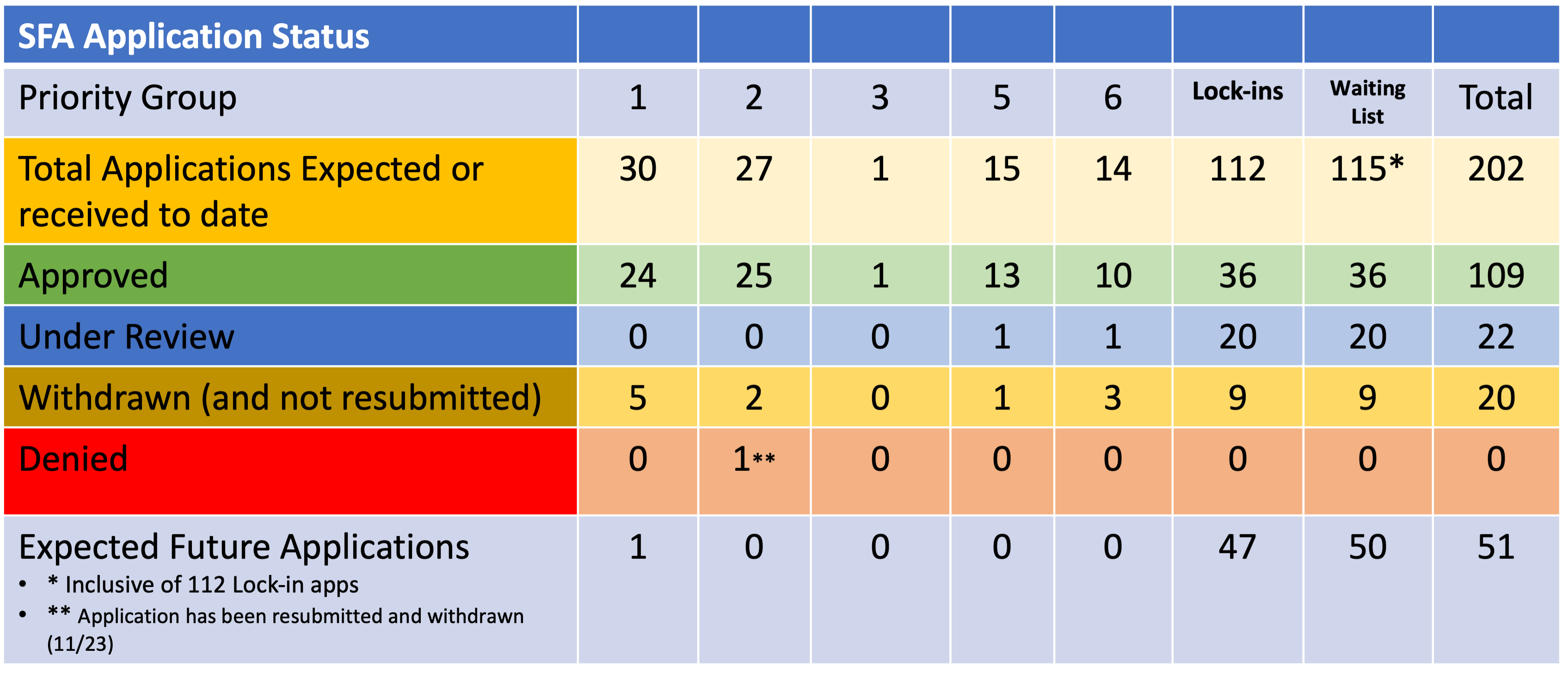
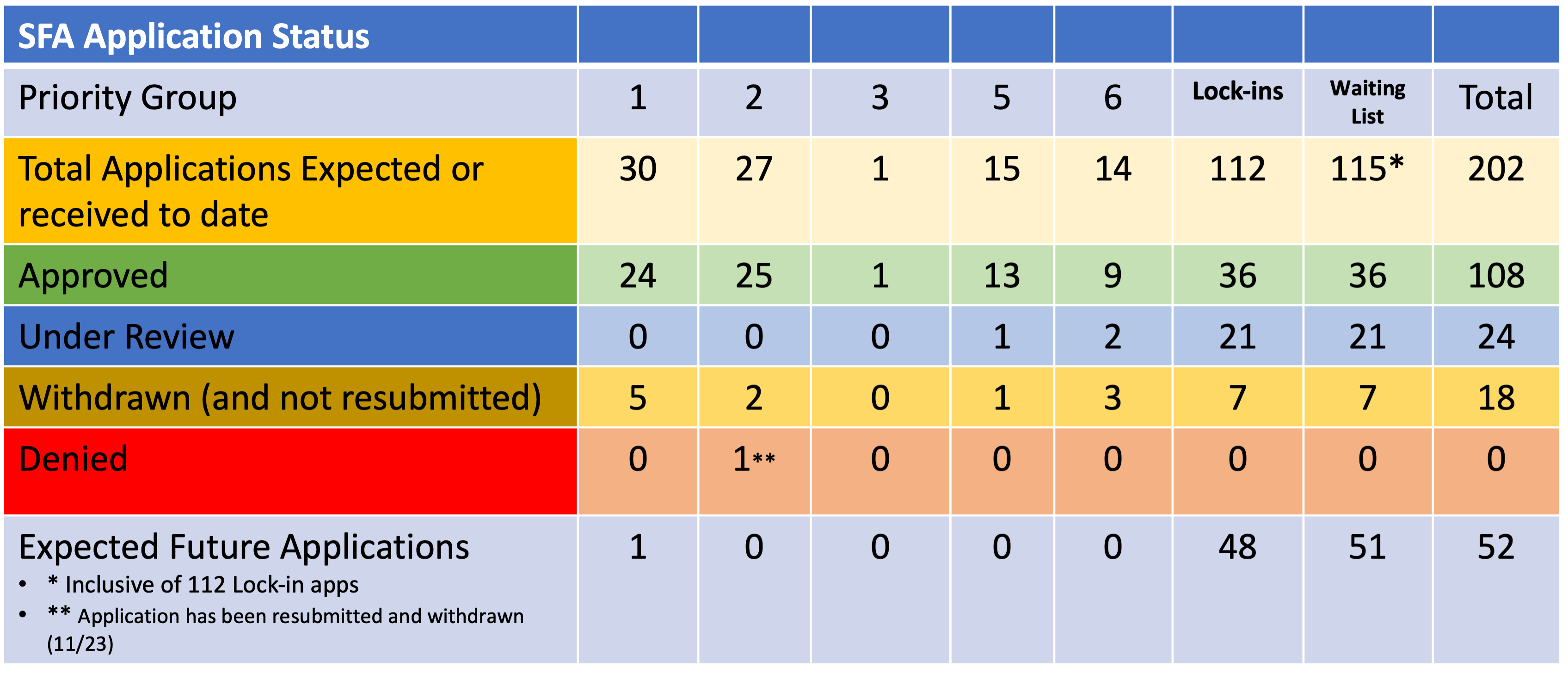
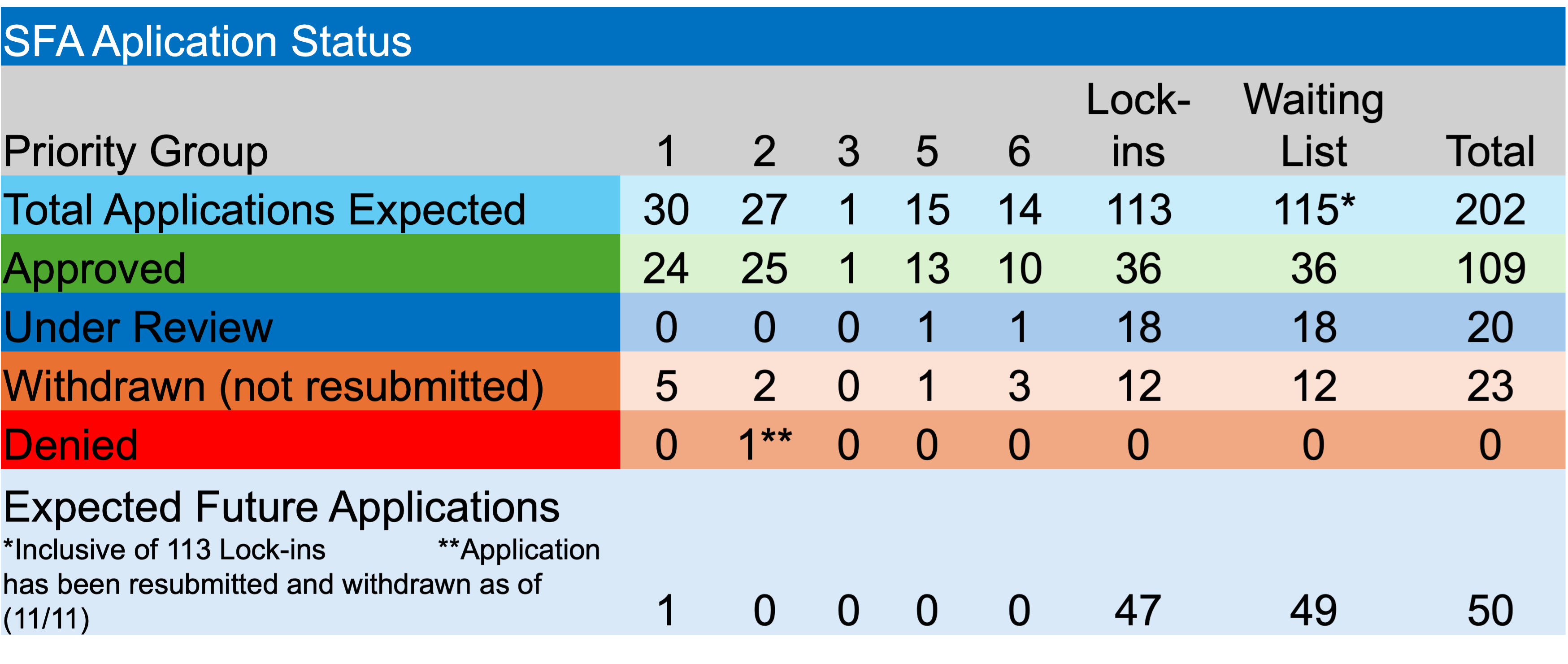
As reported in yesterday’s blog post, of the potential 202 applications, 109 have been approved, 21 are currently under review, while another 21 plans have withdrawn the applications. That leaves 51 plans that have yet to file (remember the 12/31/25 deadline) including a Priority Group 1 fund.

So, despite the terrific effort to date, the PBGC clearly has its work cut out for it. Currently, the eFiling portal to submit applications is closed. The PBGC has been opening and closing access to the filing portal based on its ability to meet the 120-day deadline. They may need to accelerate the pace of submissions and approvals in the coming months in order to complete the process by 12/31/26. Obviously, more to come from the PBGC. Also, keep your questions coming!

ARPA Update as of January 17, 2025

By: Russ Kamp, CEO, Ryan ALM, Inc.

I hope that you enjoyed the long holiday weekend. For many of us on the East coast, the holiday’s days and nights were likely spent inside given the frigid temps. Unfortunately, the upcoming week is not going to provide any weather relief.

However, this should warm your heart, as the PBGC continued to be active implementing the ARPA legislation that is nearing its fourth anniversary (3/11/21). To date, the PBGC has approved the Special Financial Assistance (SFA) for 109 multiemployer plans. The grants have totaled $70.9 billion and 1,528,409 American workers/retirees have had the promised pension benefit protected, and in some cases, restored.

During the last week, the PBGC accepted one new application, as Greendale, WI based United Food and Commercial Workers Unions and Employers Pension Plan filed a revised application seeking $54.3 million for its 15,420 plan participants. In other news, two funds, Cement Masons Local No. 524 Pension Plan and Local 1922 Pension Plan each withdrew their initial application. The two funds were seeking just over $20 million for roughly 2k members. Finally, the Legacy Plan of the UNITE HERE Retirement Fund, a Priority Group 6 member, received approval of its revised application. They have been awarded $868.8 million in SFA and interest that will go to protecting the retirements for 91,744 participants. Congrats!

The PBGC’s eFiling portal is temporarily closed. According to the PBGC’s website, “the PBGC will accept as many applications as the agency estimates it can process within the statutory 120-day review period. When the number of applications under review reaches that level, the application e-Filing Portal will temporarily close until PBGC has capacity to receive more applications.” There are still an estimated 93 funds going through the process of filing applications SFA grants. 

ARPA Update as of January 10, 2025

By: Russ Kamp, CEO, Ryan ALM, Inc.

Welcome to the second full week of January. Although the PBGC’s efiling portal remains temporarily closed, there was still some good activity last week, including the approval of another three applications seeking Special Financial Assistance (SFA). Pleased to report that Laborers’ Local No. 265 Pension Plan, Local 734 Pension Plan, and Upstate New York Engineers Pension Fund each a non-priority group member received approval for their revised applications. In total, they will receive $244.6 million in SFA for the 11,374 plan participants. What an exciting way to begin 2025.

In other news, there was one application withdrawn, Warehouse Employees Union Local 169 and Employers Joint Pension Plan, from Elkins Park, PA, withdrew its initial application seeking nearly $90 million in SFA for just over 3,600 members of the plan.

The 108 funds receiving SFA to date have been awarded grants exceeding $70 billion benefiting the quality of life for more than 1.4 million American workers. There is still much more to do (possibly another 94 funds will get SFA), but the program has already been an incredible success. Finally, US Treasury yields continue to rise, providing pension plans with the wonderful opportunity to further de-risk the SFA assets received and those to come. IG corporate bond yields exceeding 6% are not rare. Let us know how we can help you.

One of Only Two – Time For Change

By: Russ Kamp, Managing Director, Ryan ALM, Inc.

The United States of America and Denmark share several commonalities. Both countries have democratic political systems. Each country enjoys a high standard of living. Both have a commitment to human rights and environmental concerns, with Denmark being a leader in renewable energy and sustainability, while the U.S. is witnessing a growing movement on those fronts. Both countries value education, enjoying high literacy rates. There is also a shared military alliance through NATO. What you might not realize is that the U.S. and Denmark are the ONLY countries that have a self-imposed statutory debt limit. Sure, there are other countries, such as Switzerland, that have mandatory balanced budget provisions which effectively limit the amount of debt , but they aren’t specified debt limits.

The U.S. first instituted a statutory debt limit with the Second Liberty Bond Act of 1917, setting the aggregate amount of debt that could be accumulated through individual categories like bonds and bills. The purpose in creating this legislation was to finance the country’s involvement in World War 1. The legislation allowed the U.S. to raise $9.5 billion in bonds that would be issued by the U.S. government. These bonds were marketed to the general population and to institutional investors to gain their support for the war. Was there a First Liberty Bond Act? Yes, that act had been passed earlier in 1917 allowing the government to issue $2 billion in bonds in order to support the war.

Importantly, and why we are where we are today with regard to the current deficit, the Second Liberty Bond Act program continued after the war. It set a precedent for public financing of government initiatives through bond sales. Although the debt limit was established in 1917 which allowed the Treasury to issue bonds without specific Congressional approval, the “limit” has been raised more than 100 times since then and roughly 78 times since 1960 alone. As a result, the US debt has risen from around $250 billion during World War II, to about $2.1 trillion during the Reagan years, to $5.6 trillion at the conclusion of the 1990s, and to today’s $36 trillion. So, why do we have a debt limit when it has been elevated so many times previously and to a magnitude certainly not contemplated in 1917?

The political brinkmanship associated with the debt limit debate rarely serves a purpose, often unnecessarily frightening Americans and our capital market participants. As we brace for another “discussion”, is maintaining a debt “limit” at all necessary? NO! Today’s federal deficit is in no way constraining to future generations. I’ve referenced Warren Mosler and his book, “The 7 Deadly Innocent Frauds of Economic Policy” on many occasions. He covers the topic of our government debt and whether we are leaving our debt-burden to our children, grandkids, etc. Mosler states, “the idea of our children being somehow necessarily deprived of real goods and services in the future because of what’s called the national debt is nothing less than ridiculous.”

As Mosler explains, that the financing of deficit spending is of “no consequence”. He further explains that when the “government spends, it just changes numbers up in our bank accounts.” The government doesn’t borrow money, it moves funds from checking accounts at the Fed to savings accounts (Treasury securities) at the Fed. The good news, is that the entire federal deficit ($36 trillion or so) is nothing more than the economy’s total holdings of savings accounts at the Federal Reserve. The private sector now has an asset equivalent to the deficit. How wonderful! Can you imagine if we didn’t have the ability to deficit spend. Think of all the stimulus that would have been removed from our economy that supported jobs, wages, and demand for goods and services.

The major issue with our ability to deficit spend has nothing to do with financing it, but everything to do with providing too much stimulus that creates demand for goods and services that exceeds our economy’s ability to meet such demand. So, I ask again, does having a debt limit (ceiling) make sense? No, unless you enjoy all the grandiose speeches from the halls of Congress based on little knowledge of how our monetary system truly works. Finally, I’d like to give a special nod to Charles DuBois, my former colleague at Invesco, who spent hours educating me on this subject. Thanks, Chuck!

P&I: Asset Owner CIOs See Uncertainty in 2025

By: Russ Kamp, Managing Director, Ryan ALM, Inc.

P&I is out with a story today about asset owner CIOs “forecasting” uncertainty for 2025. The capital markets are always uncertain. It only takes a “surprise” to disrupt even the most obvious trend. Given a new regime in Washington, stubborn inflation, geopolitical risks throughout the globe, and equity valuations that are stretched (that’s putting it mildly), CIOs have reason to be uncertain, especially over a short timeframe, such as a calendar year or two.

The lack of certainty can be destabilizing to individuals and investment strategies. I covered the psychology of uncertainty in a post earlier this year. Here were a few highlights:

  • When facing ongoing uncertainty, our bodies stay at a high level of physiological arousal, exerting considerable wear and tear.
  • Uncertainty exerts a strong pull on our thoughts and inhibits our ability to act, leaving us in a suspended waiting game.
  • We can manage uncertainty by figuring out what we can control, distracting ourselves from negative thoughts, and reaching out to others.

The last point is particularly important. We can manage “uncertainty” by figuring out what we can control. As a plan sponsor, we can utilize an investment strategy (cash flow matching or CFM) that creates certainty for the portion of the portfolio that uses CFM. In the following post, I question the significant use of equity and equity-like product in public pension systems that are accompanied by tremendous annual volatility. Again, this produces great uncertainty.

Adopting the use of greater fixed income exposure also doesn’t ensure less uncertainty, as changes in US interest rates can play havoc on fixed income strategies. ONLY with a CFM strategy do you bring certainty of cash flows (absent any defaults) to the management of pension plans. Traditional fixed income strategies benefited from a nearly 4-decade move down in rates, but there is currently great uncertainty as to the future direction of inflation and as a result, rates. With CFM one knows what the performance will look like a decade from now. With a fixed income strategy focused on a generic index, such as the BB Aggregate, one has no idea how that portfolio will perform 10 or more years from now.

Lastly, there is no reason to live with the uncertainty that many CIOs currently foresee. I wrote a piece just recently on achieving “peace of mind“. Uncertainty won’t help you in your quest for a good night’s sleep, but achieving peace of mind is very much achievable once you adopt a CFM strategy and secure the promised benefits (or grants) for some period of time. Call us. We want to remove as much uncertainty from your professional life as possible.

ARPA Update as of December 13, 2024

By: Russ Kamp, Managing Director, Ryan ALM, Inc.

Welcome to the last full week before the Christmas season kicks off. Most investors will be sorry to see 2024 come and go. For the PBGC, 2024 has been a year of great accomplishments, with the approval of Special Financial Assistance (SFA) for 35 multiemployer plans covering 458,171 participants with SFA grants totaling $16.2 billion – wow!

The last week was a continuation of the PBGC’s activity with seven more funds submitting applications seeking $638.2 million for nearly 27k members. The applications included five new submissions and 2 revised applications. The applicants included the Dairy Industry-Union Pension Plan for Philadelphia and Vicinity, Bricklayers Pension Fund of West Virginia, United Wire, Metal and Machine Pension Plan, Distributors Association Warehousemen’s Pension Trust, Local 945 I.B. of T. Pension Plan, Alaska Teamster – Employer Pension Plan, and the Local 888 Pension Fund. Grant requests ranged from United Wire’s $228.5 million to the Bricklayers $1.96 million for their 170 participants.

In addition to the new submissions, there was one approval. Teamsters Local 11 Pension Plan will receive $29.3 million for the 2,012 members of its plan. This North Haledon, NJ fund submitted a revised application on August 29, 2024. In other ARPA news, there were no applications denied or withdrawn during the previous 7 days. In addition, there were no new plans added to the waitlist or forced to repay a portion of the SFA due to census errors.

US Treasury interest rates backed up fairly significantly last week as inflation data came in a little higher than recent trends giving bonds investors reason to challenge the narrative that the Fed would continue pushing down the Fed Funds rate. The higher rates are providing plan sponsors with greater cost savings on future benefits through cash flow matching strategies.

Kamp Named CEO of Ryan ALM, Inc.

By: Ronald J. Ryan, CFA, CEO, Ryan ALM, Inc.

Press Release

________________________________________________________________________________

Russ Kamp Named CEO of Ryan ALM, Inc.

Effective 1/01/25 Russ Kamp will be the new CEO of Ryan ALM, Inc.

Ronald J. Ryan, CFA will become the Chairman and CFO. Ron announces “Ryan ALM has prospered in a rather difficult environment for fixed income asset managers in the last 20 years. As founder and CEO, it is time to pass the torch to someone who has the vision and talent to take us forward. Russ has demonstrated a professionalism and integrity that is most respected by his peers. His attention to client needs is unsurpassed. His resume is proof of his abilities and success. It is an honor to work with Russ. I will remain as head of research and a member of our asset management team. I look forward to the best years ahead for Ryan ALM working with Russ and our highly experienced team.”

Steve deVito, head of trading, will also become the Chief Compliance Officer of Ryan ALM. Steve has nearly 40 years of fixed income experience and serves as an important member of the asset management team.

Martha Monteagudo, head of product development, will continue in her position. She started with Ryan ALM in 2004 and is a valuable member of the asset management team.

As our name implies, Ryan ALM is an Asset Liability Manager (ALM) specializing in cash flow matching. We strongly believe that cash flow matching is the best fit for any liability objective. Our cash flow matching product (Liability Beta Portfolio™) can reduce funding costs by about 2% per year (about 20% on 1-10-year liabilities). Our turnkey system is unique in the industry including:

  1.  Custom Liability Index (CLI)
  2. ASC 715 Discount Rates
  3. Liability Beta Portfolio™ (LBP)
  4. Modified Asset Exhaustion Test (AET)

The Ryan ALM asset management team has over 160 years of experience making us one of the most experienced teams in the fixed income industry. For more information, please go to our web site at www.RyanALM.com.

How Comforting is $1,305.54/year?

By: Russ Kamp, Managing Director, Ryan ALM, Inc.

One doesn’t have to spend much time on LinkedIn.com these days without seeing a discussion about the pros and cons of Defined Benefit (DB) vs. Defined Contribution (DC) aka 401(k) plans. Anyone who has read just a few of the >1,500+ posts on this blog know that I and Ryan ALM, Inc. are huge supporters of DB plans. Based on the following, it becomes apparent why that is the case.

One topic frequently mentioned among our peers is financial literacy. As a former member of two boards of education (11 years in total), I have witnessed first-hand how little financial literacy is shared with our high school students, especially as it relates to saving and investing. That said, as important as education is, the greatest issue for me is the lack of disposable income for the average American worker.

Frequently we read about the spending habits of younger generations, including being the “avocado toast” crowd. Examples often used include the daily purchase of a Starbucks drink or two, the use of Uber Eats, and similar examples of perceived wasteful spending. They fail to mention that even “well-paid” workers (>$100k) are burdened by a mortgage or rent payment, they likely have student loan debt, they have to buy insurance in order to use their car, which is also a very expensive purchase, they are required to have health insurance, homeowners or rental insurance, and God forbid that they have a spouse and a couple of kids. Childcare expenses have gotten to be insane. Is there any wonder that funding one’s own retirement has proven to be incredibly challenging?

So how are we doing? Unfortunately, most of the literature on the subject uses average balances to represent 401(k) savings. This practice needs to stop. According to Vanguard the average balance in 2024 is $134,128, but the median balance is $35,285. In addition, Morningstar has just published an article stating that retirees should use only a 3.7% withdrawal rate (no longer 4%) to safely use a 401(k) retirement balance given the recent performance of equity markets and the current interest rate environment. Let’s see: 3.7% * $35,285 = $1,305.54. That is an annual withdrawal, although it looks like it should be a monthly payout! What kind of retirement will that level of annual withdrawals provide? For comparison purposes, the average DB payout in the private sector is $11k and nearly $25k in public pensions.

As a reminder, DC plans were intended to be supplemental to DB plans. It is highly regrettable that they have morphed into most everyone’s primary means of “accumulating” retirement resources. This migration in proving to be an unmitigated failure and the consequences will be untenable. The American worker needs access to a DB plan. Let’s work together to protect and preserve those that remain, while encouraging former sponsors of these plans to rethink the decision to freeze or terminate. There are also state sponsored entities that afford employees in smaller companies access to a DB-like plan. That said, please manage them with a focus on the pension promise (securing benefits). Don’t rely on markets and all the volatility that comes with that exposure to “fund” these essential programs. That strategy hasn’t worked!

Corporate Pension Funding Improves, Again: Milliman

By: Russ Kamp, Managing Director, Ryan ALM, Inc.

The Milliman 100 Pension Funding Index (PFI) has once again been produced (View the complete Pension Funding Index). The index, which includes the largest 100 U.S. corporate pension plans, reveals a positive change in the funded ratio for November 2024. Asset growth of 1.88% lifted the combined assets of these 100 plans by $18 billion, which was more than enough to overcome growth in the present value of the future benefit payments ($13 billion). The funded ratio improved to 103.5% from October’s 103.2%.

The discount rate for valuing pension liabilities now stands at 5.21% as of November 30, 2024. The current rate represents a 10 basis point decline from the end of October. “November saw the second consecutive month of improvement in the PFI funded ratio, with the 1.88% investment gain more than offsetting the rise in plan liabilities caused by falling discount rates,” said Zorast Wadia, author of the PFI.

Given the incredible performance of risk assets during the last two years, valuations appear very stretched. Many corporate plans have reduced risk through ALM strategies, including cash flow matching (CFM). It may be time to reduce asset allocation risk to a greater extent, especially for those plans that continue to manage the pension’s assets in a more traditional approach.