ARPA Update as of November 21, 2025

By: Russ Kamp, CEO, Ryan ALM, Inc.

Welcome to Thanksgiving week. I don’t think that I’m alone when I say that Thanksgiving is my absolute favorite holiday. I hope that you and your family enjoy a truly special day. I’m thankful that we’ll have all of our kids and grandkids together and also very happy not to have to watch the Giants that day!

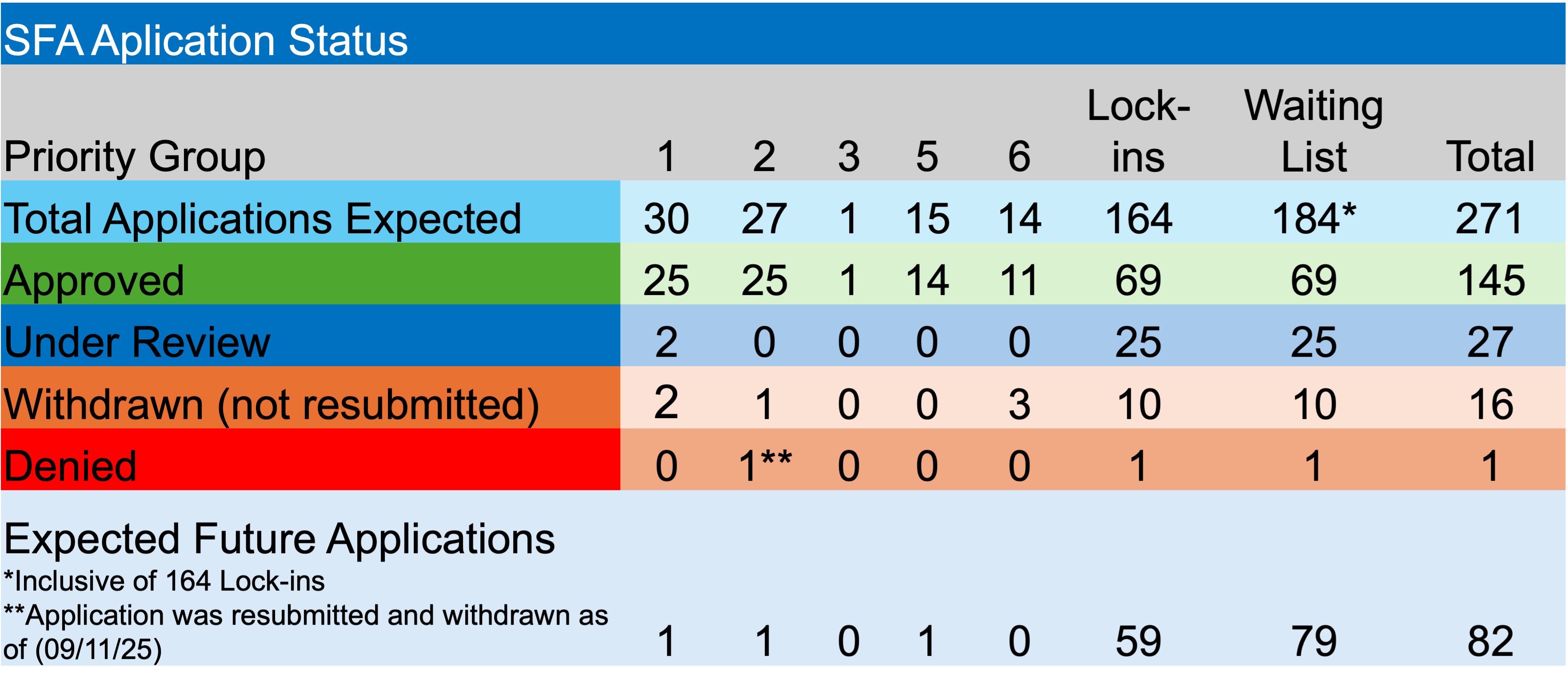
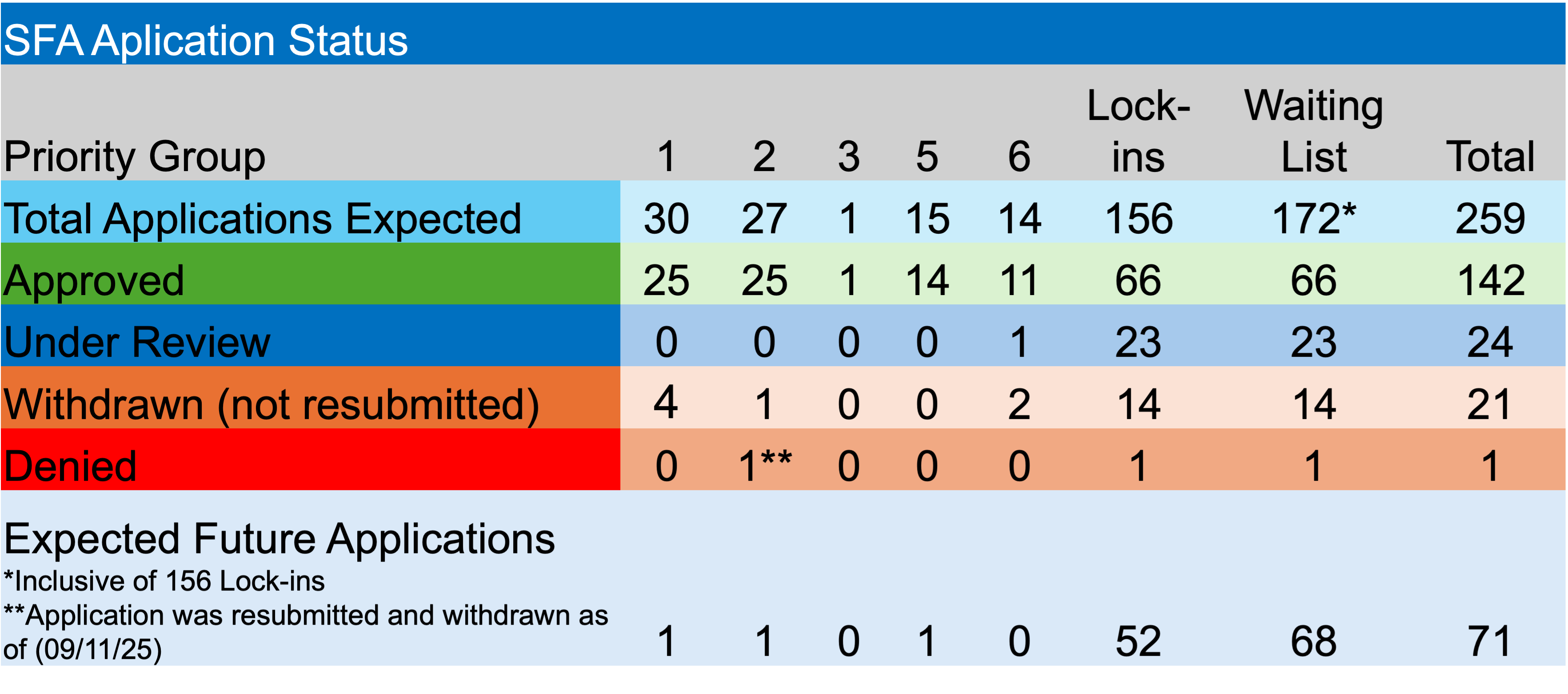
With regard to ARPA and the PBGC’s implementation of this critically important legislation, after a week of “rest”, there was some activity posted by the PBGC through the weekly update on their website. Not as much activity as one would expect, given the significant waiting list (81 funds) of pension plans to submit an initial application.

Happy to report that there was an application approved. It is the first one in more than one month (10/16/25). Emeryville, CA-based, Distributors Association Warehousemen’s Pension Trust, will receive $32.7 million in SFA for 3,358 plan participants. Their revised application was approved on November 20th.

In other ARPA news, Cumberland, Maryland Teamsters Construction and Miscellaneous Pension Plan, has submitted a revised application. They are hoping to get approval for $8.4 million in SFA for 101 members. In addition, there were no pension funds asked to repay a portion of the SFA due to census errors, which has been the case for the last couple of months. There were also no applications denied due to eligibility issues.

I’ve discussed quite often the growing list of funds that have asked to be added to the waitlist. These non-priority funds appear to be running out of time to have their initial application reviewed. Two more funds were added in the last week. By my estimate, there remain 79 pension systems yet to file the initial application. As a reminder, the legislation specifically reads that initial applications must be filed with the PBGC by December 31, 2025. Unfortunately, the PBGC’s e-Filing portal remains temporarily closed.

PBGC Increases Premium Rates – Why?

By: Russ Kamp, CEO, Ryan ALM, Inc.

The demise of the defined benefit (DB) plan, most notably within the private sector, is harming the American worker and significantly reducing the odds of a dignified retirement. The Federal government should be doing everything that it can to protect the remaining pensions, including keeping fees low to ensure that these critically important retirement vehicles continue to operate. But unfortunately that doesn’t seem to be the case in this particular situation.

I have been very impressed with and supportive of the PBGC’s effort implementing the ARPA pension legislation, but I question the need to raise premium rates for 2026, which the PBGC has just announced. Why? As of fiscal year-end 2024, the PBGC’s single employer insurance program had a $54.1 BILLION surplus, as assets totaled $146.1 billion and liabilities stood at $92.0 billion. Despite these significant excess resources, the PBGC is increasing rates for the “flat rate premium per participant” in single-employer plans to $111 per participant in 2026 from $106. This 4.7% increase was described in a Chief Investment Officer article as modest! That increase doesn’t seem modest anyway you look at it, but certainly not when one remembers that $54 billion surplus. What is the justification? The rate per $1,000 in “unvested benefits”, not subject to indexing, was frozen by Congress in Section 349 of the SECURE 2.0 Act of 2022 and therefore remains $52. Seems like we need more legislation to freeze the flat-rate premium.

Despite the significant improvement in the multiemployer pension program due to the Special Financial Assistance (SFA) related to ARPA pension reform, that insurance pool is still underwater. As a result, multiemployer plans that only pay a per-participant premium will see the per-participant rate for flat rate premiums rise to $40 from $39 next year. That amounts to an increase of 2.6%. So, the program that is underwater sees a premium increase of 2.6%, while the insurance pool with the massive surplus gets an outsized 4.7% increase? I guess one must work for the government to understand that decision.

Again, we need to do much more to protect DB pensions for all American workers. Asking untrained individuals to fund, manage, and then disburse a “retirement benefit” with little to no disposable income, low investment knowledge, and no crystal ball to help with longevity considerations is just poor policy doomed to failure. We are the wealthiest country in the world, yet we can’t seem to figure out how to control costs associated with retirement, healthcare, education, childcare, etc. and in the process, we are crippling a majority of American families. It isn’t right!

ARPA Update as of October 10, 2025

By: Russ Kamp, CEO, Ryan ALM, Inc.

Welcome to Columbus and Indigenous Peoples’ Day. Bond markets are closed and the equity markets remain open. Columbus Day remains a federal holiday, but with most federal employees already furloughed, it will not be a day to celebrate for many.

Regarding ARPA and the PBGC’s activity implementing this critical legislation, last week proved a busy one as there were three new applications received, two approved, and one withdrawn. There was also a plan added to the burgeoning waitlist. Happy to report that there were no applications denied or required to rebate a portion of the SFA as a result of census errors.

Now for the details. Ironworkers’ Local 340 Retirement Income Plan, Operative Plasterers & Cement Masons Local No. 109 Pension Plan, and Dairy Employees Union Local #17 Pension Plan, each a non-priority group member, filed their initial applications seeking a combined $60.4 million in SFA for nearly 3k plan participants. The PBGC has 120-days to act on these applications.

Pleased to report that two plans, Local 734 Pension Fund and the Retirement Plan of the Millmen’s Retirement Trust of Washington received approval for their initial applications, and they will receive $89.5 and $7.2 million, respectively for their combined 2,597 members. The PBGC has now awarded $74.3 billion in SFA grants to support the pensions for 1.828 million workers.

In other ARPA news, Pension Plan of the Pension Fund for Hospital and Health Care Employees – Philadelphia and Vicinity has withdrawn its initial application seeking $229.8 million in SFA that would support 11,084 members. Finally, the Buffalo Carpenters Pension Fund has added their name to the waitlist. They immediately secured the valuation date as July 31, 2025. Good luck to them as there are 67 plans currently on the waitlist that have yet to submit an application.

I’ve mentioned on several occasions the approaching deadline to file an initial application seeking SFA approval. I do hope that an extension of the filing deadline is approved. There are a lot of American workers who should be provided the full benefits that they have been promised and could secure through the ARPA legislation. This should be a bi-partisan effort.

Taking From Peter to Pay Paul

By: Russ Kamp, CEO, Ryan ALM, Inc.

Do you, or would you, consider yourself a “high earner” with a salary of $145k/year?

Try asking a family of four in NYC that question, when you consider the expenses from taxes (federal, state, city, sales, and property), the housing costs associated with an apartment, childcare, healthcare, food, clothing, etc. Yet, those at the IRS certainly do. In case you didn’t realize it, SECURE 2.0 is eliminating the tax deductibility of “make up” contributions for those 50 and up after they have maxed out their $23,500 annual contribution beginning in 2027. As a reminder, for those that 50-years old and up one can contribute another $7,500. For those between the ages of 60-and 63-years-old there is a super catch up contribution of $11,500. Why a 64- or 65-year-old can’t contribute more is beyond me. Perhaps it will blow out the U.S. federal budget deficit!

Unfortunately, if you are so lucky to earn a whopping $145k from a single employer in a calendar year, you will be forced to use a Roth 401(k) for those make up contributions. As stated previously, you lose the tax deductibility for those additional contributions. So, if you earn $200k and you contribute the additional $7,500 or the $11,500, instead of seeing your gross income fall by those figures, you will be taxed at the $200k level, increasing your tax burden for that year. Yes, the earnings within the account grow tax free, but the growth in the account balance is subject to a lot of risk factors.

We should be incentivizing all American workers to save as much as possible. Let’s stop with all these different gimmicks. Do we really want a significant percentage of our older population no longer participating in our economy? Those 65-years and older represent about 17% of today’s population, but they are expected to be 23% by 2050. Do we really want them depending on the U.S government for social services? No, and they don’t want that either. We want folks to be able to retire with dignity and remain active members of our economic community.

The demise of the traditional DB pensions has placed a significant burden on most American workers who are now tasked with funding, managing, and then disbursing a “retirement” benefit with little disposable income, no investment acumen, and a crystal ball to determine longevity as foggy as many San Francisco summer days. Again, with the burdens associated with all of the expenses mentioned above and more, it really is a moot point for many Americans to even consider catch up contributions, but for those lucky few, why penalize them?

A Peer Group?

By: Russ Kamp, CEO, Ryan ALM, Inc.

Got an email today that got my heart rate up a little. The gist of the article was related to a particular public pension fund that eclipsed its “benchmark” return for the fiscal year ended June 30, 2025. Good job! However, the article went on to state that they failed to match or exceed the median return of 10.2% for the 108 public pension funds with asset >$1 billion. What a silly concept.

Just as there are no two snowflakes alike, there are no two public pension systems that are the same, even within the same state or city. Each entity has a different set of characteristics including its labor force, plan design, risk tolerance, benefit structure, ability to contribute, and much more. The idea that any plan should be compared to another is not right. Again, it is just silly!

As we’ve discussed hundreds of times, the only thing that should matter for any DB pension plan is that plan’s specific liabilities. The fund has made a promise, and it is that promise that should be the “benchmark” not some made up return on asset (ROA) assumption. How did this fund do versus their liabilities? Well, that relationship was not disclosed – what a shocker!

Interestingly, the ROA wasn’t highlighted either. What was mentioned was the fact that the plan’s returns for 3-, 5-, and 10-years were only 6.2%, 6.6%, and 5.4%, respectively (these are net #s), and conveniently, they just happened to beat their policy benchmark in each period.

I’d be interested to know how the funded ratio/status changed? Did contribution expenses rise or fall? Did they secure any of the promised benefits? Did they have to create another tier for new entrants? Were current participants asked to contribute more, work longer, and perhaps get less?

I am a huge supporter of defined benefit plans provided they are managed appropriately. That starts with knowing the true pension objective and then managing to that goal. Nearly all reporting on public pension plans focuses on returns, returns, returns. When not focusing on returns the reporting will highlight asset allocation shifts. The management of a DB pension plan with a focus on returns only guarantees volatility and not success. I suspect that the 3-, 5-, and 10-year return above failed to meet the expected ROA. As a result, contributions likely escalated. Oh, and this fund uses leverage (???) that gives them a 125% notional exposure on their total assets. I hope that leverage can be removed quickly and in time for the next correction.

What might SS Recipients Get in 2026’s COLA

By: Russ Kamp, CEO, Ryan ALM, Inc.

With the demise of the defined benefit plan for many workers in the US private sector, Social Security benefit payments become ever more important for a greater percentage of the American retirees and those with disabilities. There have been several stories recently about Social Security and what the “average” recipient might receive in 2026 and worse, what their benefit reduction might be should the forecast of a “lockbox” shortfall in 2033 come to pass. We’ll get the official word on the 2026 COLA sometime in October, but early estimates are forecasting a 2.5% increase for next year. This potential increase barely matches headline CPI and it falls short of the current Core and Sticky inflation #s.

Social Security’s average monthly benefit among all retired workers is $2,006 in 2025, according to a recent AARP article. If the 2.5% increase turns out to be correct, checks will increase $50 / month. If my math is correct, that equates to an average monthly check of $2,056. The maximum Social Security benefit for a worker retiring at full retirement age is $4,018 in 2025. A 2.5% COLA will bring that figure to $4,118 in 2026. For those retiring at 62-years-old the maximum benefit in 2025 is $2,831, while the maximum benefit for a worker retiring at age 70 is $5,108 in 2025. Those numbers will be adjusted accordingly.

As we celebrate Social Security’s 90th anniversary, we need to understand that the on-going rhetoric about SS running out of money is a fallacy. There DOES NOT exist an “operational constraint on the government’s ability to meet all Social Security payments in a timely manner. It doesn’t matter what the numbers are in the Social Security Trust Fund account, because the trust fund is nothing more than record-keeping, as are all accounts at the Fed.” (Warren Mosler, “Seven Deadly Innocent Frauds of Economic Policy”) He continues, “When it comes time to make Social Security payments, all the government has to do is change numbers up in the beneficiary’s accounts, and then change numbers down in the trust fund accounts to keep track of what it did. If the trust fund number goes negative, so be it. That just reflects the numbers that are changed up as payments to beneficiaries are made.”

What we should fear is that Congress does not understand this concept and acts rashly to address the impending “crisis” that doesn’t exist. Recent estimates target a possible reduction in “benefits” at 23% to 24% in 2033. Try telling the nearly 70 million Americans, many relying on SS for most of their retirement assets, that they will see a dramatic reduction in a promised benefit that they themselves helped to fund. With 50% of retirees using SS for more than 50% of their retirement income and another 25% in which SS makes up 90% or more of their retirement income, the economic impact from these potential benefit cuts would be cruel and absolutely unnecessary.

Corporate Pension Funding – UP!

By: Russ Kamp, CEO, Ryan ALM, Inc.

I was out of the office last week, and as a result I am trying to play catch-up on some of the stories that I think you’d be interested in. Happy to report that Milliman released its monthly Milliman 100 Pension Funding Index (PFI), which, as you know, analyzes the 100 largest U.S. corporate pension plans. Importantly, the news continues to be good for corporate pension funding.

For July, a discount rate increase of 3 bps helped stabilize corporate pension funding, lowering the Milliman PFI projected benefit obligation (PBO) by $6 billion to $1.213 trillion as of July 31. Anticipated investment returns were marginally subpar at 0.38%. After taking into consideration a higher discount rate, marginal investment gains, and net outflows, overall corporate pension funding increased by $4 billion for the month.

The Milliman 100 PFI funded ratio now stands at 105.3% up from June’s 105.7%. For the last 12-months, the funded ratio has improved by 2.8%, as the collective funded status position improved by $32 billion. “July marks four straight months of funding improvement, with levels not seen since late 2007, before the global financial crisis,” said Zorast Wadia, author of the PFI. “In order to preserve funded status gains, plan sponsors should be thinking about asset-liability management strategies to help mitigate potential discount rate declines in the future.” We couldn’t agree more with you, Zorast!

As highlighted below, overall corporate pension funding has improved dramatically. A significant contributor to this improvement has been the rise in U.S. interest rates which significantly lowered the present value of those future benefits. Let’s hope that the current funding will encourage plan sponsors to maintain their DB pension plans for the foreseeable future. You have to love pension earnings as opposed to pension expense!

Figure 1: Milliman 100 Pension Funding Index — Pension surplus/deficit

View the complete Pension Funding Index.

ARPA Update as of August 1, 2025

By: Russ Kamp, CEO, Ryan ALM, Inc.

Talk about jumping out of the frying pan into the fire! I left New Jersey’s wonderful heat and humidity only to find myself in El Paso, TX, where the high temperature is testing the limits of a normal thermometer. Happy to be speaking at the TexPERS conference this week, but perhaps they can do an offsite in Bermuda the next time.

Regarding the ARPA legislation and the PBGC’s implementation of this critical pension program, we continue to see the PBGC ramp up its activity level. This past week witnessed five multiemployer plans submitting applications of which four were initial filings and the fifth was a revised offering. Another plan received approval, while one fund added its name to the waitlist. Finally, two funds have locked-in the measurement dates (valuation purposes).

Now the specifics: The four funds submitting initial applications were Colorado Cement Masons Pension Trust Fund, Iron Workers-Laborers Pension Plan of Cumberland, Maryland, Cumberland, Maryland Teamsters Construction and Miscellaneous Pension Plan, and Exhibition Employees Local 829 Pension Fund that collectively seek $50.8 million in SFA for their 1,260 plan participants. This week’s big fish, UFCW – Northern California Employers Joint Pension Plan, a Priority Group 6 member, is seeking $2.3 billion for its 138.5k members.

The plan receiving approval of its application for SFA is Laborers’ Local No. 130 Pension Fund, which will receive $33.3 million in SFA and interest for its 641 participants. In an interesting twist, Laborers’ Local No. 130 Pension Fund, has added the fund to a growing list of waitlist candidates. If the Laborers name seems to resemble the name of the recipient of the latest SFA grant you wouldn’t be wrong. I was as confused as you are/were until I realized that these entities have different that there are two different EIN #s.

Happy to report that there were no applications withdrawn, none denied, and no SFA recipients were asked to return a portion of the proceeds due to incorrect census information. However, there are still 119 funds going through the process. There is a tremendous amount of work left to be done at this time. This comes on the heels of 131 funds being approved for a total of $73.4 billion in SFA and interest supporting the retirements for 1.77 million American workers/retirees. What an incredible accomplishment!

ARPA Update as of July 18, 2025

By: Russ Kamp, CEO, Ryan ALM, Inc.

I have the pleasure of drafting this post from beautiful Newport, RI, where I’m attending and speaking at the Opal Public Fund Forum East. The West forum’s location wasn’t too shabby either as it took place in Scottsdale last January! Business travel isn’t as glamorous as those who don’t travel think, but there are some nice perks, too. As they say in real estate: location, location, location!

With regard to ARPA, since you likely didn’t decide to open post this to find Waldo or Russ, the PBGC was fairly busy during the previous week, as there was one new application, one approved application, two new additions to the waitlist and two funds that locked-in their measurement date. Now the details.

I’m pleased to report that the Roofers Local 88 Pension Plan, a Canton OH-based fund, has filed a revised application seeking $9 million for their 484 participants. As usual, the PBGC has 120-days to act on the application or it is automatically approved. In addition, Union de Tronquistas de Puerto Rico Local 901 Pension Plan, a San Juan, PR-based fund, a Priority Group One member will receive $49 million in SFA and interest for the 3,397 members.

In other news, Local 400 Food Terminal Employees Pension Trust Fund and the Textile Processors Service Trades Health Care Professional and Technical Employees International Union Local No. 1 Pension Fund (that name is a mouth full) have both added their funds to the PBGC’s waitlist for the submission of an SFA application. Good luck. There were also two funds from the waitlist, Iron Workers Local 473 Pension Plan and Greenville Plumbers and Pipefitters Pension Fund have locked in their measurement date and both chose April 30, 2025.

Lastly, there were no applications denied or withdrawn, and none of the previous SFA recipients were asked to rebate a portion of their proceeds due to census errors. As reported previously, the PBGC has their work cut out for them, as all of the outstanding applications need to be filed by year-end.

Why? – Revisited

By: Russ Kamp, CEO, Ryan ALM, Inc.

My 44-year career in the investment industry has been focused on DB pension plans, in roles as both a consultant and an investment manager (I’ve also served as a trustee). I’ve engaged in 000s of conversations related to the management of DB pension plans covering the good, the bad, and even the ugly! I’ve published more than 1,600 mostly pension-related posts on this blog with the specific goal to provide education. I hope that some of my insights have proven useful. Managing a DB pension plan, whether a private, public, or a multiemployer plan is challenging. As a result, I’ve always felt that it was important to challenge the status quo with the aim to help protect and preserve DB pensions for all.

Unfortunately, I continue to think that many aspects of pension management are wrong – sorry. Here are some of the concerns:

  • Why do we have two different accounting standards (FASB and GASB) in the U.S. for valuing pension liabilities?
  • Why does it make sense to value liabilities at a rate (ROA) that can’t be purchased to defease pension liabilities in this interest rate environment?
  • Why do we continue to create an asset allocation framework that only guarantees volatility and not success?
  • Why do we think that the pension objective is a return objective (ROA) when it is the liabilities (benefits) that need to be funded and secured?
  • Why haven’t we realized that plowing tons of plan assets into an asset class/strategy will negatively impact future returns?
  • Why are we willing to pay ridiculous sums of money in asset management fees with no guaranteed outcome?
  • Why is liquidity to meet benefits an afterthought until it becomes a major issue?
  • Why does it make sense that two plans with wildly different funded ratios have the same ROA?
  • Why are plan sponsors willing to live with interest rate risk in the core bond allocations?
  • Why do we think that placing <5% in any asset class is going to make a difference on the long-term success of that plan?
  • Why do we think that moving small percentages of assets among a variety of strategies is meaningful?
  • Why do we think that having a funded ratio of 80% is a successful outcome?
  • Why are we incapable of rethinking the management of pensions with the goal to bring an element of certainty to the process, especially given how humans hate uncertainty?

WHY, WHY, WHY?

If some of these observations resonate with you, and you are as confused as I am with our current approach to DB pension management, try cash flow matching (CFM) a portion of your plan. With CFM you’ll get a product that SECURES the promised benefits at low cost and with prudent risk. You will have a carefully constructed liquidity bucket to meet benefits and expenses when needed – no forced selling in challenging market environments. Importantly, your investing horizon will be extended for the growth (alpha) assets that haven’t been used to defease liabilities. We know that by “buying time” (extending the investment horizon) one dramatically improves the probability of a successful outcome.

Furthermore, your pension plan’s funded status will be stabilized for that portion of the assets that uses CFM. This is a dynamic asset allocation process that should respond to improvement in the plan’s funded status. Lastly, you will be happy to sit back because you’ve SECURED the near-term liquidity needed to fund the promises and just watch the highly uncertain markets unfold knowing that you don’t have to do anything except sleep very well at night.