Houston, We Have A Problem!

By: Russ Kamp, CEO, Ryan ALM, Inc.

That famous phrase from the movie Apollo 13, is actually modified from the original comment spoken by Jack Swigert, the command module pilot, who said, “Okay, Houston…we’ve had a problem here”. In any case, I am not referencing our space program, the City of Houston or for that matter, any other municipality. However, I am acknowledging that we continue to have an issue with how the debt of companies, municipalities, and other government entities get rated and how those rating agencies get compensated.

There was a comment in New Jersey Spotlight News (a daily email newsletter) that stated “New Jersey is facing uncertain economic times, to say the least, but its state government got a vote of confidence from Wall Street this week.” Of course, I was intrigued to understand what this vote of confidence might be especially given my knowledge of the current economic reality facing my lifelong state of residence. It turns out that Moody’s has elevated NJ’s debt rating. Huh?

Moody’s action in raising the rating to Aa3 follows a similar path that S&P took several months ago. Yes, NJ was able to recently close its budget gap by $600 million through tax increases but given that the state has one of the greatest tax burdens of any U.S. state, the ability to further raise taxes is likely significantly curtailed unless they want to witness a mass exodus of residents, including the author of this post!

According to Steve Church, Piscataqua Research, a highly experienced and thoughtful actuary, “New Jersey’s public employees, teachers, police and fire systems are $96B underfunded by reference to their actuaries’ contribution liability calculations and $154B underfunded using their actuaries’ LDROM calculations!” Ouch! Furthermore, they offer an OPEB that is funded at <10%. In addition, New Jersey, like many states, will be negatively impacted by the cuts in Medicaid and other social safety net programs. These cuts are likely to put significant pressure on the state’s budget, which has already risen significantly in just the last 5 years from $38.3 billion in fiscal year 2020 to nearly $60 billion today.

So, how is it possible that NJ could see a ratings increase given the significant burden that it continues to face in meeting future pension and OPEB funding, while also protecting the social safety net that so many Jersey residents are depending on. Well, here’s the rub. Rating agencies are paid under the practice called “issuer-pays”. This process has often been criticized, especially during the GFC when a host of credit ratings were called into question. Unfortunately, few alternatives have been put into practice today. How likely will a municipality or corporate entity pay an agency for a rating that puts the sponsor in a poor light? We’ve been extremely fortunate to have mostly weathered recent economic storms, but as history has shown, there is likely another just around the corner. How will these bonds hold up during the next crisis?

ARPA Update as of September 12, 2025

By: Russ Kamp, CEO, Ryan ALM, Inc.

Welcome to FOMC week. I wouldn’t ordinarily mention the Federal Reserve in the ARPA update, but we could see an interest rate cut, and perhaps one that is larger than currently anticipated. The implications from falling interest rates are potential large, as it raises the costs to defease pension liabilities (benefits and expenses) that would be secured through the SFA grant by reducing the coverage period. This impact could be potentially diminished if the yield curve were to steepen given recent inflationary news.

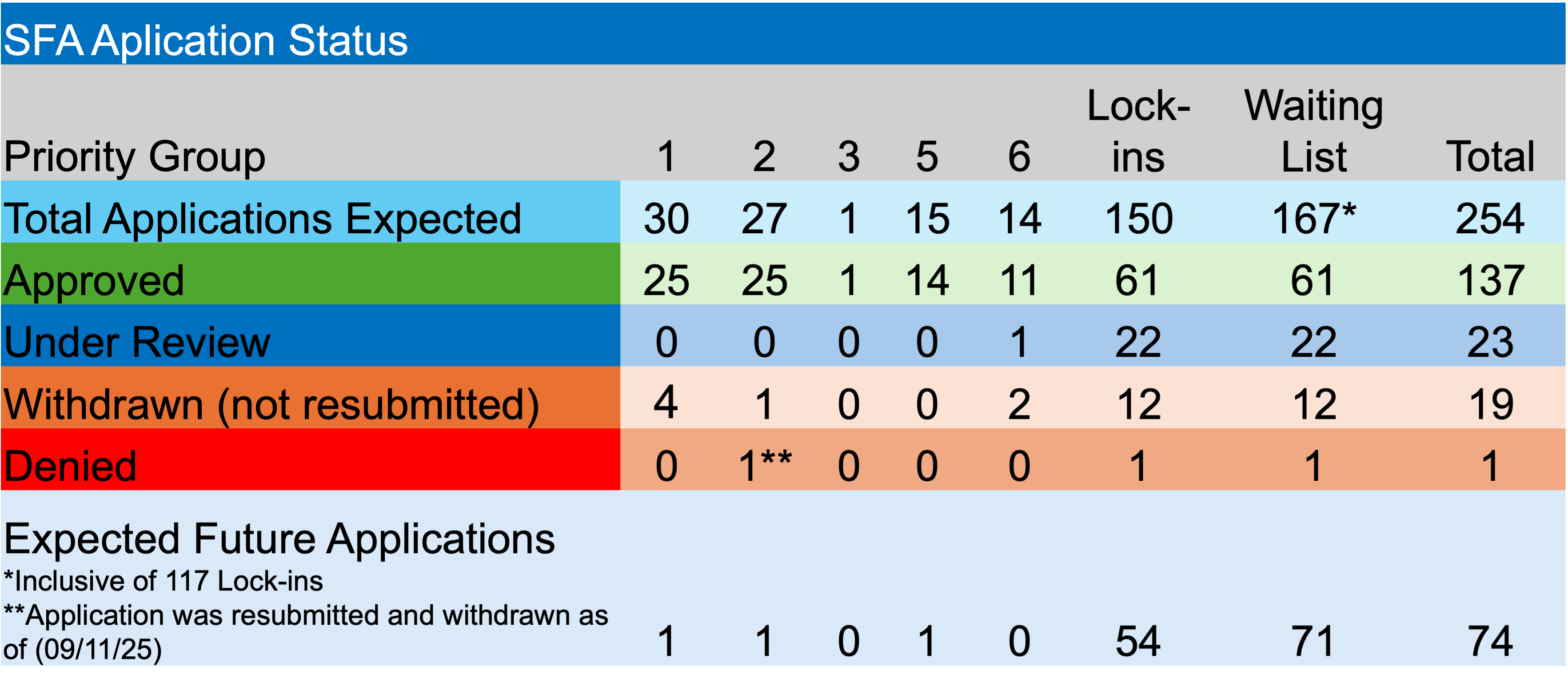
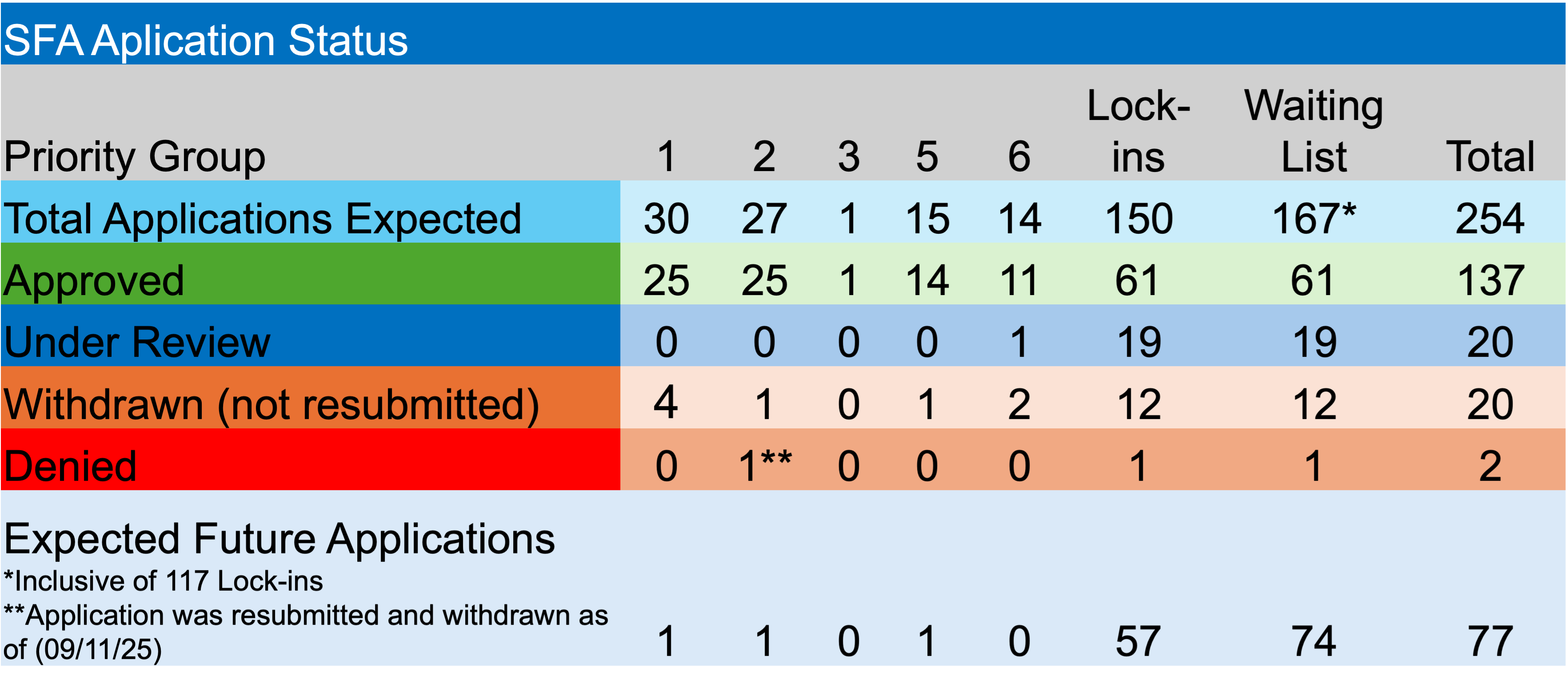
Enough about rates and the Fed. The PBGC is still plugging away on the plethora of applications before them and those yet to be accepted. Currently, there are 20 applications under review. Teamsters Industrial Employees Pension Plan is the latest fund to submit an application seeking SFA. They are hoping to secure $27.4 million for the 1,888 participants. The PBGC has 6-7 applications that must be finalized in each of the next 3 months.

Happy to report that both Alaska Teamster – Employer Pension Plan and Hollow Metal Pension Plan received approval for their applications. The two non-priority pension funds will receive a combined $240.1 million for >13k members.

In other ARPA news, Bakery Drivers Local 550 and Industry Pension Fund, a Priority Group 2 member, whose initial application was originally denied because they were deemed ineligible, has had their revised application denied because of “completeness”. Will three times be the charm? In their latest application they were seeking $125.8 million to support 1,122 plan participants.

Lastly, Greater Cleveland Moving Picture Projector Operators Pension Fund, became the most recent fund added to the waitlist. They are the 167th fund on the waitlist of non-priority members, with 74 still to submit an application. According to the PBGC’s website, their e-Filing portal is limited at this time.

We’ll keep you updated on the activity of the U.S. Federal Reserve and the potential implications from their interest rate decision. Hopefully, concerns related to inflation will offset the current trends related to employment providing future SFA recipients with an environment conducive to defeasing the promised benefits at higher yields and thus, lower costs.

ARPA Update as of August 22, 2025

By: Russ Kamp, CEO, Ryan ALM, Inc.

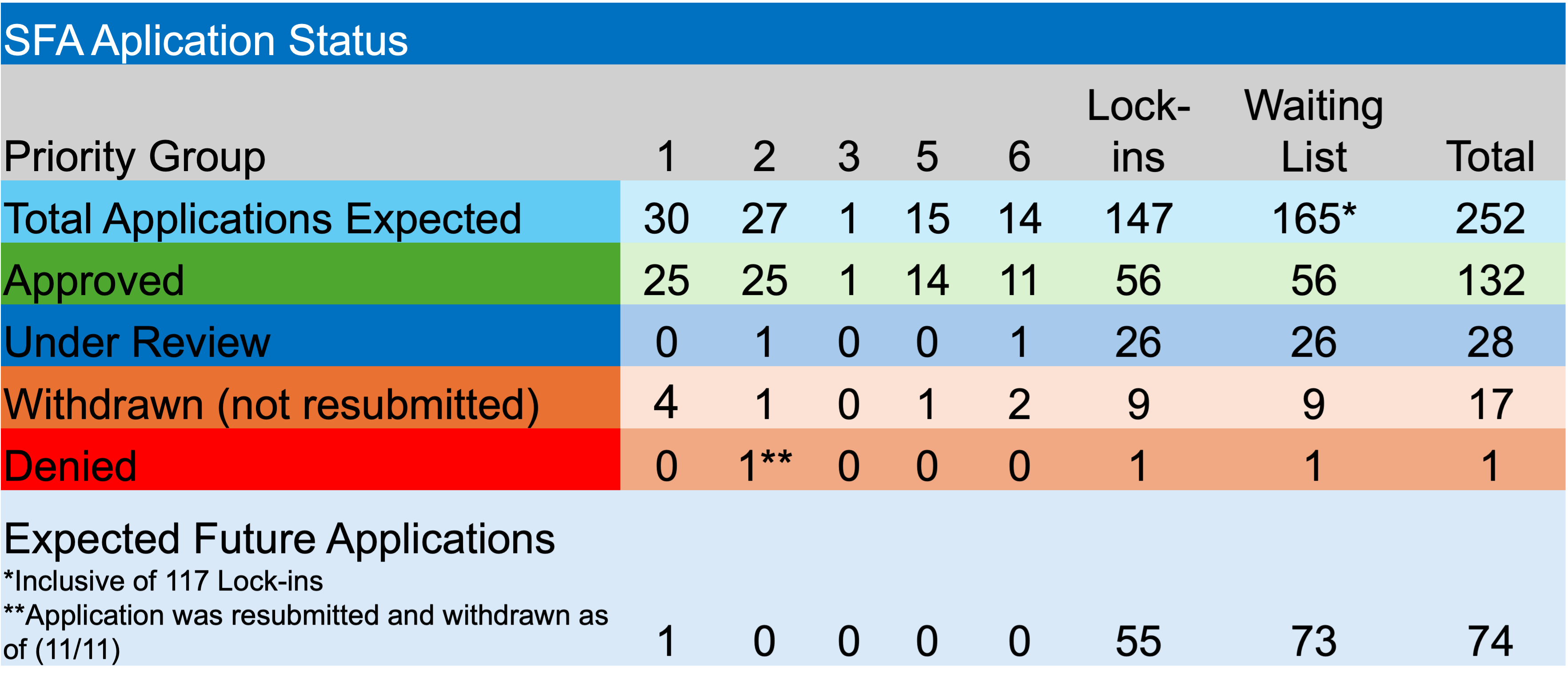
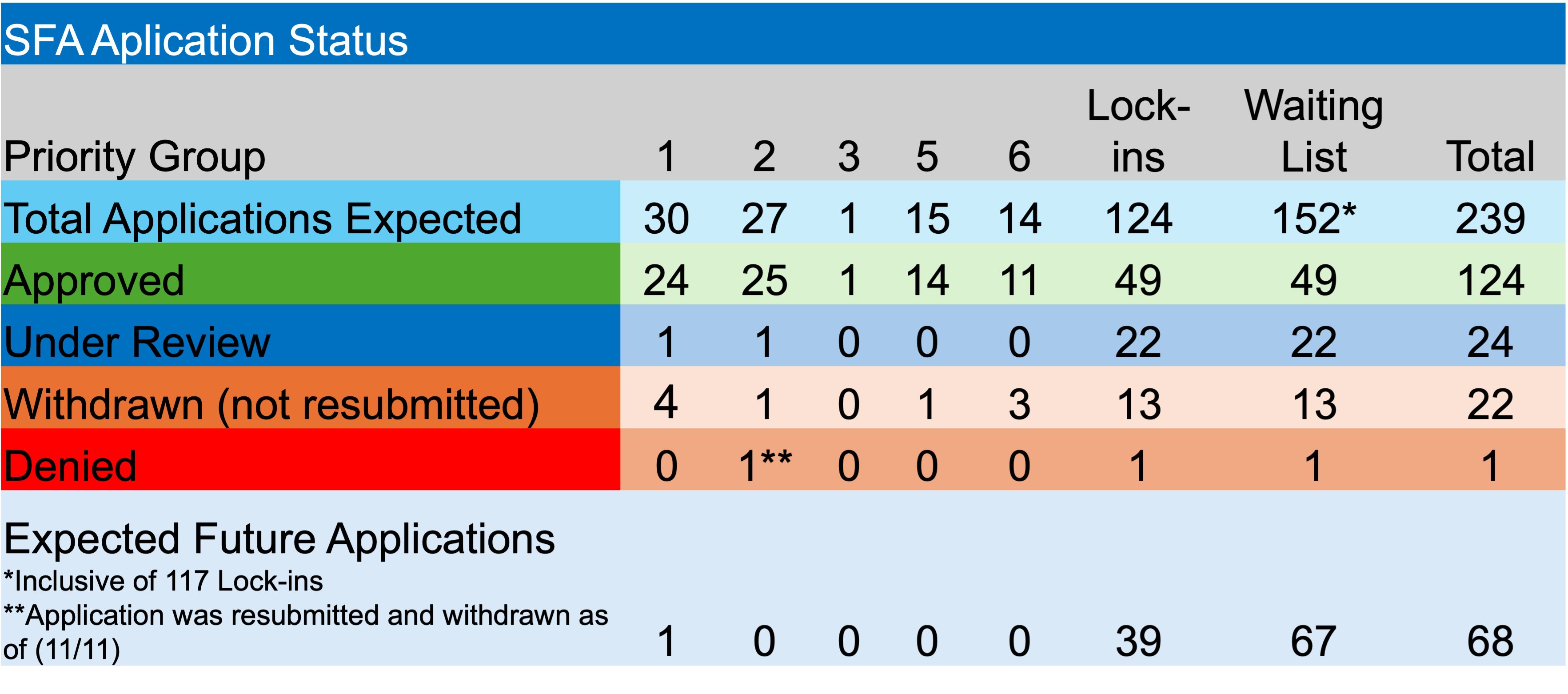
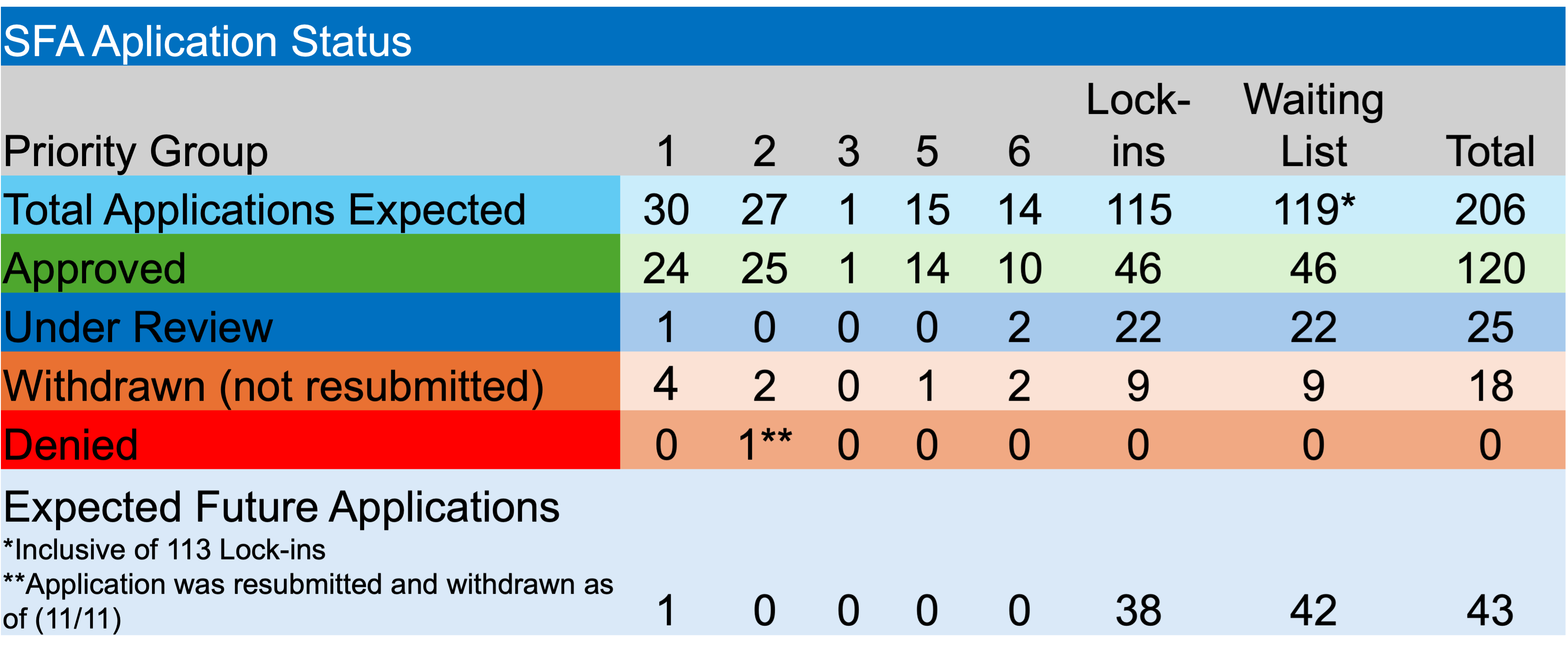
Welcome to the last week of “summer”. I don’t know about you, but I can believe that Labor Day is next weekend. I suspect that the PBGC is feeling the same way as they continue to work their way through an imposing list of applicants with a December 31, 2025, deadline for initial applications to be reviewed. As the chart below highlights, they have their work cut out for them.

Regarding last week’s activity, the PBGC did not accept any new applications as the e-Filing portal remains temporarily closed. However, they did approve the revised applications for two funds. Laborers’ Local No. 91 Pension Plan (Niagra Falls) and the Pension Plan of the Asbestos Workers Philadelphia Pension Fund have been awarded a total of $96.2 million in SFA and interest that will support 2,057. This brings the total of approved applications to 132 and total SFA to $73.5 billion – wow!

In other ARPA news, I’m pleased to announce that there were no applications denied or withdrawn during the previous week, but there were two more funds that were asked to repay a portion of the SFA received due to census errors. Sixty-four funds have been reviewed for potential census errors, with 60 having to rebate a small portion of their grants, while four funds did not have any issues. In total, $251.7 million has been repaid from a pool of $52.3 billion in SFA received or 0.48% of the grants awarded. The $251.7 relative to the $73.5 billion in total SFA grants would be only 0.34% of the total awards.

Lastly, three more funds have been added to the waitlist. There have been 165 non-Priority Group members on the waitlist including 56 that have received SFA awards, while another 26 are currently being reviewed. That means that 82 funds must still file an application reviewed and approved in a short period of time.

As stated above, pension funds sitting on the waitlist must have the initial application reviewed by the PBGC by 12/31/25. Any fund residing on the waitlist after that date loses the ability to seek SFA support. Applications that have been reviewed prior to 12/31/25 may still get approval from the PBGC provided the approval arrives before 12/31/26. I don’t see them getting through the remaining 74 waitlist funds by the end of 2025.

ARPA Update as of August 1, 2025

By: Russ Kamp, CEO, Ryan ALM, Inc.

Talk about jumping out of the frying pan into the fire! I left New Jersey’s wonderful heat and humidity only to find myself in El Paso, TX, where the high temperature is testing the limits of a normal thermometer. Happy to be speaking at the TexPERS conference this week, but perhaps they can do an offsite in Bermuda the next time.

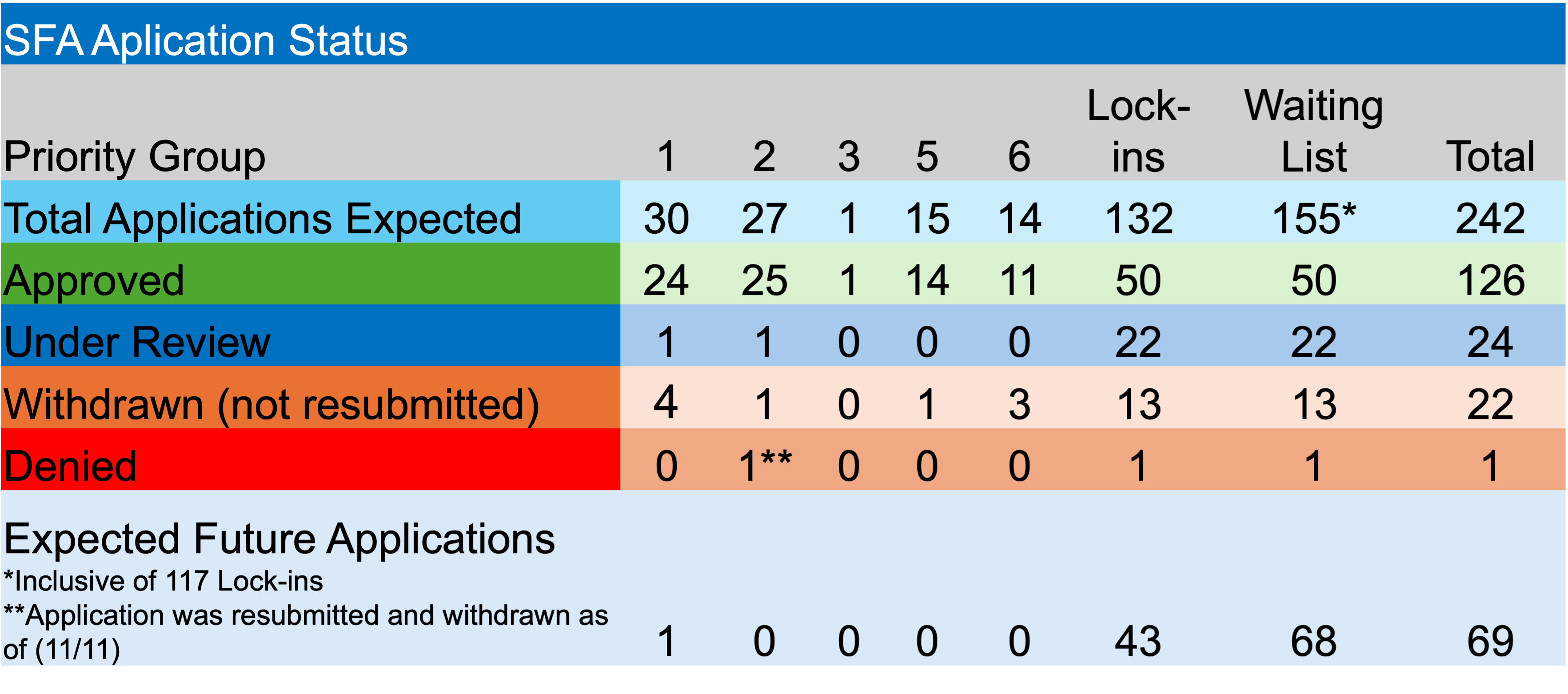
Regarding the ARPA legislation and the PBGC’s implementation of this critical pension program, we continue to see the PBGC ramp up its activity level. This past week witnessed five multiemployer plans submitting applications of which four were initial filings and the fifth was a revised offering. Another plan received approval, while one fund added its name to the waitlist. Finally, two funds have locked-in the measurement dates (valuation purposes).

Now the specifics: The four funds submitting initial applications were Colorado Cement Masons Pension Trust Fund, Iron Workers-Laborers Pension Plan of Cumberland, Maryland, Cumberland, Maryland Teamsters Construction and Miscellaneous Pension Plan, and Exhibition Employees Local 829 Pension Fund that collectively seek $50.8 million in SFA for their 1,260 plan participants. This week’s big fish, UFCW – Northern California Employers Joint Pension Plan, a Priority Group 6 member, is seeking $2.3 billion for its 138.5k members.

The plan receiving approval of its application for SFA is Laborers’ Local No. 130 Pension Fund, which will receive $33.3 million in SFA and interest for its 641 participants. In an interesting twist, Laborers’ Local No. 130 Pension Fund, has added the fund to a growing list of waitlist candidates. If the Laborers name seems to resemble the name of the recipient of the latest SFA grant you wouldn’t be wrong. I was as confused as you are/were until I realized that these entities have different that there are two different EIN #s.

Happy to report that there were no applications withdrawn, none denied, and no SFA recipients were asked to return a portion of the proceeds due to incorrect census information. However, there are still 119 funds going through the process. There is a tremendous amount of work left to be done at this time. This comes on the heels of 131 funds being approved for a total of $73.4 billion in SFA and interest supporting the retirements for 1.77 million American workers/retirees. What an incredible accomplishment!

ARPA Update as of July 3, 2025

By: Russ Kamp, CEO, Ryan ALM, Inc.

Welcome to the Summer doldrums. The PBGC’s ARPA activity appears to have been impacted by the holiday-shortened week. We hope that you and your family had a terrific Fourth of July weekend.

There isn’t a whole lot to discuss about last week. There were no applications received as the PBGC’s e-Filing portal remains temporarily closed. No applications were approved or denied, and there were no pension funds looking to be added to a very crowded waiting list.

However, there was one fund, Trucking Employees of North Jersey Welfare Fund, Inc. Pension Plan, that repaid a portion of the Special Financial Assistance (SFA) received earlier. The $7.7 million repayment represents 0.99% of the $774.3 million grant. The Truckers’ fund is the 55th fund to repay a portion of the SFA grant. There are four funds that had no census errors. It was estimated that roughly 60 pension funds had been granted SFA prior to the PBGC’s use of the Social Security Master Death file. In total, $229.4 million has been recouped from $50.9 billion in grants (0.45%).

In other ARPA news, eight funds currently on the waitlist have elected their measurement lock-in date. As a reminder, the measurement date refers to the date on which a plan submits a lock-in application to PBGC. This date is crucial because it sets and permanently establishes the plan’s SFA measurement date and base data for its eventual SFA application, regardless of when the full application is later submitted. Specifically, the lock-in application fixes: 1) the non-SFA and SFA interest rates, 2) the SFA measurement date, and 3) participant census data. Five of the funds chose March 31, 2025, while the other three selected April 30, 2025, as the measurement date for their pension plans.

According to the ARPA legislation, the PBGC is prohibited from accepting initial applications after December 31, 2025. They may receive and review revised applications until December 31, 2026. They currently have about 70 plans on the waitlist, in addition to the 46 that are under review or have been withdrawn. It will take a tremendous effort to process these initial applications prior to the legislation’s deadline.

U.S. $ Decline and the Impact on Inflation

By: Russ Kamp, CEO, Ryan ALM, Inc.

As I was contemplating my next blog post, I took a look at how many of my previous >1,625+ posts mentioned currencies, and specifically the U.S. $. NEVER had I written about the U.S. $ other than referencing the fact that we enjoy the benefit of a fiat currency. I did mention Bitcoin and other cryptos, but stated that I didn’t believe that they were currencies and still don’t. Why mention them now? Well, the U.S. $ has been falling relative to nearly all currencies for most of 2025. According to the WSJ’s Dollar Index (BUXX), the $ has fallen by 8.5% for the first half of 2025.

Relative to the Euro, the $ has fallen nearly 14% and the trend isn’t much better against the Pound (-9.6%) and the Yen (-8.7%). So, what are the implications for the U.S. given the weakening currency? First, the cost of imports rises. When the $ loses value, it costs more to buy goods and services from abroad. The likely outcome is that the increased costs get passed onto the consumer, who is already dealing with the implications from uncertain tariff policies.

Yes, exports become cheaper, which would hopefully increase demand for our goods, but the heightened demand could also lead to greater demand for U.S. workers in order to meet that demand leading to rising wages (great), but that is also potentially inflationary.

What have we seen so far? Well, first quarter’s GDP (-0.5%) reflected an increase in imports spurred on by fear of price increases due to the potential for tariffs. Q2’25 is currently forecasted to be 2.5% according to the Atlanta Fed’s GDPNow model, as U.S. imports have fallen. According to the BLS, import prices have risen in 4 of 5 months in 2025, with March’s sharp decline the only outlier.

The potential inflationary impact from rising costs could lead to higher U.S. interest rates, which have been swinging back and forth depending on the day of the week and the news cycle. Furthermore, there is fear that the proposed “Big Beautiful Bill” could also drive rates higher due to the potential increase in the federal deficit by nearly $5 trillion due to the stimulative nature of deficits. Obviously, higher U.S rates are great for individual savers, but they don’t help bonds as principal values fall.

We recommend that plan sponsors and their advisors use bonds for the cash flows (interest and principal) and not as a performance driver. Use the fixed income exposure as a liquidity bucket designed to meet monthly benefits and expenses through the use of Cash Flow Matching (CFM), which will orchestrate a careful match of asset cash flows funding the projected liabilities cash flows. The remaining assets (alpha bucket) now benefit from time, as the investment horizon is extended.

Price increases on imports due to a weakening $ can impact U.S. inflation, but there are other factors, too. I’ve already mentioned tariffs and wage growth, but there other factors, including productivity and global supply chains. Some of these drivers may take more time to hash out. There are many uncertainties that could potentially impact markets, why not bring an element of certainty to your pension fund through CFM.

ARPA Update as of June 20, 2025

By: Russ Kamp, CEO, Ryan ALM, Inc.

Despite the chaotic nature of our markets and geopolitics, it is comforting that I can report weekly on the progress being made by the PBGC implementing the critical ARPA legislation. That is not to say, that the 2nd Circuit’s recent ruling isn’t creating a bit of chaos, too.

Regarding last week’s activity, the PBGC’s efiling portal must have been wide open, as they accepted initial applications from 5 pension plans residing on the waitlist. The PBGC will now have 120-days to act on these submissions.

There were no applications approved, denied, or withdrawn last week, but that isn’t to say that the PBGC rested on its laurels. There were two more plans that repaid a portion of the SFA received, as census errors were corrected. International Association of Machinists Motor City Pension Plan and Western States Office and Professional Employees Pension Fund repaid 1.61% and 1.08% of the SFA, respectively. In total, 57 plans have “settled” with the PBGC, including four funds that had no census errors. To date, $219 million was repaid from grants exceeding $48 billion or 0.45% of the grant.

In other ARPA news, another 16 funds have been added to the waitlist resulting from the 2nd Circuit’s determination that previously terminated plans can seek SFA. We do believe that it will prove beneficial for these plans, but it will stress the resources of the PBGC to meet ARPA imposed deadlines.

Given the highly unpredictable nature of war and tariffs on inflation and U.S interest rates, it isn’t surprising that the U.S. Federal Reserve held the Fed Funds Rate steady last week. We encourage those plans receiving SFA grants to secure the promised benefits through a cash flow matching strategy. Who knows how markets will impact bonds and stocks for the remainder of the year.

$6 billion – Is That All?

By: Russ Kamp, CEO, Ryan ALM, Inc.

A recent ruling by the 2nd Circuit has opened the door for roughly 100+ multiemployer plans to pursue Special Financial Assistance (SFA) that were originally deemed ineligible because the plans had terminated. The PBGC’s inspector general, in a “risk advisory”, has estimated that the cost to provide the SFA to these newly eligible plans could be as much as $6 billion. Is that all? Let’s not focus on the $s, but the number of American workers and their families that this additional expenditure will support.

As I reported last week in my weekly update related to ARPA’s pension reform, the PBGC had denied the application for the Bakery Drivers Local 550 and Industry Pension Fund, a New York-based terminated pension plan, because it had terminated. The plan covered 1,094 participants in 2022 and was 6.3% funded, according to their Form 5500. Regrettably, the plan terminated in 2016 by mass withdrawal after Hostess Brands, Inc., its largest contributor, went bankrupt. However, the court stated, that despite terminating in 2016, the plan “continued to perform audits, conduct valuations, file annual reports, and make payments to more than 1,100 beneficiaries.”

As of June 13, 2025, the PBGC had already received 223 applications for SFA with $73.0 billion approved supporting the retirements for 1.75 million American workers. What an incredible outcome! However, according to the inspector general’s letter, the potential $6 billion in added cost would include $3.5 billion to repay the PBGC’s earlier loans to approximately 91 terminated plans, which was described as a “potential waste”. He went on to state that the potential repayment to the PBGC would be a waste of taxpayer funds due to the positive current and projected financial condition of the multiemployer program. “PBGC’s multiemployer program is in the best financial condition it has been in for many years. PBGC’s 2023 Projections Report states that PBGC’s multiemployer program is projected to ‘likely remain solvent for at least 40 years.’” GREAT!

Perhaps the repayment of $3.5 billion in loans could enable the PBGC to lower the annual premiums on the cost to insure each participant, which might keep some plans from seeking termination due to excessive costs to administer the program. Something needs to be done with private DB plans, too, as those costs per participant are far greater, but that’s a story for another blog post.

As regular readers of this blog know, we’ve celebrated the success of this program since its inception (July 2021). The fact that 1.75 million American workers to date have had their promised benefits secured, and in some cases, restored, is wonderful. Think of the economic impact that receiving and spending a monthly pension check has on their communities. Furthermore, think about what the cost would have been for each of these folks had the Federal government been needed to provide social services. None of these workers/retirees did anything wrong, yet they bore the brunt.

The estimated $6 billion in additional “investment” in American workers is a drop in the bucket relative to the annual budget deficit, which has been running from $1-$2 trillion annually. Restoring and supporting the earned retirement benefits is the right thing to do.

ARPA Update as of May 2, 2025

By: Russ Kamp, CEO, Ryan ALM, Inc.

I think someone forgot that the calendar flipped from April to May. The April showers have been followed by the May monsoons in New Jersey. The May flowers may be washed out to see!

Regarding the ARPA implementation by the PBGC, the current efiling portal is describes as limited, which is certainly far better than the frequently mentioned “temporarily closed” status. As a result, there were three new applications submitted during the past week. Local 1102 Retirement Trust, IBEW Eastern States Pension Plan, and Local 1922 Pension Plan are each classified as non-priority group members. In the case of Local 1922, its application was revised. In total, these three funds are seeking $53.7 million in special financial assistance (SFA) for just over 6k participants.

In other ARPA news, Aluminum, Brick & Glass Workers International Union, AFL-CIO, CLC, Eastern District Council No. 12 Pension Plan, a Wyomissing, PA based plan, has received approval of its revised application. They will receive $8.5 million for the 580 members of its pension plan. This was the first application approved in nearly a month.

Happy to mention that there were no applications denied, withdrawn, or asked to repay excess SFA during the last week. However, there were two additional plans added to the waitlist. Sports Arena Employees Local 137 Retirement Fund and Retirement Plan of Local 1102 Retirement Fund have been added to the waitlist. In total, 119 non-priority funds have sought SFA through the waitlist process. Neither of these funds locked-in a date for valuation purposes on the discount rate. Four funds have not currently chosen a lock-in date.

There are still 43 plans that have yet to submit an application for review, with all but one of those a non-priority group member. Despite significant recent volatility, U.S. Treasury interest rates, particularly 10- and 30-year maturities, are enjoying fairly robust yields. The 30-year yield is once again above 4.8%. This level of rates provides pension plans receiving the SFA some additional cost reduction to defease benefit payments.

What Was The Purpose?

By: Russ Kamp, CEO, Ryan ALM, Inc.

I was introduced to the brilliance of Warren Mosler through my friend and former colleague, Chuck DuBois. It was Chuck who encouraged me to read Mosler’s book, “The 7 Deadly Innocent Frauds of Economic Policy”. I would highly recommend that you take a few hours to dive into what Mosler presents. As I mentioned, I think that his insights are brilliant.

The 7 frauds, innocent or not, cover a variety of subjects including trade, the federal deficit, Social Security, government spending, taxes, etc. Regarding trade and specifically the “deficit”, Mosler would tell you that a trade deficit inures to the benefit of the United States. The general perception is that a trade deficit takes away jobs and reduces output, but Mosler will tell you that imports are “real benefits and exports are real costs”.

Unlike what I was taught as a young Catholic that it is better to give than to receive, Mosler would tell you that in Economics, it is much better to receive than to give. According to Mosler, the “real wealth of a nation is all it produces and keeps for itself, plus all it imports, minus what it exports”. So, with that logic, running a trade deficit enhances the real wealth of the U.S.

Earlier this year, the Atlanta Fed was forecasting GDP annual growth in Q1’25 of 3.9%, today that forecast has plummeted to -2.4%. We had been enjoying near full employment, moderating yields, and inflation. So, what was the purpose of starting a trade war other than the fact that one of Mosler’s innocent frauds was fully embraced by this administration that clearly did not understand the potential ramifications. They should have understood that a tariff is a tax that would add cost to every item imported. Did they not understand that inflation would take a hit? In fact, a recent survey has consumers expecting a 6.7% price jump in goods and services during the next 12-months. This represents the highest level since 1981. Furthermore, Treasury yields, after initially falling in response to a flight to safety, have marched significantly higher.

Again, I ask, what was the purpose? Did they think that jobs would flow back to the U.S.? Sorry, but the folks who suffered job losses as a result of a shift in manufacturing aren’t getting those jobs back. Given the current employment picture, many have been employed in other industries. So, given our full-employment, where would we even get the workers to fill those jobs? Again, we continue to benefit from the trade “imbalance”, as we shipped inflation overseas for decades. Do we now want to import inflation?

It is through fiscal policy (tax cuts and government spending) that we can always sustain our workforce and domestic output. Our spending is not constrained by other countries sending us their goods. In fact, our quality of life is enhanced through this activity.

It is truly unfortunate that the tremendous uncertainty surrounding tariff policy is still impacting markets today. Trillions of $s in wealth have been eroded and long-standing trading alliances broken or severely damaged. All because an “innocent” fraud was allowed to drive a reckless policy initiative. I implore you to stay away from Social Security and Medicare, whose costs can always be met since U.S. federal spending is not constrained by taxes and borrowing. How would you tell the tens of millions of Americans that rely on them to survive that another innocent fraud was allowed to drive economic policy?