Bond Math and A Steepening Yield Curve – Perfect Together!

By: Russ Kamp, CEO, Ryan ALM, Inc.

We are in the midst of a project for a DB pension plan in which we were asked to model a series of liability cash flows (benefits and expenses) using cash flow matching (CFM) to defease and secure those liabilities. The plan sponsor is looking to allocate 40% of the plan’s assets initially to begin to de-risk the fund.

We first approached the assignment by looking to defease 100% of the liabilities as far into the future as that 40% allocation would cover those benefits and expenses. As it turns out, we can defease the next 11-years of projected B&E beginning 1/1/26 and carrying through to 10/31/37. As we’ve written many times in this blog and in other Ryan ALM research (ryanalm.com), we expect to reduce the cost of future liabilities by about 2% per year in this interest rate environment. Well, as it turns out, we can reduce that future cost today by 23.96% today.

Importantly, not only is the liquidity enhanced through this process and the future expenses covered for the next 11-years, we’ve now extended the investing horizon for the remaining assets (alpha assets) that can now just grow unencumbered without needing to tap them for liquidity purposes – a wonderful win/win!

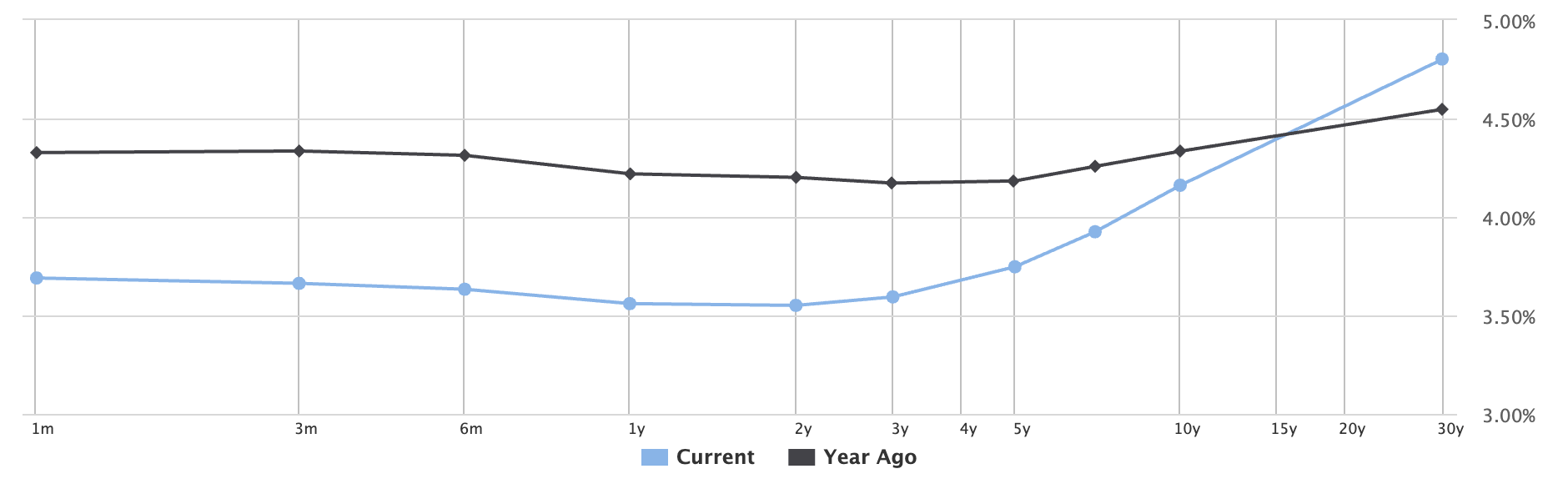
As impressive as that analysis proved to be, we know that bond math is very straightforward: the longer the maturity and the higher the yield, the greater the potential cost savings. Couple this reality with the fact that the U.S. Treasury yield curve has steepened during the last year, and you have the formula for far greater savings/cost reduction. In fact, the spread between 2-year Treasury notes and 30-year bonds has gone from 0.35% to 1.35% today. That extra yield is the gift that keeps on giving.

So, how does one use only 40% of the plan’s assets to take advantage of both bond math and the steepening yield curve when you’ve already told everyone that a full implementation CFM only covers the next 11-years? You do a vertical slice! A what? A vertical slice of the liabilities in which you use 40% of the assets to cover all of the future liabilities. No, you are not providing all of the liquidity necessary to meet monthly benefits and expenses, but you are providing good coverage while extending the defeasement out 30-years. Incredibly, by using this approach, we are able to reduce the future cost of those benefits not by an impressive 24%, but by an amazing 56.1%. In fact, we are reducing the future cost of those pension promises by a greater sum than the amount of assets used in the strategy.

Importantly, this savings or cost reduction is locked-in on day one. Yes, the day that the portfolio is built, that cost savings is created provided that we don’t experience a default. As an FYI, investment-grade corporate bonds have defaulted at a rate of 0.18% or about 2/1,000 bonds for the last 40-years according to S&P.

Can you imagine being able to reduce the cost of your future obligations by that magnitude and with more certainty than through any other strategy currently in your pension plan? What a great gift it is to yourself (sleep-well-at-night) and those plan participants for whom you are responsible. Want to see what a CFM strategy implemented by Ryan ALM can do for you? Just provide us with some basic info (call me at 201/675-8797 to find out what we need) and we’ll provide you with a free analysis. No gimmicks!

Do the Analysis! Remove the Guess Work.

By: Russ Kamp, CEO, Ryan ALM, Inc.

I am truly blessed working for an organization such as Ryan ALM, Inc. I am awed by the folks that I get to work with and the product/strategy that I get to represent. As a reminder, we’ve created a cash flow matching (CFM) strategy that brings an element of certainty to the management of pensions that should be welcomed by pension plan sponsors and their advisors far and wide. What other strategy can inform you on the day that the portfolio is constructed what the performance of that strategy will be for the full-term of the assignment (barring any defaults within investment grade bonds)? Name another strategy that can lay out the liquidity with certainty for each month (chronologically) of that assignment.

Given that liquidity is becoming a challenge as pension plans (mostly public) adopt a more aggressive asset allocation favoring alternative investments, using a CFM strategy that provides ALL the liquidity to meet ongoing benefits and expenses should be a decision that is easily embraced. Yet, our conversations with key decision makers often stall as other parties get involved in the “review”. To this day, I’m not sure what is involved in most of those conversations.

Are they attempting to determine that a traditional core fixed income strategy benchmarked to a generic index such as the BB Aggregate is capable of producing the same outcome? If so, let me tell you that they can’t and it won’t. Any fixed income product that is not managed against your plan’s specific liabilities will not provide the same benefits as CFM. It will be a highly interest rate sensitive product and performance will be driven by changes in interest rates. Do you know where U.S. rates are headed? Furthermore, the liquidity provided by a “core” fixed income strategy is not likely to be sufficient resulting in other investment products needing to be swept of their liquidity (dividends and capital distributions), reducing the potential returns from those strategies.  Such a cash sweep will reduce the ROA of these non-bond investments. Guinness Global’s study of S&P data for the last 85 years has shown that dividends and reinvestment of dividends account for 50% or more of the S&P returns for rolling 10- and 20-year periods dating back to 1940.

Are they trying to determine if the return produced by the CFM mandate will be sufficient to meet the return on asset assumption (ROA)? Could be, but all they need to realize is that the CFM portfolio’s yield will likely be much higher than the YTM of a core fixed income strategy given CFM’s 100% exposure to corporate bonds versus a heavy allocation to lower yielding Treasuries and agencies in an Agg-type portfolio. In this case, the use of a CFM strategy to replace a core fixed income mandate doesn’t impact the overall asset allocation and it certainly doesn’t reduce the fund’s ability to meet the long-term return of the program.

Instead of trying to incorporate all these unknown variables/inputs into the decision, just have Ryan ALM do the analysis. We love to work on projects that help the plan sponsor and their advisors come to sound decisions based on facts. There is no guess work. Importantly, we will construct for FREE multiple CFM portfolios, if necessary, to help frame the decision. Each plan’s liabilities are unique and as such, each CFM portfolio must be built to meet that plan’s unique liability cash flows.

All that is required for us to complete our analysis are the projected liability cash flows of benefits and expenses (contributions, too) as far into the future as possible. The further into the future, the greater the insights that we will create for you. We can use the current allocation to fixed income as the AUM for the analysis or you can choose a different allocation. We will use 100% IG corporates or you can ask us to use either 100% Treasuries/STRIPS or some combination of Treasuries and corporate bonds. We can defease 100% of the plan’s liabilities for a period of time, such as the next 10-years or do a vertical slice of a % of the liabilities, such as 50%, which will allow the CFM program to extend coverage further into the future and benefit from using longer maturity bonds with greater YTMs. Isn’t that exciting!

So, I ask again, why noodle over a bunch of unknowns, when you could have Ryan ALM provide you with a nearly precise evaluation of the benefits of CFM for your pension plan? When you hire other managers in a variety of asset classes, do they provide you with a portfolio up front? One that can give you the return that will be generated over a specific timeframe? No? Not surprised. Oh, and BTW, we provide our investment management services at a significantly lower fee than traditional core fixed income managers and we cap our annual fee once a certain AUM is reached. Stop the guess work. Have us do the work for you. It will make for a much better conversation when considering using CFM. Call me at 201/675-8797 or email me at rkamp@ryanalm.com for your free analysis. I look forward to speaking with you!

You Don’t Say!

By: Russ Kamp, CEO, Ryan ALM, Inc.

Morgan Stanley has published the results from their Taft-Hartley survey, in which they have to provided “insights into how Taft-Hartley plans are managing priorities and navigating challenges to strengthen their plans”. I sincerely appreciate MS’s effort and the output that they published. According to MS, T-H plans have as their top priority (67% of respondents) delivering promised benefits without increasing employer’s contributions. That seems quite appropriate. What doesn’t seem to jive with that statement is the fact that only 29% that improving or maintaining the plan’s funded status was important. Sorry to burst your bubble plan trustees, but you aren’t going to be able to accomplish your top priority without stabilizing the funded status/ratio by getting off the performance rollercoaster.

Interestingly, T-H trustees were concerned about market volatility (84%) and achieving desired investment performance while managing risk (69%). Well, again, traditional asset allocation structures guarantee volatility and NOT success. If you want to deliver promised benefits without increasing contributions, you must adopt a new approach to asset allocation and risk management. Doing the same old, same old won’t work.

I agree that the primary objective in managing a DB plan, T-H, public, or private, is to SECURE the promised benefits at a reasonable cost and with prudent risk. It is not a return game. Adopting a new asset allocation in which the assets are divided among two buckets – liquidity and growth, will ensure that the promises (monthly benefits) are met every month chronologically as far into the future that the assets will cover delivering the promised benefits. However, just adopting this bifurcated asset allocation won’t get you off the rollercoaster of returns and reduce market volatility. One needs to adopt an asset/liability focus in which asset cash flows (bond interest and principal) will be matched against liability cash flows of benefits and expenses.

This approach will significantly reduce the volatility associated with markets as your pension plan’s assets and liabilities will now move in lockstep for that portion of the portfolio. As the funded status improves, you can port more assets from the growth portfolio to the liquidity bucket. It will also buys time for the remaining growth assets to help wade through choppy markets. According to the study, 47% of respondents that had an allocation to alternatives had between 20% and 40%. This allocation clearly impacts the liquidity available to the plan’s sponsor to meet those promises. If allocations remain at these levels, it is imperative to adopt this allocation framework.

Furthermore, given today’s equity valuations and abundant uncertainty surrounding interest rates, inflation, geopolitical risk, etc., having a portion of the pension assets in a risk mitigating strategy is critically important. Thanks, again, to MS for conducting this survey and for bubbling up these concerns.

Cash Flow Matching: Bringing Certainty to Pension Plans

By: Russ Kamp, CEO, Ryan ALM, Inc.

Imagine a world, or at least the United States, where pension plans are no longer subject to market swings and the uncertainty those swings create. What if you could “guarantee” (outside of any corporate bond defaults) the promises made to your plan participants, ensuring their financial security with confidence? In today’s highly unpredictable investing environment, relying solely on the pursuit of investment returns is a risky ride—one that guarantees volatility and sleepless nights but not necessarily success. It’s time to rethink how we manage defined benefit (DB) pension plans and embrace a strategy that brings true certainty: Cash Flow Matching (CFM). Discover through the hypothetical conversation below how CFM can transform your investing approach, protect your plan, and deliver peace of mind for everyone involved. Let’s go!

Why are we talking about Cash Flow Matching (CFM) today?

First off, thanks for taking a few minutes to chat with me. As you may have heard me say before, our mission at Ryan ALM, Inc. is simple — to protect and preserve defined benefit (DB) pension plans and to secure the promises made to participants.

We believe that Cash Flow Matching (CFM) is one of the few strategies that can help us keep those promises with real certainty.


Why Now?

Because the world feels more uncertain than ever.

And if we’re honest, most of us don’t like uncertainty. Yet somehow, in the pension world, many plan sponsors have gotten used to it. Why is that?

Over the years, we’ve been taught that managing a DB plan is all about chasing returns. But that’s not really the case. When a plan invests 100% of its assets purely with a return objective, it locks itself into volatility — not stability or success.

That approach also puts your plan on the “asset allocation rollercoaster,” where markets rise and fall, and contributions swing higher and higher along with them. It’s time to step off that ride — at least for part of your portfolio.


So if it’s not all about returns, what is the real objective?

Managing a DB pension plan is all about cash flows — aligning the cash coming in (from principal and interest on bonds) with the cash going out (for benefits and expenses).

The real goal is to secure those promised benefits at a reasonable cost and with prudent risk. That’s the foundation of a healthy plan.


Does bringing more certainty mean I have to change how I manage the plan?

Yes — but only a little. The adjustments are modest and easy to implement.


How can I adopt a CFM strategy without making major changes?

The first step is to reconfigure your asset allocation. Most DB plans are currently 100% focused on returns. It’s time to split your assets into two clear buckets:

  1. Liquidity bucket – designed to provide cash flow to pay benefits and expenses.
  2. Growth bucket – focused on long-term return potential.

What goes into the liquidity bucket?

Most plans already hold some cash and core fixed income. Those assets can move into the liquidity bucket to fund benefit payments and expenses.


And what happens with the remaining assets?

Nothing changes there. Those assets stay in your growth or alpha bucket. The difference is that you’ll no longer need to sell from that bucket during market downturns, which helps protect your fund from the negative impact of forced selling.


Is that all I need to do to create more certainty?

Not quite. You’ll also want to reconfigure your fixed income exposure.

Instead of holding a generic, interest-rate-sensitive bond portfolio (like one tied to the Bloomberg Aggregate Index), you’ll want a portfolio that matches your plan’s specific liabilities — using both principal and income to accomplish the objective.

That’s where true cash flow matching comes in.


How does the matching process work?

We start by creating a Custom Liability Index (CLI) — a model of your plan’s projected benefit payments, expenses, and contributions. This serves as the roadmap for funding your monthly liquidity needs.


What information do you need to build that index?

Your plan’s actuary provides the projected benefits, expenses, and contributions as far out into the future as possible. The more data we have, the stronger the analysis. From there, we can map out your net monthly liquidity needs after accounting for contributions.


Which bonds do you use to match the cash flows?

We invest primarily in U.S. Treasuries and U.S. investment-grade corporate bonds. We stick with these because they provide dependable cash flows without introducing currency risk.

We limit our selections to bonds rated BBB+ or higher, and the longest maturity we’ll buy matches the length of the mandate. For example, if you ask us to secure 10 years of liabilities, the longest bond we’ll buy will mature in 10 years.


Do you build a laddered bond portfolio?

No — a traditional ladder would be inefficient for this purpose.

Here’s why: the longer the maturity and the higher the yield, the lower the overall cost of funding those future liabilities. So instead of a simple ladder, we use a proprietary optimization process to build the portfolio in a way that maximizes efficiency and minimizes cost.


It sounds manageable — not a big overhaul. Am I missing something?

Not at all. That’s exactly right.

Dividing assets into liquidity and growth buckets and reshaping your bond portfolio into a CFM strategy is typically all that’s required to bring more certainty to part of your plan.

Every plan is unique, of course, so each implementation will reflect its own characteristics. But generally speaking, CFM can reduce the cost of future benefits by about 2% per year — or roughly 20% over a 10-year horizon.

On top of that, it helps stabilize your funded status and contribution requirements.


How much should I allocate to CFM?

A good starting point is your existing cash and bond allocation. That’s the least disruptive way to begin.

Alternatively, you can target a specific time horizon — for example, securing 5, 7, or 10 years of benefits. We’ll run an analysis to show what asset levels are needed to meet those payments, which may be slightly more or less than your current fixed income and cash allocations.


Once implemented, do I just let the liquidity bucket run down?

Most clients choose to rebalance annually to maintain the original maturity profile. That keeps the strategy consistent over time. Of course, the rebalancing schedule can be customized to your plan’s needs and the broader market environment.


This all sounds great — but what does it cost?

In line with our mission to provide stability at a reasonable cost and with prudent risk, our fee is about half the cost of a typical core fixed income mandate.

If you’d like, we can discuss your specific plan details and provide a customized proposal.


Final thoughts

Thank you for taking the time to explore CFM. Many plan sponsors haven’t yet heard much about it, but it’s quickly becoming a preferred approach for those who value stability and peace of mind.

At the end of the day, having a “sleep well at night” strategy benefits everyone — especially your participants.

Dear Plan Sponsor: Please ask Yourself the Following Questions

By: Russ Kamp, CEO, Ryan ALM, Inc.

Do you believe that your pension plan exists to meet (secure) a promise (benefit) that was given to the plan’s participants?

Are you factoring in that benefit promise when it comes to asset allocation?

Do you presently have exposure to core fixed income, and do you know where U.S. interest rates will be in the next day, month, year, 5-years?

Has liquidity to meet benefits and expenses become more challenging with the significant movement to alternatives – real estate, private equity, private debt, infrastructure, etc.?

Do you believe that providing investment strategies more time is prudent?

So, if you believe that securing benefits, driving asset allocation through a liability lens, improving liquidity, eliminating interest rate risk, and buying-time are important goals when managing a defined benefit plan, how are you accomplishing those objectives today?

Cash Flow Matching (CFM) achieves every one of those goals! By strategically matching asset cash flows of interest and principal from investment-grade bonds against the liability cash flows of benefits and expenses, the DB pension plan’s asset allocation becomes liability focused, liquidity is improved from next month as far out as the allocation covers, interest rate risk is mitigated for the CFM portfolio, the investing horizon is extended for the remaining assets improving the odds of a successful outcome, and most importantly, the promises made to your participants are SECURED!

How much should I invest into a CFM program? The allocation to CFM should be a function of the plan’s funded ratio/status, the ability to contribute, and the level of negative cash flow (contributions falling short of benefits and expenses being paid out). Since all pension plans need liquidity, every DB pension plan should have some exposure to CFM, which provides the necessary liquidity each month of the assignment. There is no forced liquidation of assets in markets that might not provide natural liquidity.

Again, please review these questions. If they resonate with you, call me. We’ll provide you with a good understanding of how much risk you can remove from your current structure before the next market crash hits us.

Hey Ryan ALM – What if…?

By: Russ Kamp, CEO, Ryan ALM, Inc.

We hope that you are enjoying a wonderful summer season. Thanks for taking the time to visit our blog, where we’ve now produced >1,650 mostly pension-related posts.

I wanted to share the following email exchange from earlier this week. I received an email at 6:40 pm on Monday from a senior member of the actuarial community who is familiar with our work. He said that he had a client meeting on Wednesday and he was wondering if we could model some potential outcomes should the plan decide to take some risk off the table by engaging a cash flow matching strategy (CFM).

The actuary gave us the “net” liabilities (after contributions) for the next 10-years and then asked two questions. How far out into the future would $200 million in AUM cover? If the client preferred to defease the next 10-years of net liabilities, how much would that cost? We were happy to get this inquiry because we are always willing to be a resource for members of our industry, including plan sponsors, consultants, and actuaries.

We produced two CFM portfolios, which we call the Liability Beta Portfolio™ or LBP, in response to the two questions that had been posed. In the first case, the $200 million in AUM would provide the client with coverage of $225.8 million in future value (FV) liabilities through March 31, 2031 for a total cost of $196.3 million. Trying to defease the next 10-years of liabilities would cost the plan $334.8 million in AUM to defease $430 million in net liabilities.

 $200 million in AUM10-year coverage
End Date3/31/31 7/01/35
FV$225,750,000$430,000,000
PV$196,315,548$334,807,166
YTM  4.52%  4.75%
MDur  2.73 years  4.45 years
Cost Savings $-$29,424,452-$95,192,834
Cost Savings %  13.04%   22.14%
Excess CF$230,375$679,563
RatingBBB+  A-

As we’ve mentioned on many occasions, the annual cost savings to defease liabilities averages roughly 2%/year, but as the maturity of the program lengthens that cost savings becomes greater. We believe that providing the necessary liquidity with certainty is comforting for all involved. Not only is the liquidity available when needed, but the remaining assets not engaged in the CFM program can now grow unencumbered.

If you’d like to see how a CFM program could improve your plan’s liquidity with certainty, just provide us with the forecasted contributions, benefits, and expenses, and we’ll do the rest. Oh, and by the way, we got the analysis completed and to the actuary by 12:30 pm on Tuesday in plenty of time to allow him to prepare for his Wednesday meeting. Don’t be shy. We don’t charge for this review.

A few Observations from Newport

By: Russ Kamp, CEO, Ryan ALM, Inc.

As I mentioned in my ARPA update on Monday, I had the pleasure of attending the Opal Public Fund Forum East in beautiful Newport, RI, and neither the conference nor Newport disappointed. I don’t attend every session during the conference, but I do try to attend most. In all honesty, I can’t listen to another private equity discussion.

As always, there were terrific insights shared by the speakers/moderators, but there were also some points being made that are just wrong. With this being my first day back in the office this week, I don’t have the time to get into great detail regarding some of my concerns about what was shared, but I’ll give you the headline and perhaps link a previous blog post that addressed the issue.

First, DB pension plans are not Ponzi Schemes that need more new participants than retirees to keep those systems well-funded and functioning. Actuaries determine benefits and contributions based on each individual’s unique characteristics. If managed appropriately, systems with fewer new members can function just fine. Yes, plans that find themselves in a negative cash flow situation need to rethink the plan’s asset allocation, but they can continue to serve their participants just fine. Remember: a DB pension plan’s goal is to pay the last benefit payment with the last $. It is not designed to provide an inheritance.

Another topic that was mentioned several times was the U.S. deficit and the impending economic doom as a result. The impact of the U.S. deficit is widely misunderstood. I was fortunate to work with a brilliant individual at Invesco – Charles DuBois – who took the time to educate me on the subject. As a result of his teaching, I now understand that the U.S. has a potential demand problem. Not a debt issue. I wrote a blog post on this subject back in 2017. Please take the time to read anything from Bill Mitchell, Warren Mosler, Stephanie Kelton, and other disciples of MMT.

Lastly, the issue of flows into strategies/asset classes seems not to be understood. The only reason we have cycles in our markets is through the movement of assets into and out of various products/strategies. Too much money chasing too few good ideas creates an environment in which those flows can overwhelm future returns. It is the same for individual asset management firms. Many of the larger asset management firms have become sales organizations in lieu of investment management organizations as they long ago eclipsed the natural capacity of their strategies. In the process, they have arbitraged away their insights which may have provided the basis for some value-added in the past. I believe that too much money is chasing many of the alternative/private strategies. In the process, future returns and liquidity will be negatively impacted. We’ve already seen that within private equity. Is private debt next?

Again, always enjoy seeing friends and industry colleagues at this conference. I continue to learn from so many of the presenters even after 44-years in the industry. However, not everything that you hear will be correct. It is up to you to challenge a lot of the “common wisdom” being shared.

Problem/Solution: Asset Allocation

By: Ronald J. Ryan, CFA, Chairman, Ryan ALM, Inc.

In this post, Ron continues with his series on identifying solutions to various pension-related problems. This one addresses the issue of asset allocation being driven exclusively from an asset perspective.

Most, if not all asset allocation models are focused on achieving a total return target or hurdle rate… commonly called the ROA (return on assets). This ROA target return is derived from a weighting of the forecasted index benchmark returns for each asset class except for bonds which uses the yield of the index benchmark. These forecasts are generally based on some historical average (i.e. last 20 years or longer) with slight adjustments based on recent observations. As a result, it is common that most pensions have the same or similar ROA. 

This ROA exercise ignores the funded status. It is certainly obvious that a 60% funded plan should have a much higher ROA than a 90% plan. But the balancing item is contributions. If the 60% funded plan would pay more in contributions than the 90% plan (% wise) then it can have a lower ROA. I guess the question is what comes first. And the answer is the ROA with contributions as a byproduct of that ROA target. The actuarial math is whatever the assets don’t fund… contributions will fund.

If the true objective of a pension is to secure and fully fund benefits and expenses (B+E) in a cost-efficient manner with prudent risk, then you would think that liabilities (B+E) would be the focus of asset allocation. NO, liabilities are usually missing in the asset allocation process. Pensions are supposed to be an asset/liability management (ALM) process not a total return process. Ryan ALM recommends the following asset allocation process:

Calculate the cost to fully fund (defease) the B+E of retired lives for the next 10 years chronologically using a cash flow matching (CFM) process with investment grade bonds. CFM will secure and fully fund the retired lives liabilities for the next 10 years. Then calculate the ROA needed to fully fund the residual B+E with the current level of contributions. This is calculated through an asset exhaustion test (AET) which is a GASB requirement as a test of solvency. The difference is GASB requires it on the current estimated ROA before you do this ALM process. Ryan ALM can create this calculated ROA through our AET model. If the calculated ROA is too high, then either you reduce the allocation to the CFM or increase contributions or a little bit of both. If the calculated ROA is low, then increasing the allocation to CFM is appropriate. Running AET iterations can produce the desired or most comfortable asset allocation answer.  

Cash flow matching (CFM) will provide the liquidity and certainty needed to fully fund B+E in a cost-efficient manner with prudent risk. The Ryan ALM model (Liability Beta Portfolio™ or LBP) will reduce funding costs by about 2% per year or roughly 20% for 1-10 years of liabilities. We will use corporate bonds skewed to A/BBB+ issues. According to S&P, investment grade defaults have averaged 0.18% of the IG universe annual for the past 40-years. Fortunately, Ryan ALM has never experienced a bond default in its 21-year history (knock wood).

Assets are a team of liquidity assets (bonds) and growth assets (stocks, etc.) to beat the liability opponent. They should work together in asset allocation to achieve the true pension objective.

For more info on cash flow matching, please contact Russ Kamp, CEO at  rkamp@ryanalm.com

Don’t Engage in a Cash Sweep – Dividends Matter!

By: Russ Kamp, CEO, Ryan ALM, Inc.

We’ve already shared with you the importance of dividends to the long-term return of the S&P 500 by referencing studies conducted by Guinness Global Investors.

According to the Guinness study, which was last updated as of April 2020, the contribution to return of the S&P 500 from dividends and dividends reinvested for 10-year periods since 1940 was a robust 47% down insignificantly from 48% a decade ago. Extending the measurement period to 20 years from 1940 forward highlights an incredible 57% contribution to the total return of the S&P 500 from dividends. Importantly, this study is on the entirety of the S&P 500, not just those companies that pay dividends. If the universe only included dividend payers, this analysis would reveal strikingly greater contributions since roughly 100 S&P 500 companies are not currently paying a dividend.

As if this study isn’t enough to convince you of the importance of dividends to the long-term return of stocks, Glen Eagle Trading put out an email today that referenced a recent Wall Street Journal article, titled “Why Investors Are Right to Love Dividends”. The article highlighted the fact that recent studies show S&P 500 dividend-paying stocks returned 9.2% annually over the past 50 years, which is more than double the 4.3% return of non-dividend payers, with lower volatility. Then there is this study by Ned Davis which broke down the contribution of dividends for the 47-years ending December 21, 2019.

Once again, it becomes abundantly clear why investing in companies paying dividends is a terrific long-term strategy. It also begs the question, why do many plan sponsors and their advisors regularly “sweep” income from their equity managers to meet ongoing benefits and expenses? In doing so, instead of structuring the pension plan to have a liquidity bucket to meet those obligations, this activity diminishes the potential long-term contribution to equities from dividends. As longer-term returns are reduced, greater contributions are needed to make up the shortfall compounding the problem.

Please don’t sweep interest and dividend income or capital distributions for that matter, establish an asset allocation that has a dedicated liquidity bucket that uses cash flow matching to secure and fund ongoing benefits and expenses. The remainder of the assets not deployed in the liquidity bucket go into a growth bucket that benefits from the passage of time.

Why? – Revisited

By: Russ Kamp, CEO, Ryan ALM, Inc.

My 44-year career in the investment industry has been focused on DB pension plans, in roles as both a consultant and an investment manager (I’ve also served as a trustee). I’ve engaged in 000s of conversations related to the management of DB pension plans covering the good, the bad, and even the ugly! I’ve published more than 1,600 mostly pension-related posts on this blog with the specific goal to provide education. I hope that some of my insights have proven useful. Managing a DB pension plan, whether a private, public, or a multiemployer plan is challenging. As a result, I’ve always felt that it was important to challenge the status quo with the aim to help protect and preserve DB pensions for all.

Unfortunately, I continue to think that many aspects of pension management are wrong – sorry. Here are some of the concerns:

  • Why do we have two different accounting standards (FASB and GASB) in the U.S. for valuing pension liabilities?
  • Why does it make sense to value liabilities at a rate (ROA) that can’t be purchased to defease pension liabilities in this interest rate environment?
  • Why do we continue to create an asset allocation framework that only guarantees volatility and not success?
  • Why do we think that the pension objective is a return objective (ROA) when it is the liabilities (benefits) that need to be funded and secured?
  • Why haven’t we realized that plowing tons of plan assets into an asset class/strategy will negatively impact future returns?
  • Why are we willing to pay ridiculous sums of money in asset management fees with no guaranteed outcome?
  • Why is liquidity to meet benefits an afterthought until it becomes a major issue?
  • Why does it make sense that two plans with wildly different funded ratios have the same ROA?
  • Why are plan sponsors willing to live with interest rate risk in the core bond allocations?
  • Why do we think that placing <5% in any asset class is going to make a difference on the long-term success of that plan?
  • Why do we think that moving small percentages of assets among a variety of strategies is meaningful?
  • Why do we think that having a funded ratio of 80% is a successful outcome?
  • Why are we incapable of rethinking the management of pensions with the goal to bring an element of certainty to the process, especially given how humans hate uncertainty?

WHY, WHY, WHY?

If some of these observations resonate with you, and you are as confused as I am with our current approach to DB pension management, try cash flow matching (CFM) a portion of your plan. With CFM you’ll get a product that SECURES the promised benefits at low cost and with prudent risk. You will have a carefully constructed liquidity bucket to meet benefits and expenses when needed – no forced selling in challenging market environments. Importantly, your investing horizon will be extended for the growth (alpha) assets that haven’t been used to defease liabilities. We know that by “buying time” (extending the investment horizon) one dramatically improves the probability of a successful outcome.

Furthermore, your pension plan’s funded status will be stabilized for that portion of the assets that uses CFM. This is a dynamic asset allocation process that should respond to improvement in the plan’s funded status. Lastly, you will be happy to sit back because you’ve SECURED the near-term liquidity needed to fund the promises and just watch the highly uncertain markets unfold knowing that you don’t have to do anything except sleep very well at night.