Have You Ever Wondered?

By: Russ Kamp, Managing Director, Ryan ALM, Inc.

Ever wonder why future pension contributions aren’t part of the funded ratio calculation, yet future benefit payments are? Ironically, under GASB 67/68, which requires an Asset Exhaustion Test (AET), which is a test of a pension plan’s solvency, future contributions are an instrumental part of the equation. Why the disconnect? 

Also, the fact that future contributions, which in many cases are mandated by legislation or through negotiations, are not in the funded ratio means that the average funded ratio is likely understated. Furthermore, given the fact that the funded ratio is likely understated, the asset allocation, which should reflect the funded status, is likely too aggressive placing the plan’s assets on a more uncertain path leading to bigger swings in the funded ratio/status of the plan as the capital markets do what they do.

As part of the Ryan ALM turnkey LDI solution, we provide an AET, which often highlights the fact that the annual target return on asset assumption (ROA) is too high. A more conservative ROA would likely lead to a much more conservative asset allocation resulting in far smaller swings and volatility associated with annual contributions and the plan’s funded status. As you will soon read, contributions are an important part of the AET for public pensions. When performing the test, you need to account for future contributions from both employees and employers. These contributions, along with investment returns, help to sustain the pension plan’s assets relative to liabilities over time.

Here’s a quick summary of how contributions fit into the asset exhaustion test:

  1. Current Assets: Start with the current market value of the plan’s assets.
  2. Benefit Payments: Forecast the actuarial projections for future benefit payments
  3. Administrative Expenses: Add in the actuarial projections for administrative expenses
  4. Future Contributions: Subtract the actuarial projections for future contributions from employees and employers to get a net liability cash flow.
  5. Investment Returns: Grow the current market value of plan’s assets at the expected investment return on the plan’s assets (ROA) plus a matrix of lower ROAs to create an annual asset cash flow
  6. Year-by-Year Projection: Perform a year-by-year projection to see if the asset cash flows will fully fund the net liability cash flows. Choose the lowest ROA that will fully fund net liability cash flows as the new target ROA for asset allocation

By including contributions in the test, you get a more accurate picture of the plan’s long-term sustainability. So, I ask again, why aren’t future contributions included in the Funded Ratio calculation? Isn’t it amazing how one factor (not including those contributions) can lead to so many issues? With less volatility in funded status and contributions, DB plans would likely have many more supporters among sponsors and the general public (aka taxpayer) . It is clearly time to rethink this issue.

3% Return for the Decade? It Isn’t Far-fetched!

By: Russ Kamp, Managing Director, Ryan ALM, Inc.

This blog is a follow up to a post that I published last week. In that post I cited a recent analysis by Goldman Sach’s forecasting a 3% 10-year return. I concluded the blog with the following: “I wouldn’t worry about the 5% fixed income yield-to-worst (YTW) securing my pension liabilities. Instead, I’d worry about all the “growth” assets not used to secure the promises, as they will likely be struggling to even match the YTW on a CFM corporate bond portfolio.”

How likely is it that Goldman and other financial institutions are “right” in forecasting such a meager return for the next decade? I’m sure that plan sponsors and their advisors are pondering the same question. Well, here is more insight into how one forecasts long-term equity returns (not necessarily Goldman’s forecasting technique) and how one might arrive at such a low equity return (S&P 500 as the proxy) that, if realized, would likely crush pension funding.

Inputs necessary to forecast the future return for the S&P 500 are the current S&P EPS ($255), future expected EPS growth (5.5%) and an assumed P/E multiple in 10 years. Finally, add in the dividend yield (1.3%) and you have your expected annualized return.

Charles DuBois, my former Invesco research colleague, provided me with his thoughts on the following inputs. He believes that nominal earnings growth will be roughly 5.5% during the next decade, reflecting 4% nominal GDP growth coupled with a small boost from increasing federal deficits as a share of GDP and a boost for net share buybacks (1.5% in total). 

Right now, earnings per share for the S&P 500 are forecasted to be about $255 in 2024. If earnings grow by the 5.5%/per annum described above, in 10 years earnings for the S&P 500 will be $428 per share.

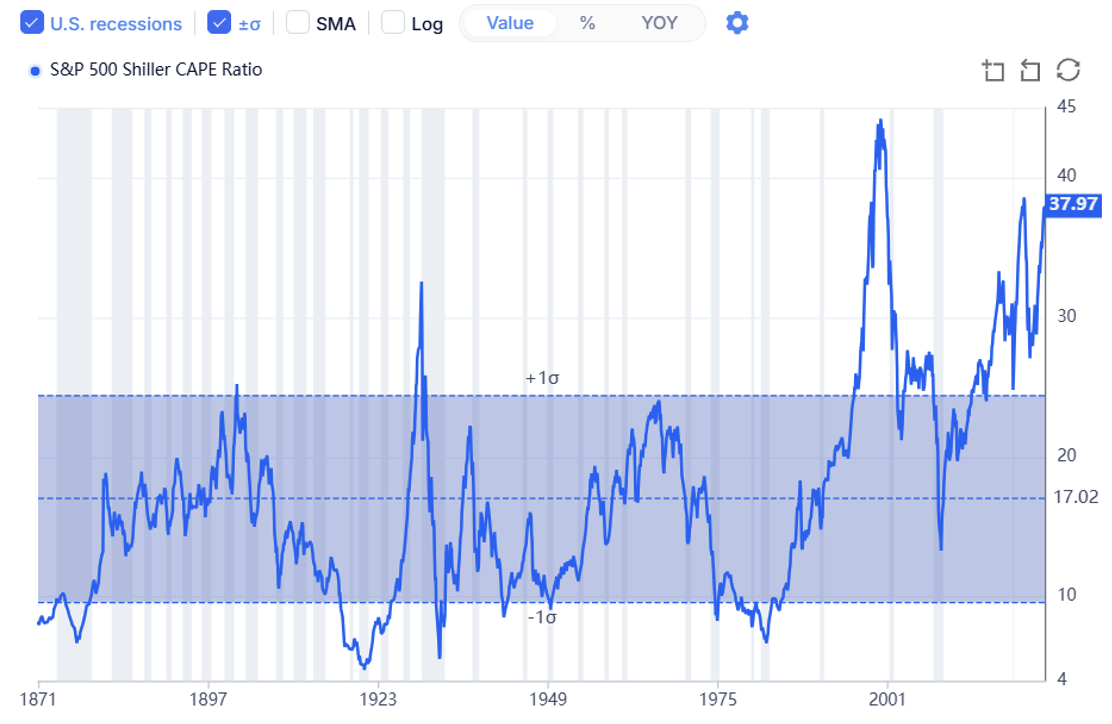
The S&P is currently trading at 5,834, which is 22.9X (high by any measure) the current EPS. Let’s assume a more normal, but still historically high, multiple of 18X in 10 years. That gets you to an S&P 500 level of 7,704 or a 2.8% annual rate of gain over the next 10 years.  Add in a 1.3% dividend yield gets you to 4.1%. Not Goldman’s 3%, but close. It is still much lower than the long-term average for the market or the average ROA for most public and multiemployer pension plans.

If one were to assume a 15X P/E multiple in 10 years, the return to the S&P 500 is 0.64%/annum and the “total” return is slightly less than 2.0%. UGLY! Obviously, the end of the 10-year period multiple is the key to the return calculation. But all in all, the low returns that most investment firms (including Goldman) are forecasting seem to be in the right neighborhood given these expectations.

Given the potential challenges for Pension America to achieve the desired return (ROA objective) outcome, a cash flow matching (CFM) strategy will help a pension plan bridge this potentially difficult period. Importantly, by having the necessary liquidity to meet monthly benefits and expenses, assets won’t have to be sold to meet those obligations thus eliminating the potential to lock in losses. Lastly, the roughly 5% yield-to-worse (YTW) on the CFM portfolio looks to be superior to future equity returns – a win/win!

It just might be time to rethink your plan’s asset allocation. Don’t place all of your assets into one return bucket. Explore the many benefits of dividing pension assets into liquidity and growth buckets. Want more info? Ryan ALM, Inc. has a ton of research on this idea. Please go to RyanALM.com/research.

That’s Not Right!

By: Russ Kamp, Managing Director, Ryan ALM, Inc.

I’ve recently had a series of terrific meetings with consultants, actuaries, and asset owners (mostly pension plans) about cash flow matching (CFM). I believe that most folks see the merit in using CFM for liquidity purposes, but often fail to see the benefit of bringing certainty to a portfolio for that segment that is defeasing asset cash flows relative to liability cash flows (benefits and expenses). I’m not entirely sure why that is the case, but one question comes up regularly. Question: If I use 30% of my assets on lower yielding fixed income, how am I supposed to meet my ROA objective? I guess that they believe that the current 4.75% to 5% yielding investment grade corporate portfolio will be an anchor on the portfolio’s return.

What these folks fail to understand is the fact that the segment of the portfolio that is defeasing liability cash flows is matched as precisely as possible. The pension game has been won! If the defeased bond portfolio represents 30% of the total plan, the ROA objective is now only needed to be achieved for the 70% of assets not used to SECURE your plan’s liabilities. The capital markets are highly uncertain. Using CFM for a portion of the plan brings greater certainty to the management of these programs. Furthermore, we know that time (investing horizon) is one of the most important investment tenets. The greater the investing horizon the higher the probability of achieving the desired outcome, as those assets can now grow unencumbered as they are no longer a source of liquidity.  It bears repeating… a major benefit of CFM is that it buys time for the growth assets to grow unencumbered.

Plan sponsors should be looking to secure as much of the liability cash flows (through a CFM portfolio) as possible eliminating the rollercoaster return pattern that ultimately leads to higher contribution expenses. As mentioned above, capital markets are highly uncertain. The volatility associated with a traditional asset allocation framework has recently been calculated by Callan as +/-33.6% (2 standard deviations or 95% of observations). Why live with that uncertainty? In addition, Goldman Sachs equity strategy team “citing today’s high concentration in just a few stocks and a lofty starting valuation” forecasts that the S&P 500 “will produce an annualized nominal total return of just 3% the next 10 years, according to the team led by David Kostin, which would rank in just the 7th percentile of 10-year returns since 1930.” (CNBC)

Given that forecast, I wouldn’t worry about the 5% fixed income YTW securing my pension liabilities. Instead, I’d worry about all the “growth” assets not used to secure the promises, as they will likely be struggling to even match the YTW on a CFM corporate bond portfolio.

What Will Their Performance be? Continued

By: Russ Kamp, Managing Director, Ryan ALM, Inc.

I recently published a post titled, “What Will Their Performance be in About 11 Years?” I compared the Ryan ALM, Inc. cash flow matching (CFM) strategy to a relative return fixed income manager, and I raised the question about future performance. Barring any defaults within the investment grade universe, which historically average about 2/1,000 bonds, we can tell you on day one of the portfolio’s construction what the performance will be for the entire period of a CFM mandate.

In my previous post, I stated, “now, let me ask you, do you think that a core fixed income manager running a relative return portfolio can lay claim to the same facts? Absolutely, not! They may have benefitted in the most recent short run due to falling interest rates, but that future performance would clearly depend on multiple decisions/factors, including the duration of the portfolio, changes in credit spreads, the shape of the yield curve, the allocation among corporates, Treasuries, agencies, and other bonds, etc. Let’s not discount the direction of future interest rate movements and the impact those changes may have on a bond strategy. In reality, the core fixed income manager has no idea how that portfolio will perform between now and March 31, 2035.

Whatever benefit the active relative-return fixed income manager might have gotten from those declining rates earlier this year has now been erased, as Treasury yields have risen rapidly across all maturities since the Fed announced its first cut in the FFR. Including today’s trading, the US 10-year Treasury note yield has backed up 67 bps since the yield bottomed out at 3.5% in mid-September (currently 4.17% at 11:40 am). The duration of the 10-year note is 8.18 years, as of this morning. That equates to a loss of principal of -5.48% in roughly 1 month. Wow!

Again, wouldn’t you want the certainty of a CFM portfolio instead of the very uncertain performance of the relative return fixed income manager? Especially when one realizes that the active fixed income manager’s portfolio won’t likely cover the liquidity needed to meet benefits and expenses. Having to “sell” bonds in a rising rate environment locks in losses for the active manager, while the CFM portfolio is designed to meet ALL of the liquidity through maturing principal and income – no selling. This seems like a no-brainer!

Milliman: Public Pension Funded Ratio at 82.8%

By: Russ Kamp, Managing Director, Ryan ALM, Inc.

Milliman recently released results for its Public Pension Funding Index (PPFI), which covers the nation’s 100 largest public defined benefit plans.

Positive equity market performance in September increased the Milliman 100 PPFI funded ratio from 82.0% at the end of August to 82.8% as of September 30, representing the highest level since March 31, 2022, prior to the Fed’s aggressive rate increases. The previous high-water mark stood at 82.7%. The improved funding for Milliman’s PPFI plans was driven by an estimated 1.4% aggregate return for September 2024 (9.4% for the YTD period). Total fund performance for these 100 public plans ranged from an estimated 0.7% to 2.1% for the month. As a result of the relatively strong performance, PPFI plans gained approximately $72 billion in MV during the latest month. The asset growth was offset by negative cash flow amounting to about $10 billion. It is estimated that the current asset shortfall relative to accrued liabilities is about $1.138 trillion as of September 30. 

In addition, it was reported that an additional 5 of the PPFI members had achieved a 90% or better funded status (34 plans have now eclipsed this level), while regrettably, 14 of the constituents remain at <60%. Given that changing US interest rates do not impact the calculation for pension liabilities under GASB accounting, which uses the ROA as the liability discount rate, the improvement in the collective funded status may be overstated, as US rates continued to decline throughout the third quarter following an upward trajectory to start the calendar year.

ARPA Update as of October 11, 2024

By: Russ Kamp, Ryan ALM, Inc.

I hope that you enjoyed a wonderful holiday weekend. Autumn’s beautiful colors are finally present in the Northeast – enjoy those, too. As you will soon read, the PBGC had a busy week according to its latest update, so the extra day of rest was likely necessary.

The PBGC’s effort implementing the ARPA legislation continues in full swing. During the prior week there were three new applications received, two approved, another 2 withdrawn, and finally there were two more plans rebating excess SFA as a result of census corrections. Thankfully, there were no applications rejected. Lastly, there were no multiemployer plans seeking to be added to the waitlist (non-Priority Group members).

The plans receiving approval included Midwestern Teamsters Pension Plan and the Carpenters Pension Trust Fund – Detroit & Vicinity. The Carpenters nailed a $635.0 million SFA grant for its 22,576 participants, while the much smaller Midwestern Teamsters plan received $23.6 for 615 members. The PBGC has now awarded $68.6 billion in SFA grants to 94 pension systems.

Sheet Metal Workers’ Local No. 40 Pension Plan, Warehouse Employees Union Local 169 and Employers Joint Pension Plan, and Local 111 Pension Plan were granted the opportunity to submit requests for SFA grants. In the case of Local 111, they submitted a revised application. They are collectively seeking $124,7 million for 6,193 plan members. Good luck! In other news, the Teamsters Local 210 Affiliated Pension Plan and Local 111 Pension Plan withdrew their initial applications. These two funds were seeking $137.3 million collectively.

Finally, Milk Industry Office Employees Pension Trust Fund and Local 805 Pension and Retirement Plan rebated excess SFA grant money as a result of a census audit that confirmed overpayment. The Milk Industry delivered $193k (2.4% of the SFA received) to the PBGC, while Local 805 forked over $3.2 million (1.8% of the grant). Both represented a larger percentage of the SFA received than the previous transactions. At this time, 21 plans have returned $147.5 million in SFA and interest representing 0.37% of the grants received.

I hope that you find these updates useful. I remain incredibly bullish regarding the ARPA legislation and the positive impact that it continues to have on the American worker that earned this pension promise. Please don’t hesitate to reach out to Ryan ALM with any questions related to the legislation and what should be done to secure the promised benefits with the SFA grant assets.

Ryan ALM, Inc. 3Q’24 Pension Monitor

By: Russ Kamp, Managing Director, Ryan ALM, Inc.

We are pleased to share with you the Ryan ALM, Inc. Q3’24 pension monitor. This quarterly report compares different liability growth rates (based on a 12-year average duration) versus the asset growth rate for public, multiemployer, and corporate funds based on the P&I asset allocation survey of the top 1,000 plans which is updated annually each November.

With regard to Q3’24, Public Pension funds (4.9%) outperformed Corporate Pension plans (3.6%) by 1.3% net of liability growth, as public pension plans had a much greater exposure to US equities (21.9%) versus Corporates (12.6%). The S&P 500 continues to produce exceptionally strong returns in this uncertain environment. From a liability standpoint, the ASC 715 discount rates (+4.6%) marginally trailed liability growth for both public and multiemployer plans that operate under GASB accounting rules using the ROA.

Please don’t hesitate to reach out to us with any questions that you might have regarding this monitor.

What Will Their Performance Be In About 11 years?

By: Russ Kamp, Managing Director, Ryan ALM, Inc.

How comforting would it be for both plan sponsors and their advisors to know how a particular strategy is going to perform over some defined period of time? I would think that having that knowledge would be quite comforting, at least as a “core” holding. Do you think that a core fixed income manager running a relative return strategy versus the Bloomberg Barclays Aggregate Index could tell you how that portfolio will perform in the next 10 1/2 years? No. Ryan ALM can with a very high degree of certainty. How’s that? Well, cash flow matching (CFM) of asset cash flows to liability cash flows locks in that relationship on the day that the portfolio is constructed. Ryan ALM views risk as the uncertainty of achieving the objective. If the true pension objective is to fund benefits and expenses in a cost-efficient manner with prudent risk, then our CFM model will be the lowest risk portfolio.

We were awarded a CFM assignment earlier this year. Our task was/is to defease the future grant payments for this foundation. On the day the portfolio was built, we were able to defease $165.1 million in FV grant payments for only $118.8 million, locking in savings (difference between FV and PV of the liability cash flows) of $46.3 million equal to 28.0% of those future grant payments. That’s fairly substantial. The YTM on that day was 5.19% and the duration was 5.92 years.

Earlier this week, we provided an update for the client through our monthly reporting. The current Liability Beta Portfolio (the name that we’ve given to our CFM optimization process) has the same FV of grant payments. On a market value basis, the portfolio is now worth $129 million, and the PV of those future grant payments is $126 million. But despite the change in market value due to falling interest rates, the cost savings are still -$46.3 million. The YTM has fallen to 4.31%, but that doesn’t change the initial relationship of asset cash flows to liability cash flows. That is the beauty of CFM.

Now, let me ask you, do you think that a core fixed income manager running a relative return portfolio can lay claim to the same facts? Absolutely, not! They may have benefitted in the most recent short run due to falling interest rates, but that would clearly depend on multiple decisions/factors, including the duration of the portfolio, changes in credit spreads, the shape of the yield curve, the allocation among corporates, Treasuries, agencies, and other bonds, etc. Let’s not discount the direction of future interest rate movements and the impact those changes may have on a bond strategy. In reality, the core fixed income manager has no idea how that portfolio will perform between now and March 31, 2035.

Furthermore, will they provide the necessary liquidity to meet those grant payments or benefits and expenses, if it were a DB pension? Not likely. With a yield to maturity of 4.31% and a market value of assets of $129.3 million, they will produce income of roughly $5.57 million/year. The first year’s grant payments are forecast to be $9.7 million. Our portfolio is designed to meet every $ of that grant payment. The relative return manager will be forced to liquidate a portion of their portfolio in order to meet all of the payments. What if rates have risen at that point. Forcing liquidity in that environment will result in locking in a loss. That’s not comforting.

CFM portfolios provide the client with the certainty of cash flows when they are needed. There is no forced selling, unlike the relative return manager that might be forced to sell in a market that isn’t conducive to trading. Furthermore, a CFM mandate locks in the cost savings on day 1. The assets not used to meet those FV payments, can now be managed more aggressively since they benefit from more time and aren’t going to be used to meet liability cash flows.

Asset allocation strategies should be adapted from a single basket approach to one that uses two baskets – liquidity and growth. The liquidity bucket will house a defeased bond portfolio to meet all the cash flow requirements and the remainder of the assets will migrate into the growth bucket where they can now grow unencumbered. You’ll know on day 1 how the CFM portfolio is going to perform. Now all you have to worry about are those growth assets, but you’ll have plenty of time to deal with any challenges presented.

ARPA Update as of September 27, 2024

By: Russ Kamp, Managing Director, Ryan ALM, Inc.

Welcome to the last update for September 2024. Let’s hope that today brings at least one Mets’ win in Atlanta. It would mark quite the turnaround from where this team was on June 1st.

With regard to the PBGC’s implementation of the ARPA legislation, the efiling portal still remains temporarily closed. As a result, new applications have not been forthcoming. There are presently 22 applications with the PBGC. Sixteen of those must be acted on by November 30th.

Activity was fairly limited during the past week. There were no applications approved or denied. There was one application withdrawn. Bricklayers Pension Fund of West Virginia withdrew the initial application seeking $1.2 million for the 170 plan participants. In addition, 3 funds repaid a portion of the SFA grant received. Mid-Jersey Trucking Industry and Teamsters Local 701 Pension and Annuity Fund, the Pension Plan of the Bakery Drivers and Salesmen Local 194 and Industry Pension Fund, and the Building Material Drivers Local 436 Pension Plan each returned a portion of the overfunding due to incorrect census data. In total, the three plans returned $2.7 million from the $348.3 million received in SFA or 0.78%. To date, 17 plans have returned $142.3 million or 0.36% of the grant monies received. Lastly, there were no additional plans seeking to be added to the waitlist, which remains at 68.

Please don’t hesitate to reach out to us with any questions that you might have regarding investment strategies for the SFA assets. We are always willing to model your plan’s forecasted cash flows so that various implementations can be reviewed.

Defined Benefit Pension Plan: “Absolute Truths”

By: Russ Kamp, Managing Director, Ryan ALM, Inc.

The four senior team members at Ryan ALM, Inc. have collectively more than 160 years of pension/investment experience. We’ve lived through an incredible array of markets during our tenures. We have also witnessed many attempts on the part of Pension America to try various strategies (schemes) to meet the promises that have been made to the pension plan participants. Regrettably, defined benefit (DB) pension plans continue to be tossed aside by corporate America in favor of defined contribution (DC) plans. Both public and multiemployer plan sponsors would be wise to adopt a strategy that seeks more certainty in order to protect and preserve these critically important retirement vehicles before they are subject to a similar fate.

We’ve compiled a list of DB pension “Absolute Truths” that we believe return the management of pension plans back to its roots when “SECURING the promised benefits at a reasonable cost and with prudent risk” was the primary objective. The dramatic move away from the securing of benefits to today’s arms race focus on the return on asset assumption (ROA) has eliminated any notion of certainty in favor of far greater variability in likely outcomes.

Here are the Ryan ALM DB Truths:

  • Defined Benefit (DB) plans are the best retirement vehicles!
  • They exist to fulfill a financial promise that has been made to the plan participant upon retirement.
  • The primary objective in managing a DB plan is to SECURE the promised benefits at a reasonable cost and with prudent risk.
  • The promised benefit payments are liabilities of the pension plan sponsor.
  • Liabilities need to be measured, monitored, and managed more than just once per year.
  • Liabilities are future value (FV) obligations – a $1,000 monthly benefit is $1,000 no matter what interest rates do. As a result, they are not interest rate sensitive.
  • Plan assets (stocks, bonds, real estate, etc.) are Present Value (PV) or market value (MV) calculations. We do not know the FV of assets except for bonds cash flows (interest and principal at maturity)
  • In order to measure and monitor the funded status, liabilities need to be converted from FV to PV – a Custom Liability Index (CLI) is absolutely needed.
  • A discount rate is used to create a PV for liabilities – ROA (publics), ASC 715 (corps), STRIPS, etc.
  • Liabilities are bond-like in nature. The PV of future liabilities rises and falls with changes in the discount rate (interest rates).
  • The nearly 40-year decline in US interest rates beginning in 1982 crushed pension funding, as the growth rate for future liabilities far exceeded the growth rate of the PV of assets.
  • The allocation of plan assets should be separated into two buckets – Liquidity (beta) and Growth (alpha).
  • The liquidity assets should consist of a bond portfolio that matches (defeases) asset cash flows with the plan’s liability cash flows (benefits and expenses (B&E)).
  • This task is best accomplished through a Cash Flow Matching (CFM) investment process.
  • The liquidity assets should be used to meet B&E chronologically buying time for the alpha assets to grow unencumbered in their quest to meet future liabilities.
  • The Growth assets will consist of all non-bonds, which can now grow unencumbered, as they are no longer a source of liquidity. Growth assets will fund future liabilities.
  • The Return on asset (ROA) assumption should be a calculated # derived through an Asset Exhaustion Test (AET)
  • The pension plan’s asset allocation should be responsive to the plan’s funded status and not the ROA.
  • As the funded status improves, port alpha (profits) from the Growth portfolio into the Liquidity bucket (de-risk) extending the cash flow matching assignment and securing more promises.
  • This de-risking ensures that plans don’t continue to ride the asset allocation rollercoaster leading to volatile contribution costs.
  • DB plans are a great recruiting and retention tool for managing a sponsor’s labor force.
  • DB plans need to be protected and preserved, as asking untrained individuals to fund, manage, and then disburse a “benefit” through a Defined Contribution plan is poor policy.
  • Unfortunately, doing the same thing over and over and… is not working. A return to pension basics is critical.

You’ve made a promise: measure it – monitor it – manage it – and SECURE it…   

Get off the pension funding rollercoaster – sleep well!