Remember: NO Free Lunch!

By: Russ Kamp, CEO, Ryan ALM, Inc.

In 1938, journalist Walter Morrow, Scripps-Howard newspaper chain, wrote the phrase “there ain’t no such thing as a free lunch”. The pension community would be well-served by remembering what Mr. Morrow produced more than eight decades ago. Morrow’s story is a fable about a king who asks his economists to articulate their economic theory in the fewest words. The last of the king’s economists utters the famous phrase above. There have been subsequent uses of the phrase, including Milton Friedman in his 1975 essay collection, titled “There’s No Such Thing as a Free Lunch”, in which he used it to describe the principle of opportunity cost.

I mention this idea today in the context of private credit and its burgeoning forms. I wrote about capacity concerns in private credit and private equity last year. I continue to believe that as an industry we have a tendency to overwhelm good ideas by not understanding the natural capacity of an asset class in general and a manager’s particular capability more specifically. Every insight that a manager brings to a process has a natural capacity. Many managers, if not most, will eventually overwhelm their own ideas through asset growth. Those ideas can, and should be, measured to assess their continuing viability. It is not unusual that good insights get arbitraged away just through sheer assets being managed in the strategy.

Now, we are beginning to see some cracks in the facade of private credit. We have witnessed a significant bankruptcy in First Brands, a major U.S. auto parts manufacturer. Is this event related to having too much money in an asset class, which is now estimated at >$4 trillion.? I don’t know, but it does highlight the fact that there are more significant risks investing in private deals than through public, investment-grade bond offerings. Again, there is no free lunch. Chasing the higher yields provided by private credit and thinking that there is little risk is silly. By the way, as more money is placed into this asset class to be deployed, future returns are naturally depressed as the borrower now has many more options to help finance their business.

In addition, there is now a blurring of roles between private equity and private credit firms, which are increasingly converging into a more unified private capital ecosystem. This convergence is blurring the historic distinction between equity sponsors and debt providers, with private equity firms funding private credit vehicles. Furthermore, we see “pure” credit managers taking equity stakes in the borrowers. So much for diversification. This blurring of roles is raising concerns about valuations, interconnected exposures, and potential conflicts of interest due to a single manager holding both creditor and ownership stakes in the same issue.

As a reminder, public debt markets are providing plan sponsors with a unique opportunity to de-risk their pension fund’s asset allocation through a cash flow matching (CFM) strategy. The defeasement of pension liabilities through the careful matching of bond cash flows of principal and interest SECURES the promised benefits while extending the investing horizon for the non-bond assets. There is little risk in this process outside of a highly unlikely IG default (2/1,000 bonds per S&P). There is no convergence of strategies, no blurring of responsibilities, no concern about valuations, capacity, etc. CFM remains one of the only, if not the only, strategies that provides an element of certainty in pension management. It isn’t a free lunch (we charge 15 bps for our services to the first breakpoint), but it is as close as one will get!
What’s Your Duration?

By: Russ Kamp, CEO, Ryan ALM, Inc.

The recent rise in U.S. Treasuries had us redoubling our effort to encourage plan sponsors of U.S. pension plans to take some risk off the table by using cash flow matching (CFM) to defease a portion of the plan’s liabilities, given all the uncertainties in the markets and our economy. We were successful in some instances, but for a majority of Pension America, the use of CFM is still not the norm. Instead, many sponsors and their advisors have elected to continue to use highly interest rate sensitive “core” fixed income offerings most likely benchmarked to the Bloomberg Barclays Aggregate Index (Agg).

For those plan sponsors that maintained the let-it-ride mentality, they are probably celebrating the fact that Treasury rates have fallen rather significantly in the last week or so as a result of all of the uncertainties cited above – including inflation, tariffs, geopolitical risk, stretched equity valuations, etc. Their “core” fixed income allocation will have benefited from the decline in rates, but by how much? The Bloomberg Barclays Aggregate Index (Agg) has a duration of 6.1 years and a YTW of 4.58%, as of yesterday. YTD performance had the Agg up 2.78%. Not bad for fixed income 2+ months into the new year, but again, equities have been spanked in the last week, and the S&P 500 is down -3.1% in the last 5 days. So, maintaining that exposure sure hasn’t been beneficial.

Also, remember that the duration of the average DB pension plan is around 12 years. Given the 12-year duration, the price movement of pension liabilities, which are bond-like in nature, is currently twice that of the Aggregate index. A decline in rates might help your core fixed income exposure, but it is doing little to protect your plan’s funded status/funded ratio. The use of CFM would have insulated your plan from the interest rate risk associated with your pension liabilities. As rates fell, both assets and the present value of those liabilities would have appreciated, but in lockstep! The funded status for that segment of your asset allocation would have been insulated.

Why wait to protect your hard work in getting funded ratios to levels not seen in recent years? A CFM strategy provides numerous benefits, including providing liquidity on a monthly basis to ensure that benefits and expenses are met when due, reducing the cost to fund liabilities by 20% to 40% extending the investing horizon allowing for choppy markets to come and go with little impact on the plan, and protecting your funded status which helps mitigate volatility in contributions. Seems pretty compelling to me.

20+ Years in the Making!

By: Russ Kamp, CEO, Ryan ALM, Inc.

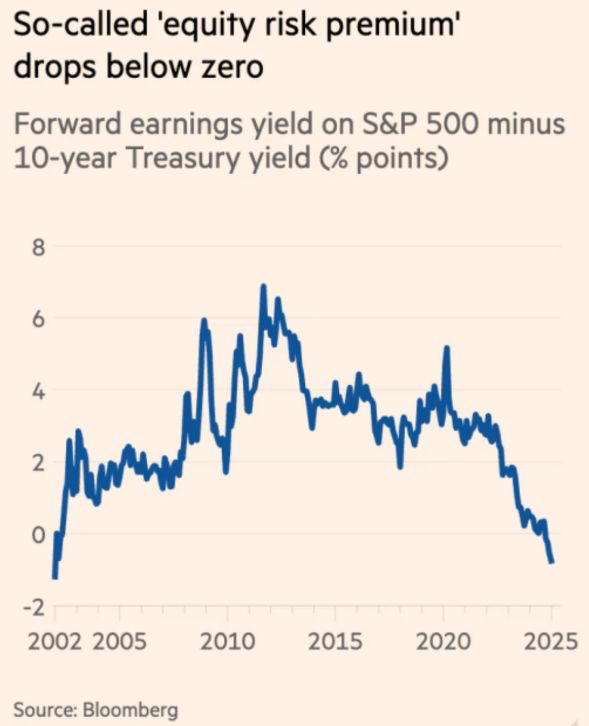
For the first time since the dot.com bubble burst, the equity risk premium on the S&P 500 has fallen below 0. If you are concerned that U.S. large cap equities are looking frothy, this graph certainly supports that sentiment. Is now the time to take some equity profits and migrate those assets to bonds? We believe that the time is right to protect your enhanced funded status from the uncertainty as to where inflation and U.S. interest rates are going and the potential impact on traditional core fixed income strategies that are based on generic market indices instead of funding liability cash flows.

If you are like us (Ryan ALM, Inc.), and prefer not to make one’s living forecasting events that one can’t control, like interest rates, inflation, geopolitical events, etc., we suggest that you don’t engage in fixed income strategies that could be harmed by an upward movement in U.S. interest rates. Take those equity profits and invest in a cash flow matching strategy (CFM) that will secure your fund’s promised benefits, while eliminating interest rate risk since the process defeases future benefit payments that are not interest rate sensitive. A $1,000 monthly benefit payment is $1,000 whether rates are at 2% or 10%. In addition, you’ll be extending the investing horizon for the portfolio’s remaining growth (alpha) assets. CFM is the bridge over potentially troubled waters!

It May Not Be the Iron Gwazi, But…

By: Russ Kamp, CEO, Ryan ALM, Inc.

I was fortunate to enter the investment industry in October 1981. The 10-year Treasury note’s yield was around 15% at that time. U.S. interest rates would fall (collapse?) for most of the next four decades until they bottomed during the beginning of Covid-19. Oh, it was great to be a bond manager during those decades. You could basically be long duration relative to the Aggregate index with little worry that rates would rise. It was a time to “mint” money in fixed income. Then, it wasn’t!

The beginning of Covid-19 brought about a substantial reaction to the collapse of our economy through major federal stimulus programs. The historic infusion of financial support created excess demand for goods and services at the same time that many of those services were temporarily restricted. The result was the worst inflation shock since the 1970s, which led to the double digit yields mentioned above.

It wasn’t surprising that inflation would appear after decades of it being well contained. It was perhaps the magnitude (9.1% inflation at the peak) of the move that grabbed everyone’s attention. For bond managers, the revival of inflation created an environment that forced the U.S. Federal Reserve to initiate the most aggressive policy shift in quite some time beginning in March 2022. As a result of the Fed’s action, bond managers suffered their worst year ever as represented by the BB Aggregate Index (-13%). The average fixed income manager faired only slightly better than the index according to eVestment’s database, as the median core bond manager produced a -12.8% result for all of 2022.

The following two years have been incredibly volatile for U.S. bond managers. Calendar year 2023 was looking to be a very poor year until the investing community was certain that the Fed had accomplished its objective by the end of that year, and as a result, interest rates fell. For the year, the median fixed income manager was up 6.1%, or a little bit less than 1/2 what they had lost in the previous year. This past year was no better, except that markets were rosier to begin 2024, only to have a challenging conclusion to the year as inflation proved much stickier. The median manager produced only a 2% return for the year, holding on to <1/2 the income while seeing principal losses. Given the topsy turvy nature of the bond market during the last three years, it shouldn’t come as a surprise that the median manager has only generated a -1.9% 3-year annualized result.

The rollercoaster of fixed income returns observed during the last several years may not be as extreme as those we witness in other asset classes, mainly equities, but it is not helpful to the long-term funding of pension plans or endowments and foundations. As most know, changes in interest rates are the greatest risk to fixed income strategies. The 4-decade decline in rates was preceded by a nearly 3-decade rise in rates beginning in the early 1950s. Does the significant rise in rates starting in 2022 mark the beginning of another long-term secular upward trend or is this just a head fake? I wouldn’t want to have to bet on the future of interest rates in order to manage a successful program and you shouldn’t either.

Cash flow matching (CFM) mitigates interest rate risk. The defeasing of benefit payments, which are future values, are not interest rate sensitive since a $1,000 monthly payment in the future is $1k whether rates rise or fall. Furthermore, the cost savings that are produced on the day that the CFM portfolio is built will be maintained whether rates rise or fall. We are seeing at least a -2% reduction in cost per year in our model. Ask us to defease your benefit payments for 10 years and you’ll see a roughly 20% reduction. Longer-term programs (such as 30-years) can see substantial cost savings and annual reductions >-2%/year.

So, I ask, why invest in a core bond product, the success of which is predicated mostly on the direction of interest rates, when one can invest in a CFM strategy that provides the certainty of cash flows to meet benefit payments? Furthermore, CFM portfolios mitigate interest rate risk and extend the investing horizon for your plan’s alpha (growth) assets, while getting you off the rollercoaster of annual returns. Lastly, given the recent rise in U.S. interest rates, building a CFM portfolio with investment grade corporate bonds can produce a YTW of 5.5% or better. Seems like a sleep well at night strategy to me.

BTW, the Iron Gwazi is the world’s steepest and fastest hybrid rollercoaster found at Busch Gardens in Florida. It has a height of 206 feet and a 91 degree drop. It might just rival the feeling one got going through the Great Financial Crisis. That wasn’t any fun!

Kamp Named CEO of Ryan ALM, Inc.

By: Ronald J. Ryan, CFA, CEO, Ryan ALM, Inc.

Press Release

________________________________________________________________________________

Russ Kamp Named CEO of Ryan ALM, Inc.

Effective 1/01/25 Russ Kamp will be the new CEO of Ryan ALM, Inc.

Ronald J. Ryan, CFA will become the Chairman and CFO. Ron announces “Ryan ALM has prospered in a rather difficult environment for fixed income asset managers in the last 20 years. As founder and CEO, it is time to pass the torch to someone who has the vision and talent to take us forward. Russ has demonstrated a professionalism and integrity that is most respected by his peers. His attention to client needs is unsurpassed. His resume is proof of his abilities and success. It is an honor to work with Russ. I will remain as head of research and a member of our asset management team. I look forward to the best years ahead for Ryan ALM working with Russ and our highly experienced team.”

Steve deVito, head of trading, will also become the Chief Compliance Officer of Ryan ALM. Steve has nearly 40 years of fixed income experience and serves as an important member of the asset management team.

Martha Monteagudo, head of product development, will continue in her position. She started with Ryan ALM in 2004 and is a valuable member of the asset management team.

As our name implies, Ryan ALM is an Asset Liability Manager (ALM) specializing in cash flow matching. We strongly believe that cash flow matching is the best fit for any liability objective. Our cash flow matching product (Liability Beta Portfolio™) can reduce funding costs by about 2% per year (about 20% on 1-10-year liabilities). Our turnkey system is unique in the industry including:

  1.  Custom Liability Index (CLI)
  2. ASC 715 Discount Rates
  3. Liability Beta Portfolio™ (LBP)
  4. Modified Asset Exhaustion Test (AET)

The Ryan ALM asset management team has over 160 years of experience making us one of the most experienced teams in the fixed income industry. For more information, please go to our web site at www.RyanALM.com.

U.S. Treasury STRIPS – The Naked Truth

At KCS, we have been sharing ideas with plan sponsors to reconfigure their existing fixed income exposure into an enhanced asset allocation framework that might just stabilize a plan’s funded status and contribution costs.  The motivation has been driven by the fear of rising interest rates.  Unfortunately, this fear has provided the impetus for many of our friends in the industry to shed exposure to domestic fixed income programs.  Stop!

Despite the near unanimous expectation that rates have to rise from these “historically low levels”, the fact is that interest rates have actually fallen rather significantly year to date.  In fact, the U.S. 10-year Treasury Bond has seen its yield fall by 37 bps (as of 4/15).  The KCS crystal ball is no clearer than that of any other market participant, so why “guess” where rates are going.

We think it would be advantageous for plan sponsors to reconfigure their existing fixed income exposure to include a separate, lower risk portfolio that matches near term benefit payments for the next 5-7 years depending on the current funded ratio of the plan and projected future contributions. This strategy will improve the plan’s liquidity, while extending the investing horizon for less liquid assets that we would use to support their active portfolio.

We have recommended that the lower risk portfolio be invested in U.S. Treasury STRIPS to match benefit payments.  However, that instrument’s name raises more questions than answers, and has often turned potential users off before the conversation really heats up.  We are here today to say that STRIPS, although misunderstood, are actually low risk, useful fixed income securities.

STRIPS is an acronym for “separate trading of registered interest and principal securities”. Treasury STRIPS are fixed-income securities, sold at a significant discount to face value and offer no interest payments because they mature at par, which is why they are so good at matching projected cash flows. Backed by the U.S. government, STRIPS, which were first introduced in 1985, offer minimal risk and some tax benefits in certain states, replacing TIGRs and CATS (…retired to the zoo?!) as the dominant zero-coupon U.S. security.

If you are concerned about your plan’s funded status, the direction of interest rates and / or the current composition of your fixed income assets, call us to discuss a new path forward. We are here and ready to help you!

Rethink the Use of Fixed Income in a Defined Benefit Plan

With the closure of the first quarter, we’d like to remind you of a blog post that we first published in early January.  Our thoughts are still relevant, especially given the market action within fixed income during the quarter and what is transpiring in US fixed income today.  The 10-year Treasury has rallied 2% today, and we think that it may continue to move lower.  The following paragraphs are what we originally posted.

What I’d like to highlight today is a new use for a plan’s current fixed income exposure. In day two of the conference, I attended a panel discussion titled, “Opportunities in Fixed Income and Credit Markets”.  The panel was occupied by 4 senior investment pros (plan sponsor, consultant, and investment managers).  They generally discussed the likelihood that interest rates were going to rise (I’m beginning to wonder if there is anyone out their who doesn’t think that rates will rise), and the implications of that movement on traditional fixed income portfolios.  Most of the panelists talked about various sub-sectors (mortgages, asset backs, bank loans, etc) and which ones might hold up better. There was discussion about shortening duration, etc. They also talked about fixed income’s traditional role as an anchor to windward, a risk reducer, and a provider of liquidity.

However, only one individual mentioned taking a step back to truly contemplate the “role” of fixed income.  He didn’t provide any further perspective, which is why I’m addressing the issue here and today.  I believe (as do my partners at KCS) that a plan’s liabilities should be the focal point of any pension discussion.  As such, they need to be the primary objective for the plan, the driver of asset allocation decisions and investment / portfolio structure.  The asset class most similar in characteristic to liabilities is fixed income.  As such, fixed income needs to play a prominent role in a defined benefit plan.

Instead of worrying about the implications from a rising interest rate environment on an LDI strategy that currently consists of long duration corporates, change the emphasis to matching near-term liabilities, by converting your current fixed income portfolio into a Treasury STRIP portfolio that matches cash flows with projected benefits (Beta portfolio).  First, you are improving liquidity.  Second, duration is shortened in an environment that may not be conducive to long bonds.  Third, you are lengthening the investing time horizon for the balance of the corpus, which will allow asset classes / products with a liquidity premium a chance to capture that performance increment (Alpha portfolio). Finally, the funded status and contribution costs should begin to stabilize.  As the Alpha portfolio outperforms liability growth (hopefully), siphon excess profits and extend the beta portfolio.

This is a proactive move to restructure the fixed income portfolio in an environment of uncertainty.

Lastly, I am not of the general school of thought that interest rates are definitely going to rise, and soon.  I believe that we still have slack demand in our economy, brought on by underemployment, which will keep inflation in check and provide room for stable to slightly lower rates.