MV versus FV

By: Russ Kamp, CEO, Ryan ALM, Inc.

There seems to be abundant confusion within certain segments of the pension industry regarding the purpose and accounting (performance) of a Cash Flow Matching (CFM) portfolio on a monthly basis. Traditional monthly reports focus on the present value (PV) of assets in marking those assets to month-end prices. However, when utilizing a CFM strategy, one is hoping to defease (secure) promised benefits which are a future value (FV). As a reminder, FVs are not interest rate sensitive. The movement in monthly prices become irrelevant.

If pension plan A owes a participant $1,000 next month or 10-years from now, that promise is $1,000 whether interest rates are at 2% or 8%. However, when converting that FV benefit into a PV using today’s interest rates, one can “lock in” the relationship between assets and liabilities (benefit payment) no matter which way rates go. To accomplish this objective, a CFM portfolio will match those projected liabilities through an optimization process that matches principal, interest, and any reinvested income from bonds to those monthly promises. The allocation to the CFM strategy will determine the length of the mandate (coverage period).

Given the fact that the FV relationship is secured, providing plan sponsors with the only element of certainty within a pension fund, does it really make any sense to mark those bonds used to defease liabilities to market each month? Absolutely, NOT! The only concern one should have in using a CFM strategy is a bond default, which is extremely rare within the investment grade universe (from AAA to BBB-) of bonds. In fact, according to a recent study by S&P, the rate of defaults within the IG universe is only 0.18% annually for the last 40-years or roughly 2/1,000 bonds.

A CFM portfolio must reflect the actuaries latest forecast for projected benefits (and expenses), which means that perhaps once per year a small adjustment must be made to the portfolio. However, most pension plans receive annual contributions which can and should be used to make those modest adjustments minimizing turnover. As a result, most CFM strategies will purchase bonds at the inception of a mandate and hold those same issues until they mature at par. This low turnover locks in the cost reduction or difference in the PV vs. FV of the liabilities from day 1 of the mandate. There is no other strategy that can provide this level of certainty.

To get away from needing or wanting to mark all the plan’s assets to market each month, segregate the CFM assets from the balance of the plan’s assets. This segregation of assets mirrors our recommendation that a pension plan should bifurcate a plan’s asset allocation into two buckets: liquidity and growth. In this case, the CFM portfolio is the liquidity bucket and the remaining assets are the growth or alpha assets. If done correctly, the CFM portfolio will make all the necessary monthly distributions (benefits and expenses), while the alpha assets can just grow unencumbered. It is a very clean separation of the assets by function.

Yes, bond prices move every minute of every day that markets are open. If your bond allocation is being compared to a generic bond index such as the Aggregate index, then calculating a MV monthly return makes sense given that the market value of those assets changes continuously. But if a CFM strategy can secure the cost reduction to fund FVs on day 1, should a changing MV really bother you? Again, NO. You should be quite pleased that a segment of your portfolio has been secured. As the pension plan’s funded status improves, a further allocation should be made to the CFM mandate securing more of the promised benefits. This is a dynamic and responsive asset allocation approach driven by the funded status and not some arbitrary return on asset (ROA) target.

I encourage you to reach out to me, if you’d appreciate the opportunity to discuss this concept in more detail.

The Intrinsic Value of Bonds

Ronald J. Ryan, CFA, Chairman

The true value of bonds is the certainty of their cash flows (interest + principal payments). I don’t believe there is another asset class with such attributes. This is why bonds have traditionally been the asset choice for LDI strategies in general and, defeasement specifically. Given that the true objective of a pension is to secure benefits in a cost-efficient manner with prudent risk then cash flow matching with bonds is a best fit. In the 1970s and 1980s cash flow matching was called Dedication and was the main pension strategy at that time.

Today we live in a volatile and uncertain financial world. Volatility of a pension’s funded status is not a good thing and leads to volatility in contribution costs which are calculated annually based on the present value of assets versus the present value of liabilities. Since 2000 contribution costs have spiked and for many pension plans are 5 to 10x higher than 1999. One would think that a prudent plan sponsor would install a strategy to derisk their pension and reduce or even eliminate this volatility. Cash flow matching (CFM) is the answer. CFM fully funds and matches the monthly liability cash flows (future values) thereby eliminating the present value volatility that plaques most pensions.

As our name implies, Ryan ALM is an Asset Liability Manager specializing in CFM. As the founder of Ryan ALM, my experience with CFM goes back to the 1970s when I was the Director of Fixed Income research at Lehman Bros. Our current CFM model (Liability Beta Portfolio™ or LBP) is a cost optimization model that will fully fund monthly liability cash flows at the lowest cost to the plan sponsor. Our model will reduce funding costs by about 2% per year (1-10 years of liability cash flows = 20% cost reduction). Moreover, there are several other significant benefits to our LBP:

  • LBP de-risks the plan by cash flow matching benefit payments with certainty
  • LBP provides liquidity to fully fund liabilities so no need for a cash sweep
  • Mitigates interest rate risk since it is funding benefits (future values)
  • LBP reduces asset management costs (Ryan ALM fee = 15 bps)
  • Enhances ROA by out-yielding active bond management 
  • Reduces volatility of the funded ratio + contributions
  • Buys time for Alpha assets to grow unencumbered

  “Where is the knowledge we have lost in information” T.S. Eliot

ARPA Update as of February 7, 2025

By: Russ Kamp, CEO, Ryan ALM, Inc.

Welcome to February! I am a day late in reporting on the PBGC’s activity from last week, as I was an instructor at the IFEBP’s Advanced Trustee and Administrator’s Conference. Fortunately, it is in Orlando and not New Jersey, where the weather remains cold, snowy, and wet! For one of the first times in my 43-year professional career I’m hoping for a significant flight delay of perhaps three days!

The PBGC’s eFiling portal is now open but defined as limited. During the previous week there was one new application submitted. The Retail Food Employers and United Food and Commercial Workers Local 711 Pension Plan is seeking $64.2 million in Special Financial Assistance (SFA) for their 25,306 plan participants or $2,538.65 per member, which seemed modest, and in fact it is, as the average SFA payout has been $46,385 per beneficiary on applications that have been approved.

In addition to the one new application, two non-priority plans, Laborers’ Local No. 130 Pension Fund and Pension Plan of the Asbestos Workers Philadelphia Pension Fund each withdrew an initial application. Collectively, they are seeking $72.4 million for 2,124 members.

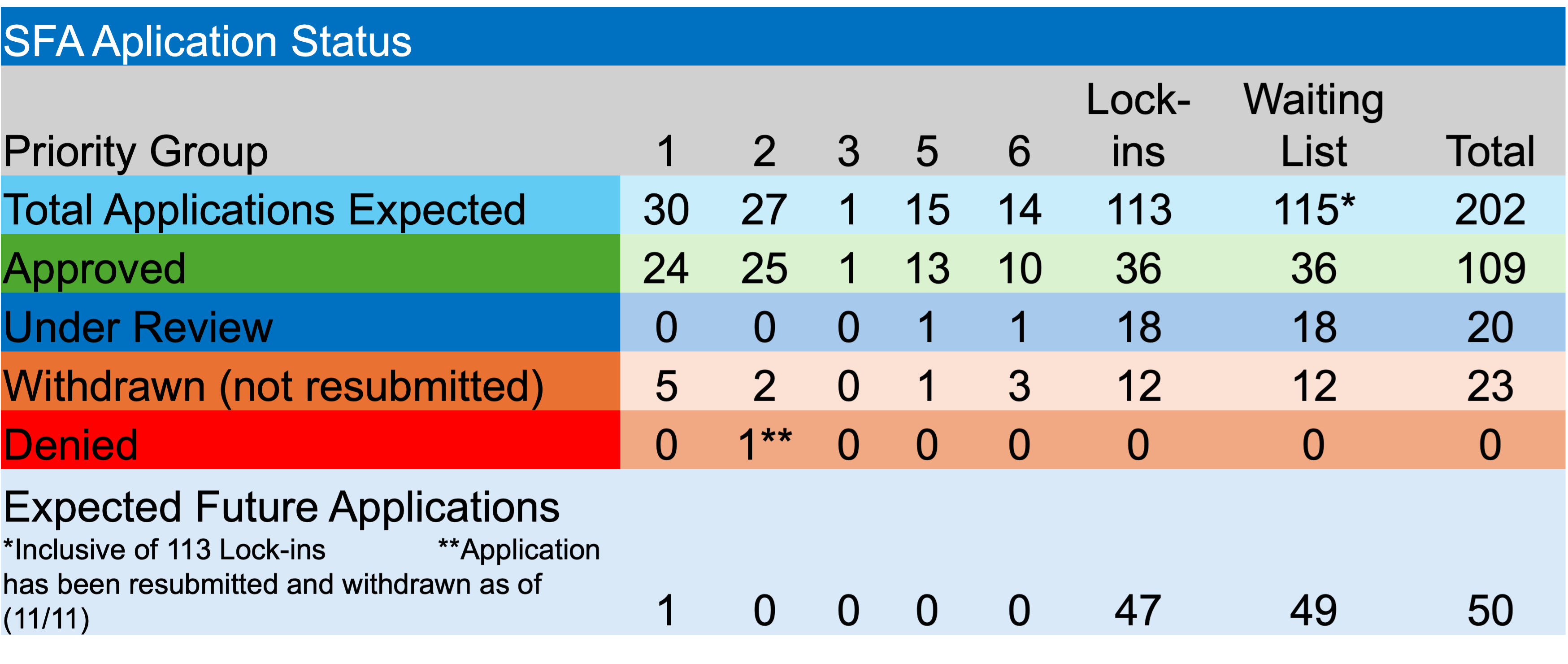
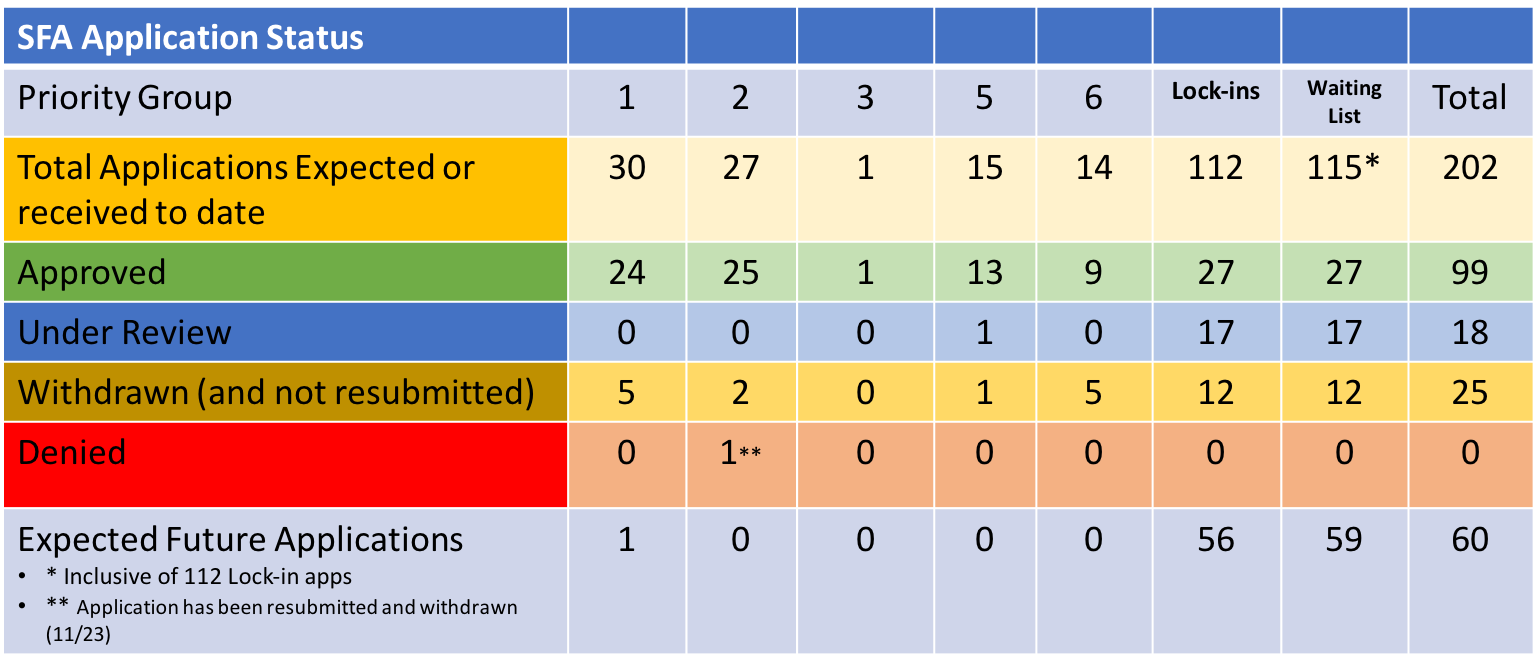
There were no applications denied or approved during the past week. In addition, there were no plans required to repay an overpayment of SFA due to census errors. There hasn’t been a repayment since December 2024. Finally, there were no plans seeking to be added to the waitlist. There are still 49 plans waiting to submit an initial application to the PBGC.

The U.S. interest rate environment remains favorable for plans looking to defease the pension liabilities with the proceeds from the SFA. Investment-grade corporate bond portfolios are currently producing yields above 5% despite very tight spreads between corporates and the comparable maturity Treasury. Given the elevated valuations for domestic equities, particularly large cap stocks, now is the time to use 100% of the SFA to secure the promises.

ARPA Update as of November 15, 2024

By: Russ Kamp, Managing Director, Ryan ALM, Inc.

I can’t believe that Thanksgiving is next week. It appears that the PBGC was motivated to get some things done in anticipation of that holiday, as we witnessed more activity last week than we’ve been seeing in the most recent past.

There were four applications filed last week, including the following pension plans: Roofers and Slaters Local No. 248 Pension Plan, Pension Plan of the Asbestos Workers Philadelphia Pension Fund, Local 1783 I.B.E.W. Pension Plan, and Cement Masons Local Union No. 567 Pension Plan. These plans are not seeking significant sums as far as the SFA goes, as in total they are seeking $92.6 million for 2,637 participants. The IBEW plan out of Armonk, NY submitted a revised application. The other three were the initial filings for these plans.

Pleased to report that Local 360 Labor-Management Pension Plan received approval for its revised application. This fund will receive $30.4 million for the 6,117 members of the plan. This fund initially filed an SFA application in early 2023 only to withdraw it in July 2023. Good for them that they were finally successful in receiving the grant.

Local 810 Affiliated Pension Plan wasn’t as fortunate as Local 360, as they withdrew the initial application that had been seeking $104.1 million for 1,437 members of the plan. In addition to the four new filings, the one withdrawal, and the one approved application, the PBGC also was involved in negotiating two repayment of excess SFA due to census errors. Iron Workers Local 17 Pension Fund
Bricklayers and Allied Craftsmen Local 7 Pension Plan returned $260,471.70 representing only 19 bps of the SFA grants awarded. To date, 25 funds have returned a total of $149.9 million representing 0.38% of the awarded grants.

Recessionary expectations have waned in the last couple of months and flows into bonds, which had been strong for most of the year have recently turned negative. As a result, US interest rates have backed up. It is a great time to secure the promised benefits (and expenses) through cash flow matching strategies. A rising rate environment will be quite bearish for traditional fixed income shops. We’ll be happy to provide you and your fund with a free analysis of what can be achieved through a defeasement strategy.

The Proof’s in the Pudding!

By: Russ Kamp, Managing Director, Ryan ALM, Inc.

Not sure why I used the title that I did, but I recently had pudding (vanilla) over the holiday weekend, so maybe that inspired me, and boy, was it good! That said, we, at Ryan ALM, Inc., are frequently challenged about the benefits of Cash Flow Matching (CFM) versus other LDI strategies, most notably duration matching. There seems to be singular focus on interest rate risk without any consideration for the need to create the necessary liquidity to meet monthly benefit payments. Given that objective, it isn’t surprising that duration matching strategies have been the dominant investment strategy for LDI mandates. But does that really make sense?

Are duration matching strategies that use an average duration or several key rate durations along the Treasury curve truly the best option for hedging interest rate risk? There are also consulting firms that espouse the use of several different fixed income managers with different duration objectives such as short-term, intermediate, and long-term duration mandates. Again, does this approach make sense? Will these strategies truly hedge a pension plan’s interest rate sensitivity? Remember, duration is a measure of the sensitivity of a bond’s price to changes in interest rates. Thus, the duration of a bond is constantly changing.

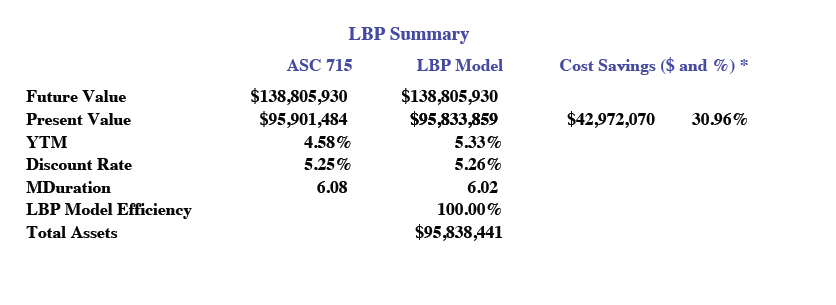
We, at Ryan ALM, Inc., believe that CFM provides the more precise interest rate hedge and duration matching, while also generating the liquidity necessary to meet ongoing benefits (and expenses (B&E)) when needed. How? In a CFM assignment, every month of the mandate is duration matched (term structure matched). If we are asked to manage the next 10-years of liabilities, we will match 120 durations, and not just an “average” or a few key rates. In the example below, we’ve been asked to fund and match the next 23+ years. In this case, we are funding 280 months of B&E chronologically from 8/1/24 to 12/31/47. As you can see, the modified duration of our portfolio is 6.02 years vs. 6.08 years for liabilities (priced at ASC 715 discount rates). This nearly precise match will remain intact as US interest rates move either up or down throughout the assignment.

Furthermore, CFM is providing monthly cash flows, so the pension plan’s liquidity profile is dramatically improved as it eliminates the need to do a cash sweep of interest, dividends, and capital distributions or worse, the liquidation of assets from a manager, the timing of which might not be beneficial. Please also note that the cost savings (difference between FV and PV) of nearly 31% is realized on the day that the portfolio is constructed. Lastly, the securing of benefits for an extended time dramatically improves the odds of success as the alpha/growth assets now have the benefit of an extended investing horizon. Give a manager 10+ years and they are likely to see a substantial jump in the probability of meeting their objectives.

In this US interest rate environment, where CFM portfolios are producing 5+% YTMs with little risk given that they are matched against the pension plan’s liabilities, why would you continue to use an aggressive asset allocation framework with all of the associated volatility, uncertainty, and lack of liquidity? The primary objective in managing a pension plan is to SECURE the promised benefits at a reasonable cost and with prudent risk. It is not an arms race designed on producing the highest return, which places most pension plans on the asset allocation rollercoaster of returns.